
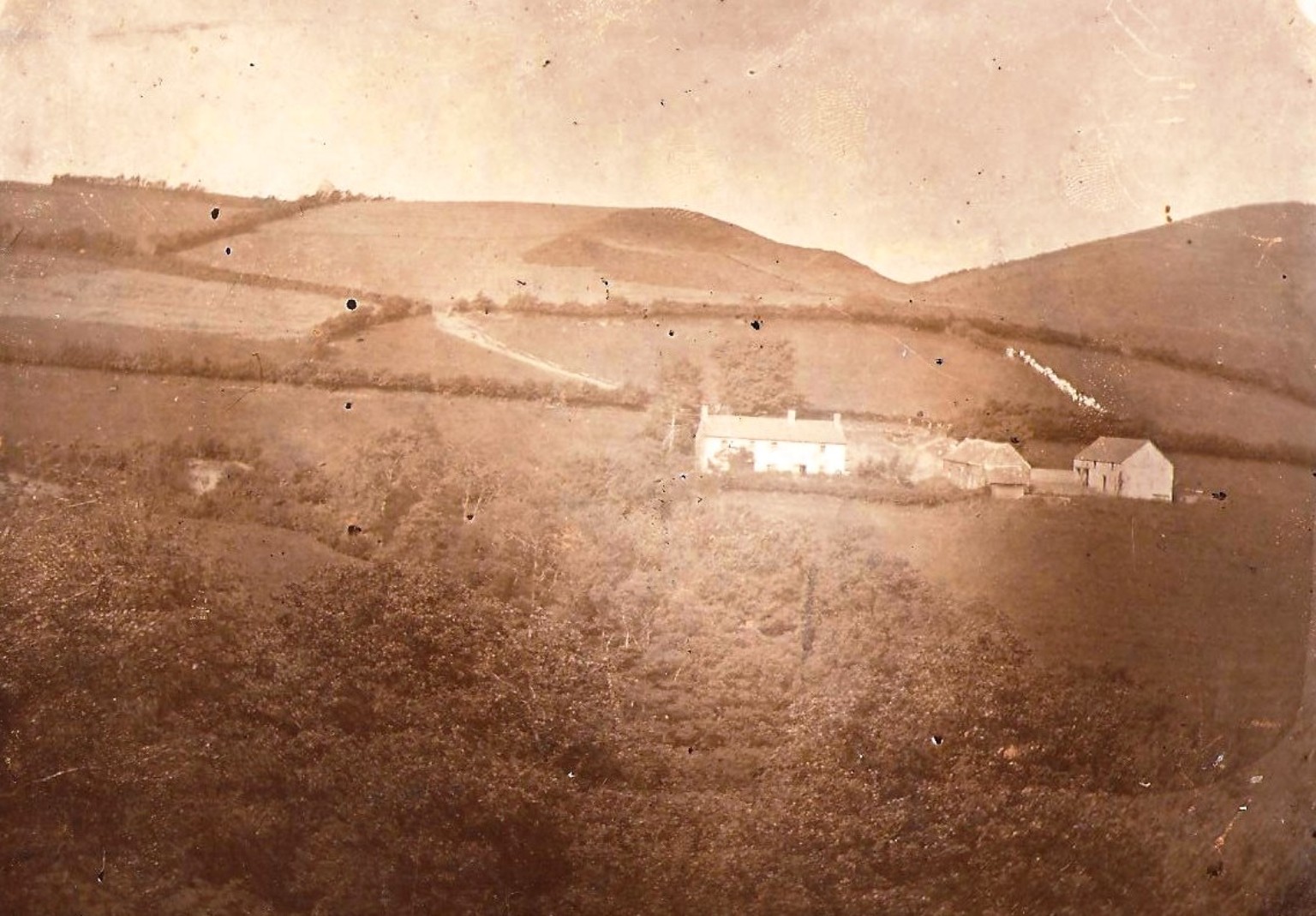
The old photograph of Caeadda shows a whitewashed farmhouse below the hills of western Montgomeryshire. Two agricultural buildings stand nearby, and rough pasture stretches down towards the camera. There is no date on the picture, but it captures a place which had already been home to generations of farmers. It is an ordinary-looking upland holding, and that is one reason its history interests me.
In September 1837, Caeadda was included in a sale arranged at the Eagles Hotel in Machynlleth. The farm comprised approximately 144 acres, and its tenant was Thomas Davies. That brief entry in an estate record tells us something important. Caeadda belonged to the world of tenant farming, in which families might work the same land for generations without owning it, and in which the fortunes of the household depended upon the animals, crops and other resources the holding could support.
My grandfather, Griffith Llewelyn Davies, was born at Caeadda in November 1888. When I began researching his life in the late 1990s, I knew little about the generations who had preceded him. I gradually found them in parish registers, census returns, wills, newspaper reports and photographs. Those records brought into view not simply a family tree, but a working farm which survived agricultural depression, bereavement and the enormous changes of the twentieth century. Caeadda eventually passed to another branch of the family, and its history continued.
Before the Davies Family
The written history of Caeadda reaches back to the early eighteenth century, but the land has an older past. During agricultural work around the farm, a number of stone objects were found, including thirteen perforated stones recorded as possible spindle whorls, together with flint and other stone artefacts. J. Barfoot described finds from Caeadda in Archaeology in Wales in 1986 and returned to the subject in an article on prehistoric shafthole implements in Montgomeryshire Collections the following year.
These finds are evidence of prehistoric activity in the locality, not proof that the present farm has been continuously occupied since prehistoric times. The precise dates and functions of some of the objects remain matters for archaeological interpretation. Nevertheless, they give the place a history considerably longer than the records of the Davies family.
The name itself is usually understood as Cae Adda, Adam’s Field. In 1880 the Reverend D. Silvan Evans of Llanwrin mentioned Cae Adda among local place names derived from personal names in correspondence published in Archaeologia Cambrensis. The identity of the Adam commemorated in the name is unknown.
My earliest documentary reference is a will from 1717 naming Eleanor Herbert of Cae Adda Goch. In 1744, Catherine John died at Cae Adda Felin. These references cannot automatically be treated as evidence for one and the same farmhouse, but they establish the name in the locality. Hugh Thomas was living at Caeadda by 1727, when his son Thomas was born there, and he died at the farm in 1760. Whether Hugh was connected with the Davies family who followed him has never been satisfactorily established.
The First Davies Generations
The Davies connection begins at nearby Cilgwyn. David Thomas, or Dafydd ap Tomos, married Elinor John at Llanwrin parish church on 26 January 1734. Their son Thomas David was baptised in 1738 and married Mary David in November 1762. I have long suspected that Thomas and Mary moved to Caeadda soon after their marriage, but the evidence does not permit that date to be stated as fact.
The first secure documentary reference comes from 9 January 1780. On that date their daughter Jane was baptised at Llanwrin, and the parish register described her father as being of Cae Adda. Thomas and Mary lived out their lives at the farm. Mary died in January 1824 and Thomas in September 1826, both being buried at Llanwrin.
Their son Thomas Davies, born at Caeadda in 1788, succeeded to the holding. In February 1826 he married Anne Davies of the Esgair Hir farming family. Their son, another Thomas, was born at Caeadda in March 1827. The recurrence of the same Christian name across generations makes this family less straightforward to trace than it might appear. Farm names, burial inscriptions and the increasingly detailed parish records are often what allow one Thomas Davies to be distinguished from another.
The repeated appearance of the name Thomas Davies in the family records is not as straightforward as it first seems. The earliest Davies occupant was Thomas David, baptised in 1738, whose father farmed at Cilgwyn. His son Thomas, born at Caeadda in 1788, married Anne Davies of Esgair Hir. The next Thomas was born in 1827. Gravestones and occasional references to farm names therefore become unusually valuable, since a simple baptismal entry giving a child’s name and parents can easily be confused with another family in the same parish.
The Davies family did not live in isolation. Marriage, employment and inheritance connected Caeadda with Cilgwyn, Esgair Hir, Gwernstablau, Hendreboeth and other farms in the Llanwrin district. Some of those connections would become important many years later, when relatives acquired neighbouring holdings or inherited interests in properties which had belonged to an older generation. To understand Caeadda properly, it is necessary to think of it as one part of that closely connected agricultural community.
The 1837 Sale and the World of the Tenant Farmer
In September 1837 Caeadda appeared in the sale of property associated with the widow Ann Jones. My earlier research connected this sale with the Jones family of Garthmyl Hall and a dispute over inheritance. The National Library of Wales separately records a printed notice dated 15 September 1837 for Cae Adda and Bwlch-y-Lluan among papers later deposited from the Cymerau family. The presence of the notice in that archive does not, on its own, prove ownership by the Cymerau Estate, and the full sequence of title still requires examination of conveyances.
The particulars recorded Caeadda as a farm of approximately 144 acres with Thomas Davies as tenant. That acreage gives a useful measure of the holding, although it tells us little by itself about the quality of its land, the amount of mountain grazing available or the return made from livestock.
In nineteenth-century Montgomeryshire, continued occupation of a farm did not necessarily mean ownership. The tenant provided stock, implements and labour, paid rent and worked within arrangements made with a landlord whose estate might include numerous other properties. A competent family could maintain a holding for generations without owning a single acre of it. Caeadda would remain in that position until the early twentieth century.
The Agricultural Year and the Machynlleth Markets
For a sheep farmer, the work followed a demanding annual cycle. Breeding preparations in autumn and early winter were followed by the constant care of livestock through the cold months, when the amount of fodder available could become a serious concern. Lambing was an especially anxious period, particularly on exposed upland ground. A few days of severe weather might undo months of preparation and cause losses from which a farmer would take a long time to recover.
Gathering sheep from the hills was also a test of knowledge and endurance. Flocks grazed across rough country, sometimes beyond the boundaries which divided the more sheltered fields below. Shepherds needed to recognise their own animals and understand customary arrangements with neighbouring farmers. A stray sheep was not necessarily an occasion for dispute. It might be kept safely until the next gathering and returned to its owner. These practical understandings helped neighbouring holdings work alongside one another.
Shearing brought the need for additional labour. My earlier research into the district describes the long-established practice of neighbouring farmers helping one another, working at one holding before moving on to the next. A group might help at Caeadda and later be found at Esgair Llewelyn or Penlan. The work was difficult and, before powered clippers, was carried out by hand. Meals for the additional men placed demands upon the farmhouse as well, and the shearing season was consequently a family undertaking as much as a task for the shepherds.
The commercial focus of this farming world was Machynlleth. Market days meant selecting and driving livestock from the hills, negotiating with dealers, buying supplies and meeting people from across the district. The town’s annual fairs included opportunities to engage agricultural servants, many of whom lived with their employers. For farming households some distance from town, the same occasions served an important social purpose. News was exchanged, relatives were seen and business was conducted which could not conveniently be managed from an isolated farmhouse.
A Victorian Farming Household
Thomas Davies, born in 1827, eventually succeeded his father in the working of Caeadda. On 22 June 1859 he married Gwen Jones, who had been born in Liverpool but brought up at Esgair Llewelyn, another old farmhouse associated with the Llanwrin district. They went on to have twelve children, all of whom survived infancy.
The farm was primarily concerned with sheep, but an upland household required much more than a flock on the hill. Cattle, poultry, pigs, hay, household food production and the maintenance of buildings and boundaries all demanded attention. There was no firm division between the business of farming and the work of the home. The women of the household had responsibilities without which the agricultural operation could scarcely have functioned.
The census returns for 1861 and 1871 record three resident servants at Caeadda. This suggests a household of some standing among the local tenant farmers, although it should not be confused with the wealth of the landed gentry. Thomas and Gwen were working people who managed a substantial undertaking and depended upon its success.
Much of their business was conducted through Machynlleth. Its markets and fairs brought together farmers, dealers, labourers and shopkeepers from the surrounding countryside. Livestock might have to be taken considerable distances before it could be sold. Hiring fairs helped employers find agricultural servants, while the market day itself offered opportunities to settle accounts, purchase supplies and meet people from neighbouring farms.
The work of a substantial Victorian farmhouse was easily underestimated. Gwen had twelve children, and the household also accommodated servants during its more prosperous years. Preparing meals, washing, cleaning, looking after poultry and managing dairy produce all took time. It is reasonable to suppose that some of the practical work was divided among the women of the house, while Gwen supervised the household and, when required, participated in agricultural business. Her daughter Mary Winifred later remained at Caeadda and appears to have taken on much of the domestic responsibility.
The family’s connections with chapel and education are another part of the story. Their son Thomas had been baptised at Sion Calvinistic Methodist Chapel, while later generations took part in Sunday school activities and village musical events. The Welsh language remained important within the household. Gwen appears to have made her mark rather than signed many documents, but this should not be confused with a lack of practical ability or understanding of business. Her later participation in agricultural shows and the management of Caeadda provides evidence of both.
Depression, Family Labour and the Oak at Caeadda
The relatively favourable years of the mid-Victorian period were followed by a long agricultural depression. Imported produce, falling prices and the changing wool trade placed pressure upon farming households, while the tenant’s rent remained a regular obligation. The effects can be seen in the census returns from Caeadda. By 1881 the number of resident servants had fallen to one, and by 1891 none was recorded.
The change did not mean that the work had disappeared. It had increasingly to be undertaken by the family. Thomas’s sons John, Thomas and David gained their experience on the holding, while his daughter Mary Winifred assisted within the household. Such arrangements helped to keep expenditure down, but they also show how dependent the survival of a farm could be upon the labour of its own children.
Thomas found another source of income in the woodland. In May 1881, and again in April 1891, oak timber from Caeadda was advertised for sale at auctions in Machynlleth. The notices reached readers beyond the immediate locality, evidence that the timber was regarded as a commercial resource and that its sale was more than an incidental farmyard transaction.
These timber sales are among the most revealing details in the farm’s nineteenth-century history. They show an established sheep farmer drawing upon the wider resources of his holding during difficult years. We cannot say precisely what profit the sales produced, but the advertisements survive as evidence of the business decisions being made at Caeadda.
Timber was one way of finding income outside the ordinary sale of sheep, but the surviving advertisements cannot tell us exactly what Thomas received. They also raise the question of how rights to cut or sell timber were arranged under his tenancy. We should not assume that every tree on the property was automatically his to dispose of. What the advertisements establish is that substantial quantities of oak from Caeadda were brought to market in 1881 and 1891, at a time when many agricultural households were having to reconsider how they managed their resources.
The local consequences of agricultural uncertainty could be severe. During the hard winter of 1894–95, conditions across the Welsh uplands placed livestock and fodder supplies under great pressure. The farming family at Penlan, another holding connected with this story, later struggled with debts following attempts to replace lost stock and was declared bankrupt in 1897. We cannot attach a precise figure to losses at Caeadda, but the example shows the narrow margin which separated an established tenant from financial disaster during exceptionally difficult years.
Gwen Davies and the Farm after 1891
Thomas Davies died at Caeadda on 15 June 1891, aged sixty-four. An influenza outbreak was then affecting the Llanwrin district, severe enough for the village school to close temporarily, and my earlier research associated his death with that epidemic. He was buried at Llanwrin four days later.
His widow Gwen was fifty. She remained at Caeadda and worked with their eldest son, John, who had already become a skilled shepherd. John won prizes with Welsh Mountain sheep and in sheepdog and shearing competitions. His dog Fly won the Talybont sheepdog trials in 1895. He also conducted the Llanwrin choir at local events, a reminder that the life of the farm was closely connected with that of the parish.
Gwen was more than a retired farmer’s wife. In 1892 and 1893 she entered Welsh Mountain rams in her own name at the Machynlleth Agricultural Show and gained second prize on both occasions. Such entries were public recognition of her continuing interest in the livestock business. A fuller account of her life appears in my separate study, Gwen Jones of Caeadda, 1841–1926.
John died suddenly at Caeadda in October 1897, aged thirty-six. Once again the management of the farm had to be reorganised. His younger brother David, then twenty-seven, assumed the leading practical role alongside Gwen. The partnership between mother and son would continue for almost thirty years.
Gwen’s appearances at the Machynlleth Agricultural Show are worth remembering alongside the better-documented prizes won by her sons. They placed her name in the public record of a trade still generally discussed through its male farmers. Local newspapers also show her taking part in community occasions, including the celebrations for Edward VII’s coronation and the opening of the Llanwrin Revolt School in 1908. It would be a mistake to imagine her confined to the farmhouse after her husband’s death; she continued to have an active presence in the farming and social life of the district.
David Davies and a Farm in Transition
David Davies was born at Caeadda on 6 January 1870 and spent his entire life there. He became a particularly capable sheep farmer. In the Machynlleth sheepdog trials of 1909 he came second and won £3; in October 1910 he again finished second, this time among forty competitors. He also showed Welsh Mountain sheep successfully and acted as a shearing judge at the Talybont and North Cardiganshire show in 1910.
His career belonged to a period when agricultural practice was changing, sometimes to the irritation of farmers who had learned their methods from their fathers. In November 1902 David attended a meeting at the Wynnstay Hotel in Machynlleth about proposals for more frequent sheep dipping. He opposed the proposals, believing that dipping would not prevent scab. His comments are useful evidence of the disagreements which accompanied changes in livestock management; they should not be mistaken for proof that his view was medically correct.
David married Catherine Harriet Pugh at Maengwyn Chapel, Machynlleth, in April 1923. She came from another established farming family with connections to Glyncaerig and Alltddu. They had no children. The marriage strengthened an existing connection between Caeadda and the Glyncaerig and Alltddu farming families.
The Purchase of Caeadda and the Wider Family
The family’s apparent purchase of Caeadda between about 1916 and 1922 brought a substantial change. The Davieses had occupied the holding for generations but had not owned it. Many Welsh estates were disposing of farms during these years, sometimes enabling longstanding tenants to buy the places where they had spent their working lives. The exact conveyance for Caeadda has not yet been identified, so the date must remain approximate, but the change from rent-paying tenant to owner was an important event in the farm’s history.
Gwen remained at Caeadda until her death in October 1926, aged eighty-five. Her will and probate provide further glimpses of the household. She left a personal estate valued at £2,630 11s 2d and possessed a ten-volume Welsh-language Gwyddoniadur, a set of books important enough for her to specify who should inherit it. Her original intention had been to leave the volumes to her grandson Trevor Owen Davies, but she later changed the bequest in favour of her youngest son Griffith. We do not know what became of the books.
The family had meanwhile spread into several neighbouring holdings. Thomas Davies, born at Caeadda in 1864, went to farm the extensive Penlan holding above Ceinws and later moved to Gwernstablau. He became involved in parish administration, while William Davies continued the farming connection at Esgair Llewelyn. When Gwen’s brother William Jones died in 1925, David and Griffith inherited interests in Esgair Llewelyn and Esgair Neiriau. They entered into a business agreement concerning those properties in 1932, although its later history remains unclear.
Not all the children remained in farming. Ellis Jones Davies trained as a chemist in London and established a business before his premature death in 1898. Owen Jones Davies emigrated to North America and eventually became a farmer in Canada. These different careers show how the sons of an established Welsh farming household could take opportunities beyond the parish while still carrying with them the connections and experience of the place where they had grown up.
The Last Davies Years
David lived long enough to see tractors, mechanical equipment, new veterinary practices and increasing government involvement alter the terms of agricultural life. The two world wars brought further demands upon food production and labour. Upland sheep farming did not lose its dependence upon practical experience, but the world in which he had learned his trade was disappearing.
His younger brother Griffith Llewelyn Davies, my grandfather, had worked at Caeadda before marrying in 1929 and moving to Tymawr near Ceinws. Griffith died in 1943. His eldest son, David William Davies, later worked for his uncle at Caeadda, but died there of meningitis in July 1951, aged only twenty.
David Davies died at the farm on 7 October 1960, aged ninety. His personal estate was valued at approximately £24,814. That probate figure cannot be used as a valuation of the farm alone, but it indicates the scale of the estate left after a long working life. He was buried in the Nonconformist cemetery at Machynlleth.
Because David and Harriet had no children, Caeadda passed to his nephew, the Reverend Trevor Owen Davies. Born at the farm in 1895, Trevor had followed a very different career, studying at Aberystwyth and Oxford before becoming a Presbyterian minister and the last principal of Trefeca College. He died in April 1966. Harriet left Caeadda that year, moving to Pencoed near Cemmaes.
After Trevor’s death, the property passed through the descendants of Jane Davies, another of Thomas and Gwen’s children. Jane had married William Rowlands Nutting in 1909. Their daughter Gwen Jones Nutting married Goronwy Pughe. Through that branch the farm continued within the extended family, even though the Davies surname was no longer that of its occupants.
Caeadda in the Twenty-First Century
The later history of the farm is unusually well documented for a place of this kind. Willie and Mairwen Pughe farmed Caeadda during the twentieth century, and their son Dafydd gradually took over in the 1980s. Members of the wider family continued farming in the Dyfi Valley, including at Morben, on the other side of the valley.
In 2024 the photographer David J. Shaw published a remarkable record of their working lives. His project, Caeadda: Hill Farmers of the Dyfi Valley, was also the subject of a photographic essay in The Guardian on 22 November 2024. It records Dafydd Pughe and his relatives gathering and tending livestock, helping one another with demanding jobs and attending the agricultural markets which remain important to the area.
The photographs also introduce the younger generation. Dafydd’s daughter Catrin had studied agriculture and hoped to make her own future in farming. Other members of the family were taking different paths while retaining close ties to the farm. Shaw’s work is valuable because it records people actually engaged in the life which earlier documents can only imperfectly reconstruct.
The modern pressures are different from those encountered by Thomas Davies during the agricultural depression. Costs, environmental requirements, changing agricultural support and the question of who will succeed to a farm all bear upon the decisions made by present-day families. Yet the work still requires an intimate knowledge of the land and animals. The same markets and neighbouring relationships that mattered to earlier generations remain recognisable.
The photographs do not show an unchanging rural world. They show a working community adapting, as its predecessors did, to circumstances it cannot entirely control. They also carry the history of Caeadda beyond the point at which the old Davies succession ended in 1966.
The History of One Farm
When I began researching my grandfather’s family, I did not expect to find a story extending from eighteenth-century parish records to modern photographs of his descendants. The documents show Caeadda as a tenancy, a household employing servants, a farm sustained increasingly by family labour, and eventually a property acquired by the people who worked it. They also preserve the names of the women whose contribution was essential but so often overlooked in accounts of rural life.
Questions remain about the earliest occupants, the legal history of the 1837 sale and the precise date of the family’s purchase. Those gaps should be acknowledged. Yet sufficient evidence survives to trace how a working farm in the Montgomeryshire hills passed through generations without losing its agricultural purpose. The Davies surname gave way to Pughe, but the family connection continued. The whitewashed house in the old photograph is still part of a living farming history, and that is what makes Caeadda worth remembering.
Related Essays
- Gwen Jones of Caeadda, 1841–1926: A Welsh Farming Matriarch
- Esgair Llewelyn: A Medieval Welsh Farmhouse and the Social History of a Llanwrin Family
- Trevor Owen Davies (1895–1966): From Welsh Farm Boy to Christ Church, Oxford
- The Llyfnant Valley: Farming, Waterfalls, Tourism and the Waters Family
- Voices from the Uplands: Why I Wrote It and Why It Matters
Explore more Montgomeryshire and rural history
Continue with the Montgomeryshire History, Welsh Rural History and Family History & Genealogy guides, or browse the related essays above.
Receive new historical essays by email
For new essays on Welsh history, biography, genealogy and rural community life, subscribe on the homepage.
Sources and Further Reading
This essay draws principally upon the family research assembled in The Davies Caeadda Family, Old Llyfnant Valley Farming Families and Voices from the Uplands: The Davies Family and the Soul of Rural Wales, together with Llanwrin parish registers, census returns, civil registration, probate material, family photographs and local newspaper reports. The 1837 sale particulars and the 1881 and 1891 advertisements for Caeadda oak are especially valuable for the history of the farm as a business.
- J. Barfoot, “Caeadda, Llanwrin”, Archaeology in Wales, 26 (1986), pp. 38–39; and “Two Halves of Prehistoric Shafthole Implements from Caeadda, Llanwrin”, Montgomeryshire Collections, 75 (1987), pp. 96–99.
- Heneb Historic Environment Record, Caeadda Finds, PRN 17532, recording the perforated stones and other finds in the locality.
- National Library of Wales Annual Report 1979–80, recording the deposited printed sale notice for Cae Adda and Bwlch-y-Lluan dated 15 September 1837.
- The Reverend D. Silvan Evans, correspondence concerning personal names in the Llanwrin landscape, Archaeologia Cambrensis (1880).
- Aberystwyth Observer, 4 June 1891, reporting the influenza outbreak affecting Llanwrin; and contemporary Cambrian News agricultural and community reports.
- David J. Shaw, Caeadda: Hill Farmers of the Dyfi Valley, photographic project (2024); and The Guardian, 22 November 2024; also BBC Countryfile Magazine, September 2025.
Some points remain open to further research, particularly the earliest date of Davies occupation, the exact sequence of ownership following the 1837 sale and the date of purchase by Gwen and David Davies. The prehistoric finds are discussed as evidence of activity in the area, not as proof of continuous occupation of the present farm.