
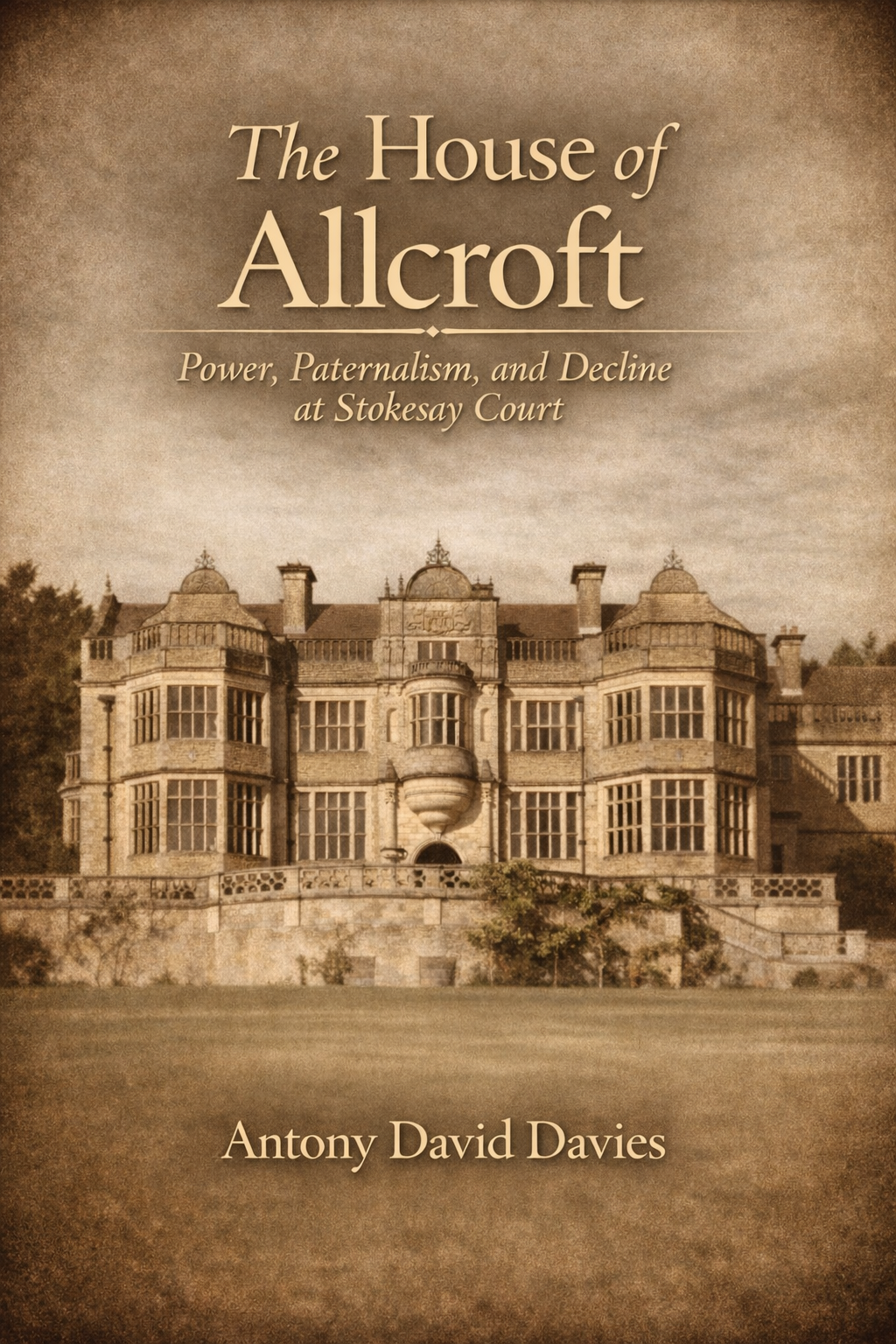
The House of Allcroft
Power, Paternalism, and Decline at Stokesay Court
A history of commercial wealth, landed authority and the decline of a country-house world.
The book traces the Allcroft family from provincial commerce and the glove trade to landed influence, public service and life at Stokesay Court. It examines wealth, inheritance, respectability, paternalism, household authority, philanthropy and the weakening of inherited social structures across the nineteenth and twentieth centuries.
Why I wrote this book
Although I remained pleased with The Allcroft Family: From Worcester to Stokesay, published in 2016, I was never entirely satisfied with it. In particular, I felt that the later part of the story lacked the depth it deserved. The nineteenth-century foundations of the family and estate were reasonably well established, but the twentieth century, the period in which the social and economic world surrounding Stokesay Court changed most profoundly, remained comparatively thin.
By the 2020s the research landscape had changed considerably. Vast quantities of newspapers, archival material and other historical sources that had previously required lengthy searches or remained difficult to access were increasingly available online. These new resources offered the opportunity to fill many of the gaps that had frustrated me in the earlier book, particularly in relation to the later generations of the family, the estate, public life, household relationships and the changing position of the country house.
I therefore decided not simply to revise the earlier book, but to undertake a complete reassessment of the research. The result became The House of Allcroft. Rather than treating Stokesay Court principally as the setting for one family history, I wanted to use the Allcrofts and their estate as a case study through which to examine the wider history of wealth, status, paternalism and the country house in Britain.
Where the research began
The documentary foundation remained the large body of material accumulated since I first began researching Stokesay Court and the Allcroft family in 1994. The earlier book had brought much of that material together, but the new project required me to return to the evidence almost from the beginning and reconsider it in the context of the society in which the family lived.
The central question had changed. I was no longer interested only in tracing the Allcrofts from commerce to landed status, or in recording successive generations of the family. I wanted to understand what their experience could tell us about the wider structures of nineteenth- and twentieth-century Britain: the conversion of commercial wealth into social standing, the responsibilities and expectations attached to landed authority, the operation of paternalism, the relationship between employers and those who worked for them, and the gradual weakening of the economic and cultural assumptions on which the country-house world had rested.
This change of approach also allowed the twentieth century to assume its proper importance. Rather than appearing merely as the final chapters of a family history, it became central to understanding decline, adaptation and survival. The history of Stokesay Court could therefore be placed within the much larger story of what happened to landed wealth and the traditional country house as British society changed around it.
Sources and method
The study draws on family and genealogical research, census and civil records, newspapers, directories, wills, property history, photographs and personal recollection. The aim is to move from individual biography into the wider history of the Victorian and Edwardian country house: hierarchy, service, duty, paternalism, employment and the social expectations attached to wealth.
How it fits into my wider work
The House of Allcroft is the fullest example of my interest in authority as a historical subject. Like my work on Welsh rural communities and Victorian professional life, it asks how legitimacy is created, how institutions and social expectations sustain it, and why systems that once appeared permanent can unravel surprisingly quickly.
Publication details
- Author: Antony David Davies
- Published: July 2026
- Formats: Kindle and paperback
- Paperback ISBN: 9798181008908
For related research, see Country Houses & Estates.
Read The House of Allcroft
The full study is available in paperback and Kindle editions.