
Most people assume that political identity is something acquired, a set of opinions formed by the news cycle, public argument, and the shifting pressures of the present. In Wales, that assumption seldom survives contact with history.
Welsh political culture was not born yesterday. Nor did it begin with devolution, or with the institutions of modern Cardiff Bay. It was formed much earlier, in the long moral and social experience of communities shaped by land, language, chapel, class, and memory. For centuries, large parts of Wales were governed by structures of power that did not speak the people’s language, did not fully share their priorities, and often did not understand the society over which they presided. Out of that experience came a political instinct that was cautious, communal, morally alert, and deeply suspicious of authority that lacked legitimacy.
The more I have studied my own ancestry over the years, the more I have come to believe that my own political instincts owe less to modern ideology than to inheritance. By that I do not mean biology in any crude sense, but cultural inheritance, a way of seeing the world passed down through families, habits, expectations, and moral memory.
I am not a politician, nor a candidate. I am a historian. But I come from a long line of Welsh upland families whose lives were shaped not by the abstractions of Westminster, but by the intimate realities of power as it was actually experienced, through estates, chapels, schools, tenancies, and local reputation. Once that older world becomes visible, much about Wales begins to make sense.
Wales’s Political Life Long Predates Its Modern Institutions
There remains a habit, particularly outside Wales, of treating Welsh politics as something modern and faintly artificial, as though it began only when Wales acquired devolved institutions of its own. That is a serious misunderstanding.
For much of Welsh history, politics did not mean parties, manifestos, or televised debate. It meant survival. It meant understanding where authority lay and how far it could be trusted. It meant knowing the reach of the landlord, the minister, the magistrate, the schoolmaster, and the local worthies who mediated between community and state. It meant learning when to comply, when to resist, and when silence itself was a strategy.
That long experience left its mark. In many parts of Wales, especially rural Wales, political judgement developed less as ideological enthusiasm than as moral caution. The instinct was not to be dazzled by slogans, but to ask who held power, whose interests were being served, and whether authority had earned respect. That wariness was not incidental. It was historical.
Tenant Farming and the Politics of Dependence
My own ancestry is rooted in the upland farming communities of Montgomeryshire and southern Merionethshire, especially around Llanwrin, Machynlleth, and the Dyfi valley. These were communities in which families often held farms over generations, but did so as tenants rather than owners. That distinction mattered profoundly.
A tenant farmer might be industrious, respectable, and locally influential, yet still remain dependent on decisions made elsewhere. The land could feel hereditary in practice, but not in law. A farm might sustain a family for decades and still never truly belong to them. That condition bred a distinctive moral and political outlook. It encouraged caution, continuity, and a strong sense that security rested not only on labour, but on relationships, reputation, and the conduct of those above you.
The Davies family of Caeadda in Llanwrin belonged to precisely that world, a class of capable and respectable Welsh tenant farmers whose standing rested less on wealth than on competence, character, and endurance across generations. (Source 1) The farm was not merely an economic unit. It was a moral institution, a place in which obligation was learned, discipline was internalised, and identity was formed. In such households, politics was never merely theoretical. It was woven into the terms on which life itself was lived.
The Chapel and the Moral Language of Welsh Public Life
No serious account of Welsh political inheritance can ignore Nonconformity. In rural Wales, the chapel was never merely a place of worship. It was also a centre of education, music, literacy, debate, mutual aid, and social discipline. It shaped the moral vocabulary through which ordinary people judged conduct and power.
In that culture, authority was not automatically honoured because it existed. It had to justify itself. Leadership was expected to possess moral seriousness. Public hypocrisy was resented. Respectability was not merely social polish, but a form of moral credibility. This helps explain why Wales, especially in the nineteenth century, produced such strong Liberal and radical traditions. The chapel taught people to test authority against conscience.
That chapel culture was not always generous. It could be stern, controlling, even exclusionary. But it helped to form a society in which the moral legitimacy of power mattered deeply. Even in a more secular age, that inheritance has not entirely vanished. Much of modern Welsh political temperament still bears its imprint.
Caeadda, Esgair Llewelyn, and the Moral World of the Uplands
The documented story of my own family reaches back into the old Welsh patronymic tradition, with figures such as David Thomas, born about 1713, who in his own time would have been known as Dafydd ap Tomos. (Source 2) The survival of that naming culture in rural Wales long after it had faded elsewhere was itself significant. It reflected the tenacity of a society not easily reduced to the administrative simplicity preferred by Anglicising authority.
From that early period, the Davies family became firmly rooted in Llanwrin parish, and most especially at Caeadda, where they established a long association with the land. Thomas Davies of Caeadda, born in 1827, lived through the great transitions of nineteenth-century Wales, when tenant farming, Welsh-language culture, and chapel authority still formed a coherent moral order, but were increasingly pressed upon by modern educational structures, state administration, and economic change. (Source 3)
His wife, Gwen Jones, born in 1841 and descended from the Jones family of Esgair Llewelyn in southern Merionethshire, represents another essential element in Welsh political inheritance. (Source 4) Women like Gwen are often less visible in the formal record, yet their influence was immense. They transmitted discipline, piety, language, memory, and the habits of respectability. They shaped the moral expectations through which children learned what was honourable, what was shameful, and what obligations were owed to others. If Wales possessed a political soul, it was formed not only in councils and chapels, but in kitchens, farmhouses, and the domestic order maintained by women whose names too often appear only faintly in the archive.
Evan Lewis and the Rise of Rural Civic Confidence
Rural Wales is sometimes caricatured as politically passive, deferential, or merely traditional. The record does not support that view. My own family history points in the opposite direction.
My great-great-uncle Evan Lewis, who farmed at Argoed in Tregynon, was elected to Montgomeryshire County Council in 1898 as a Liberal representative for Tregynon and Manafon. He later served as a Justice of the Peace in Newtown and was also involved in local educational and district governance. (Source 5) His career places him within one of the most significant developments in modern Welsh history, the gradual transfer of civic authority from a narrow landed elite to a rising class of chapel-formed, educated, and self-respecting Welsh farmers, tradesmen, and professionals.
Men like Evan Lewis were not revolutionaries. Yet they helped bring rural Wales into public life on new terms. They entered the machinery of governance not as clients of the old order, but as participants in it. In counties long shaped by estate influence, that marked a profound change.
Gatty Lewis and the Continuity of Liberal Civic Wales
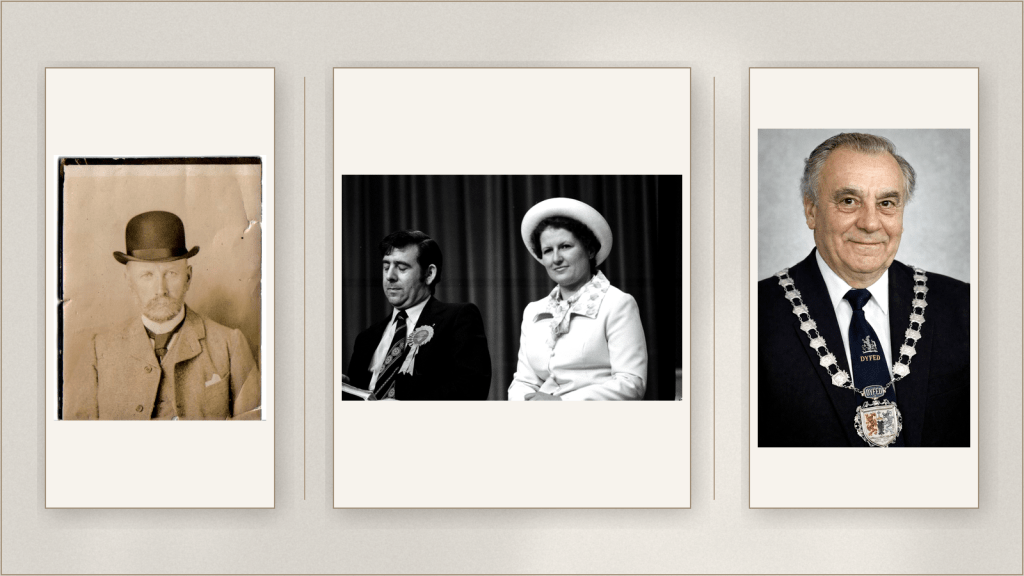
That tradition did not end with the Victorian age. Evan Lewis’s youngest son, John Gatty Pugh Lewis, born in 1911, carried elements of that Liberal civic culture into the administrative Wales of the later twentieth century. He farmed near Llanilar, became Managing Director of Aberystwyth Tractors Ltd, served on the Aberystwyth Rural District Council, and later sat on Dyfed County Council from 1974, eventually becoming its chairman in the mid-1980s. (Source 6)
This continuity matters. It shows that Welsh Liberal civic culture was not merely a relic of chapel rhetoric, but a lived inheritance, capable of adapting to modern administrative frameworks while preserving older assumptions about duty, fairness, and competent local service. Welsh public life has often been less interested in ideological display than in whether people can govern decently. Gatty Lewis belonged to that practical tradition.
Edward Jenkins and Welsh National Consciousness Beyond Wales
Another branch of this inheritance points beyond Liberal civic culture towards the early growth of organised Welsh national consciousness. My great-great-uncle Edward Jenkins, a carpenter from the Llyfnant area who later settled in Birmingham, was one of the founding members and first vice-president of the Birmingham branch of Cymru Fydd in October 1897. (Source 7)
This is significant for more than genealogical reasons. First, it reminds us that Welsh political identity was never confined strictly to Wales itself. The diaspora in English cities helped preserve Welsh language, culture, associational life, and political aspiration. Secondly, Cymru Fydd represented one of the earliest modern movements to articulate Welsh self-government in explicit terms. Its work linked culture and politics, and understood that a nation could be sustained not only by territory, but by memory, speech, and collective purpose.
Edward Jenkins’s life reflects an enduring Welsh truth, that Wales has always been more than a boundary on a map. It is also a peoplehood carried outward by those who left, but did not cease to belong.
Revolt Schools, Parish Councils, and the Politics of Conscience
Some of the most significant political acts in Welsh history were not parliamentary at all. They were local protests, voluntary committees, educational campaigns, and small acts of organised refusal. My great-uncle Hugh Davies was involved in the movement to establish a so-called revolt school at Llanwrin, created in protest against the perceived Anglican dominance of the National School system. (Source 8) This was not a trivial local quarrel. It formed part of a much wider Welsh struggle over education, religion, and cultural fairness.
The same is true of local government. My great-uncle Robert Hughes served on Corris Parish Council as a Liberal in the early twentieth century, while another kinsman, Thomas Davies, served as a parish councillor in Llanwrin. (Source 9) Such offices may appear modest, but they were among the places in which Welsh democracy was most concretely learned. Parish councils dealt with roads, sanitation, schooling, welfare, and the everyday infrastructure of communal life. Through them, rural people came to exercise public responsibility in practical form.
This was Welsh politics in one of its truest expressions, local, moral, and grounded in responsibility rather than spectacle.
From Liberal Wales to Modern Welsh Nationhood
The story does not stop in the age of chapel Liberalism. It stretches into modern Wales, and into the long reconfiguration of Welsh political identity in the twentieth century.
Within my wider family, the distinguished harpist Elinor Bennett, granddaughter of my great-uncle William Davies, married Dafydd Wigley, later leader of Plaid Cymru, Member of Parliament for Caernarfon, Assembly Member, and subsequently a member of the House of Lords. (Source 10) This connection is historically meaningful because it illustrates the longer transfer of Welsh political energy from nineteenth-century Liberal Nonconformity into newer forms of national political expression.
The old Liberal tradition in Wales was never merely partisan. It was moral, cultural, and national in sentiment, grounded in chapel discipline, educational aspiration, self-respect, and the conviction that Wales should not be treated as peripheral or inferior. As that tradition weakened institutionally, much of its energy flowed elsewhere, into Labour in some places, and increasingly into Plaid Cymru in others. In that sense, the connection between Elinor Bennett and Dafydd Wigley may be read not merely as a family detail, but as a bridge between cultural Wales and constitutional Wales, between inherited nationhood and formal political expression.
Why This Matters
I do not write these things out of sentiment alone. I write them because Wales is in danger of forgetting the deeper sources of its own political character.
We live in an age dominated by noise, speed, and shallow oppositions. Political identity is often treated as something instantly assembled, a performance of allegiance rather than the outcome of historical formation. Yet Wales has long possessed a moral political culture shaped by rural resilience, chapel seriousness, communal obligation, and an ingrained suspicion of unaccountable power.
That inheritance was not flawless. It could be severe. It could exclude. It could demand conformity. But it also produced communities that believed authority must be earned, not merely asserted. That remains one of the healthiest instincts in Welsh public life.
A Final Reflection
When I trace my ancestry, I do not merely recover names. I recover a world.
I find the tenant farmers of Caeadda in Llanwrin, rooted in the uplands across generations. I find Gwen Jones of Esgair Llewelyn, carrying Merionethshire’s moral culture into Montgomeryshire. I find Evan Lewis entering county government in the age when rural Wales was learning civic confidence. I find Gatty Lewis carrying that tradition into modern county administration. I find Edward Jenkins sustaining Welsh political nationhood beyond Wales itself. I find Hugh Davies in the revolt school movement, and Robert Hughes and Thomas Davies in parish service, reminders that Welsh politics was often built from below.
My ancestors did not leave manifestos. But they left habits of thought, loyalties, and expectations. They left a moral inheritance.
And if Wales is wise, it will remember that its political soul was not first built in parliaments or party machines. It was built in farmhouses, chapels, school disputes, parish meetings, and upland fields, by ordinary people who understood, long before the modern age, what power looked like, and what it cost.
Sources
Source 1. Census returns, tithe records, parish records, and family research relating to the Davies family of Caeadda, Llanwrin.
Source 2. Parish register and genealogical reconstruction for David Thomas, c.1713, and the early patronymic Davies line.
Source 3. Census returns, tenancy records, parish material, and family history for Thomas Davies (1827–1891) of Caeadda.
Source 4. Census and family records for Gwen Jones (1841–1926) of Esgair Llewelyn.
Source 5. County council election reports, local newspapers, and civic records relating to Evan Lewis of Argoed, Tregynon.
Source 6. Local government records, newspaper reports, and business references concerning John Gatty Pugh Lewis and Dyfed County Council.
Source 7. Newspaper notices and associational records relating to the Birmingham branch of Cymru Fydd and Edward Jenkins, October 1897.
Source 8. Local education dispute records, newspaper coverage, and family material relating to the Llanwrin revolt school movement.
Source 9. Parish council records and local newspaper notices for Robert Hughes of Corris and Thomas Davies of Llanwrin.
Source 10. Published biographical material and family connection relating to Elinor Bennett and Dafydd Wigley.
 Antony David Davies FRSA FRAS AFRHistS FIoL MCMI