
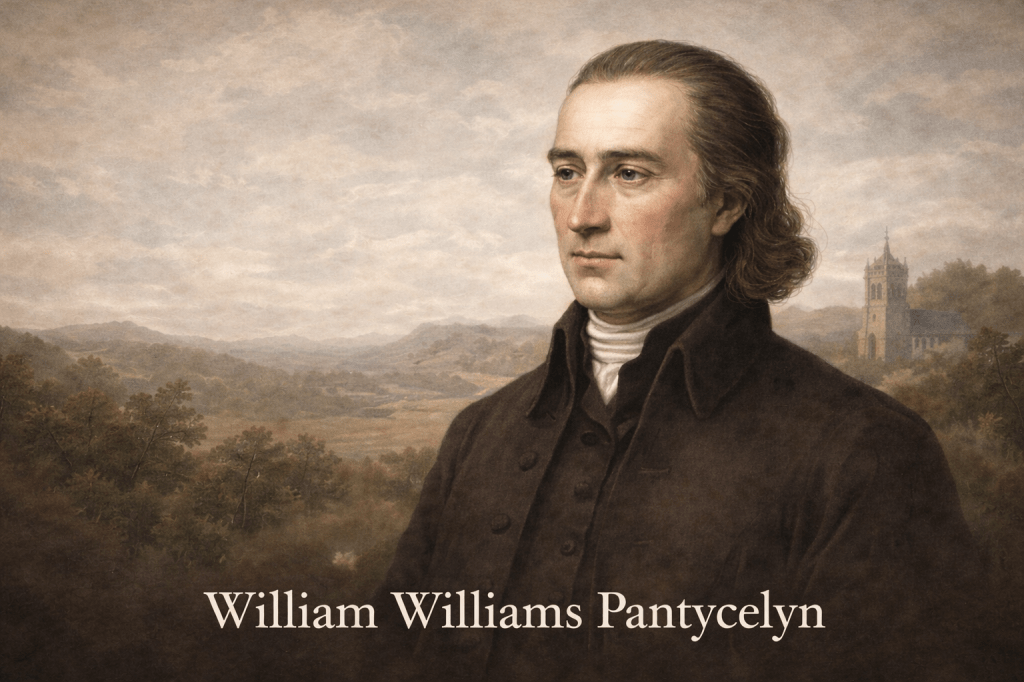
In my earlier essays on Daniel Rowland, the great evangelist of the Welsh Methodist Revival, and Howell Harris, the organiser and engine who turned revival into a disciplined movement, I explored two forms of power that shaped modern Wales.
The first was the power of the pulpit, preaching as national event, the sermon as moral theatre, the minister as uncrowned king.
The second was the power of organisation, the creation of societies, networks, and lay discipline, the building of a parallel Welsh civic culture long before Wales possessed political sovereignty.
But a revival cannot endure through preaching and structure alone.
To survive, it requires a third force, one subtler than the sermon, and more portable than the society.
It requires a voice.
That voice was William Williams Pantycelyn, the spiritual poet of the revival, the hymn-writer who gave Welsh evangelical religion its lasting language, and in doing so helped create something far larger than a Methodist movement.
He helped make Wales a singing nation.
1. Why the Revival Needed a Poet
The Welsh Methodist Revival began, like most revivals, in the shock of encounter. It was born in preaching, in testimony, in sudden awakenings of conscience, in the sense that eternity had broken into ordinary life.
This is why Daniel Rowland remains so central. Rowland’s genius lay in his ability to turn a sermon into an experience. He did not merely explain doctrine, he made people feel the weight of sin, the urgency of grace, and the terror and sweetness of judgement.
But preaching is, by its nature, fleeting.
Even the greatest sermon is bound to a moment, a place, and a living voice. It depends on the presence of the preacher and the memory of the hearer. It can be retold, but it cannot be carried intact across generations in the way a song can.
Howell Harris understood this in practice. He created the societies, the networks, the structures of fellowship that made revival sustainable. He turned the event into a movement.
Yet even movements fade unless they become culture.
And culture is not sustained by minutes of meetings.
It is sustained by language.
This is where William Williams enters the story, not as a supporting figure, but as the revival’s essential third pillar.
Rowland preached the revival into existence.
Harris organised it into survival.
Williams sang it into permanence.
2. Pantycelyn and the Welsh Landscape of the Soul
William Williams was born in 1717 at Cefncoed in Carmarthenshire, and became forever associated with Pantycelyn, near Llandovery, a place-name that has come to feel almost symbolic in Welsh religious memory.
Like Harris and Rowland, he was formed by rural Wales, by distance, by travel, by the intimate social worlds of farms, lanes, and small communities. This was not the Wales of factories and coal, but the Wales of chapel-less valleys, parish churches stretched thin, and communities whose moral life depended heavily on custom, reputation, and neighbourly scrutiny.
Williams trained for the Church of England and was ordained as a deacon. He might have lived a respectable clerical life within the established order.
But the revival did not allow him to remain respectable.
He encountered the preaching of Howell Harris and the emerging evangelical movement, and underwent the same kind of spiritual awakening that had transformed so many early revival leaders.
From that moment, he became an itinerant preacher and exhorter.
Yet his greatest calling was not primarily in the pulpit.
It was in the hymn.
3. Hymnody as Theology, Not Ornament
It is difficult today, in a Wales that has largely moved beyond chapel dominance, to recover the seriousness of hymnody in the eighteenth century. Modern listeners often treat hymns as sentimental, decorative, or culturally quaint.
For Williams Pantycelyn, hymn-writing was none of these things.
It was theology.
It was evangelism.
It was spiritual formation.
His hymns were not vague devotional poetry. They were dense, doctrinally rich, and emotionally precise. They taught the central themes of evangelical religion, the fallenness of humanity, the necessity of conversion, the immediacy of Christ, the struggle of sanctification, the hope of heaven, and the fear of judgement.
In effect, Williams was catechising Wales through song.
This was an act of cultural genius.
Because in a largely oral society, where many people were newly literate or not literate at all, hymnody became a form of mass education. People could memorise what they could not read. They could learn doctrine through repeated singing. They could carry spiritual language into the home, the field, and the workplace.
If Harris built the revival’s infrastructure, Williams furnished its inner rooms.
4. The Hymn as Memory, Why Songs Outlive Sermons
There is a reason why Rowland is remembered as a preacher but Williams is remembered as a national inheritance.
A hymn can be repeated.
It can be carried.
It can be learned by children, sung by labourers, whispered by the dying, and shouted by congregations.
A sermon depends on a preacher.
A hymn depends on a people.
This is why hymnody is so historically powerful. It creates a shared emotional and theological language that can survive long after the original leaders are gone.
Williams gave the revival exactly what it needed if it was to become permanent.
He turned spiritual experience into communal memory.
In doing so, he helped create the emotional cohesion of Welsh chapel life, one of the most distinctive features of Wales from the late eighteenth century through the twentieth.
5. The Spiritual Pilgrimage, A Welsh Imagination is Born
One of the most striking features of Williams’s hymnody is its imaginative range. He did not write merely about isolated moments of salvation.
He wrote about journey.
The believer, in his vision, is a traveller, a pilgrim, a soul moving through wilderness, temptation, danger, and hardship, sustained only by divine grace.
This is why his work resonated so deeply in Wales.
Eighteenth-century Wales was a country of physical journey. People walked long distances across difficult terrain. Roads were poor. Weather was harsh. Life itself could feel like endurance.
Williams’s metaphors were not abstract.
They were lived.
In his hymns, the Welsh believer could see their own life reflected as spiritual pilgrimage. Hardship became meaningful. Struggle became a sign of sincerity rather than failure. Perseverance became the defining virtue of faith.
This spiritual imagination would become one of the core psychological features of Welsh evangelical culture.
It is no exaggeration to say that Williams helped Wales learn how to narrate its own suffering.
6. Emotion Disciplined, Not Emotion Unleashed
The Welsh Methodist Revival is sometimes caricatured as emotionalism, as mass enthusiasm, as religious frenzy.
That caricature fails for many reasons, but one of the most important is William Williams.
His hymnody reveals a disciplined emotional intelligence. He did not merely stir feeling, he shaped it. He gave believers a structured way to express fear, repentance, longing, assurance, and joy without collapsing into chaos.
This matters historically.
Because the revival was not simply about producing spiritual excitement. It was about producing spiritual seriousness, moral discipline, and communal stability.
Williams’s hymns became a form of emotional governance.
They taught people what to feel, when to feel it, and how to interpret it.
This is one of the reasons Welsh chapel life became such a powerful moral force. It did not merely encourage devotion, it trained character.
7. The Making of a Singing Wales
To understand Williams properly, one must understand that he did not simply shape a denomination.
He shaped a national habit.
The Welsh tradition of communal singing, later mythologised as a defining cultural trait, was not simply an ancient inheritance. It was intensified, organised, and normalised through chapel culture.
And chapel culture, in its most formative phase, was carried by hymnody.
Williams’s work helped create a Wales in which religion was not merely believed, it was sung. In which theology was not merely heard, it was memorised. In which communal identity was reinforced not only through institutions but through sound.
This is one of the great cultural consequences of the revival.
It made Wales audible.
8. Pantycelyn and the Birth of Welsh Nonconformist Power
In the nineteenth century, Wales became the classic land of the chapel. The chapel was not only a religious institution. It became a social system, a school, a debating chamber, a welfare network, a political incubator, and a moral tribunal.
This Nonconformist Wales did not arise from nowhere.
It rested on eighteenth-century foundations.
Rowland created the authority of the preacher.
Harris created the structure of the society.
Williams created the culture of the hymn.
And that culture was essential.
Because the chapel’s power depended on cohesion. It depended on shared language, shared emotional discipline, shared moral seriousness. Hymnody was one of the most effective instruments ever devised for producing communal unity.
In that sense, Williams was not only a poet.
He was an architect of Welsh civic identity.
9. A National Poet Even Beyond Belief
Modern Wales is, in many respects, a post-chapel nation. The cultural dominance of Nonconformity has declined sharply. Many Welsh people no longer inhabit the theological world that Williams assumed.
Yet Williams Pantycelyn remains unavoidable.
He remains unavoidable because he shaped Welsh language as a vessel of moral and emotional expression. He remains unavoidable because he helped create the tradition of communal singing that still echoes through Welsh culture, even in secular contexts. He remains unavoidable because his hymns possess literary power, not merely religious utility.
In the deepest sense, he belongs not only to church history but to Welsh cultural history.
He is one of the great poets of the nation.
And he is one of the most historically influential.
10. The Revival’s Third Pillar, The Voice That Endured
When we step back from the revival’s personalities and conflicts, and view it as a national turning point, a clear structure emerges.
Daniel Rowland gave Wales preaching as event.
Howell Harris gave Wales revival as movement.
William Williams Pantycelyn gave Wales revival as culture.
This is why Williams matters so much.
Because culture outlives organisation.
And organisation outlives preaching.
Williams ensured that the revival did not remain merely a remarkable episode in eighteenth-century religion, but became a living inheritance that shaped Welsh identity long after the original revival fires had cooled.
Conclusion, The Hymns That Carried Wales
The Welsh Methodist Revival remade Wales. It created new institutions, new patterns of leadership, and a moral seriousness that shaped the nation’s social fabric for generations.
But if we ask what carried the revival beyond its own lifetime, beyond its founding leaders, beyond its original localities, the answer is not simply preaching, and not simply societies.
It is hymnody.
It is the voice.
William Williams Pantycelyn did not merely write hymns for a movement.
He gave Wales a devotional language that could be sung across centuries.
And in doing so, he ensured that the revival did not die with its founders.
It became part of the nation’s memory.
It became part of the nation’s sound.
It became, in a very real sense, part of Wales itself.
