
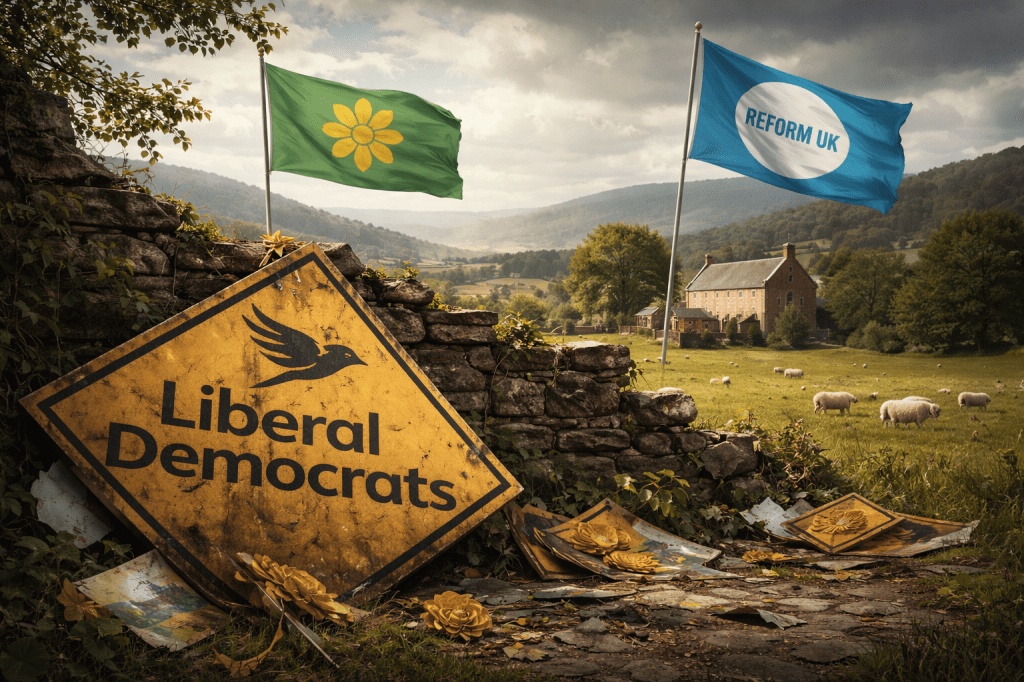
For more than a century, Liberalism in Wales was not merely a party label, it was the organising language of public life. It fused chapel morality, civic ambition, land reform, and a distinctly Welsh insistence on dignity into a durable political culture. (source 1) (source 2).
Its decline, therefore, is not simply an electoral story, it is a cultural one, a transformation in how Wales understands authority, community, and national worth. (source 3).
In 2026, this question is no longer academic. Polling and political analysis increasingly describe a realignment in which Welsh politics is consolidating into competing blocs, with Plaid Cymru and Reform UK frequently presented as the two dominant poles. (source 11) (source 12) (source 13).
If that frame holds, the contest for Wales’s political future is increasingly cast between a party carrying forward much of the ethical tradition of Liberal Wales, and a party that has learned to weaponise something closer to its insurgent tone.
To understand that irony, we must begin with what Welsh Liberalism actually was, and how its institutional presence steadily narrowed.
What Welsh Liberalism Was
Welsh Liberalism cannot be reduced to Victorian free trade or abstract moderation.
From the later nineteenth century it became a fused political temperament, Nonconformist in moral register, radical in its challenge to landed influence, and increasingly national in its insistence that Wales possessed distinct civic claims. (source 1) (source 2)
Nonconformity as civic infrastructure
From the 1860s to the early twentieth century, Liberal politics in Wales became closely associated with temperance, land reform, education reform, and disestablishment of the Church of England in Wales. (source 1). These causes were rooted in a chapel centred civic world in which preaching, literacy, debate, and voluntary organisation trained generations in self government. (source 2).
In Welsh terms, Liberalism became the public arm of a moral ecosystem.
The Welsh land question
Liberalism in Wales also drew power from rural grievance, particularly the Welsh land question and the sense that dignity and security should not be rationed by estate interest or inherited deference. (source 4).
It offered reform rather than rupture, but did so in defence of community against entrenched power.
Wales first, often within the Union
Welsh Liberalism was frequently Unionist in constitutional form, yet it cultivated an unmistakable Wales first sensibility. (source 1).
In debates over disestablishment and in movements such as Cymru Fydd, Liberal Wales developed the expectation that Wales should not be governed as a provincial afterthought. (source 1)
The Tradition in People
Welsh Liberalism was embodied in figures who made it credible.
David Lloyd George remains the most internationally recognised expression of the tradition, insurgent in rhetoric against entrenched power, yet reformist in ambition. (source 3). His daughter, Megan Lloyd George, the first woman elected as MP for a Welsh constituency, embodied both continuity and fracture, her later move to Labour reflecting the wider realignments of the twentieth century. (source 5)
In Mid Wales, the lineage was unusually continuous.
Lord Davies of Llandinam represented Montgomeryshire from 1906 to 1929, tying Welsh Liberalism to philanthropic and internationalist horizons. (source 6). Clement Davies, MP for Montgomeryshire from 1929 to 1962 and leader of the UK Liberal Party after the war, sustained Liberal Wales during national marginalisation. (source 7). Emlyn Hooson, elected in 1962, combined Welsh language commitment with a defence of Welsh national rights within Liberal politics. (source 8)
For much of the twentieth century, Montgomeryshire functioned as a living remnant of Liberal Wales.
Montgomeryshire, and the Shock of 2010
If one moment marks the psychological collapse of Liberal Wales in rural Mid Wales, it is 2010.
Lembit Öpik held Montgomeryshire from 1997 until his defeat in 2010.
In 2005 he secured 15,419 votes against 8,246 for the Conservative candidate, a majority of 7,173. (source 9). That was structural dominance, not a marginal hold.
In 2010, the seat fell. (source 10). A majority of over 7,000 was overturned in a single electoral cycle in a constituency that had returned Liberal or Liberal aligned MPs for most of the period since 1880. (source 10) (source 3)
It was a rupture, and its effect on Welsh Liberal Democrat morale and credibility was profound. The party has never regained Montgomeryshire at Westminster since that defeat. (source 10). When the constituency was abolished and replaced by Montgomeryshire and Glyndŵr in 2024, the Liberal Democrats placed fourth. (source 16)
From dominance in 2005, to defeat in 2010, to fourth place in 2024, the trajectory is stark.
Liberal Democrats in the Senedd, From Coalition Partner to Marginal Presence
The same contraction is visible in the Senedd.
At the first National Assembly election in 1999, the Welsh Liberal Democrats won six seats and entered coalition with Labour, participating directly in the early architecture of devolution. (source 17). In 2003 they again won six seats, and in 2007 five, remaining a credible parliamentary force. (source 18) (source 19).
By 2011, they were reduced to five seats, increasingly dependent on regional list representation. (source 20). In 2016, the collapse was dramatic, the party fell to a single Member. (source 21). In 2021, it returned just one Member again. (source 22)
From coalition partner in 1999, to marginal survival by 2021, the institutional narrowing is clear. This is not simply electoral fluctuation, it is the steady evaporation of parliamentary mass.
Why the Liberal Inheritance Did Not Move to Labour in 2026
One might assume that the ethical inheritance of Welsh Liberalism would consolidate behind Labour. Yet in 2026 that is not what polling suggests.
Analysis describes a period of incumbency fatigue affecting Welsh Labour after decades of governance. (source 11). The January 2026 YouGov poll placed Labour at just 10 percent on Senedd voting intention, a historically low figure. (source 12). This collapse has been linked in reporting to dissatisfaction with devolved governance and public service performance. (source 23)
The vacuum created by Labour’s decline has not been filled by moderation.
It has been filled by blocs with clarity of identity.
2026, Consolidation and Closed Lists
The 2026 Senedd election will be the first fought under the expanded 96 Member structure and a new closed proportional list system. (source 24) (source 25). Seats will be allocated using the D’Hondt formula. (source 26)
Closed lists encourage bloc consolidation and penalise fragmentation more sharply than the previous two vote system. (source 26). The contest becomes which party can aggregate the largest coherent vote share within multi member constituencies.
Recent analysis describes Welsh politics as undergoing consolidation rather than ideological conversion. (source 11). YouGov’s January 2026 poll placed Plaid Cymru in a clear lead, with Reform UK second and Labour sharply reduced. (source 12). A February 2026 poll reinforced the Plaid versus Reform frame. (source 13)
The Missing Centre, and the Survival of Pavement Liberalism
The Welsh Liberal Democrats are not extinct.
They retain a presence in local government, most notably in Powys County Council where they emerged as the largest party in 2022. (source 27). Council records confirm the continued existence of a Welsh Liberal Democrat group. (source 28)
This suggests that while national Liberalism has withered, a form of pavement Liberalism survives, the politics of casework, potholes, planning disputes, and local brokerage. It persists in Mid Wales even when it no longer scales into Senedd representation.
But under a closed list system that rewards large blocs, such localised survival does not automatically translate into renewed national influence.
The Split Inheritance
The rural independence of mind that once made Mid Wales a Liberal fortress has divided into two streams.
One is an ethical and cultural Liberalism, rooted in Welsh civic seriousness and national dignity, consolidating behind Plaid. (source 11). The other is an anti metropolitan protest Liberalism, distrustful of distant institutions and hungry for disruption, consolidating behind Reform. (source 12) (source 13)
Reform’s tone can echo the insurgent rhetoric once used by Lloyd George.
But Lloyd George’s insurgency was tethered to a chapel shaped reform tradition and civic uplift. Reform’s populism is shaped more by contemporary grievance politics than by Welsh civic institutional life.
Plaid, meanwhile, is increasingly functioning as the default progressive Welsh identifying choice for voters who see Labour as tired and the Liberal Democrats as organisationally thin. (source 11) (source 12)
Conclusion
Welsh Liberalism was a national civic culture, Nonconformist in tone, reformist in instinct, and conscious of Welsh worth. (source 1) (source 2)
Its decline reflects class realignment, the weakening of chapel infrastructure, migration of cultural leadership, and institutional contraction. (source 3)
Montgomeryshire shows the story in miniature, from Lord Davies and Clement Davies, through Hooson, through Öpik’s rise and fall, to fourth place in 2024. (source 6) (source 7) (source 8) (source 16)
Traditions do not die cleanly, they relocate. In 2026, Liberal Wales appears to have split, the ethical and cultural inheritance migrating toward Plaid, the protest inheritance toward Reform, while the Liberal Democrats endure chiefly in local government enclaves.
That is not the end of the tradition, but it is the end of the assumption that it still has a single, stable political home.
Footnotes and Sources
- Welsh Liberal Party overview: https://en.wikipedia.org/wiki/Welsh_Liberal_Party
- Open University, Wales 1880–1914 (PDF): https://www.open.edu/openlearn/pluginfile.php/59855/mod_oucontent/oucontent/369/6a0adbe5/73c20f54/wales1880_1914.pdf
- Russell Deacon, “The Slow Death of Liberal Wales 1906–1979”: https://liberalhistory.org.uk/wp-content/uploads/2015/06/49-Deacon-Slow-Death-of-Liberal-Wales-3.pdf
- D. W. Howell, Welsh Land Question (PDF): https://bahs.org.uk/AGHR/ARTICLES/61_1_5_howell.pdf
- Megan Lloyd George biography: https://en.wikipedia.org/wiki/Megan_Lloyd_George
- National Library of Wales, Lord Davies of Llandinam: https://www.library.wales/welshpoliticalarchive/lord-davies-of-llandinam
- Dictionary of Welsh Biography, Clement Davies: https://biography.wales/article/s2-DAVI-EDW-1884
- Dictionary of Welsh Biography, Emlyn Hooson: https://biography.wales/article/s8-HOOS-EML-1925
- UK Parliament API, Montgomeryshire 2005 result: https://api.parliament.uk/uk-general-elections/elections/24823
- UK Parliament election results, Montgomeryshire 2010: https://electionresults.parliament.uk/elections/2975
- Cardiff University, “Consolidation not conversion” (2025): https://blogs.cardiff.ac.uk/thinking-wales/consolidation-not-conversion-understanding-waless-ongoing-realignment/
- YouGov January 2026 Senedd poll: https://yougov.co.uk/politics/articles/53876-plaid-open-14-point-lead-over-reform-uk-in-yougov-january-2026-senedd-voting-intention
- Nation.Cymru Senedd poll report (Feb 2026): https://nation.cymru/news/plaid-cymru-holds-narrow-lead-over-reform-in-new-senedd-election-poll/
- PoliticsHome, Craig Williams support withdrawn: https://www.politicshome.com/news/article/conservative-party-withdraw-support-betting-scandal-candidates
- ITV News Wales, Craig Williams result coverage: https://www.itv.com/news/wales/2024-07-05/craig-williams-loses-montgomeryshire-and-glyndwr-seat-and-labour-gain
- Powys County Council, Montgomeryshire and Glyndŵr result 2024: https://en.powys.gov.uk/article/16662/Parliamentary-Election-Results-for-Montgomeryshire-and-Glyndwr-Constituency—4th-July-2024
- 1999 National Assembly for Wales election: https://en.wikipedia.org/wiki/1999_National_Assembly_for_Wales_election
- 2003 National Assembly election: https://en.wikipedia.org/wiki/2003_National_Assembly_for_Wales_election
- 2007 National Assembly election: https://en.wikipedia.org/wiki/2007_National_Assembly_for_Wales_election
- 2011 National Assembly election: https://en.wikipedia.org/wiki/2011_National_Assembly_for_Wales_election
- 2016 National Assembly election: https://en.wikipedia.org/wiki/2016_National_Assembly_for_Wales_election
- 2021 Senedd election: https://en.wikipedia.org/wiki/2021_Senedd_election
- The Guardian, reporting on Welsh Labour polling decline (Feb 2026): https://www.theguardian.com/politics/2026/feb/01/wales-independence-plaid-cymru-green-coalition-reform-cardiff-caerphilly-byelection
- Senedd Cymru, election changes overview: https://senedd.wales/how-we-work/our-role/senedd-election-and-member-changes/
- Senedd blog, closed list system explainer: https://senedd.wales/senedd-now/senedd-blog/how-will-the-new-voting-system-work-at-the-next-senedd-election/
- Senedd blog, D’Hondt formula explainer: https://senedd.wales/senedd-now/senedd-blog/senedd-election-2026-what-is-the-d-hondt-formula-and-how-does-it-work/
- 2022 Powys County Council election results: https://en.wikipedia.org/wiki/2022_Powys_County_Council_election
- Powys County Council councillors by party: https://powys.moderngov.co.uk/mgMemberIndex.aspx?FN=PARTY&PIC=1&VW=TABLE

One response to “The Decline of Liberalism in Wales, and the Fracturing of Its Inheritance”
[…] (source 1) Antony David Davies, “The Decline of Liberalism in Wales, and the Fracturing of Its Inheritance” https://antonydavies.uk/2026/02/23/the-decline-of-liberalism-in-wales-and-the-fracturing-of-its-i… […]
LikeLike