
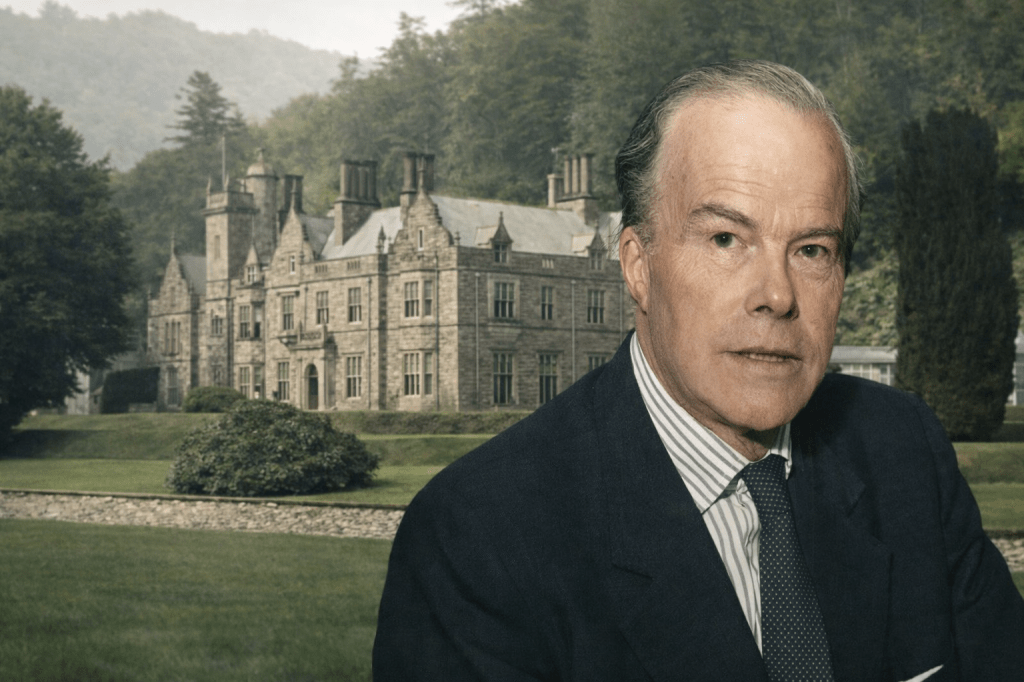
Land, Service, Unionism, and the Passing of a Governing Tradition in Mid-Wales
James David Gibson-Watt, later Baron Gibson-Watt, occupies a distinctive position in the political and social history of twentieth-century Wales. He was not merely a Conservative politician associated with Radnorshire, but a representative of a governing culture rooted in landownership, military service, and paternal stewardship, a tradition that shaped rural Wales long before devolution reshaped its constitutional imagination.
To understand Gibson-Watt is to view him not as a mere partisan, but as a vestige of an older constitutional settlement, one in which authority derived from continuity, service, and responsibility rather than political assertion.
Doldowlod and the Estate Tradition of the Marches
Born on 11 September 1918, the son of James Miller Gibson-Watt of Doldowlod Hall, near Llandrindod Wells, he inherited both estate and expectation. Doldowlod formed part of the long continuity of landed authority in Radnorshire, representing the improvement ethos of nineteenth-century rural Britain carried forward into the modern age (source 1).
The estate belonged culturally to the Welsh Marches, a borderland where identity historically operated as overlap rather than division. Allegiance was local and British simultaneously, and the Anglo-Welsh frontier functioned less as a boundary than as a zone of shared governance and economic life. It was precisely this Marcher understanding of Britain, porous, integrated, and administratively unified, that later constitutional devolution would begin to formalise and harden into institutional distinction.
Personal memory intersects directly with this historical landscape. Between 1995 and 1997, my father served as gardener at Doldowlod, during which period I came to know Lord Gibson-Watt personally. My recollection is notable for its absence of overt politics. Despite his long parliamentary career, conversation rarely turned toward party matters. His evident enthusiasm lay instead in forestry, estate management, and rural affairs, interests entirely consistent with his later public service in agricultural and forestry governance (source 2).
He appeared, above all, a countryman rather than a political campaigner.
War Service and the Continuum of Duty
If land supplied inherited standing, war supplied earned legitimacy. Commissioned into the Welsh Guards in 1939, Gibson-Watt served with exceptional distinction in North Africa and Italy. During fighting in Tunisia in 1943 he continued commanding his company despite serious wounds, earning the Military Cross, later supplemented by two Bars for further gallantry during the Italian campaign, an extraordinarily rare distinction (source 1).
For men of his class and generation, military command, estate stewardship, and parliamentary service were not separate careers but successive expressions of a single obligation. The transition from officer, to landowner, to Member of Parliament represented a continuous line of duty to Crown, country, and locality.
Such decoration shaped how contemporaries understood him. Authority rested not on rhetoric but on demonstrated courage. Obituaries consistently recalled physical bravery, directness, and personal fearlessness as defining traits throughout his political life (source 3).
A Marcher Conservative at Westminster
After unsuccessful contests in Brecon and Radnor, Gibson-Watt entered Parliament as Conservative MP for Hereford in 1956, retaining the seat until 1974 (source 1).
His career illustrates a specifically Marcher political identity. Though representing an English constituency, he lived in Radnorshire and remained socially embedded in Mid-Wales. The border in his political imagination was administrative rather than national. Governance flowed across it naturally.
The later devolution settlement he opposed sought, in effect, to institutionalise distinctions that figures such as Gibson-Watt had spent their lives treating as secondary to British unity.
Within government he served as a whip and later as Minister of State at the Welsh Office from 1970 to 1974 under Edward Heath (source 4). The Welsh Office embodied Westminster’s preferred response to Welsh pressures, administrative recognition without constitutional separation.
Unionism at Home, Politics at the Table
While Lord Gibson-Watt himself seldom discussed politics socially, Lady Diana Gibson-Watt possessed unmistakable political conviction.
My memories include animated conversations in which she robustly challenged contemporary political thinking. Her outlook was firmly Unionist. National distinctions, English or Welsh, held little constitutional meaning in her view. I recall clearly being told:
“You should thank God you’re British.”
The remark captures an outlook widespread among Britain’s post-war governing class, British identity understood as the stabilising constitutional framework within which regional cultures comfortably existed.
A revealing domestic episode occurred during the 1997 General Election. My father, politically a Montgomeryshire Liberal, rather innocently permitted the Liberal Democrats to erect an election sign in our garden at Doldowlod. Lady Gibson-Watt was distinctly unimpressed. The sign did not survive the afternoon.
The moment, gently comic in retrospect, illustrates how political allegiance within estate society retained something approaching institutional loyalty even as the wider political culture was changing rapidly beyond its boundaries.
The 1979 Referendum and the Power of Administrative Unionism
Gibson-Watt’s most historically consequential role came as chairman of the “No Assembly” campaign during the 1979 Welsh devolution referendum (source 1).
The scale of that victory is often forgotten. Devolution was rejected by nearly four to one, with only around 20 per cent of Welsh voters supporting the creation of an Assembly. The result represented not merely electoral defeat for constitutional reform, but the overwhelming endorsement of the administrative Unionism Gibson-Watt represented.
His opposition rested on two interconnected fears. First was the belief that an Assembly would introduce unnecessary bureaucracy, distancing rural communities from effective government. Second was a deeper concern that institutional nationalism would weaken the integrated British political system that, in his view, had secured Welsh stability and economic development.
Campaign rhetoric associated with the movement framed devolution as duplication without benefit, constitutional experimentation driven more by sentiment than necessity. For Gibson-Watt, Wales required responsive governance within Britain, not constitutional separation from it.
In 1979, that argument prevailed decisively.
Forestry, Agriculture, and the Administrative State
Following his elevation to the peerage in 1979 as Baron Gibson-Watt of the Wye, his public work increasingly centred on rural governance rather than parliamentary politics (source 2).
He served as:
- Forestry Commissioner, 1976–1986
- President of the Royal Welsh Agricultural Society
- Chairman of the Council on Tribunals
- Member of the Historic Buildings Council for Wales
(source 2)
These roles reveal the essential nature of his career. He belonged to the governing architecture of the late British administrative state, committees, commissions, and advisory bodies staffed by figures assumed to possess experience, judgement, and social responsibility rather than ideological zeal.
Forestry remained a lifelong interest, entirely consistent with personal recollections from Doldowlod during his later years.
1997 and the Closing of a Constitutional Circle
There is an unavoidable historical symmetry in the fact that while my father worked at Doldowlod between 1995 and 1997, the constitutional settlement Gibson-Watt had spent much of his political life defending was approaching its end.
The 1997 Welsh devolution referendum, held only months after that election campaign episode in the estate garden, narrowly approved the creation of the National Assembly for Wales. The vote effectively dismantled the administrative Unionist model that Gibson-Watt had helped defend so decisively in 1979.
The world of Marcher paternal governance, estate influence, and Westminster-centred Welsh administration yielded to democratic Welsh institutional nationhood.
Character and Historical Meaning
Contemporaries described Gibson-Watt as honest, courageous, and unfashionably principled, a man more comfortable among trees and livestock than ideological debate (source 3).
Historically, he represents a transitional generation:
- landowners shaped by stewardship rather than nationalism,
- soldiers whose authority derived from service,
- Unionists convinced Britain functioned best through integration rather than differentiation.
By the time of his death in 2002, Wales had moved decisively beyond the political assumptions that formed him.
Yet memory complicates abstraction. At Doldowlod in the 1990s one encountered not a constitutional combatant but a country gentleman absorbed by forestry and land, while political conviction survived most vividly in drawing-room conversation.
Lord Gibson-Watt therefore stands as one of the last representatives of a governing order in which land, service, and British identity formed a continuous moral obligation, an order whose quiet passing was confirmed, almost symbolically, during the very years his estate still formed part of everyday life.
Footnotes
(1) Dictionary of Welsh Biography, GIBSON-WATT, James David (1918–2002)
https://biography.wales/article/s6-GIBS-DAV-1918
(2) Wikipedia, David Gibson-Watt, Baron Gibson-Watt
https://en.wikipedia.org/wiki/David_Gibson-Watt%2C_Baron_Gibson-Watt
(3) The Guardian, Obituary: Lord Gibson-Watt
https://www.theguardian.com/news/2002/apr/04/guardianobituaries.obituaries
(4) UK Parliament Historical Biography
https://api.parliament.uk/historic-hansard/people/mr-david-gibson-watt/index.html
