
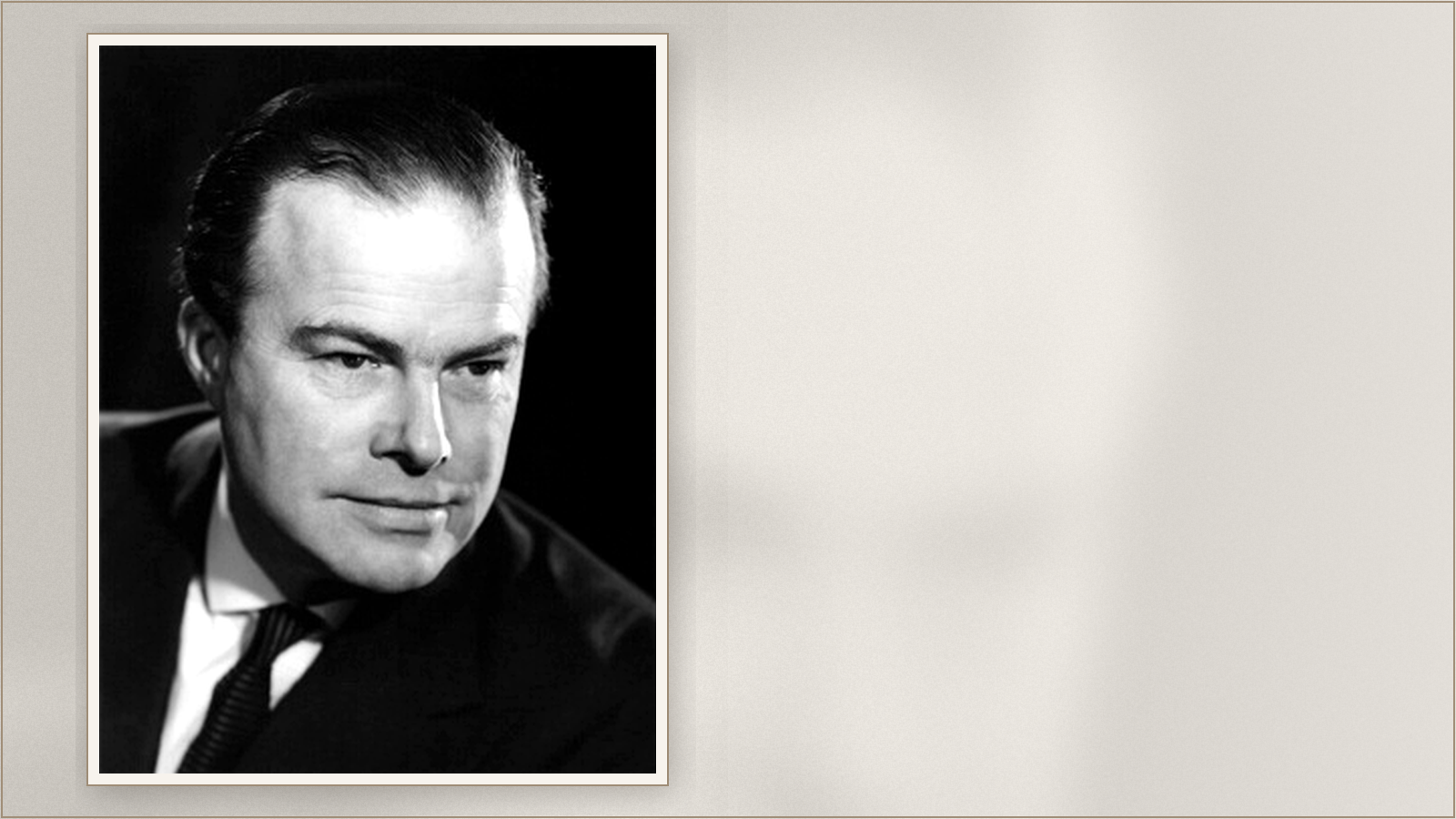
Some political lives belong so completely to their period that they become difficult to understand once that period has passed. James David Gibson-Watt, later Baron Gibson-Watt of the Wye, was one such figure. A decorated Welsh Guards officer, landowner, farmer, forester, county councillor, Conservative Member of Parliament and Welsh Office minister, he belonged to a governing tradition in which private inheritance and public duty were expected to sustain one another.
It was a world rooted in land, military service and local standing. Authority rested less upon public self-promotion than upon an assumption of responsibility, sometimes paternalistic, often socially exclusive, but not necessarily insincere. Gibson-Watt represented that tradition at Westminster and, perhaps even more clearly, at Doldowlod, his family home in the upper Wye valley.
His life also intersected with a much larger constitutional argument. He served in the Welsh Office while opposing political devolution, helped shape Conservative thinking on Welsh government before 1970, and later led the successful No Assembly campaign in 1979. He lived long enough to see Wales vote, by the narrowest of margins, for an elected Assembly in 1997. When he spoke in the House of Lords the following year, he did so as a surviving representative of an older Welsh settlement, one in which Welsh affairs were administered through Westminster, the Welsh Office and a network of public bodies, rather than through a legislature in Cardiff.
Yet the public figure and the private man were not quite the same. My own memories of Lord Gibson-Watt date from the 1990s, when my father worked as gardener at Doldowlod. I remember little political conversation with him. What interested him most visibly was the estate itself, its trees, forestry, farming and the practical management of land. By then, he seemed less like a former minister than the countryman he had always been beneath the politics.
Doldowlod and the inheritance of James Watt
David Gibson-Watt was born on 11 September 1918, the son of James Miller Gibson-Watt and Marjorie Adela Ricardo. His father died in 1929, when David was still a boy. He was educated at Eton and later studied history at Trinity College, Cambridge, although the outbreak of war intervened before the settled life of estate and public service could properly begin.
Doldowlod had entered the family story through James Watt, the engineer whose improvements to the steam engine became fundamental to Britain’s industrial transformation. Watt acquired land beside the Wye at the beginning of the nineteenth century. The purchase was followed by the gradual enlargement of the estate, with further farms, woodlands and agricultural land added by Watt and his descendants.
The house itself was principally developed by Watt’s son, James Watt junior, who used Doldowlod as a rural retreat from his business and intellectual life in Birmingham. Later generations enlarged and altered it further. By the time of David Gibson-Watt’s birth, Doldowlod was not simply a country house but the centre of a substantial landed inheritance connecting the industrial wealth of the Midlands with the rural society of Radnorshire.
That origin matters. Doldowlod was not the ancient seat of a medieval Welsh dynasty. Its landed standing grew from the wealth and aspirations of the Industrial Revolution. Yet, over several generations, the family became embedded in the political, agricultural and social life of the county. This was a familiar process in nineteenth-century Wales. Commercial and industrial fortunes were translated into land, land into local influence, and local influence into public office.
Gibson-Watt inherited not only the estate but also part of the documentary and material legacy of James Watt. The family papers, books and objects associated with Watt remained at Doldowlod for generations. David took that custodial responsibility seriously. He assisted scholars who wished to consult the archive, and in 1994 a substantial body of Watt manuscripts was transferred to Birmingham Central Library. Further material descended through the family at Doldowlod until after his death, when additional papers and books were acquired for public collections. In that sense, Gibson-Watt was one of the last private custodians of a documentary inheritance that belonged not only to his family but to the history of the Industrial Revolution.
Doldowlod stood in a part of Wales where identities rarely fitted into convenient categories. The upper Wye valley looked towards Radnorshire, Breconshire, Herefordshire and the English Midlands at once. Families, markets and institutions crossed the border with little regard for later constitutional theories. Gibson-Watt’s political outlook grew from that world. He was Welsh by residence and public service, British by constitutional instinct, and profoundly attached to a locality whose life could not easily be separated from the wider Marches.
Twenty-one as war began
There is a striking symmetry between Gibson-Watt’s coming of age and the beginning of the Second World War. He reached his twenty-first birthday on 11 September 1939, only eight days after Britain declared war on Germany. Celebrations planned at Doldowlod were abandoned in the circumstances, and contemporary reports indicated that he expected to join his regiment within days.
The detail is more than anecdotal. It marks the abrupt end of one kind of life and the beginning of another. The young heir to an established estate entered adulthood at precisely the moment when the assumptions of his generation were being tested by war. The world of inheritance, family expectation and local responsibility remained, but it was immediately overlaid by military obligation.
The war also brought direct bereavement to the family. His younger brother, Martin Ricardo Gibson-Watt, served in the Royal Navy, was awarded the Distinguished Service Cross, and was killed on 19 December 1941 when HMS Kandahar struck a mine while attempting to assist HMS Neptune. He was only twenty-one. David’s own remarkable wartime survival therefore unfolded within a family already marked by the loss of a son on active service.
Three Military Crosses
The Second World War gave Gibson-Watt’s generation an experience of duty more severe than anything estate inheritance could provide. Commissioned into the Welsh Guards in October 1939, he served in North Africa and Italy, eventually attaining the rank of major.
His record was exceptional. During the assault on Hammam Lif in Tunisia in May 1943, he continued to command No. 4 Company of the 3rd Battalion, Welsh Guards, despite being wounded. His courage and leadership brought him the Military Cross.
A Bar followed after the fighting around Monte Cerasola, near Monte Cassino, where his conduct during a counterattack in February 1944 was again recognised. His second Bar belonged to the final Italian campaign, during operations connected with the crossing of the Po in April 1945. The distinction in chronology matters: the three awards were not compressed into a single period of fighting but reflected repeated recognition for gallantry over the course of two demanding campaigns.
To receive the Military Cross three times was a rare distinction and became central to his public reputation. The importance of this service should not be reduced to biography’s customary list of decorations. For men formed by his social background, military command reinforced an existing belief that privilege carried obligations. The ideal was not merely that a landowner should possess authority, but that he should prove himself capable of exercising it under danger.
Gibson-Watt’s later political reputation drew heavily upon that experience. Even those who considered him conventional or politically unimaginative generally accepted his courage and personal integrity. His directness at Westminster, sometimes admired and sometimes caricatured, belonged to the same character that had led soldiers under fire.
After leaving the Army in 1946, he returned to Doldowlod and entered local public life. The transition from major to farmer, county councillor and parliamentary candidate was not, in his world, a series of unrelated career changes. It was understood as a continuation of service by other means.
From Radnorshire to Hereford
Gibson-Watt was elected to Radnorshire County Council and became the Conservative candidate for Brecon and Radnor. He contested the constituency in both 1950 and 1951 against the Labour member, Tudor Watkins.
The first contest was complicated by the presence of an Independent Liberal candidate. In 1951 the election became a straight fight, but Watkins retained the seat. Gibson-Watt’s inability to win Brecon and Radnor is worth noting. Local standing and landed influence still mattered, but they no longer guaranteed political authority. Rural Wales had been changed by organised labour, Nonconformist Liberalism, agricultural politics and the growth of a more democratic political culture.
His opportunity came across the border. In February 1956 he was elected Conservative Member of Parliament for Hereford following the elevation of J. P. L. Thomas to the peerage. Gibson-Watt represented Hereford for the next eighteen years.
The arrangement suited the geography of his life. He was an English constituency MP whose home, agricultural interests and local identity remained firmly rooted in Mid Wales. To a later generation that combination might appear constitutionally awkward. To Gibson-Watt it was probably entirely natural. Herefordshire and Radnorshire were divided by a national boundary, but united by agriculture, family connections, trade and the culture of the Marches.
A maiden speech rooted in Mid Wales
His maiden speech in the House of Commons, delivered on 4 July 1956, is unusually revealing because it already contained many of the themes that would occupy him for the rest of his life. Speaking during debate on the Mid-Wales Investigation Report, he made clear that although he represented Hereford, his personal knowledge of the area under discussion was extensive. He had been born there, had spent most of his life there and knew many of the parishes concerned.
He spoke about rural depopulation, roads, electricity, agriculture and forestry. Forestry, in particular, was presented not simply as a matter of planting trees but as part of the economic future of upland communities. He argued that timber production could help create an indigenous rural industry, but insisted that it should develop in partnership with farming rather than at its expense. He was critical of policies that had allowed the Forestry Commission to become distrusted by agricultural interests.
The speech deserves attention because it provides a thread running through the whole of his career. His first substantial intervention in the Commons was concerned with Mid Wales and forestry. His maiden speech in the House of Lords, more than two decades later, would again centre upon forestry. In retirement, forestry remained one of the principal subjects that animated him at Doldowlod. What might otherwise appear as a collection of separate appointments was in fact a consistent preoccupation extending across almost half a century.
A small but humane social reform
One of the least remembered parts of Gibson-Watt’s parliamentary career also complicates any attempt to portray him as simply a traditionalist country Conservative. In the 1956–57 session he secured a place in the ballot for private members’ legislation and introduced the Legitimation (Re-registration of Birth) Bill.
Moving its second reading on 1 March 1957, St David’s Day, he described the measure as a modest piece of social legislation intended to remove an unnecessary stigma from children whose parents subsequently married. The existing arrangements could result in birth documentation that marked a child out as having been born illegitimate, even after legal legitimation. Gibson-Watt argued that the state should not perpetuate that distinction where it could reasonably be removed.
The episode is significant less because it transformed British society than because it reveals something of his political instincts. His conservatism could coexist with a paternal and sometimes genuinely humane desire to remove what he considered unnecessary social hardship. It was reform within the existing order rather than a challenge to that order, but reform nonetheless.
Whips, independence and Charollais cattle
Gibson-Watt moved steadily through the Conservative ranks. He became an assistant whip in 1957 and a government whip in 1959. The position brought him close to the machinery of government, but also restricted his freedom to speak. For a man with strong interests in agriculture and Welsh affairs, that constraint appears to have become increasingly uncomfortable.
He resigned from the whips’ office in November 1961. The Dictionary of Welsh Biography is clear that this should not be understood as an act of disloyalty to Harold Macmillan. Gibson-Watt wanted greater freedom to participate from the back benches and had even temporarily acted as Macmillan’s Parliamentary Private Secretary during Anthony Barber’s illness.
The dispute over proposed imports of Charollais cattle nevertheless helps explain the kind of independence he wanted to recover. Gibson-Watt bred Welsh Black cattle and was concerned both about animal disease and about the implications of introducing foreign breeds. In January 1962, soon after leaving the whips, he secured an adjournment debate on the danger of leptospirosis arising from the proposed imports. He joked that it was effectively his first proper speech for more than four years because service as a whip had kept him in what he called a “reserved occupation”.
It would be too simple to say that he resigned solely over Charollais cattle. The stronger interpretation is that the dispute exemplified the freedom he wanted, the ability to speak independently on subjects in which he believed he possessed practical expertise.
He subsequently served as Parliamentary Private Secretary to Chancellor Reginald Maudling. After the Conservatives entered opposition in 1964, he became a front-bench spokesman first on the Post Office and broadcasting and then on Welsh affairs. He also served on the BBC General Advisory Council.
Shaping Conservative policy for Wales
By the middle of the 1960s Gibson-Watt had become one of the Conservative Party’s principal spokesmen on Wales. Edward Heath appointed him to the Welsh brief in opposition, and he shadowed successive Secretaries of State, including Cledwyn Hughes and George Thomas. Contemporary observers regarded him as a serious candidate to become Secretary of State for Wales if the Conservatives returned to office.
More importantly, he was helping to shape Conservative thinking about the constitutional future of Wales before devolution became a referendum question. Internal Conservative policy work during the late 1960s moved towards strengthening Welsh administrative machinery while rejecting the creation of a Welsh Parliament. By 1969 Gibson-Watt’s view had prevailed within the relevant policy group. Wales might require distinctive administration, but not a separate elected legislature.
This pushes the story of his anti-devolution politics back by a decade. His chairmanship of the 1979 No campaign was not a late intervention by a retired politician. It was the public culmination of a constitutional position he had helped formulate while still a senior opposition spokesman.
He also occupied the Conservative front bench during some of the most difficult years in modern Welsh politics. Following the Aberfan disaster in 1966, he addressed the need to remove dangerous and unsightly tips and pressed questions about the responsibilities that should fall upon local authorities, nationalised industries and private owners. His response belonged to the broader problem facing Welsh politicians of the period: how far economic, industrial and environmental questions required specifically Welsh administrative answers.
In 1969 he accompanied Edward Heath to the Investiture of Prince Charles at Caernarfon. The occasion placed him at the centre of a carefully staged assertion of Welsh identity within the monarchy and the Union, at precisely the moment when Plaid Cymru, language protest and constitutional nationalism were challenging older assumptions about Wales’s place in Britain.
Governing Wales from Westminster
When Edward Heath formed a government in 1970, Gibson-Watt was appointed Minister of State at the Welsh Office under the Secretary of State, Peter Thomas. He remained there until 1974. His exclusion from the Cabinet itself caused some surprise, because several contemporaries had expected him to receive the senior post.
The Welsh Office had been created in 1964. It represented a significant recognition that Welsh affairs required their own administrative machinery, but it remained a department of the United Kingdom government, responsible to Westminster rather than to a separately elected Welsh institution.
This arrangement suited Gibson-Watt. He did not deny the existence of Welsh needs or the legitimacy of administering certain services on a specifically Welsh basis. Indeed, as a Welsh Office minister he participated directly in that process. What he rejected was the argument that administrative recognition should lead to constitutional autonomy.
The distinction is important. Gibson-Watt was not opposed to government for Wales. He was opposed to the development of a separate political centre from which Wales might govern itself. His preferred system combined a Secretary of State in the British Cabinet, a specialist department, local government and appointed public bodies. In his view, this gave Wales influence at the heart of the United Kingdom without creating a competing source of democratic authority in Cardiff.
His years at the Welsh Office coincided with economic difficulty and considerable change. The decline of traditional industry, the future of rural Wales, the Welsh language, road building, inward investment and regional development all demanded government attention. Gibson-Watt later defended the Heath administration’s Welsh record, pointing to its abolition of the proposed Mid-Wales Rural Development Board, the protection of the Senni and Dulais valleys from reservoir schemes, the creation of a Welsh-language advisory committee and the transfer of further educational responsibilities to the Welsh Office.
These were not the actions of a minister who believed Wales should be ignored. They belonged to a different understanding of how Wales should be governed.
The countryman in government
Agriculture and forestry were not political subjects that Gibson-Watt adopted for convenience. They were among the central interests of his life. At Doldowlod he bred Welsh Black cattle, and from 1962 to 1964 he chaired the Livestock Export Council. In 1964 he also organised a British agricultural exhibition in Moscow, an unusual international extension of interests more commonly associated with his work in rural Wales.
His specialist knowledge remained active even in ministerial office. During a Commons exchange in 1972 concerning the export prospects of native Welsh livestock breeds, he reminded Emlyn Hooson that he had formerly chaired the Livestock Export Council and noted that he had telephoned the president of the Welsh Black Cattle Society the previous evening to check the current position. It was a small incident, but revealing. He was not simply invoking an old agricultural credential. He remained connected to the breed societies and producers whose interests he claimed to understand.
After leaving the House of Commons he became a Forestry Commissioner, serving part-time from 1 October 1976 until 1986. He was President of the Royal Welsh Agricultural Society in 1976 and then served for many years as chairman of its council, remaining in that role until 1994. He also became involved with the Historic Buildings Council for Wales, Timber Growers UK and the Council on Tribunals, and was a Fellow of the Royal Agricultural Societies of both England and Wales.
The length of his service to the Royal Welsh Agricultural Society deserves particular emphasis. Almost two decades at the centre of one of rural Wales’s most important institutions amounted to another career in itself. It is better understood not as an ornamental retirement appointment but as a transfer of his public-service instinct away from Westminster and back into the agricultural world from which he had come.
He also continued to serve locally as a Justice of the Peace at Rhayader until retiring from the bench at the age of seventy. That long magistracy is easily overlooked beside ministerial office and a peerage, but it was entirely consistent with the older county tradition he represented. Local public service did not cease because national office had been attained.
These positions reveal much about the public culture to which he belonged. Twentieth-century Britain was governed not only through Parliament and the Civil Service, but through commissions, councils, agricultural societies, tribunals and advisory bodies. Their members were often selected because they were believed to possess experience, independence and standing within their fields.
The system could be narrow and socially self-reproducing. It gave considerable influence to people who had not been elected to exercise it. Yet it also depended upon a strong ethic of unpaid or modestly rewarded public service. Gibson-Watt’s long work in forestry, agriculture and administrative oversight cannot be dismissed simply as the occupation of a retired politician. It reflected genuine knowledge and a sustained commitment to rural affairs.
That is the man I remember from Doldowlod. Between 1995 and 1997 my father worked there as gardener, and I came to know something of the household and estate. Lord Gibson-Watt’s parliamentary career was already behind him, but his interest in trees and forestry remained immediate. He appeared at home in that landscape in a way that no account confined to ministerial office can quite convey.
Forestry as a lifelong philosophy
Gibson-Watt’s concern with forestry was not merely commercial or estate-based. In the House of Lords he repeatedly treated timber as a strategic national resource. During debate on the Wildlife and Countryside Bill in 1981, he complained that governments expected increased timber production while simultaneously placing additional restrictions upon those responsible for producing it. He argued that Britain would eventually have to take food and timber security more seriously as dependence upon other resources changed.
Whether every prediction proved correct is less important than the continuity of outlook. The young MP who had warned in 1956 that forestry policy must work with agriculture had become, twenty-five years later, a Forestry Commissioner and peer still arguing that land use, timber supply and rural economics had to be considered together.
That continuity gives additional meaning to my own memory of him among the woods at Doldowlod. By the 1990s, forestry was not an elderly man’s hobby. It was one of the subjects that had connected his first parliamentary speech, his later public appointments and his private management of the estate across almost his entire adult life.
Diana Gibson-Watt and the politics of the household
If Lord Gibson-Watt rarely introduced party politics into ordinary conversation, his wife, Diana, was less reticent. The daughter of the banker Sir Charles Hambro, she had married David Gibson-Watt on 10 January 1942 and shared the long public and private life of Doldowlod.
Their family life was not untouched by tragedy. Their eldest son, Jamie, born in 1943, died in October 1946 at only three years of age. By the time Gibson-Watt had returned permanently from the Army, the family had therefore endured both the death of his younger brother during the war and the loss of his own young son.
My memories of Lady Gibson-Watt are of a woman with firm opinions and an unmistakably Unionist understanding of the country. Welshness and Englishness could exist as cultural identities, but neither displaced the constitutional primacy of being British. On one occasion she told me:
“You should thank God you’re British.”
It was a striking remark, but one entirely consistent with the world in which she and her husband had been formed. Britishness was not regarded as one identity among several. It was the larger political inheritance within which Welsh, English and Scottish loyalties found their place.
A more comic expression of the same political certainty came during the 1997 general election. My father, whose political sympathies then lay with the Liberal tradition of Montgomeryshire, allowed a Liberal Democrat sign to be placed in our garden at Doldowlod. Lady Gibson-Watt was not pleased. The sign disappeared before the afternoon was over.
The incident was minor, but revealing. Election posters were not merely expressions of private choice within an estate community. They could be interpreted as visible challenges to the political allegiance of the house itself. Even in the 1990s, something survived of the older association between landownership, household and party loyalty.
The No Assembly campaign of 1979
Gibson-Watt’s most important intervention in Welsh constitutional history came after he had left the Commons. In 1979 he chaired the No Assembly campaign opposing the implementation of the Wales Act 1978.
The result was overwhelming. On a turnout of 58.3 per cent, 243,048 people voted in favour and 956,330 voted against. Only 20.3 per cent of valid votes supported the proposed Assembly, while 79.7 per cent opposed it. Every Welsh county returned a No majority. In Powys, the proposal was rejected by 81.5 per cent of those voting.
The outcome cannot be attributed to Gibson-Watt alone, as he himself later acknowledged. The Yes campaign suffered from internal Labour divisions, uncertainty about the proposed institution, hostility in parts of south-east Wales and widespread suspicion of another level of government. The political circumstances of 1979 were also very different from those that would prevail eighteen years later.
Nevertheless, Gibson-Watt was a fitting chairman for the campaign. He embodied the alternative constitutional settlement. Wales, in his understanding, already possessed a voice through its Members of Parliament, its Secretary of State, the Welsh Office and its representation within the government of the United Kingdom. An Assembly risked duplication, institutional conflict and the gradual weakening of Westminster’s authority.
The significant point is that this was not a position improvised for the referendum. A decade earlier he had already helped steer Conservative Welsh policy towards administrative recognition without legislative devolution. The 1979 campaign therefore represented the mature expression of a constitutional philosophy he had carried through opposition, ministerial office and retirement.
The 1979 result appeared to vindicate that view completely. Devolution had not merely been defeated, it seemed to have been removed from serious political consideration for a generation.
His elevation to the peerage was announced that year, and the letters patent dated 7 September 1979 created him Baron Gibson-Watt, of the Wye in the District of Radnor. The territorial designation was apt. It linked the peerage directly to the river and landscape around Doldowlod. He was introduced to the House of Lords in November, and, appropriately, his maiden speech there concerned forestry.
Why he left the Commons
Gibson-Watt did not contest the October 1974 general election. The standard biographical explanation emphasises an operation towards the end of the Heath government and the effect of health upon his decision to retire from the Commons.
One later obituary offered a further explanation, suggesting that he was also disappointed by the refusal of Secretary of State Peter Thomas to create a Cambrian Mountains National Park, a proposal that would have affected part of the Gibson-Watt estate. The claim is interesting but should be treated cautiously, because it is less securely documented than the medical explanation. It is safest to regard health as the principal established reason, while allowing that frustration over Welsh rural policy may also have contributed to his decision to leave parliamentary politics.
From rejection to acceptance
The constitutional question did not disappear. By the 1990s, the political conditions within Wales had altered. Conservative representation had declined sharply, the Welsh Office was increasingly criticised for its dependence upon appointed bodies, and support had grown for some form of democratic control over Welsh administration.
The 1997 referendum produced a result almost unimaginably different from that of 1979, although it was hardly decisive. On a turnout of just over 50 per cent, 559,419 voted Yes and 552,698 voted No. The Assembly was approved by a majority of only 6,721 votes.
Powys remained opposed, with 57.3 per cent voting No. The constitutional culture represented by Gibson-Watt had therefore not vanished. In much of rural and eastern Wales it remained powerful, even as Wales as a whole moved narrowly in another direction.
There is a personal symmetry in the timing. My father’s years at Doldowlod coincided with the final approach to the 1997 vote. The Liberal Democrat sign that disappeared from the garden belonged to the general election that brought Tony Blair’s government to power and cleared the way for the second referendum. Political change, which could seem remote within the daily routines of an estate, was gathering beyond its boundaries.
Yet it would be wrong to suggest that the referendum instantly swept away everything Gibson-Watt represented. The original National Assembly had no primary legislative or tax-raising powers. The Secretary of State for Wales remained in the Cabinet, and Westminster retained parliamentary sovereignty. What began in 1997 was not a complete constitutional revolution but a process whose ultimate extent was still uncertain.
His last word on devolution
Gibson-Watt returned to the subject in April 1998 during the House of Lords debate on the Government of Wales Bill. His speech deserves attention because it was more measured than the image of an unyielding anti-devolution campaigner might suggest.
He regretted the legislation and defended the record of the Welsh Office. He feared continuing disputes between the new Assembly and the Secretary of State over money and responsibilities. He also worried that dividing oversight of forestry among different administrations would damage an industry already under pressure.
He reminded the Lords that he had chaired the victorious No campaign in 1979. This time, however, he accepted the referendum result. Although he disliked much of the Bill, he said that he would not vote against it. The Assembly was going to be created and should be made to work for the benefit of Wales.
That response complicates any attempt to portray him simply as an embittered opponent of constitutional change. His instincts remained Unionist, but they were accompanied by an older respect for settled authority and constitutional procedure. He had lost the argument, narrowly but legitimately, and accepted that the new institution must be given the opportunity to succeed.
Character, reputation and public presence
Contemporaries remembered Gibson-Watt as a physically commanding figure. At around six feet four inches tall, with a strong voice and considerable presence, he was not easily overlooked in the House of Commons. Accounts of the Welsh Grand Committee describe Labour opponents attempting to shout him down, only for Gibson-Watt to continue above them in a voice capable of carrying across the chamber.
His reputation was equally marked by personal straightforwardness. Admirers saw honesty, decency and seriousness. Critics sometimes saw stiffness and convention. The Liberal broadcaster Robin Day could caricature him as a rather mechanical political figure, while those who worked with him tended to stress integrity rather than charisma.
That contrast is useful. Gibson-Watt was not a mass politician, and he never appears to have tried to become one. He belonged instead to an older culture in which authority was expected to derive from service, competence, standing and duty. By the later twentieth century, that style could look remote, even anachronistic, but it remained recognisable to those who encountered him.
There were lighter sides to his parliamentary life. He played for the Lords and Commons cricket team and acquired some reputation as a useful batsman. The detail is minor, but it adds something human to a career otherwise dominated by war, agriculture, constitutional politics and administration.
The end of a governing tradition
Diana Gibson-Watt died in August 2000. Lord Gibson-Watt died at Doldowlod on 7 February 2002, aged eighty-three. A private funeral was followed by a public memorial service at Holy Trinity Church in Llandrindod Wells on 27 April 2002.
Probate records placed the value of his estate at a little over £4.1 million. That figure should not be read as the value of Doldowlod alone, but it provides a final indication that the landed inheritance into which he had been born remained substantial at the end of his life.
By then, the Wales into which he had been born had changed profoundly. The social deference once surrounding the landed estate had weakened, the political influence of county families had declined, and Wales possessed its own elected national institution. The administrative Unionism that he had defended had not entirely disappeared, but it was no longer sufficient as a permanent answer to the question of Welsh government.
Gibson-Watt should not be romanticised. The governing tradition he represented rested upon inherited property, privileged education and access to institutions unavailable to most people. Nor should his opposition to devolution be treated as politically neutral. It reflected a particular understanding of Britain and a suspicion of Welsh institutional nationhood that many contemporaries rejected.
Yet he should not be reduced to a caricature of the reactionary landowner. His military record was one of extraordinary courage. His private member’s legislation showed that social conservatism did not exclude modest humanitarian reform. His knowledge of farming and forestry was real. His public service continued long after the prospect of political advancement had ended. His custodianship of the Watt papers connected the estate to a larger historical inheritance, and even in defeat over devolution he showed a willingness to accept the constitutional decision and work within the new settlement.
Most importantly, he was not merely a survivor of administrative Unionism. He had helped formulate it. The distinction between recognising Wales administratively and empowering it constitutionally ran through his political life from the 1960s to the creation of the Assembly. That makes him an especially revealing figure in the history of twentieth-century Welsh Conservatism.
My own recollection remains less dramatic. At Doldowlod, in the closing years of his life, the former minister and referendum campaigner appeared chiefly as an elderly countryman concerned with trees, land and the continuity of the estate. Politics was more readily encountered in Lady Gibson-Watt’s conversation, or in the rapid disappearance of an ill-judged Liberal Democrat poster.
That contrast between public history and private memory is precisely what makes David Gibson-Watt worth remembering. He stood at the end of a governing culture that joined estate, regiment, county and Parliament into a single conception of duty. Its authority had been weakened by democracy, social change and Welsh political nationhood, but it had not been entirely without honour.
In him, the old order did not end with a dramatic collapse. It receded quietly, among the farms and woodlands of the upper Wye, as a different Wales came into being around it.
Further Reading: Doldowlod
The following essays examine other aspects of Doldowlod’s history, including the family, the working estate, its railway and personal recollections. Each may also be read independently.
Related Essays
- Diana Hambro, Lady Gibson-Watt: A Life at Doldowlod
- Doldowlod Hall: Industry, Landscape and the Making of a Radnorshire Estate
- Doldowlod Hall Estate: My Teenage Years, 1995–1997
- David Davies, 1st Baron Davies of Llandinam (1880–1944): Wealth, Duty and the Search for an Enforceable Peace
- Arthur Charles Humphreys-Owen (1836–1905): Land, Liberalism and Public Duty in Victorian Montgomeryshire
- Clement Davies (1884–1962): Liberal Leader and MP for Montgomeryshire
Explore more Welsh history
Browse more research in Essays and Notable People of Mid Wales.
Sources and Further Reading
- David Lewis Jones, “Gibson-Watt, James David, Baron Gibson-Watt, 1918–2002”, Dictionary of Welsh Biography.
- UK Parliament, historic Hansard, including debates of 4 July 1956, 1 March 1957, 30 January 1962, 18 December 1972, 26 March 1980, 12 March 1981 and 21 April 1998.
- House of Commons Library, Results of Devolution Referendums, 1979 and 1997.
- Andrew Roth, “Lord Gibson-Watt”, The Guardian, 4 April 2002.
- The Independent, obituary of Lord Gibson-Watt, 2002.
- Institute of Welsh Affairs, material on Conservative constitutional policy and Welsh devolution.
- Friends of the National Libraries, provenance record for the James Watt papers acquired from family descent at Doldowlod.
- University and Library of Birmingham collections and exhibition material relating to James Watt and the Doldowlod archive.
- The Radnorshire Society, “James Watt, Father and Son”.