
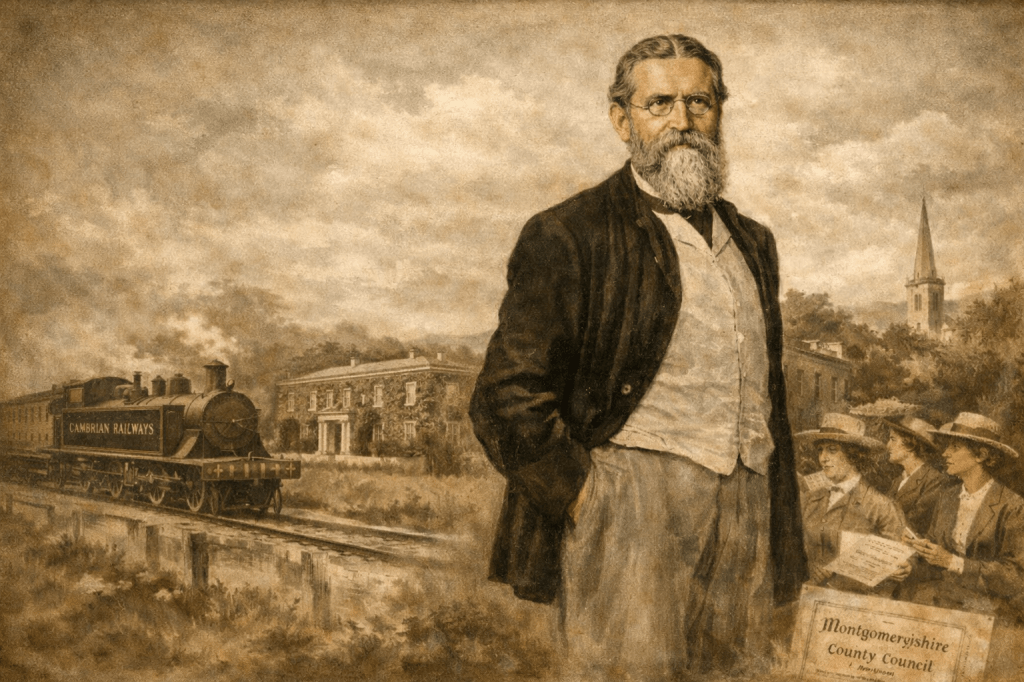
In the political and civic history of Montgomeryshire during the late nineteenth century, Arthur Charles Humphreys‑Owen stands as a representative figure of a transitional generation. Born into the professional middle ranks of Victorian society but elevated through inheritance into the ranks of the county gentry, Humphreys-Owen embodied the gradual adaptation of the traditional landowning class to the expanding democratic and institutional structures of modern Wales.
His career encompassed several spheres of public life, including the law, railway administration, local government, education, and parliamentary politics. Through these activities he contributed to the civic development of Montgomeryshire at a moment when Welsh society was undergoing profound transformation. The rise of Nonconformist political culture, the expansion of educational institutions, and the growing demands for representative government were reshaping the structures of Welsh public life. Humphreys-Owen navigated these changes not as a radical reformer but as a moderate Liberal country gentleman, whose leadership reflected the evolving relationship between traditional authority and modern civic responsibility.
Early Life and Family Background
Arthur Charles Humphreys was born on 9 November 1836 at Garthmyl in Montgomeryshire, the son of Erskine Humphreys, a barrister of Lincoln’s Inn (source 1). The Humphreys family belonged to the professional classes rather than the hereditary landed aristocracy, yet they were well integrated into the social and legal networks of Victorian Britain.
Humphreys’ social position changed decisively in 1876, when he inherited the estates of the Owen family of Glansevern through the maternal line. As a condition of the inheritance he adopted the additional surname Owen, thereafter becoming Arthur Charles Humphreys-Owen (source 1).
The inheritance included Glansevern Hall, a substantial estate situated near Berriew in the fertile Severn valley. The property extended to nearly 8,000 acres, making Humphreys-Owen one of the principal landowners in Montgomeryshire (source 2).
In Victorian Wales such estates were not merely economic assets. They formed the basis of local leadership, and their proprietors were expected to contribute to county administration, public institutions, and agricultural development. Humphreys-Owen would spend the remainder of his life fulfilling these responsibilities.
Education and Legal Formation
Humphreys-Owen received the education typical of the Victorian governing classes. He attended Harrow School, one of Britain’s leading public schools, before proceeding to Trinity College, Cambridge, where he graduated in 1860 (source 1).
Following his university education he pursued a legal career and was called to the Bar at Lincoln’s Inn in 1863 (source 1). Although his formal training lay in the law, Humphreys-Owen’s professional life soon came to be dominated by the duties associated with estate management and public service within his native county.
The County Gentry and Public Service
The inheritance of Glansevern placed Humphreys-Owen firmly within the ranks of the Montgomeryshire gentry. As with many Victorian landowners, this position carried expectations of public duty. He served as a Justice of the Peace and later as a Deputy Lieutenant of Montgomeryshire, offices traditionally associated with the leadership of county society (source 1).
The late nineteenth century also witnessed the creation of modern structures of local government. Following the Local Government Act 1888, elected county councils replaced the earlier administrative system dominated by magistrates.
Within this new framework Humphreys-Owen became actively involved in local administration and eventually served as chairman of Montgomeryshire County Council, helping guide the county through the early decades of modern local government (source 2).
Railways and Economic Development
The economic development of rural Wales during the nineteenth century depended heavily upon the expansion of railway infrastructure. Humphreys-Owen became closely associated with the Cambrian Railways, the principal railway system serving mid-Wales.
The Cambrian network linked towns such as Machynlleth, Newtown, and Aberystwyth with the English railway system centred on Oswestry.
Humphreys-Owen served as chairman of the Cambrian Railways Company from 1900 until his death in 1905 (source 3). In this capacity he oversaw a network that played a vital role in the economic life of mid-Wales, allowing agricultural produce and livestock from upland farming communities to reach wider British markets.
Railways also facilitated the development of coastal tourism and strengthened commercial links between rural Wales and the industrial centres of Britain.
Education and the Advancement of Welsh Institutions
Perhaps Humphreys-Owen’s most enduring contribution lay in the field of education. He played a prominent role in the development of the modern Welsh educational system following the Welsh Intermediate Education Act of 1889.
From 1896 until 1905 he served as chairman of the Central Welsh Board for Intermediate Education, the body responsible for overseeing the network of intermediate schools created by the Act (source 1).
The Board represented an important stage in the emergence of a coordinated national system of secondary education in Wales. Its work helped expand educational opportunity beyond the elementary level and contributed to the intellectual and cultural development of Welsh society.
Humphreys-Owen also supported the newly established University of Wales, reflecting his commitment to the advancement of higher education within Wales (source 1).
Parliamentary Career
Humphreys-Owen entered parliamentary politics relatively late in life. In 1894 he was elected Liberal Member of Parliament for Montgomeryshire following the elevation of Stuart Rendel to the House of Lords (source 4).
The by-election was closely contested. Humphreys-Owen secured victory by a majority of 225 votes, a significantly narrower margin than Rendel had previously enjoyed (source 2).
He served as MP for Montgomeryshire from 1894 until his death in 1905 (source 1). During these years Welsh Liberal politics was undergoing a generational transformation. A younger cohort of politicians, most notably David Lloyd George, was advancing a more assertive programme of reform.
Humphreys-Owen represented an earlier tradition of Liberal leadership rooted in county society and moderate reform rather than populist political mobilisation.
The Education Act Crisis of 1902
One of the most contentious political controversies of Humphreys-Owen’s parliamentary career arose from the Education Act 1902.
The Act reorganised educational administration but provoked intense opposition across Wales. Many Nonconformists objected strongly to the requirement that local rates should support Anglican voluntary schools.
Humphreys-Owen himself acknowledged the complexity of his position during parliamentary debates, observing that he would be involved in implementing the legislation both as a member of a county council and as a manager of a voluntary school (source 5).
His remarks reveal the delicate balancing act faced by Liberal landowners in predominantly Nonconformist Wales. While personally connected to the Anglican educational system, he also represented a constituency whose religious culture was largely Nonconformist.
Marriage and Family
In 1874 Humphreys married Maria Russell, the daughter of a Queen’s Counsel (source 2). Maria Humphreys-Owen herself took an active interest in educational and civic work, reflecting the growing participation of women in Liberal social reform movements during the late Victorian period.
The Glansevern household thus became a centre of local civic engagement, linking traditional landowning leadership with the emerging reformist culture of Liberal Wales.
Death and Legacy
Arthur Charles Humphreys-Owen died on 9 December 1905, aged sixty-nine (source 1).
His career spanned a crucial period in Welsh history. Born into a society still dominated by traditional landed authority, he lived to see the emergence of modern democratic institutions, national educational structures, and a more politically self-conscious Wales.
Through his work in local government, railway administration, educational reform, and parliamentary politics, Humphreys-Owen helped shape the civic landscape of Montgomeryshire during this transitional era.
Conclusion
Arthur Charles Humphreys-Owen represents a generation of Welsh public figures who bridged two political worlds. Rooted in the traditions of the Victorian county gentry, he nevertheless played an important role in the development of modern Welsh institutions.
His career demonstrates how members of the traditional elite adapted to the expanding civic life of Wales while continuing to exercise influence within their communities.
In the rural landscape of Montgomeryshire, where estates, chapels, and farming communities formed the fabric of society, Humphreys-Owen stood as a figure whose life reflected the gradual transformation of Welsh public life in the late nineteenth and early twentieth centuries.
Footnotes
- Dictionary of Welsh Biography, “Humphreys-Owen, Arthur Charles (1836–1905)”.
- F. W. S. Craig, British Parliamentary Election Results 1885–1918.
- Cambrian Railways Company historical records and director lists.
- UK Parliamentary Archives, Montgomeryshire By-Election (1894).
- Hansard, Education (England and Wales) Bill debates, 1902.
