
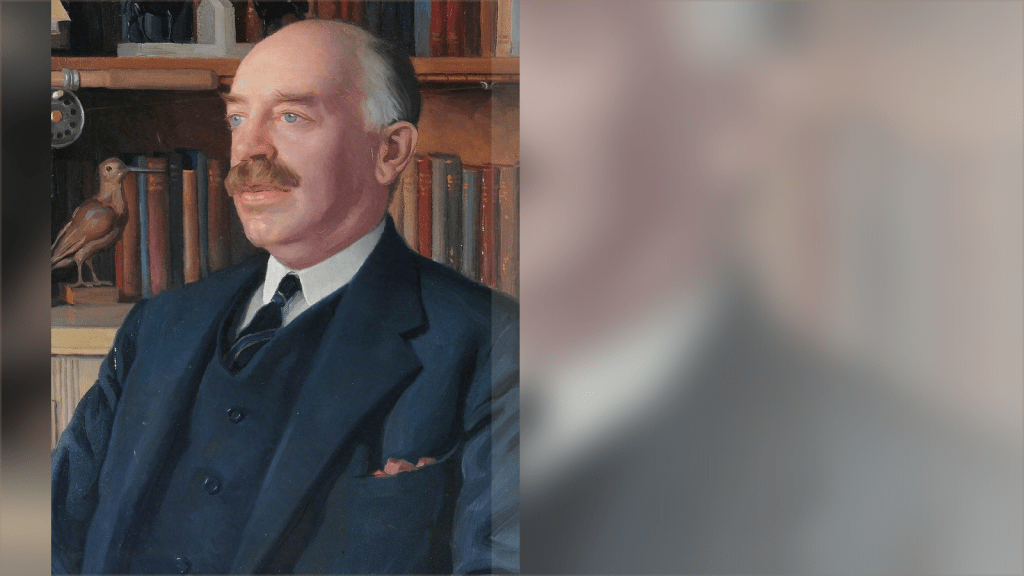
The Inheritance of Duty and the Pursuit of Peace
Few figures in modern Welsh public life better illustrate the moral tension between inherited wealth and public obligation than David Davies, 1st Baron Davies of Llandinam. Born into one of the most powerful industrial families in Wales, he belonged to a generation that inherited the material rewards of the Victorian age while confronting the political, social, and international crises of the twentieth century. If his grandfather, David Davies of Llandinam, the celebrated “Top Sawyer”, had helped to build the industrial infrastructure of modern Wales through coal, railways, and commercial ambition, the younger David Davies devoted his life to causes of a very different kind, public health, rural improvement, youth welfare, and above all the cause of international peace.
His career cannot be understood simply as that of a wealthy philanthropist or an eccentric idealist. Rather, it was shaped by the particular moral culture from which he emerged, that of Welsh Liberalism, Nonconformist seriousness, and a deeply rooted belief that privilege carried responsibilities which had to be discharged in service to others. His life reveals the meeting point of family wealth, religious duty, Montgomeryshire paternalism, and a sincere, sometimes intensely driven, effort to prevent the recurrence of war on a catastrophic scale. In that sense, he was both a product of his inheritance and a man determined to redirect it towards moral ends. (source 1) (source 2)
Family Background and the Burden of Inheritance
David Davies was born at Llandinam in May 1880, the only son of Edward Davies. His background placed him within the upper ranks of Welsh society, yet the character of that wealth mattered. This was not ancient aristocratic money, softened by centuries of landed continuity, but comparatively recent industrial wealth, acquired through the harsh and often dangerous world of coal, transport, and enterprise in industrial South Wales. When his father died in 1898, Davies inherited a vast fortune while still only eighteen years of age, becoming one of the wealthiest young men in Wales. (source 2) (source 5)
He received the education expected of a man of his standing, first at Merchiston Castle School in Edinburgh and later at King’s College, Cambridge. Yet his life was shaped by more than privilege alone. The Davies family was steeped in the moral disciplines of Welsh Calvinistic Methodism, and this religious background left a deep mark on his outlook. Wealth, in such a tradition, could not easily be regarded as a matter of personal indulgence. It carried obligations, and in Davies’s case those obligations became central to his public identity. He appears to have regarded his inheritance less as a reward than as a trust, something to be justified through service, reform, and practical action. (source 2) (source 6)
Montgomeryshire, Liberalism, and Local Authority
Although his later reputation rests largely on his internationalism, the foundations of his public life were laid in Montgomeryshire. In 1906, at the age of twenty six, he entered Parliament as Liberal member for Montgomery Boroughs, and significantly he did so without opposition. This reflected not only his own standing but also the extraordinary local influence of the Davies family. By the years immediately before the First World War, political opponents complained of what they described as “the cult of David Davies-ism”, a phrase which, though hostile, captured the unusual extent of his local authority. (source 5)
Yet Davies was never a conventional parliamentarian. He did not thrive in the atmosphere of Westminster, nor was he especially suited to party manoeuvre or routine debate. His instincts were shaped less by parliamentary performance than by a paternal, interventionist form of county leadership, rooted in landownership, local improvement, and a belief that public life should have moral purpose. He was capable of disregarding party expectations when questions of conscience were involved, including on matters such as Irish Home Rule. In this respect, he resembled an older tradition of Welsh Liberal paternalism, in which local duty and moral independence mattered more than strict party discipline. (source 5)
His real energies were often directed towards practical improvement at home. He invested in agricultural development on the Plas Dinam estate and played an important part in the movement which led to the establishment of what became the Royal Welsh Agricultural Society in 1904. These efforts reflected a wider recognition that Welsh rural life, if it were to remain viable, required renewal, organisation, and modern methods. Later, in 1922, he founded the Boys and Girls Clubs of Wales, demonstrating again that his public commitments were not confined to high politics but extended to the welfare and development of younger generations in Welsh society. (source 2) (source 3) (source 6)
Public Health and the Campaign Against Tuberculosis
Long before his name became associated with international peace, Davies had already committed himself to one of the most urgent domestic causes of the age, the fight against tuberculosis. In Edwardian Wales, tuberculosis was a devastating social and public health crisis, affecting communities across class lines but bearing particularly heavily upon those whose labour underpinned industrial society. In 1910, Davies gave the immense sum of £150,000 to establish the King Edward VII Welsh National Memorial Association. This was one of the most remarkable acts of Welsh philanthropy in the period and reflected both his generosity and his preference for systematic action rather than symbolic benevolence. (source 1) (source 2)
The Association was not conceived merely as a charitable body in the narrow sense. Davies wanted an organised national campaign, supported by institutions, medical knowledge, and coordinated provision. Sanatoria, hospitals, and professional expertise were to form part of a larger machinery directed towards the prevention and treatment of disease. His family’s support for an academic chair at the Welsh National School of Medicine further demonstrated that this was a vision of reform grounded in structure, research, and permanence. Here one sees clearly an important feature of his public life, the belief that entrenched social problems required institutions capable of addressing them on a national scale. (source 2)
War and Disillusionment
The First World War transformed Davies profoundly. Like many men of his generation, he entered the conflict with a sense of patriotic duty, and he did not remain a distant observer. He raised and commanded the 14th Battalion of the Royal Welsh Fusiliers, thereby exposing himself directly to the realities of modern warfare. The experience left a deep impression upon him. The industrial power which had enriched his family’s world was now being turned towards destruction on an unprecedented scale, and for Davies the war appears to have sharpened a growing conviction that existing forms of international politics were dangerously inadequate. (source 1) (source 5)
In 1916 he became Parliamentary Private Secretary to David Lloyd George, but the experience of high politics in wartime did not reconcile him to Westminster. On the contrary, he was disillusioned by the atmosphere of intrigue and calculation which surrounded government. He withdrew from such circles and returned to the backbenches, increasingly convinced that the deeper problem lay not merely with individual politicians but with the structure of international relations itself. The war had demonstrated, in the starkest possible terms, the inability of traditional patriotism and national rivalry to secure civilised order. It is therefore unsurprising that his post-war life became increasingly devoted to the search for some more durable and rational foundation for peace. His later remark, “We are prepared to die for our country; but God forbid we should ever be willing to think for it”, captures well both his impatience with unreflective nationalism and his insistence that moral seriousness required intellectual courage. (source 3) (source 6)
Internationalism and the Architecture of Peace
After the war, Davies devoted himself with remarkable persistence to the cause of international organisation. If his grandfather had built railways, docks, and commercial systems, the younger Davies sought to build institutions which might restrain violence and preserve peace. In 1919, he and his sisters endowed the Woodrow Wilson Chair of International Politics at Aberystwyth, the first chair of its kind in the world. This was a gesture of major significance, not merely financially but intellectually. It suggested that peace must be studied, understood, and pursued through serious scholarship rather than treated as a vague aspiration. (source 1) (source 2)
He also gave strong support to the League of Nations Union, which established an impressive presence in Wales, with more than 600 branches by 1926. This reflected both the strength of Welsh civic idealism in the inter-war years and Davies’s own capacity to mobilise support for causes he believed to be morally urgent. Yet he was not naïve. He understood that international goodwill alone would not suffice. A League without effective power, in his view, could not guarantee security. It was from this conviction that his later support for collective security developed. In 1932 he founded the New Commonwealth Society, advocating an International Police Force and a world court endowed with real authority. These ideas were controversial, but they were not fanciful. They arose from a sober recognition that the modern world required enforceable institutions if it was to avoid recurring catastrophe. (source 4) (source 5) (source 6)
His writings, including The Problem of the Twentieth Century, set out these principles in sustained form and helped to articulate a vision of international order that outlived him. The same outlook found architectural expression in the Welsh National Temple of Peace and Health in Cardiff, a building which brought together his twin preoccupations, the prevention of war and the eradication of disease. It stands as one of the clearest monuments to his belief that moral purpose should be made institutional, visible, and enduring. (source 3) (source 4)
Final Years and Historical Significance
David Davies died in June 1944, only a few months before the end of the Second World War and before the establishment of the United Nations, whose framework in some respects reflected concerns he had long advanced. There is a certain poignancy in this timing. He did not live to see the full post-war settlement, yet much of his life had been devoted to anticipating precisely the need for stronger forms of international cooperation and collective security. Even in wartime, his sense of public duty remained rooted in practical sacrifice, as shown by his offer of Plas Dinam as a war hospital. (source 3) (source 5)
His life forms a striking contrast with that of his grandfather. The elder David Davies helped to build the economic machinery of industrial Wales, while the grandson sought to use the fruits of that achievement in the service of social healing and international peace. Both men were builders, but they worked in different spheres. One shaped the physical infrastructure of a changing nation, the other tried to shape the moral and institutional conditions necessary for civilisation to endure.
David Davies, 1st Baron Davies, should therefore be remembered not simply as a wealthy benefactor, nor merely as an idealist remote from practical realities. He was a serious and complex figure whose career reflected some of the defining tensions of modern Welsh history, wealth and duty, local power and international vision, patriotic service and disillusionment with nationalism, inheritance and moral purpose. In his life, the civic traditions of Montgomeryshire met the international crises of the twentieth century, and from that meeting emerged one of the most distinctive peace advocates Wales has produced.
Footnotes
- Wikipedia, “David Davies, 1st Baron Davies.”
- John Davies, “DAVIES, DAVID of Llandinam (1880–1944), first Baron Davies,” Dictionary of Welsh Biography.
- Welsh Centre for International Affairs, “David Davies 75: Internationalist ‘Father’ of the Temple of Peace.”
- Aberystwyth University, “The David Davies Books Project.”
- J. Graham Jones, “Peacemonger,” Journal of Liberal History.
- Cardiff University ORCA, Peace Profile: David Davies.
