
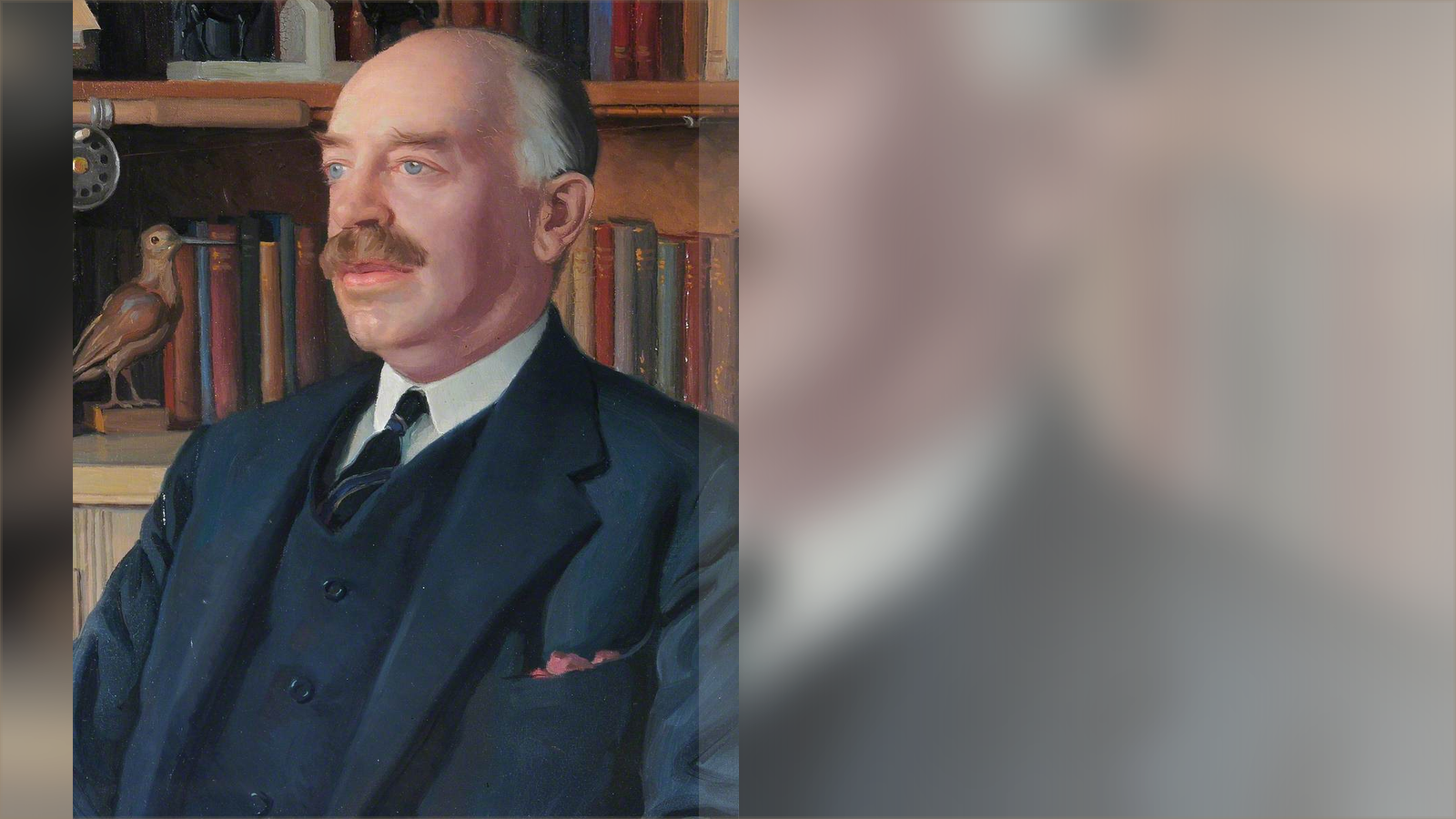
David Davies inherited almost everything that late Victorian Wales could bestow upon a young man: wealth, land, industrial influence, political opportunity and one of the most recognisable names in Montgomeryshire. What he did not inherit was an uncomplicated world in which to enjoy them.
Born at Llwynderw, Llandinam, on 11 May 1880, Davies belonged to the third generation of a family whose fortunes had risen with the making of industrial Wales. His grandfather, David Davies of Llandinam, the celebrated “Top Sawyer”, had built railways, developed collieries and helped to create the docks at Barry. By the time the younger David reached adulthood, the family possessed extensive land, controlling interests in major industrial concerns and a position of almost unrivalled authority in its native county.
Yet David Davies was not content merely to preserve that inheritance. His life became an extended attempt to justify it.
The causes to which he devoted himself were characteristically large: the eradication of tuberculosis, the improvement of housing, the advancement of Welsh education, the organisation of rural society, the welfare of young people and, above all, the creation of an international system capable of preventing war. He was impatient with small remedies. Whether dealing with disease or international aggression, his instinct was to build an institution.
This was both his strength and his limitation. Davies possessed imagination, money and a formidable capacity for action, but he could also be impetuous, paternalistic and inclined to believe that sufficient energy could force the world into a more rational shape. He was not a detached humanitarian standing outside the structures of power. He was a coal owner, landowner, financier, politician and member of the governing class. His public life is most revealing when those identities are considered together.
The Llandinam inheritance
David was the only son of Edward Davies and Mary, usually known as May, Jones. His younger sisters, Gwendoline and Margaret Davies, would become celebrated collectors and benefactors, later closely associated with Gregynog Hall and with the remarkable collection of Impressionist and Post-Impressionist art now held by Amgueddfa Cymru.
The children’s early lives were marked by loss. Their mother died in 1888, when David was eight. They were subsequently brought up by their maternal aunt, Elizabeth Jones, who married their widowed father in 1892. Edward Davies, already in uncertain health, died in 1898.
At eighteen, David and his sisters became joint beneficiaries of an estate valued at more than £2 million. Their inheritance included over 10,000 acres, a substantial interest in the Cambrian Railways and control of important holdings in the Ocean Coal Company and Barry Docks. This was not merely personal wealth. It brought responsibility for businesses upon which thousands of livelihoods depended.
Davies was educated at Merchiston Castle School in Edinburgh and then at King’s College, Cambridge, where he studied history between 1899 and 1903. At school he acquired a reputation for throwing himself completely into whatever occupied him. The description of him as a “110 per cent man” was revealing. Moderation would seldom be his distinguishing characteristic. His connection with Merchiston did not end with his schooldays: surviving correspondence shows that he remained involved with the school’s governors and administration during the 1920s and 1930s, while four pocket notebooks from his school years survive among his papers.
He was a Calvinistic Methodist and a teetotaller, formed by a Nonconformist culture in which prosperity was accompanied by an expectation of moral purpose. That inheritance should not be romanticised. The family’s influence rested upon capital, land and industrial authority. Nevertheless, Davies appears genuinely to have regarded wealth as a trust rather than a purely private possession.
There was also a less solemn side to him. After Cambridge he travelled extensively, visited North America and Asia, went on big-game expeditions and owned a ranch in Canada. He became an enthusiastic huntsman, maintained foxhounds and beagles at Llandinam and devoted considerable attention to shooting and country sports. His interests extended beyond Wales: archival correspondence records his purchase of the Coulin estate in Scotland in 1924, while his papers also preserve material relating to Canadian ranching and business interests. The future apostle of international organisation was also unmistakably an Edwardian country gentleman whose wealth and landownership reached well beyond Montgomeryshire.
A rural moderniser
Davies’s attachment to Montgomeryshire was not decorative. He understood agriculture and involved himself energetically in the development of the Llandinam estate. He encouraged the improvement of native breeds, and has traditionally been credited with helping to save the Welsh pig from extinction.
He was also closely involved in the establishment of the Welsh National Agricultural Society in 1904, the organisation that later became the Royal Welsh Agricultural Society. Its creation reflected the growing confidence of Welsh agricultural interests and their desire for a national institution of their own. Davies’s support combined patriotism with practicality. Rural Wales, in his view, was not to be preserved unchanged as a picturesque survival. It needed organisation, better methods and institutions capable of representing it.
This approach would recur throughout his career. Davies believed that improvement required more than goodwill. It needed administration, finance, expertise and a permanent structure.
His position within Montgomeryshire was nonetheless that of a powerful paternalist. Landownership, family reputation and personal generosity gave the Davies family an authority that operated alongside formal democratic politics. That influence could be constructive, but it was not socially neutral. Davies often approached the county as a man accustomed to directing rather than merely persuading.
An unconventional Liberal
In 1906 Davies succeeded Arthur Charles Humphreys-Owen as Liberal MP for Montgomeryshire. He was returned unopposed, but his political position was far from straightforward.
His grandfather and father had broken with Gladstonian Liberalism over Irish Home Rule and become Liberal Unionists. The younger Davies also opposed Home Rule. He was sympathetic to aspects of tariff reform, resisted the disendowment of the Church in Wales and had not supported Lloyd George’s campaign against the 1902 Education Act. On temperance and Nonconformity he stood closer to the traditional Welsh Liberal position, but his programme crossed established party boundaries.
That he could enter Parliament on so personal a platform demonstrated the extent of his local influence. A Conservative newspaper complained before the First World War that Montgomeryshire had surrendered itself not to Radicalism but to the “cult of David Daviesism”. The phrase was hostile, but perceptive. His authority in the county rested less upon party organisation than upon name, property, patronage and the belief that he could get things done.
Westminster suited him poorly. He disliked parliamentary procedure, rarely distinguished himself in debate and never became comfortable with the theatre of the House of Commons. His political temperament was practical, impatient and personal. He preferred organising a campaign, financing an institution or commissioning experts to mastering the slower disciplines of parliamentary negotiation.
He was not politically insignificant, but his importance cannot be measured by speeches or ministerial office. His real influence lay in the connection between private wealth and public action.
The campaign against tuberculosis
Tuberculosis was among the most destructive diseases in early twentieth-century Wales. Its prevalence was bound up with overcrowding, poor housing, malnutrition and exhausting working conditions. Industrial communities suffered heavily, although the disease was by no means confined to them.
For Davies, this was not an abstract social problem. His family’s commercial wealth came partly from the coal industry whose settlements bore many of the consequences of rapid and poorly planned growth. His intervention therefore carried a moral complexity often lost in uncomplicated accounts of philanthropy. The same industrial economy that produced extraordinary fortunes had also produced communities in which disease could flourish.
Following the death of Edward VII in 1910, Davies promoted the creation of a Welsh national memorial dedicated not to stone or ceremony but to the conquest of tuberculosis. He contributed £150,000, half of the initial £300,000 raised, and became the first president of the King Edward VII Welsh National Memorial Association.
The Association developed into a national system of dispensaries, sanatoria and hospitals. By 1921, all seventeen Welsh local authorities had entered agreements with it for the provision of tuberculosis services. The Davies family also supported the establishment of a chair of tuberculosis at the Welsh National School of Medicine.
This was philanthropy on an institutional scale. Davies did not simply pay for individual beds or distribute relief. He helped to create an organised Welsh health service for a particular disease, bringing voluntary action, medical expertise and local government into a common structure. When the National Health Service was established in 1948, the Association’s hospitals and responsibilities were absorbed into it.
Davies’s ambitions also extended to housing. He supported town-planning experiments and schemes intended to provide healthier homes for working families. Developments at Wrexham, Barry and Rhiwbina reflected the contemporary understanding that disease could not be separated from the physical environment in which people lived.
These projects were paternalistic, but they were not superficial. They sought to alter the conditions that produced ill health, not merely to alleviate its most visible consequences.
Education and civic nation-building
The Davies family’s support for Welsh national institutions long pre-dated David’s maturity. His grandfather had assisted the early development of the University College of Wales at Aberystwyth, while his father served as one of its treasurers.
David continued that association. In 1903, together with his stepmother and sisters, he contributed towards the Edward Davies Chemical Laboratory. He later endowed a chair of colonial history and, from 1926 until his death, served as president of the college. He encouraged its eventual expansion onto the Penglais site and helped to raise substantial funds for its development.
He was also a generous supporter of the National Library of Wales, serving on its council and later as its president. These commitments formed part of the wider construction of a Welsh national civic life during the late nineteenth and early twentieth centuries. Wales still lacked political autonomy, but institutions such as the university colleges, the National Library, the National Museum and the agricultural society gave national identity an administrative and intellectual form.
Davies understood this instinctively. A nation, like a cause, required institutions if it was to possess permanence.
That conviction also lay behind his support for The Welsh Outlook, the monthly journal founded in 1914 under the editorship of Thomas Jones. Financed by Davies and associated with progressive Liberalism, cultural nationalism and discussion of social reform, the journal attempted to create a serious Welsh forum for the political and social problems of a changing nation. Davies’s secretarial correspondence shows that his involvement extended to matters concerning the publication and running of the periodical. It was another form of nation-building, not through bricks and endowments this time, but through the creation of a public intellectual space in which Welsh questions could be debated alongside wider international ones.
In 1922 he and Captain John Glynn-Jones, welfare officer for the Ocean Coal group, founded the movement that became the Boys’ and Girls’ Clubs of Wales. Glynn-Jones had become concerned about the young “collier boys” whose lives were divided between hard industrial work and limited opportunities for recreation. The first club opened at Treharris in 1922, followed by clubs at Nantymoel, Ton Pentre and Gelli, Treorchy, Wattstown and Nine Mile Point. Full-time youth workers provided sport, exercise, cultural activity and a framework of discipline and responsibility within communities whose young people were too easily regarded merely as future industrial labour.
The scheme soon became more ambitious. On 8 August 1925 a purpose-built Boys’ Village opened near Aberthaw as a holiday camp for working-class boys from South Wales. It could accommodate around 180 people and included dormitories, kitchens, a canteen, a main hall, sports facilities and a chapel. Here again the relationship between philanthropy and industry was direct. Davies was chairman of the Ocean Coal Company, and the youth movement grew from concern for boys in communities connected with the industrial system from which his family derived much of its wealth. The initiative was paternalistic, but it also represented a serious attempt to give young people a life beyond the pit and the street.
Soldier and political intimate
The First World War complicated Davies’s later reputation as a peace campaigner. He was not a conscientious objector, nor did he reject military service. He helped to raise and commanded the 14th Battalion of the Royal Welsh Fusiliers, one of the battalions of the 38th (Welsh) Division.
Davies spent his own money on equipment, including field telephones and bicycles, and made horses available for military use. His battalion trained intensively in Snowdonia before reaching the Western Front in December 1915. It then served in the trenches around Laventie, Festubert and Givenchy.
He approached soldiering with characteristic energy and a taste for unconventional schemes. Yet direct experience of the trenches exposed him to the filth, waste and human cost of industrial warfare. His later internationalism did not emerge from an abstract rejection of patriotism. It developed from the belief that patriotism without an effective international order repeatedly delivered men into slaughter.
In June 1916 Davies was recalled to Britain and became parliamentary private secretary to David Lloyd George, initially when Lloyd George was Secretary of State for War and then after he became prime minister. Davies entered the political circle sometimes known as the “Garden Suburb”, which operated close to the centre of wartime government.
The surviving papers show that his wartime work was much broader than the title of parliamentary private secretary might suggest. He handled or considered material on army medical services, casualties, clothing and contracts, petrol control, recruitment of discharged soldiers, gas warfare, the Air Board, Allied strategy, Irish conscription, German peace proposals and war aims. His papers also include material concerning tanks, a proposed surprise attack, propaganda in the United States and the idea of an Inter-Allied Council. By the later years of the war he was therefore studying not simply battlefield experience but the administrative anatomy of modern conflict: manpower, supply, technology, communications, propaganda and coordination between governments. His later conviction that peace required institutions capable of matching the organisational power of war becomes much easier to understand against this background.
For a time, Davies and Lloyd George enjoyed a warm relationship. Davies sounded out Liberal opinion, acted as an intermediary and assisted Lloyd George personally. But proximity weakened rather than strengthened his faith in political leadership. He became increasingly disturbed by intrigue, opportunism and the concentration of authority around the prime minister.
Their relationship deteriorated sharply in 1917. Davies accused Lloyd George of neglecting the moral considerations upon which durable political success depended. Lloyd George, under pressure over the employment of a fit young officer in a political post, released him from his service. Their rupture became both personal and political.
Davies remained in Parliament after the war but grew increasingly estranged from the coalition government. In 1918 he repudiated the coalition “coupon” offered to him and was again returned unopposed. He later denounced the government’s opportunism and accused Lloyd George of sacrificing Liberal principles for the retention of power.
This was not simply wounded pride. Davies distrusted the concentration of power, the influence of Lloyd George’s private political fund and the erosion of collective responsibility. Yet his own political authority in Montgomeryshire rested upon an unusually personal form of power. His criticism of political patronage therefore contained a certain irony.
Coal, labour and Liberal decline
Davies’s position as chairman of the Ocean Coal Company placed him close to one of the central conflicts of modern Welsh history. Industrial relations in the coalfield were becoming increasingly bitter, culminating in the General Strike and miners’ lockout of 1926.
His commercial interests were broader than Ocean Coal alone. He served as a director of the Great Western Railway and Midland Bank and as chairman of Ocean Coal and Wilsons Ltd. His papers range across property, industrial and financial affairs and include Canadian and Scottish interests as well as those centred on Wales. He should therefore be understood not simply as an heir drawing income from a coal fortune, but as a participant in the wider networks of British industrial and financial capitalism.
He did not become a socialist, nor did he cease to defend private ownership. He was hostile to proposals that appeared to threaten landed property and resisted Lloyd George’s plans for extensive state acquisition of agricultural land. Nevertheless, he favoured arbitration in industrial disputes and believed that an independent tribunal should intervene in conflicts between coal owners and miners.
The archive allows this to be stated more firmly than a general preference for conciliation. During the General Strike and the prolonged miners’ lockout, Davies wrote to a number of recipients advocating the establishment of arbitration machinery, suggested how negotiations might be conducted and drafted notes on possible terms for reopening the mines. He was therefore attempting to construct a mechanism through which a seemingly irreconcilable dispute could be transferred from industrial confrontation into adjudication.
This was characteristic of Davies. He sought to reconcile capital and labour through impartial institutions, much as he later hoped to reconcile states through courts and enforceable law. He did not wish to abolish the existing social order. He wanted to discipline it, make it more responsible and prevent conflict from overwhelming it.
By the later 1920s he was thoroughly disillusioned with party politics. He considered Lloyd George untrustworthy and believed that Liberalism had abandoned its principles. He stood down at the 1929 general election and was succeeded, despite his preference for another candidate, by Clement Davies.
His parliamentary career had lasted twenty-three years, but Westminster had never been the natural field for his abilities. Outside it, he was capable of exercising far greater influence.
Peace through law, not pacifism
The First World War convinced Davies that moral appeals alone could not restrain aggressive states. His internationalism was therefore markedly different from absolute pacifism.
He supported the League of Nations and helped to develop the League of Nations Union in Wales. The movement acquired a remarkable reach, with hundreds of local branches rooted in chapels, schools, women’s organisations and civic associations. It drew upon an established Welsh tradition of peace campaigning, but Davies increasingly feared that enthusiasm without enforcement would prove useless.
Davies and his sisters provided important financial support, while figures such as the Rev. Gwilym Davies and Annie Hughes-Griffiths carried much of the movement into Welsh civic life. Surviving records include branch lists, conference papers, committee minutes, correspondence and monthly reports. The scale of this organisation matters. Davies’s internationalism was not intended to remain an elite argument conducted in London drawing rooms or university common rooms. It was deliberately translated into local associations and public education across Wales.
The central problem, as he saw it, was that international law was not truly law if no authority possessed the power to enforce it. Nations could sign agreements, submit disputes and condemn aggression, but an aggressor could ignore them if sanctions depended upon the uncertain willingness of individual governments.
Davies proposed an international tribunal whose decisions would be upheld by an international police force. This was to include military capacity, particularly air power. Collective security, in his conception, meant that aggression against one state would be treated as an offence against the whole international community.
His major work, The Problem of the Twentieth Century, published in 1930, set out the argument at length. The title was well chosen. For Davies, the defining problem of modern civilisation was not the absence of idealism but the failure to create institutions strong enough to contain national violence.
In 1932 he became Baron Davies of Llandinam and helped to establish the New Commonwealth Society for the promotion of international law and order. His elevation to the peerage carried a revealing symbolism. The arms included mining imagery, with pickaxes and a miner’s safety lamp, while the Welsh motto, Goreu Bonedd Rhinwedd, “The highest nobility is virtue”, expressed with unusual neatness the principle by which he liked to interpret privilege: rank and wealth were defensible only if turned towards public purpose.
The New Commonwealth was not merely a vehicle for Davies’s own books and speeches. It brought together a strikingly broad political constituency. Clement Attlee wrote a pamphlet for it on an international police force, while Winston Churchill became one of its most prominent supporters and addressed the organisation publicly. Its records include campaigning during the Abyssinian crisis and petitions and resolutions intended to place pressure on government. What united these otherwise very different figures was the contention that international law required some credible means of enforcement.
Davies was therefore not arguing that war could be abolished simply by changing human hearts. He was arguing that force should be transferred from competing national governments to a collective authority. It was an ambitious and problematic proposal, but not a sentimental one.
Events in Manchuria, Abyssinia and Central Europe appeared to confirm his fears. The League could condemn aggression but lacked the unity and power required to stop it. Davies became a fierce opponent of appeasement and urged the creation of a united political front in defence of collective security.
His thinking was sometimes dismissed as utopian. E. H. Carr, holder of the Woodrow Wilson Chair at Aberystwyth, criticised the assumptions of liberal internationalism in The Twenty Years’ Crisis. There was an unmistakable tension between Davies’s belief that international institutions could rationalise power and Carr’s insistence that international relations could not be understood without confronting power as it actually existed.
Yet Davies had confronted one important reality: promises unsupported by credible enforcement would fail when tested by determined aggression. Later scholarship has consequently treated his international-police-force campaign as more than an eccentric interwar scheme. It formed part of a wider British debate about how international order might be given practical coercive force, a debate that survived the collapse of the League and fed into thinking about the post-war system. The United Nations that eventually emerged was not Davies’s design, but the problem he had identified remained central.
Aberystwyth and the study of international politics
Shortly after the Armistice, Davies and his sisters offered £20,000 to the University College of Wales at Aberystwyth to endow a chair in memory of the university’s fallen students. Their proposal was unusually explicit about its purpose. The new chair was to study the problems of law, politics, ethics and economics raised by the prospect of a League of Nations, while encouraging a truer understanding of civilisations beyond Britain. In 1919 the Department of International Politics was established, the first of its kind in the world, with Alfred Zimmern as the inaugural Woodrow Wilson Professor.
The endowment was therefore more than a commemoration of Wilsonian idealism. It represented Davies’s conviction that the causes of war required systematic study. Peace could not remain the province of sermons, resolutions and goodwill meetings. It needed scholarship, trained minds and a serious understanding of relations between states. The fact that the gift commemorated students killed in the recent war gave the project an additional moral force: intellectual inquiry was to become part of the answer to the destruction that had taken them.
That the chair later became occupied by one of the most influential critics of liberal internationalism was not a failure of the project. On the contrary, it demonstrated the value of establishing a discipline capable of testing idealism against evidence and argument. Davies helped create an intellectual institution whose importance extended well beyond his own beliefs.
The Temple of Peace and Health
Davies’s two principal causes, public health and international peace, were brought together in the Welsh National Temple of Peace and Health in Cathays Park, Cardiff.
In 1934 he pledged approximately £60,000 towards its construction. Designed by Sir Percy Thomas and opened on 23 November 1938, the building provided a home for the Welsh National Memorial Association and the Welsh work of the League of Nations Union. It also housed the Welsh National Book of Remembrance, commemorating those of Welsh birth or parentage who died in the First World War.
The opening was given a deliberately human centre. The building was formally opened not by a cabinet minister or aristocrat, but by Minnie James of Dowlais, then aged seventy-two, who had lost three sons during the First World War and was chosen to represent the bereaved mothers of Wales. Around her stood figures including Davies, Lord Robert Cecil, church leaders and other representatives of public life. The symbolism was unmistakable. A building conceived by wealthy patrons and designed on a monumental scale was opened by a working-class mother whose family had paid the cost of war in the starkest possible way.
Davies intended the Temple not simply as a Welsh monument but as the first in a wider chain of peace temples around the world. That ambition was overtaken almost immediately by events. The opening took place beneath the shadow of another European conflict, and within ten months Britain was again at war.
Davies insisted that the building was not intended as a mausoleum. It was to be a working institution, joining remembrance to the prevention of future suffering. The Temple embodied his characteristic faith in structures. Disease required hospitals and medical organisation. Peace required courts, scholarship and international authority. Memory required a permanent civic home. Within a year, Europe was again at war.
War, death and legacy
The outbreak of the Second World War did not cause Davies to abandon internationalism. He turned his attention towards wartime organisation and the shape of the post-war settlement. He supported aid for Finland following the Soviet invasion, considered the defence of reservoirs and the evacuation of children, and continued to write about European federation and collective security.
His public life had been accompanied by repeated private bereavement. His mother had died when he was a child and his father before he reached twenty. His first wife, Amy Penman, died in 1918, and their daughter Marguerite Elizabeth, born in 1917, died on 18 December 1930 at the age of thirteen. It would be unsafe to claim a direct political consequence from these losses, but they form an important part of the emotional landscape of a man whose public causes were so often concerned with mortality, prevention and institutional protection.
He died at Llandinam on 16 June 1944, suffering from cancer, before the defeat of Nazi Germany and the establishment of the United Nations. The family was struck by a further loss only three months later when his eldest son, David Michael, known as Mike, was killed on active service with the Royal Welch Fusiliers.
It is tempting to present the creation of the United Nations as the fulfilment of Davies’s ideas. That would be too simple. The United Nations did not possess the independent international police force he had advocated, and its Security Council embedded great-power privilege rather than superseding it. Nevertheless, its charter reflected the same central problem that had occupied him: how to combine international law, collective security and effective sanctions in a world of sovereign states.
Davies’s legacy is visible in institutions that outlived him. The tuberculosis service he helped to build became part of the National Health Service. The Department of International Politics at Aberystwyth acquired a worldwide reputation. The Boys’ and Girls’ Clubs of Wales continued their work among young people. The Royal Welsh Agricultural Society became one of the central institutions of rural Wales. The Temple of Peace and Health remains one of the most distinctive expressions of Welsh civic internationalism.
The surviving archive also continues to enlarge the picture. The Lord Davies of Llandinam Papers at the National Library of Wales comprise 184 large archival boxes and 48 smaller boxes, and received a further five large boxes in February 2026. The collection ranges across political correspondence, industrial affairs, international campaigning and the Dinam estates. That continuing accession matters because Davies’s historical reputation was formed long before all of this material had been available to researchers. His life remains unusually open to reinterpretation through the documentary record.
His achievements should not be separated from the privileges that made them possible. Davies could act on a national scale because his family had accumulated immense industrial wealth. His outlook remained that of a paternalist who believed that responsible leadership should come from those with the resources and position to provide it. He did not seek a thorough redistribution of power.
Yet privilege alone does not explain what he did with it. Many inherited fortunes left little beyond houses, collections and diminished estates. Davies converted a substantial part of his wealth into institutions designed to survive him.
His grandfather had helped to construct the physical machinery of industrial Wales: railways, collieries and docks. David Davies attempted something less tangible but no less ambitious. He tried to build the institutional machinery of a healthier and more peaceful society.
Seen across the whole of his career, a remarkably consistent pattern emerges. Tuberculosis was to be met by a national medical organisation, housing problems by planning, youth welfare by clubs and residential provision, industrial conflict by arbitration, Welsh public life by national institutions, and international aggression by courts backed by force. Davies repeatedly attempted to convert moral aspiration into machinery. That habit of mind, more than any single cause, is the clearest link between the coal owner, philanthropist, politician and internationalist.
He did not solve the problem of the twentieth century. No one did. His faith in international authority sometimes underestimated the force of nationalism, dictatorship and conflicting state interests. But he recognised with unusual clarity that goodwill without structure was fragile, and that law without the means of enforcement was little more than advice.
David Davies was not simply a philanthropist, a pacifist or a wealthy eccentric. He was a soldier troubled by war, an industrialist concerned with social improvement, a Liberal who distrusted party politics and an idealist preoccupied with the practical uses of power.
In him, the paternal culture of rural Montgomeryshire confronted the destructive capacity of the modern world. The institutions he created were his answer. Some proved more durable than others, but the question that drove him remains unresolved: how can power be brought under law before violence makes law irrelevant?
Related Essays
- Arthur Charles Humphreys-Owen (1836–1905): Land, Liberalism and Public Duty in Victorian Montgomeryshire
- Clement Davies (1884–1962): Liberal Leader and MP for Montgomeryshire
- Robert Owen of Newtown (1771–1858): Industry, Character and the New Moral World
- David Gibson-Watt (1918–2002) of Doldowlod: War, Politics and Welsh Unionism
Explore more Welsh history
Browse more research in Essays and Notable People of Mid Wales.
Sources and Further Reading
- Dictionary of Welsh Biography, “David Davies of Llandinam, first Baron Davies”
- J. Graham Jones, “The Peacemonger: David Davies, First Baron Davies of Llandinam”, Journal of Liberal Democrat History, issue 29.
- W. John Morgan, Peace Profile: David Davies of Llandinam, Cardiff University.
- National Library of Wales, Lord Davies of Llandinam Papers, including wartime, coal dispute, secretarial and estate correspondence.
- National Library of Wales, Welsh National Memorial Association records.
- Aberystwyth University, Department of International Politics, centenary history and timeline.
- Welsh Centre for International Affairs, material on Lord Davies, the League of Nations Union and the Temple of Peace.
- Boys’ and Girls’ Clubs of Wales, historical records of the movement.
- Cadw, listed-building record for the former Boys’ Village, West Aberthaw.
- Michael C. Pugh, “An International Police Force: Lord Davies and the British Debate in the 1930s”, International Relations.
- Kenneth O. Morgan, “Davies, David, first Baron Davies”, Oxford Dictionary of National Biography.
- Trevor Fishlock, A Gift of Sunlight: The Fortune and Philanthropy of the Davies Sisters.