
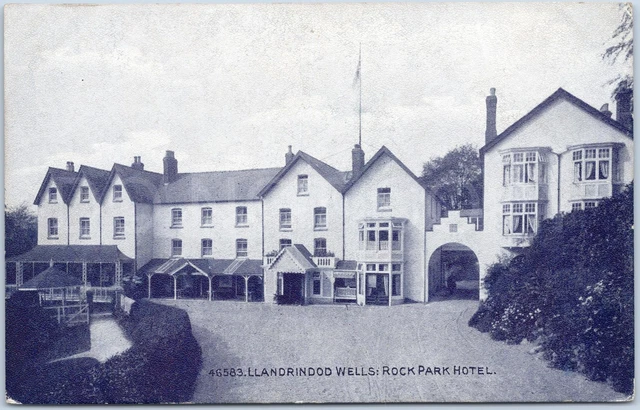
On 10 October 1865, the railway finally reached Llandrindod Wells. A special train brought visitors into a place which was still more common and countryside than town. Despite the rain, local people gathered to meet the arrivals, a band played, and the celebrations moved to the grounds of Rock House, where around 150 people sat down to a banquet.
There was something wonderfully appropriate about the choice of venue. The railway would transform Llandrindod, making possible the villas, boarding houses, shops, hotels and seasonal crowds which turned a scattered Radnorshire watering place into one of the most fashionable inland resorts in Wales. Rock House, however, was already there. It had been receiving travellers before the railway, before the enclosure of the common and before most of the streets of modern Llandrindod had even been imagined.
During the next century and a half it would change almost beyond recognition. The old inn and farm became a Victorian hotel and then an Edwardian spa resort. Horses gave way to motor cars and, remarkably, aeroplanes landed on the Ddole below. When the traditional hotel finally ceased trading, the building found another life as a residential education and activity centre. Children eventually canoed and abseiled where earlier generations had come to take mineral water and fish for trout. Only in the final years of the twentieth century did a building which had repeatedly reinvented itself finally run out of uses. Rock Park was demolished in 2000, but its history reaches back almost two centuries.
Before there was a town
The origins of Rock Park belong to a landscape almost impossible to reconcile with the later photographs of Llandrindod Wells. Before the railway, the villas and the great hotels, there were farms, common land and mineral springs. One of those farms was Dolysgallog, the property which eventually became associated with Rock House. By the early nineteenth century it had developed into an inn serving people who came to take the waters.
W. H. Howse, writing in Old-Time Llandrindod in 1952, traced the Rock House inn back into the reign of George III and identified Edward Tompson as landlord in 1816. Five years later Rock House was described as a well-established and accustomed inn. The wording matters, because this was not a newly opened establishment testing whether the growing reputation of the mineral springs might bring a little extra income. Rock House was already recognised as a place where travellers stayed. By 1825 another keeper, recorded simply as Mr Smith, was in charge.
Contemporary descriptions present a modest establishment by later standards. There were two principal parlours, one used for dining and another serving as a withdrawing room for ladies, yet Rock House was apparently unusual in being constructed substantially of stone at a time when many buildings associated with the early spa remained considerably more rudimentary. The later Rock Park Hotel would eventually contain scores of rooms, specialist hotel departments and a substantial resident workforce. The beginning was much simpler.
David Smith and the old Rock House
The censuses allow us to put people back into this early landscape. In 1841, Rock House was occupied by David Smith, then aged in his forties, together with his family. Ten years later he was still there. The 1851 census records Smith, aged fifty-seven, as a farmer of seventy acres. His wife Hannah, also fifty-seven, lived with him, together with their adult and teenage children and a young house servant.
That description is one of the most revealing in the whole history of Rock Park. Smith was not recorded as the proprietor of a grand hotel, but as a farmer, even though Rock House was already associated with the spa trade. The apparent contradiction disappears once we remember what early nineteenth-century Llandrindod actually was. A place such as Rock House could be several things at once: a farm, family home, boarding establishment and source of accommodation for people visiting the mineral waters. Tourism had not yet become detached from the rural economy surrounding it.
A newspaper advertisement published in the Hereford Journal on 2 October 1861 makes the position much clearer. Rock House was then offered as part of the sale of a reversionary interest and was described as the:
“far-famed Boarding House, Llandrindod Wells, called ‘the Rock House’.”
The property comprised more than seventy-two acres of arable, meadow, pasture and woodland, and it was explicitly stated to be in the occupation of Mr David Smith.
The description confirms both sides of the establishment. Rock House was a substantial agricultural holding, but it was also a boarding house with a reputation extending far enough beyond Llandrindod for an auctioneer to call it “far-famed”. It also raises an intriguing possibility. David Smith was born around 1793 or 1794 and would therefore have been about thirty-one years old in 1825, when a Mr Smith was recorded as keeper of the Rock-house Inn. It is entirely possible that the two men were the same person, although the evidence is not sufficient to state that as fact. If they were identical, the Smith family’s connection with Rock House may have stretched across almost four decades. By the early 1860s, however, the old world was about to change.
Green-Price, the railway and the making of Llandrindod
Around 1861–62, the Rock House estate passed into the hands of Richard Dansey Green-Price. The timing could scarcely have been more significant. The Central Wales railway was approaching, enclosure was transforming the old common, and land which had previously belonged to an open rural landscape was acquiring enormous speculative value. The Green-Prices were closely associated with that transformation and, after taking possession of the estate, brought in James & Sons, previously connected with the Severn Arms Hotel at Penybont, to operate Rock House.
The symbolic importance of the property became apparent when the railway opened in October 1865. The celebratory banquet in the Rock House grounds was not simply another social gathering. It brought together the old watering place and the new railway age, and the train would make possible the town which was about to grow around the hotel.
When the Woolhope Naturalists’ Field Club visited Llandrindod in 1867, the contrast was still extraordinary. Much of the future town remained open land. The Llanerch, Pump House and Rock House were the principal hotels, while the lines of projected streets could be seen taking shape across what had recently been common.
Rock House had not been built because a prosperous Victorian resort already existed.
Like the Pump House, it belonged to the earlier landscape from which the resort emerged.
Philip James and the railway-age hotel
By 1869, the James family were firmly established. A legal document dated 27 November that year records Phillip James the younger of the Rock House Hotel, Cefnllys, innkeeper. An even more evocative survival comes from September 1870, when a hotel bill was issued under the heading:
Philip James & Son, Rock Hotel and Boarding House, Llandrindod Wells.
One guest was charged £4 2s. 6d. for twelve days’ board. The terminology is interesting. Rock House was simultaneously a hotel and boarding house, reflecting the older spa tradition in which visitors often remained for extended periods rather than passing through for a night or two.
The 1871 census catches Philip James in residence. He was a widower in his early forties and was explicitly described as Hotel Keeper. His sister Maria acted as housekeeper, while around them was a small but recognisable hotel staff, including a butler, cook and gardener. The contrast with David Smith’s household twenty years earlier is striking. Rock House was becoming less a farm which accommodated visitors and more a specialised hospitality business. The railway had begun to change the scale of everything.
Edward Careless

The next great figure in the history of Rock House was Edward Careless. Born at Broadway in Worcestershire on 23 August 1835, Careless arrived in Llandrindod in the later 1870s and became proprietor of Rock House. His obituary later stated that he had carried on the hotel for around eighteen years, placing his tenure approximately between the late 1870s and the mid-1890s. The 1881 census records him there as Hotel Keeper, while by 1891 he was explicitly described as Hotel Proprietor. The changing workforce beneath him tells us a great deal about the evolution of the establishment.
In 1881 the resident staff included domestic servants, a barmaid, porter and employees associated with horses and transport.
Ten years later the structure was considerably more specialised. There were cooks, waitresses, kitchen staff, laundry workers, chamber staff and apparently a resident hotel manageress, Jane Powell.
The distinction is important. A generation earlier, hotelkeeping had still been centred strongly on the proprietor’s household. By the 1890s Rock House was developing a managerial and departmental structure characteristic of the larger Victorian hotel. Careless himself belonged to the emerging civic elite of Llandrindod, representing Cefnllys on the Rhayader Board of Guardians, serving on the old Llandrindod Local Board and taking part in the management of the National School. He was also a keen supporter of local sport and was regularly seen at football matches on the Quarry Ground.
His interests extended beyond Rock House. Contemporary sources also identify him as proprietor of the Mackworth Hotel at Swansea, suggesting that his hotel career operated on a considerably larger scale than a single local establishment.
Around 1896, Careless retired. He remained in Llandrindod and died at Fronheulog on 28 September 1902, aged sixty-seven. His funeral provides an unusually human glimpse into the relationships formed during his hotel years. The church was crowded, with clergymen, doctors, businessmen and local public figures among those attending, including the architect Richard Wellings Thomas. The bearers were described simply as “old servants” of Careless.
That phrase is worth preserving. Hotel histories too easily become stories of owners, architects and wealthy visitors, yet establishments such as Rock House depended upon people who cooked, cleaned, carried luggage, tended horses, served meals and maintained rooms. The presence of former servants at Careless’s funeral suggests relationships which had extended well beyond the purely commercial. Among the floral tributes was one from “Miss Powell and May”, raising the possibility that Jane Powell, the hotel manageress recorded in 1891, remained connected with the Careless family after his retirement. Careless belonged to the great Victorian phase of Rock House. What followed would transform it again.
Morgan Watkins and the hotel behind the façade
The 1901 census provides one of the richest surviving records of Rock House. The Hotel Keeper was now Morgan Watkins, aged fifty-seven and born at Llangadock in Carmarthenshire. His wife Margaret and four adult daughters lived with him, but the most revealing part of the return is the substantial body of hotel employees who followed them across more than one census page. There were waitresses, cooks, housemaids, kitchen staff, laundresses, a sewing maid, porters, boots, a page, an ostler and a coachman. More than twenty employees appear to have been living within the establishment.
The difference from 1851 could scarcely be greater. Fifty years earlier David Smith had been farming seventy acres and living at Rock House with his family and one resident domestic servant. By 1901 the same site had become a small institution, requiring people to receive guests, handle luggage, tend horses, prepare meals, serve tables, clean rooms, wash linen, mend clothing, maintain public spaces and keep the whole operation moving. The comfortable hotel experience depended upon work which guests were not supposed to notice.
There was also a clear social hierarchy inside the building. Much of the domestic labour fell to women, often young and unmarried, working as housemaids, laundresses, cooks and waitresses. Men were more visible in jobs connected with transport, luggage, grounds and public service. One of the employees was a teenage page, while others worked as boots, porters, coachman or ostler. For one group Rock House represented rest, treatment and leisure; for another it was a place of work, discipline and long hours. Both groups slept under the same roof, but experienced the hotel in entirely different ways.
The workforce was geographically mobile too. Employees came from different parts of Wales and England, showing that the railway did not merely bring visitors into Llandrindod, it also brought workers in search of employment. One group travelled for health or pleasure; another travelled because the first group created jobs. The guests were similarly varied, including people from commercial and professional backgrounds. Llandrindod’s clientele was never composed simply of invalids seeking mineral cures. The railway resort attracted businessmen, commercial travellers, families and prosperous members of the expanding middle classes. By the beginning of the twentieth century Rock House was already a large hotel. Then came the rebuilding.
Reconstructing Rock House
Powys Archives preserves the evidence for the architectural transformation which produced the Rock Park Hotel remembered from twentieth-century photographs and postcards.
Plans survive for the reconstruction of the Rock House Hotel, including drawings associated with Richard Wellings Thomas and dated November 1907. Wellings Thomas was one of the architects who gave Llandrindod much of its distinctive appearance, and his involvement places Rock House firmly within the great final phase of Edwardian development in the town. The rebuilding was substantial enough for later descriptions to say that the old hotel had effectively lost the appearance of its farmhouse origins.
Sources indicate that by 1908 the property had become associated with the Gibson-Watt family of Doldowlod and had been virtually rebuilt as an elegant spa hotel. The change of name reflected the change of ambition. Rock House became increasingly known as the Rock Park Hotel and Spa, and by 1909 advertisements identify R. P. Culley & Co. as proprietors. Richard Palethorpe Culley was not a small provincial innkeeper, but part of a wider hotel and catering business. The hotel itself was increasingly operated through professional management rather than the older model of proprietor and family household.
The 1911 census identifies Stanley Ford, aged thirty-seven and born at Camberwell in London, as resident Hotel Manager. His wife Margaret lived with him, and Ford signed the census schedule himself at Rock Park Hotel. The return appears to record approximately eighty-three rooms, although the figure should be treated cautiously because of later markings on the schedule. Even allowing for that qualification, the scale of the rebuilt establishment is obvious. The resident staff included porters, a waiter, chambermaids, kitchen workers, bar staff and a gardener. Rock Park had become the sort of hotel which required management rather than merely a proprietor.
Taking the waters at Rock Park
The hotel cannot be understood separately from the park below it. Rock Park was one of the landscapes through which Llandrindod sold the idea of health. Mineral springs, pump rooms, paths, ornamental planting, treatment facilities and hotel accommodation formed part of the same visitor experience, and the landscape itself was deliberately created.
Thomas Heighway became an important figure in the management and development of the Rock Park wells. He was associated with the discovery or exploitation of further springs and with the planting of an extraordinary range of specimen trees.
By 1912, around 190 trees representing more than forty species were reportedly growing within the park. The gardens were therefore more than decoration. They were part of the therapeutic landscape, where visitors were expected to drink the waters and then walk, sit, converse and move through surroundings designed to appear restorative.
The celebrated chalybeate fountain, erected in 1879 by the Gibson-Watt family, became one of the most recognisable features of the park.
Further mineral waters were exploited during the later nineteenth century. By the 1890s the complex offered sulphur, saline, magnesia and other waters, while treatment facilities became increasingly elaborate.
A pavilion followed in 1908–09. Rock Park was selling more than medicine. It was selling an environment in which health, leisure and social display could be experienced together.
The Edwardian hotel
Contemporary advertising reveals the world being offered to guests. The Rock Park Hotel promoted its proximity to the mineral springs and baths, but equally important were the activities surrounding them. The hotel advertised extensive private grounds, tennis and croquet lawns, golf and miles of reserved trout fishing, while motor garaging appeared as the motor car changed the way prosperous visitors travelled.
Figures for the estate vary between sources, with advertisements giving anything from around fifty to seventy acres. The discrepancy is less important than the scale. The hotel occupied a large landscape which combined parkland, recreation, agriculture and the spa.
An extended stay at Rock Park was intended to be a complete experience. A guest could take the waters, walk through the grounds, fish, play games, dine and socialise without ever needing to separate hotel life from the landscape around it. That explains why Rock Park became one of the great hotels of Llandrindod. It did not simply overlook the spa; it belonged to it.
The old landed world meets the new resort
Rock Park also remained connected with rural Radnorshire. A surviving photograph from Michaelmas Day 1913 records tenants associated with a local estate gathering at the hotel. The annual ritual was an old one: tenants came to pay their rents and were then entertained at dinner at the landlord’s expense. The setting, however, was thoroughly modern. A traditional relationship between landlord and tenant was being enacted inside a commercial spa hotel built for railway-age tourism.
That overlap matters. Llandrindod did not replace rural Radnorshire; the old county and the new resort existed together. Rock Park brought them under the same roof, and in doing so became a meeting place between landed society, agricultural life and the new commercial world of tourism.
Motor cars and aeroplanes
Rock Park also became associated with one of the most extraordinary aspects of twentieth-century Llandrindod: aviation. The flat Ddole below the hotel offered an obvious landing ground, and on 6 August 1913 the celebrated aviator Gustav Hamel appeared there, part of the brief period when flying displays drew enormous crowds across Britain. Aeroplanes were still novelties and to watch one take off or land was an event in itself.
For Rock Park the connection with aviation would continue.
Tom Norton, whose Automobile Palace became another landmark of Llandrindod’s embrace of modern transport, was associated with the hotel and the adjoining flying ground.
By the early 1930s advertisements could even refer to the combined business of “hotel and aerodrome.” Sir Alan Cobham’s flying displays also used the field. Few details better illustrate how far Rock House had travelled. The old boarding house which had served visitors arriving by horse and carriage now overlooked aeroplanes.
Rock Park between the wars

The 1921 census provides another detailed snapshot. The resident licensed hotelkeeper was Edgar Broadhead, aged forty-six, and significantly he was recorded as an employee of the Rock House Hotel Company, with his place of work given as the Rock Park Hotel. Ownership, management and operation had become clearly separated.
Around thirty people were associated with the hotel household on census night. There were specialist employees, including bookkeepers, domestic staff, bar staff, waitresses, kitchen workers, gardeners and other hotel servants. There were also visitors whose occupations and backgrounds demonstrate the continuing reach of the establishment. One guest was associated with the Egyptian Government service in Cairo, while others came from commercial and professional backgrounds. The old spa world had been damaged by the First World War, but Rock Park was far from finished.
Toddy O’Sullivan and Brendan O’Regan
One of the most unexpected connections in the hotel’s history belongs to the 1930s. The hotel was then associated with Toddy O’Sullivan and his wife Niamh, and among the young people who learned the practical business of hotelkeeping under them was Brendan O’Regan.
O’Regan later became one of the most important figures in twentieth-century Irish tourism and aviation, closely associated with the development of Shannon Airport, its catering operations and the commercial ideas which helped make Shannon internationally famous.
Decades later he remembered his time at Rock Park and credited the O’Sullivans with giving him his introduction to the hotel industry. It is an extraordinary connection. A young man learning hotelkeeping in Llandrindod Wells went on to participate in one of the most innovative chapters in European aviation and tourism. Rock Park’s influence, however indirectly, travelled rather further than the borders of Radnorshire.
September 1939

The 1939 Register, taken only weeks after the outbreak of the Second World War, captures another generation of Rock Park. The manager was John H. Savory, born in 1892, while his wife Margaret E. Savory was recorded as Manageress. The resident workforce still included a bookkeeper, chamber staff, waitresses, bar staff, a porter and chef, while among the guests were people living on private means, retired professionals and a retired naval officer.
The social world is recognisable. Rock Park was still a substantial residential hotel, serving people who expected a degree of comfort and personal attention that was becoming increasingly difficult to sustain in the changing economic conditions of the twentieth century. War would accelerate those changes, but the hotel survived.
The long post-war survival

In 1952, W. H. Howse could still describe Rock House as retaining something of the “airs and graces of Victorian days.” The phrase is affectionate, but also revealing, because by then the Victorian spa world was already passing into memory. Medical science had moved on, domestic service had changed, and holidaymakers had far more options than their grandparents. Cars enabled people to travel further and stay for shorter periods, while seaside resorts, continental travel and eventually package holidays transformed expectations.
Large hotels built for long seasonal stays became increasingly difficult to maintain, yet Rock Park continued operating into the 1970s. Motoring organisations still used it, social functions continued and the great building survived long after the age which had created it. Then, around the turn of 1973–74, its conventional hotel career came to an end. Rock Park, however, was not finished.
From hotel to study centre
On 5 January 1974, the Liverpool Daily Post reported that the Rock Park Hotel had “just been sold.” The purchaser was Joseph Allnatt Centres Ltd, and the intention was to convert the old hotel into a student study centre. Within months the transformation was visible. An advertisement of 20 April 1974 described:
Rock Park, Llandrindod Wells
as a Study and Holiday Centre for young people.
School journey groups were invited, field studies and pony trekking were offered, and there was also an indoor heated swimming pool. The change was profound, but there was a certain logic to it. Rock Park already possessed the things a residential education centre required: bedrooms, kitchens, large communal rooms, grounds, recreation facilities and space for large numbers of people. The very scale which had become difficult to sustain as a traditional hotel made the building useful for another purpose. Children replaced spa visitors, and the institution survived by changing its clientele.
A second Rock Park
Joseph Allnatt Centres was an established residential education business, not an improvised local scheme. Corporate records confirm the company’s financial interest in Rock Park in April 1974, when a charge was registered specifically over the Rock Park Hotel property. The precise ownership sequence during the following decade remains less clear than the earlier hotel history, but what is clear is that Rock Park continued functioning as a large residential centre. Then came another change.
Bill and Liz Higginson
Bill and Liz Higginson had begun Young Leisure Activity Holidays in Kent in 1982. Bill was a former Middlesex cricketer and had worked as cricket professional at Tonbridge School, teaching cricket, football and hockey, while Liz handled much of the business side of their growing activity-holiday operation. At first they hired school premises during holidays, but in 1986 they were given the opportunity to acquire a permanent centre of their own. That centre was Rock Park.
A report in the Kent & Sussex Courier on 20 February 1987 said that the couple had moved to Llandrindod only a little more than a week earlier. Their new centre could accommodate around 200 people, and the list of activities would have astonished many Edwardian visitors: canoeing, archery, orienteering, shooting, abseiling, climbing, water sports, pottery and pony trekking. The indoor heated swimming pool remained. The old Rock Park had once sold mineral water, croquet and trout fishing. The new Rock Park sold adventure.
The activity-holiday boom
By 1988, Rock Park Centre was advertising organised summer holiday activities for local children aged six to sixteen. For £30 a week they could take part in canoeing, abseiling, archery, shooting, pottery, swimming, tennis and other activities. The social world could hardly have been further removed from the Edwardian hotel, yet there was continuity beneath the surface. Rock Park was still selling landscape and recreation. People still came to escape normal routines, to stay away from home and to do things associated with health, leisure and the outdoors. The definition of those things had simply changed.
There was also a striking social change in who could use the place. In the Victorian and Edwardian period Rock Park had depended heavily on prosperous visitors with the money and time to spend weeks taking the waters, fishing or playing croquet. By the late 1980s local children could spend a day there for £6, or a week for £30. The setting was the same, but the experience had been democratised. A landscape once associated with genteel spa leisure had become part of ordinary childhood recreation.
By 1989, Bill Higginson had become a significant figure in the wider activity-holiday industry and was chief executive of the British Activity Holiday Association. The industry was expanding rapidly, but regulation had failed to keep pace. Higginson publicly advocated higher standards and supported attempts to introduce accreditation for centres, instructor qualifications and equipment. Rock Park stood at the heart of that changing industry.
In 1991, it was advertising nationally under the hybrid name:
Rock Park Hotel & Activity Centre.
Activities included mountain biking, climbing, canoeing, abseiling, archery and an assault course, while the indoor heated pool remained an attraction. Adults, families, groups and unaccompanied children were all invited. The word “hotel” had returned, but this was no restoration of the old spa establishment. Rock Park had reinvented itself again.
The final years
In 1992, pupils from Holy Cross School in Shrewsbury stayed at Rock Park and used the swimming pool. The centre was still functioning, but the outdoor-activity industry was entering a period of intense scrutiny.
The Lyme Bay canoeing tragedy of 1993, in which four young people died, transformed the national debate over regulation and safety at commercial activity centres.
Rock Park became caught up in that wider discussion.
A Daily Express report of 10 December 1994 stated that the centre had previously received adverse assessments from the Wales Tourist Board and Holiday Which?, including concerns relating to aspects of water-based activities and other safety procedures.
Those reports need to be handled carefully. They were contemporary allegations and assessments, and they should not be exaggerated beyond what the sources state. More importantly, the same newspaper gave a straightforward explanation for the centre’s eventual closure: Bill Higginson had been forced to close because of lack of business. By December 1994, Rock Park Centre had therefore ceased operating. After almost two centuries of adaptation, the building had finally lost its function.
Dereliction
An empty building of Rock Park’s size was difficult to protect and expensive to maintain, and deterioration followed. Bruce Osborne, writing at the end of the decade, described Rock Park as standing derelict and partially burnt down, its future uncertain. By then redevelopment had already entered the picture.
In 1998, Powys County Council received a planning application for:
fourteen houses, a new site access and an adoptable road
on what was now described as the Rock Park Hotel Site.
The language itself marks the change. This was no longer development at the hotel, but development of the hotel site.
In July 1999, the property was advertised for sale as:
“Residential Building Land, Former Rock Park Hotel, Llandrindod.”
Full planning permission was advertised for fourteen houses and the asking price was £195,000. The Rock Park name had moved from hospitality to property development.
Demolition
The Royal Commission’s record for the Rock Park Hotel gives the final date. The derelict building was demolished in 2000. The great hotel which had evolved from an early nineteenth-century inn, witnessed the coming of the railway, served generations of spa visitors, overlooked aeroplanes, survived two world wars and eventually accommodated thousands of children was gone. Residential development ultimately occupied the site. Rock House Court preserves the old name, but little else about the modern setting conveys the scale of what once stood there.
The people behind Rock Park
It is easy to turn lost hotels into architecture, but Rock Park deserves better. The censuses allow us to see the people whose work made the place possible: David Smith farming seventy acres while visitors came to the waters; Philip James running the railway-age hotel with a butler and cook; Edward Careless building a long career in hotelkeeping and civic life; Jane Powell apparently managing the establishment beneath him; Morgan Watkins presiding over more than twenty resident employees in 1901; Stanley Ford managing the rebuilt Edwardian hotel; Edgar Broadhead serving the Rock House Hotel Company between the wars; Toddy and Niamh O’Sullivan training a young Brendan O’Regan; John and Margaret Savory managing the hotel as another European war began; and Bill and Liz Higginson giving the building its last great reinvention.
Then there were the people whose names rarely appeared in advertisements. Cooks, waitresses, barmaids, housemaids, laundry workers, gardeners, porters, coachmen, pages, boots, kitchen maids and clerks made beds, washed linen, cleaned rooms, served meals, carried luggage, tended horses, answered bells and maintained the appearance of effortless comfort on which the reputation of a great hotel depended. In the nineteenth and early twentieth centuries, Rock Park rested upon an obvious social bargain: one class of people could enjoy leisure because another class was at work.
The railway intensified that relationship. It brought visitors from industrial towns, cities and professional households, but it also drew workers into Llandrindod from elsewhere in Wales and England. The same train which carried a guest towards treatment or recreation could carry a young woman towards a season of domestic service. The hotel therefore belonged to two different kinds of mobility, one chosen and pleasurable, the other economic and necessary.
The later activity-centre years altered that social relationship dramatically. By the 1980s Rock Park was no longer organised around servants making leisure invisible for prosperous guests. It had become a place where children and families were expected to participate physically, to climb, canoe, swim, shoot and abseil. The meaning of health and recreation had changed from passive treatment and genteel exercise to activity, challenge and independence. The building’s social history did not end when the spa hotel did; it simply entered another form.
What Rock Park tells us
The history of Llandrindod Wells can easily be written as a story of rise and decline, but Rock Park shows something more complicated. The early inn belonged to a rural spa landscape in which David Smith’s Rock House combined farming and hospitality. The railway transformed it into a Victorian hotel, Edward Careless helped professionalise it, Morgan Watkins presided over an increasingly large workforce, and the Edwardian rebuilding turned it into one of the grand hotels of the resort. The park, mineral springs, fishing and recreation made it part of a complete spa landscape rather than simply a building standing beside one.
Then Rock Park encountered the twentieth century. Motor cars arrived, aeroplanes landed below the hotel, professional management replaced the older family hotelkeeper and the traditional watering-place economy weakened. Still the building survived. When ordinary hotelkeeping could no longer sustain it, Rock Park became something else. The conversion of 1974 was not merely the humiliation of a failed Victorian hotel; it was another adaptation. The same bedrooms, kitchens, grounds and recreational spaces which had once served spa visitors could serve schoolchildren and residential groups.
By the late 1980s the transformation was almost complete. Where Edwardian guests had taken mineral water and played croquet, children were canoeing and abseiling. Where Victorian servants had carried hot water and luggage, outdoor instructors prepared climbing equipment and archery ranges. Where affluent visitors had once come to improve their health through the waters, another generation came for activity, independence and adventure. Rock Park had continued to sell the same underlying things, landscape, recreation, health and escape, but to a completely different society.
Eventually, however, there was no next generation. The centre closed in 1994, the empty building deteriorated and fire damaged what remained. Planning maps replaced hotel brochures, and in 2000 the old Rock Park Hotel disappeared. Its loss removed more than an architectural landmark. Rock House had existed before modern Llandrindod Wells, had watched the town appear, and had seen railway carriages give way to motor cars and motor cars share the landscape with aeroplanes. It had housed farmers, hotelkeepers, servants, commercial travellers, spa visitors, retired professionals, children and outdoor instructors.
Few buildings in the town had adapted themselves to so many different versions of Llandrindod. That may be the most important thing about Rock Park. The story is not simply that a great hotel was built and later demolished, but that an old Radnorshire inn survived by repeatedly becoming something new. For almost two centuries it did so successfully, until its time finally ran out.
The hotel is gone. The park remains. Beneath the quiet modern landscape, the history of Rock House still belongs to the story of how Llandrindod Wells was made.
Explore more Llandrindod Wells history
Continue with Tom Norton and the Automobile Palace, the Pump House Hotel, or browse the Llandrindod Wells History guide.
Sources and Further Reading
W. H. Howse, Old-Time Llandrindod, Radnorshire Society, 1952.
Bruce Osborne, Llandrindod Wells, New Millennium Spa Heritage Series, for the history of Rock House, Rock Park and the spa estate.
Hereford Journal, 2 October 1861, advertisement for the sale of the reversionary interest in Rock House, then occupied by David Smith and described as the “far-famed Boarding House”.
Census of England and Wales, 1841, Rock House, Cefnllys, household of David Smith.
Census of England and Wales, 1851, Rock House, Cefnllys, household of David Smith.
Documentary and newspaper evidence relating to Philip James and the Rock Hotel and Boarding House, 1869–70.
Census of England and Wales, 1871, Rock House, household of Philip James.
Census of England and Wales, 1881 and 1891, Rock House Hotel, household of Edward Careless.
Brecon and Radnor Express and Carmarthen Gazette, 9 October 1902, obituary and funeral report for Edward Careless.
Census of England and Wales, 1901, Rock House Hotel, household of Morgan Watkins and resident hotel staff.
Powys Archives, Richard Wellings Thomas papers, R/DX/27/54, reconstruction of Rock House Hotel, November 1907, together with related architectural plans.
Contemporary Rock Park Hotel and Spa advertising, c.1909–15, including R. P. Culley & Co. as proprietors.
Census of England and Wales, 1911, Rock Park Hotel, household of Stanley Ford.
Census of England and Wales, 1921, Rock Park Hotel, household of Edgar Broadhead and records of the Rock House Hotel Company.
1939 Register, Rock Park Hotel, Llandrindod Wells, including John H. and Margaret E. Savory.
People’s Collection Wales and Powys Archives photographic collections relating to Rock House, Rock Park, hotel residents and the Rock House Ddole.
Contemporary material relating to Gustav Hamel, Tom Norton and aviation at the Rock House Ddole.
Brendan O’Regan, later recollections of his hotel training at Rock Park under Toddy and Niamh O’Sullivan.
Liverpool Daily Post, Welsh edition, 5 January 1974, report of the sale of Rock Park Hotel to Joseph Allnatt Centres Ltd for conversion into a study centre.
Reading Evening Post, 20 April 1974, advertisement for Rock Park Study and Holiday Centre.
Companies House records for Joseph Allnatt Centres Ltd, including the April 1974 charge over Rock Park Hotel.
Kent & Sussex Courier, 20 February 1987, report on Bill and Liz Higginson and the move of Young Leisure Activity Holidays to Rock Park Centre.
South Shropshire Journal, 29 July 1988, advertisement for Young Leisure activities at Rock Park Centre.
Wales on Sunday, 13 August 1989, report on Bill Higginson, Rock Park and the developing regulation of the activity-holiday industry.
South Shropshire Journal, 5 January 1990, planning notice concerning Mr and Mrs Higginson and development at Rock Park Hotel.
Wales on Sunday, 5 May 1991, advertisement for Rock Park Hotel & Activity Centre.
Shrewsbury Chronicle, 1 May 1992, report of Holy Cross School pupils staying at Rock Park and using the swimming pool.
Daily Express, 10 December 1994, report on the closure of Rock Park Centre and the wider debate over activity-centre safety.
South Shropshire Journal, 27 November 1998, planning application PR528802 for fourteen houses on the Rock Park Hotel site.
South Shropshire Journal, 23 July 1999, advertisement for the former Rock Park Hotel site as residential building land.
Royal Commission on the Ancient and Historical Monuments of Wales, Coflein record NPRN 408741, Rock Park Hotel, including confirmation of demolition in 2000.
Cadw, Register of Historic Parks and Gardens, Rock Park, Llandrindod Wells.