
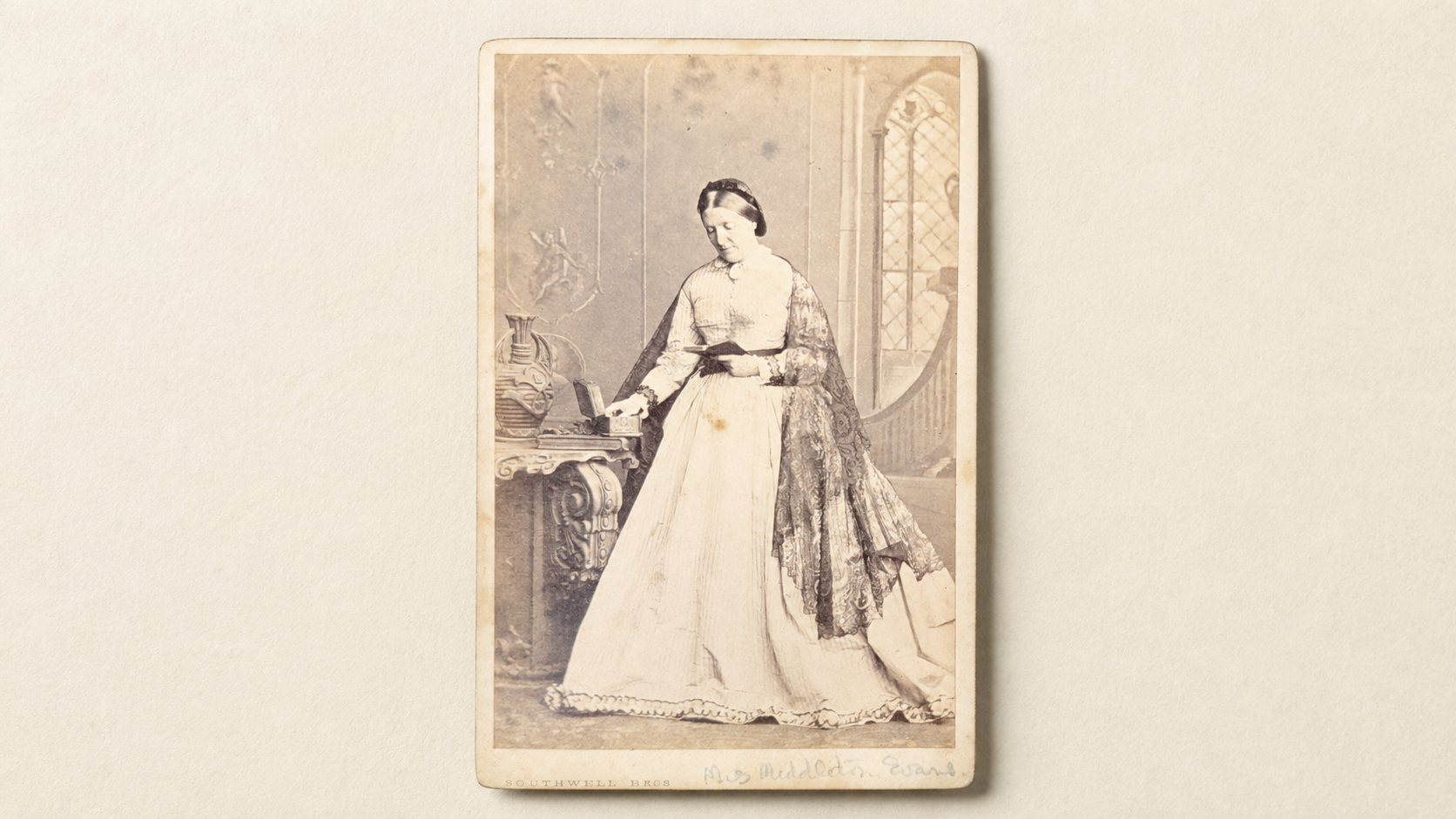
Old photographs have a habit of preserving a face while allowing almost everything around it to disappear. A sitter who once belonged to a family, a household and a recognisable social world can, within a few generations, become little more than an unnamed Victorian figure in a dealer’s box. Mary Anne Wilkins Lucas came very close to that fate. Her surviving carte de visite carries her married name faintly at the foot, but even her middle name was later misread, while much of her life disappeared behind the more easily documented careers of her father and husband.
The records now allow a very different picture to emerge. Mary was baptised at St Mary, Brecon, on 19 October 1825, the daughter of Henry John Lucas and his wife Theresa. In December 1849 she married Edward Middleton Evans of Llwynbarried, one of the established landowners of Radnorshire and High Sheriff of the county that year. She subsequently became the mistress of a substantial landed household, raised a family, and lived through the extraordinary transformation of Llandrindod Wells from a scattered rural district into one of the leading spa towns of Victorian Wales.
Yet none of those things provides the chief reason for remembering her. During the 1870s Mary became one of the most determined supporters of the campaign to establish a cottage hospital at Llandrindod Wells. She served on its Ladies Committee, organised fundraising, worked closely with those directing the scheme and, according to a contemporary account, wrote no fewer than 1,500 fundraising, or “begging”, letters. In a period when women possessed little formal political power, Mary used the position and connections available to her to help create an institution intended particularly for people who could not afford adequate medical care at home.
Her life connects several strands of nineteenth-century mid Wales, the medical world of Brecon, the landed society of Radnorshire, the rise of Llandrindod Wells, the beginnings of organised hospital care in the county, and the often overlooked civic work undertaken by women. What begins with an old photograph therefore leads into a much larger story.
A Daughter of Brecon’s Medical World
Mary’s background is particularly important because medicine was woven deeply into the family in which she grew up. Her father, Dr Henry Lucas, had moved from Carmarthen to Brecon and established himself as a successful physician there. R. C. B. Oliver, writing in the Transactions of the Radnorshire Society in 1981, described Mary as belonging to a third generation of medical people. When the Brecknock Infirmary opened in 1831, Henry Lucas became its first medical director. He later served as Mayor of Brecon and died while holding that office in 1840.
Medicine continued through the wider Lucas family. Henry’s sons included Dr T. E. Prestwood Lucas and Dr Henry John Lucas, who became well known in Brecon and Crickhowell. Oliver referred not only to their professional ability but to their particular devotion to their patients, rich and poor alike. Mary therefore grew up in circumstances where medicine was not simply a means of earning a comfortable living. It carried with it an expectation of public service.
The parish register provides the earliest secure point in her own life. At St Mary, Brecon, on 19 October 1825, Mary Anne Wilkins Lucas was baptised, the daughter of Henry John and Theresa Lucas. The entry is valuable for another reason. A later account rendered her middle name incorrectly as something resembling “Wilhui[s]”, but the original record leaves little room for doubt. She was Mary Anne Wilkins Lucas, and Wilkins formed part of her recorded name from childhood.
There is a small complication in descriptions of her place within the family. The contemporary announcement of her marriage in 1849 called her the fifth daughter of the late Henry Lucas, while Oliver later described her as the elder daughter of Henry Lucas by his second wife. The two descriptions need not be contradictory. They appear to reflect the structure of a family formed across more than one marriage. What is certain is that Mary belonged to an established professional household in Brecon and spent her formative years surrounded by medicine, civic service and the obligations that accompanied social position.
That background would become highly significant more than fifty years later, when a rapidly growing town across the county boundary found itself in need of a hospital.
Marriage into the Radnorshire Gentry
On 4 December 1849 Mary married Edward Middleton Evans at St Mary’s Chapel in the parish of St John the Evangelist, Brecon. The surviving register records both parties as being of full age. Edward was a bachelor and gentleman, resident in St Mary’s Ward, and the son of Morgan John Evans, gentleman. Mary was a spinster living in Morgan’s Ward and was identified as the daughter of Henry Lucas, physician.
The marriage was sufficiently notable to be reported in the London press. Edward was then High Sheriff of Radnorshire, one of the most prominent ceremonial offices within the county. His father, Morgan John Evans, had held the same position in 1819, and Edward’s appointment thirty years later reflected the established standing of the family within Radnorshire society. Edward had also been educated at University College, Oxford, taking his BA in 1845.
The marriage therefore brought together two neighbouring but rather different worlds. Mary came from Brecon’s professional and civic elite, a family whose reputation rested heavily upon medicine. Edward belonged to the landed society of Radnorshire, where property, magistracy, county office and family connections still carried enormous influence.
Mary’s married home was Llwynbarried, near Nantmel. In the middle of the nineteenth century a landed household such as this was more than a private residence. It functioned as part of the social machinery of the county. Family relationships, estate management, hospitality, charitable giving and connections with neighbouring landowners, clergy and professional families all overlapped. For women, much of the influence exercised within this world left few official records, but it could nevertheless be considerable.
Mary’s later activity demonstrates how those apparently domestic networks could be turned towards a wider public purpose.
Life at Llwynbarried
The 1871 census gives us the clearest glimpse of the Middleton Evans household during Mary’s married life. Edward was recorded at Llwynbarried as a magistrate and landowner, while Mary, born at Brecon, appears alongside him with their children. Among them was Henry, already an undergraduate at Oxford, as well as Herbert and several younger sons and daughters. A substantial number of domestic servants completed the household.
This was the familiar structure of a prosperous Victorian gentry home, but it should not be reduced simply to a list of names and servants. Mary stood at the centre of a household involving children at different stages of education, the management of domestic staff and the social responsibilities attached to a landed family. By the time she became heavily involved in the hospital campaign during the later 1870s, she had long experience of the correspondence, organisation and personal relationships upon which such a household depended.
Those skills mattered because Victorian voluntary institutions were built through networks. Before public services assumed many of the responsibilities later taken for granted, a new hospital might depend upon a landowner willing to give a site, a doctor prepared to work without payment, clergy willing to collect subscriptions, wealthy families prepared to donate, tradespeople willing to assist, and countless smaller contributions from ordinary residents. Someone had to bring those interests together and continue pressing when the initial enthusiasm had faded.
Mary proved particularly good at doing so.
The family’s later movements show that Llwynbarried was not their only home. In 1881 Edward and Mary were living in Cheltenham, where Edward was described as a landed proprietor and Mary, aged 57, was again recorded as having been born in Brecon. Two years later Edward appears in an estate transaction with an address at Ferryside in Carmarthenshire. These changes should not be interpreted too readily as a permanent withdrawal from Radnorshire. The family retained its estate interests and, when Mary was buried in 1887, she was still described as being of Llwynbarried.
Llandrindod Wells and the Making of a New Town
Mary’s adult life coincided with the transformation of Llandrindod Wells. When she married in 1849 there was not yet a town in anything approaching its later form. The mineral springs were well known and visitors had been travelling to take the waters for generations, but the district remained predominantly rural.
The arrival of the railway in the 1860s fundamentally altered its prospects. Suddenly the mineral waters were accessible to visitors travelling from the industrial towns and cities of Britain. Enclosure released land for development, hotels and boarding houses appeared, houses and shops followed, and the spa began to acquire the physical shape of a town.
The scale of the change is difficult to appreciate from the modern landscape. Llandrindod was not an old market town gradually expanding beyond a medieval core. Much of Victorian Llandrindod was being created almost from the ground upwards. Fields and common land became building plots, roads appeared, commercial premises were established, and the railway station became the point through which thousands of seasonal visitors entered the town.
The Middleton Evans estate was directly involved in this process. Surviving deeds and plans concern land around the Pump House, Railway Terrace and other areas affected by Llandrindod’s expansion. Agricultural land increasingly became development land, bringing the old structures of estate ownership into direct contact with builders, hotel companies, public bodies and a rapidly changing local economy.
Yet a town required more than hotels and building plots. The first generation of development had created the commercial spa, but a permanent community needed institutions. Schools, churches, local government, libraries and medical services gradually followed.
The campaign for a hospital belongs to this second stage in the creation of Llandrindod Wells.
The Beginnings of Llandrindod Wells Hospital
The fullest published account of the hospital’s origins is R. C. B. Oliver’s “Llandrindod Wells Hospital: Its Beginnings and Early Years”, published in the Transactions of the Radnorshire Society in 1981. Written to mark the hospital’s centenary, Oliver drew upon contemporary newspaper reporting and surviving records to reconstruct the difficult process by which the county’s first hospital was established.
The need was considerable. Even in 1871 the nearest doctor to Llandrindod was Charles E. Lomax of Cross Gates, several miles away. Later that year, or early in 1872, Dr William Bowen Davies arrived in the growing spa town. Originally from Llandovery, he had previously held a medical appointment in Jersey and appears to have recognised quickly the opportunities presented by the expanding “Cambrian Spa”.
Davies established himself permanently, building Brynarlais, a substantial house and surgery alongside the main road. Very soon he began discussing the possibility of establishing a cottage hospital and convalescent home. By this period hundreds of small cottage hospitals had appeared across Britain. Their purpose was to provide basic hospital treatment and trained nursing within a local setting, particularly for people whose own homes were unsuitable for proper medical care.
For Radnorshire the proposal had an additional geographical logic. Rhayader, Knighton and Presteigne, the county’s traditional market towns, were all relatively peripheral. Llandrindod occupied a more central position, possessed good railway connections and was rapidly emerging as the county’s most important new settlement.
Davies found support among local clergy, professional men and the landed families whose property surrounded the town. Edward Middleton Evans made one of the most important practical contributions by giving a site for the hospital, situated between the developing town and the railway crossing to the north.
Mary’s contribution was to prove still more personal.
Mary Middleton Evans and the Hospital Campaign
Oliver described Mrs Middleton Evans as Dr Davies’s “most enthusiastic collaborator”. Those words deserve attention because they place Mary not at the margins of the campaign but close to its centre. Her involvement was not simply the conventional patronage of a landowner’s wife whose name might lend respectability to a charitable subscription list. The surviving evidence shows sustained work over several years.
Oliver believed that Mary’s enthusiasm may have arisen partly from her upbringing within the Lucas medical family. It is a persuasive interpretation. Her father had helped establish institutional medicine in Brecon, her brothers and relatives continued the family’s medical traditions, and the Brecknock Infirmary had been part of her childhood world. When Llandrindod needed its own hospital, Mary was therefore supporting something she understood from personal experience.
The campaign moved into a more formal phase with a well-attended public meeting in the Assembly Room, High Street, Llandrindod Wells, on 21 August 1877. A committee of local gentry and clergy was appointed to advance the scheme, with Edward Middleton Evans as chairman and Dr Davies as honorary secretary. Promises had already been secured for £712 in donations and £128 in annual subscriptions.
Those figures were encouraging, but they did not mean that the hospital was safely financed. Money had to be collected, subscriptions maintained and new donors found. Buildings cost more than expected, equipment had to be purchased and the institution required continuing income once it opened.
This was where Mary’s particular contribution became indispensable.
At a later public meeting, the Rev. J. J. Evans of Llanyre revealed that Mrs Middleton Evans had written no fewer than 1,500 “begging” letters for the hospital. The phrase was the language of the time, but the figure is remarkable. In an age before telephones, email, photocopying or automated mailing, such a campaign represented a formidable undertaking.
The letters themselves do not appear to have survived in anything approaching that number, but it is possible to imagine the organisation required. Potential subscribers had to be identified, appeals written and sent, replies answered, promises recorded and donations acknowledged. People who had failed to respond might need to be approached again. Supporters had to be kept interested over a campaign lasting several years.
Even allowing for whatever assistance may have been available within a wealthy household, 1,500 letters reveal persistence on an extraordinary scale.
Mary also helped organise fundraising events. Oliver records that Mrs Middleton Evans and her friends made £72 profit from a bazaar, a substantial contribution towards a project in which every pound mattered. She became a member of the Ladies Committee alongside Clara Thomas, Mrs Venables, Mrs G. H. Philips, Mrs Gibson Watt, Mrs Thirlwall and Mrs Bowen Davies.
These women were doing much of the work upon which Victorian philanthropy depended. The formal committee contained the names of prominent landowners, clergy and professional men, but committees alone did not furnish hospitals. Money had to be raised through bazaars, collecting cards, church appeals, concerts, personal subscriptions and persistent correspondence.
Mary’s place in the story is unusually well documented because a contemporary speaker quantified that work. Fifteen hundred letters prevent us from dismissing her role as ceremonial.
Building a Hospital Without the State

The history of the campaign also reveals how different medical provision was before the twentieth-century welfare state. There was no National Health Service, no automatic expectation that central or local government would build a hospital, and no guaranteed public funding once one had been constructed. If Radnorshire wanted a hospital, local people had to find the land, raise the money, construct the building, furnish it and continue paying for its work.
The project therefore brought together different parts of local society. Landed families supplied substantial donations and influence. Clergy organised collections. Doctors contributed professional expertise. Visitors to Llandrindod were encouraged to subscribe, and tradespeople supported fundraising events. Oliver noted that some money had even been contributed by poorer people themselves, a striking indication of the interest felt in an institution intended largely for their benefit.
The hospital building was completed during 1880, but completion did not mean that it could immediately receive patients. At a meeting on 9 July that year Edward Middleton Evans was again in the chair while Dr Davies explained the financial position. The building had cost £1,008, £200 was still owed to the builder, and other unpaid bills included the architect’s fee of £123. There was, Oliver noted, no money left to furnish the building or lay out the grounds.
The problem captures the reality of Victorian voluntary provision. A generous public meeting could agree that a hospital was desirable, but years of work might follow before the doors could actually open.
The institution was finally furnished in February 1881. Even then the first patient was not admitted until July. The delay was perhaps unsurprising. Hospital treatment was still unfamiliar to many rural people, while admission depended upon the charitable structures established to regulate access.
The original rules stated that the Llandrindod Wells Cottage Hospital and Convalescent Home was intended for the poor of Radnorshire and Breconshire suffering from disease or accident, although infectious cases were excluded. Patients normally required recommendations from those who had subscribed to the institution. The system was paternalistic, but within the medical world of the 1880s it represented a major extension of care for people who might otherwise have had little alternative to treatment at home.
The hospital itself was tiny by later standards. It stood on a plot little more than forty-five feet along its longest side and contained two wards, a dining room, kitchen, pantry, matron’s accommodation and servants’ quarters. There was room for six adults and two children.
Its modest size should not obscure its importance. This was Radnorshire’s first hospital.
Medicine, Mineral Waters and the Early Hospital
The early hospital remained closely connected with the medical culture of the spa. Oliver recorded that patients were permitted free use of mineral waters associated with the Pump House Hotel. The hospital also enjoyed an unlimited supply of drinking water without charge from springs belonging to the Middleton Evans estate.
Dr Davies gave his services as Medical Director without payment and supplied medicines and drugs free during the hospital’s first year. Such arrangements demonstrate how heavily the institution depended upon individual generosity. It was not simply a building supported by subscriptions, but a network of people contributing land, money, professional labour, water, medicines, furnishings and time.
That context helps explain the significance of Mary’s fundraising. Her letters were part of a much wider economy of voluntary service in which personal relationships could determine whether a necessary institution survived. A hospital needed money continually, not merely at the moment of construction.
The relationship between the hospital and the mineral waters is also significant in understanding Victorian Llandrindod. The town had developed because of its reputation for health, yet the medicine of the hospital represented something rather different from the traditional spa cure. The two existed side by side, mineral water and therapeutic tourism on the one hand, professional medicine and trained nursing on the other.
Mary’s own life bridged those worlds. She belonged to the landowning family whose property was intertwined with the spa’s growth, but she came from the professional medical culture of Brecon and helped introduce an institution built upon more modern ideas of hospital treatment.
Women and Civic Power
Mary’s work deserves to be placed within the wider history of Victorian women. For most of her adult life women were excluded from formal political power. Married women faced substantial restrictions over property and legal independence, and the institutions of county government were overwhelmingly controlled by men. Yet it would be a mistake to conclude that women were absent from public life.
Charitable activity offered one of the principal routes through which women, particularly those from middle-class and landed backgrounds, could influence their communities. Hospitals, schools, church organisations, relief societies and visiting associations all depended heavily upon female labour. Women raised money, organised events, maintained correspondence, visited poorer families and built networks of support across social boundaries.
This could easily be dismissed as an extension of domestic responsibility, and nineteenth-century society often presented it in precisely those terms. In practice it could amount to considerable civic influence. Mary had no elected office and no formal authority over the developing town, yet she helped bring into existence an institution that survived her.
Her story is especially valuable because there is no need to invent a public role for her. The evidence is already there. She sat on the Ladies Committee, helped organise a profitable bazaar, worked alongside Dr Davies and wrote some 1,500 appeals. Contemporary testimony described her efforts as unwavering.
The example also reminds us that the building of Victorian towns was not solely the work of architects, businessmen and male civic leaders. Much of the social infrastructure depended upon work undertaken by women whose names rarely appeared on foundation stones.
The Surviving Carte de Visite
The surviving portrait gives Mary’s story an unusually personal focus. It was taken by the Southwell Brothers of Baker Street, London, whose imprint survives both beneath the image and on the reverse of the card. They styled themselves “Photographers Royal”, and their Baker Street studios belonged to the fashionable world of Victorian portrait photography.
Mary is shown standing beside an elaborate studio table. One hand rests close to a small object on the table, while in the other she appears to hold a book or album. A richly patterned shawl falls from her shoulders and across the side of her dress. Behind her is the carefully arranged scenery of the Victorian photographic studio, architectural forms, a tall window and decorative furnishings intended to create an atmosphere of cultivated respectability.
It is an accomplished portrait and one consistent with the position of the Middleton Evans family. This was not a quick photograph produced by a local itinerant photographer, but a visit to a fashionable London studio. The carte de visite itself appears to date from the 1860s, when Mary would have been a woman in her late thirties or early forties.
The temptation with such photographs is to try to read character from the sitter’s face. Mary looks down rather than directly towards the camera, but it would be unwise to turn that into a judgement about her personality. Victorian portraiture was carefully staged and expressions were governed by convention as much as individual temperament.
The documentary evidence tells us far more. Whatever Mary may have been like in private, she was capable of sustained organisation and persistence. The woman who stands quietly in the Southwell Brothers’ studio is the same woman who later wrote hundreds upon hundreds of letters in pursuit of a hospital for Llandrindod.
The faint identification at the bottom of the card is therefore particularly valuable. The photograph is not simply an illustration to accompany her biography. It is itself one of the surviving sources through which her identity has been recovered.
Later Years and Death
By 1881 Edward and Mary were living in Cheltenham, although their connection with Llwynbarried remained. Edward was described in the census as a landed proprietor, while Mary was recorded as aged 57 and born in Brecon. Estate material later places Edward at Ferryside in Carmarthenshire.
The reasons for these movements remain uncertain. They may have reflected family circumstances, health, estate management or simply the habits of a landed family with the means to reside elsewhere. Without further evidence it would be wrong to impose a narrative of withdrawal or decline upon them.
Mary’s final secure record lies back in Radnorshire. The burial register for the parish of Nantmel records Mary Anne Middleton Evans, of Llwynbarried, buried on 12 February 1887, aged 63. Her recorded age does not fit perfectly with the baptism of October 1825, but discrepancies of this kind are far from unusual in nineteenth-century records. Her distinctive married name and the reference to Llwynbarried leave little doubt about the identification.
The burial date is not necessarily the date of death, and until a death notice or civil certificate provides greater precision it is best to preserve that distinction. What can be said is that Mary died in early February 1887, only a few years after the hospital had begun receiving patients.
She had therefore lived long enough to see the result of the campaign to which she had devoted so much effort.
In late 1892 Edward Middleton Evans’s engagement to Mrs T. Ridgeway was announced, by which point he had been a widower for more than five years. That later event closes one uncertainty which once surrounded Mary’s chronology, but by then her own story had already ended.
Recovering Mary
The reconstruction of Mary’s life illustrates how easily women can disappear from the historical record even when they belonged to prominent families. At first sight, the documents seemed to tell us considerably more about Edward Middleton Evans than about his wife. Estate deeds bore his name, county lists recorded his public offices and university records documented his education. Mary appeared intermittently, as daughter, wife, mother and eventually widow’s predecessor.
Once the search was widened, a different picture emerged. Her baptism restored her full name and parentage. Her marriage register connected the professional Lucas family with the landed Middleton Evanses. Census returns revealed the family household at Llwynbarried and their later residence in Cheltenham. The Nantmel register supplied the end of her life.
Most importantly, the history of Llandrindod Wells Hospital restored Mary’s own public activity.
This is where genealogy and local history complement one another particularly well. Genealogy establishes who a person was, when they lived and how they were related to others. Local history explains the community around them and allows individual lives to be understood in context. Without the genealogical evidence Mary risks becoming simply “Mrs Middleton Evans”. Without the hospital records, the most significant part of her adult life remains hidden.
The surviving carte de visite adds the final human element. The face can now be joined to the name, the name to the family, and the family to the history of the town.
Why Mary Matters to Llandrindod Wells
Mary Anne Wilkins Lucas does not need to be turned into a national reformer to deserve attention. Her importance is local, and that is precisely what makes it valuable. Llandrindod Wells was not created by one great founder. It was made through the accumulated efforts of landowners, doctors, builders, hoteliers, tradespeople, clergy, visitors and residents who gradually gave the new settlement the buildings and institutions of a town.
Mary belonged to that generation. Through marriage she was connected with land that formed part of Llandrindod’s physical development, but through her own work she became associated with something more enduring. Edward Middleton Evans provided the hospital site and chaired its committee. Dr William Bowen Davies supplied the medical vision and professional leadership. Mary brought persistence, organisation and an extraordinary commitment to fundraising.
Her 1,500 letters are perhaps the most revealing memorial she could have left. They represent hours of work which no photograph could capture and no formal office required. They also remind us how much of nineteenth-century civic life depended upon people prepared to perform repetitive, often thankless tasks until a scheme became reality.
It is easy to describe Victorian women through the achievements of fathers and husbands because the records themselves encourage us to do so. Mary was indeed the daughter of Dr Henry Lucas and the wife of Edward Middleton Evans, and both relationships help explain the world in which she lived. Neither, however, is sufficient to explain why she deserves to be remembered.
Her own actions do that.
The old Southwell Brothers portrait preserves Mary as she appeared more than a century and a half ago, standing quietly within the carefully arranged surroundings of a fashionable London studio. The records restore something the photograph alone cannot show, her place in the history of the community in which she lived.
Mary Anne Wilkins Lucas was a daughter of Brecon’s medical world, a member of the Radnorshire gentry, the mistress of a substantial Victorian household and one of the determined people who helped give Llandrindod Wells its first hospital.
That is a history worth recovering.
Explore more Llandrindod Wells history
Continue with the Pump House Hotel, the Gwalia Hotel, or browse the Llandrindod Wells History guide.
Sources and Further Reading
- St Mary, Brecon, baptism register, 19 October 1825, recording Mary Anne Wilkins Lucas, daughter of Henry John and Theresa Lucas.
- St Mary’s Chapel, parish of St John the Evangelist, Brecon, marriage register, 4 December 1849, recording the marriage of Edward Middleton Evans and Mary Anne Wilkins Lucas, daughter of Henry Lucas, physician.
- 1871 Census of England and Wales, Llwynbarried, Radnorshire, recording Edward Middleton Evans as magistrate and landowner, with Mary, their children and household.
- 1881 Census of England and Wales, Cheltenham, Gloucestershire, recording Edward Middleton Evans as landed proprietor and Mary, aged 57, born at Brecon.
- Nantmel parish burial register, 12 February 1887, recording Mary Anne Middleton Evans, of Llwynbarried, aged 63.
- London Evening Standard, 3 May 1845, Oxford degree notice relating to Edward Middleton Evans.
- London Evening Standard, 14 February 1849, list of sheriffs, recording Edward Middleton Evans of Llwynbarried as High Sheriff of Radnorshire.
- London Evening Standard, 7 December 1849, marriage notice describing Mary as the fifth daughter of the late Henry Lucas, MD, of Brecon.
- R. C. B. Oliver, “Llandrindod Wells Hospital: Its Beginnings and Early Years”, Transactions of the Radnorshire Society, Vol. LI, 1981, pp. 7–11.
- Powys Archives, Brecknock Museum Transfer, B/D/BM/A/7, material relating to Dr Thomas Prestwood Lucas and the Lucas medical family.
- Powys Archives, R/X/11/349 and R/X/11/350, genealogical and associated material relating to the Lucas and Middleton Evans families.
- Powys Archives, A/150/22, plan of sale of the Middleton Evans Estate.
- Powys Archives, A/150/23, abstracts, copy deeds and associated papers concerning the Middleton Evans Estate, including material relating to the Pump House Hotel.
- Powys Archives, A/150/18, agreement concerning the later sale of parts of the Middleton Evans Estate to Llandrindod Wells Urban District Council.
- Surviving carte de visite portrait identified as Mrs Middleton Evans, Southwell Brothers, Photographers Royal, 16 and 22 Baker Street, London, private collection.
The surviving evidence still leaves some questions unanswered. Mary’s exact date of birth has not yet been established, and the age recorded at her burial does not agree precisely with her baptism in October 1825. A contemporary death notice, probate material or further family correspondence may eventually add more to the circumstances of her final years. What survives is nevertheless sufficient to recover something much more important than a sequence of dates, the place Mary Anne Wilkins Lucas occupied in the social and civic history of Victorian Llandrindod Wells.