
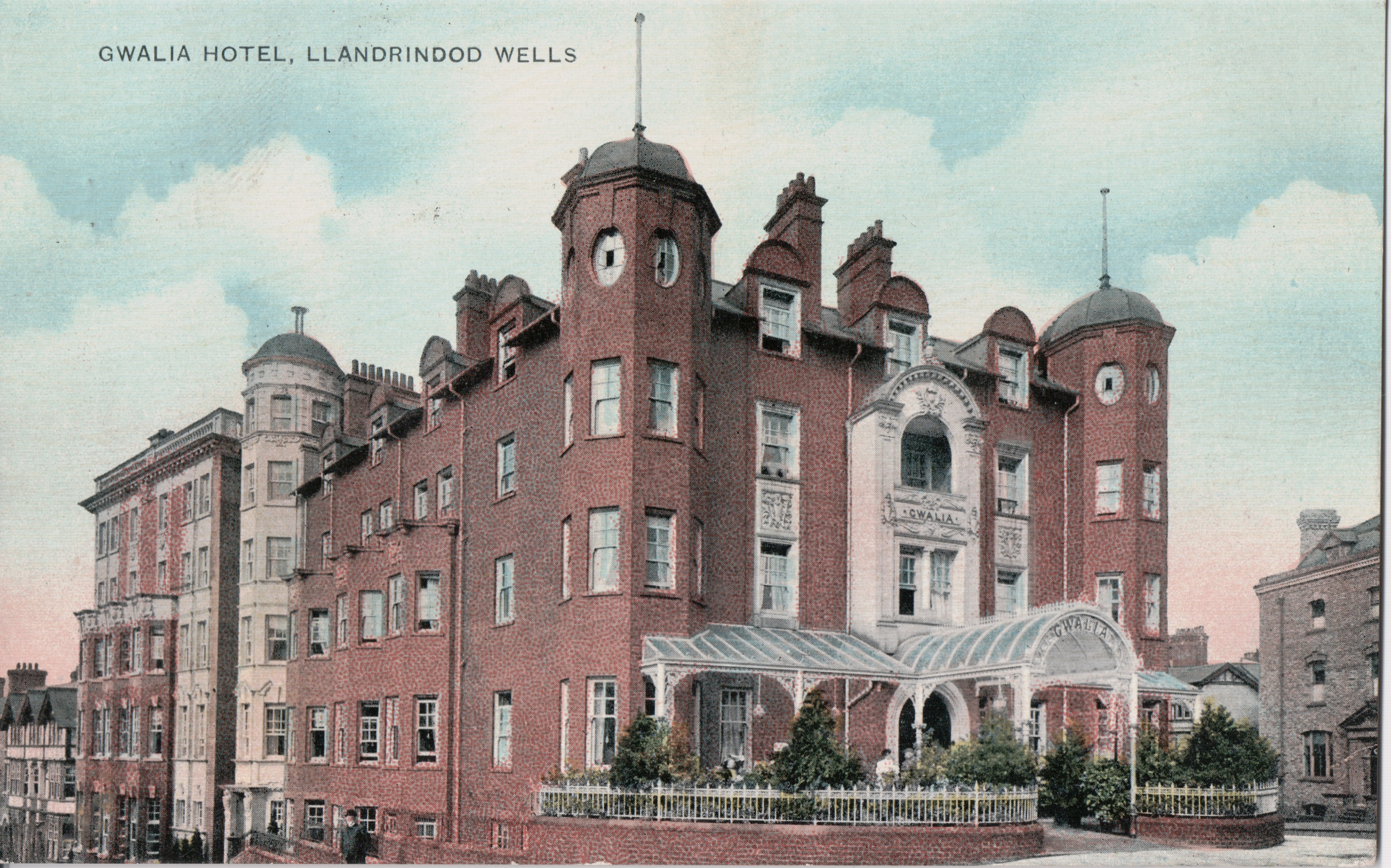
Some buildings sit quietly in the landscape, fixed to the moment that produced them. The Gwalia never behaved like that. It began as a modest private hotel on one side of the road, expanded almost immediately, crossed the road into a purpose-built establishment of national ambition, and eventually became one of the principal hotels of Llandrindod Wells. Later it passed into local government. Across those different lives, the Gwalia gathered together proprietors, servants, invalids, holidaymakers, politicians, musicians, preachers, councillors and clerks.
Its story has often been blurred with those of Ye Wells or the Pump House Hotel, but they were different places. The confusion has also hidden another important distinction: there were effectively two Llandrindod Gwalia hotels in succession. The first opened in 1889 in a smaller building on the opposite side of the road from the later hotel. The second, the great red-brick building familiar today, was a new purpose-built establishment opened in 1898.
The Gwalia matters because it was more than a hotel. It was a family enterprise, a workplace, a Welsh cultural institution, a political meeting place, a spa establishment and, in its later years, a large interwar resort hotel. Census returns, newspapers, surviving correspondence, municipal records, the 1939 Register and personal recollections allow something of that layered institution to be recovered.
From Cardiganshire to London
The story begins with Edward and Elizabeth Jenkins. Edward was born at Capel Sion in Cardiganshire in 1836 and began his working life as an apprentice in the drapery trade at Aberystwyth. He later worked in Shrewsbury before moving to London. Elizabeth Meredith, also born in Cardiganshire, likewise made her way to the capital. They married at Old Jewin Street Chapel in April 1867.
In London the couple established the Gwalia at Upper Woburn Place. The name was deliberate. Gwalia, a poetic name for Wales, announced a Welsh identity in the middle of the metropolis. Contemporary advertising stressed the hotel’s convenience for Euston, St Pancras and King’s Cross, while later photographs and advertisements show a substantial establishment serving travellers from Wales and beyond.
The London Gwalia was more than a railway hotel. Welsh visitors used it as a familiar base in the capital, and some guests stayed for long periods. The German Orientalist Heinrich Wenzel, a scholar of Tibetan and Indian languages, lived there for roughly six years. The London business gave Edward Jenkins both experience and a commercial identity that he would later transfer to Llandrindod Wells.
The first Gwalia in Llandrindod

Edward Jenkins brought the Gwalia name to Llandrindod Wells in 1889. The first establishment stood in a more modest building on the opposite side of the road from the later hotel. It was initially advertised as the “Gwalia Private Hotel and Boarding Establishment”, a description that places it within the older world of residential spa accommodation rather than the grand-hotel culture that followed.
Its success was immediate. By July 1890 Jenkins was advertising an “important extension” comprising nineteen additional bedrooms, together with a drawing room, billiard room, smoking room, hairdressing and shaving saloon, lending library and news-room. The terms were £2 5s a week or 7s a day. Visitors were promised home comforts and proximity to the saline, sulphur and chalybeate springs.
The scale of that expansion is revealing. Within barely a year the original Gwalia was already being enlarged to accommodate a rapidly increasing business. The hotel was also becoming more than a place to sleep. Reading, billiards, grooming, conversation and the social routines of a long spa stay were built into the offer from the beginning.
A new hotel across the road

The original building could not contain the business for long. On Monday 27 September 1897 the foundation stone of what newspapers already called the “New Gwalia Hotel” was laid on the opposite site. A decorated platform had been erected for the ceremony, and Mrs M. Mordey, wife of the chairman of the Gwalia Company, formally laid the stone. That evening a banquet was held at the existing Gwalia.
Swash, of Swash and Bain, the architects, described a building intended to be up to date in every respect. The projected cost was between £9,000 and £10,000 and the hotel was expected to be ready for occupation early in the following season. Alderman Mark Mordey and other figures connected with the company were prominent in the proceedings, while Edward and Elizabeth Jenkins were publicly praised as the popular manager and manageress.
The new Gwalia formally opened on Wednesday 27 July 1898. This date is unusually well supported. Contemporary opening reports identify the event, and an advertisement issued by Gwalia Hotel Ltd in November 1899 looked back on the company’s history and stated that the new premises had opened on 27 July 1898. The same advertisement traced the Llandrindod business to its beginnings in 1889 and described the new hotel as the culmination of the extensions required by rapidly growing trade.
The distinction matters. The great Gwalia was not merely an enlargement of the first establishment. It represented the transfer of an already successful business into an entirely new purpose-built hotel across the road.
The new building was erected by D. Jenkins of Swansea from designs by Swash and Bain of Newport. Ruabon brick, Bath stone dressings, carved panels and domed corner towers gave the hotel a commanding presence above Rock Park. Inside, a central hall with stained glass, mosaic flooring and draped arches led to a grand staircase and galleries. The principal floor contained the dining room, drawing room, writing room and smoking room, while about fifty-eight bedrooms occupied the upper floors.
Electric light, a passenger lift and hot-water heating advertised modernity. Contemporary accounts of the opening also show how deliberately the hotel had been equipped for the habits of late-Victorian visitors. J. Shoolbred & Co. of London supplied furnishings, while the building included hairdressing saloons, recreation and card rooms, servants’ accommodation, bicycle storage and even a photographic darkroom. Below stairs lay kitchens, sculleries, stores and service rooms. A circulating library connected with Mudie’s and a stationery and fancy-goods department helped fill the long hours of a spa season. The Gwalia was designed not simply for invalids taking the waters, but for cyclists, photographers, commercial travellers and long-stay holidaymakers as well.
The opening celebrations also reveal something of Edward Jenkins’s own philosophy of hospitality. About 130 people attended the banquet connected with the new hotel, and speakers praised the Jenkins establishments for their cleanliness, generous tables and cordial welcome. Jenkins himself reportedly remarked that there was “religion in making people comfortable”. The phrase is unusually revealing. For him, hospitality, commerce and Nonconformist values were not separate worlds, and the character of the Gwalia reflected that combination.
A hotel that kept growing
The Gwalia of 1898 was only the beginning. Municipal building records show alterations and additions in 1900, a substantial programme represented by five plans and specifications in 1906, and further internal alterations in 1912. Later advertisements sometimes described the business as “Established 1889, 1898 and 1908”, effectively presenting its development in three stages: the first Llandrindod house, the new purpose-built hotel and a later phase of enlargement.
This repeated expansion explains how an establishment opening with roughly fifty-eight bedrooms could later advertise around 120. The familiar Gwalia was not the product of a single building campaign but of continuing investment through the prosperous years of the spa.
Edward and Elizabeth Jenkins

Edward and Elizabeth lived in the hotel and managed it directly. The 1911 census placed Edward, aged seventy-four, at the head of the establishment as a private hotel manager, with Elizabeth assisting in the business. Their niece, another Elizabeth Jenkins, was assistant manageress. Ownership, management and family life overlapped within the same building.
Edward became so closely associated with the hotel that he was affectionately known as “Jenkins of the Gwalia”. His interests reached far beyond commerce. He served twice on Llandrindod Wells Urban District Council and was a Justice of the Peace for Radnorshire. He was active in eisteddfodic life, wrote Welsh poetry and song lyrics, worked in the alliterative metres and gave practical encouragement to young Welsh musicians and poets.
His religious commitments were equally strong. He had rendered service to Calvinistic Methodist churches while in London and later became an elder of the Presbyterian Church at Llandrindod. He was remembered as the first president of the Central Wales Federation of Free Churches and as one of those who helped establish the Llandrindod Wells Free Church Council. His support for Welsh religious and cultural life helps explain why the Gwalia so often functioned as more than a commercial hotel.
Jenkins’s influence also reached beyond the hotel itself. The history of the neighbouring Albert Hall records that he suggested its name, drawing a conscious parallel between Llandrindod and London: his London Gwalia stood near the Royal Albert Hall, and the Llandrindod Gwalia likewise stood beside the new hall. The story neatly captures the way Jenkins transplanted elements of his London Welsh experience into the developing spa town.
Edward and Elizabeth’s golden wedding in April 1917 was celebrated in the lounge of the Gwalia. The Hotel Company presented them with a gold fruit bowl, while visitors gave Elizabeth a gold bracelet watch and an amethyst brooch set with pearls, and Edward gold cuff links and a gold pencil case. Guests also contributed verses and drawings to a commemorative album. The occasion reveals how thoroughly the Jenkins family home and the hotel’s social life had become intertwined.
Elizabeth died in March 1919, aged eighty-two. Her funeral was itself a major local event. Services were held at the hotel, the Presbyterian Church and the cemetery, and the press noted the attendance of many leading townspeople. Edward received more than 150 messages of sympathy from political, religious and cultural figures across Wales.
Edward remained at the head of the hotel into old age. In the 1921 census he appeared as an eighty-five-year-old widower, still described as hotel manager and employer. He died on 28 July 1925, in his eighty-ninth year.
His obituary offered the fullest contemporary assessment of his life. It recalled his Cardiganshire origins, his years in Aberystwyth, Shrewsbury and London, his creation of the London Gwalia and his arrival in Llandrindod in 1889. It also remembered him as a bard, an eisteddfod worker, a supporter of young musicians, a civic figure and a committed Liberal. No single role was enough to describe him.
The working hotel

The 1911 census provides the clearest view of the Gwalia as a working community. Thirty-four people slept there on census night. Only a minority belonged to the Jenkins family. The rest were resident staff and boarders whose labour and presence made the hotel function.
Senior women translated the proprietors’ standards into daily routines. There were housekeepers, bookkeepers, chambermaids, waitresses, cooks, kitchen maids and scullery workers. Male employees included a chef, boots and sculleryman. The polished world seen by guests depended upon a much less visible world of heat, cleaning, carrying, washing, cooking and constant attention.
Staff came from rural communities across Wales and neighbouring English counties. For young women in particular, hotel service offered paid employment away from the farm or family home. It provided board and lodging and a measure of independence, but demanded long hours and discipline.
The hotel was also a meeting place of languages and classes. Some employees were bilingual in Welsh and English, while others spoke only English. Boarders included retired professionals, business people and longer-term residents. In the same corridors moved proprietors, servants, invalids, commercial travellers and visitors of private means.
Contemporary visitor lists underline the Gwalia’s place within the hierarchy of the spa. In 1901 the Pump House, Gwalia and Rock House regularly headed the published hotel returns, ahead of the town’s smaller establishments. At the height of the season the lists could become so long that the Radnorshire Standard issued them as separate supplements. A surviving Gwalia visitor book covering 1901 to 1910, now represented at Powys Archives with the original recorded at Radnorshire Museum, offers an unusually rich record of the clientele behind those published totals and has the potential to reveal patterns of repeat visits, family parties and longer stays beyond the better-known celebrity guests.
Politics, Lloyd George and Welsh public life
The Gwalia’s political associations began before the new hotel existed. David Lloyd George was staying at the earlier Gwalia by 1895. A surviving letter written there on 21 June records the success of the Llandrindod conference involving Cymru Fydd and the Welsh Liberal Federation and celebrates the carrying, despite strong opposition, of a resolution in favour of “home rule all round”. Margaret Lloyd George also wrote approvingly of the speech. The evidence places the old Gwalia firmly inside the political world of Cymru Fydd before the purpose-built hotel had even been conceived.
The same hotel appears in a more private episode from that month. Lloyd George was there with Herbert Lewis when Lewis received news of the death of his wife Ada. Lloyd George stayed with him and helped with the immediate arrangements. Public politics and private grief occupied the same rooms.
Lloyd George continued to use the new Gwalia almost as soon as it opened. Correspondence places him there on 4 September 1898, little more than five weeks after the formal opening and on the eve of another public meeting. Further letters show repeated political visits. In 1903, after what he called a “triumphant meeting”, he wrote from the Gwalia that he was “staying with Jenkins”; after returning to London he remarked that “Llandrindod has created a great impression”. Surviving correspondence also places him at the Gwalia around another successful Llandrindod meeting in 1904 and again on 30 August 1905. The pattern is therefore one of repeated political use of the hotel rather than an occasional stay.
That relationship became part of the hotel’s identity. Edward Jenkins’s 1925 obituary described him as a lifelong personal friend of Lloyd George and claimed that the former prime minister affectionately called him “The Guv’nor”. It also stated that Lloyd George habitually made the Gwalia his home when staying in Llandrindod.
The hotel was repeatedly used for Liberal meetings. On 30 November 1910 Lloyd George, then Chancellor of the Exchequer, arrived during the general election campaign in support of Sir Francis Edwards. He was received at the Gwalia by a gathering of Welsh Liberal politicians and civic figures before addressing an enthusiastic audience on the People’s Budget and the House of Lords.
At Easter 1912 Welsh Liberal members met privately at the hotel to discuss what concessions they were prepared to allow Reginald McKenna over the Welsh Church Bill. Edward Jenkins was given the task of guarding the door against interruption. Years later a journalist remembered Jenkins laughing that, while keeping everyone else away, he had himself been able to hear the politicians arguing on the other side.
The pattern continued after the First World War. In June 1924 Lloyd George attended a meeting of Liberal members at the Gwalia during a conference intended to reconcile the divided wings of Welsh Liberalism. In March 1927 a Liberal “Ginger Group” was formed there in an attempt to revive the party and reconnect it with younger Nonconformists, students and workers who had moved towards Labour.
By then the hotel’s political reputation was almost proverbial. A correspondent writing in 1928 about the Welsh National Federation recalled arriving in Llandrindod and instinctively making for the Gwalia, confident that he would find the political entourage installed there. That assumption tells us as much as any formal meeting notice. The Gwalia had become a habitual political headquarters in the town.
The same 1928 account also revealed a different side of hotel life. The two women sharing the management explained that the Gwalia kept a “prophet’s chamber” in which itinerant Methodist preachers supplying the local pulpit were entertained. Politics, Nonconformity, hospitality and business existed side by side.
Other distinguished visitors reflected different aspects of Welsh and British public life. The Celtic scholar Sir John Rhŷs wrote from the Gwalia in September 1899. Edward Elgar stayed in December 1906 and again in February 1909 while seeking relief through the waters and exercise. One surviving postcard identified his room at the hotel simply as “My room”.
War, service and continuity
The First World War entered the Gwalia directly. In April 1918 Major James German, chairman of a Prisoners of War Fund, was staying there while guests organised an energetic appeal. Visitors contributed possessions for an auction that raised £250, a golf competition brought in a further £31 9s, and Sir Francis Edwards gave ten guineas.
The war also touched the hotel through its employees. John “Jack” Bevan of Brecon worked at the Gwalia before enlisting in November 1914. He later served on the Western Front with the Monmouthshire Regiment and died of wounds on 4 June 1918, aged twenty.
Advertising shows that the hotel continued to invest in comfort during the war. In 1916 it was described as one of the most comfortable private hotels in the Principality and was said to have been lately renovated throughout. The Gwalia remained open, modernised and socially active through years of national disruption.
The interwar resort hotel

By the 1920s the Gwalia was selling far more than accommodation near the springs. In 1920 it styled itself “The Premier Hotel of the Mineral Spas of Wales”, stressing its central position, south-west aspect and proximity to the Pump Room, baths, golf links, lake and River Ithon. The mature Gwalia marketed the complete Llandrindod experience of treatment, scenery and recreation.
Sport formed an important part of that identity. In 1923 the hotel advertised a Ladies’ and Gentlemen’s Golf Challenge Bowl for Whit Monday, with an orchestra engaged for dances during the holidays. Visitors were also offered the right of five miles of fishing. By 1927 the Gwalia Hotel Whitsuntide Challenge Cup had become an established event, and one competitor that year arrived in Llandrindod by aeroplane.
Fishing was promoted as an attraction in its own right. A 1930 advertisement described the hotel as particularly convenient for anglers, overlooking Rock Park and the Ithon Valley and offering five miles of preserved trout fishing. Golfers, anglers, spa visitors and holidaymakers were all being courted as distinct but overlapping markets.
The hotel also developed a substantial social programme. A 1926 advertisement listed lounges, a ladies’ drawing room, billiards and a dance room, together with two electric lifts and central heating. By 1933 a dance band was playing every Saturday. Later Easter programmes included billiards, table-tennis tournaments, whist drives and dances.
The medical side of the Gwalia should not be overlooked. Ground-floor bedrooms and invalid diets were advertised in the 1920s, while by 1937 the hotel promoted a complete electrical and hydropathic installation. At that date it offered 120 bedrooms and accommodation for 200 guests, two lifts, central heating, hot and cold water in bedrooms, a dance room, two billiard tables, free use of a swimming pool and garage space for thirty cars.
The distinction between hotel and health establishment had therefore become increasingly blurred. The Gwalia was no longer simply a place near the mineral springs. Guests could sleep, dine, take treatment, fish, golf, dance, play billiards and socialise within a single resort experience.
The motor car changed the way visitors reached the town, and the Gwalia adapted. AA and RAC recognition and substantial garage accommodation appeared alongside the older language of waters, baths and railway travel. The hotel was modernising without abandoning the spa identity on which it had been built.
The final hotel generation

Management passed into the next generation after Edward Jenkins’s death. The 1939 Register records Elizabeth Jenkins, born in 1867, as manageress. She had spent most of her adult life within the business and represented a direct continuity between the founders and the hotel’s final years.
A later notice appears to provide a final link with the Jenkins generation. In 1956 the Welsh Gazette reported the death at Capel Seion of a Miss Elizabeth Jenkins, formerly of the Gwalia, aged nearly ninety. The age and association strongly fit the niece and later manageress recorded in the hotel’s earlier records, although without the full obituary the identification is best treated with a little caution. If so, her death closed a personal connection with the Gwalia that had stretched back into its founding generation.
The 1939 Register also shows how substantial the establishment remained. Staff included housekeepers, bookkeepers, a private secretary, chambermaids, pantry maids, kitchen workers, cooks, waitresses and domestic servants. Residents of private means shared the building with the young women and men whose labour sustained them.
One later recollection preserves the social world of the staff. A woman remembered simply as Lizzie spent much of the 1930s working at the Gwalia and recalled the girls from Merthyr eagerly awaiting the weekly arrival of the Merthyr Express. The newspaper carried home into the hotel and maintained links between migrant workers and the communities they had left behind.
Among the hotel’s more remarkable later residents was Richard Dixon Oldham FRS, one of the pioneers of modern seismology. The Royal Society records the Gwalia as his place of death on 15 July 1936. His presence is a reminder that the hotel could also function as a semi-residential home for people staying over longer periods.
Even on the eve of war the Gwalia was still functioning as a full resort hotel. Easter 1939 advertising promoted challenge bowls, billiards and table tennis, whist drives and dances. In March 1940, after the outbreak of the Second World War, the hotel was still advertising Easter holidays built around golf, billiards, table tennis and dancing.
The outbreak of war therefore did not immediately end ordinary hotel life. The Gwalia was later requisitioned for military use, however, and it never reopened as a hotel. The old spa economy had weakened, domestic service was harder to recruit, travel patterns had changed and maintaining a building of such scale had become increasingly difficult.
Sale and conversion
In August 1948 the directors of Gwalia Hotel Ltd offered the property for sale with vacant possession. It was advertised with 105 bedrooms, twelve bathrooms, dining room, ballroom, billiard room, bars, reception rooms, offices, staff rooms, stores, lifts and a staff annexe.
The building was offered at auction on 21 September. Contemporary reporting then shows that Radnorshire County Council made a separate offer of £25,000, which the company accepted by November. The council intended to convert the former hotel into new county offices.
The proposed purchase was not universally welcomed. Within days a correspondent questioned whether Radnorshire should commit such a sum before the Boundary Commission had settled the future structure of local government. With county amalgamations being discussed, there was concern that a large headquarters might become an unnecessary burden. The argument places the Gwalia’s conversion within a wider debate about the future of Welsh local government.
Conversion followed. County departments previously dispersed across several premises were brought together during 1950, and on 18 May 1951 Captain Geoffrey Crawshay formally opened the former hotel as Radnorshire County Hall. Bedrooms became offices, reception rooms became committee spaces and service areas became administrative rooms.
By 1952 the old hotel was already being remembered historically. Speaking at a Llandrindod Wells Welsh Society dinner, T. I. Ellis recalled visiting the town fifty years earlier and referred to the old Gwalia as a place that had become “famous in the history of Wales”. That judgement now seems less extravagant than it might once have done.
From county hall to public building
The Gwalia served Radnorshire County Council until 1974, then Radnorshire District Council until 1996. Powys County Council later used it as an area office, and the library moved there in 2014.
There is an appropriate irony in my own connection with the building through Powys Archives. While on secondment with the archive service, I worked in the Gwalia’s basement. Powys Archives itself records that a deed chest containing a substantial group of Llandrindod Wells Urban District Council documents had been discovered in the basement strongroom of the former council offices. By then the spaces that had once served hotel life had become repositories for the documentary memory of the town.
An uncertain future
Powys County Council placed the Grade II listed Gwalia on the market in 2024 with an asking price of £250,000. Disposal has proved more difficult than the original marketing suggested. A proposed sale had fallen through by July 2025. The council then authorised renewed negotiations and a revised disposal process, but in May 2026 councillors were told that a second prospective sale had also collapsed. The asking price was subsequently reduced to £225,000. The building therefore remains unsold after two serious attempts at disposal, and its future is still unresolved.
The building covers about 4,133 square metres over six levels. Its scale is both opportunity and difficulty. Any new use must meet the costs of maintaining a very large listed structure. Housing, hospitality, offices, cultural use or mixed schemes are conceivable, but none is simple.
Its Grade II status protects more than the familiar red-brick exterior. The entrance hall still preserves galleries on three sides at two levels, decorative ironwork balustrades, wooden newel posts, plasterwork and Art Nouveau glass rising through the stair hall, while the former council room retains a classical plaster frieze and dentilled cornice. These survivals preserve something of the spatial experience of the hotel itself.
The library closed at the Gwalia on 7 December 2024 and reopened in Radnorshire Museum in January 2025, a move connected with the council’s intention to dispose of the building. Even so, the Gwalia is not entirely dormant. It still serves as a Powys Register Office, and the Rock Park Room remains an approved venue for civil ceremonies.
Remembering the Gwalia
The temptation with a building like the Gwalia is to remember the architect and the opening date, then move on. The surviving evidence demands more. The hotel was created by Edward and Elizabeth Jenkins, but it was sustained by generations of chambermaids, cooks, waitresses, bookkeepers, porters, managers and other workers whose names are scattered through census returns and registers.
It was also one of those rare establishments in which different strands of Welsh life repeatedly crossed. Spa visitors came for treatment, politicians came to organise and argue, preachers were entertained, musicians and poets found encouragement, golfers and anglers returned for sport, and longer-term residents made the hotel their temporary home.
The political history alone gives the building unusual significance. From Cymru Fydd and the Liberal movement of the 1890s through Lloyd George’s repeated visits, the Welsh Church discussions of 1912, the Liberal negotiations of the 1920s and the later “Ginger Group”, the Gwalia became one of Llandrindod’s recognised meeting places for national Welsh affairs.
Its later civic life did not erase that inheritance. Hotel workers gave way to council officers, guests to members of the public, and ledgers to official files. The purpose changed, but the building remained a place where private lives met larger institutions.
Read alongside the still-operating Hotel Metropole, the Gwalia also shows the different ways Llandrindod’s great hotels survived the decline of the old spa economy: one through continued hospitality and repeated commercial reinvention, the other through adaptation to public and civic use.
Related Essays
- Llandrindod Wells Hospital: From Cottage Hospital to County War Memorial
- Board and Lodging: The Boarding Houses of Llandrindod Wells
- Bowling in Llandrindod Wells: From the Spa Greens to Rock Park and the Indoor Game
- From the Pump House Links to Death or Glory: A History of Golf in Llandrindod Wells
- From Spa Town to Administrative Capital: Civic Government and the Making of Llandrindod Wells
Explore more Llandrindod Wells history
Continue with the Llandrindod Wells History guide, or follow the related essays above to explore the people, buildings and institutions that shaped the town.
Sources and Further Reading
This essay draws upon contemporary newspaper reporting, census returns, the 1939 Register, civil registration, surviving correspondence, historic advertisements, municipal building records, archival catalogues and surviving images of the Gwalia. Gwalia, 16 July 1890, advertisement for the original Llandrindod Gwalia and its nineteen-bedroom extension.
South Wales Daily News, 29 September 1897, report of the laying of the foundation stone of the New Gwalia Hotel.
South Wales Daily News, 30 July 1898, report of the formal opening of the new Gwalia Hotel.
Welsh Gazette, 30 November 1899 and 8 March 1900, Gwalia Hotel advertisements recounting the origins and development of the Llandrindod business.
Llandrindod Wells Urban District Council building-plan records, Powys Archives, including alterations and additions in 1900, additions in 1906 and internal alterations in 1912.
Cadw listed-building record 9055, former Gwalia Hotel. Historic England, Bedford Lemere photographic series for the Hotel Gwalia, Upper Woburn Place, London, 1908.
National Library of Wales, William George and David Lloyd George correspondence, including the 21 June 1895 Gwalia letter on the Llandrindod conference and “home rule all round”, together with further Gwalia correspondence from 1898, 1903, 1904 and 1905 documenting repeated political visits and meetings.
Hereford Journal, 3 December 1910, report of Lloyd George’s election visit and speech at the Gwalia.
Preston Herald, 17 July 1915, Gwalia Hotel advertisement, including the description “Established 1889, 1898 and 1908”.
Birmingham Daily Post, 20 April 1916, Gwalia advertisement noting that the hotel had been lately renovated throughout.
South Wales Daily News, 11 April 1917, report of Edward and Elizabeth Jenkins’s golden wedding celebrations at the hotel. Welsh Gazette, 27 March 1919, report of the funeral of Elizabeth Jenkins.
Western Mail, 9 June 1920, Gwalia advertisement styling the hotel “The Premier Hotel of the Mineral Spas of Wales”. Western Mail, 15 May 1923, advertisement for the Gwalia golf challenge bowl, dances and fishing.
Western Mail, 14 June 1924, report of Lloyd George attending a Liberal meeting at the Gwalia.
Welsh Gazette, 30 July 1925, and Western Mail, 29 July 1925, obituaries of Edward Jenkins.
Swanage Times & Directory, 2 October 1926, Gwalia advertisement describing interwar facilities and invalid provision.
Western Mail, 26 and 31 March 1927, reports on the formation of the Liberal “Ginger Group” and recollections of the 1912 Welsh Church Bill meeting at the Gwalia.
Western Mail, 8 June 1927, report of the Gwalia Hotel Whitsuntide Challenge Cup.
Western Mail, 11 April 1928, account of the Welsh National Federation meeting and the Gwalia “prophet’s chamber”.
Yorkshire Post and Leeds Intelligencer, 3 May 1930, Gwalia advertisement promoting preserved trout fishing.
Wellington Journal, 2 September 1933 and 17 July 1937, advertisements describing the hotel’s social, medical and leisure facilities.
Birmingham Daily Post, 29 March 1939, Easter programme at the Gwalia. Liverpool Daily Post, 11 March 1940, Easter holiday advertisement for the Gwalia after the outbreak of war.
Sir John Rhŷs correspondence, letter headed Gwalia Hotel, Llandrindod, 5 September 1899. Elgar Society chronology and journal material based on Alice Elgar’s diary and surviving postcards, covering the December 1906 and February 1909 visits.
Brecon and Radnor Express, 11 April 1918, report of Prisoners of War Fund fundraising by visitors at the Gwalia.
First World War biographical and military records for John “Jack” Bevan of Brecon, formerly employed at the Gwalia.
Census of England and Wales, 1911, Gwalia Hotel, RG14/33695; Census of England and Wales, 1921, Gwalia Hotel schedule 135. 1939 Register, Gwalia Hotel, Llandrindod Wells, TNA R39/7695.
Royal Society biographical record for Richard Dixon Oldham FRS. People’s Collection Wales, Corwyn Rogers, recollections concerning “Lizzie” and women from Merthyr working at the Gwalia in the 1930s.
Powys Archives, R/X/140/2, Gwalia Hotel visitor book, 1901–1910; the catalogue records the archival copy and notes the original at Radnorshire Museum. South Wales Daily Post, 26 August 1948, sale advertisement for the Gwalia Hotel.
Western Mail, 13 and 18 November 1948, reports and correspondence concerning Radnorshire County Council’s £25,000 purchase.
Western Mail, 19 May 1951, report of the formal opening of Radnorshire County Hall; and 4 March 1952, retrospective reference to the old Gwalia as a place “famous in the history of Wales”.
Powys Archives catalogue of Llandrindod Wells Urban District Council records, including material found in a deed chest in the Gwalia basement strongroom.
Powys County Council, library relocation notices, registration-service information and contemporary property-disposal material, together with council and local press reporting on the failed sale processes of 2025 and 2026.
The Albert Hall, Llandrindod Wells, historical account of the hall and Edward Jenkins’s role in suggesting its name, linking the Llandrindod Gwalia with his earlier London establishment near the Royal Albert Hall.
The Radnorshire Society Transactions, study of Llandrindod Wells visitor lists and hotel returns, including the 1901 prominence of the Pump House, Gwalia and Rock House and the seasonal supplements issued when visitor lists became exceptionally long.
Welsh Gazette, 1956, notice of the death at Capel Seion of Miss Elizabeth Jenkins, formerly of the Gwalia and aged nearly ninety; used cautiously pending examination of the full obituary.
People’s Collection Wales and Powys County Archives image material for the Gwalia, including a Percy Benzie Abery glass negative and other historic views; descriptive metadata has been used cautiously where later catalogue dating conflicts with contemporary evidence.
Powys deposited postcard catalogue, Gwalia Hotel postcards including examples postmarked 28 May 1907 and 28 July 1915.