
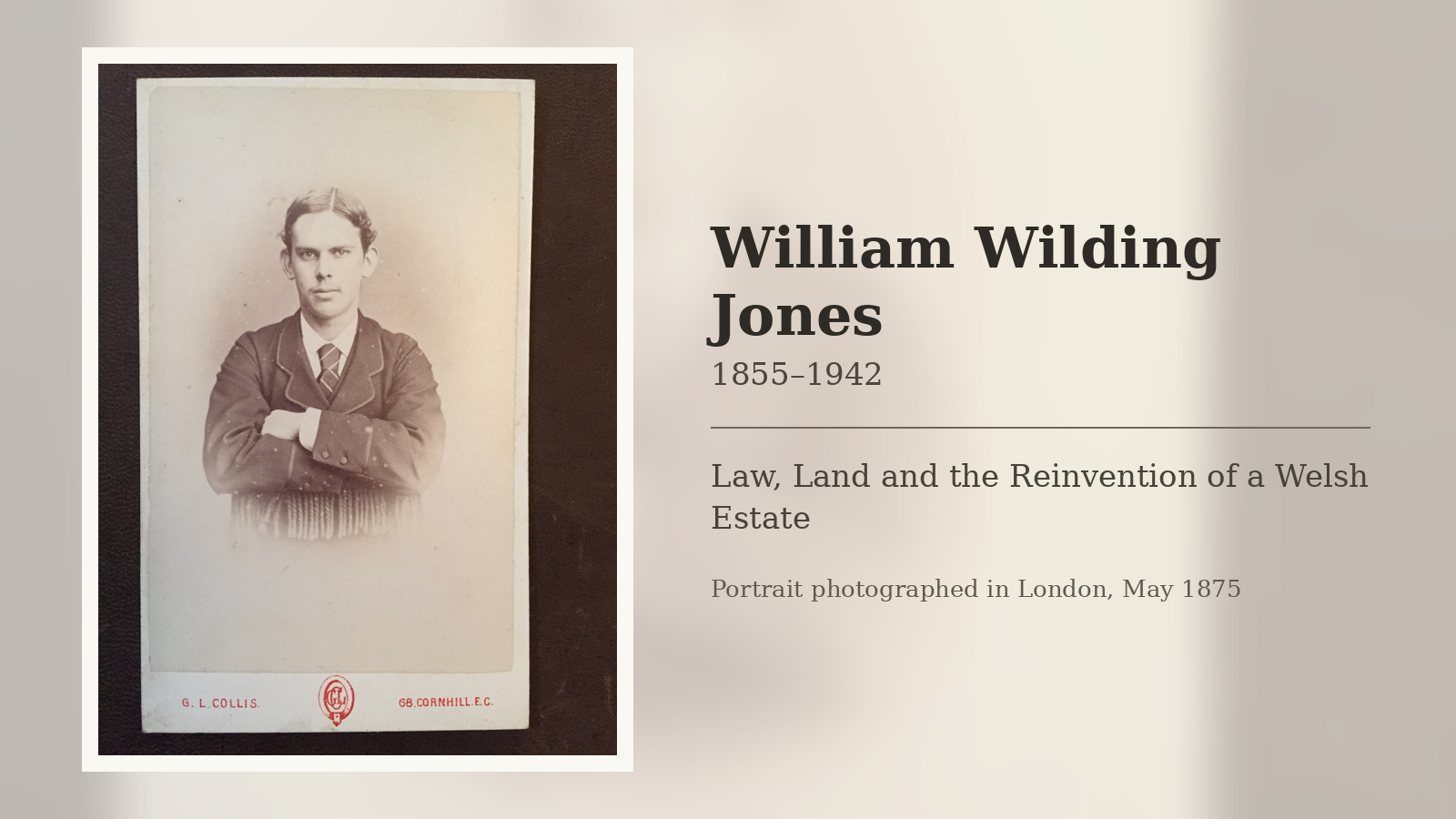
One of the most revealing surviving images of William Wilding Jones was taken before almost everything for which he would later be remembered. In May 1875, aged nineteen, he sat for the London photographer G. L. Collis at 68 Cornhill. He appears serious and self-possessed, his arms folded and his gaze directed squarely at the camera. On the reverse of the carte-de-visite he wrote, in a confident hand, “Yours faithfully, W. Wilding Jones.” It is a small personal survival, but an unusually evocative one. He had not yet qualified as a solicitor, his published comedy still lay two years in the future, and the Glandwr estate remained in the hands of his grandfather. Several possible lives still seemed open to him.
The life which eventually emerged was a long and quietly substantial one. Wilding Jones was a solicitor for more than six decades, a published playwright and theatre critic, a senior member of the Worshipful Company of Skinners, closely associated with the governance of Tonbridge School, and the professional adviser to one of the great landed estates of Merionethshire. He was also the man who inherited Glandwr at perhaps the most difficult moment in the history of British landownership. His grandfather had created the estate as an expression of Victorian success. His father had attempted to live the life of a resident country gentleman. Wilding approached the inheritance rather differently.
He treated Glandwr as a solicitor would.
That distinction is central to understanding him. Wilding did not preserve the estate by attempting to freeze it in the form created by earlier generations. He sold outlying property, concentrated the land around Glandwr, converted the great house into an income-producing asset, and maintained a smaller family residence nearby. What can appear at first sight to be retreat was, on closer examination, a deliberate attempt to make an increasingly difficult landed inheritance economically sustainable.
There is therefore a strong case for seeing William Wilding Jones not as the man under whom Glandwr declined, but as the man who extended its life.
From St Kilda to Streatham
William Wilding Jones was born on 31 July 1855 at St Kilda, Melbourne, in the Colony of Victoria. The location is confirmed by his surviving City of London Freedom record, which later described his birthplace specifically as “St Kilda in the Colony of Victoria”.
His Australian birth reflected the remarkable geographical reach of the Jones family. His grandfather, William Jones of Glandwr, had risen from his origins in the Dolgellau district to establish a successful legal career in the City of London. His father, William Halse Gatty Jones, had gone considerably further. During the Australian gold-rush era Gatty established himself as a solicitor in Melbourne, became involved with mining interests and eventually entered the Victorian Legislative Assembly. Wilding was consequently born into a family which was Welsh in origin but whose professional world stretched from Merionethshire to the City of London and colonial Australia.
Wilding spent his earliest childhood in Melbourne before returning to Britain with his family in June 1863.
By the time of the 1871 census the family was living at 9 Streatham Hill in Surrey. Wilding, aged fifteen, was recorded as a scholar. The household was substantial and prosperous, containing his parents, several children and four domestic servants. This was the environment in which he grew up, not yet the household of a permanently resident Welsh squire, but one of the successful Victorian professional class whose wealth had been accumulated through law, property and business.
The unusual name by which he was generally known also deserves explanation. Wilding was pronounced “Will-ding”, and came through family connections on his mother’s side. The name became sufficiently important that the next generation increasingly adopted Wilding-Jones as a surname.
A solicitor in preparation at sixteen
The surviving Law Society records show that Wilding’s professional path was being laid down remarkably early.
At the age of sixteen he appears in the register of candidates for the Law Society’s Preliminary Examination. He is listed as candidate number 154, “Jones, Wm Wilding”, aged sixteen, with his residence given as 9 Streatham Hill, Surrey. The record shows that while Wilding was still described in the census as a scholar, his route towards the solicitors’ profession had already begun.
The expectations surrounding him were understandable. His grandfather had built the family fortune through law. His father had practised successfully in both Britain and Australia. To enter the solicitors’ profession was to continue a family tradition which had already proved remarkably successful.
Yet law was not the only interest occupying the young Wilding Jones.
That is what makes his early adulthood particularly interesting.
The young playwright
As a young man Wilding developed serious literary and theatrical ambitions. In 1877 he published Love Me Little, Love Me Long: An Original Comedy, in Five Acts, through J. Welch. The original work survives in library collections and confirms that this was a genuine published dramatic work rather than simply an unpublished family amusement.
He did not stop with one play. In July 1879 W. Wilding Jones published “Robertson as a Dramatist” in The Theatre, New Series, volume II, pages 355–360. The article concerned Thomas William Robertson, one of the most significant figures in the transformation of the Victorian stage. Later histories of nineteenth-century drama continued to cite Wilding’s essay, meaning that his youthful criticism had a life extending far beyond his eventual abandonment of literary ambitions.
Wilding also had considerable musical ability. During the 1870s and 1880s he appeared as a pianist at musical evenings around Bontddu and Barmouth.
These strands of his early life are worth considering together. The young Wilding was not simply waiting dutifully to become another family solicitor. He was interested in drama, literary criticism and music, and was confident enough to publish his own work. At the same time, however, his legal training had already begun.
The May 1875 portrait captures him almost exactly at this crossroads. He had already entered the Law Society examination system, but his comedy and theatrical criticism still lay ahead. The long professional career had begun to take shape, but it had not yet entirely displaced the writer.
The third generation of a London legal family
Wilding qualified as a solicitor in 1876 and joined his father in the firm of W. H. Gatty Jones & Son at 7 Crosby Square, Bishopsgate.
The address carried considerable family significance. His grandfather had established himself in the same part of the City, and by Wilding’s generation Crosby Square had become closely associated with the Jones legal and business network. The young solicitor was therefore inheriting much more than an occupation. He entered a web of clients, relatives and commercial connections accumulated over several decades.
One surviving example concerns model dwellings in Little Norfolk Gardens, off Curtain Road. Research into the development has shown that W. H. Gatty Jones & Son became involved through William Wilding Jones when difficulties arose over unpaid interest on a loan. The correspondence demonstrates that legal and financial relationships within the extended family network could pass directly through the firm.
By the 1881 census Wilding, aged twenty-five, was living with his parents at 9 Streatham Hill and was already recorded as a solicitor. The entry places father and son side by side within the same household and provides a neat snapshot of the professional continuity which underpinned the family’s position.
The 1891 census finds Wilding still unmarried and continuing to practise in London. His life remained overwhelmingly metropolitan even though the family’s landed interests were firmly rooted in Wales.
After his father retired, Wilding continued practising independently under his own name. The old Crosby Square connection was eventually relinquished and his practice moved to Granville House, Arundel Street, off the Strand. He would remain professionally active there for decades.
His work was not confined to family conveyancing or estate administration. The surviving papers of inventor William Charles Werry include a 1913 account owed to W. Wilding Jones for legal charges and disbursements connected with proceedings brought against Werry by the Thames Ironworks Company Ltd. It is only one preserved case, but it demonstrates that Wilding’s practice extended into commercial disputes and the affairs of inventors and industrial businesses.
Freeman of the City
The original City of London document survives from the year in which Wilding qualified. On 22 September 1876 he appeared before the Chamberlain of London and requested admission to the Freedom of the City by patrimony through the Skinners’ Company. The document records him as William Wilding Jones, born on 31 July 1855 at St Kilda in Victoria, and identifies his father as William Halse Gatty Jones, Citizen and Skinner of London.
His father’s own admission to the Freedom was recorded as 8 April 1846.
The record connects several strands of Wilding’s life in a single document: Melbourne, London, the legal profession and the institutional networks of the City.
His association with the Worshipful Company of Skinners subsequently became much more than nominal.
The Skinners and Tonbridge School
Wilding took a particular interest in the educational responsibilities of the Skinners’ Company. The Company had a historic relationship with Tonbridge School and played a major role in its governance. By 1900 Wilding had risen to become one of its four Wardens. His name survives in the contemporary inscription associated with the construction of the Tonbridge School Chapel of 1900–02.
Wilding later served as Master of the Skinners’ Company in 1904–05. He was also a governor of Tonbridge School, and both of his sons were subsequently educated there.
This helps explain the nature of his public life. His grandfather had been conspicuous in civic and Welsh organisations. His father became involved in the local society of Barmouth. Wilding followed neither example exactly. His influence operated within the quieter institutions of the professional and commercial establishment: law, education and the livery companies of the City.
He possessed status, but did not appear particularly interested in displaying it publicly.
Marriage to Ellen Maria Pavey
On 27 January 1894 Wilding married Ellen Maria Pavey at St James Norlands in Kensington.
The surviving marriage licence provides considerably more detail. Wilding appeared personally on 18 January and declared himself a bachelor over the age of twenty-one, resident in the parish of St James Piccadilly. Ellen was likewise over twenty-one and had been resident within the parish of St James Norlands for the necessary period.
Wilding was thirty-eight when they married. Ellen was twenty-two.
The marriage register gives Wilding’s occupation as solicitor and records his father as William Halse Gatty Jones. Ellen’s father was John Beauchamp Pavey, described in the register as a land agent.
That description is intriguing because other records identify Pavey with the carpentry trade. The discrepancy should probably be allowed to stand rather than explained too confidently. Whether he had genuinely moved into some form of land agency work, whether the description was socially convenient, or whether some other explanation lies behind it cannot presently be established.
The surviving evidence does, however, allow Ellen’s birth year to be corrected. The 1939 Register gives her date of birth as 7 November 1871. Her age at marriage and in the 1911 census are consistent with 1871 rather than the 1872 sometimes given in earlier family research.
Wilding and Ellen, generally known as Nellie, would have three children: Hugh Wynne Wilding Jones, Eric Vaughan Wilding Jones and Sylvia May Wilding Jones.
A prosperous household at Hove
By 1901 the family was living at 7 Wilbury Gardens in Hove. The census gives an unusually useful glimpse of their domestic circumstances. Wilding, aged forty-five, was recorded as a solicitor. Ellen was twenty-nine. Their sons Hugh and Eric were aged five and one respectively.
The household also contained three servants: a cook, a housemaid and a nurse.
This is an important detail when assessing Wilding’s later handling of Glandwr. His decision to dispose of property should not be mistaken automatically for personal financial collapse. The evidence suggests that he was maintaining the comfortable domestic arrangements expected of a prosperous solicitor and landowner.
Hove itself was a logical home for such a man. It had developed into a fashionable residential town and offered convenient railway access to London. Wilding could maintain his professional life in the capital while his family lived within the more spacious surroundings of the south coast.
Inheriting Glandwr
Wilding’s father died at Glandwr Hall in September 1897.
The inheritance looked formidable. At its peak the combined Glandwr holdings had exceeded 3,000 acres, stretching through the country between Barmouth and Bontddu and including separate properties around Dolgellau and Aberangell. Gatty had taken up residence at Glandwr after succeeding his own father in 1882. He described himself as a farmer in the 1891 census, served as a magistrate and became involved with the Merioneth Agricultural Society and the social life of Barmouth.
Yet appearances concealed financial weakness. At Gatty’s death his estate was valued at £3,927, falling to £2,971 after duties and liabilities. Wilding himself faced inheritance taxation approaching £1,000.
The distinction between owning land and possessing money was becoming increasingly important. A landed estate might appear immensely valuable, yet much of that wealth was locked into farms, buildings, woodland and property. Houses required maintenance. Tenanted farms required investment. Agricultural rents were under pressure. Death duties were becoming increasingly significant.
The Great Agricultural Depression had fundamentally weakened the assumptions upon which many Victorian estates had been built.
Wilding inherited Glandwr at exactly the wrong moment for an owner determined to preserve everything unchanged.
Fortunately, he appears to have had no such determination.
Breaking up the outer estate
The surviving auction advertisements allow the process of restructuring to be followed in much greater detail than was previously possible.
In 1898 a substantial group of outlying properties was offered for sale. These included Tymawr in the parish of Mallwyd, occupied by Morris Lewis and described as an upland farm of more than 227 acres near Dinas Mawddwy. Another lot comprised Maes-y-Clawdd near Bontddu, occupied by John Lewis and extending to more than 105 acres.
The auction advertisement drew particular attention to the mineral possibilities of Maes-y-Clawdd, noting the presence of copper veins.
Another lot comprised the Figre and Clogau Gold and Copper Works, sold subject to an existing lease. Tynion, Ffridd Llawllach and separate portions of Llwynon Isaf were also included.
This is much more informative than simply knowing that Wilding sold part of the estate. What was being disposed of was geographically and economically mixed: an upland farm near Dinas Mawddwy, agricultural land near Bontddu, enclosed grazing, mineral rights and mining property. Such holdings might increase the acreage recorded against the name of an estate, but they also increased the complexity of managing it.
Wilding was reducing that complexity.
The Dolgellau sales of 1901
The process continued in 1901. An advertisement announced an “Important and Attractive Sale of Valuable Freehold Building Sites, Accommodation Land, and Several Shops and Dwelling-Houses” at Dolgellau. The auction was to be held at the Lion Hotel on Friday 20 September 1901.
The sale included freehold building plots ranging in size from 2,465 square yards to 17,484 square yards, together with houses and shops at Nos. 1, 2, 3, 4 and 6 Eldon Row. Their position facing Eldon Square and adjoining the Market and Town Hall was particularly emphasised.
Most revealing of all was the address from which plans and particulars could be obtained: W. Wilding Jones, Solicitor, Granville House, Arundel Street, Strand, London.
Wilding’s own legal office was therefore directly involved in the disposal. This removes any lingering impression of a passive heir allowing agents to dismantle an estate around him.
Wilding was directing the process.
The scattered Dolgellau properties could be sold. The more remote agricultural holdings could be sold. The uncertain mineral interests could be sold.
The central Glandwr estate remained.
The evidence increasingly points towards rationalisation rather than uncontrolled decline.
From great house to investment
Wilding did not immediately abandon the idea of using Glandwr Hall. He knew the house from childhood and had spent time there as a young man. His musical appearances around Bontddu and Barmouth demonstrate his familiarity with the district. In 1900 he advertised for a gardener and caretaker to occupy Glandwr Hall Lodge.
By 1905, however, another solution had emerged.
Glandwr Hall itself was offered to let. Advertisements promoted more than 1,000 acres of good shooting, making the property attractive to the wealthy families who increasingly rented country houses for sporting and social purposes.
At approximately the same time Wilding built Islwyn nearby. It was smaller and more practical than Glandwr Hall, yet allowed the family to retain a country residence upon the estate. For the following half-century it would fulfil that function.
The arrangement was remarkably sensible. The family retained its Welsh base. The great house earned rent. The burden of permanently staffing and occupying Glandwr Hall was transferred to the tenant.
William Henry Higgins and his family from Manchester rented the Hall between 1905 and 1911. They were followed by the Rowe family. Alfred Rowe had made his fortune as a rancher in Texas and died aboard the Titanic in April 1912. His widow Constance continued living at Glandwr, and their son Charles later succeeded her as tenant.
The arrangement survived for decades.
That longevity is perhaps the best evidence that Wilding’s decision worked.
The Bontddu path dispute
Absence from the Hall did not mean indifference to the estate.
A glimpse of Wilding as a landowner appears in a 1907 case at the Merionethshire Assizes concerning a path beside the Mawddach. The route crossed land belonging to several owners, including Wilding Jones.
The contemporary report recorded that Wilding had protested against public use of the section passing across his property. Interestingly, however, he declined to join neighbouring landowners in the legal action itself. A witness, John Owen of Bontddu, captain of St David’s Gold Mine, gave evidence concerning long-standing public use of the route.
The episode is small, but revealing. Wilding was prepared to defend what he believed to be his rights as a proprietor, but he did not automatically involve himself in expensive litigation simply because his neighbours had done so.
For a solicitor, that restraint may not have been accidental.
Gable House, Tonbridge
By 1911 Wilding and his family were living at Gable House in Tonbridge. The census gives one of the richest surviving snapshots of the family.
Wilding was fifty-five and still recorded as a solicitor. Ellen was thirty-nine. They had been married for seventeen years and had had three children, all of whom were still living. Hugh Wynne Wilding Jones was fifteen, Eric Vaughan Wilding Jones eleven and Sylvia May Wilding Jones seven.
Gable House contained fourteen rooms. The family employed a cook, a housemaid and a nurse.
This was a substantial Edwardian household. The move to Tonbridge also reflected the family’s connection with the school. Hugh and Eric were being educated there, while Wilding’s own involvement with the Skinners’ Company placed him close to the institutional world which governed it.
One particularly interesting visitor was staying at Gable House on census night. Charles Wilfrid Blaxland, aged fifty-six and himself a solicitor, was Wilding’s first cousin.
Charles belonged to another branch of the Jones legal dynasty. His mother, Rebecca Cartwright Jones, had been a daughter of William Jones of Glandwr and sister of Gatty Jones. She married George Blaxland, who had been William Jones’s legal partner. Charles followed his father and uncle into law, also serving for a period as a coroner.
His presence at Gable House is a valuable piece of social evidence. More than half a century after the original professional alliance between the Jones and Blaxland families, the younger generation remained close enough for one solicitor cousin to be staying in another’s home.
The family network which had helped build the Jones position in Victorian London was still functioning.
Solicitor to Nannau
The most important evidence discovered concerning Wilding’s professional career lies not in London but in the archive of another Welsh estate.
Bangor University’s Nanney Williams Collection contains an extensive body of papers relating to Wilding Jones and repeatedly identifies him as “Solicitor of the Nannau Estate”.
The scale of the material is striking. There are legal notes sent by Wilding to members of the Vaughan family, correspondence with land agents and other solicitors, estate accounts, papers concerning wills and codicils, probate, estate duty, powers of attorney, trusts, timber sales and property transactions. There are letters from the Dolgelley Copper Mines Ltd, correspondence involving the Penmaenpool Bridge Company, papers relating to the Nannau Estate Trust and documents concerned with the purchase of Alltllwyd farm.
The archive even preserves continuity between generations. Earlier material refers to W. Gatty Jones of 7 Crosby Square as solicitor to the Nannau Estate before Wilding took on the role himself.
This discovery requires a substantial reassessment of Wilding’s relationship with Wales.
Unlike his grandfather, he did not involve himself prominently with London Welsh societies. Unlike his father, he did not settle permanently at Glandwr and become a conspicuous member of Barmouth society.
It would therefore be easy to conclude that his Welsh interests had weakened.
The archive demonstrates otherwise.
Wilding remained deeply connected with Merionethshire, but the nature of that connection had changed. His role was professional rather than public. From London he participated in the legal machinery upon which major Welsh landed estates depended.
That fact also changes the interpretation of what he did at Glandwr.
Wilding did not merely own an estate.
He understood estates professionally.
He knew about settlements, succession, trustees, taxation, conveyancing, leases and the complications created when inherited property had to support several generations.
When Glandwr came into his hands, he applied that knowledge to his own inheritance.
The loss of Hugh
No amount of legal planning could protect the family from the upheaval of the First World War.
Wilding’s eldest son, Hugh Wynne Wilding-Jones, had been born on 3 March 1896. He attended Tonbridge School and entered Corpus Christi College, Oxford, in 1915. College records remembered him as intelligent and popular, a good conversationalist with a quiet sense of humour.
In the normal course of events Hugh would have been expected eventually to succeed his father at Glandwr.
After only two terms at Oxford, however, he volunteered for military service. He was commissioned into the Royal Welch Fusiliers and reached France in September 1916. He served during the Battle of the Somme and was wounded in the left thigh in January 1917. Ill health, including colitis, delayed his return to active service.
Eventually he was sent to the Balkans and rejoined his regiment as a machine-gun officer. He was wounded in action on 20 September 1918.
Two days later he died.
Hugh was only twenty-two.
His death was both a personal tragedy and a major alteration to the future of Glandwr.
The expected heir was gone.
Eric and Sylvia
Wilding’s younger son, Eric Vaughan Wilding Jones, had been born in 1899. He too attended Tonbridge School before entering the Royal Military Academy at Woolwich. He was commissioned into the Royal Artillery and later served in India. His military career was considerably more troubled than Hugh’s, eventually ending after a court martial in 1931.
The third child, Sylvia May Wilding Jones, had been born in Hove on 15 May 1903.
Wilding’s eventual arrangements for Glandwr again reflected his legal mind. He did not simply leave the estate outright to Eric as his surviving son. Instead the property was to be preserved as a source of income for Eric and Sylvia, with the ultimate succession passing through Sylvia’s family.
This is perhaps one of the clearest indications of how Wilding regarded the estate by the end of his life. Glandwr was still something worth preserving, but its purpose was no longer primarily to provide a great house for a male heir.
It was an economic asset capable of supporting the family.
Still practising in his sixties
The 1921 census demonstrates the remarkable longevity of Wilding’s professional career. At sixty-five years and eleven months he remained a solicitor and described himself as an employer. His place of work was given as 3 Arundel Street, Strand, London.
That address connects neatly with the 1901 Dolgellau auction notice, which had directed prospective purchasers to W. Wilding Jones at Granville House, Arundel Street.
For at least two decades, therefore, the same central London district remained the base from which he practised law and conducted estate business.
There is something pleasingly circular about the chronology. The sixteen-year-old candidate in the Law Society examination register had become a solicitor at twenty-one. Nearly half a century later he was still at work.
The final household at Hove
By the later part of his life Wilding had returned to Hove. The 1939 Register records William and Ellen at 53 Wilbury Road. It confirms Wilding’s birth on 31 July 1855 and Ellen’s on 7 November 1871.
William, then eighty-four, was still described as a solicitor.
The household continued to employ domestic staff, including a cook and housemaid.
Once again this helps place the history of Glandwr in context. Wilding had not sold parts of the estate because he had personally descended into genteel poverty. Into old age he maintained a comfortable household in one of Hove’s substantial residential streets.
His property decisions appear increasingly to have been choices about capital and income rather than desperate attempts to survive.
Ellen died in 1940.
Wilding survived her by less than two years.
Death and probate
William Wilding Jones died at 53 Wilbury Road, Hove, on 31 January 1942. He was eighty-six.
The National Probate Calendar records effects of £16,612 0s. 2d., with probate granted at Llandudno on 27 April 1942 to Ethel Colbeck, spinster. The precise nature of her connection with Wilding has not yet been satisfactorily established.
Earlier family research found that after death duties and other liabilities the value remaining from his estate was considerably lower, approximately £5,573.
Within months another tragedy followed. Eric died in June 1942, leaving Sylvia as the principal surviving representative of Wilding’s immediate family.
The final years of the estate
The system Wilding had established nevertheless continued after his death. Glandwr Hall remained tenanted, while Islwyn remained associated with the family. Sylvia later married Charles Robert Hughes of Barmouth and lived there with him.
It was not until January 1955 that Sylvia sold Glandwr Hall and most of the remaining estate. Islwyn was retained briefly, but following Charles Hughes’s death in 1956 Sylvia left the district and the property was subsequently sold.
The Jones family’s direct association with this part of the Mawddach landscape had lasted for almost 130 years.
The chronology deserves emphasis.
Wilding inherited Glandwr in 1897.
The main estate was not sold until 1955.
For almost sixty years after the financially vulnerable estate came into his hands, the core of Glandwr survived.
The professionalisation of Glandwr
William Wilding Jones is easily overshadowed by the more colourful members of his family. His grandfather built the family fortune and established Glandwr. His father crossed the world, became successful during the Australian gold-rush era and entered colonial politics. His own sons lived through war, military service and personal tragedy.
Wilding’s achievements were quieter.
Much of his life survives through documents which rarely produce dramatic biographies: legal correspondence, census returns, conveyances, estate accounts, examination registers, deeds and wills.
Yet when those records are brought together, a much more substantial figure emerges.
He was preparing for the legal profession by sixteen. He published a five-act comedy in his early twenties. He contributed to contemporary theatrical criticism. He became a Freeman of the City of London and rose into the senior ranks of the Worshipful Company of Skinners. He participated in the governance surrounding Tonbridge School. He maintained a London legal practice for more than sixty years. He handled commercial disputes and acted professionally for one of the most important landed estates in Merionethshire.
Most importantly, he understood the business of inherited land.
That knowledge shaped Glandwr.
Wilding had spent decades seeing what succession, taxation, trusts, fragmented ownership and financial obligations could do to estates. When his own inheritance arrived, he was therefore unusually well equipped to recognise the danger.
His response was not romantic.
He sold Tymawr. He sold Maes-y-Clawdd. He disposed of mining and mineral interests. He sold the family’s remaining Dolgellau properties. He retained the central estate. He allowed Glandwr Hall itself to earn rent. He created Islwyn as a smaller family residence.
The decisions gradually separated the idea of Glandwr from the requirement that the Jones family must permanently inhabit its largest house.
Something was undeniably lost. The family ceased to occupy the conspicuous position in local society which William Jones and Gatty Jones had once represented. The relationship between landowner, estate and community became less immediate. The old Victorian world of Glandwr was disappearing.
But it was disappearing because the world around it had changed.
The great agricultural depression, rising taxation, the First World War and the escalating cost of maintaining large houses were not problems unique to Glandwr. Across Britain, estates were being sold, divided or abandoned.
In that context Wilding’s achievement looks rather different.
The question is no longer why he failed to preserve Glandwr exactly as his grandfather had known it.
The more interesting question is why the family retained it until 1955.
Part of the answer must surely lie with him.
Three generations
The history of Glandwr across three generations provides an unusually clear illustration of changing ideas about wealth and land.
William Jones used the profits of professional life to create the estate. For him, Glandwr represented arrival. It was tangible evidence that the solicitor from Dolgellau had acquired the wealth necessary to enter the world of substantial landed property.
Gatty Jones inherited that achievement and attempted to inhabit it fully. He lived at Glandwr, farmed, served as a magistrate and participated in the social life of Barmouth.
Wilding inherited the same property in a different age.
He reversed the process.
Instead of allowing the estate to dictate the structure of his life, he reshaped the estate to suit the economic realities confronting his family.
Land which was not essential could be sold. The great house could be rented. A smaller house could serve perfectly well as the family residence. An estate existed to provide security and income, not simply status.
That may sound less romantic than the Victorian ideal of the country gentleman, but it was probably the reason Glandwr survived for another generation.
His grandfather had used law to build the estate.
William Wilding Jones used the same professional instincts to preserve what remained of it.
He did not save Glandwr by refusing to change it.
He saved it, for a time, because he understood that it had to change.
Related Essays
Related Books
William Jones of Glandwr Hall: Law, Authority, and the Making of a Victorian Life
For the life of Wilding’s grandfather and the creation of the legal, civic and landed world inherited by later generations.
Kindle · Paperback
Old Llyfnant Valley Farming Families
For the wider Jones of Glandwr family history and the farming communities of the Llyfnant Valley across several generations.
Kindle · Paperback
Explore the wider family: The Jones Family of Glandwr Hall, Barmouth places Wilding’s stewardship within the full history of the estate and its family.
Sources and Further Reading
- Antony David Davies, Old Llyfnant Valley Farming Families, particularly the chapters on William Jones, William Halse Gatty Jones, William Wilding Jones and the children of Wilding Jones.
- Original carte-de-visite portrait of William Wilding Jones by G. L. Collis, 68 Cornhill, London, dated May 1875 and inscribed on the reverse, “Yours faithfully, W. Wilding Jones”.
- Law Society, List of Candidates for Preliminary Examination, volume 3, 1870–1872, Institute of Advanced Legal Studies Archives, LSOC/2/3. William Wilding Jones appears as candidate no. 154, aged sixteen, resident at 9 Streatham Hill, Surrey.
- City of London Freedom admission of William Wilding Jones, 22 September 1876, recording his birth at St Kilda, Victoria, on 31 July 1855 and admission by patrimony through the Skinners’ Company.
- William Wilding Jones, Love Me Little, Love Me Long: An Original Comedy, in Five Acts, J. Welch, 1877.
- W. Wilding Jones, “Robertson as a Dramatist”, The Theatre, New Series, vol. II, July 1879, pp. 355–360.
- Lewis Boyd Sebastian, An Old City Company: A Sketch of the History and Conditions of the Skinners’ Company of London, 1906, including the Tonbridge School chapel material naming W. Wilding Jones among the Wardens of the Company.
- Bangor University Archives and Special Collections, Nanney Williams Collection, Nannau Estate papers, including correspondence, solicitors’ accounts, wills, estate-duty papers, trusts and property transactions identifying William Wilding Jones as solicitor to the estate.
- Gwynedd Archives, correspondence relating to Colonel John Vaughan and the Nannau Estate, including 1914 material identifying W. Wilding Jones of London as Vaughan’s solicitor.
- Papers of William Charles Werry, including the 1913 account for legal work undertaken by W. Wilding Jones in proceedings involving the Thames Ironworks Company Ltd.
- Contemporary Merionethshire newspaper reporting of the 1907 Bontddu path dispute at the Merionethshire Assizes.
- Contemporary auction advertisement for the sale of property in the parishes of Mallwyd and Llanaber, including Tymawr, Maes-y-Clawdd, the Figre and Clogau Gold and Copper Works, Tynion, Ffridd Llawllach and Llwynon Isaf.
- Contemporary auction advertisement for the sale at the Lion Hotel, Dolgellau, on 20 September 1901, of freehold building sites, accommodation land, shops and houses, with particulars obtainable from W. Wilding Jones, solicitor, Granville House, Arundel Street, Strand, London.
- England and Wales census returns, 1871, 1881, 1891, 1901 and 1911, including the Jones households at Streatham, Hove and Gable House, Tonbridge.
- 1921 Census of England and Wales, William Wilding Jones household and occupational return, recording him as a solicitor and employer and giving his workplace as 3 Arundel Street, Strand, London.
- 1939 Register, 53 Wilbury Road, Hove, confirming the dates of birth of William Wilding Jones and Ellen Maria Wilding Jones and showing the composition of their later household.
- Marriage register and marriage-licence records for William Wilding Jones and Ellen Maria Pavey, January 1894, St James Norlands, Kensington.
- National Probate Calendar, 1942, William Wilding Jones of 53 Wilbury Road, Hove, recording his death on 31 January 1942, probate at Llandudno and effects of £16,612 0s. 2d.
- Davies family research relating to the Blaxland branch and the long-standing professional and family connections between the Jones and Blaxland families.