
Penybont is one of those places whose appearance gives little indication of the part it once played in the life of Radnorshire. It has never been large, and even at the height of its importance it remained essentially a rural village beside the River Ithon. Yet for almost two centuries people from a surprisingly wide area had reasons to come here. They came to cross the river, use the post, change horses, attend fairs, visit the bank, appear before magistrates, worship, buy goods, sell livestock, catch the train, exhibit animals or spend an afternoon watching horses race across the fields. Penybont mattered not because large numbers of people lived there, but because so many people living elsewhere depended upon it.
That distinction is important. Many villages grew because houses, workshops or industry accumulated around them. Penybont grew in importance because it became a meeting place. Its geography helped. Roads met near the Ithon crossing, the turnpike system improved those connections, an inn provided accommodation, the railway added another means of communication, and a collection of shops and public institutions gradually developed around them. Over time Penybont acquired an influence out of all proportion to its physical size. On an ordinary winter morning it might have appeared a quiet collection of buildings in the Radnorshire countryside. On a fair, show, market or race day it became something entirely different.
The older crossing
The older landscape survives in the name Rhyd-y-Cleifion, associated with the crossing here before Penybont became the usual name. It is generally interpreted as the ford of the sick, afflicted or wounded. The name has encouraged stories of lepers and even of a medieval hospital, although no secure evidence has yet been found for such an institution at Penybont. It is safer to allow the old name to remain something of a mystery. What it undoubtedly tells us is that the river crossing mattered. Before substantial bridges and engineered roads, movement through the Ithon valley depended upon knowing where a horse, cart or traveller could get safely across.
Nearby Cefnllys provides part of the background. During the Middle Ages its borough and market were intended to create an important centre in this part of Radnorshire. The experiment did not last. Cefnllys never developed into the enduring town which its medieval founders appear to have envisaged, and the settlement eventually contracted almost to nothing. It would be going too far to say that its functions were formally transferred to Penybont, but over time practical activity moved towards the more useful communications of the valley below. Penybont would eventually provide many of the things that a scattered rural population required, shops, an inn, fairs, post, banking, policing, railway facilities and places to meet.
There are even hints that the countryside around Penybont was serving as a gathering place long before the later village took shape. In 1657 George Fox, founder of the Society of Friends, addressed a large meeting somewhere on a Radnorshire common. Later tradition has associated the gathering with Penybont Common, although the precise site cannot be established with certainty. Quakerism nevertheless became deeply rooted in the surrounding district, most famously at the Pales. The episode is worth remembering because the need which lay behind it never disappeared. Radnorshire consisted largely of dispersed farms and small communities. People needed places where they could come together.
Roads and the making of Penybont
The recognisable village began to take shape during the eighteenth century. The Price family became central to this development, combining commercial enterprise with land purchase and the beginnings of what would become the Penybont Hall estate. Their influence upon the village was considerable, and the history of the Hall provides the other side of the story, showing how landownership, servants, tenants and estate management shaped the settlement around it. The growth of the estate, improvements to the road system and the establishment of an inn all strengthened Penybont’s position. It became somewhere where a traveller could stop rather than merely pass.
Road improvement was fundamental. The turnpike era altered rural Wales by making journeys more predictable and by concentrating traffic upon particular routes. Penybont stood conveniently on the road through central Radnorshire towards Rhayader and the country further west. A small village positioned on an important road could be more economically significant than a larger settlement which travellers had no reason to visit.
By 1839 a map of Penybont still showed only a modest collection of buildings. There was Penybont Hall, the Court, Homestead, the inn, Methodist chapel, blacksmith, tollhouse, shop, rectory and a scattering of houses and farm buildings. Yet almost every building served a purpose beyond simply providing a home. The blacksmith dealt with horses and implements, the inn with travellers, the tollhouse with the road, the chapel with worship and community, the shop with the needs of surrounding farms. Penybont was already a service village long before it acquired its later market and racecourse.
The bridge across the Ithon
The bridge across the Ithon was central to this usefulness. Quarter Sessions records show serious discussion of a new crossing during the 1830s. Plans and correspondence survive from 1834, followed by an agreement of 1 July 1835 for the construction of an iron suspension bridge over the river. By the later nineteenth century Penybont was routinely described as possessing a suspension bridge. The succession from ford to engineered bridge is more than a piece of local infrastructure history. It reflects the wider transformation of Penybont from an old crossing place into a regular point on an increasingly organised transport network.
Coaches, post and the Severn Arms
Travel also brought the post. Penybont had postal significance by the late eighteenth century, and for many years the postmaster was closely associated with the inn. By the early nineteenth century the arrival and departure of coaches had become part of the rhythm of village life. Horses were changed, passengers stopped for food or drink, and letters and newspapers moved between Radnorshire and the wider country. Later advertisements for the Severn Arms offered post chaises, flies, gigs, horses and drivers, while coach connections linked Penybont towards Kington, Worcester, Cheltenham and ultimately London.
The Severn Arms therefore became much more than a public house. It was a posting house, hotel, meeting place and public institution. Petty Sessions were held there, as were rent audits, political meetings, agricultural gatherings, dinners and assemblies. Its yards and stables accommodated the horses and vehicles upon which nineteenth-century travel depended. In 1830 farmers were summoned there in connection with the payment of tithes. Half a century later a public inquiry into the decline of salmon in the Wye and its tributaries was held in the same establishment. The subjects changed, but the principle did not. When business affecting the surrounding district had to be discussed, Penybont was a convenient place to do it.
Chapel, school and community
Religion created another centre of village life. In 1822 William Thomas, associated with the Penybont shop, leased land for a Calvinistic Methodist chapel. Local research regards it as the first Calvinistic Methodist chapel in Radnorshire and an unusually early English-language cause within the connexion. Its influence extended well beyond Sunday worship. A manse followed, education became important, and by 1852 pupils of the Penybont British School were being publicly examined in subjects including history, geography, grammar and arithmetic. More than two hundred people were afterwards reported to have sat down to tea.
The chapel also established a circulating library of more than one hundred books and took part in Bible distribution. By the 1880s it supported a large Sunday school and a congregation drawn from beyond the immediate village. This is an important part of Penybont’s history because it demonstrates that the Hall was never the only centre of authority. Alongside estate influence stood chapel, shop, school and voluntary association. The later closure of the chapel, when the congregation had dwindled and road works altered the bridge area, marked the disappearance of an institution which had helped to educate and bind together generations of local families.
The Thomas Shop
The Thomas family developed another remarkable Penybont institution. Their shop expanded during the nineteenth century into an enterprise far larger than might be expected in such a small place. Grocery, drapery, tailoring, laundry work, tea, seeds and other goods were supplied from Penybont, with branches and related businesses eventually extending elsewhere. The later Central Wales Emporium at Llandrindod Wells emerged from this commercial tradition. The original Penybont business survived until 1958. Its longevity is itself evidence of the village’s wider reach. A shop of that scale could never have depended solely upon customers living within a few hundred yards of its door. It served farms and families across a broad hinterland.
Policing the Ithon Valley
The coming of organised policing added another function. A police station was established at Penybont in the nineteenth century, with records relating to its construction dating from 1859. When Radnorshire developed a more formal county police organisation, Penybont became an important administrative centre. The Chief Constable was required to reside in the Penybont or Crossgates area, and county directories later described Penybont as the headquarters of the Radnorshire police. Petty Sessions for the Cefnllys Hundred were also transferred there. For several decades farmers coming to market or travellers changing horses shared the village with policemen, magistrates, witnesses and defendants attending official business.
The police station contained cells and served a wide district before later facilities developed elsewhere. Its closure in 1929 marked another stage in the changing geography of local administration. By then Llandrindod Wells had grown enormously, motor transport was changing distances, and some of the functions which had once made Penybont indispensable could be concentrated elsewhere.
The Iron Room
One of the most intriguing buildings in old Penybont was the Iron Room. Its exact architectural history remains less certain than its social importance. By the late nineteenth century it was clearly large enough to accommodate major public gatherings. In 1898 the formal luncheon associated with the Radnorshire Agricultural Society’s show was held there. Four years later it became the centre of Penybont’s planned Coronation celebrations. Residents of Llanbadarn Fawr, Llandegley and Cefnllys Rural were invited to attend. Schoolchildren, members of Friendly Societies and the general public were to form a procession behind a band, walk through the grounds of Penybont Hall and then through the village to the Iron Room.
Miss Emily Severn of Penybont Hall provided tea and commemorative mugs. A local festivities committee arranged sports and medals. Adults were to receive pork pies, while children were given buns and oranges. Most memorably of all, a Coronation Baby Show was organised for infants under one year, with separate prizes for boys and girls. Such details can appear trivial beside the grander subjects of transport and agriculture, but they reveal how a community actually lived. The Hall, chapel families, schoolchildren, Friendly Societies and villagers all came together in the same event.
The Iron Room remained valuable during the First World War. In 1918 a local entertainment troupe known as the Vagabonds reportedly attracted nearly five hundred people to a performance there, raising more than £40 for the Penybont Comforts Committee. For a village of Penybont’s size the figure is extraordinary, though the explanation is familiar. The audience did not come only from the houses around the bridge. Penybont drew people from the countryside around it.
Agricultural Penybont
Agricultural gatherings had been doing the same thing for much longer. Penybont was associated with organised agricultural improvement from the early nineteenth century. A society founded in 1809 held meetings at Presteigne and Penybont, with a Penybont agricultural show recorded in 1811 and centred upon the Fleece Inn. Further phases of organised showing followed during the nineteenth century. When the later Radnorshire agricultural organisation began its annual series in 1873, its first show was held at Penybont with John Percy Severn as president.
James Hamer, agent to the Penybont Hall estate, became one of the central figures in this agricultural world. His responsibilities were remarkably broad. He was estate agent to John Percy Severn, secretary of the Radnorshire Agricultural Society, involved with local taxation and education, connected with banking and commercial supply, and later one of the executors of Emily Severn’s estate. In a small village an individual such as Hamer could sit at the junction of landed society, banking, agriculture and local administration.
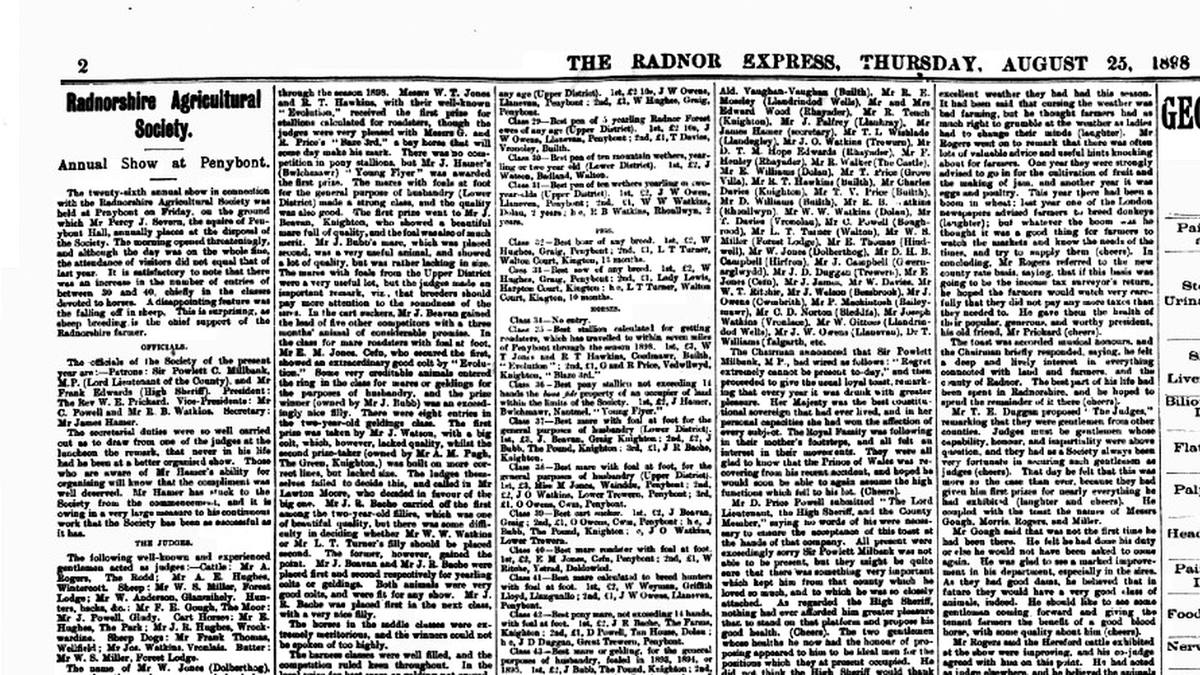
The Radnorshire Agricultural Society’s twenty-sixth annual exhibition at Penybont in August 1898 provides a particularly vivid picture. There were competitions for cattle, sheep and pigs, working horses, hunters, Hackneys, cobs and ponies, together with poultry, butter and other produce. Sheepdogs were tested in practical trials in a field near Penybont Hall. There was jumping and competitive trotting. John Percy Severn appeared among the exhibitors, while James Hamer acted as secretary. The public luncheon was held in the Iron Room, catered for by the Severn Arms, and a band from Llandrindod Wells played during the day.
Eleven years later the thirty-seventh exhibition was again held at Penybont. Despite poor weather the show continued to attract competitors across a wide range of agricultural classes. Trotting again formed part of the programme. Major-General Robert Children Whitehead of Penybont Hall presided over the luncheon. Whitehead’s own career had taken him from the Crimea to the Anglo-Zulu War before he inherited the estate and entered Radnorshire public life. The gathering therefore brought together tenant farmers, breeders, labourers, tradesmen and some of the county’s most prominent landowners.
Fairs and hiring days
The fairs were another old Penybont tradition. Regular hiring and general fairs brought agricultural servants, farmers, traders and visitors into the village. Nineteenth-century descriptions record three annual fair dates. For young men and women seeking work these occasions could determine where they would spend the next term of employment. For farmers they provided an opportunity to hire labour and conduct business. For everyone else they became social occasions in a countryside where opportunities for large gatherings were comparatively rare.
Later memories describe stalls, swing boats, fortune tellers, boxing booths, shooting galleries, coconut shies, tinkers and sellers of sweets and household goods. Some recollections speak of enormous crowds, even of circus animals arriving by train. Such numbers and details should be treated with the caution due to oral memory, but the broader picture is convincing. A fair day transformed Penybont. Employment, trade, entertainment and courtship all occupied the same space.
Horses before the Wembley of Wales
Horse racing at Penybont was older than the famous twentieth-century meeting. Local research places annual racing on Mynydd Pridd before 1843. That year reports referred to a new course within half a mile of the Severn Arms, while an 1859 meeting was again advertised on the old course near Penybont. Those early races eventually disappeared, but the tradition of horse competition survived through agricultural shows, jumping and trotting.
The horses are important because they alter the way the later races should be understood. The modern meeting was not a sporting idea imposed upon a village with no previous connection to racing. Penybont had possessed race meetings in the nineteenth century and competitive trotting remained part of its agricultural culture at the end of that century. When racing was revived after the First World War, the organisers were drawing upon a much older local tradition.
The railway arrives
The arrival of the railway added another reason to come to Penybont, part of the wider railway transformation of central Radnorshire explored elsewhere in the history of Llandrindod Wells station. The line reached the Penybont and Crossgates area in October 1864, initially using a temporary terminus before continuing towards Llandrindod. Pen-y-bont station stood some distance from the main village, but its influence was considerable. Passenger facilities were accompanied by a goods yard and siding, while the nearby tunnel carried the line onwards through the district.
The railway did not replace Penybont’s road traffic. Instead the two systems worked together. Goods arrived by rail and completed their journeys by cart. Farmers drove livestock to the station. Buyers could travel into the district without spending a day on horseback or in a coach. The Thomas business could send goods much further afield, and later recollections even record day-old chicks being despatched from Penybont by train to London.
A village full of trades
By the early twentieth century the village contained an extraordinary variety of trades for its size. Memories include blacksmiths, a wheelwright, boot and shoe repairers, builders, coal merchants, agricultural suppliers, a bank, post office, provision shops and specialised trades alongside the Thomas establishment. The countryside around Penybont was full of farms but relatively few substantial settlements. A single journey into the village could therefore combine business at the bank, a call at the blacksmith, shopping, collecting post and perhaps a drink or meal at the Severn Arms.
James Hamer and a changing rural economy
The Hamer family provides one of the clearest links between nineteenth-century estate society and twentieth-century commercial agriculture. James Hamer was closely identified with estate administration, county agricultural organisation and banking. His son, R. P. Hamer, became associated instead with auctions, livestock marketing and racing. The continuity is striking. The family remained central to Penybont while the economic structure around it changed. The squire and great estate gradually became less dominant, while the auctioneer and organised market became more important.
The livestock market
The establishment of Penybont Market in 1919 was the culmination of a much longer development. Pressure for a proper market existed before the First World War. In 1911 the Radnorshire Chief Constable argued that Penybont required a formal livestock facility, and by the closing years of the war agricultural organisations were again considering improved arrangements. R. P. Hamer became the principal figure in what followed.
The market’s success rested upon everything that had preceded it. The roads existed, the railway was nearby, farmers were accustomed to coming to Penybont for shows and fairs, and an auctioneer already had a network of clients throughout the district. The market did not create Penybont’s agricultural importance. It gave permanent form to something which had developed over generations.
A newspaper advertisement from September 1929 demonstrates the scale of R. P. Hamer’s business. His annual Penybont sale offered several thousand ewes, wethers, lambs and rams. Within days he was conducting further major sales at Rhayader, St Harmon and Llanbadarn Fynydd. Yet catalogues and enquiries were directed to the Auctioneer’s Office at Penybont. A very small Radnorshire village had become the administrative headquarters of a livestock business serving a considerable area.
Market day had a social importance which cannot easily be measured in sale books. Farmers who might spend much of their working week on isolated holdings met neighbours and buyers. Prices were discussed, news exchanged and livestock compared. Friendships, rivalries and bargains developed around the sale ring. The Severn Arms stood nearby. For many people the market was as much a social appointment as an economic one.
The modern races
The first meeting of the modern Penybont racing series took place on 3 August 1921. R. P. Hamer chaired the organising committee. Horse racing formed only part of the day’s entertainment, which included school races, athletics, cycling, tug of war and other competitions. It was as much a community festival as a race meeting.
The timing was significant. Only weeks earlier the local war memorial had been unveiled, commemorating men from Cefnllys, Llanbadarn Fawr and Llandegley who had died during the First World War. The summer of 1921 therefore belonged to a community both remembering the losses of war and rebuilding the public life which war had interrupted.
The Wembley of Wales
Penybont’s races grew. By the later 1920s they were being promoted under an extraordinary description, the “Wembley of Wales”. The phrase appears in race publicity decades before its better remembered post-war use. Special trains, bands and entertainment helped turn the meeting into one of the great summer gatherings of the district.
The description was still being used in 1958, when the Wellington Journal advertised the thirtieth annual Galloway and Trotting Races at Penybont. There were open and local events and £325 in prize money, with racing beginning at two o’clock on the show and adjoining grounds. “The Wembley of Wales” was deliberately extravagant, but it worked because people knew what Penybont meant in this particular setting. On race day a village which was ordinarily quiet could draw spectators and competitors from far beyond the parish.
The contrast between ordinary and exceptional days was part of the character of Penybont. Most mornings would have begun with the ordinary sounds of rural life, horses in earlier generations, carts, livestock, the smithy, trains in the distance and people going about familiar business. Then came a fair or market day and the same roads filled with strangers. Animals arrived. Auctioneers called bids. Children watched the amusements. Farmers disappeared into the inn. During the races the fields themselves became public space.
War on Rhos Swydd
War brought different gatherings. During the Second World War substantial numbers of Allied servicemen trained on Rhos Swydd Common and in the surrounding district. Later memories describe tents, military vehicles, weapons and exercises associated with preparations before D-Day. Precise numbers recalled decades later should be treated cautiously, but the military presence was sufficiently large to become part of local memory. The same open countryside which had hosted agricultural competitions and horses had become a training landscape for war.
The fading of the old village economy
The second half of the twentieth century gradually dismantled much of the economy which had made Penybont so important. Motor transport allowed people to bypass local shops and travel directly to larger towns. Rural trades disappeared. The police headquarters had already closed. Banking became centralised. The Thomas Shop finally ceased trading in 1958, remarkably the same year in which Penybont’s races were still being advertised proudly as the Wembley of Wales.
The races themselves evolved. Trotting became increasingly important, while galloping finally ended in 1996. Harness racing preserved part of a tradition which could be traced back through the twentieth-century meetings to the trotting classes of the Victorian agricultural shows and, further still, to Penybont’s nineteenth-century race meetings.
The market lasted even longer. After passing from the Hamer business into other hands it remained part of Penybont’s agricultural life into the opening years of the twenty-first century. The disruption caused by the foot-and-mouth crisis in 2001 brought that era to an end. The loss was more than commercial. Rural markets had always provided regular opportunities for people working alone or in small family groups to meet. When the sale ring closed, another of the reasons which had brought the countryside into Penybont disappeared with it.
Where the countryside came together
That perhaps explains why Penybont deserves more attention than its size might suggest. Its history is not primarily about architecture or population. It is about function. For generations this small village provided things which people living across a dispersed countryside could not easily provide for themselves.
They came for the bridge and the road. They came for the coach and post. They came to the chapel and school. They came to the shop, bank and blacksmith. They came before magistrates and policemen. They came to fairs looking for workers or work. They brought cattle and sheep to agricultural shows and later to the market. They came to the Iron Room for meals, meetings and entertainments. They arrived by railway. They came to see the horses.
Penybont never needed to become a town because its influence did not depend upon urban growth. Its importance rested upon being accessible to a scattered rural society.
On ordinary days it remained a small Radnorshire village beside the Ithon.
On the days that mattered, the countryside came to Penybont.
Related Essays
- Penybont Hall: The Rise and Fall of a Radnorshire Estate
- The Welsh Shopping Centre: The Central Wales Emporium and the Thomas Family of Penybont
- Hooves Across the Hills: The Drovers of Radnorshire
- Newbridge-on-Wye: A Village Made by Movement
- Rhayader: The Making of a Radnorshire Market Town
- Llandrindod Wells Railway Station: William Killan and the Railway That Made a Spa Town
Explore more Radnorshire history
Continue with the Radnorshire History guide, or browse the related essays above.
Receive new historical essays by email
For new essays on Welsh history, biography, genealogy and rural community life, subscribe on the homepage.
Sources and Further Reading
The principal archival and institutional sources include the Radnorshire Quarter Sessions material held by Powys Archives, including records for the proposed Penybont bridge and the 1835 agreement for an iron suspension bridge over the Ithon. The surviving built environment is documented through Cadw’s record for the Thomas Shop and the listed-building records for the Severn Arms and associated ranges. Historical gazetteer material is available through A Vision of Britain through Time.
Particularly valuable local research has been published by the Penybont and District Local History Group, whose work covers the postal service, the police station, agricultural shows, Penybont Market, the Thomas family, the railway, the chapel, the Iron Room and the history of racing. The Penybont and District Community Council heritage material provides further information on village trades, fairs, the market and local memories. These later accounts are used alongside contemporary evidence, with oral recollections treated cautiously where exact dates or crowd numbers cannot be independently confirmed.
Contemporary newspaper material used in preparing this essay includes the Radnorshire Standard, especially its reports of the agricultural shows and Penybont festivities; the Radnor Express and Brecon and Radnor Express and Carmarthen Gazette for the Severn family and village institutions; the Montgomeryshire Echo; the Worcester Journal; the Sheffield Independent; the Welsh Gazette; and the Wellington Journal. Particularly useful notices include the 1898 and 1909 agricultural-show reports, the 1902 Coronation celebrations in the Iron Room, R. P. Hamer’s livestock sale advertisement of September 1929, and the 1958 advertisement for the thirtieth annual Galloway and Trotting Races under the title “The Wembley of Wales”.