
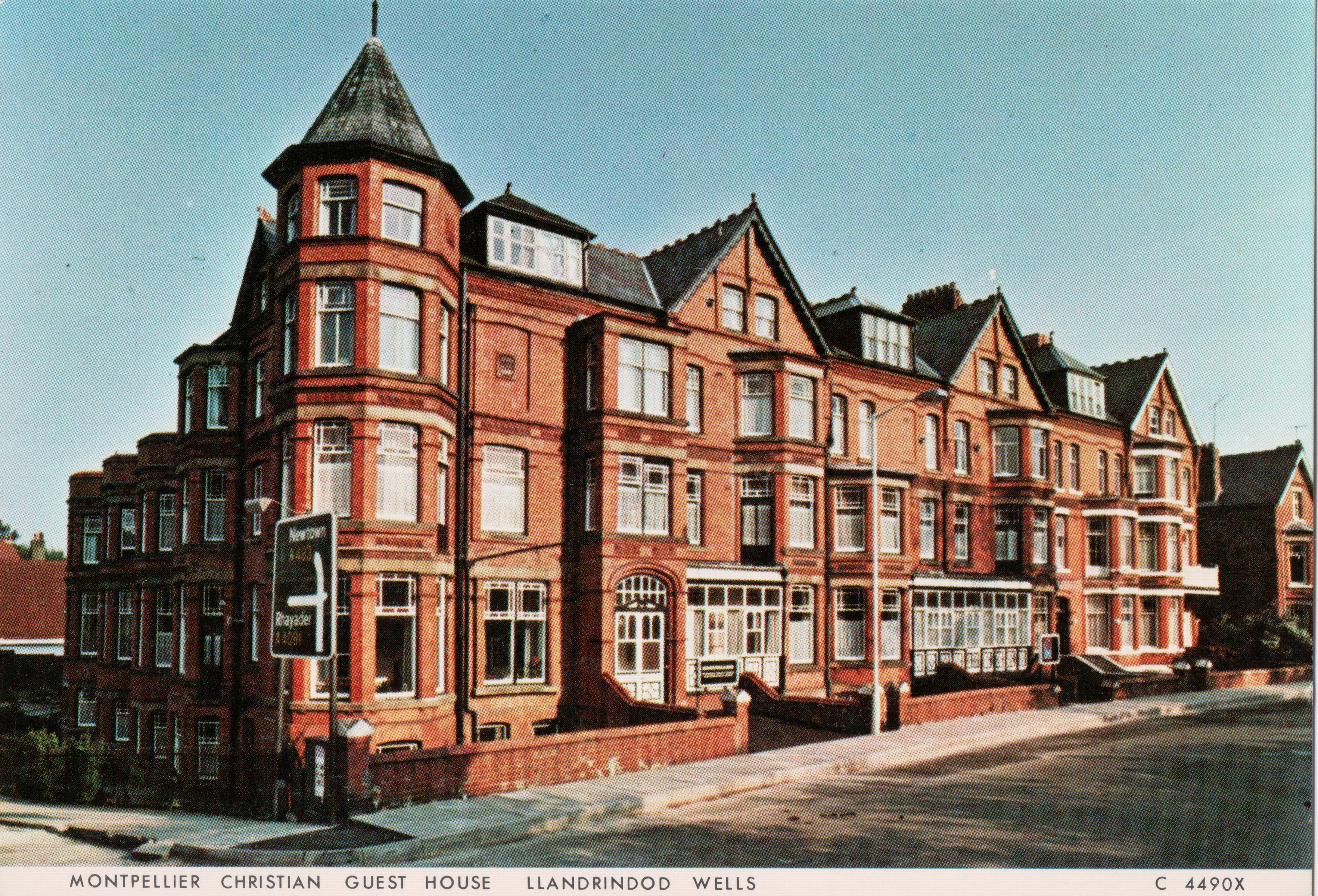
Among the surviving hotels of Llandrindod Wells, the Montpellier has a history rather different from that of the Metropole, Pump House or Rock Park. It was never the largest of the town’s establishments, yet for much of the late nineteenth and early twentieth centuries it occupied a distinctive place within the spa. It grew from a respectable Victorian boarding house into a substantial private hotel, was developed by two sisters, attracted members of the aristocracy, adapted itself to the motor age, remained in hotel use during the Second World War, and returned to the post-war holiday trade before entering a more uncertain period in the 1950s.
The story is also inseparable from the growth of the district around it. Montpellier House gave its name to Montpellier Park and Montpellier Park Road, while the adjoining common was gradually laid out for roads, houses and building plots as Llandrindod expanded. At the centre of the hotel’s formative years were Mary Bryan Smith and her sister Frances Tysoe Smith. Mary belongs to the late Victorian boarding-house period. Frances took what was already an established concern and developed it into a much more sophisticated Edwardian private hotel, while at the same time pursuing a serious career as an artist.
The Montpellier of Wales
The name itself belongs to the older history of Llandrindod as a health resort. Long before Montpellier became an hotel name, writers were comparing Llandrindod with Montpellier in southern France, a city associated with medicine, climate and convalescence. In August 1893 the Wrexham Advertiser published a long article under the heading “The Montpellier of Wales”. Its writer explained that a guidebook had already bestowed the description upon Llandrindod, before praising the town’s elevated position, clean air and mineral waters.
The comparison fitted the Llandrindod of the 1890s very well. Visitors rose early to drink the saline, chalybeate and sulphur waters, while the town offered boating, music, excursions and an increasingly elaborate social life. The same writer complained that Llandrindod still needed more enterprise if it was to become properly known to English visitors. Within the following twenty years much of that ambition would be realised through larger hotels, improved public amenities, golf, bowls, better roads and sustained advertising far beyond Radnorshire.
We cannot yet prove exactly when Montpellier House acquired its name, or who first chose it, but the connection is difficult to ignore. A substantial house catering for visitors stood in a town already being promoted as the “Montpellier of Wales”. The name then spread beyond the building itself. What later became the Recreation Ground was known until at least the mid-1890s as Montpellier Park, while Montpellier Park Road and Montpellier Common became familiar local names.
Mary Bryan Smith and the boarding house
The earliest secure evidence so far found for Montpellier as a commercial establishment comes from 1895. In August that year The Queen, answering a reader who wanted accommodation at Llandrindod Wells, recommended “Montpellier, Spa-road”, under Mrs Bryan Smith, with terms from two guineas. It was described as a boarding house.
That description should not make us imagine a cheap lodging house. As explored more fully in the history of Llandrindod’s boarding houses, a good boarding establishment could offer respectable middle-class visitors a quieter and more domestic alternative to the largest hotels, particularly when they intended to remain for several weeks while taking the waters. The fact that Montpellier was recommended in a national publication suggests that it had already acquired a reputation outside Radnorshire.
Mrs Bryan Smith was Mary Bryan Smith, later so closely associated with Ye Wells. By December 1897 she was still giving Montpellier as her address while serving as secretary of Llandrindod Hospital, a position which places her firmly within the civic life of the town. A year later the position had changed. An advertisement of December 1898 described her as the “late Proprietress of Montpellier”, using her former connection with the house as part of her commercial reputation.
The word “late” simply meant former. Mary was very much alive, and the description is valuable because it proves that she had not merely lived at Montpellier, she had run it. By this date she had moved into the Ye Wells story, while Montpellier would soon pass into the hands of her sister, Frances Tysoe Smith. The early development of the hotel was therefore not the work of two unrelated women who happened to share a surname, but of two sisters whose careers in Llandrindod hospitality overlapped.
There are hints that the property itself was developing around them. Local building records contain work connected with Montpellier during the later 1890s, and in 1900 a bicycle room was proposed at the property. That is a small detail, but a revealing one. Before the motor car transformed tourism, the bicycle had already begun to change the way visitors travelled through the countryside. Montpellier was adapting to that new mobility before the Edwardian building boom had reached its height.
Frances Tysoe Smith
By 1901 Frances Tysoe Smith was at Montpellier, describing herself as an artist and lodging-house keeper. In the same year Richard Wellings Thomas prepared plans for alterations and additions to the property. The surviving Wellings Thomas papers contain an architectural drawing for the proposed work, while the county architect’s collection preserves another plan of Montpellier from the same period.
Frances was an unusual figure in the hotel trade. Born in 1853, she had previously been involved in education and later developed a serious career as a painter. Her subjects included flowers, landscapes and marine scenes. She exhibited in Birmingham, Liverpool and London, including at the Royal Academy, and became associated with the artistic community at St Ives. Hotel keeping was only one part of her life.
Her artistic interests were visible even at Montpellier. In 1901 she sought permission for an artist’s studio, although the proposal was not approved. She was also associated with the Eastbourne Invalid Chair, a device intended to assist in moving invalids, including on stairs. In a health resort visited by elderly and convalescent people, the idea was not as eccentric as it might first appear. It belonged to the same world in which hotels, bath establishments and medical treatment overlapped.
By September 1907 there was no ambiguity about the status of the business. A large illustrated advertisement in the Radnorshire Standard called it the “Montpellier Private Hotel”, with Miss Tysoe Smith as proprietress. It was promoted as conveniently situated for the Pump Rooms and amusements, with fine and extensive views. The advertisement included a photograph, and that image has become one of the most useful pieces of evidence for the building’s history.
The hotel shown in 1907 was already large and architecturally elaborate, with projecting bays, varied rooflines and a prominent turreted section. This matters because a further programme of work followed in 1908. Wellings Thomas prepared specifications for additional alterations and additions to the Montpellier Private Hotel for Frances. The 1907 photograph therefore catches the building immediately before another important phase of change. It also shows that the 1908 works did not create the basic hotel from a modest house. Montpellier was substantial already.
A neighbourhood taking shape
At almost exactly the same time, the land around the hotel was changing. Montpellier had become more than the name of one building. It was increasingly the name of a developing quarter of Llandrindod.
The process was already under way by 1900, when plans were being prepared for a building estate at Montpellier Park. It formed part of the wider process by which Llandrindod was being laid out and built across the former common. By 1907 and 1908 Montpellier Common was being laid out more deliberately for development. In February 1908 contractors were invited to tender for making roads on the common, including sidewalks and sewerage, while building sites were openly offered for sale. Richard Wellings Thomas was again involved, and his papers include a plan of Montpellier Common dated October 1907.
By April 1909 tenders were being invited for six houses in Montpellier Park for Edwin Holt. What had once been open land associated with the common and recreation ground was becoming a residential district of roads, villas and substantial houses. The Montpellier Hotel therefore stood at the centre of two related developments, the growth of the spa hotel trade and the physical expansion of Llandrindod itself.
The location had always been part of the hotel’s appeal. It was close enough to the Pump Rooms and town amusements to be convenient, yet sufficiently near open land to advertise views, fresh air and recreation. As the town grew around it, the setting gradually became more suburban, but the Montpellier name remained fixed in the geography of the district.
A modern private hotel
By the end of the First World War, the Montpellier had become a remarkably well-equipped establishment. In June 1919 Frances Tysoe Smith announced her retirement and instructed the auctioneer Carl Hewitt to offer the freehold hotel for sale.
The particulars describe an old-established private hotel with a large number of guest and sitting rooms, seven bathrooms, a substantial lounge, billiard room, cloakrooms, extensive kitchens and staff quarters containing eight bedrooms. Outside were tennis and croquet lawns, a dell and further land with development value. The technical equipment was equally notable. The hotel had central heating, electric lighting and a Waygood-Otis automatic electric passenger lift. It was also R.A.C. listed.
This was a long way from the boarding house recommended to visitors in 1895. Under Frances, Montpellier had become a modern Edwardian hotel with the sort of facilities expected by an increasingly demanding clientele. The passenger lift is particularly striking. It was still being advertised as an amenity during the Second World War, but the 1919 sale notice proves that it belonged to the hotel’s earlier period of modernisation.
The sale did not proceed as Frances intended. At the auction in the Albert Hall on 24 June 1919, bidding began at about £7,000 and rose to £10,300, but the property was withdrawn. Whatever reserve had been set was not reached. Frances had announced her retirement, yet the hotel had not found a buyer at auction.
Her withdrawal from day-to-day hotel life nevertheless appears to have been genuine. In September 1919 she witnessed a will while staying at Ye Wells and gave her occupation simply as “Artist”. It is a fitting detail. Frances was leaving behind the business she had developed for almost two decades, but she was not retiring from public life altogether. She returned to the identity which had existed alongside the Montpellier throughout those years.
An hotel of standing
The precise ownership of the Montpellier immediately after the failed 1919 auction still needs further work, but the hotel itself plainly continued to prosper. In June 1922 the Wellington Journal reported a particularly distinguished group of guests, including the Marchioness of Winchester, the Dowager Countess of Clarendon, Edith Lady Milbank and Lord Glanusk.
That list says more about the Montpellier’s standing than any advertisement could. It was smaller than the great hotel palaces of Llandrindod, yet it could attract guests from the upper levels of British society. Its size may even have been part of the attraction. Montpellier could offer comfort and status without the scale and bustle of the Metropole or Pump House.
By 1929 Lieutenant-Colonel H. S. Laverton was associated with the hotel, which was advertising “the comforts of a modern hotel” and its convenient position for the Pump Rooms and golf courses. He remained connected with the Montpellier into the 1930s. The identification is not yet absolutely proven, but the man appears very likely to have been the former 3rd Hussars officer H. S. Laverton, who had served in India and South Africa and later with the King’s African Rifles during the First World War.
By 1936 the Montpellier was still advertising nationally, carrying R.A.C. recognition and promising first-class cuisine. In 1938 it appeared among the accommodation promoted during Llandrindod’s bowling and entertainment season. In March 1939, only months before the outbreak of war, the hotel was selling Easter holidays built around golf, fishing, motoring and walking.
The change in language is revealing. The Montpellier had not abandoned the spa, but it had learned to live beyond it. The Victorian visitor had come principally for water, treatment and convalescence. The interwar visitor increasingly came for scenery, sport and the freedom of the motor car. The hotel changed with them.
War without disappearance
The Second World War transformed Llandrindod. Several of its largest hotels were taken over for military or medical purposes, and some never returned to their old role. Montpellier followed a rather different course.
In February 1942 it was still advertising vacancies. Under manageress M. C. Wadman it promised “assured warmth” and good food, together with central heating and an electric lift. The wording belongs unmistakably to wartime Britain. Gone were the easy references to Easter holidays and motoring tours. Warmth, food and dependable accommodation had become selling points in themselves.
The advertisement does not tell us who was staying there, nor does it prove that the hotel was untouched by wartime demands. It does show, however, that Montpellier had not simply disappeared into requisition. At least at this point in 1942 it was functioning sufficiently as an hotel to advertise accommodation.
By 1947 the old holiday language had returned. The Montpellier announced that it was reopening for the season, again carrying R.A.C. and A.A. recognition. Excellent cuisine, breakfast in bed, central heating, a sun lounge, lift, golf, tennis and fishing were among the attractions. Mrs O. Munslow was then the name given for enquiries.
The last great post-war seasons
The hotel still presented itself confidently in 1950. One advertisement announced that it would reopen on 3 April for the season, with spacious lounges, a large billiards room, excellent cuisine and facilities for tennis, bowls, golf and fishing. Another described the Montpellier as the “Queen of Hotels” in the “Queen of Welsh Spas”. Whatever problems lay ahead, there was little hint in the advertising of a business apologising for itself.
The seasonal reopening is also worth noticing. Llandrindod’s older spa economy had always been concentrated between spring and autumn, and the Montpellier was still working to that rhythm after the Second World War. The 1947 reopening at the end of March and the 1950 reopening at the beginning of April suggest that winter closure had become part of its normal pattern.
Yet within a year the hotel was on the market. In March 1951 the complete concern was advertised for auction. The particulars describe three lounges, a smoke-room, billiard room, dining room, 46 letting bedrooms, nine bathrooms, nine staff rooms, a passenger lift, gardens and all main services. It was to be offered fully furnished and equipped, with the freehold available separately if the complete business failed to sell.
Three years later the Montpellier was being offered for sale again. The 1954 advertisement described five reception rooms and 65 bedrooms, 37 with hot and cold running water, together with domestic offices, central heating, lawns and gardens. The difference between the 1951 and 1954 room totals should be treated cautiously. It may reflect a different way of counting guest, staff and other rooms rather than a sudden enlargement of the building.
More telling was the language of the later sale. A low price was said to be acceptable for a quick transaction, and the property was promoted not only as an hotel but as suitable for a convalescent home or school. By then its future was no longer assumed to lie entirely in traditional hotel keeping.
It would be too easy to describe this simply as decline. The British holiday trade itself was changing. Large residential hotels with dozens of bedrooms, several lounges, dining rooms, gardens and a sizeable domestic staff had been created for a world in which visitors often remained for long periods. Rising costs, changing expectations, greater car ownership and, eventually, foreign holidays altered that market. Montpellier had repeatedly adapted before, but by the 1950s the economic world which had created it was beginning to recede.
Survival
The later twentieth-century ownership of the Montpellier still needs fuller reconstruction. What is clear is that the name and the hotel use survived long after the 1950s sales. The building remained part of Llandrindod’s hospitality trade into the twenty-first century, passing through several owners and operating companies.
During the Covid period the Montpellier was still sufficiently active as a hospitality business to receive support through the Welsh Government’s Economic Resilience Fund, with four jobs recorded as safeguarded. That provides a rather unexpected final link in a chain stretching back to Mary Bryan Smith’s boarding house in the 1890s.
The scale of the modern establishment is much reduced from the Montpellier of the mid-twentieth century. That alone is a reminder of how extensively old hotels can be reorganised as commercial needs change. The Montpellier of 1951 had 46 letting bedrooms and nine staff rooms. The great private hotel developed under Frances Tysoe Smith belonged to another age, even though the building and name endured.
Why the Montpellier matters
The Montpellier is easy to pass as simply another survivor from Llandrindod’s spa years, but its history is much richer than that. It began, so far as the evidence presently allows us to see, as a substantial Victorian house and boarding establishment in a town consciously presenting itself as the “Montpellier of Wales”. Under Mary Bryan Smith it had already acquired a national reputation by the mid-1890s. Under her sister Frances it was enlarged, modernised and turned into a sophisticated private hotel with electricity, central heating, a passenger lift, billiards, tennis and croquet.
Around it, Montpellier Park changed from open common and recreation ground into a new residential quarter. Within it, the character of tourism changed repeatedly. Spa visitors were joined, and eventually partly replaced, by golfers, motorists and holidaymakers. Aristocratic names appeared in the guest lists, wartime residents replaced the easy seasonal traffic of the 1930s, and post-war visitors returned for billiards, fishing, bowls and tennis.
More than anything, the Montpellier is a story of adaptation. Its buildings, clientele and advertising altered repeatedly while the name endured. It survived because it was never quite the same hotel from one generation to the next.
At the centre of its formative years were two sisters. Mary Bryan Smith belongs to the late Victorian boarding-house world and later to the history of Ye Wells. Frances Tysoe Smith took that family connection and carried Montpellier into the Edwardian age, while maintaining a separate identity as an artist whose work reached far beyond Radnorshire. Their story gives the Montpellier something that many hotel histories lack, a clear human thread running through the bricks, extensions, advertisements and changing fashions of the spa.
Related Essays
Explore more Llandrindod Wells history
Continue with the Llandrindod Wells History guide, or follow the related essays above to explore the people, buildings and institutions that shaped the town.
Receive new historical essays by email
For new essays on Welsh history, biography, genealogy and rural community life, subscribe on the homepage.
Sources and further reading
The principal evidence for this essay comes from contemporary advertisements and reports in the Wrexham Advertiser, The Queen, Radnorshire Standard, Radnor Express, Morning Post, Western Mail, Wellington Journal, Birmingham Daily Post, Swanage Times & Directory and Somerset Guardian and Radstock Observer, covering the period from 1893 to 1954.
Particularly important architectural material survives at Powys Archives in the papers of Richard Wellings Thomas and the former Radnorshire County Council architect’s collection, including plans for alterations to Montpellier, later additions to the private hotel, and plans connected with Montpellier Common. The historic development of Montpellier Park and the Recreation Ground is recorded in the Cadw and Coflein survey of Llandrindod Wells public parks. Frances Tysoe Smith’s artistic career can be followed through the Cornwall Artists Index and surviving exhibition records.
The feature image is a historic postcard view of the Montpellier during its later Christian Guest House period. Its publisher and precise date have not yet been established.