
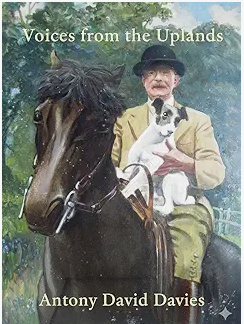
Voices from the Uplands
The Davies Family and the Soul of Rural Wales
A study of family, community and rural Welsh life.
Centred on the Davies family of Caeadda, Llanwrin, and the wider upland communities of Montgomeryshire, this book brings together long-running archival and genealogical research, oral testimony and close engagement with the landscape. It examines farming, kinship, Nonconformity, education, migration, language, cultural memory and the changes that reshaped rural society across successive generations.
Why I wrote this book
Voices from the Uplands is the third and final volume in the sequence of books that grew from my research into my maternal family. The Davies Caeadda Family and Old Llyfnant Valley Farming Families were essentially genealogical works, concerned with reconstructing families, relationships, farms and successive generations. By the time I came to this final book, however, I felt that simply recording who these people were was no longer enough.
I wanted to end the project by attempting to recover something of the world in which they had lived. Years of research had increasingly led me to the conclusion that the rural society familiar to these families was disappearing remarkably quickly, not only physically, but from collective memory. The farms remained, as did many of the chapels, houses and place names, but the network of relationships, beliefs, customs and assumptions that had once held upland communities together was becoming much harder to recover.
The book therefore became an attempt to create a snapshot of that world. Its subjects include farming, family and kinship, chapel life, Nonconformity, education, migration, language and the sense of belonging created by a comparatively small and closely connected rural community. The Davies family remains the thread running through the book, but the real subject is the society in which they lived.
Where the research began
The documentary foundations had already been established through decades of family research and through the two earlier books. What became increasingly apparent as I returned to that material was how little had been written about the everyday Nonconformist world of the Montgomeryshire uplands. Nonconformity had been central to the lives of many of the people I was researching, yet much of what that culture meant in practice, its chapels, Sunday schools, ministers, social expectations, family connections and place within rural identity, was in danger of becoming remote from modern experience.
I therefore approached the surviving family records differently. Rather than asking principally who belonged to whom, I began asking what sort of world these people inhabited, what shaped their beliefs and decisions, how farming communities functioned, and what happened as the institutions which had sustained that society began to weaken.
Family photographs, oral testimony and inherited memories became particularly important alongside conventional documentary sources. They could not replace archival evidence, but they helped restore something of the human texture that census returns, certificates and registers alone could never provide.
I was greatly honoured that my cousin, the harpist Elinor Bennett OBE, agreed to write the Foreword. Her own connection with the Caeadda family gave the book an appropriate opening, linking the generations whose lives I had spent so many years researching with a living family memory of that inheritance.
Sources and method
The research draws on census returns, civil registration, parish and chapel records, newspapers, wills, family papers, photographs, maps and oral testimony. Genealogical reconstruction remains important, but it is used as the framework for a wider social history. Wherever the documentary record becomes uncertain, I try to distinguish what can be established from what can only reasonably be inferred.
How it fits into my wider work
Voices from the Uplands brought this particular family-history project to a close. The first book had begun with the question of who my ancestors were. The second widened that investigation to the interconnected families of the Llyfnant Valley. This final volume asked a different question: what was the world that produced them?
For that reason, I regard it as an important transition in my own historical work. Genealogical reconstruction provided the evidence, but the purpose had become social history. The focus had shifted from descent to community, belief, landscape and cultural change, and particularly to the recovery of aspects of rural Welsh life which were disappearing from living memory.
The companion study Caeadda, Llanwrin: Three Centuries of Farming in the Montgomeryshire Uplands traces the farm at the centre of this research from its earlier occupants through Victorian tenant farming to the Davies and Pughe generations. It draws on the documentary material preserved in this book and its predecessors.
Publication details
- Author: Antony David Davies
- Foreword: Elinor Bennett OBE
- Published: December 2025
- Formats: Kindle, paperback and hardcover
For an individual life drawn from the Caeadda research, see Gwen Jones of Caeadda, 1841–1926: A Welsh Farming Matriarch. For the wider research context, see Welsh Rural History and Research Methods.
Read Voices from the Uplands
If this account of the research and the rural world behind it interests you, the complete book is available in Kindle, paperback and hardcover editions.