
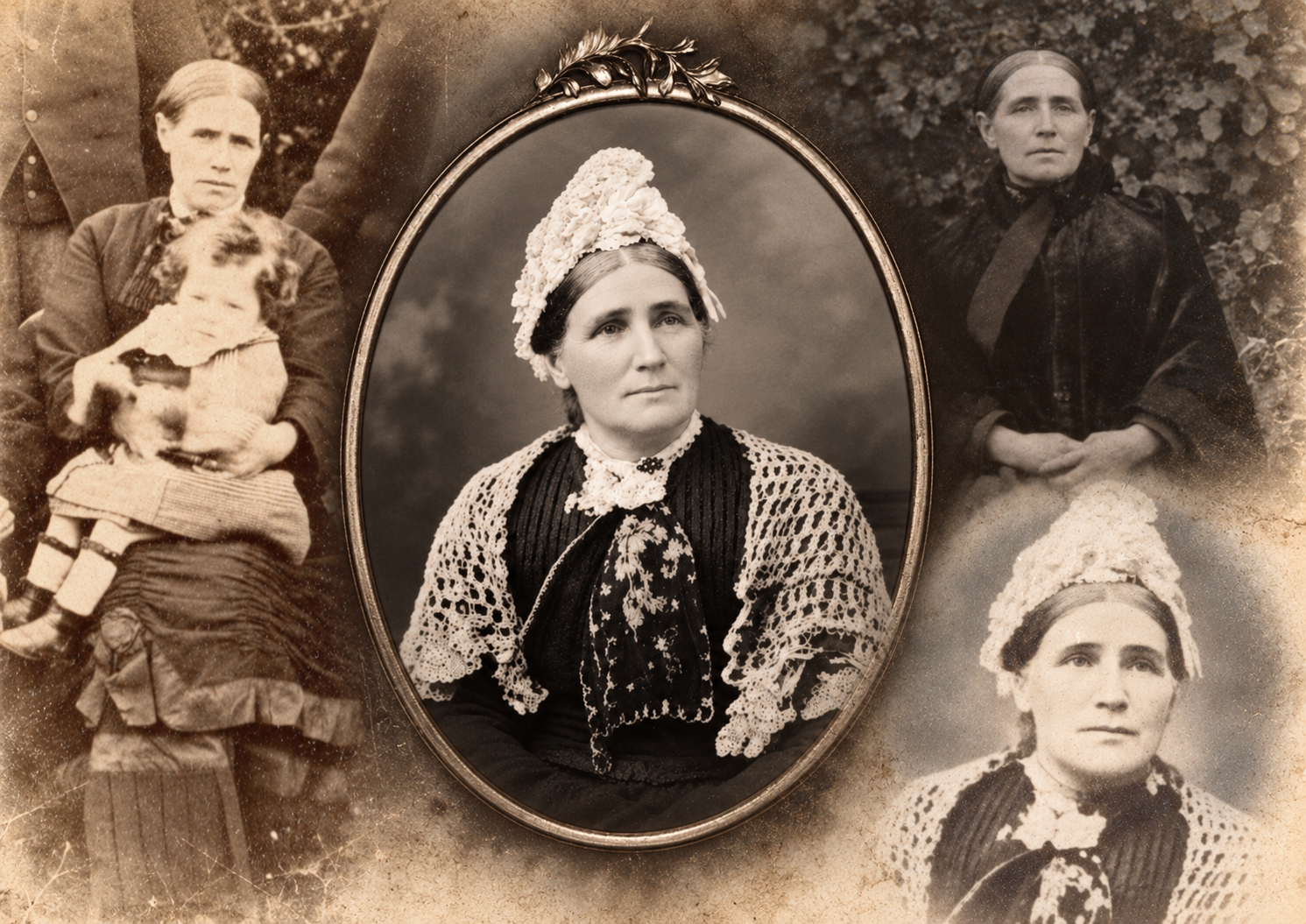
The history of rural Wales is much easier to write around men than around women. Men more often appear as named farmers, tenants, landowners, councillors, chapel officers and witnesses. Their occupations were recorded, their livestock advertised and their public work reported. Women could spend an entire lifetime carrying a considerable share of the burden of a farm and leave behind little more than a sequence of census entries, a marriage certificate and a death record.
Gwen Jones, later Davies, was my great-grandmother. Enough evidence survives to recover something much more substantial than a name in a family tree, and her life deserves to be understood both as part of my own family history and as part of the wider social history of rural Wales.
Born in Liverpool in 1841 but raised among the upland farms of Wales, Gwen married into the Davies family of Caeadda near Llanwrin when she was eighteen. She became the mother of twelve children, all of whom survived infancy. She lived through the agricultural depression, the decline of the old servant-based farm household, severe winters, repeated family bereavements and enormous changes in the legal and social position of women. When her husband died, she did not simply retire into the background. She remained at the centre of Caeadda, entered Welsh Mountain rams in her own name at the Machynlleth Agricultural Show, continued in the farm household into her eighties and died leaving a substantial personal estate.
There is another contradiction at the heart of her story. Official evidence suggests that Gwen spoke only Welsh and did not conventionally sign her name. Yet among the possessions she considered important enough to name in her will was a ten-volume Welsh-language encyclopaedia. She was a woman whom the surviving bureaucracy might easily classify as uneducated, but whose life demonstrates the danger of confusing formal literacy with knowledge, judgement or authority.
Her story is family history, but it is also social history. Through Gwen we can see something of the lives of thousands of women upon whom the farms of nineteenth-century Wales depended.
A Welsh family in Liverpool
Gwen’s story begins not at Caeadda, nor even in Montgomeryshire, but in Victorian Liverpool.
Her parents were Ellis Jones and Mary Jones. Family tradition long maintained that the young couple ran away to Liverpool together, perhaps against the wishes of their families. For many years that remained one of those stories which survive within families without quite becoming documentary history.
A record discovered during this research brings us considerably closer to what actually happened.
On 21 September 1840 Ellis Jones and Mary Jones married at St Paul’s Church in Liverpool. Both stated that they were living in Clayton Square. Ellis was described as a waiter and a bachelor. His father, Hugh Jones, was a skinner. Mary was a spinster, and her father, John Jones, was described as a farmer. The witnesses were Matthew Bradshaw and Ellinor Jones.
Less than four months later, on 14 January 1841, their first child was born.
She was Gwen Jones.
The surviving family research places Gwen’s birth at 19 Clayton Square. She was subsequently baptised at St David’s Church, Liverpool, on 31 January. Her mother belonged to the Jones family of Esgair Llewelyn, near Aberllefenni, where Mary’s parents John and Gwen Jones had been farming since around 1815.
The short interval between Ellis and Mary’s marriage and Gwen’s birth certainly makes the old story of a hurried departure to Liverpool more understandable. It does not prove that they eloped. There may have been no family opposition at all. What can now be established is that the couple were already living in the same part of Liverpool, that Ellis was employed there as a waiter, and that Mary was several months pregnant when they married.
That turns family tradition into something rather more interesting. The details may have been embroidered in the telling, but the underlying story of two young Welsh people establishing themselves in Liverpool before the birth of their first child clearly has a basis in fact.
From Liverpool to Esgair Llewelyn
Gwen’s baptism also deserves reconsideration.
St David’s Church stood on Brownlow Hill. It had opened in 1827 and was the first Church of England church in England built specifically for Welsh-language worship. The legislation authorising its construction explicitly referred to the large number of people from Wales who had settled in Liverpool, and provision was made for Welsh-language preaching.
This matters. Gwen’s baptism in an Anglican church should not be taken as evidence that the Jones family had abandoned Welsh religious or cultural identity. St David’s existed precisely because Liverpool possessed a substantial Welsh population wanting to worship in its own language.
The infant Gwen was therefore born geographically in England but culturally into a recognisably Welsh community.
Liverpool was not necessarily an escape from Wales. For families such as hers it could be an extension of Wales, connected through migration, language, employment, chapel and kinship to the rural communities they had left behind.
One part of the story should now be treated with more caution.
Earlier family research described Gwen as having been born in a temperance hotel at 19 Clayton Square. Ellis’s documented occupation as a waiter certainly makes employment in a hotel entirely plausible. However, later research has revealed problems with identifying exactly which hotel occupied which number in Clayton Square at this date.
Brown’s Temperance Hotel certainly existed in Clayton Square during the 1840s, but contemporary references do not provide a simple match with the number given for Gwen’s birthplace. Historic numbering in the square appears to have changed as properties were altered and combined.
For that reason the firm evidence is best kept separate from family interpretation. Gwen was born at 19 Clayton Square, and her father was working as a waiter in Clayton Square. The precise establishment in which he worked remains to be proven.
The important point remains unchanged. Gwen’s first home stood in one of the busiest commercial districts of a rapidly expanding port city, far removed in appearance from the mountain farms upon which almost all of the rest of her life would be spent.
The Liverpool chapter was short.
By the middle of the 1840s Ellis and Mary had returned to Wales and were living at Esgair Llewelyn with Mary’s parents. Family tradition claimed that a fire at the Liverpool hotel prompted their return. No independent evidence has yet been found proving that detail, so it should remain identified as family tradition.
For Gwen, however, the return meant that her formative years were spent within an old upland farming household rather than in Liverpool.
Esgair Llewelyn had been occupied by her maternal grandparents John and Gwen Jones since the early nineteenth century. It belonged to a landscape of dispersed farms, rough roads, sheep walks and family networks extending between Llanwrin, Corris, Aberllefenni and the Dolgellau district.
The house itself had much older origins. Its surviving fabric belongs to a tradition of medieval and early modern Welsh domestic architecture, altered repeatedly as succeeding generations adapted it to changing needs. Gwen grew up in a building which already represented centuries of rural occupation.
More important to her own story was the woman who presided over it. Her grandmother, another Gwen Jones, appears to have been a formidable figure. After the death of her husband in 1865 she remained in control of Esgair Llewelyn, with her son-in-law Ellis continuing to work there. Later census evidence places the elder Gwen not simply as an elderly relative but as the farmer herself.
That becomes particularly significant when we consider what her granddaughter would do after being widowed.
Before Gwen left Esgair Llewelyn she experienced a major loss.
Her mother Mary died on 29 October 1857, aged only thirty-eight. Gwen was sixteen. Ellis and Mary had six children, of whom Gwen was the eldest.
We cannot simply assume that Gwen thereafter became a substitute mother to her younger brothers and sisters. No surviving document tells us how responsibilities were divided inside the farmhouse.
Nevertheless, the chronology matters. At sixteen Gwen lost her mother. She was the eldest child in a household containing younger siblings, a father and grandparents. Less than two years later she was married and beginning a household of her own.
The transition from childhood to adult responsibility must have been rapid.
It may also help explain something of the woman she later became. Gwen grew up in a household containing an unusually strong older female presence, lost her own mother before adulthood and entered marriage already familiar with the realities of illness, death and domestic responsibility.
Marriage and Life at Caeadda
On 22 June 1859, aged eighteen, Gwen married Thomas Davies of Caeadda at Llanwrin parish church.
One point from earlier treatments needs correcting. Gwen and Thomas were not legally obliged to marry in the Anglican parish church because they were Nonconformists. The Marriage Act of 1836 had already enabled Nonconformists and Roman Catholics to marry in registered places of worship. Their choice of Llanwrin church therefore cannot be explained simply as a legal necessity.
The marriage united two established local farming families.
Caeadda itself already had a lengthy documented history. National Library of Wales estate records place the farm among properties associated with the Cymerau Estate in the early nineteenth century, and a sale particular survives for Cae Adda and Bwlch-y-Lluan dated 15 September 1837. Family research into that sale found Caeadda described as a farm of about 144 acres, occupied by Thomas Davies as tenant.
Gwen was therefore marrying into a family deeply established at the holding, but Caeadda was not their landed estate. They were tenant farmers.
That distinction shaped everything. The family had the security which could come from a long tenancy and accumulated farming knowledge, but they still had rent to pay. Their prosperity depended upon livestock, labour, markets, weather and their ability to adapt.
When Gwen married in 1859, the law gave married women far less independent control of property than she would possess by the end of her life.
Marriage severely restricted a woman’s separate property rights. Parliament began changing that position with the Married Women’s Property Act of 1870, and the reforms of 1882 gave married women substantially greater control over property in their own names.
Gwen lived through that transformation.
At eighteen she entered a legal and social system in which the husband was formally at the head of the household. By her widowhood in the 1890s, both law and society were changing. By her death she was able to leave a substantial personal estate and make precise decisions in her will concerning its distribution.
Her life therefore crossed more than an agricultural transition. It also crossed an important change in the legal status of women.
Motherhood and the Working Farm
One of the most important facts about Gwen’s life has been too easily lost among the individual biographies of her children.
Thomas and Gwen had twelve children. Every one of them survived infancy.
Their eldest surviving child, John Davies, was born at Caeadda on 17 August 1861 and baptised at Llanwrin parish church on 7 October. Their youngest daughter, Jane Davies, was born at Caeadda on 10 August 1884.
Gwen’s childbearing therefore extended across almost twenty-three years. She was about twenty when John was born and forty-three when Jane arrived.
That changes the scale on which her life must be understood. During much of the period when she was helping to maintain the domestic economy of Caeadda she was also pregnant, recovering from childbirth, nursing an infant or caring for several young children at once.
The survival of all twelve children is itself striking for the nineteenth century. It also created a very large household whose needs were inseparable from the economy of the farm.
Those children subsequently became part of the labour system which helped Caeadda endure the agricultural depression. Family and farm were not separate institutions. They were the same economic unit.
The census records provide a particularly useful measure of how the household changed.
In 1861 and again in 1871 Caeadda employed three live-in domestic servants. That suggests a household enjoying a reasonably comfortable position during the relatively prosperous agricultural years of the mid-nineteenth century.
For Gwen this meant that the phrase “farmer’s wife” should not simply be imagined as a woman personally performing every domestic task from dawn until night.
She certainly carried responsibility for the household, but in the better years she was also managing the work of others.
Food preparation, preserving, bread making, dairy work, poultry, pigs, cleaning, laundry, clothing and the feeding of workers all formed part of the economy associated with a substantial farm. Gwen’s role would increasingly have been one of organising that domestic machinery as well as participating in it.
The servant figures then change dramatically. By 1881 there was only one live-in maid at Caeadda. By 1891 there were no live-in servants at all. Gwen and Thomas instead increasingly depended upon their own children. Sons John, Thomas and David worked within the farm economy, while Mary Winifred was also working at Caeadda.
Few statistics illustrate the agricultural depression more vividly. Three resident servants had become none.
Agricultural Depression and Widowhood
British agriculture entered a prolonged period of difficulty from the 1870s. Falling prices and increased competition placed pressure upon farmers throughout the country, including the pastoral farms of mid Wales.
Thomas and Gwen adapted.
Their growing children supplied labour which the household could no longer afford to purchase in the same way. Thomas also diversified. In May 1881 and again in April 1891 he sold substantial quantities of oak timber from Caeadda at auctions in Machynlleth. The sales were advertised over a wide area.
This is an important reminder that upland farming was never simply a matter of owning sheep. A viable farm depended upon a mixture of activities and resources. Woodland could provide income. Family labour could replace hired workers. Domestic production could reduce household expenditure. Livestock breeding could enhance reputation and value.
Gwen was living at the centre of all of this. By the time she became a widow she had spent more than thirty years learning how Caeadda functioned.
In June 1891 influenza was spreading through the Llanwrin district. Earlier family research found a report of the epidemic serious enough to close the village school temporarily.
Thomas became one of its victims.
He died at Caeadda on 15 June 1891, aged sixty-four, from what was described as Russian influenza, and was buried at Llanwrin four days later.
Gwen was fifty.
Her husband’s death might easily have marked the point at which responsibility passed decisively to the next generation.
It did not.
Gwen the farmer
After Thomas’s death, Gwen appears to have run Caeadda in partnership with her eldest son John.
John was a capable farmer in his own right, trained from childhood in shepherding and livestock work. The important point, however, is that Gwen did not vanish from the economic record.
In August 1892 she entered Welsh Mountain rams at the Machynlleth Agricultural Show. She came second.
The following year she entered again. She came second again.
These two appearances are among the most revealing facts in her life.
Agricultural shows were not casual social occasions. Livestock classes were public tests of breeding and husbandry. Winning enhanced the reputation both of the animal and of the farm from which it came.
Gwen was competing in her own name.
That does not mean she was uniquely overturning the conventions of Victorian rural life. Modern research has shown that female farmers were more common in Wales than in England. Frances Richardson’s study of Nantconwy found women comprising as much as 22 per cent of farmers in that area between 1750 and 1900, with widowhood, long-established tenancies and the inheritance of livestock among the factors allowing women to remain in agriculture.
Gwen therefore belonged to a genuine Welsh rural tradition. What remains particularly striking is the visibility of her role. She was not merely described on a census as the widow of a farmer. Her animals were being publicly judged at one of the major agricultural events of her district.
There is a compelling family parallel here.
Gwen had grown up watching her grandmother remain at the head of Esgair Llewelyn after becoming a widow. The elder Gwen Jones was recorded as the farmer there, rather than simply as a dependent member of her son-in-law’s household.
A generation later, Gwen Davies did something remarkably similar at Caeadda.
We cannot prove that one consciously copied the other. There is no diary in which the younger Gwen explained her ideas about women and farming.
Nevertheless, the pattern is difficult to ignore.
Both women belonged to substantial upland farming households. Both were widowed. Both continued exercising authority over the farm rather than automatically surrendering it to the nearest adult man.
This may tell us something important about the practical culture of Welsh family farming. Formal society was patriarchal, but a farm could not afford to disregard experience merely because that experience belonged to a woman.
Gwen and John soon faced another test.
February 1895 brought the Great Frost, one of the longest and severest cold periods recorded in nineteenth-century Britain. Earlier family research repeated a temperature of minus 27.2°C as if it were local to Llanwrin, but that figure belongs to Braemar in Scotland and should not be used as a Montgomeryshire measurement.
What remains beyond doubt is that such prolonged cold was potentially disastrous for upland farms. Sheep were vulnerable, fodder supplies were placed under pressure, roads could become impassable and access to markets difficult.
Caeadda survived.
We cannot calculate Gwen’s individual contribution, nor should survival be turned into a heroic story unsupported by accounts or ledgers. But the farm remained viable during precisely the period in which Gwen and John were managing it.
That is evidence enough.
In October 1897 John Davies died suddenly at Caeadda at only thirty-six.
It was a considerable loss. John had already built a reputation as a livestock breeder, shearer and sheepdog competitor and was the obvious candidate to carry Caeadda into the next generation.
Once again Gwen remained.
After John’s death she continued at Caeadda with another son, David Davies. By the 1915 electoral roll she was living there with David, Hugh and her youngest son Griffith Llewelyn Davies. In 1926 she was still at Caeadda with David, David’s wife Harriet, and Griffith.
There is an additional piece of evidence which deserves particular emphasis. Research already undertaken on the family records Griffith Llewelyn Davies in 1921 as working as a farmer for his mother. If the original 1921 census wording confirms that transcription, this may be the clearest documentary statement of Gwen’s position in the entire surviving record.
Three decades after Thomas died, her adult son was still being described in relation to his mother’s farming enterprise.
That takes us beyond the rather vague language of “helping to run the farm”. Gwen appears to have possessed recognised economic authority at Caeadda into old age.
Language, Education and the Gwyddoniadur
The census records tell us something else about Gwen.
In 1891, 1901 and 1911 she was recorded as speaking Welsh rather than English. Documents also survive on which she made a cross rather than signing her name.
Earlier accounts have therefore described Gwen as illiterate. It is worth being more cautious.
A person who could not write a conventional signature was certainly limited in formal written literacy, but this does not necessarily tell us everything she could understand or read, particularly within a Welsh-speaking oral culture. Nor do English administrative records measure the full range of knowledge available within a Welsh farming and chapel household.
What can be established is that Gwen did not normally sign her name and that Welsh remained her principal language.
What should not be done is to translate those facts into intellectual incapacity. Her subsequent life makes such an interpretation impossible.
The contrast between Gwen and her children is particularly striking.
The family research found that all twelve of Thomas and Gwen’s children appear to have received some education.
A National School opened in Llanwrin in 1876, by which time several of the older children were already beyond elementary-school age. Earlier education would have depended upon other arrangements, including Sunday school and schools outside the immediate village.
Whatever Gwen’s own experience of formal schooling, the next generation was not kept from it.
The family’s subsequent history demonstrates the consequences. Some children became successful farmers. Others moved into different occupations. The grandchildren included individuals whose lives extended far beyond the immediate agricultural community.
One of the most remarkable was Trevor Owen Davies.
The strongest evidence of Gwen’s relationship with Welsh culture may come from her will.
Among her possessions was a ten-volume set of the Gwyddoniadur Cymreig.
This was not an ordinary collection of household books. Y Gwyddoniadur Cymreig was one of the great nineteenth-century Welsh-language encyclopaedic projects, published by Thomas Gee’s important Denbigh press. It attempted to make a wide body of religious, historical, biographical, scientific and general knowledge available through Welsh.
Gwen considered these books important enough to specify their destination in her will.
Originally she intended them for her grandson Trevor Owen Davies. Shortly before her death she altered the provision and left them instead to her youngest son, Griffith Llewelyn Davies. The volumes subsequently remained within the family and, in a later generation, were given to a granddaughter to assist with her education.
There is an obvious puzzle. Why did a woman who apparently could not sign her own name possess and treasure a ten-volume Welsh encyclopaedia?
There is no safe answer. Perhaps another member of the family read from the books. Perhaps Gwen herself could understand some written Welsh despite lacking confidence in writing. Perhaps their value was cultural and religious as much as practical.
The evidence does not allow us to choose.
But the books mattered to her. That is the historical fact.
The proposed bequest to Trevor becomes particularly interesting when his later life is considered.
Trevor was born at Caeadda in 1895, the son of Gwen’s daughter Mary Winifred Davies and Owen Gruffydd Owen. He was educated locally, then at Machynlleth County School, before studying classics at University College Aberystwyth and theology at Christ Church, Oxford. He completed a B.Litt. on Augustine, entered the Presbyterian ministry and eventually became principal of Trefeca College.
We should not invent Gwen’s motive for originally choosing him to receive the Gwyddoniadur. The relevant provision would need to be dated before we could know how far Trevor’s academic career had advanced when Gwen made that decision.
Nevertheless, the later history is resonant.
A major Welsh-language work of learning owned by a woman with little formal education was originally intended for a grandson who became a scholar, theologian and college principal.
Few objects better illustrate the movement between generations in this family.
Family, Community and Later Life
Gwen’s life was not confined to Caeadda.
Newspaper research places her at a number of local events.
During the celebrations for the coronation of Edward VII in 1902 she helped with the tea tables. She again performed this role during the opening of the school at Llanwrin in June 1908. Earlier family work called this the “Revolt School”, but Powys Archives records the institution formally as Llanwrin Emergency/CP School, and that archival designation is preferable unless a contemporary newspaper establishes “Revolt School” as a local name.
Tea tables might appear an inconsequential detail, but in rural communities they were not.
Public dinners, chapel gatherings, school openings, eisteddfodau, agricultural shows and celebrations depended upon organised hospitality. Women who took responsibility at such events were participating in the public functioning of the community, even if their role was not described in the political language normally used for men.
Gwen also appears at significant local weddings. In October 1887 she attended the marriage of Henry Lester Smith and Jennie Owen and presented them with a pair of vases. In October 1903 she attended the marriage of Professor John Roberts and Jennie Gittins at the Methodist chapel at Lake Vyrnwy, giving the couple a set of silver carvers in a Morocco leather case.
These details reveal a woman participating comfortably in the networks of respectable farming, professional and Nonconformist society.
By the 1920s Gwen had lived at Caeadda for more than sixty years.
The farm she knew in old age was no longer quite the farm she had entered as an eighteen-year-old bride.
The household of three resident servants had disappeared. Several children had left to establish farms and households of their own. Some had died. Horse power and hand labour were beginning to give way to mechanisation. Education had expanded. Women’s property rights had changed. The franchise had begun to include women. The First World War had passed through the lives of a generation which Gwen had watched grow up.
Yet she remained at Caeadda.
David’s marriage brought another woman, Harriet, into the central domestic position within the farmhouse. Gwen was by then in her eighties and presumably relinquishing many of the practical tasks she had once managed.
Authority, however, is not always the same thing as physical work.
A woman who had lived within the same household for more than six decades, raised twelve children there and helped keep the farm running after the deaths of both her husband and eldest son would not suddenly have become insignificant because she could no longer undertake the work of her younger years.
She had become the matriarch.
Death, Memory and the Missing Grave
Gwen Davies died at Caeadda on Sunday, 10 October 1926. She was eighty-five.
The recorded cause was “probably heart failure”. Probate was granted on 4 March 1927 to her sons David Davies and Griffith Llewelyn Davies. Her personal estate was valued at £2,630 11s 2d. Earlier family research calculated that after liabilities and duties the remaining estate was about £1,120.
For the widow of a tenant farmer, the gross figure was substantial.
It provides a fitting final piece of evidence for a life which official records might otherwise encourage us to underestimate.
Gwen had entered marriage in 1859 when the independent property rights of married women were severely restricted. She died almost seventy years later in possession of an estate which was legally her own and with a will determining how her possessions should pass through the family.
One mystery remains.
Gwen’s burial place has never been securely identified. She was not buried beside Thomas in Llanwrin churchyard.
That is unusual enough to deserve further investigation, particularly given the importance attached to burial, chapel and family continuity in the world in which she lived.
Her mother’s burial at Tal-y-llyn and the family’s connections with several Nonconformist communities create possible avenues, but at present there is no evidence strong enough to name her grave.
It is better to leave the question open than to fill the silence with speculation.
The grave may be missing, but Gwen’s face is not.
A portrait of her survived within the family and has been reproduced in my earlier work. It shows an older woman, carefully dressed and directly facing the camera.
The survival of that portrait is significant because family memory treated Gwen differently from many of her contemporaries.
Her image continued to be displayed by descendants, her name remained familiar, and the Gwyddoniadur remained within the extended family. More than a century after her death, Gwen is still remembered and respected among her descendants, not simply as an ancestor whose name survives in records, but as a formidable family figure whose character and standing were carried forward in family memory.
The archival evidence and family memory point in the same direction.
Gwen was remembered because she mattered.
Gwen did not create Caeadda’s history. The farm had existed for generations before her arrival.
Estate records place it within the local landed landscape in the early nineteenth century, and an 1837 sale particular survives. Archaeological survey also records Cae Adda as a post-medieval farmstead within the Llanwrin landscape.
What Gwen represents is one chapter within that longer history, but an unusually important one.
She lived there through the transition from Victorian agricultural prosperity to depression, through the disappearance of resident domestic servants, through widowhood, influenza, harsh winters and the death of the son expected to succeed her husband.
And Caeadda did not end with Gwen.
Modern documentary work has recorded the farm still being worked by descendants, with the knowledge and responsibilities of the land continuing into the twenty-first century.
That continuity gives Gwen’s story an ending very different from those of so many abandoned upland holdings.
The household changed. The Davies surname itself eventually ceased to define the tenancy. Agriculture modernised. Yet Caeadda remained a working farm within the wider family.
More than a farmer’s wife
There is a temptation when writing about nineteenth-century rural women to compensate for their historical invisibility by making them exceptional in every respect.
Gwen does not need that treatment.
Women did farm in Wales. Widows did take over holdings. Women worked, managed households, controlled dairy production, kept accounts informally, raised livestock and sustained complex networks of kinship. Modern scholarship demonstrates that female farmers were a recognisable part of Welsh rural society.
What makes Gwen valuable is that unusually rich evidence survives for one of them.
We can see her as a girl born among Welsh migrants in Liverpool, as the motherless eldest daughter at Esgair Llewelyn, as an eighteen-year-old bride moving to Caeadda, as the mother of twelve children, as the manager of a large household, as a farmer’s wife during depression, as a widow entering rams at the Machynlleth show, as the mother whose adult sons continued working the land, as the Welsh-speaking old woman who made her mark rather than signing her name, and as the owner of a ten-volume Welsh encyclopaedia which she deliberately passed into another generation.
Those details are more revealing than any attempt to turn her into a modern heroine.
They place her firmly within her own world.
Why Gwen matters
When Gwen was born, Queen Victoria had been on the throne for less than four years. Railways were only beginning to transform Britain. Elementary education was not compulsory. Married women’s independent property rights were profoundly restricted. Welsh remained the ordinary language of much of rural mid Wales.
By the time Gwen died in 1926, Britain had passed through industrialisation, agricultural depression, political reform and the First World War. Women had entered the parliamentary electorate. The legal position of wives had been transformed. Motor cars were appearing on rural roads. The authority of the old chapel and farming household was beginning to face a very different world.
Gwen had not merely witnessed those changes. Her own life had been shaped by them.
Yet the things which seem to have mattered most to her remained remarkably consistent, family, farm, Welsh language, community and continuity.
That is why her story deserves to stand alone rather than simply appearing as one chapter in a family genealogy.
The great events of history eventually reached Caeadda, but history there was also made through quieter acts: keeping a household together, raising children, surviving a bad winter, selecting a ram, feeding workers, attending a neighbour’s wedding, choosing who should receive a set of books, and refusing to let a farm collapse when death removed the men expected to run it.
For most of Gwen’s life nobody would have regarded such things as historically important.
They were simply life.
More than a century later, they are precisely what makes her worth remembering.
For the history of the farm itself, including the generations who occupied it after Gwen’s death, see Caeadda, Llanwrin: Three Centuries of Farming in the Montgomeryshire Uplands.
The wider story of the community around Caeadda, including the parish church and the graves of generations of our family, is explored in Llanwrin: A Montgomeryshire Village, Its People and My Family’s History.
Related Essays
- Esgair Llewelyn: A Medieval Welsh Farmhouse and the Social History of a Llanwrin Family
- Voices from the Uplands: Why I Wrote It and Why It Matters
- Trevor Owen Davies (1895–1966): From Welsh Farm Boy to Christ Church, Oxford
- The Llyfnant Valley: Farming, Waterfalls, Tourism and the Waters Family
- The Women of Glandwr: Kinship, Household and Inheritance in a Victorian Welsh Family
- Saving the Soul of Wales: Why We Must Preserve Welsh Family and Chapel Records
- Thomas Davies of Penlan and Gwernstablau (1864–1930): Farming, Family and Public Life in Montgomeryshire, the life of Gwen’s son Thomas, my great-uncle, and his farming career, family and local public service.
- Owen Jones Davies (1875–1958): From Caeadda to the Welsh Settlement of Wood River, the life of Gwen’s son Owen, who emigrated to Canada and became a farmer and choir leader at Wood River.
Explore more Montgomeryshire and rural history
Continue with the Montgomeryshire History, Welsh Rural History and Family History & Genealogy guides, or browse the related essays above.
Sources and Further Reading
This essay draws upon census returns, parish registers, civil registration, electoral records, probate and testamentary material, contemporary newspaper reports, family photographs and oral tradition, together with research developed in The Davies Caeadda Family, Old Llyfnant Valley Farming Families and Voices from the Uplands: The Davies Family and the Soul of Rural Wales. The distinction between documentary evidence and family tradition has been retained, particularly in relation to the story of Ellis and Mary Jones going to Liverpool and the reported fire which preceded their return to Wales.
- Lancashire OnLine Parish Clerk Project, St Paul’s Liverpool marriage records.
- UK Parliament, the law of marriage.
- UK Parliament, married women’s property rights.
- Frances Richardson, “Women Farmers of Snowdonia, 1750–1900”.
- Dictionary of Welsh Biography, Trevor Owen Davies.
- National Library of Wales, Gee Printing Company records.
- Esgair Llewelyn: A Medieval Welsh Farmhouse and the Social History of a Llanwrin Family.