
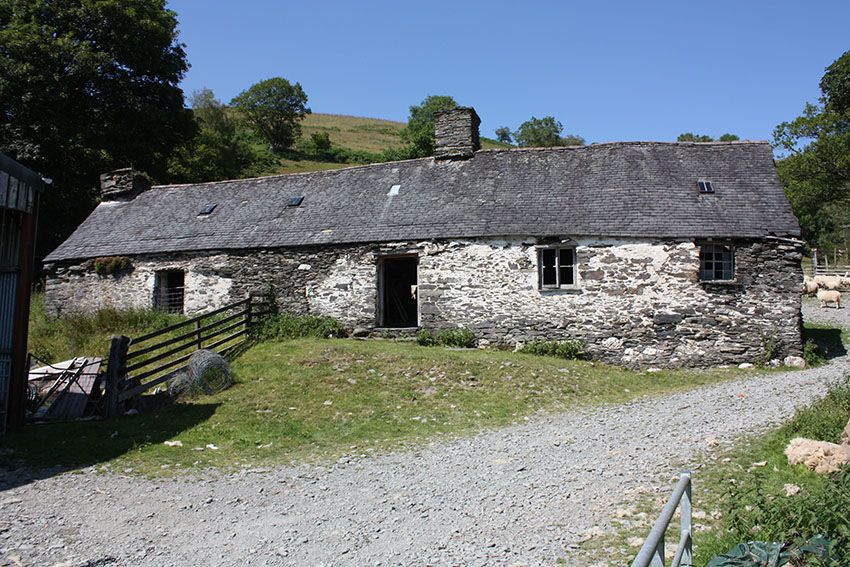
High in the Montgomeryshire uplands, above the quieter reaches of the Dyfi valley, stands an abandoned farmhouse known as Esgair Llywelyn, Llywelyn’s Ridge.
It is an arresting place. The track rises through pasture and bracken towards whitewashed walls, a slate roof and windows long emptied of domestic life. Sheep graze around the yard. Wind passes through the openings where voices, fires and family routines once filled the rooms.
The Royal Commission on the Ancient and Historical Monuments of Wales describes Esgair Llywelyn as a remote upland farmhouse of considerable historical interest. Its surviving fabric belongs principally to the early sixteenth century. It began as a cruck-framed hall house, probably built around 1500 or shortly afterwards, and was altered over succeeding generations. Its smoke-blackened timbers, inserted fireplaces and surviving cupboard beds preserve the material history of a household that developed over centuries. Yet the story for which the farm is remembered reaches much further back.
According to a tradition preserved in my family, Llywelyn ap Gruffudd, the last native Prince of Wales recognised by the English Crown, once sought refuge on this ridge. The tale places him here during the troubled closing years of his rule, when the political order he had spent his life constructing was beginning to collapse.
There is no surviving medieval document that proves he came to Esgair Llywelyn. Indeed, the present house was built more than two centuries after his death. What survives is something different: a family tradition attached to a particular place, repeated across generations and given permanence by the name of the farm itself.
That distinction matters. History and legend should not be confused, but neither should legend be dismissed merely because it cannot be entered into an itinerary or proved from a royal roll. Sometimes a story’s endurance becomes part of the history.
The Story I Inherited
I first heard the tale when I was a child. “You know we once hid the Prince of Wales, don’t you?”
It was delivered half seriously, as family stories often are, leaving the listener uncertain where fact ended and embellishment began. But it was not an isolated invention. The story belonged to the family’s understanding of the place and was known beyond a single household.
My cousin, the distinguished harpist Elinor Bennett, recorded the tradition in her Welsh-language autobiography, Tannau Tynion. Her grandparents began married life at Esgair Llywelyn during the early twentieth century, and her mother was born there. Elinor recalled the belief that Llywelyn the Last had taken shelter at the farm while attempting to recover authority in the country between the Dyfi and Dulas rivers.
The story even became associated with one of the house’s old cupboard beds. Family memory suggested that Llywelyn had hidden or slept there.
The dating of the building makes that particular detail impossible in a literal sense. The bed and the surviving house are much later than 1282. But oral traditions frequently gather around the objects people can see and touch. A story once associated with a ridge, an earlier dwelling or the surrounding land may eventually become attached to a bed in the house that replaced it. The bed gave an ancient story a physical home.
What the Name Can Tell Us
Esgair Llywelyn is a suggestive name, but it is not proof that the prince visited.
“Esgair” can describe a ridge or long upland rise. “Llywelyn” might refer to the prince, but it could also commemorate another man of that common Welsh name. Without an early documentary form establishing when the place-name arose, certainty is impossible.
The Royal Commission’s architectural record nevertheless gives the site genuine importance. Esgair Llywelyn is not a modern romantic invention masquerading as an ancient farmhouse. It is an important late-medieval or early modern hall house, preserving the form of an upland Welsh home built approximately two centuries after the conquest.
Its name may predate the surviving building. A house can be rebuilt while the name of its land survives. Farms commonly inherit names from earlier settlements, landscape features or forgotten occupants. It is therefore possible that the tradition is older than the present walls, although that possibility remains unproved.
This is where responsible family history must resist temptation. The evidence allows us to say that the tradition existed and became attached to Esgair Llywelyn. It does not allow us to say that Llywelyn unquestionably slept there. The uncertainty is not a weakness. It is the heart of the story.
Llywelyn and the Making of a Principality
Llywelyn ap Gruffudd was born into the ruling dynasty of Gwynedd during the first half of the thirteenth century. Through military success, political negotiation and the submission of other Welsh rulers, he extended his authority far beyond his original power base.
His greatest diplomatic achievement came in 1267. Under the Treaty of Montgomery, Henry III formally recognised him as Prince of Wales. This was an extraordinary concession. Llywelyn was not simply styling himself as a regional ruler. His title and supremacy were being acknowledged by the English Crown.
Montgomeryshire therefore occupies an important place in his story. The treaty that marked the height of his power was concluded at Montgomery, within sight of a landscape that later became central to his decline.
Recognition did not bring lasting stability. Llywelyn’s authority depended upon a complicated network of personal allegiances, territorial claims and reluctant submissions. Some Welsh rulers resented his expansion. Among the most important was Gruffudd ap Gwenwynwyn, lord of Powys Wenwynwyn, whose disputes with Llywelyn helped to destabilise the politics of central Wales.
When Edward I succeeded Henry III, relations deteriorated. War in 1277 ended in Llywelyn’s defeat and the Treaty of Aberconwy, which stripped away much of the authority he had secured a decade earlier. He retained his title but lost control of extensive territories.
For several years an uneasy peace followed. It ended on Palm Sunday 1282 when Llywelyn’s brother Dafydd ap Gruffudd attacked the English position at Hawarden. The revolt spread, and Llywelyn joined a war he had not initiated.
This is the historical setting into which the Esgair Llywelyn tradition must be placed.
The Final Journey into Mid Wales
During the closing months of 1282, Llywelyn left the relative security of Gwynedd and moved into central Wales. He was attempting to widen support for the rebellion and strengthen his position among the lords of the region.
His exact movements cannot always be reconstructed. Medieval chronicles were not modern diaries, and the surviving administrative evidence illuminates some places while leaving others in darkness. We know that his final campaign brought him into the country around Builth. Tradition associates his last night with a cave near Aberedw, although this too belongs partly to later remembrance.
On 11 December 1282, Llywelyn was killed near Cilmeri during fighting associated with the battle of Orewin Bridge. His head was taken to London and displayed. His body is traditionally believed to have been carried to Cwmhir Abbey, although its final resting place has never been established beyond doubt.
The geographical argument for a connection with Esgair Llywelyn is therefore possible only in the broadest sense. The farm lies within the landscapes of central Wales through which power, messengers, fugitives and armed companies moved. But no surviving source places Llywelyn at Llanwrin or on the ridge that later bore his name.
Nor should the tradition be tied too confidently to the last few days of his life. The family version recorded by Elinor Bennett appears to place the visit around 1280 and associates it with disputed land between the Dyfi and Dulas. That may preserve a distant recollection of the territorial conflicts that troubled the region, but 1280 itself was not part of the final winter campaign. The great uprising began in 1282.
Oral memory does not preserve chronology with archival precision. It compresses events, landscapes and emotions into a story capable of being remembered.
A Landscape Filled with Pursuit
Another place-name enters the tradition. Near the farm is Nant y Floeddiast, a stream associated in local recollection with Llywelyn’s flight and a wounded horse abandoned as soldiers drew closer.
The name has sometimes been rendered within the family story as “the Stream of the Bloody Beast”. That translation should be treated cautiously until it has been tested against historical Welsh place-name evidence. Place-names are vulnerable to folk etymology, particularly when an obscure word is made to fit an already familiar legend.
Yet the connection is revealing even if its linguistic origins prove different. The landscape surrounding Esgair Llywelyn has been made to participate in the story. The ridge shelters the prince. The stream records the wounded animal. The paths become routes of escape.
This is how historical memory takes possession of a landscape. Events no longer survive only as dates. They become attached to rocks, springs, caves, fields and ruined houses.
Wales contains many such places. Llywelyn’s Cave at Aberedw, the memorial at Cilmeri and the tradition of his burial at Cwmhir Abbey all demonstrate how the prince’s final journey has been mapped through both history and remembrance. Some associations are better documented than others, but together they form a geography of national loss. Esgair Llywelyn belongs to that geography, although at its most intimate and local level.
My Visit to the Farm
I have visited Esgair Llywelyn only once. The approach was difficult, the track uncertain and the place apparently withdrawing into the hills. When I reached it, the farmhouse was empty but still standing. Its survival seemed improbable. The roof remained over walls that had outlived those who farmed there, and the open doorway framed nothing but darkness.
Knowing the Royal Commission’s dating makes the house no less affecting. Llywelyn could not have occupied those particular rooms. But generations of my family did. They worked there, slept in its cupboard beds, repeated the story and taught their children to associate the ridge with the last prince.
Standing there, I was not encountering the thirteenth century untouched. No one ever does. I was encountering the many layers through which the past reaches us: medieval political catastrophe, a later farmhouse, an inherited place-name, family testimony and my own response to a site already heavy with meaning. That experience was real even where the legend remained uncertain.

What Llywelyn Came to Represent
Llywelyn should not be turned into a modern nationalist before his time. He did not leave a programme proposing a Welsh parliament, a national university and an independent Welsh church. Those aspirations are more closely associated with Owain Glyndŵr’s revolt more than a century later.
Llywelyn’s ambitions belonged to the political world of the thirteenth century. He sought to preserve and extend a native principality, command the homage of other Welsh rulers and secure recognition of his authority from the English Crown.
Yet the consequences of his death reached far beyond medieval dynastic politics. Dafydd continued the resistance until his capture in 1283, so Llywelyn’s death did not end the war immediately. Nor did it extinguish Welsh resistance forever. Madog ap Llywelyn led a major rising in 1294, and Owain Glyndŵr established another Welsh principality after 1400.
Nevertheless, Llywelyn’s death became the great symbol of a broken political order. Edward’s conquest was consolidated through military occupation, castle building and the administrative settlement associated with the Statute of Rhuddlan in 1284. Native political independence was replaced by the authority of the English Crown.
For later generations, Llywelyn became more than the ruler who died near Builth. He became Llywelyn Ein Llyw Olaf, Llywelyn, Our Last Leader. That is the figure who entered family legend.
The Truth a Legend Carries
Did Llywelyn ap Gruffudd take shelter at Esgair Llywelyn? The honest answer is that we do not know.
The surviving farmhouse did not exist in 1282. No medieval chronicle or administrative record presently places him there. The name alone cannot establish his presence, and the story’s chronology has changed as it has passed between generations.
But we know that the tradition was preserved. We know it became embedded in the identity of the farm and those who lived there. We know that it survived strongly enough to be told within the family, recorded by Elinor Bennett and carried into another generation. That is not proof of a royal visit. It is evidence of historical memory.
Small nations have often preserved their past outside official archives. Memory survives in poems, place-names, family stories and the emotional ownership of landscape. Such traditions should be examined critically, but criticism need not mean contempt. The historian’s task is neither to certify every legend nor to extinguish it. It is to understand how and why it endured.
Esgair Llywelyn may never yield evidence of a fugitive prince. Its importance lies partly in the fact that, for generations, people believed the ridge had sheltered him.
When I stood before the abandoned farmhouse, I could not honestly say that Llywelyn had crossed its threshold. The present doorway was built long after his death.
But I could say that his memory had entered there. It had remained in the name of the place, in the stories told beside its hearth and in the imagination of the families who knew those hills. The walls preserved no thirteenth-century chamber, but the ridge preserved an act of remembrance.
Perhaps that is why the story still troubles and moves us. The prince may or may not have hidden there. His loss undoubtedly did.
Related Books
Voices from the Uplands: The Davies Family and the Soul of Rural Wales
The wider story of family, place, oral memory and rural Montgomeryshire from which traditions such as Esgair Llywelyn emerged.
About the book · Paperback · Kindle
Old Llyfnant Valley Farming Families
The detailed genealogical and local-history study behind much of my research into the families and upland communities of this part of Montgomeryshire.
About the book · Paperback · Kindle
Related Essays
Explore more Welsh rural history
Continue with Welsh Rural History, or browse the related essays above.
Receive new historical essays by email
For new essays on Welsh history, biography, genealogy and rural community life, subscribe on the homepage.
Sources and Further Reading
- Royal Commission, Coflein: Esgair Llewelyn, NPRN 29163 — the essential architectural record, dating the surviving hall house to approximately 1500 or later.
- Cadw: Castles of the Princes of Wales — Cilmeri, Cwmhir Abbey, Llywelyn’s Cave and other sites associated with the prince.
- Cadw: Wales History Map — confirms that the Treaty of Montgomery formally recognised Llywelyn as Prince of Wales in 1267.
- Dictionary of Welsh Biography: Dafydd ap Gruffudd — useful for the outbreak of the 1282 war and the continuation of resistance after Llywelyn’s death.
- Dictionary of Welsh Biography: Gruffudd ap Gwenwynwyn — background to the disputes over Powys and the lands north of the Dyfi.
- J. Beverley Smith, Llywelyn ap Gruffudd: Prince of Wales, University of Wales Press, 1998. This remains the principal modern scholarly biography.
- R. R. Davies, The Age of Conquest: Wales 1063–1415, Oxford University Press, 2000.
- Thomas Jones, ed. and trans., Brut y Tywysogyon, or The Chronicle of the Princes: Peniarth MS 20, University of Wales Press, 1952.
- Elinor Bennett, Tannau Tynion, cited as the published family testimony preserving the Esgair Llywelyn tradition.
- Antony David Davies, Old Llyfnant Valley Farming Families, for the family and local historical context.