
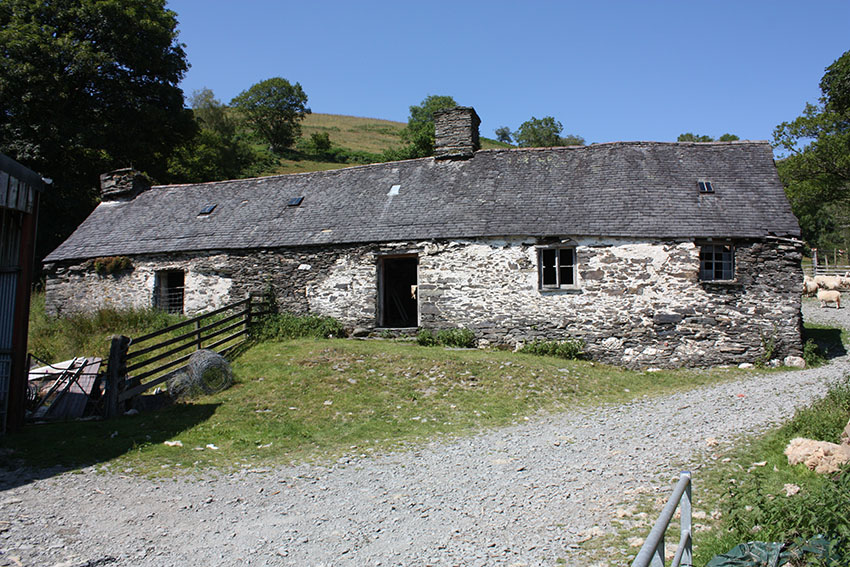
There are places in the Welsh uplands which seem, at first sight, to stand outside ordinary history. Esgair Llewelyn, also found in the records as Esgair Llewellyn, Esgair Llywelyn and Esgairllewelyn, is one of them. Set high above the Llyfnant valley, reached by rough lanes and tracks north of Mathafarn, it belongs to that older world of scattered farms, steep ground, chapel roads, sheep walks, family memory and hard-won survival.
It is not a grand house, and that is precisely why it matters. Its significance lies in the endurance of an ordinary upland farmhouse, and in the generations of people who made a life there. Esgair Llewellyn was a farm, a home, a working household and, in architectural terms, one of the most important surviving upland houses in Montgomeryshire. Its history is not merely the story of an old building. It is the story of how a medieval Welsh farmhouse was adapted, inhabited, modernised, neglected, remembered and preserved.
It is also part of my own family history.
The Medieval House
The farmhouse at Esgair Llewellyn is listed Grade II*, a status which reflects its exceptional importance. Cadw describes it as a late medieval cruck-framed hall-house, later altered and extended. In its earliest form it belonged to the world of the open hall, before domestic life in upland Wales was divided into the clearly separated rooms and fireplaces familiar from later centuries.
The original house was built around a cruck frame, with curved timbers rising to form the structural heart of the building. The evidence of smoke-blackening on the roof timbers shows that the earliest hall was open to the roof, with a central hearth and smoke rising into the upper space before escaping through the roof. This was not a picturesque detail, but a way of life. Cooking, warmth, work, conversation, sleeping arrangements and the ordering of the household all belonged to the same enclosed world.
The house was later modernised. A great fireplace was inserted, the walls were rebuilt in stone, and a lobby-entry plan developed around the new chimney. These alterations probably belong to the later sixteenth century, when many Welsh houses were being transformed by the introduction of chimneys, ceilings and more private domestic spaces. At Esgair Llewellyn, those changes did not erase the medieval house. They were layered onto it.
Further alterations followed. The west end appears to have developed as a more separate domestic unit, perhaps used by an older generation within an extended family household. Such an arrangement would fit well with the social world of Welsh farming families, where inheritance, marriage, age and authority were often negotiated within the same group of buildings. Later still, nineteenth-century features, including wallpaper, casement windows, a winding stair, built-in beds and cupboard beds, show the effort to keep an ancient house usable for modern life.
The later history of the household makes these architectural changes easier to understand. By 1851 Esgair Llewellyn contained three generations of the same family alongside servants and agricultural labour. In such a household, the subdivision of an older open hall into smaller rooms, the creation of more private sleeping spaces, the use of cupboard beds and the development of a partly separate western end were not simply architectural fashions. They answered practical domestic needs. An ancient house was being made to accommodate old parents, married children, grandchildren, servants and the daily work of a substantial upland farm. The changing structure of Esgair Llewellyn therefore reflects the changing structure of the family that lived within it.
The survival of cupboard beds is particularly evocative. They remind us that privacy in such houses was partial, negotiated and practical. The family did not live in a world of spare rooms and wide corridors. Space was fitted around need. People slept, worked, cooked, stored, prayed, mended, read and entertained within a house that had grown slowly around them.
The Farm Buildings
Esgair Llewellyn was not only a house. It was a working farmstead. The multi-purpose farm building east of the farmhouse is also listed, and is probably eighteenth-century in date. It appears on the tithe map of 1840 and was built of local stone, with a slate roof, ventilation slits, loft hatches and evidence of mixed agricultural use.
This matters because the history of Esgair Llewellyn cannot be understood from the house alone. The outbuildings, yard, tracks, fields, sheep walks and mountain grazing were all part of the same working system. The farmhouse held the family, but the farmstead held the economy. The barns, cow-houses and storage spaces were where the daily labour of the holding was organised. They remind us that Esgair Llewellyn was never merely picturesque. It was practical, productive and hard-used.
Before The Jones Family
The known history of Esgair Llewellyn reaches well before the nineteenth-century census returns. In the eighteenth century the name appears in Montgomeryshire Quarter Sessions material, connected with men such as David Evans of Esgair Llewellyn, and later with Evan Arthur of Esgairllewelyn. These references are brief, but they matter. They show that the farm was not hidden from the administrative world. Men associated with Esgair Llewellyn appeared in the formal machinery of county life, the world of juries, recognizances, roads, duties and local responsibility.
A burial entry for David Evans of Esgair Llywelyn in 1778 gives another glimpse of the farm before the Jones family came into clearer view. These fragments do not allow us to reconstruct the full household, but they show continuity. Esgair Llewellyn was already an established holding, known by name, before the age of census schedules and civil registration made ordinary rural families more visible.
The Jones family connection can be traced back before John Jones himself. The family history identifies William Jones, born about 1740 and died in 1832, as a farmer at Cwmgerwyn, a farm not far from Esgair Llewellyn and now long abandoned. His wife Mary, born about 1737, died at Esgair Llewellyn on 17 May 1817 and was buried at Tal-y-llyn. That detail is important. It suggests that the Jones connection with Esgair Llewellyn was already established before the marriage of John Jones and Gwen Lewis later that same year.
By the early nineteenth century, then, the farm had clearly entered the story of the Jones family.
John Jones And Gwen Lewis
In the 1841 census, Esgair Llewellyn was occupied by John Jones, farmer, and his wife Gwen. The family tree material adds important precision to the census evidence. John Jones was born at Tal-y-llyn, Merionethshire, in March 1781, and was baptised there on 23 March 1781. He was the son of William and Mary Jones of Cwmgerwyn, and it is likely that he had learned the skills of upland farming within that family setting before taking on Esgair Llewellyn.
John married Gwen Lewis at Dolgellau on 11 July 1817. Gwen had been born at Dolgellau in February 1796 and was baptised there on 20 February 1796. She was the daughter of Owen Lewis and Mary David of the Dolgellau area. Owen Lewis, born about 1753, farmed at Fronoleu, Tabor, near Dolgellau. He died in January 1825 and was buried at Dolgellau on 19 January 1825. He had married Mary David at Dolgellau on 30 October 1786. Mary David was born about 1761 and died at Waterloo Street, Dolgellau, on 16 December 1846.
Owen Lewis appears to have been a man of substance. His estate was valued at around £1,000 at the time of his death, and Gwen inherited £400 from him in 1825, a very considerable sum. He was also an early supporter of the British and Foreign Bible Society, founded in 1804 to distribute Bibles, including Welsh-language Bibles. That connection places him within the religious and cultural currents of early nineteenth-century Wales, where literacy, scripture, Nonconformity and the Welsh language were closely bound together.
Through Gwen, the Jones household at Esgair Llewellyn was connected not only with Llanwrin and Tal-y-llyn, but also with Dolgellau, Tabor, Fronoleu and the wider Merionethshire world. That is important. Upland families were not static. They were held together by marriage, chapel, kinship, service, tenancy and movement between neighbouring districts. Gwen’s life joined the Dolgellau background of the Lewis family to the upland farming world of Llanwrin.
John and Gwen’s life at Esgair Llewellyn placed them within a demanding upland economy. In 1851, John Jones was recorded as farmer of a substantial holding. The family tree records the farm as 40 acres of arable land, 80 acres of pasture and 300 acres of mountain, employing three servants. This was not a tiny cottage economy. Esgair Llewellyn was a serious upland farm, combining enclosed fields, pasture and extensive mountain land. Its wealth was not the easy wealth of the lowland estate, but it was a farm of standing.
The 1851 household gives us a vivid picture of rural family structure. John Jones, aged seventy, was still head of the household. Gwen, aged fifty-five, was his wife. Their daughter Mary was present, as was Ellis Jones, John and Gwen’s son-in-law. The grandchildren included Gwen, John, Mary and Owen. Servants were also present, including a house servant and an agricultural labourer. Esgair Llewellyn was therefore not merely a nuclear family home. It was a working farm household, with three generations, servants, labour, kinship and inheritance all under the same roof.
John Jones died at Esgair Llewellyn on 27 June 1865, the cause recorded as old age. He was buried at Llanwrin on 1 July 1865. His death did not end the family’s hold on the farm. Instead, it brought Gwen Lewis, by then Gwen Jones, even more clearly into view.
Gwen Jones, Farmer And Matriarch

One of the most striking figures in the history of Esgair Llewellyn is Gwen Lewis, later Gwen Jones. She was my three-times great-grandmother, but her significance is not merely personal. She emerges from the records as a woman of real authority.
After John Jones died, Gwen remained at Esgair Llewellyn. In the 1861 and 1871 census returns she appears not simply as an elderly widow within the household, but as the effective head and farmer. In 1871 she was recorded as a widow of seventy-five, farming 174 acres. Her sister Mary Lewis, also born at Dolgellau, was living with her, described as formerly a cook. Ellis Jones, Gwen’s widowed son-in-law, was also in the household, along with grandchildren and servants.
This is one of the moments where the census tells us more than it perhaps intended. Gwen was not a passive survivor of the Jones household. She was the centre of it. She had come from Dolgellau as Gwen Lewis, married John Jones, raised a family, endured the death of her husband, and continued to hold the farm together. In a society where farms often depended on male names in official records, Gwen’s presence as head of household and farmer is important.
Her photograph, preserved in family memory, gives that record a face. She appears as an elderly woman, plainly dressed, bonneted, direct and unsentimental. It is easy to romanticise the past, especially when dealing with remote Welsh farms. Gwen’s life deserves something better than romance. She lived through work, loss, age and responsibility. She belonged to a generation of Welsh rural women whose authority was often domestic, practical and economic, even when the public record did not always know how to describe it.
Gwen died at Esgair Llewellyn on 11 December 1888, the cause recorded as apoplexy, a stroke. She was buried at Llanwrin on 14 December 1888. With her death, a long chapter in the life of the farm came close to its end.
Mary Jones And Ellis Jones

John and Gwen’s only known child was Mary Jones, born at Esgair Llewellyn in late 1818 and baptised at Llanwrin on 7 December 1818. She appears to have received some education, as she was literate. Her life adds one of the most human episodes in the history of the family.
According to family tradition, Mary went to Liverpool, where relatives were connected with a hotel. In Liverpool she married Ellis Jones on 21 September 1840. Ellis came from Dinas Mawddwy and was the son of Hugh Jones, a skinner, a man who worked with animal hides. Ellis himself appears to have worked as a hotel waiter at 19 Clayton Square, Liverpool. Just over three months after the marriage, their daughter Gwen Jones was born there on 14 January 1841 and baptised at St David’s Church, Liverpool, on 31 January.
It is easy to pass over this episode too quickly, but it deserves attention. It places the Esgair Llewellyn family within the wider movement between rural Wales and urban Britain. Liverpool was one of the great destinations for Welsh migration, employment and commerce. Mary’s presence there, her marriage to Ellis, and the birth of their first child in Clayton Square, all suggest a family story that moved beyond the upland farm before returning to it.
By some point between early 1841 and late 1844, Ellis and Mary had returned to Llanwrin and were living at Esgair Llewellyn with Mary’s parents. The reason remains uncertain. Family tradition holds that the hotel where Ellis worked burned down, but this has not yet been verified. Whatever the cause, their return brought Ellis into the working life of the farm. For around forty years he was employed at Esgair Llewellyn, first under his father-in-law John Jones, then under his mother-in-law Gwen Jones, before eventually becoming the senior farmer there himself.
Mary Jones died aged only thirty-eight on 29 October 1857 and was buried with her Jones ancestors at Tal-y-llyn. Her early death shaped the household that followed. Ellis remained a widower, and the children of Ellis and Mary grew up within the Esgair Llewellyn household, under the continuing presence of their grandmother Gwen.
The Children Of Ellis And Mary Jones
The children of Ellis and Mary Jones show the reach of the Esgair Llewellyn family beyond the farm itself. Their lives connect Llanwrin with Dolgellau, Tabor, Arthog, Barmouth, chapel networks, agricultural responsibility and local office.
Their eldest child, Gwen Jones, was born at 19 Clayton Square, Liverpool, on 14 January 1841 and baptised at St David’s Church later that month. She later married Thomas Davies of Caeadda in 1859, creating one of the most important links between the Jones family of Esgair Llewellyn and the Davies family of Caeadda.
John Jones was born at Esgair Llewellyn in 1845 and baptised at Llanwrin on 30 June 1845. He later farmed at Hafodymeirch, near Tabor, Dolgellau, and married Jane Owens at Ebenezer Chapel, Llanuwchllyn, in 1884. His appointment in 1900 as Treasurer of Festri Tir Stent, an area of common grazing on the slopes of Cadair Idris, suggests a man trusted in the management of local agricultural affairs. He died at Hafodymeirch on 15 January 1910.
Mary Jones was born at Esgair Llewellyn on 28 March 1847 and baptised at Llanwrin on 13 July. In 1881 she married David Evans at New Siloan Chapel, Barmouth. They farmed at Nantygwrddail, near Arthog. She died of stomach cancer on 18 December 1896, aged only thirty-nine, and was buried at Tabor Chapel near Dolgellau.
Owen Jones was born at Esgair Llewellyn on 1 May 1849 and baptised at Llanwrin on 11 June. He served an apprenticeship in carpentry, but died at Esgair Llewellyn on 13 October 1871, aged twenty-two, after suffering from consumption, or tuberculosis, for nine months. His death is another reminder of how fragile life could be, even within a relatively established farming family.
William Jones was born at Esgair Llewellyn on 8 February 1852 and baptised at Llanwrin on 3 June. He later took over the running of the farm after the death of his father Ellis in 1889. He became a prominent figure in the Aberllefenni community, contributed financially to the Methodist Chapel, and moved in circles which included the Jones family of Llwydiarth Hall. In March 1892 he was appointed Overseer of the Poor for the townships of Glanfechan and Blaen Glesrych. In the years before the modern welfare state, this was a position of real local responsibility. The Overseer of the Poor helped administer poor relief, and the office required both standing and trust within the parish.
Elinor, or Ellen, Jones was born at Esgair Llewellyn on 11 October 1856. Unlike some of her older siblings, she does not appear to have been baptised at Llanwrin parish church, which may suggest a strengthening Methodist connection within the family by the mid-1850s. She spent her life at Esgair Llewellyn and became housekeeper at the farm. In March 1882 she was one of the young local women who helped organise a party connected with the Sunday School at Aberllefenni. She died at Esgair Llewellyn on 5 January 1896, aged only thirty-nine, after suffering from an abscessed liver.
Together, these children show that Esgair Llewellyn was not a dead-end farm hidden in the hills. It produced sons and daughters who married, moved, farmed, served chapels, held local office, worked with livestock, kept households and carried the family name into other parts of Merionethshire and Montgomeryshire.
Chapel, School And Community
Esgair Llewellyn was remote, but it was not isolated from community life. The surrounding world of Llanwrin, Aberllefenni, Corris, Mallwyd, Dolgellau and the Llyfnant valley was bound together by farms, roads, chapels, schools, markets and kinship.
A Welsh newspaper report from Y Dydd in April 1882 places Miss E. Jones of EsgairLlewelyn among the young women assisting at a gathering connected with the Independent Sunday Schools at Aberllefenni. The same report refers to the Band of Hope, children’s recitations, manuscripts, translations, singing and local adjudicators. This is a valuable glimpse of the cultural world around the farm.
The Band of Hope was part of the wider temperance movement, and Sunday Schools were among the great institutions of Welsh Nonconformist life. They were not simply places where children learned Bible stories. They were centres of literacy, Welsh-language culture, public speaking, music, moral formation and community identity. The presence of a Jones daughter from Esgair Llewellyn in that setting places the family within the respectable chapel world of late nineteenth-century rural Wales.
It also reminds us that upland farms were not silent places. The young people who lived at Esgair Llewellyn would have known sermons, hymns, recitations, local competitions, school inspections, funerals, inquests, fairs, markets and the gossip of neighbouring farms. Their world was physically difficult, but socially rich.
The Farm In The Census Returns
The census returns allow the social history of Esgair Llewellyn to be followed with unusual depth. In 1841, John and Gwen Jones were already there. In 1851, the farm was substantial, worked with family labour and servants. By 1861 and 1871, Gwen Jones stood at the head of the household, a widow and farmer. By 1881, Ellis Jones had become head, with the older Gwen still present. In 1891 and 1901, William Jones, son of Ellis, remained at Esgair Llewellyn as an unmarried farmer.
The 1891 household included William Jones, his sister Ellen, and farm servants. By 1901 William was still there, unmarried, with a domestic servant and a young agricultural labourer. These later returns suggest contraction. The older multi-generational household had thinned. The farm remained occupied, but the line was narrowing. The great household of John, Gwen, Ellis, Mary, grandchildren and servants had become the household of an unmarried farmer, female domestic service and hired labour.
This pattern was common in upland Wales. Farms did not simply pass smoothly from father to son. They were affected by death, late marriage, non-marriage, migration, economic pressure, tenancy arrangements and the difficulty of sustaining younger generations on marginal land. The census returns for Esgair Llewellyn show all of this quietly. They do not announce decline, but they record it.
Farming Life And The Shearing Season

The economy of Esgair Llewellyn was shaped by sheep, mountain grazing and the seasonal demands of upland farming. Lambing, shearing, gathering, washing, branding and salving sheep all structured the agricultural year. These were not small matters. They required skill, stamina, neighbouring cooperation and deep knowledge of the land.
The shearing season was one of the great events of the farming year. On hill farms it usually took place in June or July, and in the nineteenth century it was still done by hand. Before shearing, the sheep had to be gathered and washed, because unwashed wool was worth less. Local farmers worked together, moving from farm to farm in turn. One day the group might be at Caeadda, the next at Esgair Llewellyn. This pooling of labour made practical sense, but it also made shearing a social event.
The women of the farms had their own essential role in this seasonal world. Wives and daughters prepared meals for the men, and the work could be followed by singing, contests and other forms of entertainment. In this sense, Esgair Llewellyn was part of a wider neighbourhood economy, one in which labour, hospitality and mutual obligation bound farms together.
A second shearing could take place later in the year, often around September, when sheep were clipped around the neck and forequarters to prevent wool being lost on rough winter ground. Sheep also had to be marked for ownership, and before modern dipping became common, salving with tar and butter was used against scab and parasites. These details are not decorative. They show the physical reality behind the census word “farmer.”
A later dispute involving another Montgomeryshire farm shows what could happen when the interests of tenant and landlord diverged. The Ceniarth case of 1900 concerned compensation for improvements, forestry damage and the condition of a farm when its longstanding tenant departed. It provides further context for the practical arrangements upon which Welsh farming households depended.
Roads, Drains And The Difficult Geography Of Survival

The early twentieth-century newspaper reports reveal another side of Esgair Llewellyn’s history, the practical difficulty of maintaining life in such a place.
In June 1908, the Aberystwyth Observer reported proceedings of the Machynlleth Rural District Council. The Sanitary Inspector stated that Esgairllewelyn farmhouse was in the same condition as previously reported in May 1907, and that a notice had first been sent to Mrs Owen of Hengwrt in April 1906. The same meeting heard that the road to Esgairllewelyn was almost impassable in parts, and that for hundreds of yards it ran largely along the bed of a brook. If arrangements were not made, local inhabitants would have to travel along the bed of the river.
The report is striking because it brings together house, ownership, public health, roads and rural administration. Esgair Llewellyn was not merely picturesque. It was difficult to reach, difficult to maintain, and increasingly problematic for the authorities. A house which had survived from the late medieval period was now being judged by Edwardian standards of sanitation, drainage, access and repair.
A further report in the Montgomeryshire Express and Radnor Times in February 1910 described the Esgairllewelyn road as a public highway, but one for which the Council was not responsible for maintenance. Some parts led through a brook, and the committee considered it useless to spend money on the road unless a proper right of way could be secured through a neighbouring field. Users of the road were being allowed by the tenant of Glyncaerog to follow a course along the field, but the underlying problem remained unresolved.
These reports help explain the later fate of the house. The decline of occupation was not only a family matter. It was geographical, economic and administrative. A remote farmhouse, dependent on difficult access, old drainage and a hard upland setting, became less and less suited to modern expectations. The same features which now make Esgair Llewellyn historically precious made it increasingly hard to inhabit.
William Jones And The End Of The Jones Tenure
After Ellis Jones died in 1889, his son William Jones took over the running of Esgair Llewellyn. William had been born at the farm in 1852, and he appears to have carried both the practical and social responsibilities of the holding into the late Victorian period.
He was more than merely the last Jones farmer at Esgair Llewellyn. His contribution to the Methodist Chapel at Aberllefenni and his appointment as Overseer of the Poor show a man recognised within his community. The office of Overseer placed him within the old parish system of welfare, responsibility and discipline. It was not an honorary title. It involved judgement, administration and the difficult business of deciding how poor relief should be managed.
In the early twentieth century, William Jones appears to have retired to Esgair Neiriau, also called Esgair Merion, leaving the running of Esgair Llewellyn to his nephew William Davies. He may have purchased both Esgair Llewellyn and Esgair Neiriau during the period when many local landowners were selling farms to tenants, though the precise date requires further confirmation. He died at Esgair Neiriau on 26 May 1925, aged seventy-three, after suffering a stroke. His estate was valued at £2,504 18s 6d. His death marked the end of the Jones family’s direct farming involvement in the immediate area, although the blood connection continued through the Davies family.
Gwen Jones Of Caeadda And The Davies Link
The Davies connection with Esgair Llewellyn did not begin in isolation. My great-grandmother Gwen Jones was born at 19 Clayton Square, Liverpool, on 14 January 1841, the daughter of Ellis Jones and Mary Jones of Esgair Llewellyn. She had returned to Esgair Llewellyn as a child and grew up within the household of her grandparents John and Gwen Jones.
On 22 June 1859, aged eighteen, she married Thomas Davies of Caeadda at Llanwrin parish church. Through that marriage, the Jones family of Esgair Llewellyn and the Davies family of Caeadda became closely linked. This matters because it shows the later Davies presence at Esgair Llewellyn as part of a wider pattern of kinship, marriage and neighbouring farm connections, rather than as a disconnected transfer from one family to another.
Gwen Jones of Caeadda was herself a significant figure. As a Victorian farmer’s wife she would have carried a heavy burden of domestic and agricultural responsibility, including cooking, cleaning, dairy work, poultry, pigs, kitchen garden produce, feeding the household and labourers, and helping to sustain the farm economy. After the death of her husband Thomas Davies in 1891, she helped run Caeadda with her sons. She entered Welsh rams at the Machynlleth Agricultural Show in 1892 and 1893, coming second in both years, an unusual and revealing public appearance for a woman in that agricultural world.
She died at Caeadda on 10 October 1926, aged eighty-five, the cause recorded as probably heart failure. Probate was granted to her sons David Davies and Griffith Llewelyn Davies in 1927, and her estate was valued at £2,630 11s 2d. Her life forms one of the key bridges between Esgair Llewellyn and Caeadda.
William Davies And Esgair Llewelyn

By the early twentieth century, Esgair Llewellyn had entered another stage of its history. William Davies, son of Thomas Davies and Gwen Jones of Caeadda, was born at Caeadda on 11 January 1878. He was almost certainly named after his maternal uncle, William Jones of Esgair Llewellyn.
William Davies grew up in the Caeadda farming world. He was only thirteen when his father died in 1891, and probably learned much of his farming and shepherding from his elder brothers John, Thomas and David. Like David, he became a skilled shepherd and competed in local sheepdog trials, including events at Staylittle, Abergynolwyn, Machynlleth and Llanbrynmair. These details matter because they place him within the practical culture of upland sheep farming, not merely within a chain of inheritance.
William married Jane Evans at the registry office in Machynlleth on 22 June 1901. Jane was one of the daughters of John Evans of Faedre Fawr, near Llawryglyn in the mountains around Trefeglwys. Their first child, born prematurely at Cae Cyno on 18 August 1901, died unnamed. In all, William and Jane had seven children.
Sometime between April 1903 and October 1904, William and Jane moved to Esgair Llewellyn, where William took over the running of the farm from his uncle William Jones, who retired to Esgair Neiriau. This gives us a much firmer date for the practical transfer of the farm into Davies hands than the later census alone would suggest.
By 1911, William Davies was recorded at Esgair Llewellyn as head of the household, aged thirty-two, a farmer. He was living there with his wife Jane and their children Ellis Jones Davies, Sarah Gwendoline Davies and Hannah Jane Davies. A young servant, William Lloyd Williams, was also present. The house was recorded as having eight rooms.
William Davies was my great-uncle. His presence at Esgair Llewellyn brought the farm into the wider Davies family story, linking it with Caeadda, Esgairneiriau and the interwoven farming families of the Llyfnant valley. William was also the grandfather of Elinor Bennett, the internationally renowned Welsh harpist, whose own connection with Esgair Llewellyn forms part of the later memory of the house.
The 1911 return is poignant because it shows a young family at Esgair Llewellyn at almost the end of its life as an inhabited farmhouse. The older Jones world had passed, but the house was not yet silent. Children were still being raised there. Work was still being done. The family table, the farmyard, the road, the servants’ work and the old rooms were still part of daily life.
William and his family appear to have left Esgair Llewellyn sometime between 1911 and 1913. The reasons cannot be stated with certainty, but the repeated reports about the poor condition of the house and the difficulty of the road suggest why continued occupation may have become untenable. By 1911 Cae Cyno was still being farmed by Edwin Hamer and his wife, but it was put up for sale later that year. It is possible that William later rented or occupied Cae Cyno after changes in the Evans and Hamer family arrangements.
William died at Cae Cyno on 28 November 1918, aged only forty, the cause recorded as Spanish flu. He was buried at Llanwrin on 29 November 1918. Administration of his estate was granted to his widow Jane on 7 March 1919, and his estate was valued at £1,832 10s 9d. In March 1919 Jane sold his livestock, farming implements and other effects at auction at Cae Cyno. She later moved back to her childhood home of Faedre Fawr with her children, and in 1925 married her widowed brother-in-law Edwin Hamer.
David Davies, Griffith Llewelyn Davies And Later Family Memory

The later Davies connection is also important to me personally. Griffith Llewelyn Davies was my grandfather. He was born at Caeadda on 17 November 1888 and lived and worked there for the first forty years of his life. He was recorded in 1911 as a feeder on the farm, and by 1921 was working as a farmer for his mother. His elder brother David Davies, eighteen years his senior, was almost certainly an important father figure and teacher in farming life.
When their uncle William Jones died in 1925, the Esgair Llewellyn and Esgair Neiriau farms passed into the Davies family inheritance. David Davies purchased, or otherwise secured, Esgair Llewellyn in 1926 from Ann Jones of Bronygog and David Jones JP of Llwydiarth, and in 1932 David and Griffith drew up a formal business partnership to run Esgairllewelyn and Esgairneiriau.
David remained at Caeadda for his entire life, while Griffith never lived at either Esgair Llewellyn or Esgair Neiriau. By then Esgair Llewellyn was probably no longer suitable for ordinary domestic occupation. Its poor condition had already been raised before the First World War, and two more decades of limited use and neglect can only have deepened the problem.
This is often how rural houses survive. They do not always disappear in a dramatic collapse. They cease first to be necessary. The family moves elsewhere. The road becomes too difficult. The roof is patched, then patched again. The house is used for storage, for animals, for shelter, for memory. Its rooms become quieter. The hearth goes cold. Yet the building remains, carrying within its timbers and stones the evidence of all those earlier lives.
A House Still Holding Its People
One of the most moving details recorded in later work on Esgair Llewellyn is that family members returned and scratched their names into the plaster beside the great fireplace. Among those names was Elinor Bennett. That act, simple and informal, belongs to the long afterlife of Esgair Llewellyn. It was no longer merely a farmhouse. It had become a place of return.
Such marks matter. They show that the house continued to hold emotional force for those connected with it. People returned not because it was convenient, but because it meant something. A name scratched into plaster is not an official record, but it is a record all the same. It says, in the most direct way, I was here, and this place belongs to my story.
Esgair Llewellyn is therefore both an architectural survival and a family witness. Its crucks, smoke-blackened timbers, stone walls, fireplace, cupboard beds and farm buildings tell one story. The census returns tell another. The photographs of Gwen Lewis, Ellis Jones and William Davies add faces to the names. The newspapers add moments of community, death, road disputes and administrative concern. Together they allow us to recover something fuller than genealogy alone can provide.
Bringing The Jones Family Back To Life

The Jones family of Esgair Llewellyn were not famous in the usual sense. They did not found a great estate, sit in Parliament or leave behind a large archive of letters. Yet their history is precisely the kind of history that matters most if we want to understand rural Wales.
William Jones of Cwmgerwyn and his wife Mary take us back into the eighteenth-century world of neighbouring farms and family burial grounds. John Jones represents the older farming order, a man born at Tal-y-llyn in 1781, established by the mid-nineteenth century as farmer of a substantial upland holding. Gwen Lewis represents the strength of Welsh rural women, moving from Dolgellau into marriage, motherhood, widowhood and authority. Mary Jones, who died in 1857, reminds us how often women’s lives were cut short before the records had much chance to describe them. Ellis Jones, widower and farmer, carried the household through the later nineteenth century. William Jones and Ellen Jones show the unmarried adult children who kept farms going when inheritance and marriage did not follow neat lines.
The servants and labourers also belong in this history. They came from places such as Mallwyd, Pennal and Cardiganshire, moving through the farm households of mid Wales in search of work. Their names appear briefly, but their labour sustained the life of Esgair Llewellyn. Without them, the acreage recorded in the census could not have been worked, the animals could not have been tended, and the household could not have functioned.
To bring the Jones family back to life is not to invent scenes for them. It is to read the records closely enough that their world becomes visible again. We can see the old house with its great fireplace and cupboard beds. We can imagine Gwen Jones, elderly but still central, managing the farm after John’s death. We can see Ellis Jones, ageing and widowed, surrounded by adult children. We can place Elinor Jones at the Sunday School gathering in Aberllefenni, part of a chapel culture of song, discipline, Welsh-language learning and temperance. We can understand the anxiety caused by bad roads, poor drainage and difficult access. We can see why the farm was both loved and hard to sustain.
That is the value of Esgair Llewellyn. It allows one family’s history to open onto a wider Welsh history, the history of upland farming, female authority, Nonconformist culture, rural service, old age, inheritance, decline and memory.
Why Esgair Llewelyn Matters
Esgair Llewellyn matters because it has survived against the odds. Architecturally, it preserves the form and fabric of a late medieval Welsh hall-house, with later layers of sixteenth, seventeenth, eighteenth and nineteenth-century adaptation. Socially, it preserves the memory of the families who lived and worked there. For Welsh rural history, it is a rare place where building history and family history can still be read together.
It also reminds us that the history of Wales is not only found in castles, chapels, estates and towns. It is found in farms like Esgair Llewellyn, in the households that fed animals before dawn, walked rough roads to chapel, buried children and parents, hired servants, worried about weather, argued over roads, kept kinship networks alive and adapted old houses to new needs.
For me, there is inevitably another layer. Gwen Lewis, later Gwen Jones, was my three-times great-grandmother. Through her, I am a descendant of the Jones family of Esgair Llewellyn. My great-grandmother Gwen Jones, born in Liverpool in 1841 and died at Caeadda in 1926, married Thomas Davies of Caeadda in 1859, linking the Jones and Davies families before the later Davies association with Esgair Llewellyn. Griffith Llewelyn Davies was my grandfather. William Davies of Esgair Llewellyn was my great-uncle, and through him the house is connected with Elinor Bennett, one of Wales’s most distinguished harpists. These personal links matter to me, but they are not the only reason Esgair Llewellyn deserves attention.
The deeper reason is that Esgair Llewellyn gives us a rare opportunity to recover the lived history of a Welsh upland farm across several centuries. Its stones and timbers preserve the medieval house. The census preserves the household. The newspapers preserve moments of crisis and community. The photographs preserve faces. Family memory preserves the emotional pull of the place.
In that sense, Esgair Llewellyn is not simply a ruin, a listed building or a family address. It is a place where architecture, landscape and memory have endured together. The medieval crucks survived because successive generations adapted them. The farm survived because families adjusted themselves to the demands of the uplands. Family memory survived because people continued to return, to preserve photographs, to record names and dates, and even to scratch their names into the plaster of the old house.
That endurance is perhaps the most important part of the story. Esgair Llewellyn changed repeatedly, but it was never entirely severed from what came before. The open medieval hall became a divided farmhouse. The Jones household gave way to the Davies connection. A working farm became an increasingly difficult place to inhabit, and eventually a historic building whose value lay as much in memory as in use. Yet the landscape remained, the house remained, and enough evidence survived for the people themselves to be recovered.
Esgair Llewellyn is still there. So too, in the records, photographs, stones, timbers and family memory, are the people who made it matter.
The neighbouring history of Caeadda, Llanwrin follows the Davies family through tenant farming, family labour and eventual ownership, complementing the history of Esgair Llewelyn.
Related reading: The Davies Caeadda Family, Old Llyfnant Valley Farming Families, Welsh Rural History and Voices from the Uplands.
For the history of Llanwrin as a whole, and the churchyard where several generations of the Jones family are buried, see Llanwrin: A Montgomeryshire Village, Its People and My Family’s History.
Related Essays
- Gwen Jones of Caeadda, 1841–1926: A Welsh Farming Matriarch
- The Monks’ Trod: A Medieval Road Through the Cambrian Mountains
- When an English City Drowned a Welsh Village: Llanwddyn and the Making of Lake Vyrnwy
- Voices from the Uplands: Why I Wrote It and Why It Matters
- The Mid-Wales Railway: The Lost Route Through the Heart of Wales
- Thomas Davies of Penlan and Gwernstablau (1864–1930): Farming, Family and Public Life in Montgomeryshire, the neighbouring farming world of Llanwrin, including the Penlan shearing photograph and links with the Davies family.
- Owen Jones Davies (1875–1958): From Caeadda to the Welsh Settlement of Wood River, a descendant of the Esgair Llewelyn and Caeadda family networks who emigrated to the Canadian Prairies.
Explore more Welsh rural history
Continue with Welsh Rural History, or browse the related essays above.
Sources and Further Reading
This essay draws on census returns from 1841 to 1911, parish register material, civil registration evidence, burial records, family papers, family photographs, Montgomeryshire Quarter Sessions references, nineteenth and early twentieth-century Welsh newspapers, and the listed building records for Esgair Llewellyn. Particular use has been made of the Cadw listed building description, the Coflein and Royal Commission record, Richard Suggett’s work on the house, and family research contained in The Davies Caeadda Family, Old Llyfnant Valley Farming Families and my own family tree.
Newspaper references include The Cambrian News and Merionethshire Standard, 5 July 1889, Y Dydd, 7 April 1882, the Aberystwyth Observer, 11 June 1908, and The Montgomeryshire Express and Radnor Times, 15 February 1910. Family evidence includes the photographs of Gwen Lewis, later Gwen Jones, Ellis Jones of Esgair Llewellyn, and William Davies of Esgair Llewellyn, together with family tree material relating to the Jones, Lewis and Davies families of Cwmgerwyn, Llanwrin, Dolgellau, Tal-y-llyn, Caeadda, Esgairneiriau and the Llyfnant valley.