
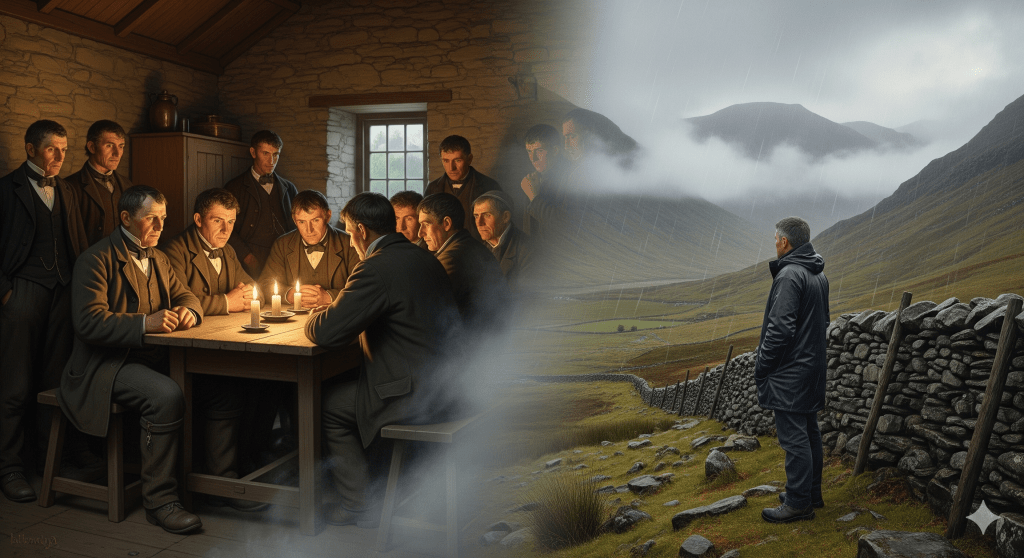
Most people assume political identity is something you acquire, a set of opinions shaped by the news cycle, social media, and the dominant arguments of the moment. In Wales, that assumption rarely survives contact with the deeper story.
Because Welsh political culture is not merely contemporary. It is historical. It is inherited. It is shaped by land, language, chapel, class, and memory. It is rooted in the long moral and social experience of communities that were, for centuries, governed by forces that did not speak their language, did not share their priorities, and did not fully understand the nature of the places they claimed to administrate.
I have come to believe, through decades of genealogical research, that my own political instincts, my sense of what feels fair, what feels credible, what feels Welsh, and what feels like a threat to Welsh continuity, have less to do with modern ideology than with ancestral inheritance.
I am not a politician. I am not a candidate. But I am a historian, and I come from a long line of upland Welsh families whose lives were shaped by power, not in Westminster, but in the far more intimate forms of power that operated through estates, chapels, tenancy, and social expectation.
And once you see that world clearly, you begin to understand Wales.
Wales’s Politics Were Not Born in the Senedd, or Even in Westminster
There is a temptation, especially among commentators outside Wales, to treat Welsh politics as a late and somewhat artificial phenomenon, a modern experiment that began with devolution. But Wales had a political consciousness long before it had political institutions of its own.
For most of Welsh history, politics did not mean manifestos. It meant survival. It meant knowing where authority lay, and how to navigate it. It meant understanding the landlord’s power, the minister’s influence, the chapel deacon’s judgment, the magistrate’s partiality, and the schoolmaster’s expectations. It meant learning when to comply, when to resist, and when to endure in silence.
The modern Welsh instinct, particularly in rural areas, is not easily manipulated by slogans, because it has been forged over centuries of moral experience. Wales is not naïve. It is wary. It has reason to be.
That wariness, that deep suspicion of distant power and superficial promises, is not a personality trait. It is an inheritance.
The Tenant Farmer’s Wales, Land Without Ownership, and the Politics of Dependency
My own ancestry is rooted in upland farming communities in Montgomeryshire and southern Merionethshire, particularly the Llanwrin area near Machynlleth, and the Dyfi valley. These were communities where families did not simply “farm”, they held land through tenancy, often across generations, and where security was never fully secure.
A tenant farmer could be respectable, hardworking, even locally influential, yet still ultimately dependent on decisions made elsewhere. The land might feel like an inheritance, but it was not legally theirs. The farm was a way of life, but it could also be taken away. And that reality shaped a distinctive Welsh moral economy.
It created people who valued stability over speculation, continuity over novelty, community over individualism, and fairness over ideology.
The Davies family of Caeadda, Llanwrin, were exactly such people. For over two centuries, they belonged to that class of respectable Welsh tenant farmers who lived in the grey space between the landed elite and the labouring poor, a social stratum defined not by wealth but by competence, reputation, and moral standing.
The farm was not merely a business. It was a moral institution. It was a place where duty was learned, where identity was formed, where the seasons shaped thought, and where the chapel reinforced the idea that life had obligations beyond the self.
When people speak of “Welsh values”, this is the world they often mean, whether they realise it or not.
The Chapel as a Political Institution, and the Moral Formation of Wales
It is impossible to understand Welsh political heritage without understanding Nonconformity. In rural Wales, the chapel was not merely a place of worship. It was the centre of education, culture, music, mutual aid, and social discipline. It created the moral language through which Welsh people understood power.
In that world, political authority was not automatically respected. It had to be justified. Leadership was expected to be moral. Power was expected to be accountable. Hypocrisy was despised. Public life was watched closely.
This is why Wales historically produced such strong Liberal and radical traditions. Not because rural Wales was inherently ideological, but because chapel culture taught people to question power, to resist injustice, and to value conscience over conformity.
The chapel did not always make people kind. It could be controlling. It could be exclusionary. It could enforce silence. But it created a society where the moral legitimacy of authority mattered deeply.
That is still true in Wales today, even among those who no longer attend chapel. The cultural inheritance remains.
The Davies Family of Caeadda, and the Quiet Political Mind of the Uplands
The Davies family story begins, in documented form, with the old Welsh patronymic system, with figures such as David Thomas, born circa 1713, who would have been known in his own time as Dafydd ap Tomos. That system, which endured in rural Wales long after it had vanished elsewhere, was itself a form of cultural resistance, a quiet refusal to fully submit to the administrative simplification of Anglicised governance.
From that early period, the Davies line became firmly rooted in Llanwrin parish, and most significantly at Caeadda, where the family established a long dynastic association with the land.
Thomas Davies of Caeadda (1827–1891), one of my direct ancestors, lived through a period of profound change. He inhabited the world of mid-Victorian Wales, where tenant farming, chapel culture, and Welsh language tradition still formed a coherent moral universe, but where modernity was beginning to press in through new systems of state administration, schooling, and economic change.
His wife, Gwen Jones (1841–1926), from the Jones family of Esgair Llewelyn in southern Merionethshire, represents something even more important in Welsh political heritage, the matriarchal moral inheritance of rural Wales.
Women like Gwen were rarely visible in formal records. Yet they were the moral backbone of their households. They transmitted values, discipline, cultural memory, and religious identity. They shaped how children understood right and wrong, what was respectable, what was shameful, and what was worth enduring.
This is not sentimental. It is historical.
If Wales has a political soul, it was forged as much by women like Gwen Jones as by any politician in Cardiff Bay.
Evan Lewis, the Liberal County Councillor, and the Rise of Rural Civic Power
The assumption is often made that rural Wales was politically passive, that the uplands were simply “traditional” and therefore inert. The record, including my own family record, does not support that.
My great-great-uncle Evan Lewis (1855–1929), who farmed at Argoed in Tregynon, was politically active in the Liberal tradition and was elected to Montgomeryshire County Council in 1898, representing Tregynon and Manafon. He served for many years, later became a Justice of the Peace in Newtown, and also served on the school board and the Rural District Council.
This matters because it places him within a crucial phase of Welsh political history, the moment when the old power of the landed gentry was increasingly challenged by a rising class of chapel-formed, educated, self-respecting Welsh farmers and tradesmen.
Men like Evan Lewis were not radicals in the modern sense. But they were the architects of Welsh civic self-confidence. They brought rural Wales into the machinery of governance, not as dependents, but as participants.
And that, in a society long shaped by the estate system, was a quiet revolution.
Gatty Lewis, Dyfed County Council, and the Liberal Tradition in Modern Wales
The story does not end with Victorian Liberalism.
Evan Lewis’s youngest son, John Gatty Pugh Lewis (1911–2002), carried that Liberal civic tradition forward into the modern administrative Wales of the late twentieth century.
He farmed near Llanilar, became Managing Director of Aberystwyth Tractors Ltd, then served for over twenty-five years in local government, first on the Aberystwyth Rural District Council and later as a Dyfed County Councillor from 1974. In the mid-1980s he served as Chairman of Dyfed County Council.
This is an extraordinary continuity, because it shows the Liberal tradition not as a mere historical curiosity, but as a lived civic identity stretching across generations.
It also reveals something else, the Welsh political instinct for practical administration. Welsh civic culture, especially in rural areas, has always been less interested in ideological theatre than in whether people can actually run things competently and fairly.
Gatty Lewis belongs to that tradition.
Edward Jenkins, Cymru Fydd, and Welsh National Consciousness Beyond Wales
If Evan Lewis and Gatty Lewis represent Liberal civic Wales, another ancestor represents something even more historically significant, the emergence of modern Welsh nationalism.
My great-great-uncle Edward Jenkins (1857–1936), a carpenter from the Llyfnant area who settled in Birmingham, was in October 1897 one of the founding members and first Vice President of the Cymru Fydd (Young Wales Society) in Birmingham.
This detail is striking for several reasons.
First, it shows that Welsh national consciousness was not confined to Wales itself. The Welsh diaspora in English cities played a formative role in sustaining Welsh language culture, political identity, and the intellectual conditions for self-government.
Second, Cymru Fydd was one of the first modern movements explicitly campaigning for Welsh self-rule. In Birmingham, the society aimed to cultivate Welsh identity through literature, music, history, and politics, and it supported the Liberal Party while promoting the early political career of David Lloyd George.
Edward Jenkins’s life embodies a Welsh truth that remains relevant today, Wales has always been more than a geographic boundary. It is a people, a language, a culture, and a moral inheritance, carried wherever Welsh communities settled.
Parish Councils, Revolt Schools, and the Politics of Conscience
What fascinates me most about Welsh political heritage is not simply formal office, but the politics of conscience.
Because in rural Wales, some of the most important political acts were not elections. They were protests, committees, refusals, and local acts of self-organisation.
My great-uncle Hugh Davies was involved in the movement to establish a so-called “revolt school” in Llanwrin, an independent school formed in protest against the perceived Anglican character of the National School system.
This was not an eccentric local dispute. It was part of a wider Welsh protest tradition, rooted in the Nonconformist demand for fairness, cultural respect, and educational autonomy.
It is difficult to overstate how deeply education and religion were intertwined in this period, and how profoundly Nonconformists resented the continued institutional privilege of the Established Church.
This was Welsh politics at its most fundamental, the insistence that public institutions should not be instruments of cultural domination.
Robert Hughes, Corris Parish Council, and the Civic Farmer as a Welsh Political Type
Another figure in this family story, and one who illustrates the wider spread of Welsh Liberal civic culture, is my great-uncle Robert Hughes.
In the early twentieth century, Robert Hughes was elected to Corris Parish Council as a Liberal, serving for several years. His service represents the transformation of rural Welsh society in the years before the First World War, when tenant farmers, chapel men, and locally respected figures began to occupy the structures of public administration.
The parish council became one of the most important institutions in rural Wales, because it allowed communities to govern themselves in practical matters, roads, sanitation, schools, local welfare, and the everyday infrastructure of life.
This is where Welsh democracy was learned.
Thomas Davies, Llanwrin Parish Council, and the Local Roots of Authority
Wales’s political heritage is not only about famous names, or national movements. It is also about the deep civic tradition of local service.
My great-uncle Thomas Davies served as a Llanwrin Parish councillor, one of those quiet figures whose public duty rarely enters the national record but whose influence is felt in the everyday life of a community.
Parish government in rural Wales has often been underestimated, yet it has historically been one of the principal mechanisms through which Welsh people protected local interests, defended local identity, and maintained a sense of self-determination within a broader state framework.
This, too, is part of the inheritance.
From Liberal Wales to Plaid Cymru, Elinor Bennett and Dafydd Wigley
Finally, the lineage takes us into the modern era, and into the heart of Welsh national political leadership.
In my wider family, Elinor Bennett, the celebrated harpist, is the granddaughter of my great-uncle William Davies. She married Dafydd Wigley, former leader of Plaid Cymru, MP for Caernarfon, Assembly Member, and later a member of the House of Lords.
This connection is not merely interesting. It is historically meaningful, because it represents the long evolution of Welsh political identity.
In the nineteenth century, the chapel-formed Welsh political mind expressed itself primarily through Liberalism. That Liberalism was not simply a party label, it was a moral framework, rooted in Nonconformity, temperance, education, civic responsibility, and the belief that Wales should not be treated as inferior.
In the twentieth century, the Liberal tradition weakened, and much of that moral and national energy flowed into Labour, and later, increasingly, into Plaid Cymru.
Thus, the story of Elinor Bennett and Dafydd Wigley can be read, in cultural terms, as a bridge between worlds, the Welsh musical and cultural tradition, and the political project of Welsh self-government.
It is a reminder that Welsh politics is not separate from Welsh culture. In Wales, culture has always been political.
Why I Write, and Why This Matters
I do not write these things as a sentimental exercise. I write them because Wales is at risk of losing its own memory.
We are living in an age where political narratives are increasingly shaped by noise, outrage, and simplistic binaries. Wales, like everywhere else, is vulnerable to that.
But Wales has something powerful, if it chooses to remember it.
It has a deep inherited moral culture, shaped by chapel discipline, rural resilience, communal obligation, and an instinctive suspicion of unaccountable power.
That culture is not perfect. It could be harsh. It could be controlling. It could exclude.
But it produced a people who believed that authority must be earned.
That belief is one of Wales’s greatest political strengths.
And it is part of my inheritance.
A Final Reflection, The Politics of Belonging
When I trace my ancestry, I do not merely find names. I find a world.
I find the Davies family of Caeadda, tenant farmers rooted in Llanwrin parish for generations. I find Gwen Jones of Esgair Llewelyn, carrying the Merioneth tradition into the Montgomeryshire uplands. I find Evan Lewis, a Liberal County Councillor in the age when rural Wales was learning civic power. I find Gatty Lewis, carrying that tradition into modern Dyfed and serving as Chairman of the County Council.
I find Edward Jenkins (1857–1936), the Birmingham carpenter whose Cymru Fydd activism shows how Wales’s political identity was sustained far beyond its borders.
I find Hugh Davies, standing with his community in the revolt school movement, a reminder that Welsh political history is not merely parliamentary, it is local, moral, and deeply rooted.
I find Robert Hughes, elected to Corris Parish Council as a Liberal, embodying the civically minded Welsh farmer as a political type.
I find Thomas Davies, serving quietly as a Llanwrin Parish councillor, representing the deep tradition of local responsibility.
And I find Elinor Bennett, granddaughter of William Davies, whose marriage to Dafydd Wigley links the cultural Wales of music, language, and tradition to the modern constitutional Wales of Plaid Cymru and devolution.
My ancestors did not leave manifestos.
But they left a legacy.
They left a way of seeing.
And if Wales is wise, it will remember that its political soul was not built in parliaments.
It was built in farmhouses, chapels, parish meetings, and upland fields, by ordinary people who knew, long before the modern era, what power looked like, and what it cost.
