
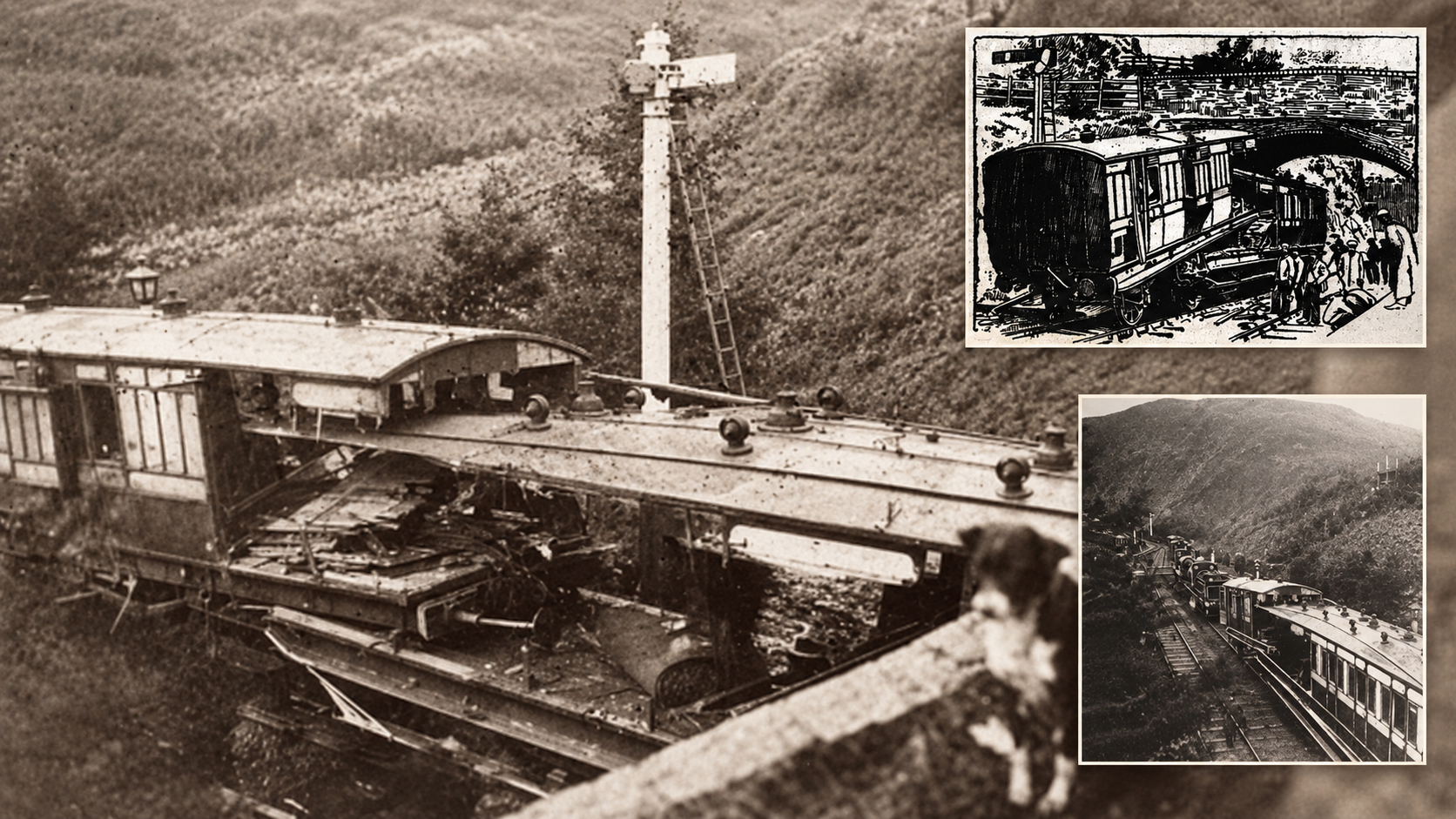
On the morning of Saturday 16 September 1899, the small station at Tylwch on the Mid-Wales section of the Cambrian Railways became the scene of one of the most serious accidents ever to occur on the line. An excursion train carrying passengers north towards Manchester ran into the morning mail train, which was standing at the station waiting to cross it. The two locomotives met head-on, the leading vehicles of the excursion were crushed together, passengers were injured, and one young woman, Margaret, or Maggie, Rowlands of the St Harmon and Pantydwr district, lost her life. The disaster was immediately reported across Britain, yet the circumstances were more complicated than the simple story of a failed brake which later entered local memory. The surviving newspaper accounts, the evidence given at the inquest and the subsequent findings of Lieutenant-Colonel H. A. Yorke of the Board of Trade reveal an accident in which signalling, speed, braking, staffing and human judgement all played a part.
Tylwch lay on a predominantly single-track railway running north from Brecon and Builth through the heart of Mid Wales towards Llanidloes and Moat Lane. Stations such as Tylwch were not merely places where passengers joined or left trains, they were essential crossing points where trains travelling in opposite directions could safely pass. The system depended upon signals, points and disciplined working. One train might be brought into the station and held at a platform while another was admitted onto the adjoining road. Provided the signals were obeyed and the points correctly set, the process was routine. If a train passed a protecting signal before the route ahead had been made safe, however, there might be only seconds in which to recover the situation.
A Saturday Excursion to Manchester
The train which approached Tylwch from the south that morning was a special excursion for Manchester, contemporary reports generally describing it as running from Brecon to Belle Vue. Belle Vue, then one of Manchester’s great leisure attractions, drew visitors from across the country with its gardens, entertainments, exhibitions and amusements. For people living in rural Mid Wales, a cheap excursion of this kind offered access to a world far removed from the small farming and railway communities of Radnorshire and Montgomeryshire. The train appears to have collected passengers as it travelled north, and by the time it reached the Pantydwr and St Harmon district it was heavily occupied.
The excursion was a substantial train, one contemporary local account describing it as consisting of around ten to twelve carriages. Among those who joined locally was Maggie Rowlands, who boarded at Pantydwr. Newspaper reports place her at Bryncenarth in the St Harmon district and identify her as the daughter of a railway platelayer. Contemporary newspapers disagreed over her age, some reporting twenty-five and others twenty-seven. Her surviving family gravestone at St Harmon resolves the discrepancy, recording that Margaret died on 16 September 1899 aged 27. She was travelling with a young man to whom she was attached or engaged, and had been aboard the train for only a short distance before the collision occurred.
The other train was the morning mail from Shrewsbury towards Brecon. The arrangement was that the mail and the excursion would pass one another at Tylwch. The mail arrived first and drew up on the down road. According to the stationmaster, James Davies, it reached Tylwch at about 6.14 in the morning. The excursion should then have been brought safely into the other platform road, allowing the two trains to stand side by side before continuing in opposite directions. The signals protecting Tylwch, however, were at danger.
Forty-Five Seconds
There was never any serious dispute that the excursion approached against the signals. James Davies said so at the inquest, and the excursion driver, Samuel Hopkins of Llanidloes, admitted that he had seen them. At one point during the proceedings Lieutenant-Colonel Yorke made the position clear, there was no question about the signals being against the excursion, because the driver himself accepted it.
The critical sequence then unfolded with extraordinary speed. Davies said that the mail had arrived at 6.14, and that the collision followed only about three-quarters of a minute later. Put another way, roughly forty-five seconds separated the arrival of the mail from the impact which followed. Tylwch was being worked largely by Davies alone, and once the excursion had passed the home signal he had almost no time in which to alter the points or protect the occupied road by any other means. The approach to the station was also partly obscured by a curve, reducing the opportunity for anyone at Tylwch to see the train until it was dangerously close.
The position of the points is important because later retellings can give the impression that the accident began simply because the station had been wrongly set. The contemporary evidence suggests something more precise. The points had not yet been set to admit the excursion to the road it should ultimately have taken, because the excursion was still supposed to be held outside the station by signals at danger. Once that signal was overrun, Davies had only seconds to react. The signal was therefore not a minor detail in the chain of events, it was the principal protection standing between the approaching excursion and the mail train already occupying the station.
Hopkins later gave a vivid account of his efforts to stop. He said that, on seeing the signals at danger, he applied the vacuum brake but found that there was insufficient vacuum. He then applied the hand brake, reversed his locomotive, put down sand to improve adhesion and sounded the whistle as a warning that something was wrong. The excursion guard, Homer, subsequently applied his own hand brake after hearing the driver’s whistle.
That account might have left the impression that an otherwise properly handled train had simply suffered a sudden mechanical failure. The difficulty was that Hopkins also stated that he had already been aware of trouble with the vacuum before reaching Tylwch. When he took charge at Builth, he said, he could obtain only about fifteen inches of vacuum instead of the expected eighteen. He made no formal report, asked for no mechanical examination and continued with the excursion. At most, the later official account said, he had made a casual remark to the guard that he had a poor brake. The brake question therefore became central to everything that followed.
The Collision
The mail driver, Richard Jones of Caersws, saw the excursion approaching on the wrong road. He remained on his locomotive. Moments later the two engines met head-on.
The impact was severe. Contemporary reports describe the locomotives rearing upwards and becoming locked together. The front van of the excursion and the first passenger coach behind it were telescoped, and the first five compartments were smashed. Three of those compartments were fortunately empty, while passengers occupied the remaining two. A second coach was derailed. The mail train itself appears to have suffered less extensive damage beyond its locomotive and leading vehicles, and no serious passenger casualties were reported from it.
The relatively small number of deaths should not disguise the violence of the collision. Newspaper accounts repeatedly remarked upon the extraordinary good fortune that so few people had been killed. A heavily laden excursion train had struck another passenger train head-on, vehicles had been driven into one another, compartments had been destroyed, and yet only one life was lost. The fact that several of the shattered compartments were unoccupied was probably decisive. Had they been full, Tylwch might have entered railway history as one of the great disasters of the Cambrian system.
Initial reports spoke of six injured passengers, two of them seriously hurt. More detailed local reporting later identified nine injured people, including the excursion driver and fireman. The official figures were higher again, reflecting the confusion that commonly followed railway accidents and the different ways in which passengers and railway servants were counted. One local account listed among the injured men from Llanidloes, Pantydwr and St Harmon, demonstrating how deeply the disaster affected the communities clustered along the line.
Among those injured was the young man travelling with Maggie Rowlands. Maggie herself was found beneath the wreckage. Contemporary reports suggested that her visible injuries were not as severe as might have been expected, and that death was believed at the time to have been caused partly by shock. Such language needs to be understood in the medical context of the late nineteenth century, but what mattered to those waiting at Tylwch was much simpler. One of the excursionists had died within minutes of boarding a train that was supposed to carry her to Manchester for a day of leisure.
Among the Wreckage
News of the collision spread rapidly. The Montgomery and Radnor Echo reported that word had reached Llanidloes by about half past six that morning, and that anxiety spread through the town as people tried to discover whether relatives and friends were among the injured. The weather was poor, but many nevertheless made their way towards Tylwch through heavy rain.
The scene around the station quickly filled with railwaymen, medical staff, local people and rescuers. The injured were carried into the waiting room. A telegraphic appeal was sent for doctors, ambulance men and every available man who could be spared. Assistance came by special train, and the response involved people from across the district. Contemporary reports name Dr Vaughan Owen of Llanidloes, Dr Richardson of Rhayader, Nurse Roberts of Llanidloes, railway officials, and members of the Llanidloes railway ambulance corps.
Workers from the Elan Valley also assisted among the wreckage. Their presence is a striking reminder of the wider industrial landscape of Mid Wales at the end of the nineteenth century. At the same moment that the railway was binding rural communities together, the vast Elan Valley waterworks were transforming another part of the region. Men engaged in one of the great engineering projects of Victorian Wales now found themselves helping to deal with disaster on another.
Breakdown gangs were summoned from Oswestry and Builth. The wreckage was substantial, but railwaymen worked quickly. By around noon the line had been sufficiently cleared for traffic to move again.
The stationmaster, James Davies, was later described by a contemporary reporter as looking haggard and worn when he appeared before the inquest. His appearance reflected the pressure under which he had been placed. A fatal collision had occurred at the station he controlled, and his actions during the final minutes were being examined by the coroner, company representatives and the Board of Trade. Davies maintained that the signals had been properly set against the excursion and that, once Hopkins had overrun the home signal, there had been no realistic opportunity to save the train from the road occupied by the mail.
He was asked whether the presence of another man in the signal box would have prevented the collision. He did not think so, given how quickly events unfolded after the signal had been passed. Even so, the fact that a crossing station of this importance was being worked largely single-handedly became part of the wider discussion surrounding the accident.
Maggie Rowlands
The death of Maggie Rowlands gave the disaster its human centre. Newspaper reports describe her as living at Bryncenarth in the St Harmon and Pantydwr district, the daughter of a platelayer and therefore part of a family already tied closely to the railway. Her surviving family gravestone at St Harmon records that she died on 16 September 1899, aged 27, resolving the conflicting ages printed in contemporary newspapers. She had joined the excursion at Pantydwr, only the station before Tylwch, and was travelling with the young man to whom she was engaged or otherwise closely attached.

Her companion survived, but was injured and described as deeply distressed when he learned that she had died. The contrast was stark. The two had set out on what should have been a day of recreation, travelling north towards Belle Vue, and within minutes one of them was dead beneath the wreckage of a train at a station barely beyond home.
The inquest was held on the Tuesday following the collision. After the proceedings, Maggie’s funeral took place that afternoon and she was buried at St Harmon. The weather was again poor, yet the contemporary local press reported that a large number of people attended despite the scattered population of the district. It was the final stage of a story that had begun as a railway excursion and briefly drawn national attention to a remote Mid-Wales station.
For the wider public, Tylwch quickly became another newspaper disaster. For the Rowlands family and the community around St Harmon, it was something much more immediate and permanent.
The Inquest
The coroner’s inquest produced a very different atmosphere from the later Board of Trade findings. Hopkins described the failure of the vacuum brake and the measures he had taken once he realised the train was not stopping as expected. Davies confirmed that the signals had been against the excursion. Evidence was also given about the gradients approaching Tylwch, which the railway company did not regard as sufficiently severe to explain the failure to stop.
The question of the brake dominated much of the evidence. Hopkins said the vacuum had failed. The company, however, was already challenging that explanation. Its representative stated that he was prepared to show that the excursion locomotive’s brake had been in good order on the previous day.
The jury nevertheless returned a verdict of accidental death and attached no blame to the railway servants. The local press broadly welcomed that conclusion. The Montgomeryshire Echo, writing a week after the accident, believed that the employees had undergone searching examination and had emerged creditably. It praised Hopkins, his fireman and the guard for remaining at their posts when danger became obvious and for doing everything they could in the final moments to prevent the collision.
Yet even that sympathetic account recognised a difficulty. If Hopkins knew the brake was defective, why had he continued his journey?
That question would become central to Yorke’s final judgement.
What Went Wrong?
When Lieutenant-Colonel H. A. Yorke completed his Board of Trade investigation, his conclusions were markedly less sympathetic than those of the coroner’s jury. Yorke did not accept that brake failure by itself explained or excused the collision.
His reasoning was straightforward. Hopkins said that he had known at Builth that the vacuum was below what it should have been. Yet he made no proper report, requested no examination and continued with a heavily laden excursion. Guard Homer, likewise, proceeded as though the train were fit to run.
If the brake really was defective, Yorke considered that both men had failed to obey the rules laid down for such circumstances. The train should have been driven at a speed at which it remained controllable by hand brakes. If, on the other hand, they did not genuinely believe the brake to be defective at the time, then their later evidence became difficult to reconcile with their behaviour.
Yorke therefore concluded that Hopkins had applied the brake too late because he expected the signal at Tylwch to be lowered before reaching it. The signal remained at danger. By the time Hopkins acted decisively, the available margin had gone.
That was the central finding. Hopkins was held chiefly responsible for the accident.
Guard Homer was also strongly criticised. Yorke concluded that he had not been paying sufficient attention to the signals or to the speed of the train and had not used his own hand brake until the driver sounded the whistle. He was therefore regarded as nearly as blameworthy as Hopkins.
The official report also raised broader concerns about the method of working at Tylwch and the staffing arrangements at the station, although these did not remove responsibility from the crew of the excursion.
The result was a much more uncomfortable explanation than the simple brake-failure story that had circulated immediately after the crash. Tylwch was not a case in which machinery failed without warning and left railwaymen helpless. Even if the vacuum had been deficient, Yorke believed that adherence to the existing rules should still have prevented disaster.
Remembering Tylwch
The significance of Tylwch lies partly in the difference between how the accident was first understood and what the later investigation concluded. The inquest treated Maggie Rowlands’s death as accidental and attached no blame to the railway servants. The local press initially supported that view and praised the conduct of the crew once danger became apparent. The Board of Trade, however, looked beyond the desperate actions of the final seconds and asked why the train had been allowed to reach that position in the first place.
The answer was not one dramatic mechanical failure, but a chain of decisions and assumptions. Hopkins saw a signal at danger but expected it to clear. The train approached at a speed which left too little margin for error. Homer was not watching the signals and speed closely enough. Davies, once the excursion had overrun the home signal, had only seconds to respond. The protection provided by the signalling system had therefore been defeated not because the signal had failed, but because it had not been obeyed.
That distinction matters. Railway safety depended upon more than engineering. It depended upon men responding correctly to the information placed before them. Signals, brakes, points and rules were all part of a system, but that system worked only if each element was treated with discipline. Tylwch demonstrated how quickly a routine crossing movement could become a disaster when expectation replaced caution.
The contemporary photograph published within a week of the accident preserves the physical aftermath. It shows wrecked rolling stock, railwaymen gathered around the damaged vehicles and the confined railway landscape in which the collision occurred. It is an image of Victorian railway technology at the point where its safeguards had failed.
Yet the most important memory of Tylwch is not the machinery. It is the people who were there: Richard Jones, standing on the mail locomotive as the excursion approached; James Davies, alone at a small country station, watching a train pass a signal it should have obeyed; Samuel Hopkins, reversing, sanding and sounding the whistle when he realised that the train was not stopping; railway ambulance men, doctors and Elan Valley workers helping among the wreckage; families in Llanidloes and the surrounding countryside waiting for news; and Maggie Rowlands, who had boarded at Pantydwr for a day out and travelled only a few miles before her journey ended at Tylwch.
The signal remained at danger. The excursion did not stop. In less than a minute, an ordinary railway crossing at a small station in rural Mid Wales became one of the defining accidents in the history of the Mid-Wales line.
Related Essays
Explore more Mid Wales history
Continue with the Montgomeryshire History and Radnorshire History guides, or browse the related essays above.
Receive new historical essays by email
For new essays on Welsh history, biography, genealogy and rural community life, subscribe on the homepage.
Sources and Further Reading
The principal contemporary accounts used here are the Montgomery and Radnor Echo, 23 September 1899; Hereford Times, 23 September 1899; Radnorshire Standard, 27 September 1899; Uttoxeter Advertiser and Ashbourne Times, 27 September 1899; Harborne Herald, 30 September 1899; Warwickshire Herald, 5 October 1899; and Huddersfield Daily Chronicle, 1 November 1899. Together they preserve the immediate reports, casualty lists, inquest evidence and contemporary summaries of the official findings. The surviving Rowlands family gravestone at St Harmon provides independent evidence for Margaret Rowlands’s date of death and confirms that she was aged 27.
The formal investigation was conducted by Lieutenant-Colonel H. A. Yorke for the Board of Trade. The surviving report, dated 6 October 1899, is catalogued by The Railways Archive, whose accident summary for Tylwch records the official casualty total and the principal operating causes.
For further specialist study, see Mike Christensen, “The Tylwch Accident and the ‘Signalling of trains at crossing places’”, British Railway Journal, no. 75 (2010), pp. 47–52. The wider history of the route is explored in The Mid-Wales Railway: The Lost Route Through the Heart of Wales.