
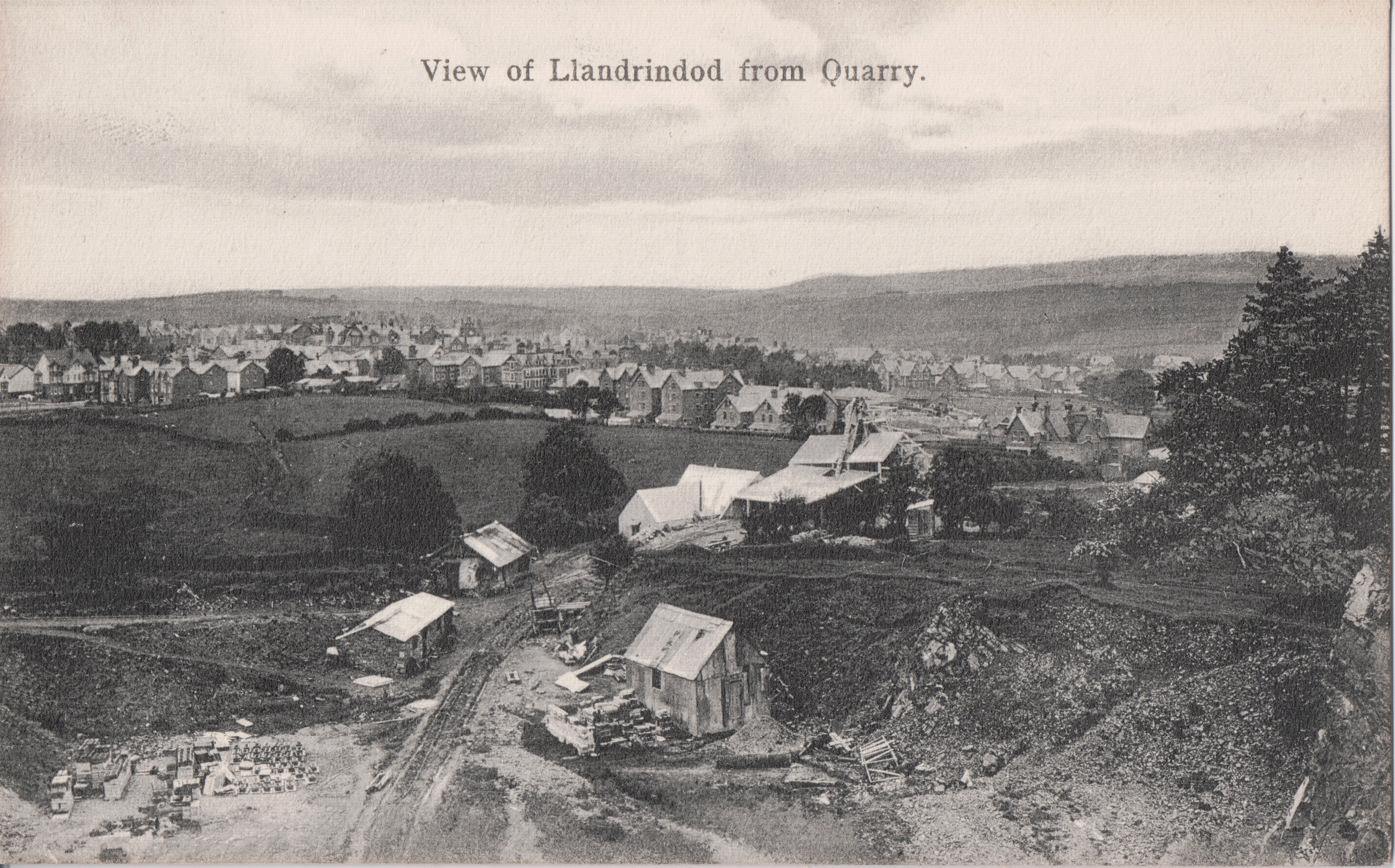
Llandrindod Wells has none of the things a Welsh county town is expected to have. There is no medieval market square, no knot of ancient streets, no old commercial core. There are broad roads, terraces, villas, hotels, parks and open spaces, almost all of them Victorian or Edwardian. The explanation is not that an older settlement was rebuilt. Modern Llandrindod was, to an unusual degree, created in the nineteenth century on land that had been common, and the creating went on far longer than the first burst of Victorian building suggests.
There had been a community here for centuries. The old parish, its church, its farms and scattered houses belonged to a rural landscape, and the mineral springs drew visitors well before the railway. By the eighteenth century Llandrindod had a name as a watering place, with Llandrindod Hall and later the Pump House taking in those who came for the waters. What did not yet exist was a town. Most of the ground now covered by streets, hotels and public buildings was open common, used for grazing and peat cutting by people living around its edges.
Several forces arrived almost together. Enclosure changed how land could be owned and divided. The railway made the district reachable on a new scale. Landowners saw money in building around an established spa. Surveyors marked out roads and plots, companies raised capital, builders and tradesmen turned plans into houses, and in time the council became a landowner and developer in its own right. The decisive steps came in the 1860s. The work continued for generations.
In what follows I have tried to separate what the surviving records establish from what I infer from them, and to say which is which.

Before there was a town
The mineral waters are where the story begins. Their reputation was made long before the Victorian age, and in the eighteenth century there were attempts to turn Llandrindod into a fashionable inland resort. Llandrindod Hall was adapted for visitors, medical writers discussed the properties of the springs, and the name carried beyond Radnorshire. In the early nineteenth century the Pump House became one of the principal centres of the spa, with inns and lodging houses serving those who came for treatment, recreation and company.
A watering place is not necessarily a town. Visitors could arrive for several weeks, lodge near the springs, take the waters and go home without any need for a substantial permanent settlement. The old ecclesiastical centre of Llandrindod lay away from the heart of the later town, and the wider landscape stayed overwhelmingly rural. Farms, cottages, fields and stretches of common occupied ground that would become some of the busiest parts of the resort.
The common was not empty ground waiting for Victorian developers to discover it. Local people grazed animals there, cut peat and exercised rights that had grown up over generations. The parish population in 1833 was only 182. Later figures are not like for like, because boundaries and administrative units changed as the town grew, but the contrast with what followed is plain enough. The making of the town meant changing the ownership, purpose and value of the land itself, and not merely putting buildings where there had been none.
One of the clearest descriptions of the place before the transformation comes from evidence given to a House of Commons committee in June 1903. Evan Bufton of Brynteg, an auctioneer who had known Llandrindod since 1869 and had sat for many years in its local government, was asked what it had been like when he first came. He thought there had been only eight or ten houses, most of them old. When counsel called the settlement a village, Bufton corrected him. It could not really be called a village, he said, because it was “an open common”.
The medicinal waters were already in use, and Bufton remembered the establishments later associated with the Pump House and Rock House, but the resort was small, its visitors few and its accommodation limited. His evidence was retrospective, given more than thirty years later, and it should be read with that in mind. It is still the testimony of a man who knew the place before the expansion and then watched it happen.
The common and enclosure
An earlier witness to that landscape was Alfred Russel Wallace. Long before he was known as the naturalist who arrived independently at the principle of natural selection, Wallace worked with his brother William as a surveyor in the Llandrindod district during the winter of 1839 and 1840. His later recollections describe moor and mountain, scattered cottages, small fields and gardens, a world far removed from the terraces and hotels of a generation later.
Wallace also remembered what common rights meant in practice. For poorer households, the ability to graze a horse, a cow or a few sheep could decide whether a family got by. His opinions need handling with care, because he became a fierce critic of private land monopoly and an advocate of land reform, and he wrote about enclosure from that position. His account is nonetheless a useful reminder that the land had users before it had developers.
The making of Llandrindod Wells therefore changed what the landscape meant. Ground valued partly through customary use came to be surveyed, measured, divided and priced. A stretch of common became a numbered building plot, a track became a street, and a view across open ground became a selling point for a villa or hotel.
Enclosure at Llandrindod is often reduced to a single date, usually 1862, but the evidence is more tangled. There was enclosure activity before the Victorian development, as Wallace’s survey work shows. The decisive reorganisation associated with the new town gathered pace in the 1860s and ran into the early 1870s.
The Swydd Neithon enclosure involved surveys, claims, allotments and legal decisions spread over several years. One surviving award was made by the surveyor John Mickleburgh on 31 December 1870 and confirmed in October 1871. Under it James Watt Gibson-Watt, as lord of the manor, received more than sixty acres at Pwl Hir. By then the new town had already begun to appear. Railway land had been settled, building sites were being offered for sale and roads were being planned, so the legal process and the physical development overlapped.
What mattered was less any one date than what enclosure made possible. Land governed by a mixture of ownership and common rights could now be treated as clearly defined property. It could be mortgaged, conveyed, divided and sold, and that is what made systematic urban development possible.
The railway changes everything
If enclosure made the land developable, the railway made development worth the risk. It reached Llandrindod in 1865. Before then the waters were known well beyond Radnorshire, but getting there meant an awkward journey by road. Now the district was connected to a far larger market of visitors from South Wales, the Midlands, north-west England and beyond. Hotels could plan for greater numbers, businesses could serve a substantial seasonal population, and property near the springs and the station took on a different value.
The railway also shaped the town’s physical geography. To the west lay Rock House, Rock Park and land associated above all with Richard Dansey Green-Price. To the east lay the Pump House estate and the lands of Edward Middleton Evans. The line ran between them and became the boundary between two major areas of speculative development. Contemporaries saw it that way too. In the 1903 parliamentary inquiry witnesses were asked directly whether Llandrindod was divided into an upper and a lower town, and the answer was yes. The modern town came not from one estate or one master plan but from separate schemes on either side of the line, which gradually spread until they met.
The most evocative moment in the creation of Llandrindod came in June 1867, when members of the Woolhope Naturalists’ Field Club travelled by rail to the district. They found a place caught between its older identity as a scattered watering place and its future as a town. The principal spa establishments were there and large areas were still open, yet the outline of the future settlement could already be seen, with lines marked across the turf to show where roads and buildings were intended to go. A visitor could stand on what was still largely Radnorshire common and see the beginnings of streets that did not yet exist.
Of all the evidence for the town’s origins, this is the passage I would most want a reader to remember.
That is what separates the new Llandrindod from the ordinary outward growth of an older town. It was, in large part, drawn onto the landscape before it was built.

Richard Dansey Green-Price and the western town
One of the principal figures of the first building phase was Richard Dansey Green-Price, who belonged to a substantial Radnorshire landed family. His father, later the first Green-Price baronet, held extensive estates and was involved in railway enterprise, and Richard himself would later be associated with further railway ventures. In the crucial years of the 1860s and 1870s he had not yet inherited the baronetcy, so it is more accurate to call him simply Richard Dansey Green-Price.
His interests centred on Rock House and the land west of the railway, and the timing was exceptionally fortunate. The waters drew visitors, the railway was transforming access and enclosure was altering what could be done with the surrounding land. In July 1867 he announced the sale of twenty-three freehold building sites on the Rock House Estate, adjoining the station. The advertisement is revealing. The scheme was described as the “nucleus of a new and beautiful town”, and Llandrindod itself was promoted as the “Buxton of South Wales”. Each plot was meant to give enough frontage for a detached or semi-detached villa with a garden, and the road was to be formed and metalled with drainage provided. Later accounts mention a layout of seventy-six plots, which may refer to the wider estate scheme rather than to that particular sale.
Intention was quickly turned into work on the ground. A newspaper report of June 1868 credited the scheme with new roads, a main sewer, a newly enclosed and planted park and a pump room near the chalybeate spring. Henry Hurst had also taken land for building and set up brickworks which the report said could turn out around 50,000 bricks a week. That is a contemporary claim and not a modern measurement, but it indicates the scale of construction being contemplated. Green-Price was not simply benefiting from a town that happened to grow around Rock House. His estate was one of the main mechanisms by which the western side of it was made.

The people who planned and built Llandrindod
Landowners controlled property, but they did not lay out every street or design every building. One of the most important professional figures west of the railway was Stephen William Williams. Born in 1837, he became Radnorshire’s county surveyor in the 1860s and combined surveying, engineering and architectural work throughout his career. A developing town needed far more than plots. Roads had to be aligned and formed, sewers laid and building lines fixed, and in a spa the appearance of the place was part of what was being sold. Williams became closely tied to the development around Rock Park and later to the Llandrindod Estate and Building Company.
He shows the difference between owning land and making a town. Green-Price could release property for development, but it took men like Williams to turn that opportunity into streets, terraces and drains.
The same is true of the people who physically built Llandrindod. A conveyance of December 1869 records Green-Price selling more than 1,300 square yards fronting Station Road to John Williams, a joiner, and Evan Jones, a bricklayer, both of Llandrindod Wells. Beside the great estate sales it is a small transaction, but it says something important about the social history of the town. Working tradesmen were not only employed on the development. Some of them were investing in it.
Henry Hurst, through brickmaking and building, was another key figure. The pace of expansion created huge demand for materials, and local brickworks became part of the economy the town generated. The famous names tell only part of the story. Surveyors, brickmakers, carpenters, joiners, masons, labourers and contractors turned plans into buildings, and hundreds of less celebrated people built the town that the landowners made possible.
The first western streets
By the end of the 1860s parts of the new town were recognisable. Station Road appears by name in the conveyance of 1869, and several houses in Norton Terrace were standing by 1871. The terrace overlooked Rock Park and formed part of the view from it, which shows that the relationship between architecture and landscape was being thought about from the start. Visitors did not come only to drink mineral water. They expected pleasant walks, respectable lodgings and chances to see and be seen, and terraces facing landscaped ground had a social and commercial advantage.
Park Terrace belonged to the next phase. Building began in the 1870s, and surviving papers show the Llandrindod Estate and Building Company dealing with John Evans & Son of Aberystwyth over numbers 1 and 2. The correspondence matters because the work did not go smoothly. There were complaints about slow progress and a threat that the company might take possession of the works.
It is the complaints in these letters, more than any prospectus, that make the builders of Park Terrace feel like real people.
Evidence of this kind removes the air of inevitability from the finished Victorian town. Looking at Park Terrace now, it is easy to imagine a developer commissioning a building and a contractor simply putting it up. The records show delay, financial pressure and disagreement. Llandrindod was planned, but not to one flawless programme. Schemes stalled, contractors disappointed their employers, companies borrowed heavily and some developments failed altogether.
Edward Middleton Evans and the eastern development
Across the railway, another large development was taking shape under Edward Middleton Evans of Llwynbarried. He belonged to the county’s landed and administrative establishment. He was educated at Oxford, served as High Sheriff of Radnorshire and as a magistrate, and was one of the small group of landowners and office-holders who held real influence in nineteenth-century Radnorshire.
His involvement in Llandrindod went well beyond owning land. A surviving plan of 1868, associated with the Hereford architect Thomas Nicholson, shows building sites being laid out on his property east of the railway, direct evidence that this side of the town was being consciously organised for development. There was therefore no single master plan for Llandrindod. To the west Green-Price and Stephen William Williams were the influential figures, and to the east Middleton Evans and Nicholson were pursuing a different scheme. The railway divided the two, and the modern town emerged as the space between them filled.
His contribution was recognised explicitly when he died at Llwynbarried on 5 November 1899, aged seventy-seven. The Radnorshire Standard observed that a “considerable portion” of the town stood on the Llwynbarried estate, and the Hereford Times likewise credited him with doing much for the development of Llandrindod Wells. These were judgements published while the transformation he had helped begin was still plainly visible, and not retrospective claims made generations later.
He gave the sites for Holy Trinity Church, the Cottage Hospital and the Convalescent Home, and contemporary reports indicate that he bore substantial expense connected with the church. He was closely associated with the water supply, forming the Llandrindod Wells Water Company and remaining involved in the later controversy over provision of water to the growing settlement. He had been High Sheriff as early as 1849 and for many years sat as a magistrate at Rhayader and Penybont. He stayed personally connected with Llandrindod almost to the end, spending several weeks there in the summer of 1899 and appearing in public in the town shortly before his death. His obituaries present him not simply as a landowner profiting from expansion but as a man involved in the institutions and infrastructure that turned a spa settlement into a functioning town.
Thomas Nicholson had an established practice in Herefordshire and the Welsh border counties, and his work for the Middleton Evans estate shows that professional architectural thinking was part of the eastern development from an early stage. He was also responsible for Christ Church, later Holy Trinity. His role is a counterpart to that of Williams in the west. The landowners controlled the ground, Williams and Nicholson turned ownership into plans, and builders turned plans into brick and stone. Landownership alone could not create a town. It needed professional planning, finance, construction and, in the end, people willing to buy, rent and use what was built.
One of the most revealing documents is the sale of land to Edwin Coleman in 1870. The deed did a good deal more than transfer a plot. Middleton Evans kept rights over minerals and mineral waters, required proposed elevations to be approved and restricted certain uses of the site. This was not a landowner selling off ground and walking away. He was trying to shape the appearance and character of the town rising on his estate. Evidence given at the 1903 Improvement Bill inquiry suggests the reservation of mineral-water rights was not a one-off but a continuing estate policy. Witnesses familiar with later Middleton Evans sales confirmed that such rights were commonly reserved, and the local architect and surveyor Richard Wellings Thomas said he understood the purpose to be the prevention of rival spas. In Llandrindod what lay under the ground could be as valuable as the building site above it.
The restrictions on undesirable uses served a similar end. A fashionable spa depended on reputation, and offensive trades or unsuitable building could damage the image being built around the waters, hotels and new streets. The covenants were a form of private planning control long before modern planning law.
Holy Trinity opened in 1871, when much of the surrounding town was still being built. A substantial church for a settlement of incomplete streets suggests real confidence in the future. The developers expected more than a seasonal cluster of hotels and lodging houses, and by the early 1870s the place was acquiring institutions as well as roads and buildings.
The eastern street system becomes visible in the records of the 1870s. Railway Terrace, North Crescent and Temple Terrace all appear, together with the area later associated with Lindens Walk. Several of those names changed. Railway Terrace became Middleton Terrace and eventually Middleton Street, Temple Terrace became Temple Street, and North Crescent later became South Crescent. The changes were gradual and not always the result of any formal act, and older names could survive in conveyances after newer ones had appeared in municipal records. A planned residential terrace could acquire shops and become a street in the ordinary sense, and the lawyers were slower to notice than the residents.


Two building companies
Two separate organisations with very similar names were involved, and they are easily confused. The Llandrindod Estate and Building Company was associated with Green-Price and the western side. Its surviving papers concern mortgages, property and building around places such as Park Terrace and Ithon Road.
The Llandrindod Wells Freehold Land and Building Company Limited was a different enterprise. Incorporated in 1875, it became involved in the eastern development around Railway Terrace and North Crescent. It ran into serious financial difficulty and was ordered to be wound up in 1881, and its properties had to be dispersed through liquidation. That appears to be one factor in the different pace of development east of the railway. It would be too simple to blame every delay on one company, but the collapse of a substantial speculative concern inevitably disturbed the orderly development of its land. The elegant streets that eventually appeared conceal long periods of financial uncertainty.
James Watt Gibson-Watt
James Watt Gibson-Watt represents another strand. Born James Watt Gibson in 1831, he was connected through his family with the descendants of the engineer James Watt and later added Watt to his surname. He was a substantial Radnorshire landowner and served as magistrate, Deputy Lieutenant and High Sheriff.
His part in the earliest street planning was different from that of Green-Price or Middleton Evans. As lord of the manor he was tied to the landholding structure beneath enclosure, and his large allotment under the Swydd Neithon award reflects that position. His influence became more visible through Rock Park and the spa landscape. In 1879 he provided the marble drinking fountain at the free chalybeate spring, and in 1885 he acquired Rock House Hotel and associated property. This was an older form of landed power adapting to the opportunities of a modern resort. The Gibson-Watt interest continued into the twentieth century, with later development connected to land around Waterloo and elsewhere.

The man and the estate
The distinction between the individual and the estate matters most in the case of Edward Middleton Evans. He died in 1899, but the arrangements he left ensured that the Middleton Evans interest in Llandrindod continued well into the twentieth century. When his will was proved in 1900 the gross estate was reported at £758,945, which the newspapers described simply as three-quarters of a million pounds.
The will, dated 30 January 1899, placed the estate in trust for ten years. After a £100 annuity to his sister, Harriet Marie Evans, the income was to be applied for the maintenance and benefit of his children, and at the end of the ten years the Llwynbarried Estate was to pass to his eldest son, Henry Middleton Evans. The rest of the property, expressly including the Llandrindod Wells Estate and the Pump House Hotel, was to stay in trust for all of Edward’s children, Henry included. Llandrindod was treated as a substantial property interest in its own right and not as an appendage of the family seat.
The trustees were active managers. In the summer of 1907 they put a remarkable portion of the Llandrindod property on the market through Knight, Frank & Rutley. A Country Life advertisement of 8 June described the “whole freehold estate” above the railway as about 700 acres, embracing much of the fashionable health resort. By July the particulars had been refined to about 654 acres, to be offered in lots at the Victoria Hall on 3 September. The change in acreage and in the sale arrangements shows the plans were still moving during the summer, and the June advertisement should not be taken as proof that all the land it described was offered in exactly that form.
The particulars show the range of assets the trustees held. They included the Pump House Hotel, its grounds, pump room, bath-house and mineral springs, the Llanerch Hotel, Llanfawr Stone Quarry, five grazing farms, smaller holdings and extensive land with road frontages suited to residential building. The Pump House Hotel was let to the Pump House Hotel Company on leases running to Lady Day 1939. The July particulars gave rent and mineral-water royalties of £1,203 10s 9d a year, calculated from the average royalties of the previous four years. The quarry was let at £150 a year plus a royalty on stone raised, and the Llanerch Hotel property was even promoted as a possible site for a first-class commercial hotel. Farmland, hotels, mineral rights, quarrying and speculative building land had become parts of one urban estate economy.
The auction on 3 September 1907 drew a crowded attendance, with buyers from London, Swansea and Cardiff as well as the locality. The whole property, Pump House Hotel included, was first offered as a single lot and withdrawn when bidding reached £106,000. The building land was then offered separately, and the Western Times reported an average of £265 an acre for vacant land. Several lots that failed under the hammer were sold privately later that afternoon. The fuller local report in the Brecon and Radnor Express records the Pump House Hotel being offered on its own, with bidding rising to £35,000 before the trustees withdrew it again rather than accept that figure.
The result marked a stage in the break-up of the Middleton Evans Estate. Some of its most valuable development land was divided and sold separately, while major income-producing assets such as the Pump House stayed under trustee control. Contemporary reporting noted that, despite the rapid recent growth of Llandrindod, accommodation in the season still fell short of demand, and it predicted more public and private building. The sale was not only the disposal of an old landed estate. It fed directly into another phase of the town’s growth.
Henry Middleton Evans did not live to see the ten years expire. He died at Llwynbarried in February 1909. His obituary described the Llandrindod portion of the estate as running for roughly a mile and a half to two miles along the upper side of the railway, and noted that recent land sales had made it increasingly profitable to him and his brothers. It specifically mentioned the sale of the Common to the Urban District Council, which shows the family estate being converted piece by piece into the municipal and residential fabric of the modern town.
This helps explain why development lasted so long. The framework was set in the 1860s and 1870s, but individual plots could stay empty for decades, estates released land when it suited them, and new roads could appear long after the first surveyors had marked out their schemes. Llandrindod was not completed by its founders. They began a process that later owners, builders, companies and public authorities carried on.
Rock Park and the spa landscape
Rock Park was inseparable from the town’s development. A Victorian spa needed more than medicinal water. Visitors expected walks, gardens, scenery, comfortable accommodation and places to socialise, so the park had an economic as well as an aesthetic role. Terraces gained from overlooking open ground, hotels from nearby walks, and the waters could be presented within a managed landscape and not simply left to rise from the ground. Rock Park, later Temple Gardens and the lake, helped to distinguish the resort from an ordinary railway settlement. The open spaces were part of what visitors came to experience.
From private estates to municipal government
By the later nineteenth century Llandrindod was unmistakably urban, but it was unfinished. Streets were still filling out, vacant plots survived in central positions and different estates had moved at different speeds. Managing the town was also becoming harder. Roads needed maintenance, sewers had to be built, drainage and sanitation needed supervision and building work needed regulation. A town approaching several thousand permanent residents could not run as a collection of private estates, hotels and speculative schemes.
Municipal government grew in importance, and legislation backed the shift. In February 1903 the Llandrindod Wells Improvement Bill was introduced in Parliament. It sought to give the Urban District Council wider powers over recreation grounds, mineral springs, public amenities, land acquisition, borrowing and the general improvement of the district. It was ambitious enough to need prolonged examination before a House of Commons committee in the summer of 1903, and the surviving verbatim reports give an unusually detailed picture of a town trying to define its next stage.
The 1903 Improvement Bill
The inquiry shows how ambitious the civic leadership had become. The town was described as having a resident population of about 2,000, rising to roughly 5,000 or 6,000 in the season, with an assessable value of £9,681. Witnesses and counsel compared the resort repeatedly with Harrogate, Bournemouth and Brighton. The promoters were no longer thinking only of roads and sanitation but of the powers and amenities of nationally recognised spa towns.
The Bill sought powers over recreation grounds, pump rooms, mineral springs, baths, a pavilion, land acquisition and municipal building. That brought the Council into direct contact with older private interests. The trustees of Edward Middleton Evans, the Pump House Hotel Company and interests connected with Rock House were among those concerned, particularly where the proposed powers might affect existing springs or allow new wells to be sunk. The issue was not only regulation. The Council was contemplating a more active role in the spa economy itself, potentially alongside establishments whose value depended on privately controlled mineral waters. The evidence about the Middleton Evans estate confirmed how persistent those private controls were, and the conflict between municipal ambition and private mineral rights grew out of the same estate structure that had shaped the nineteenth-century town.
The Council’s case included scientific evidence for its own mineral water. In July Dr Hugh Richard Jones gave evidence on an analysis of water taken in January 1903 from a well on the recreation ground. The chemical detail belongs more naturally to the history of the waters, but its presence shows that the proposed municipal facilities rested on a tested source and not a speculative one.
The committee nevertheless rejected the Bill without calling the opposition evidence, finding that the preamble had not been proved. It accepted that Llandrindod was growing and drawing large seasonal numbers, but held that the promoters had not supplied sufficiently complete plans, estimates or financial information to justify the powers sought or to show what burden would fall on ratepayers. It was therefore not simply a victory for private opponents. It was also a judgement that municipal ambition had run ahead of preparation.
The Council returns in 1905
The setback was temporary. In July 1905 the Llandrindod Wells Urban District Council Bill came before the House of Commons Police and Sanitary Committee, and counsel openly acknowledged the difficulties of the earlier scheme. The proposals had been narrowed to water supply, recreation facilities, municipal buildings and, most significant for the future shape of the town, the Pump House Common. The Llandrindod Wells Urban District Council Act received Royal Assent on 4 August 1905, giving the authority stronger statutory powers.
Preservation of the Common was presented as essential to the prosperity and character of the resort. Alderman A. E. Morgan, a member of both the Urban District Council and Radnorshire County Council, thought the question almost one of “life and death to the place”. Not every part would be left untouched. Morgan explained that selected land round the edge could be sold or built on to recover part of the purchase price, while the principal open area stayed available to residents and visitors. He estimated that development around the margins might recover about £13,000 and that the lake itself could produce further annual income. Preservation and development were conceived together from the outset.
Negotiations with the Middleton Evans interests were already moving. The solicitor Walter Henry Bird, who said he had visited Llandrindod nearly every year since 1892, indicated that an original asking figure of £25,000 had come down to about £23,000 within roughly twelve months. He also described visitor pressure to keep the Common open, including a memorial promoted when building on it seemed possible. The campaign was not confined to councillors. Regular visitors regarded the open landscape as part of what made Llandrindod attractive.
The committee was concerned that the acquisition should not turn into a speculative property scheme. It pressed for safeguards over what could be sold or built on and examined the relationship between surface ownership and the mineral-water rights the Middleton Evans estate had long sought to retain. Amendments were required, but unlike the measure of 1903 the revised Bill survived scrutiny, and when it returned to the committee it was passed and ordered to proceed to third reading. Failure in 1903 and success in 1905 mark a gradual, not automatic, transfer of influence from private estates to municipal government.
The Edwardian expansion
It is easy to assume that the great period of town building ended with Queen Victoria’s reign. The records show otherwise. New houses and shops continued to appear in Spa Road, Temple Street, Tremont Road, Grosvenor Road and elsewhere, and substantial areas of building land remained.
The Middleton Evans Estate is the clearest case. In March 1907 plans were prepared for freehold building sites between Temple Street and the Common, with further plots along Spa Road and Grosvenor Road, and sale particulars followed in August and September. Thomas Nicholson’s plan had been drawn in 1868. Almost forty years later the trustees were still offering land on the estate’s edges, which shows how long the original framework stayed active. In March 1905 the municipal building records had already referred to a “new street called Duffryn Rd for Middleton Evans trust”, a precise record of a street coming into being, and houses followed along Duffryn Road soon after.
Other areas grew at the same time. Craig Road was extended in 1905, a private road and sewer were proposed at Waterloo Farm for Captain Gibson-Watt in 1906, and in 1908 municipal records referred to houses in “New Street”, identified with Waterloo Road. More than forty years after the railway arrived, Llandrindod still had streets recent enough to be called new. It was growing in two directions at once, outward at its margins and inward as vacant sites between older buildings were occupied.
The years from 1905 to 1910 were particularly busy. Applications came in for houses in Temple Street, Duffryn Road, Wellington Road, Alexandra Road, Tremont Road, Grosvenor Road, Victoria Road, Blandford Road and elsewhere, some single houses, others pairs, groups of four or larger schemes. The census shows the pace. The urban district held 1,827 residents in 1901 and 2,779 in 1911, an increase of just over half in a decade. By the eve of the First World War Llandrindod was much more than a place occupied chiefly in the visitor season.
Municipal ownership and development
A major change came when Llandrindod Wells Urban District Council acquired the Common and Lake, after a prolonged negotiation and not a single transaction. By July 1905 the Middleton Evans interests had asked £25,000, and Bird’s evidence indicates a reduction to about £23,000. In September 1905 the Welsh Gazette reported a £25,000 scheme before the ratepayers for the Pump House Common, about thirty acres including the lake. It was unanimously adopted and already contained the principle that shaped later policy, that selected fringe land could be sold for building while the greater part stayed open. By the estate auction of September 1907 the auctioneer could speak of the Common as recently purchased by the Council, though the surviving municipal records place formal completion in December 1907 at £21,420. The three figures, £25,000, about £23,000 and £21,420, record stages in a negotiation and are not contradictory accounts. Henry Middleton Evans’s obituary of 1909, which mentions a £25,000 sale, appears to preserve the earlier public figure.
The land had begun as common, enclosure had changed its legal status, and private estates had then controlled and developed large parts of it. Now much of what was left passed to the authority representing the town. In one sense the story had come full circle, but under very different legal and economic conditions. The Council did not simply preserve every acre. It became a developer.
During 1908 several Spa Road building sites were sold by the Council. Alfred Meredith, a builder, bought one, Mary Anna Smith of Ye Wells acquired another, and Daniel Meredith bought further land. Another purchaser took a site at the corner of Spa Road and Princes Avenue. The conveyance described that land as “not yet built”. By then Llandrindod had grand hotels, substantial terraces, parks, shops and public buildings, and undeveloped land still lay in what would become central streets.
Few phrases in the council records say so much in so few words.
The old terminology survived late. Municipal records in 1910 referred to a house on Lot 12 of “The Common”, more houses followed in 1911, and another dwelling was proposed on Lot 1 in 1913. Almost fifty years after the future streets had been marked across open turf, official records were still identifying sites by the landscape from which the town had come. The common was absorbed gradually, plot by plot.
Temple Street remained among the most active areas well into the twentieth century, with valuable frontage still changing hands in 1910, 1911 and 1912. Spa Road followed a similar pattern, with municipal plots sold after the Council acquired the Common and further houses and shops proposed before the war. These streets do not belong to one building period. Their appearance today is the result of layers of development across decades.

The town matures
Expansion also moved beyond the oldest spa streets. Montpellier Park became an important area of Edwardian housing, with six houses proposed in Montpellier Park Road in 1909 and more soon after, and streetworks around Montpellier Park and Temple Avenue continued in the years just before the war. The first Victorian schemes were inseparable from the spa economy, hotels and visitors. By the Edwardian period the town also needed housing for people who lived and worked there all year. The resort was becoming a normal town as well as a destination.
Victorian Llandrindod had been created around the railway, and Edwardian Llandrindod began adapting to the motor car. Tom Norton is the clearest symbol of the change. His business grew from bicycles into motor vehicles, and his Automobile Palace in Temple Street became one of the most conspicuous commercial buildings of twentieth-century Llandrindod. Garages, petrol installations and other motor-related premises appeared elsewhere. One transport revolution had made the town, and it was already adapting to another.
The Edwardian years also brought institutions that gave Llandrindod a more settled civic character. County Buildings opened in High Street in 1909, the golf club developed substantially in the same period and the Grand Pavilion opened in 1912. What had begun as a watering place and speculative resort had become an administrative centre, a commercial community, a permanent residential town and a place of recreation and entertainment. The mineral waters remained at the heart of its identity, but they no longer explained everything that happened there.


From the First World War into the 1920s
The strongest evidence that the making of the town was continuing comes from the months before the First World War. On 13 March 1914 plans were recorded for a new road between Cefnllys Road and Craig Road for the Llandrindod Wells Building Estate Syndicate. Nearly half a century after the railway arrived, a syndicate was still laying out new roads. New houses continued to be proposed through the summer, and a motor garage was approved in Oxford Road in July. The Llandrindod that entered the war was not a completed Victorian relic. It was still growing.
The war did not stop construction outright, but it interrupted the long development cycle. Municipal records from the war years contain more alterations, garages, workshops and outbuildings, and fewer of the repeated groups of new houses that marked the Edwardian years. For that reason 1914 is a meaningful dividing line. It marked the end of the first great era in which Llandrindod was built principally as a Victorian and Edwardian spa resort, but not the end of its physical growth.
Development resumed after 1918 in a different character. The Urban District Council ran post-war housing schemes, while private builders returned to houses and villas. Montpellier Park continued to expand, and new houses appeared in Broadway, Tremont Road, Grosvenor Road, Rhydllyndu Road, Wellington Road and other areas, with Brookland Road and North Avenue among the later residential developments. This was housing for a permanent community and not development driven chiefly by the seasonal spa economy. The town had acquired administrative, commercial and residential functions of its own, and a life independent of the circumstances that created it.
The longest continuity came in the 1920s. Council records survive for the sale of sites on the Common between 1923 and 1926. More than sixty years after the Victorian enclosure and building schemes began, former common land was still being turned into urban Llandrindod. There was no moment when the Common became the town. It happened through roads laid out, plots sold and houses built.
Who created Llandrindod Wells?
No satisfactory answer exists if the question is reduced to one name. Richard Dansey Green-Price was crucial to the west of the railway, and Edward Middleton Evans shaped much of the east. Dr William Bowen Davies, arriving in 1872, helped give the growing resort the medical, public-health and civic institutions of a permanent town, and his home, Brynarlais, later became the Town Hall. James Watt Gibson-Watt represented an older layer of manorial and landed influence. None of them acted alone.
Stephen William Williams and Thomas Nicholson turned landownership into plans. Building companies supplied finance and organisation, and some succeeded while others failed. Builders such as Henry Hurst supplied materials and construction, and joiners, bricklayers, carpenters and labourers turned surveyed plots into streets and houses. The railway brought the visitors, hotel owners accommodated them, and municipal government eventually acquired large areas of land and became a developer itself.
The people who had used the Common before all this should not be forgotten either. The creation of the town changed their landscape as much as it enriched the developers who followed.
A town marked out on the common
The image that stays with me is the one from the 1860s. There was a moment when most of modern Llandrindod did not exist. The springs were there, with the hotels, the scattered houses and the newly arrived railway, but across much of the future town there was open land. Then lines appeared across the grass to show where roads and buildings would rise. Within a few years terraces followed, within a generation there were churches, hotels, parks, shops and public buildings, and within half a century the place was a substantial administrative and residential centre. Even then it was unfinished. New roads were still being planned in 1914 and former Common plots were still being sold in the 1920s.
The achievement was not that Llandrindod Wells was built overnight. It was that someone decided to turn a scattered spa and an open common into a town, and that successive generations carried the decision forward. Modern Llandrindod was not simply a town that happened to have mineral springs. It was created because of them, made possible by enclosure, transformed by the railway, financed through speculation, built by tradesmen and extended through municipal and residential development. For one brief moment before the brick, stone and slate arrived, it existed only as lines marked across the grass.
Related Essays
- Presteigne: The Making of Radnorshire’s Old County Town
- The Town That Became a Village: The Rise and Decline of New Radnor
- Llandrindod Wells Hospital: From Cottage Hospital to County War Memorial
- Board and Lodging: The Boarding Houses of Llandrindod Wells
- Bowling in Llandrindod Wells: From the Spa Greens to Rock Park and the Indoor Game
- From the Pump House Links to Death or Glory: A History of Golf in Llandrindod Wells
- From Spa Town to Administrative Capital: Civic Government and the Making of Llandrindod Wells
- Llandrindod Wells Market Hall: A Building for a Changing Town, 1872–1957
- Llandrindod Grammar School: The County School and Its Lost Alexandra Road Building
Explore more Llandrindod Wells history
Continue with the Llandrindod Wells History guide, or follow the related essays above to explore the people, buildings and institutions that shaped the town.
Sources and Further Reading
I. E. Jones, ‘The Swydd Neithon Enclosure and the Development of Llandrindod Wells’, Transactions of the Radnorshire Society, vol. XLIII, 1973, pp. 24–33, remains one of the principal studies of the relationship between enclosure and the early development of the town. His later study, ‘Growth and Change in Llandrindod Wells since 1868’, Transactions of the Radnorshire Society, vol. XLV, 1975, provides important context for the continuation of development beyond the first Victorian building boom.
Bruce E. Osborne, Llandrindod Wells: The Historic Spas of Central Wales; Tref y Ffynhonnau, British Spas Federation, 1999, provides a useful general history of the town and spa, together with reproductions of important plans and contemporary material. T. J. Llewelyn Prichard, The Cambrian Balnea; or, Guide to the Watering Places of Wales, Marine and Inland, 1825, is particularly valuable for understanding Llandrindod as a watering place before the railway and later urban development.
Alfred Russel Wallace, My Life: A Record of Events and Opinions, 1905, contains his recollections of surveying around Llandrindod during 1839–40 and provides unusual evidence for the appearance and use of the common before the Victorian town existed. His later interpretation of enclosure should be read alongside his developed political views on land ownership. The Transactions of the Woolhope Naturalists’ Field Club for 1867 are also important, particularly the account of the Club’s visit to Llandrindod in June of that year.
The Powys Archives collections are fundamental to the history of the town. They include the Swydd Neithon enclosure records and award, estate material connected with Richard Dansey Green-Price, Edward Middleton Evans and the Gibson-Watt family, papers of the Llandrindod Estate and Building Company and the Llandrindod Wells Freehold Land and Building Company, the 1868 plan for laying out building sites on the property of Edward Middleton Evans east of the railway, and the later Middleton Evans Estate sale plans and particulars. The Llandrindod Wells Urban District Council records are especially valuable for later development, containing building plans, streetworks, property conveyances, the purchase of the Common and Lake, subsequent sales of municipal building plots and post-war housing material. For the transition to stronger municipal powers, see the parliamentary proceedings on the Llandrindod Wells Improvement Bill in Hansard, 24 February 1903, the detailed House of Commons committee evidence reported in the Radnorshire Standard between May and July 1903, and the Llandrindod Wells Urban District Council Act 1905, which received Royal Assent on 4 August 1905. Taken together, these sources document the failure of the ambitious 1903 scheme and the subsequent successful extension of municipal powers two years later.
Cadw’s material on Llandrindod Wells Public Parks provides important evidence for Rock Park, the planned spa landscape and the relationship between open space and surrounding development. The Heneb Historic Environment Record is valuable for understanding the pre-urban landscape and the distinction between the old parish settlement and the later town. Coflein, maintained by the Royal Commission on the Ancient and Historical Monuments of Wales, contains records relating to numerous buildings and sites within Llandrindod and is particularly useful when the documentary history is compared with surviving structures.
Siân Lewis, ‘A Resort of the Common People in Great Troops: Llandrindod Wells Spa and its Workers in the Late Nineteenth and Early Twentieth Century’, Transactions of the Radnorshire Society, vol. 76, 2006, is valuable for restoring workers and ordinary residents to a history which can otherwise become dominated by landowners, developers and visitors. Keith Parker, ‘Radnorshire Towns in the Nineteenth Century’, Transactions of the Radnorshire Society, vol. 84, 2014, provides useful wider context for the unusual growth of Llandrindod within nineteenth-century Radnorshire.
Historic Ordnance Survey mapping, particularly the later nineteenth and early twentieth-century twenty-five-inch editions, is invaluable for following the town as individual streets and vacant plots gradually filled. Comparison between successive maps makes especially clear how long substantial areas remained undeveloped after the original street plans had been laid out.
Contemporary newspaper material provides another essential layer of evidence. The Hereford Times, Hereford Journal, Eddowes’s Shrewsbury Journal, Shrewsbury Chronicle, Radnorshire Standard, Radnor Express, Brecon and Radnor Express, Welsh Gazette, Western Times, Brecon County Times, South Wales Daily News, Western Mail, The World and Country Life contain advertisements for building sites, estate sales, reports of new buildings and descriptions of the growth of the resort.
Of particular importance are the Hereford Times, 13 July 1867, advertisement for twenty-three freehold building sites on the Rock House Estate, which described the scheme as the “nucleus of a new and beautiful town”, and Eddowes’s Shrewsbury Journal, 3 June 1868, whose account records the new roads, main sewer, planted park, pump room and Henry Hurst’s brickworks as the projected town was taking physical form.
For Edward Middleton Evans and the later history of his estate, see the Radnorshire Standard, 8 November 1899, and the Hereford Times, 11 November 1899, for contemporary obituaries; the Hereford Journal, 4 August 1900, and Radnorshire Standard, 15 August 1900, for reports of his will and the £758,945 gross estate valuation; the Brecon and Radnor Express, 13 July 1905, for the revised Urban District Council Bill, the Common negotiations and evidence from A. E. Morgan and Walter Henry Bird; and the Welsh Gazette, 28 September 1905, for the ratepayers’ approval of the proposed acquisition of the Pump House Common.
For the marketing and break-up of the Middleton Evans Estate in 1907, see The World, 21 May 1907; the supplements to Country Life, 8 June and 18 July 1907, which give detailed particulars of the estate, Pump House Hotel lease, mineral-water royalties, Llanerch Hotel, quarry, farms and building land; the Western Times, 6 September 1907, for the auction result, including the withdrawal of the whole property at £106,000 and the average £265 an acre realised for vacant building land; and the Brecon and Radnor Express, 12 September 1907, for the fuller local account of the sale, including the withdrawal of the Pump House Hotel at £35,000 and contemporary expectations of further development.
For the 1903 Improvement Bill inquiry, see the Radnorshire Standard, 27 May, 3 June, 10 June, 17 June, 24 June, 1 July, 8 July, 15 July and 22 July 1903. Together these instalments print the extended verbatim evidence and the committee’s final decision, including Evan Bufton’s recollection of Llandrindod in 1869 as “an open common”, evidence on Upper and Lower Llandrindod, the continuing reservation of mineral-water rights on the Middleton Evans estate, the Council’s proposed municipal spa facilities, Dr Hugh Richard Jones’s analysis of water from the recreation-ground well, and the committee’s rejection of the Bill.
See also the Radnorshire Standard, 20 February 1909, for the obituary of Henry Middleton Evans and its description of the extent and increasing value of the Llandrindod estate.