
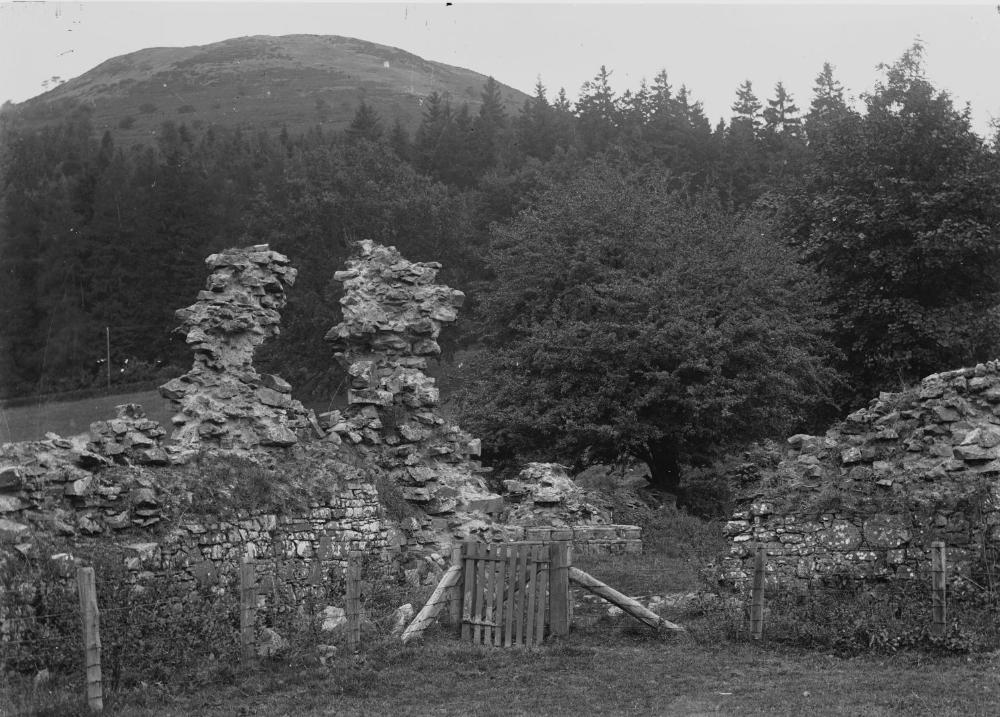
Few places in Radnorshire illustrate the deceptive nature of a quiet landscape better than Abbeycwmhir. The modern village is small, scattered and deeply rural, lying in the long valley from which Cwmhir takes its name. Nothing in its present scale immediately suggests that this was once a place connected with Welsh princes, Marcher lords, Cistercian estates, medieval chroniclers, papal administration and one of the most ambitious monastic churches ever attempted in Wales. Later generations added further layers. The abbey became a quarry, then part of a landed estate, a picturesque ruin, an object of Victorian archaeology, a visitor attraction and, increasingly, a place associated with the national memory of Llywelyn ap Gruffudd. Much of what made Cwmhir important has disappeared, but the valley has retained the marks of almost every period through which it has passed.
The foundation of Cwmhir
Older histories usually begin the story in 1143. For generations this was accepted as the foundation date of the abbey, sometimes accompanied by a story that the first community occupied a site at Ty Faenor before moving farther down the valley. The tradition became so firmly established that nineteenth-century newspapers repeated it without hesitation. Modern research is more cautious. There is no convincing archaeological evidence for an abbey at Ty Faenor, and the secure documentary foundation of Cwmhir belongs instead to 1176, when Cadwallon ap Madog, ruler of Maelienydd, established a Cistercian community associated with Whitland.
The distinction matters. Abbeycwmhir has accumulated traditions almost as readily as it has accumulated ruins, and part of its history is the history of how those traditions developed. An earlier Romanesque carved head found at Ty Faenor complicates matters without resolving them. It may have been carried there from the abbey, perhaps long after the Middle Ages, or it may preserve evidence of an earlier phase of building. It does not, by itself, prove that a monastery stood there in 1143.
Cadwallon’s foundation placed the new abbey within one of the most politically unstable parts of medieval Wales. Maelienydd lay close to the frontier between native Welsh power and the expanding Marcher lordships. Cadwallon himself was killed in 1179 by men associated with Roger Mortimer. Yet the relationship between Cwmhir and the Mortimers did not end there. Roger Mortimer later became a benefactor of the monastery founded by the man whose death he had caused, issuing an important charter around the beginning of the thirteenth century.
That apparent contradiction is characteristic of Cwmhir. The abbey could not stand outside the politics of the March. Its prosperity depended upon grants, protection and accommodation with whichever powers controlled the surrounding country.
Nor was monastic life always as solemn as later imagination made it. One episode from 1195 records lay brothers taking the abbot’s horse after he attempted to prevent them drinking ale. It is a wonderfully human glimpse into a community which otherwise survives largely through charters, foundations and ruined stone. By the end of the century Cwmhir had become sufficiently established to participate in the wider Cistercian network, including the foundation of a daughter house at Cymer.
A church conceived on an extraordinary scale
The surviving ruins give only an imperfect impression of what was intended at Cwmhir. The great church was planned on a scale entirely disproportionate to the size and eventual wealth of the community. Its nave was designed with fourteen bays, creating one of the most ambitious monastic churches in medieval Wales. Nineteenth-century antiquaries repeatedly remarked upon its almost cathedral-like proportions. Even when Stephen W. Williams was excavating Strata Florida in the 1880s, that great church was described as being surpassed in Wales only by Abbey Cwmhir.
Yet the building appears never to have been completed as originally intended. Temporary or secondary walls seem to have enclosed a smaller usable worshipping space within the great unfinished scheme. Victorian investigators recognised the problem early. When the Rev. William Jenkins Rees published his study of Cwmhir in 1850, contemporary reviewers were already struck by the contrast between the magnificent proportions of the intended building and the limited means of the community which attempted to create it.
That contrast should not be treated simply as failure. Cwmhir’s ambitions tell us something about the confidence of its patrons and the political importance of the region in the late twelfth and early thirteenth centuries. The church represented an intention, perhaps even an assertion, about what this remote valley might become.
Its construction also connected Cwmhir with a much larger world. Dressed stone had to be obtained and transported, masons and other skilled craftsmen brought into the valley, and considerable resources assembled. Masons’ marks survive on some of the stonework. Two ancient chisels reported to the British Archaeological Association in 1846 were said to have been found beside a partly dressed squared stone, apparently still positioned for working. Victorian antiquaries imagined that the mason had thrown down his tools as Owain Glyndŵr’s forces approached. The image is irresistible, but it cannot be proved. What the find does provide is something more valuable, a glimpse of the individual craftsmen behind the monumental architecture.
The monastery and its landscape
The abbey was much more than its church. Cwmhir stood at the centre of a working landscape of farms, pastures, woodland, mills, fishponds and granges. The Cistercians depended upon land as much as prayer, and the economic reach of the monastery extended well beyond the immediate valley.
The route later known as the Monks’ Trod has been interpreted as part of the medieval network linking Cwmhir with other religious centres across the Cambrian Mountains. Its precise history remains open to interpretation, but it is another reminder that the abbey belonged to a landscape of movement rather than isolation.
Different properties performed different functions. Upland estates supported cattle and sheep, while lower-lying holdings could provide grain. Cabalva, near Clyro on the Wye, formed an important lowland grange associated particularly with wheat production and milling. Elsewhere the monks controlled extensive grazing. Recent research into the old manor or grange of Gollon has pushed the known monastic landscape farther into St Harmon parish than was once appreciated.
The parkland north of the abbey adds another dimension. Documentary and archaeological evidence records Great Park and Little Park, while part of the abbey’s woodland was associated with hunting arrangements involving the Mortimers. Substantial lengths of old park boundary survive beneath later forestry. Early descriptions also referred to old deer houses and the remains of a park pale. The monastic landscape was therefore not simply one of sheep and crops, but of controlled woodland, animals and negotiated hunting rights.
Water was equally important. Several miles from the abbey lay the large Monk’s Pool, its surviving earthwork dam showing the scale of what was once an important body of water. When Thomas Wilson restored it in the nineteenth century the pool covered about three acres. What had probably originated as practical monastic infrastructure was later transformed into picturesque scenery.
Even small finds demonstrate the reach of Cwmhir. Lead papal seals recovered from the site once authenticated documents sent under the authority of Rome. A late twelfth-century hoard associated with Abbey Cwmhir contained Norman deniers, an unusual body of foreign coinage whose precise explanation remains uncertain. Such objects sit uneasily with the modern appearance of isolation. Medieval Cwmhir was remote geographically, but it was not cut off from wider religious, political and economic networks.
Cwmhir as a place of writing
There was an intellectual life here too. Scholarship has associated part of the B-text of the Annales Cambriae, particularly material covering the years from 1257 to 1263, with a chronicler connected with Cwmhir. That is important. The monastery was not only receiving news, administering estates and saying offices. Someone within or closely associated with the community was recording the political history of thirteenth-century Wales.
The chronicler appears to have taken a particular interest in regions where Cwmhir possessed lands and granges. The abbey’s geography influenced its view of the world. Cwmhir was therefore not simply the setting for history, it was one of the places in which history was being written.
Llywelyn ap Gruffudd
No association has done more to give Abbeycwmhir significance beyond Radnorshire than the tradition that the body of Llywelyn ap Gruffudd was buried there after his death in December 1282.
Llywelyn was killed near Cilmeri during the final Edwardian conquest of Wales. His head was removed and ultimately sent to London. His body was reported to have been buried at Cwmhir. The connection is stronger than later folklore alone. On 28 December 1282, scarcely three weeks after Llywelyn’s death, Archbishop John Peckham wrote concerning reports that the prince’s body had been buried in the church at Cwmhir. The evidence does not identify a surviving grave, but it demonstrates that the association between Llywelyn and the abbey existed almost immediately after his death.
It is therefore reasonable to regard Cwmhir as the probable or traditional burial place of Llywelyn while remaining clear that no grave has been identified conclusively.
That distinction became particularly important centuries later. By the nineteenth century the question of Llywelyn’s burial had become entangled with the wider rediscovery of medieval Welsh history. Archaeologists would dig at Cwmhir partly in the hope of finding him, while memorial committees debated whether the abbey rather than Cilmeri should become the principal place of national commemoration.
The memorial slab now associated with Llywelyn at the ruins belongs to the modern period, but the memory it represents is much older.
Decline, damage and Dissolution
Cwmhir never possessed wealth equal to the architectural ambition of its church. In 1291 the monastery was valued at only £35 12s, and by the later fourteenth century the community appears to have contained only a small number of monks. The great church may have been impressive, but the institution occupying it was comparatively modest.
Its position in a contested landscape also exposed it to violence. The abbey suffered during the revolt of Owain Glyndŵr at the beginning of the fifteenth century. Nineteenth-century writers often reduced the episode to a dramatic statement that Glyndŵr destroyed the abbey in 1401. The reality was probably more complex, but the monastery clearly suffered badly and never returned to the ambitions of its earlier centuries.
Even so, religious life continued. In 1524 Sir Rhys ap Thomas left money so that the monks could acquire a pair of organs. The detail is striking because it comes only thirteen years before the end. Cwmhir was diminished, but worship had not ceased.
The monastery was suppressed on 2 March 1537. Only three monks remained. Its recorded net income was modest, and the great Cistercian experiment in the long valley came to an end.
The buildings did not disappear immediately. Instead they entered a long period of dismantling and reuse. Parts of the abbey became convenient sources of worked stone. Most spectacularly, five bays of the great nave arcade were removed and re-erected in the parish church at Llanidloes. Much of the architecture that disappeared from Cwmhir therefore survives elsewhere.
The fate of other objects is less clear. A carved tympanum survives away from its original position, while the grave slab of an early abbot, traditionally identified as Abbot Mabli, was preserved and eventually placed within the later parish church. These fragments are reminders that the abbey was dispersed as well as destroyed.
There is also the curious case of an old painting once kept in the parish church. In 1938 the Western Mail investigated the history of a picture known as Christ in the Garden, which had served as an altarpiece in the earlier church and had later become so poorly understood that it had reportedly been hung upside down. A Tudor record referred to a religious picture formerly belonging to the dissolved Cwmhir monastery and later found in the possession of the Abbot of Strata Florida. Whether the surviving Abbeycwmhir painting was the same object could not be proved. The mystery remains useful precisely because it shows how easily objects could survive while knowledge of their origins disappeared.
The Fowlers and the post-monastic estate
After the Dissolution the former monastic lands passed through private hands. In 1565 the Manor of Gollon and Cefn Pawl were acquired by William Fowler, a lawyer connected with the Middle Temple and Harnage Grange near Shrewsbury. The Fowlers became important figures in the post-monastic history of the valley.
A manor house developed near the former abbey. Later tradition records its destruction by Parliamentarian forces in 1644 during the Civil War, after which the family’s focus moved towards Ty Faenor. Richard Fowler was associated with substantial later building and with the erection of a chapel near the abbey around 1680.
The Fowlers also became the subject of one of those local verses which outlive the circumstances that created them. A nineteenth-century version claimed that Radnorshire possessed neither park, deer nor a man worth £500 a year except the Fowler of Abbey Cwmhir. Different versions disagree over whether the figure intended was Richard Fowler or Sir William Fowler. The precise attribution matters less than what the rhyme suggests, that Abbeycwmhir had come to symbolise unusual landed wealth within a county characterised by smaller estates and scattered communities.
A Welsh Bible of 1588 associated with William Fowler provides another link between the medieval and post-Reformation worlds. The Cistercian abbey had vanished, but the estate that inherited its landscape continued to give the valley social importance.
Thomas Wilson and the picturesque ruin
A major transformation followed the purchase of the estate by Thomas Wilson in the 1820s. Wilson approached Cwmhir as a nineteenth-century gentleman improving a country property. The abbey ruins were cleared and excavated, surrounding ground altered, walks created and water features restored or reshaped.
This activity helped preserve and reveal the ruins, but it also changed them. Large quantities of stone were moved, and the medieval site was reorganised according to nineteenth-century ideas of scenery. The Monk’s Pool, once part of a practical landscape, became a picturesque feature. The abbey ruins themselves became part of a designed estate.
Wilson also developed the settlement. Tradesman’s Row brought together essential occupations serving the estate and local community, including blacksmithing, shoemaking and wheelwrighting. A poor house formed part of the same complex. This was the Abbeycwmhir of ordinary working people, not merely monks, princes and landowners.
Wilson’s ambitions eventually exceeded his finances. In 1837 the estate was put up for sale. Contemporary advertising presented Abbey Cwmhir as a desirable country property of pasture, meadow, woodland and ornamental planting, with the historic ruins themselves forming part of its appeal. The abbey, once stripped for useful stone, had acquired a new value precisely because it was old, ruined and picturesque.
The estate passed to Francis Philips, bringing a family whose wealth had roots in the industrial economy of Stockport into the heart of rural Radnorshire.
The Philips estate and Victorian Abbeycwmhir
The Philips family reshaped Abbeycwmhir extensively during the nineteenth century. The Hall was enlarged, the estate reorganised and the village landscape altered. Industrial wealth was being converted into landed property, architecture and social standing, a familiar pattern in nineteenth-century Britain but one given a particularly striking setting here among the ruins of a medieval monastery.
A village school was established in 1857, before elementary education became compulsory nationally. The original school included accommodation for the teacher. In 1868 it moved, according to later local tradition because the noise of the children disturbed the squire’s wife. Whether that explanation is entirely accurate or not, the old school thereafter became part of the domestic machinery of the Hall, serving as a laundry.
The old Fowler church was replaced in 1865–66 by the present St Mary’s. Its architecture and decoration reflected the High Church and Tractarian influences of the period. The relationship with the ruined abbey nearby was striking. In the nineteenth century a new church, consciously informed by medieval religious forms, rose beside the remains of the Cistercian house destroyed at the Reformation.
The estate village was not simply decorative. Farmers, estate workers, craftsmen, servants and tradespeople sustained it. The smithy, school, inn, post office, mill and cottages formed part of a highly organised landed world in which much of everyday life was connected, directly or indirectly, with the estate.
Rediscovering the abbey
At the same time, Abbey Cwmhir was being rediscovered historically.
Thomas Wilson’s clearances in the 1820s were followed by growing antiquarian interest. In 1846 two ancient chisels found among the ruins were presented to the British Archaeological Association. In 1848 the Rev. William Jenkins Rees presented a substantial study of the abbey to the Cambrian Archaeological Association. Published in expanded form in 1850, his work attracted attention far beyond Radnorshire.
A review in the Hereford Times recommended that visitors should go to Cwmhir with Rees’s book in hand. That suggestion captures a change in attitude. The abbey was becoming somewhere to visit because of its history.
The trend continued. In 1873 members of the Cambrian Archaeological Association visited Abbey Cwmhir while attending their annual meeting at Knighton. In September 1889 members of the Knighton Improvement and Debating Society made their own excursion. They were conducted over the ruins, ate luncheon at the inn, heard a lecture entitled The Old Ruins of Abbey Cwm-hir, and were shown around the grounds of the Philips estate.
The abbey had entered Victorian culture in several forms at once. It was a private estate ruin, an archaeological site, a picturesque excursion and a place of organised historical education.
The rise of Llandrindod Wells added another audience. By 1891 newspapers promoting the spa included Abbey Cwmhir among the attractions of the surrounding country, alongside Cefnllys Castle, the Wye valley and Water-break-its-neck. Thousands of people were travelling to Llandrindod each year, and the abbey became part of the excursion landscape available to them.
Excavating for Llywelyn
The most important late nineteenth-century investigations were associated with Stephen W. Williams of Rhayader. Already experienced at Strata Florida and other monastic sites, Williams began serious work at Cwmhir around 1889–90 and published on the abbey.
By the 1890s his investigations had acquired a second purpose. The search for the physical remains of Llywelyn ap Gruffudd had become part of the excavation.
The idea of commemorating Llywelyn was not new. In 1856 a committee of Welshmen, many of them based in Manchester and the surrounding industrial districts, had attempted to raise money for a monument either over the prince’s grave or at another place closely associated with him. The effort failed, but it demonstrates that Cwmhir’s association with Llywelyn already formed part of nineteenth-century Welsh historical consciousness.
A much larger campaign developed in the 1890s. In 1894 the Marquis of Bute argued that attention should be given to finding Llywelyn’s actual burial place before simply erecting a monument at the site of his death. He suggested that records should be searched and likely graves within the abbey examined carefully. Since Llywelyn had been beheaded, a headless burial might, he believed, provide important evidence.
Bute contributed £100 towards a tomb or cenotaph at Abbey Cwmhir. Stephen W. Williams was meanwhile investigating the ruins, and in 1895 newspapers across Wales carried reports headed boldly with the claim that Cwmhir was the burial place of Llywelyn ap Gruffudd.
No grave could be identified conclusively.
The failure to find one did not end the debate. Subscribers to the national memorial movement divided over where Llywelyn ought to be commemorated. Some wanted a monument near the place where he had been killed, others wanted a memorial in Gwynedd, while another group argued for a tomb over his supposed grave at Cwmhir.
By 1898 the fund was being closed. It had attracted less support than its organisers had hoped, although enough money had been raised for some form of memorial. The deeper difficulty was one of place. Cilmeri represented Llywelyn’s death, Gwynedd his princely inheritance, and Cwmhir his burial. Each carried a different historical meaning.
Abbeycwmhir emerged from the debate with no great Victorian tomb, but with its association with Llywelyn strengthened considerably.
From private grounds to visitor attraction
By the beginning of the twentieth century access to the ruins had become formalised.
A notice placed in the Radnorshire Standard in August 1902 announced that the private grounds containing the ruins would henceforth be open to the public on Tuesdays and Fridays. Anyone wishing to visit at another time had to obtain written permission from G. R. Philips. One rule was absolute, no permission would be granted to view the ruins on a Sunday.
Two years later the abbey was being advertised more directly. Admission to the ruins cost sixpence. The Sunday prohibition remained.
These little advertisements are surprisingly revealing. The ruins were still standing within private estate grounds, but they had also become something recognisable as a visitor attraction. Access was managed, rules imposed and eventually an admission charge collected. The monastery had travelled a long way from medieval religious house to Edwardian heritage destination.
The estate on the market
The First World War was followed by another important change.
In 1919 the Abbey Cwmhir estate was placed on the market. Sale particulars reveal how extensive the property remained, including the Hall, the abbey ruins, Home Farm, numerous sheep and stock farms, Abbey Mill, cottages, smithy, school, public house, shop and post office.
When the estate was offered at the Hotel Metropole in Llandrindod Wells in October, the Western Mail described more than 6,100 acres, together with shooting and fishing, grouse moors and eighteen farms. The property was initially advertised for sale as a whole, but the auctioneer withdrew it from public sale and invited private offers.
The episode demonstrates the extent to which Abbeycwmhir had remained an estate community. Houses, employment, agriculture, trades and services had developed within a landscape still substantially connected by ownership. The attempted sale marked the weakening of the old landed structure which had shaped the valley throughout the nineteenth century.
Even the setting of the auction is revealing. Abbeycwmhir’s future was being negotiated in the Metropole at Llandrindod Wells, the spa town whose visitors had helped make the ruins a recognised attraction only a generation earlier.
A valley that continued to change
Abbeycwmhir did not become frozen in time when the great estate began to fragment.
In 1931 the failure of the Fishpool dam sent water down the valley, sweeping away bridges including the old Mill Bridge. The structures were rebuilt, adding another layer to a landscape already repeatedly altered by human intervention.
Then came the 1938 investigation of the mysterious Christ in the Garden painting, another attempt to recover something thought perhaps to have survived from the religious past.
In modern times archaeology has continued to revise the story. The dry summer of 2018 exposed parchmarks west of Home Farm which were interpreted as a probable cemetery. Other cropmarks and earthworks suggest that buildings, enclosures and parts of the monastic precinct remain hidden beneath fields which today appear almost empty.
Photogrammetry and geophysical work have revealed details not recognised by earlier excavators. At the same time, research into medieval boundaries has begun to redraw the extent of the abbey’s estates.
Excavation at Cwmffwrn has carried that work into the present. Finds made in 2025 and 2026 include medieval pottery and evidence for buildings which may have combined domestic and agricultural functions. Scientific dating work is continuing. Eight and a half centuries after the monks established themselves in the valley, the archaeology of their world is still emerging from the ground.
The long memory of Cwmhir
The quietness of Abbeycwmhir can be misleading.
The valley once contained a monastery conceived on an extraordinary scale. Its monks managed farms, woodland, livestock, mills, fishponds and distant granges. They corresponded within the wider medieval Church, lived among the politics of Welsh princes and Marcher lords, and appear even to have contributed to the writing of Welsh history.
The body of Llywelyn ap Gruffudd was probably brought here after the catastrophe of 1282, giving Cwmhir an association which has never entirely faded. The monastery declined, suffered during the upheavals of the fifteenth century and disappeared at the Dissolution, but its stones, objects and memory were scattered rather than extinguished.
Later generations remade the valley for their own purposes. The Fowlers created a landed estate from former monastic property. Thomas Wilson turned the ruins into picturesque scenery. The Philips family created much of the Victorian village. Antiquaries excavated the ruins, nationalists searched for Llywelyn’s grave, tourists came from Llandrindod, and Edwardian visitors paid sixpence to enter.
What survives today is therefore not merely the ruin of an abbey. Abbeycwmhir is a landscape composed of successive histories, medieval, post-Reformation, estate, archaeological and commemorative. Its importance lies partly in what can still be seen, but equally in what has disappeared beneath pasture, been carried to other churches, absorbed into later buildings, or remains waiting to be found.
The long valley looks secluded now. It was never insignificant.
Related Essays
- The Monks’ Trod: A Medieval Road Through the Cambrian Mountains
- Rhayader: The Making of a Radnorshire Market Town
- Doldowlod Hall: Industry, Landscape and the Making of a Radnorshire Estate
- Beyond the Country House: The Workers, Tenants and Families Who Made the Welsh Estate
- The Hotel Metropole, Llandrindod Wells: From Coleman’s Hotel to a Mid Wales Institution
- The Town That Became a Village: The Rise and Decline of New Radnor
- Presteigne: The Making of Radnorshire’s Old County Town
Explore more Radnorshire history
Continue with the Radnorshire History guide, or browse the related essays above.
Sources and Further Reading
The principal institutional sources include Monastic Wales, the Coflein record for Abbey Cwmhir, the Cadw listing and historical description, and the historic environment records maintained by Heneb. The Abbey Cwmhir Heritage Trust research programme is especially valuable for recent work on the monastic landscape, granges, estate history and continuing archaeology. Particular importance has also been given to the nineteenth-century studies of the Rev. W. J. Rees and Stephen W. Williams.
For the surviving abbey fabric and the wider landscape, see also the Royal Commission’s records for the Abbeycwmhir estate landscape, the Monks’ Trod and the probable monastic cemetery revealed by the 2018 drought. Recent excavation at Cwmffwrn is documented by the Abbey Cwmhir Heritage Trust.
Contemporary newspaper material includes reports and notices in the Northampton Mercury, Worcestershire Chronicle, Hereford Times, Morning Post, Western Mail, Montgomeryshire Express, Brecon and Radnor Express and Carmarthen Gazette, South Wales Echo, South Wales Daily News, Cardiff Times, Liverpool Mercury and Radnorshire Standard. Together they illuminate the Victorian excavation of the abbey, the search for Llywelyn ap Gruffudd’s grave, the national memorial campaigns, the growth of tourism and the changing management of access to the ruins.