
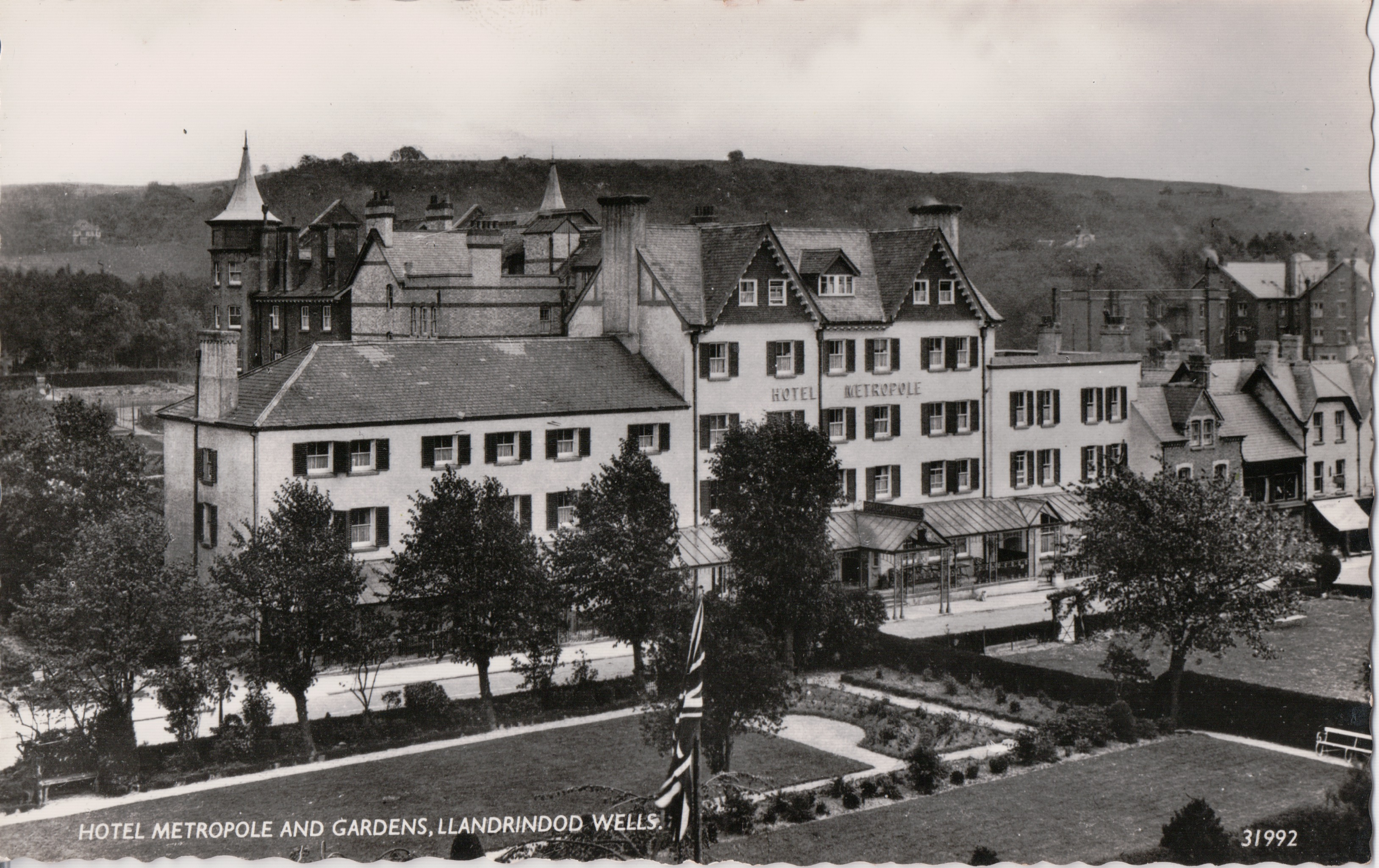
Few buildings tell the story of Llandrindod Wells as completely as the Hotel Metropole. Its history reaches back to the first great period of expansion which followed the coming of the railway, when a scattered collection of houses, mineral springs and lodging establishments began to take on the appearance of a purpose-built Victorian resort. During the century and a half which followed, the hotel changed its name, its owners, its appearance and, more importantly, the kind of visitor it sought to attract. It began as Coleman’s Hotel, became the Bridge Hotel under the Wilding family, expanded enormously under Elizabeth Miles and emerged as the Metropole shortly before the First World War. It survived requisition, the dispersal of its contents, the collapse of the old spa trade and the transformation of British holidays after 1945. In later years it reinvented itself through coach tourism, conferences, family holidays, weddings, leisure facilities and commercial events. Through all of those changes, the hotel remained one of the principal places in Llandrindod where visitors stayed and local people gathered.
The Beginnings of the Site
The story begins with the rapid development of Llandrindod during the later 1860s. Edward Middleton Evans, owner of the Pump House Estate, laid out land for development according to a plan prepared by T. Nicholson in 1868. Among the plots created was the site on the eastern side of the road running between Penybont and Builth, close to the railway station and within easy walking distance of the mineral springs. On 4 August 1870 Evans conveyed part of this land to Edwin Coleman of Howey, described as a shopkeeper. The deed reserved the minerals and mineral waters to Evans and his heirs, required the elevations of new buildings to receive approval, and prohibited uses such as an offensive trade or private lunatic asylum. It was an early example of the controlled development which accompanied the transformation of Llandrindod from rural spa into a planned resort.
Coleman was not a hotelier by background. Born at Leonard Stanley in Gloucestershire in 1824, the son of Jonathan Coleman, a yeoman, he married Emma Jane Dickerson in 1845. Their sons Jonathan and Edwin were born in Gloucestershire before the family moved to Erwbant in Llanwrthwl, where Coleman farmed about 119 acres at an elevation of roughly a thousand feet. By the mid-1850s the family had moved again, this time to Howey. Emma died from scarlet fever in 1859, and in 1861 Coleman married Eliza Meredith of Rhos-y-beddu, Llanwrthwl. At Howey he developed a business selling groceries and general goods and also served as postmaster. The 1871 census still places him there as a grocer and draper, with his son John Bennett Coleman working as a grocer’s assistant. It was from this relatively modest commercial base that the family entered the rapidly expanding Llandrindod hotel trade.
Coleman’s Hotel and Templefield
Coleman’s development was more ambitious than a single hotel. Two adjoining three-storey properties were built, the northern portion becoming Templefield House, named after the supposed Druid’s Temple or stone circle nearby, while the southern part became Coleman’s Hotel. Templefield appears to have been ready by 1871 and was let to a succession of tenants. The hotel followed soon afterwards. Although 1872 has traditionally been treated as the year in which Coleman’s Hotel opened, the earliest advertisement so far located dates from August 1873 and provides a particularly vivid description of the establishment. Coleman advertised his “Hotel and Commercial Boarding House” as ready for visitors, with moderate charges, private apartments, posting and saddle horses, and a position within three minutes’ walk of the railway station, mineral waters and new church. Edwin Coleman was named directly as proprietor.
The scale of both properties became much clearer when they were offered for auction in April 1877, only a few months after Coleman’s death. Templefield contained twenty-one bedrooms, six sitting rooms, a large dining room, an underground kitchen, larder, china closet, beer and coal cellars, stabling, a coach house with two bedrooms above it, a kitchen garden and croquet lawn. Coleman’s Hotel was itself described as a well-accustomed freehold hotel and boarding house carrying on a large and lucrative trade. It too had twenty-one bedrooms, together with private and public sitting rooms, dining room, bar parlour, taproom, kitchens, pantries, cellars and substantial land to the rear. These were not small lodging houses. By the middle of the 1870s Coleman had created a sizeable hospitality complex at what advertisements already called an increasing and rising watering place.
The auction took place on 13 April 1877, the same date on which Elizabeth Wilding later recorded in her diary that Coleman’s Hotel had been sold for £2,500. The identity of that purchaser is not yet entirely clear. John Bennett Coleman nevertheless remained closely connected with the establishment and appears as hotel keeper in the 1881 census. The Coleman period was not financially secure. In February 1883 John Bennett Coleman, described as hotel keeper and butcher of Coleman’s Hotel, entered liquidation by arrangement, and subsequent notices show creditors being asked to submit claims to an accountant in Bristol. Later that year the hotel was again offered for sale and was reportedly withdrawn when bidding reached about £2,200. The instability of these years helps explain the change which followed.
From Coleman’s Hotel to the Bridge
In March 1885 the Wilding family entered the story. John Wilding recorded that Mr Vaughan Thomas had agreed to sell Coleman’s Hotel to the family for £2,200. A deposit was paid and furniture separately acquired. The Wildings were already well established in the local hotel and coaching trade. John Wilding had been born in 1818 and had interests in building, timber and bark. In 1847 he built the Builders Arms at Cross Gates, and the family later became associated with the Severn Arms at Penybont, an important coaching inn which benefited greatly from railway construction and the growing traffic through the district.
The newly acquired Coleman’s Hotel was renamed the Bridge Hotel, a reference to the nearby crossing of the Arlais brook. A newspaper advertisement of July 1885 leaves no doubt that the change had been completed. The “Bridge Hotel, late Coleman’s” was advertised as under new management and entirely refurnished throughout, with families and tourists promised careful attention. Boarding cost 7s 6d a day or £2 10s 6d a week, while Allsopp’s ale and Guinness stout were among the drinks promoted. The advertisement was more than a change of name. It marked a deliberate relaunch of the hotel for the expanding Victorian tourist market.

The Wildings operated the Bridge as a family concern. The 1891 census shows John Wilding as hotel proprietor, living there with James Lewis Wilding and sisters Elizabeth, Annie, Margaret and Catherine. Elizabeth was concerned with housekeeping and Annie worked as bookkeeper, while the resident staff included a waitress and a “boots”. The family maintained links with the Severn Arms and their farm at Cwmtrallwm, from which food could be supplied. William Wilding was also well known locally as a fisherman. The arrangement belonged to an older tradition of hotelkeeping in which owners, relatives and servants lived and worked together beneath the same roof.
A Lion at the Bridge Hotel
One of the most memorable incidents in the history of the hotel occurred on 28 June 1889. Later accounts, including the 1972 centenary history, placed the event in 1890 and associated it with Bostock and Bailey, but contemporary newspaper reports show that the animal had escaped from Wombwell’s Menagerie while it was exhibiting in Llandrindod.
The reports differ in some of their details. One describes a young lioness which made directly for the Bridge Hotel, was prevented from entering the bar and eventually entered a drawing room through a private doorway, where a visitor escaped through a window. Another report described a full-grown African lion which entered through an open window and confronted T. J. Osborne of Old Market Street, Neath, who seized a chair while keepers moved in to secure the animal. What is certain is that a lion from Wombwell’s entered the Bridge Hotel, caused considerable excitement and was eventually recaptured without serious injury. The discrepancies are themselves a useful reminder of how quickly dramatic local incidents acquired embellishments when retold.
The Wildings Expand the Hotel
The Wildings did not merely inherit Coleman’s building. They improved it. A new stable was added in 1887. In May 1890 William Wilding recorded that Deakin, an architect from Shrewsbury, had been taking plans for enlargement. Tenders were received later that year, although a proposed major scheme costing £2,275 appears to have been postponed. Other improvements followed, including a substantial porch and verandah, a coach house in 1892, and a billiard room and laundry in 1894. Through these changes the Bridge established a reputation for comfort and good food.

By the middle of the 1890s, however, the family was considering retirement. In March 1897 the Bridge Hotel, described in the report as the Bridge House Hotel, was offered at public auction. Bidding rose slowly to £7,000, but the reserve was not reached and the property was withdrawn. The episode is significant because it shows that the Wildings did not dispose of the hotel hurriedly or cheaply. They waited, and on 1 December 1897 James Lewis Wilding, Elizabeth and Annie Wilding sold the Bridge Hotel to Elizabeth Miles of the New Inn Hotel, Pontypridd, for £7,850. Of this, £2,350 was paid immediately and the remaining £5,500 secured by mortgage at four per cent.
Elizabeth Miles
Elizabeth Miles was one of the most important figures in the history of Llandrindod’s hotel trade. Born Elizabeth Spencer at Treforest on 18 September 1847, she was the daughter of an innkeeper and married William Miles while still young. Their sons Francis and William were born in 1868 and 1869, but William Miles died in 1870. Elizabeth subsequently built a substantial business career of her own. She held licences or interests in a number of inns and hotels, including the New Inn at Pontypridd, and became involved in property and quarrying. She also leased the Angel Hotel in Cardiff for many years.

When she acquired the Bridge Hotel in 1897 it could accommodate perhaps forty guests. Over the following quarter of a century she transformed it into an establishment capable of accommodating around 200. The first phase of this expansion came quickly. By December 1899 the Bridge was advertising extensive alterations as completed, with electric lighting throughout, a billiard room, recreation facilities and first-class cuisine. It was already beginning to look less like the family-run Bridge of the Wilding period and more like the large resort hotel which would later dominate Temple Street.
The 1901 census gives some indication of the scale of change. Elizabeth Miles herself was present and described as hotel proprietor, while Lydia J. Watton appears as hotel manageress and a sizeable resident staff included chambermaids, waitresses, a barmaid, cook, page boy, hall maid and bookkeeper. Contemporary advertising also identifies Gomer Treharne as “proprietor” of the Bridge Hotel in 1900, suggesting that the hotel could have several layers of practical management beneath Miles’s ownership. By 1908 Albert Edward Sims and his wife Kate were acting publicly as host and hostess, and the 1911 census records Sims as hotel manager within an establishment containing dozens of employees, including cooks, housemaids, waitresses, a cellarman, chauffeur, billiard marker and other specialist staff.
The physical enlargement of the hotel can be followed through the Llandrindod Wells Urban District Council plan register, which records major alterations and additions in 1898, 1908, 1910 and 1911, with the earlier schemes associated with Thomas & Morgan of Pontypridd. Miles also enlarged the site itself. In April 1908 she bought more than an acre from the ninth Duke of Beaufort for £1,350 on the eastern side of the hotel, connected with the proposed Beaufort Road. An elaborate eastern frontage was developed with the expectation that this would become a principal approach, but the road scheme was never realised as intended and the older Temple Gardens side remained the familiar public face of the hotel. In 1909 a narrow strip of land to the south, together with the right to build towards Worcester House, was acquired from the Edwards family, allowing further bedrooms and an extension of the frontage. These successive purchases and building campaigns explain how the comparatively modest Bridge Hotel of 1897 was physically absorbed into the much larger Metropole which could accommodate around 200 guests.
From Horses to Motor Cars
The changing nature of transport can be traced particularly clearly through the Metropole’s history. Edwin Coleman had advertised posting and saddle horses in 1873. Under Elizabeth Miles the Bridge still maintained a substantial livery operation. In 1902 its stables advertised landaus, wagonettes, brakes and dog carts for excursions throughout the district, with destinations including Rhayader, Builth, Abbeycwmhir, Doldowlod, Llandegley and Alpine Bridge. The advertisement boasted of the best selection of carriages in Llandrindod Wells and assured visitors that only competent drivers were employed.
Yet within a few years the motor car was taking its place alongside the horse. Plans for a motor garage were being considered by 1910. By 1912 the hotel advertised a garage officially appointed by the Royal Automobile Club, while a porter continued to meet all trains. That combination is telling. The hotel was serving both generations of visitor at once, those arriving by railway and those travelling under their own power.
The motor business continued to grow. A 1928 court case concerning a car which caught fire while being handled in the Metropole garage confirms that the garage was staffed and equipped with fire extinguishers. In the same year the hotel advertised garaging for thirty cars. By 1936 the advertised capacity had risen to fifty. An underground Shell petrol installation was added in 1929. Long before mass car ownership transformed British holidays after the Second World War, the Metropole had already recognised that its future depended partly upon motorists.
The Hotel as a Public Meeting Place
The growth of the hotel also made it one of Llandrindod’s principal public rooms. This role appeared early. Auctions and property sales were frequently conducted at the Bridge, and this became a recurring feature of the hotel’s history. Property, land, household contents and other goods were offered there because the hotel provided a central, well-known venue where sellers, buyers, agents and interested members of the public could assemble. In 1897, even while the Wildings were trying to sell the hotel itself, an auction concerning the Rembrandt Studio was held there. Similar sales and valuations continued in different forms through the twentieth century.
The auction tradition is worth emphasising because it is easily overlooked when concentrating on tourists. The Metropole was not simply somewhere visitors slept. For generations it served as part of the commercial infrastructure of the town. Property auctions and contents sales brought together farmers, householders, businessmen, solicitors and auctioneers from across the district. Much later, specialist valuation events performed a similar role. In 1986 the Llandrindod Wells Cancer Research Committee held an antique valuation evening at the hotel with experts from Christie’s of London, while in 2000 Phillips Auctioneers held a valuation day there covering paintings, silver, jewellery, books, furniture, porcelain and other objects. The form of the event changed, but the Metropole’s usefulness as a central place for buying, selling and valuing property endured.
Its role as a meeting place extended far beyond auctions. In 1907 the Bridge hosted the inaugural meeting of the Women’s Unionist Association for Radnorshire, attended by members of prominent county families. In 1908 a billiards match against Ridgebourne was followed by dinner, speeches and entertainment. These were early examples of a function which would become increasingly important: the hotel as one of the principal places where Llandrindod’s civic, political, professional and social life took place.
The Metropole Name
The hotel was still being advertised as the Bridge in June 1911, but by 1 August that year it appeared in the Radnorshire Standard as the “Hotel Metropole, late Bridge Hotel”. A family tradition preserved in R. C. B. Oliver’s centenary history maintained that Elizabeth Miles acquired furnishings from a Hotel Metropole at Cromer and, faced with crockery, linen and other articles bearing the letter M, decided to rename her own hotel.
Contemporary evidence makes the story more plausible than it once appeared. The Hotel Metropole at Cromer was in financial difficulty during 1911. Its company was wound up, furnishings were sold by a bank to a broker and the hotel building itself was subsequently offered by mortgagees. Within months the Bridge Hotel in Llandrindod had become the Metropole. There is still no direct documentary proof that Elizabeth Miles personally attended the Cromer sale or purchased the particular monogrammed contents described in family tradition, so the story should remain just that, a family tradition. What can now be said is that its chronology fits remarkably well with contemporary events.
The Metropole as a Modern Resort Hotel
By 1912 the new Metropole was advertising itself confidently as “The Leading Hotel”. It had 150 bedrooms, suites of rooms, electric lifts, tennis and croquet lawns, bowls and fishing. The garage was officially appointed by the Royal Automobile Club, while a porter met arriving trains. An advertisement in May that year also announced that an elaborate new system of baths would open on 1 July, offering Vichy and Aix treatments, Scotch douches, needle, spray and shower baths.

This was not simply the survival of traditional mineral-water treatment. The Metropole was participating in a wider Edwardian enthusiasm for hydropathy, electrical therapy and scientifically presented health treatments. The eastern portion of the hotel became associated with a Hydro, and later advertisements promoted electrical equipment including Bergonié apparatus. The treatment facilities remained part of the hotel’s identity considerably longer than might be expected. In 1928 the Metropole was still advertising a complete electrical and hydropathic installation, and as late as 1936 it formally styled itself the “Hotel Metropole and Hydro”.
The First World War and the Metropole in 1921
The First World War interrupted the confident pre-war expansion of Llandrindod’s visitor economy, but the Metropole remained part of the town’s wartime life. Contemporary references from 1915 place military personnel in and around the hotel and record a concert during David Lloyd George’s visit to Llandrindod, while Templefield, still a separate property at that date, was used in connection with Belgian refugees. The surviving evidence is too fragmentary to reconstruct every wartime use of the Metropole with certainty, but it shows that the great hotels of the town were drawn into military, social and relief activity as well as ordinary hospitality. The war therefore forms an important break between the Edwardian spa at its height and the more varied interwar hotel which emerged afterwards.
The 1921 census gives a particularly valuable picture of the Metropole after the war. Elizabeth Miles, then aged seventy-three, was still present and described as hotel proprietress. The guests represented the prosperous professional and commercial clientele on which the hotel increasingly depended, including a chartered accountant, medical practitioner, bank inspector, architect and surveyor, solicitor, contractor and commercial traveller, alongside people living on private means. The return shows that, despite the disruption of the war years, the Metropole had resumed its place as a substantial hotel for professional, business and leisure visitors and was well positioned for the next phase of expansion.
Templefield Returns to the Hotel
One of Elizabeth Miles’s most satisfying acquisitions came in 1923. Templefield House, the other half of Edwin Coleman’s original development of the early 1870s, had remained separate from the hotel for more than half a century. In April 1923 Miles acquired it from the representatives of the late Mrs E. Pryce, formerly Mrs E. Coleman. Coleman’s two original buildings were therefore brought back into common ownership.
The ground floor was converted into a recreation room and rapidly became associated with the new ballroom. R. C. B. Oliver records that the ballroom was formally opened by Lord Glanely after a staff ball. By December 1923 the Western Mail was inviting visitors to spend Christmas at the Metropole and prominently advertising its “New Ball Room” and orchestra, providing firm contemporary evidence that the new facility was operating within months of the acquisition. It also shows that the hotel was already attempting to attract winter holiday trade rather than relying solely upon the traditional summer spa season.
The Family Company
By the 1920s the business had become too large to remain simply an hotel in Elizabeth Miles’s personal ownership. Hotel Metropole (Llandrindod), Ltd., company number 202935, was registered on 7 January 1925. Its stated purpose was to carry on the hotel business already being conducted by Elizabeth Miles, Gwendoline A. Miles and Francis Miles. The nominal capital was £40,000 in £1 shares, and the permanent directors were Elizabeth, her daughter-in-law Gwendoline Ann Miles and her son Francis.
On 18 March 1925 the property itself was conveyed to the new company for £32,000. The sequence is worth noting. The company was created first and the hotel formally transferred into it a little over two months later. This was not a break with family control, but a formalisation of it. Elizabeth had bought the Bridge for £7,850 in 1897. Less than thirty years later the greatly enlarged Metropole was transferred to the family company at a value of £32,000.
The Metropole and the Promotion of Llandrindod
By the later 1920s the hotel had become closely connected with the wider promotion of Llandrindod itself. In May 1928 a formal reception was held there at which visitors were welcomed to what the Western Mail called the “premier Welsh spa”. Representatives of the Urban District Council, Baths and Springs Committee and Llandrindod Wells Development Committee were present, including Tom Norton, together with representatives of both the Great Western and London, Midland and Scottish railway companies.

The event illustrates how closely the Metropole had become linked to the town’s organised visitor economy. A few weeks later it was advertised as part of Llandrindod’s claim to be an “Ideal Modern Spa Health and Holiday Resort”, offering electric lifts, complete electrical and hydropathic treatment, the ballroom and garage space for thirty cars. Hotel, spa authorities, local council, railway companies and development promoters were all working within the same economy.
The Metropole was also developing into a substantial conference venue. In February 1929 the Wales Area conference of the men’s and women’s sections of the British Legion was held in Llandrindod, with the conference dinner at the hotel. This function was not invented after the Second World War. Long before conference tourism became one of the mainstays of the modern Metropole, the building was already being used for Welsh and inter-county gatherings.
A Year-Round Hotel
Llandrindod’s traditional visitor trade had always been strongly seasonal. One of the most interesting discoveries in the Metropole’s advertising is how early its owners tried to overcome this limitation. Christmas holidays were being promoted by 1923. By November 1932 the Western Mail explicitly described the Metropole as “Open All the Year”, with special attractions and terms for Christmas. Similar advertising appeared repeatedly throughout the decade.
The significance of that policy should not be underestimated. The Metropole was consciously trying to turn Llandrindod from a place which visitors came to for a short summer spa season into a year-round resort. By the end of the decade it was offering different attractions according to the season. Swimming and diving entertained summer visitors. Golf was promoted at Christmas, and in 1938 the hotel even advertised skating on the swimming pool when the weather permitted. The same open-air pool which hosted American diving exhibitions in July could become an ice rink in winter.
The Swimming Pool
The swimming pool was one of the most ambitious interwar developments. Built under Francis Miles, it opened in August 1935 and measured approximately 120 feet by 35 feet, with depths ranging from three feet to seven feet six inches. It had modern Pulsometer filtration, was heated by steam to maintain a temperature of roughly 60 to 70 degrees Fahrenheit, and was equipped with diving facilities and a chute. Dressing rooms were provided beneath the adjoining hotel.
Contemporary newspapers described it as an important new asset for the spa. Its value was both public and private. Hotel residents could use the pool without additional charge, but it also became an attraction in its own right. In July 1938 the Metropole advertised American divers Tony Zukas and Frank Foster performing comedy, thrilling and serious dives as a Bank Holiday attraction.

The pool also represented a subtle change in ideas about health. The Metropole had spent decades selling baths, hydrotherapy and electrical treatment. It now added swimming, exercise and recreation. The old health resort was beginning to give way to the modern leisure hotel, although the two existed side by side for some years.
The Metropole in the 1930s
A 1936 advertisement brings these different strands together. The establishment was still styled the “Hotel Metropole and Hydro” and offered a complete electrical and hydropathic installation. Accommodation was advertised for 200 guests, bedrooms had hot and cold running water, use of the swimming pool was free to residents and the garage could hold fifty cars. The comparison with the thirty-car garage advertised eight years earlier shows how rapidly motor tourism was growing.
The hotel’s conference role was expanding at the same time. In April 1936 the first drama conference for Women’s Institutes in Wales was held at the Metropole, drawing delegates from throughout Wales and from Shropshire and Herefordshire. Lady Listowel presided and senior figures in the Women’s Institute movement took part. This was not a small local gathering. It demonstrates that by the mid-1930s the Metropole had the accommodation, catering and public rooms required for substantial inter-county and national events.
The 1939 Register provides one final detailed glimpse of the hotel before war disrupted everything. Kate Sims, by then widowed, remained hotel manageress. The resident workforce included housekeepers, bookkeepers, porters, waitresses, chambermaids, a barmaid, still-room and pantry staff, wine steward, cooks, kitchen porters, garage attendant and billiardman. Military officers were already among those present by September 1939, including Royal Artillery personnel, although their presence should not be confused with proof that the hotel had already been formally requisitioned.
War and Requisition
The Second World War brought the greatest interruption in the hotel’s history. Later accounts describe Llandrindod’s largest hotels being taken over for military purposes, including officer cadet training. The Metropole was certainly requisitioned by 1941. The clearest evidence is the extraordinary auction announced that October.
J. O. Bufton & Co. were instructed to conduct a five-day unreserved sale of the hotel’s “superior appointments” from 20 to 24 October. One advertisement described the contents as embracing 180 fully equipped rooms. A more detailed notice itemised 135 bedrooms, fourteen bathrooms, six sitting rooms, three lounges, two dining rooms, four drawing rooms, commercial rooms, smoking rooms, a billiard room, entrance halls, servants’ hall, kitchens, laundry, stores, staff rooms, offices and outbuildings. The 180-room figure therefore referred to the furnished establishment as a whole rather than 180 guest bedrooms.
The importance of this sale is difficult to overstate. The contents of a hotel which had taken decades to build up were dispersed because of requisition. It explains why the post-war recovery was so difficult. The Metropole did not simply need decorating after military use; much of the establishment had to be furnished again almost from the beginning.
Open Again After Eight Years
The hotel eventually returned to the family, but reopening was not immediate. Dry rot alone was later said to have cost around £8,000 to address, and compensation for wartime damage proved inadequate. The clearest public marker of recovery came in the Western Mail on 8 May 1948. The advertisement announced that the Metropole was “Open again after 8 years!” and described it as completely refurnished and redecorated. The ballroom, swimming pool and a fully licensed cocktail bar were among the attractions.
The wording suggests that normal hotel trading had effectively ceased around 1940, even though formal requisition is securely documented by 1941. The hotel may have been returned earlier, but the 1948 advertisement marks the real resumption of public business. By Easter 1949 accommodation was again being actively promoted, and in 1950 the Metropole was offering fishing on its own stretch of water, a golf competition for the Metropole Silver Cup, a resident orchestra and the Lantern Bar. The hotel was rebuilding not only its bedrooms but its social life.
There were smaller signs of revival too. In 1953 the Metropole hosted an area final of the News of the World darts competition, bringing competitors from across Mid Wales. Such events may appear modest beside the grand conferences of later years, but they show the hotel once again becoming part of the everyday recreational life of the district.
David Baird Murray and the Post-War Rescue
The decisive figure in the modern history of the Metropole was David Baird Murray, a great-grandson of Elizabeth Miles. Kate Sims, who had managed the hotel through the interwar years, remained manageress until 1947; she was followed by Prothero Beynon and then by Mr and Mrs F. McEwen. Baird Murray, educated at Harrow and commissioned into the Royal Marine Commandos, also gained hotel experience in France before taking charge of the Metropole in 1954 at only twenty-three years of age.
The position he inherited was daunting. Of roughly 150 bedrooms, only around fifty-five were usable. Turnover was just over £30,000. Baird Murray took no salary for his first two years and was paid only £250 a year from 1956. The family had attempted to sell the hotel after the war for around £20,000 but found no buyer. Property belonging to the family in Pontypridd was sold and proceeds lent back into the hotel. The survival of the Metropole was therefore not inevitable. It depended upon a willingness to reinvest in a building which many might reasonably have regarded as obsolete.
By 1956 the hotel was again trading throughout the year. A £30,000 mortgage obtained in 1959 helped finance further improvements, including central heating. Baird Murray became increasingly active in the wider tourism industry, serving as chairman of the Mid Wales Tourism Council from 1964 and becoming involved in the development of the Wales Tourist Board. He also took part in campaigns over Sunday opening and licensing, issues which directly affected the hotel and resort trade in Wales. The Metropole later joined hotel marketing organisations including Interchange and Best Western, and Baird Murray became chairman of Best Western UK in 1976.
From Spa to Touring Hotel
The post-war Metropole survived because it did not try to recreate the Victorian spa exactly as it had been. The National Health Service, private motoring, caravan holidays, overseas travel and changing medical attitudes all weakened the old spa economy. Llandrindod’s Spa Treatment Centre finally closed in January 1972. By then the Metropole had already been changing direction for years.
Advertisements from 1968 promoted the hotel in the Midlands as an AA and RAC three-star establishment in a “touring paradise”, with special terms for golfers and fishermen, swimming facilities and a welcome for children. This was a very different appeal from the hydropathic advertisements of the 1910s and 1920s. The countryside, roads, recreation and family holiday had replaced the mineral waters at the centre of the sales pitch.
The transformation is even clearer in a 1973 advertisement which described Llandrindod as an “inland resort” and promoted the Metropole as a base for touring the Wye Valley and the lake country of Wales. Swimming, golf, fishing and pony trekking were offered, while children could stay at reduced rates or free. By then the hotel was no longer selling a cure. It was selling Mid Wales.
The weakness of relying heavily upon organised touring became clear in 1974, when recession and cancellations by coach operators cost the Metropole about 10,000 bed-nights. For a large hotel in a small inland resort, the loss was serious. Baird Murray responded by widening the market again, including business with SAGA, rather than retreating to a single type of visitor. The episode is one of the clearest examples of the pattern which runs through the Metropole’s history: when an established source of trade weakened, the business survived by finding another.
Conferences Become Central
Another increasingly important market was conferences. In June 1972, the Metropole’s centenary year, the Liverpool Daily Post referred to it simply as the “conference hotel” during the Welsh Conservative Conference at Llandrindod. Senior government figures were present in the town, including Welsh Secretary Peter Thomas, Trade and Industry Secretary John Davies, Home Office minister Mark Carlisle and Welsh Office minister David Gibson-Watt. The importance here is not the politics of the gathering but the status of the venue. By its centenary the Metropole had become capable of serving as headquarters and hospitality centre for a major Welsh political conference.
The conference trade helped carry the hotel into a very different tourism economy. A weekend housing training course for councillors was being held there in 1980. In March 1983 the hotel hosted a two-day trade exhibition of equipment, services, food and beverages for the tourist industry of Mid Wales and the Border Counties. The choice of the Metropole as the venue for the tourism trade itself was fitting, and suggests why the family was prepared to invest so heavily in the building during the following years.
Reinvestment in the 1980s
The early 1980s were not easy years for large provincial hotels, and the family considered acquiring the nearby Commodore. Instead they chose to concentrate resources on the Metropole. Between 1983 and 1985 around £500,000 was spent on improvements including kitchens, food and beverage areas, furniture and the upgrading of bedrooms. The gradual provision of private bathrooms was especially important. In 1941 the hotel had contained 135 bedrooms but only fourteen bathrooms. By the later twentieth century an en-suite bathroom was no longer a luxury but an expectation.
Investment continued with a new health and leisure complex, costing roughly £420,000, which opened in March 1988. There is an elegant historical continuity here. The Metropole had opened elaborate hydrotherapy baths in 1912, retained electrical and hydropathic treatment into the 1930s, developed a heated swimming pool in 1935 and then, more than half a century later, created a modern leisure complex. The language had changed from cure to leisure, but the association between the hotel and health remained.
The new facilities helped strengthen the winter trade. The hotel was simultaneously developing as a venue for training, exhibitions and professional events. In 1987 sheep farmers were invited there to learn about Welsh lamb production, animal health and feeding regimes. In 1988 the four-day Mid Wales Gift Fair transferred to the Metropole as its new venue, while the hotel was advertising itself specifically for training and incentive courses.
The Metropole and Local Life
The later history of the hotel demonstrates just how deeply it had become embedded in the public life of Mid Wales. British Red Cross Christmas fairs were held there repeatedly, including events in 1988, 1994 and 1995. In 1998 a function at the hotel raised £400 for St John, while political, social and charitable organisations continued to use its rooms.
The range of events became extraordinary. In 2000 the first Brecon and Radnor NSPCC Ball held at the Metropole attracted support from across the old counties and from places as distant as Sheffield, Bristol, Cardiff and Swansea, raising more than £6,500. That same year Phillips Auctioneers held a valuation day at the hotel in aid of the Bracken Trust, while an eating-out review found the Metropole simultaneously accommodating a large wedding reception and a regional Kennel Club dinner without apparently disrupting ordinary restaurant service.
Wedding business became another important part of the modern hotel. By 2002 an annual bridal fayre brought together wedding specialists from across Mid Wales and promoted the Metropole itself for ceremonies and receptions. The conference business remained equally broad. In 2003 it hosted a two-day Welsh homeopathy conference incorporating lectures, exhibition stands, accommodation and a dinner and dance. The subject of individual gatherings mattered less than the pattern. The hotel had become a place where Mid Wales assembled.
The End of the Family Era
The longest chapter in the Metropole’s ownership came to an end in November 2022. The Miles and Baird-Murray family had been associated with the hotel continuously since Elizabeth Miles bought the Bridge Hotel in 1897, and by the twenty-first century the business had passed to the fifth generation, represented by Justin Baird-Murray and Sarah Hill. During their stewardship the hotel continued to be upgraded, its facilities expanded and its customer base broadened, maintaining the pattern of adaptation which had characterised the business for more than a century.
On 14 November 2022 the family sold the hotel to Crest Hotels. Rather than simply purchasing the building, Crest acquired 100 per cent of the share capital of Hotel Metropole (Llandrindod) Ltd, the company which had itself been created in January 1925. The transaction therefore brought the family ownership to an end while preserving the corporate identity established by Elizabeth Miles and her family almost a century earlier. At the time of the sale the Metropole was a 109-bedroom hotel and spa, and the outgoing family described the decision as the right moment to step back and allow new owners to take the business forward.
The new owners, Gurjinder and Parminder Singh, placed the Metropole within the Crest Hotels Group while retaining the existing operation and staff. The hotel continues to trade as the Metropole Hotel and Spa and remains part of the Crest portfolio. Hotel Metropole (Llandrindod) Ltd itself also remains an active company, meaning that the company founded in 1925 has survived the change of ownership as well as the hotel whose name it carries.
A Hotel That Survived by Changing
The Metropole’s history is not one of uninterrupted prosperity. There were repeated moments when its future could have been very different. Coleman’s business ran into financial difficulty. The Wildings tried unsuccessfully to sell at auction before finding Elizabeth Miles. The hotel was requisitioned and stripped of its contents during the Second World War. The family could not initially find a purchaser afterwards. The decline of the spa removed the market around which the great Victorian hotels of Llandrindod had originally been built. The 1974 recession brought the cancellation of thousands of coach bed-nights, while fire regulations and changing customer expectations required enormous expenditure.
What distinguishes the Metropole is its ability to change. Edwin Coleman sold accommodation, posting horses and proximity to the mineral waters. The Wildings sold family hospitality and Victorian tourism. Elizabeth Miles created a great resort hotel with electric lighting, lifts, baths, hydrotherapy, ballrooms, gardens and motor garaging. Francis Miles added the swimming pool. David Baird Murray rebuilt the business around coaches, touring motorists, conferences and year-round trade. Later generations developed leisure, weddings, training, exhibitions and specialist events.
Even the building’s public role adapted. Victorian property auctions, political meetings and society dinners were followed by Welsh conferences, agricultural gatherings, charity fairs, antique valuations, trade exhibitions and wedding fayres. For more than a century the Metropole was not simply one of Llandrindod’s largest buildings. It was one of the places where the town conducted its business.
Its survival is therefore more significant than the survival of a single Victorian hotel. The Metropole contains within its history much of the history of Llandrindod Wells itself: the railway and the mineral waters, horses and motor cars, hydrotherapy and swimming pools, Victorian family enterprise and twentieth-century company ownership, wartime requisition, post-war tourism, conferences, auctions, weddings and civic life. It began with Edwin Coleman building beside a road and railway in a rapidly expanding watering place. More than 150 years later, the hotel remains one of the clearest surviving links between the Llandrindod of the Victorian spa and the modern town.
Related Llandrindod Wells essays
- Llandrindod Wells History, the main guide to the wider series.
- Llandrindod Lake and the Lakeside Boathouse, the boating, promenade and recreational landscape that formed part of the same visitor economy as the town’s great hotels.
- The Pump House Hotel, the older spa institution whose springs helped create the town.
- The Gwalia Hotel, another of Llandrindod’s major Victorian hotels and later civic buildings.
- The Rock Park Hotel, a contrasting story of adaptation, decline and eventual demolition.
- Bryn Awel and the Glen Usk Hotel, tracing another hotel through the changing spa, motor and coach-tourism eras.
Related Essays
- Llandrindod Wells Hospital: From Cottage Hospital to County War Memorial
- Board and Lodging: The Boarding Houses of Llandrindod Wells
- Bowling in Llandrindod Wells: From the Spa Greens to Rock Park and the Indoor Game
- From the Pump House Links to Death or Glory: A History of Golf in Llandrindod Wells
- Plas Winton and the Hotel Commodore, Llandrindod Wells
Explore more Llandrindod Wells history
Continue with the Llandrindod Wells History guide, or follow the related essays above to explore the people, buildings and institutions that shaped the town.
Sources and Further Reading
The principal published source for the early history remains R. C. B. Oliver, Bridging a Century: The Hotel Metropole, Llandrindod Wells, 1872–1972 (1972), which drew upon Wilding family diaries, memories, deeds and local records. The post-war business history is greatly strengthened by Donald A. Stewart, Hoteliers and Hotels: Case Studies, The Growth and Development of U.K. Hotel Companies 1945–1989, University of Glasgow PhD thesis (1994). Census returns for 1871, 1881, 1891, 1901, 1911 and 1921, together with the 1939 Register, provide important evidence for the hotel’s owners, managers, staff and guests. Llandrindod Wells Urban District Council plans and related records held by Powys Archives provide further evidence for the successive phases of enlargement. Company registration and property records have also been used for the incorporation of Hotel Metropole (Llandrindod) Ltd in 1925 and the transfer of the hotel to the company, while later corporate and hotel records provide evidence for the 2022 acquisition by Crest Hotels and the end of 125 years of Miles and Baird-Murray family ownership.
Contemporary newspaper material used in reconstructing the hotel’s history includes the South Wales Daily News, Shrewsbury Chronicle, Bristol Mercury, Commercial Gazette, Brecon and Radnor Express, Welsh Gazette, Radnorshire Standard, Radnor Express, Western Mail, Wellington Journal, Liverpool Daily Post, Reading Evening Post, Shropshire Star, South Shropshire Journal and Caerphilly Journal. Particularly important notices include Edwin Coleman’s 1873 advertisement, the detailed 1877 sale particulars for Coleman’s Hotel and Templefield, the 1883 liquidation notices, the 1885 reopening of the Bridge Hotel, contemporary reports of the 1889 escaped lion, the unsuccessful 1897 auction and subsequent sale to Elizabeth Miles, the 1899 and 1912 advertisements detailing major improvements, the 1923 ballroom advertisement, the 1930s Hydro and swimming-pool advertisements, the October 1941 requisition sale and the May 1948 announcement that the Metropole was open again after eight years. Historic imagery used in the essay also includes material made available through People’s Collection Wales and The National Library of Wales, reproduced where applicable under the stated Creative Archive Licence and accompanying permissions.