
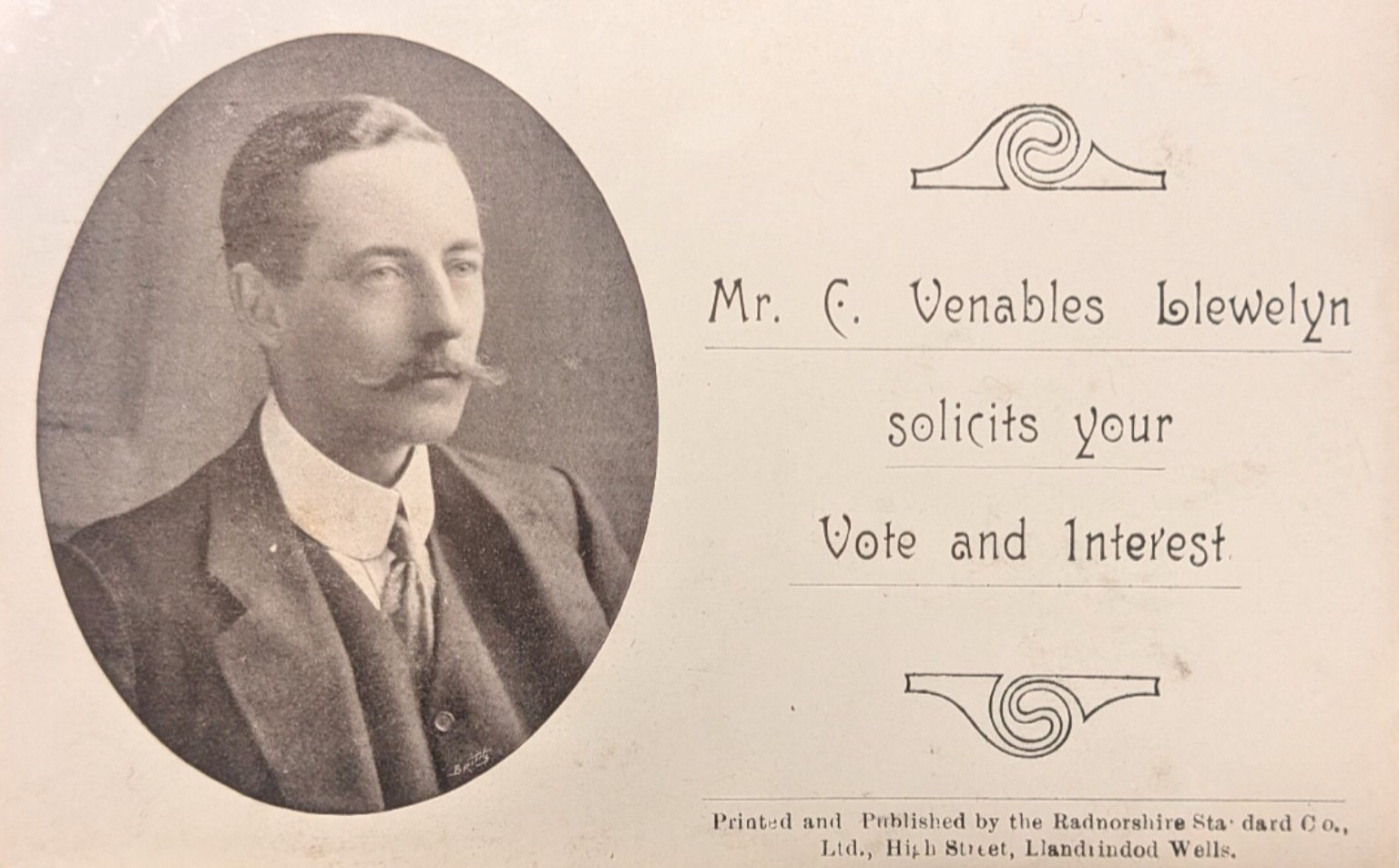
Among the surviving pieces of Radnorshire political history is a small election card which, at first glance, seems to say very little. On the left is the formal portrait of an Edwardian gentleman, neatly dressed and carefully posed. On the right appear the words, “Mr. C. Venables Llewelyn solicits your Vote and Interest.” There is no manifesto, no list of promises and not even the name of a political party. At the bottom is the imprint of the Radnorshire Standard Co. Ltd., High Street, Llandrindod Wells. The card was produced for Charles Dillwyn-Venables-Llewelyn during the remarkable political year of 1910, when he finally won the parliamentary seat of Radnorshire after two previous defeats, only to lose it again before the year was over.
The simplicity of the card is part of its interest. It belongs to a political culture in which the personal standing of a candidate still mattered enormously, particularly in a small rural constituency. Venables-Llewelyn was asking not simply for an elector’s vote, but for his “interest”, a word which carried a broader meaning. It suggested influence, recommendation and the ability to persuade others. In a county where elections could turn upon a few dozen votes, such personal networks mattered. Behind this rather restrained piece of election printing lies a much larger story of landed society, rural politics, county government and one family’s long association with Newbridge-on-Wye and the upper Wye valley.
From Penlle’rgaer to Llysdinam
Charles Leyshon Dillwyn-Llewelyn was born in 1870, the son of Sir John Talbot Dillwyn-Llewelyn and Caroline Julia Hicks-Beach. He was educated at Eton and New College, Oxford, and came from a family whose interests extended well beyond the conventional life of a landed household. Earlier generations of the Dillwyn and Llewelyn families had been involved in industry, natural science and some of the pioneering work in early photography in Wales. His father also entered politics and sat in Parliament. Charles therefore grew up in a world where public service, landownership and intellectual curiosity overlapped.
His connection with Radnorshire came principally through marriage. In 1893 he married Katharine Minna Venables, daughter and heiress of the Reverend Richard Lister Venables of Llysdinam, near Newbridge-on-Wye, and in the same year added the Venables name to his own. Through that marriage Llysdinam became linked with the wider Dillwyn-Llewelyn estates. The Venables family itself had long been established in the district, and its members had occupied clerical, judicial and county positions over several generations. Charles did not therefore arrive in Radnorshire as an outsider seeking a convenient constituency. Llysdinam became his home, and the county would remain the principal setting of his public life for the next half-century.
That background gave him advantages when he entered politics, but it did not make Radnorshire an easy seat to win. The county had strong Liberal traditions, and his principal opponent, Francis, commonly known as Frank, Edwards, was already a well-established political figure. Edwards had represented Radnorshire before, was closely associated with Welsh Liberalism and supported causes such as the disestablishment of the Church of England in Wales. Venables-Llewelyn, standing as a Conservative, was trying to break an established hold upon a constituency in which political loyalties were deeply rooted in the social and religious life of the county.
Three Attempts to Win Radnorshire
Venables-Llewelyn first contested Radnorshire at the general election of 1900. Edwards received 2,082 votes and Venables-Llewelyn 1,916, leaving a Liberal majority of 166. The two men fought the constituency again in 1906, when Edwards polled 2,187 votes against 2,013 for his Conservative challenger. The majority had risen only slightly, to 174, and the proportions were almost unchanged. Venables-Llewelyn had twice come reasonably close, but after six years of campaigning there was no obvious sign that Radnorshire was about to change hands.
The political circumstances of 1910 were very different. National politics had been thrown into crisis by the House of Lords’ rejection of David Lloyd George’s 1909 budget, a dispute which rapidly became a much wider argument about the powers of the Lords and the authority of the elected House of Commons. A general election was held in January 1910, and in Radnorshire the contest between Edwards and Venables-Llewelyn was again extremely close. This time the balance tipped. Venables-Llewelyn received 2,222 votes and Edwards 2,208. After ten years and two previous defeats, he had won the county by only fourteen votes.
The figure is worth dwelling upon because it explains so much about the surviving election material. Fourteen electors, somewhere among the farms, villages and small towns of Radnorshire, separated victory from defeat. In a constituency of this size the personal work of canvassing could make a real difference. Candidates attended meetings, visited communities, relied upon local committees and drew upon networks which might include landowners, tenants, tradesmen, clergy, chapel members, farmers and extended families. The election card’s request for both “Vote and Interest” belonged naturally to that world.
What ‘Vote and Interest’ Meant
The wording also reminds us that the electorate of 1910 was far removed from the electorate we know today. Women had no parliamentary vote, and a substantial proportion of adult men were also excluded because voting rights still depended upon residence, property and other qualifications. Parliamentary research estimates that before the reforms of 1918 roughly two in every five adult men lacked the parliamentary franchise. A person without a vote might nevertheless possess influence within a household, business or community. The word “interest” therefore reached beyond the individual ballot paper, even if we cannot know precisely what meaning the printer or candidate attached to it in this particular case.
This was not necessarily sinister or unusual. “Vote and interest” was a familiar electoral phrase and belonged to the language of personal canvassing. What makes it particularly striking in Radnorshire is the closeness of the result. When fourteen votes could decide a parliamentary seat, persuading someone else to support a candidate could be almost as valuable as voting oneself. The card is therefore more than an attractive piece of Edwardian printing. It preserves something of the way politics operated within a small rural society before universal adult suffrage and before campaigning became dominated by radio, television and mass communications.
A Short Parliamentary Career
Venables-Llewelyn entered the House of Commons in January 1910, and his surviving contributions there show interests which were closely connected with his own background and with the character of the constituency he represented. His first speech, on 11 March, came during debate on the Army Estimates. Drawing upon his military experience, he spoke about the Territorial Force, training and musketry, and raised practical questions about the availability of rifle ranges. He also touched upon the supply and breeding of horses suitable for military use, an issue with obvious relevance in rural Wales.
He also intervened on agricultural questions. During discussion of small holdings legislation he raised concerns about compensation for farmers and landowners where property was acquired or holdings divided. His position was unsurprising for a man of his background, but the subject itself was directly relevant to a predominantly agricultural constituency. Land, tenancy, compensation and the security of farmers were not abstract questions in Radnorshire, but part of the everyday economic structure of the county.
His time at Westminster was nevertheless extremely brief. The constitutional dispute which had caused the January election remained unresolved, and a second general election followed in December. Once again Venables-Llewelyn faced Edwards. This time Edwards received 2,224 votes and Venables-Llewelyn 2,182, giving the Liberal a majority of forty-two. Compared with January, the movement was tiny, but it was enough to reverse the result. The History of Parliament records Venables-Llewelyn’s service as running from 15 January until the dissolution on 3 December 1910. He never returned to the Commons.
Seen in isolation, a parliamentary career of less than a year might suggest a public life which had failed to develop. In Venables-Llewelyn’s case the opposite was true. Westminster was simply not where the greater part of his work was done.
War and Family Loss
Military service had formed part of Venables-Llewelyn’s life before he entered Parliament. He became closely associated with the Territorial movement and the Glamorgan Yeomanry, eventually attaining the rank of lieutenant-colonel. The First World War brought that military world into the family in a much more personal way. His eldest son, John Lister Dillwyn-Venables-Llewelyn, entered the Coldstream Guards after receiving his commission in January 1915. He was killed in action on 10 July 1917, aged twenty, and was buried at Canada Farm Cemetery near Ypres. His name was also remembered at Newbridge-on-Wye.
The family suffered the same loss again during the Second World War. George William Dillwyn-Venables-Llewelyn, Charles’s youngest son, served as a second lieutenant in the Royal Engineers and with No. 2 Independent Company during the Norwegian campaign. He was killed at Pothus on 26 May 1940, aged twenty-nine. The surviving recommendation for his posthumous mention in despatches records that he remained behind during a rearguard action to help remove ammunition and stores, continuing until the last lorry had been loaded before he was cut off and killed. Two sons had therefore been lost in two different wars, a fact which needs no embellishment to convey its place in the family story.
Fifty-Five Years in County Life
The contrast between Venables-Llewelyn’s brief parliamentary career and his much longer involvement in Radnorshire becomes particularly clear from the obituary published by the Western Mail on 25 June 1951, the day after his death. The newspaper did not treat the former MP primarily as a Westminster politician. Instead it described a man who had taken a prominent part in the public affairs of Mid-Wales for more than fifty years. He had served on Radnorshire County Council for fifty-five years before retiring in 1950 and had been its chairman from 1940 to 1948. He had also been a Radnorshire magistrate since 1896 and eventually became the senior magistrate, while holding judicial responsibilities in Breconshire and Glamorgan as well.
His interests ranged through much of the institutional life of the county. Agriculture naturally occupied an important place, and he was closely involved with the Radnorshire County Agricultural Society and with the Royal Welsh Agricultural Show when it came to Llandrindod Wells. He also took an interest in Poor Law administration, nursing and hospital provision. By the inter-war period he was among those associated with the development and support of Llandrindod Wells Hospital, part of the wider network of voluntary and county institutions upon which medical care depended before the National Health Service.
Freemasonry formed another substantial part of his public life. He served for many years as Provincial Grand Master in south Wales and appeared repeatedly at Masonic events across the region. In 1924 he became High Sheriff of Radnorshire. On the death of his father in 1927 he succeeded as the second baronet, and two years later he was appointed Lord-Lieutenant of Radnorshire, an office he retained until 1949. In the New Year Honours of 1946 he was appointed a Companion of the Order of the Bath. The official notice identified him as president and chairman of the Territorial Army Association of the County of Radnor, recognition of another field in which his service had extended across decades.
All of this places the election card in a rather different light. In 1910 he was asking Radnorshire to send him to Westminster. During the following forty years his public identity became much more closely associated with the county itself, its council, magistracy, agriculture, military organisation, charities and ceremonial offices. His life is therefore a useful reminder that political influence in a rural county did not begin or end with membership of Parliament.
Science at Llysdinam
Llysdinam also had a scientific life which sits comfortably within the wider traditions of the Dillwyn-Llewelyn family. The Met Office records that meteorological observations began there in the 1880s, with the original observing site established in 1882. It credits Sir Charles with beginning records of maximum and minimum temperature and rainfall during that decade, and the work was subsequently continued by members of the family and estate staff. Charles was still a boy when the earliest observations were made, which makes it sensible to see the beginnings of the station within the scientific culture of the household rather than as an isolated adult project of his own.
What matters most is the continuity. Observations survived changes of generation, estate management and eventually the establishment of the Llysdinam Field Centre. Students later continued the work, and the station was eventually automated. The World Meteorological Organization has recognised Llysdinam as a Centennial Station because of the length and value of its record. The estate was therefore more than a country house and centre of local influence. It became the setting for a scientific record extending across well over a century, linking the Victorian world of the family with modern climatology.
Death at Llysdinam
Sir Charles died at Llysdinam on 24 June 1951, only a few days before his eighty-first birthday. The Western Mail reported his death the following morning and looked back over the accumulation of county offices which had occupied so much of his life. Parliament was certainly remembered, but the greater emphasis fell upon his fifty-five years on the county council, his work as a magistrate, his agricultural interests, his military connections and his position within the public life of Mid-Wales. His funeral was to be private at Newbridge-on-Wye, followed by a memorial service at Holy Trinity Church, Llandrindod Wells.
The scale of the private wealth behind that public position became clearer the following year. On 26 March 1952 the Huddersfield Daily Examiner reported that Sir Charles had left an estate valued at £319,829 gross and £309,651 net, upon which £172,473 had been paid in estate duty. These were substantial sums, but the duty figure is equally revealing. More than half of the reported net value was absorbed by taxation, illustrating how different the financial environment facing large estates had become since the Edwardian years in which the election card had first circulated.
That does not mean that Llysdinam had ceased to matter, nor that the old landed families disappeared at a stroke. It does show how profoundly the world around them had altered. During Venables-Llewelyn’s lifetime the parliamentary electorate had been transformed, women had gained the vote, the powers of the House of Lords had been curtailed, two world wars had intervened, local government had expanded and taxation had altered the economics of inherited wealth. The man who died at Llysdinam in 1951 inhabited the same house and county as the candidate of 1910, but the social and political setting was no longer the same.
The Card That Survived
The surviving card brings the story back to its beginning. “Mr. C. Venables Llewelyn solicits your Vote and Interest.” Even the title is revealing. He was not yet Sir Charles, because the baronetcy did not pass to him until 1927. The wording is restrained and personal, while the Llandrindod Wells imprint reminds us that even a national constitutional crisis reached Radnorshire through local printers, newspapers, committee rooms and conversations between neighbours.
In January 1910 fourteen votes were enough to take Venables-Llewelyn to Parliament. In December forty-two votes were enough to remove him. Those margins give the election its drama, but they can easily distract from the longer life which followed. He spent less than a year in the House of Commons and fifty-five years on Radnorshire County Council. Around that service grew a much wider involvement in agriculture, hospitals, the magistracy, the Territorial Army and the ceremonial life of the county. Llysdinam remained at the centre of it all.
The election card therefore preserves a man at a particular moment, still seeking the office for which he had campaigned for a decade and not yet carrying the title by which he would later be known. Its few words open onto a much larger history. Venables-Llewelyn’s parliamentary career was short, but his connection with Radnorshire public life was not. In the end, the county for which he had asked a “Vote and Interest” became the principal setting of his life and reputation.
Related Essays
Explore more Radnorshire history
Continue with the Radnorshire History guide, or follow the related essays above to explore the county’s estates, institutions, public life and communities.
Receive new historical essays by email
For new essays on Welsh history, biography, genealogy and rural community life, subscribe on the homepage.
Sources and Further Reading
This essay draws principally upon the surviving 1910 election card printed by the Radnorshire Standard Co. Ltd., High Street, Llandrindod Wells; the History of Parliament record for Charles Leyshon Dillwyn-Venables-Llewelyn; House of Commons debates of 11 March, 15 March and 14 June 1910; the National Library of Wales catalogues for the Llysdinam and Dillwyn-Venables-Llewelyn estate papers; official notices in the London Gazette; the Met Office account of the long meteorological record at Llysdinam; contemporary election reporting; the Western Mail and South Wales News, 25 June 1951, for Sir Charles’s obituary; and the Huddersfield Daily Examiner, 26 March 1952, for the probate and estate-duty figures. Gerard Charmley’s study of Frank Edwards in the Transactions of the Radnorshire Society has also been used for the wider political setting of the earlier election contests.