
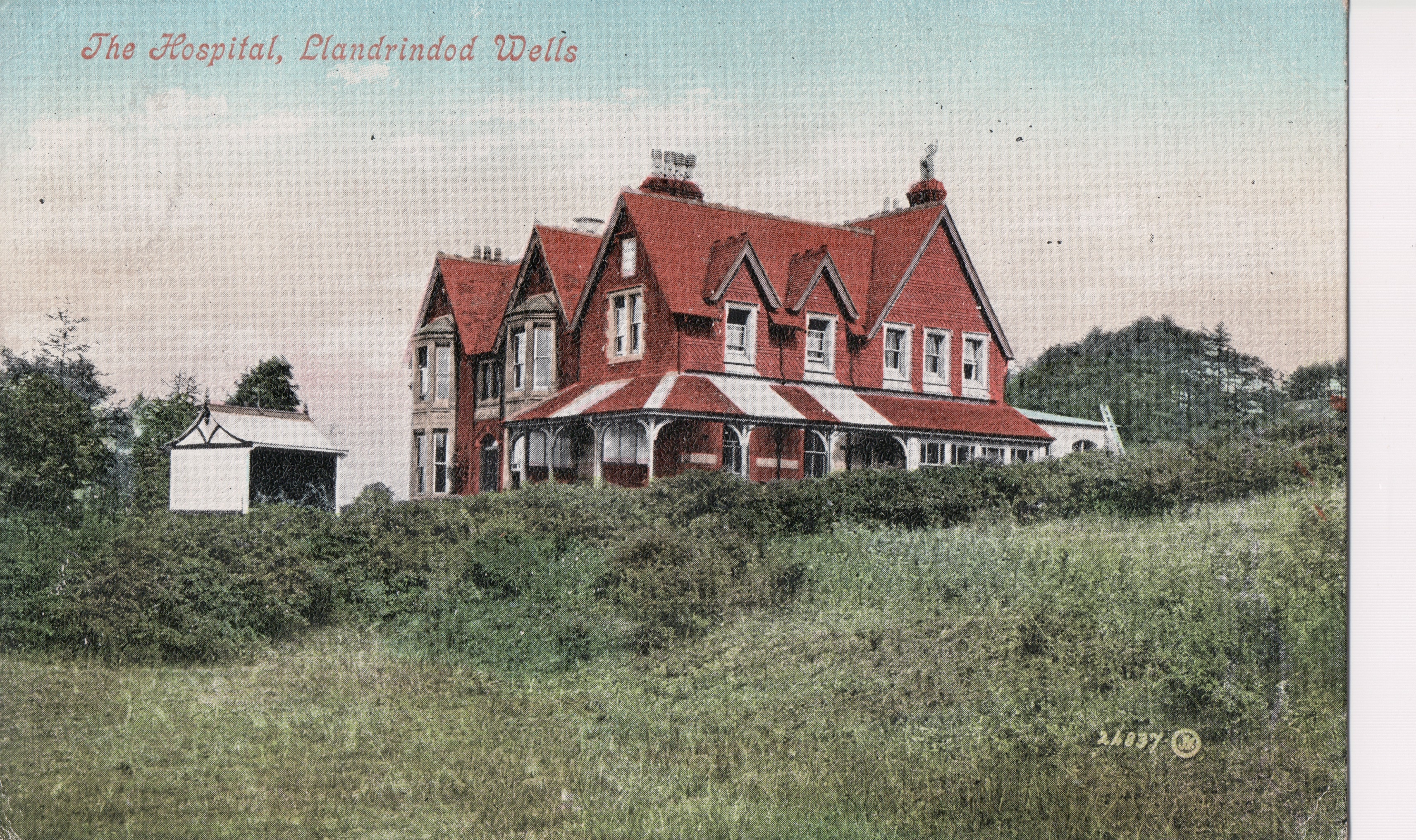
The history of Llandrindod Wells Hospital begins long before the National Health Service and before the building acquired the memorial name by which it is now known. It belongs instead to the formative years of Llandrindod itself, when a new town was taking shape around the mineral springs and railway. Hotels, boarding houses and streets were appearing rapidly, thousands of visitors came each summer to take the waters, yet the surrounding county of Radnorshire remained overwhelmingly rural and possessed no hospital of its own. The establishment of a cottage hospital at Llandrindod was therefore both a product of the new spa town and one of the institutions which helped turn that town into a permanent community.
As late as 1871 the nearest medical practitioner was Charles E. Lomax, M.R.C.S., who practised from Henwg Cottage at Crossgates, some three miles from Llandrindod. Late that year, or early in 1872, the young Dr William Bowen Davies arrived in the town. A native of Llandyfriog in Cardiganshire, he had previously served as a medical officer in Jersey and was attracted by the possibilities offered by the growing “Cambrian Spa”. He established himself permanently at Llandrindod, building Brynarlais on what later became Temple Street, incorporating his surgery into the house. His arrival was significant. For the first time the developing town had a resident medical practitioner, and Davies quickly became involved not only in medicine but in the wider civic life of Llandrindod.
The Need for a Hospital
The idea of establishing a hospital appears to have developed through discussions between Davies and local clergy, landowners, professional people and tradesmen. There was good reason for concern. Medical treatment in a scattered rural county was difficult enough, but nursing someone seriously ill or injured in a small cottage or isolated farmhouse could be almost impossible. The cottage hospital movement offered an answer. Beginning with Dr Albert Napper’s hospital at Cranleigh in Surrey in 1859, small voluntary hospitals had spread rapidly through Britain. They were deliberately modest institutions, usually with only a few beds, a doctor, trained nurse and domestic staff, but they brought professional nursing and medical care within reach of communities far removed from the great urban infirmaries.
Llandrindod was in some respects an obvious place for such an institution. The railway had made the town accessible from a wide area, it lay more centrally within Radnorshire than several of the old market towns, and the reputation of the spa had already created a concentration of medical activity. Dr Davies was also able to secure the support of Edward Middleton Evans of Llwynbarried, Nantmel, one of the principal landowners involved in the development of the new town. Middleton Evans offered a site for the proposed hospital between the centre of Llandrindod and the railway crossing to the north.
One of the most important figures in the whole story was Middleton Evans’s wife, Mary Anne Wilkins Lucas, later generally known as Mrs Middleton Evans. Her interest was perhaps unsurprising. She came from a medical family. Her father, Dr Henry Lucas, had been the first medical director of the Brecon Infirmary when it opened in 1831, while other members of the Lucas family became prominent doctors in Brecon and Crickhowell. R. C. B. Oliver, writing on the hospital’s early history in 1981, described Mrs Middleton Evans as Dr Davies’s most enthusiastic collaborator. Her contribution was immense and largely consisted of the kind of work easily lost from formal institutional histories, correspondence, persuasion, fundraising and the patient creation of a network of supporters.
The movement became public on Tuesday, 21 August 1877, when a well-attended meeting was held in the Assembly Room in High Street. A committee of local clergy and gentry was appointed, with Edward Middleton Evans as chairman and Dr Bowen Davies as honorary secretary. The proposed institution was to be called the Llandrindod Wells Cottage Hospital and Convalescent Home. By that point £712 had already been promised in donations and £128 in annual subscriptions. Significantly, contemporary reports noted that some of the donations had been made by poor people themselves, those whose class was expected to benefit most directly from the hospital.
Fundraising occupied much of the next three years. Mrs Middleton Evans was later said to have written no fewer than 1,500 “begging letters” on behalf of the hospital. Bazaars, church collections, concerts and collecting cards were used to raise money. One bazaar produced £72. The celebrated novelist Mary Elizabeth Braddon, author of Lady Audley’s Secret and a regular visitor to the spa, contributed fifty-two copies of her novel Hostages to Fortune for sale. Her association with Llandrindod was remembered in the name Braddon, given to a house in High Street where she stayed.
The project also attracted professional approval. Late in 1878 Dr Horace Swete, an authority on cottage hospitals and author of the Handy Book of Cottage Hospitals, was staying at Ye Wells. Davies invited him to inspect the proposed hospital site and Swete gave it a highly favourable opinion. This was more than a casual endorsement. Cottage hospitals were still comparatively new institutions and their design and management were subjects of considerable professional discussion. Llandrindod’s founders were consciously placing their small hospital within a wider movement in British medicine.
Building the Cottage Hospital
By July 1880 the building was substantially complete. At a meeting of subscribers on 9 July, held in the new National Schoolroom, it was reported that builder and surveyor B. A. Hamer of Kington had completed the work at a cost of £1,008. Some £200 remained owing to him, while architect Ernest Day of Worcester was due a further £123. The problem was immediate. The building existed, but there was virtually no money remaining to furnish it or lay out the grounds.
The rules adopted for the new hospital tell us much about medical care before the creation of a public health service. It was intended for poor people from Radnorshire and Breconshire suffering from illness or accident, although infectious cases were excluded. Medical control rested with the Medical Director, while committees of visitors and ladies were appointed to oversee other aspects of the institution. Admission was generally by recommendation from a Governor. A donor of £10 or more might become a Governor, as could an annual subscriber of at least £1, while clergy and ministers raising qualifying collections in their places of worship could also recommend patients.
Patients were initially expected to contribute fifteen shillings a week towards their maintenance, although the amount was very quickly reduced to two shillings and sixpence. The arrangement may appear strange from a modern perspective, but it was typical of the voluntary hospital system. The institution relied upon a complicated mixture of charity, subscriptions, donations, patient contributions and voluntary labour. Medical treatment was not yet regarded as a universal entitlement provided by the state.
The hospital was built during 1880, furnished in February 1881 and, according to its later institutional records, admitted its first patient in July of that year. There is, however, an interesting complication. The census taken on 9 April 1881 already records the hospital as occupied. It names L. M. Insdale, aged thirty-three, as matron in charge and records three patients, including agricultural labourers. Oliver therefore suggested that Insdale was probably the true first matron, remaining only briefly before Miss Emblin, who subsequently came to be remembered as the first matron of the operational hospital.
Those census entries are valuable because they return the story to the people for whom the institution was created. Among the earliest occupants were agricultural labourers, men and women whose lives were far removed from the fashionable world of the great spa hotels. The contrast is important. Llandrindod was attracting affluent visitors from across Britain, but the hospital existed principally to provide care for people who could never have afforded prolonged private medical treatment.
The original hospital was tiny. The building occupied a piece of ground only about forty-five feet square. Its wards measured approximately twenty feet by fourteen feet and were heated by open fires. There was accommodation for only six adults and two children. The original design had already been reduced because of financial constraints, although it was constructed in such a way that enlargement would be possible later.
Dr Bowen Davies served as Medical Director without payment. During 1881 he also supplied medicines and drugs free of charge. Edward Middleton Evans permitted patients to use the mineral waters of the Pump House without charge and provided good drinking water from springs on his estate. The arrangement neatly illustrates the meeting of old and new ideas about health in Victorian Llandrindod. The mineral waters which had made the town famous continued to play their part, but alongside them stood a modern institution based increasingly upon professional medicine and nursing.
Growth and Expansion
The need for the hospital quickly became obvious. In 1881, when it was formally open for only twenty-six weeks, eighteen patients were admitted. The following year there were thirty-two. In 1883 the number rose to forty-six, in 1884 to seventy-eight, and in 1885 to 102. In only a few years the little institution had outgrown its original accommodation.
A major enlargement followed in 1883. A new wing for convalescent patients increased the accommodation from eight to twenty beds, together with extensive additional offices. The whole cost of the building work was met by Miss Clara Thomas of Pencerrig and Llwynmadoc. The hospital’s later schedule of permanent benefactions credited her with an endowment of £4,500 associated with this enlargement. In 1904 she also contributed £1,000 towards a further £3,000 endowment fund raised for the hospital. The coat of arms of the Thomas family appeared on the western gable of the new wing with the initials E.L.T., almost certainly commemorating her only brother, Evan Llewelyn Thomas, who had died in Paris in 1864.
Clara Thomas became one of the hospital’s greatest benefactors. Her contribution did not end with the 1883 enlargement. In 1901 she offered to pay the entire cost of constructing a detached mortuary, and she later became President of the hospital in 1908. Her place in the history of the institution deserves to stand alongside that of the Middleton Evans family and Bowen Davies. Without benefactors such as Clara Thomas, the expansion of the hospital would have been impossible.
Further additions were made as demand continued to grow. Llandrindod Wells Urban District Council records show additions to the Cottage Hospital being approved in August 1895. The surviving entry does not tell us enough to identify the architect or establish the precise extent of this work, but it demonstrates that the physical development of the hospital continued through the later nineteenth century.
The hospital’s first ambulance appeared in 1885, presented by G. H. Philips of The Hall, Abbeycwmhir. It was horse-drawn. When it was required, horses and a driver had to be hired. It is a small detail, but one which says a great deal about the difficulties of providing emergency care across rural Radnorshire. Before motor transport, bringing a badly injured or seriously ill patient from an outlying farm or village to Llandrindod was itself a considerable undertaking.
The hospital’s finances reveal how remarkable the whole enterprise was. In 1885 income amounted to little more than £525. Annual subscriptions, endowment income, patient payments, church collections, concerts, collecting boxes and donations all contributed. The largest expenditure was food, while salaries for the matron, nurse and servant amounted to less than £60 for the year. Oliver calculated that the hospital had housed, fed and medically treated 102 patients, whose average stay was about thirty days, for less than £5 each.
By then the hospital was drawing patients from well beyond its original intended area. Of the 102 people admitted in 1885, forty-five came from Radnorshire, eleven from Breconshire and forty-six from elsewhere, including both English and other Welsh counties. The number was sufficient to produce some criticism, presumably from those who felt that an institution supported locally ought to be more exclusively reserved for local patients. Yet it also demonstrated that the hospital had acquired a reputation beyond the county.
Behind the medical work stood generations of nurses, matrons, servants and administrators. Miss Jeffery served as matron from 1883 until 1896, followed by Sister Mary Evans from 1897 to 1900. Miss G. Hopper arrived in 1901 and was succeeded about a year later by Miss Goldsbrough. Their work is much harder to reconstruct than that of the doctors and benefactors, but the hospital could not have functioned without them.
The succession of doctors can be followed more clearly. Bowen Davies remained Medical Director for many years. Dr S. G. Floyd served as his assistant and was followed in 1897 by Dr F. H. Roberts. In 1903, as age and ill health began to take their toll, Davies moved into the position of Consulting Physician, while medical work at the hospital was undertaken by local practitioners including Dr A. G. Greenway, Dr J. L. Griffiths and Dr J. Murray.
The administration of the hospital also brings another familiar Llandrindod name into the story. Mrs Bryan Smith acted as secretary for five difficult years before solicitor E. Powell Careless took over the position. Careless remained secretary for some forty-five years, continuing until the creation of the National Health Service. Mrs Bryan Smith was Mary Bryan Smith of Montpellier, whose role in the hospital adds another dimension to the history of that remarkable Llandrindod household. Her association with the hospital did not end with the secretaryship. The 1928 annual report still listed her on both the General Committee and the House Committee, showing that her involvement continued well into the inter-war years.
By 1901 the scale of the institution had changed markedly. The hospital then had twenty-two beds and admitted 256 patients during the year. Of these, seventy-one came from Radnorshire, twenty-three from Breconshire and no fewer than 162 from other counties. Annual expenditure had risen to around £961. The average patient remained for about thirty days and, remarkably, the overall cost still worked out at only a few shillings per patient per day.
A Hospital Supported by the Community
The way in which the hospital was financed also provides one of the best glimpses we have of community life in Llandrindod and the surrounding countryside. Annual subscriptions and endowment income remained important, but money was collected through churches, chapels, hotels, pump rooms and boarding houses. Concerts raised funds, and in later years flower days, flag days, galas, carnivals, regattas on the lake, football matches, bowling tournaments, sports meetings and raffles all contributed.
Donations did not always come in the form of money. Annual reports recorded newspapers, magazines and books for patients, fruit and vegetables from harvest festivals, rabbits, game, salmon from the Wye, honey, old linen, dressing gowns, bed jackets, crockery, Christmas mince pies, crackers, games and calendars. During the 1920s the collection of eggs became particularly popular. In 1925 alone some 6,650 eggs were given to the hospital, many through churches, chapels and Women’s Institutes.
This was the voluntary hospital system at its most characteristic. The institution did not belong simply to a committee or a handful of wealthy benefactors. It was supported through hundreds of small acts, a collection at chapel, a football match, vegetables from a harvest service, eggs gathered by a Women’s Institute, or a few shillings collected in a hotel. The history of the hospital is therefore also a history of communal responsibility in rural Radnorshire.
From Cottage Hospital to County War Memorial
The First World War changed the institution again. Llandrindod itself became closely associated with military medicine during the conflict, with other buildings in the town being used for the treatment and accommodation of servicemen. After the Armistice, the question arose of how Radnorshire should commemorate those who had died.
At a county meeting in 1919 support was given to the proposal that the rebuilding and enlargement of Llandrindod Hospital should form Radnorshire’s county war memorial. This was a different kind of commemoration from the more familiar stone crosses and monuments. It was intended to remain useful, bringing treatment to the living while preserving the memory of the dead.
Plans for Llandrindod Wells Hospital were prepared by architect Richard Wellings Thomas in April 1921. The surviving architectural record needs to be compared directly with the completed building before every element can be attributed to him with certainty, but it belongs clearly to the period in which the hospital was being transformed.
During 1922 and part of 1923 the existing hospital buildings were extended northwards. The scale of the work was considerable. The rebuilding cost approximately £33,000, the greater part of the money being contributed by the British Red Cross Society. Local residents from all sections of society also subscribed, together with donors from outside Radnorshire and even outside Wales.
The result was a hospital of thirty-six beds, replacing the twenty-two-bed institution which had preceded it. Four private wards were included and a small two-bed maternity ward was shortly added. The official name became the Llandrindod Wells County War Memorial Hospital. The word “Convalescent”, so central to the Victorian institution, disappeared. By the 1920s the hospital was increasingly concerned with surgery and active medical treatment rather than principally providing somewhere for patients to recover.
The change of name therefore represented something much greater than rebranding. The hospital had been physically rebuilt and its purpose had altered. The cottage hospital founded by Victorian philanthropy had become a county institution, and the memory of those lost in the First World War was incorporated into its very fabric.
Life Inside the Hospital
The surviving annual report for 1928 gives an unusually detailed picture of the hospital only a few years after that transformation. Sir Charles Venables-Llewelyn was President, Dr John Murray and Dr A. Miller Kerr were medical officers, H. S. Morris was dental surgeon, Miss M. Jayne was Matron and E. Powell Careless remained Secretary. The hospital admitted 428 patients during the year, sixty-eight more than in 1927. The recorded work included 233 medical cases, 183 surgical cases and seven maternity cases. The growth of surgery included operations on children referred by the Education Committee for tonsils and adenoids, as well as major operative work. Twenty-one patients were treated in private wards and the average stay was just under twenty-two days.
Maternity care was by then firmly established, though still on a small scale. Seven complicated or necessitous maternity cases were admitted during 1928 under a county arrangement. No mothers died, although two babies were stillborn in circumstances which had required urgent hospital treatment. What had begun as a two-bed maternity provision after the rebuilding was therefore already becoming part of the hospital’s normal work. Parliamentary figures later recorded fifty-eight deliveries at Llandrindod Wells Hospital in 1977, and the much later development of the Ithon Birth Centre continued that tradition of maintaining maternity provision within central Powys.
The 1928 report also shows that the old voluntary admission system remained very much alive. During that year 688 letters of recommendation were issued and 592 were used. A Governor’s recommendation normally admitted a patient for no more than three weeks, with a further recommendation required for another period. Patients from Radnorshire and Breconshire generally paid seven shillings a week, those from outside the two counties ten shillings and sixpence, and children under fourteen five shillings. Sudden accident cases could be admitted without a recommendation. The system had become more elaborate, but its roots were still recognisably Victorian.
The hospital’s bye-laws give an even more vivid impression of daily life. Patients were normally expected to bathe on arrival. Those well enough were expected to turn back their bedclothes, open the windows, make their own beds after breakfast, wash up after meals, dust the wards and, where necessary, assist with the nursing of other patients and the general work of the hospital. Prayers and meals divided the day, lights were put out at ten o’clock and conversation afterwards was forbidden. Smoking required permission. Patients provided their own change of linen, brush, comb and slippers and paid for their own washing. Visiting was normally confined to Tuesday and Saturday afternoons, and conduct outside the hospital was regulated too, with a visit to a public house potentially leading to discharge. The atmosphere was part hospital, part disciplined household, reflecting assumptions about order, thrift and personal responsibility which were common in voluntary institutions of the period.
By 1928 transport had also changed dramatically. The hospital’s first ambulance of 1885 had required the hiring of a horse and driver. The inter-war institution now possessed a new motor ambulance fitted for the removal of patients and available for private cases as well as hospital work. In little more than forty years the practical problem of getting a patient from an isolated community to Llandrindod had moved from horse power to motor transport.
The same report records another building phase. During 1928 a separate block was being erected to provide accommodation for members of the nursing staff and for the hospital porter and his family. The architects were Rogers & Shrimpton of Knighton and the contractor was J. L. Griffiths. Work began in June. The ground floor provided living accommodation for the porter, while six bedrooms and a bathroom for nurses occupied the floor above. Together with the hospital’s existing rooms, this meant that each member of the nursing staff could have a separate bedroom. A telephone connection between the wards and the porter’s quarters allowed him to be summoned during an emergency. The scheme was estimated to cost about £3,000 and was paid for from accumulated hospital income.
Another sign of the hospital’s changing character was the decision in 1928 to establish an X-Ray Fund. The medical staff argued that a modern hospital could no longer be regarded as properly equipped without X-ray apparatus, and about £500 was required. It marked an important change in the nature of rural medicine. The hospital which had begun with open fires, a handful of beds and mineral water was entering an age of diagnostic technology.
Yet the older Llandrindod traditions had not entirely disappeared. The 1928 committee still thanked the Pump House Hotel Company and Llandrindod Wells Urban District Council for supplying mineral waters free of charge, as they had done for many years. Nearly half a century after Bowen Davies and Middleton Evans had incorporated the waters into the life of the original cottage hospital, the link between spa medicine and hospital medicine could still be seen.
The schedule of permanent benefactions in the same report shows just how deeply the hospital had become embedded in a culture of philanthropy. In addition to the Middleton Evans and Clara Thomas gifts, it recorded substantial bequests from the Severn family of Penybont Hall and endowed beds and wards bearing the names of individual donors. Sir Francis Edwards endowed the Lady Edwards Ward, Christopher Pond endowed the Dominion Bed and the Frances May Hamilton Cot was similarly supported. Such named wards, beds and cots turned private generosity into something tangible within the hospital itself.
Into the National Health Service
By the eve of the National Health Service the hospital had forty-one beds. On 5 July 1948 the voluntary system under which it had survived for nearly seventy years came to an end. The hospital became part of the NHS and responsibility for financing healthcare moved decisively from subscriptions, bazaars, collections and philanthropy to the state.
That did not mean the voluntary tradition disappeared. Local women continued to assist patients and visit the hospital, particularly during afternoon visiting hours. In March 1955 these activities were placed on a more formal basis with the establishment of the League of Friends of Llandrindod Wells Hospital. The League later became a registered charity and remains active. Its more recent fundraising has included coffee mornings, raffles, open gardens, bingo, table-top sales, supermarket collections and the hospital tea trolley. The methods are modern, but the underlying tradition is strikingly familiar.
A Rural Hospital for Modern Powys
The later history of the hospital has been one of repeated adaptation. Architectural records from the 1980s show further development of physiotherapy facilities and provision for elderly patients. The hospital theatre underwent major refurbishment in 2012–13, while by 2016–17 Llandrindod was one of Powys’s dedicated centres for day surgery, with an associated endoscopy service. These developments reflected a wider effort to provide treatment within the county where it could safely be delivered, rather than requiring patients to travel to larger hospitals outside Powys.
One of the most important modern additions was renal dialysis. Plans for a dialysis service at Llandrindod were advanced through the Welsh Renal Clinical Network, and the unit was expected to become operational during the summer of 2011. For patients requiring dialysis several times each week, bringing treatment into Llandrindod rather than requiring repeated journeys to a distant district general hospital was particularly important. It was another modern expression of the problem which had led to the creation of the Cottage Hospital in the first place, distance.
Maternity provision also entered a new phase with the opening of the Ithon Birth Centre during 2017–18. The midwife-led facility represented a modern form of local maternity care, while preserving a service which could trace its institutional origins back to the small maternity ward added after the 1920s rebuilding.
The strategic role of the hospital has also become more explicit. Health and care planning in 2018 identified Llandrindod as a Regional Rural Centre, with its central position in Powys providing an opportunity to bring some services back into the county from neighbouring district general hospitals and to develop more treatment locally. The language is modern, but the reasoning would have been familiar to Bowen Davies and his colleagues in the 1870s. Llandrindod mattered because it could serve a widely scattered population.
The history of X-ray provision provides a particularly neat measure of the change. In 1928 the hospital was appealing for about £500 to obtain modern X-ray apparatus. In 2025 the X-ray department at Llandrindod received new digital equipment as part of a programme of investment across Powys, producing clearer images more quickly and at a lower radiation dose. Almost a century separates those two moments, but both represent the same determination to maintain useful diagnostic services locally.
Modern investment has continued. A substantial redevelopment programme announced in 2016 included improvements to outpatient accommodation, day-case and endoscopy facilities, dental services, waiting areas, the main entrance and maternity provision. In March 2026 Powys Teaching Health Board announced a further £2.5 million programme covering dental facilities, patient access and the main entrance, kitchen and dining accommodation and further work to the building. The Health Board’s wider capital programme has also identified around £7 million of investment at Llandrindod Wells Memorial Hospital, within longer-term proposals which could ultimately rise to about £14 million, subject to approval of the necessary business cases. The hospital therefore remains a changing institution rather than a preserved relic of the Victorian town.
The history of Llandrindod Wells Hospital is inseparable from the wider making of Llandrindod Wells. The railway and mineral waters may have created the circumstances in which the town could grow, but hotels and visitors alone could never have made a permanent community. A town also required schools, churches, local government, public utilities and institutions capable of supporting people during illness, injury, birth and death. The hospital was one of the clearest signs that Llandrindod was becoming something more than a seasonal spa.
Its history also tells us something about the people who built that community. Edward Middleton Evans provided the land. Mary Middleton Evans wrote hundreds upon hundreds of appeals. Bowen Davies gave his medical services and medicines. Clara Thomas paid for an entire extension and endowed it. Mary Bryan Smith carried the burden of administration during difficult years and remained involved for decades. Nurses and matrons lived and worked within the hospital. Hotels collected money, churches sent produce, sporting clubs staged fundraising events, and ordinary families contributed what they could.
There is something particularly evocative about the 6,650 eggs collected in 1925. It is a small statistic, but perhaps more than almost any other it captures what the hospital meant. The institution did not survive simply because wealthy people wrote large cheques. It survived because thousands of smaller contributions were made over generations by people who regarded the hospital as their own.
The transformation into the County War Memorial Hospital after the First World War deepened that relationship. Radnorshire chose to commemorate sacrifice not only through stone and inscription but through an institution intended to relieve suffering. Men and women entered its wards for treatment, babies were born there, generations of local people worked there and families sat beside relatives during their final days. The memorial remained alive because the hospital remained in use.
A Personal Connection
For me, the hospital also carries a personal significance. My father died there on 28 December 2016. It is a reminder that the history of an institution such as this cannot be reduced to architects, committees, bed numbers and annual accounts. Its real history lies equally in the generations of families whose lives have intersected with it at moments of birth, illness, recovery and loss.
Nearly a century and a half after the first campaign for a cottage hospital began, the central principle remains remarkably familiar. Llandrindod Wells Hospital exists because distance matters. It was founded to bring proper medical care within reach of the people of a scattered rural county, and however much medicine, funding and administration have changed since 1881, that underlying purpose has endured.
The great hotels and public buildings of Llandrindod tell us how the Victorian spa presented itself to visitors. The hospital tells a quieter and perhaps more revealing story. It tells us how the town learned to care for the people who lived around it.
Related Essays
- Board and Lodging: The Boarding Houses of Llandrindod Wells
- Bowling in Llandrindod Wells: From the Spa Greens to Rock Park and the Indoor Game
- From the Pump House Links to Death or Glory: A History of Golf in Llandrindod Wells
- Dr William Bowen Davies: The Doctor Who Helped Build Llandrindod Wells
- Llandrindod Wells Market Hall: A Building for a Changing Town, 1872–1957
- ‘Vote and Interest’: Charles Venables-Llewelyn and the Radnorshire Elections of 1910
Explore more Llandrindod Wells history
Continue with the Llandrindod Wells History guide, or follow the related essays above to explore the people, buildings and institutions that shaped the town.
Sources and Further Reading
R. C. B. Oliver, “Llandrindod Wells Hospital: Its Beginnings and Early Years”, Transactions of the Radnorshire Society, Vol. LI, 1981.
Annual Report of the Llandrindod Wells Hospital and County War Memorial, 1928.
Annual Reports of the Llandrindod Wells Cottage Hospital and Convalescent Home, and later the Llandrindod Wells Hospital and County War Memorial, 1880–1947, Powys Archives.
Llandrindod Wells Urban District Council building records, including the 1895 additions to the Cottage Hospital, Powys Archives.
Richard Wellings Thomas architectural papers, including plans for Llandrindod Wells Hospital, April 1921, Powys Archives. Llandrindod Hospital financial papers, donation books and associated records, 1907–1948, Powys Archives.
Contemporary reports in the Hereford Times and other local newspapers. Historic hospital, parliamentary and Senedd records relating to Llandrindod Wells Hospital, maternity provision and the development of renal dialysis.
Powys Teaching Health Board annual reports, strategies and capital programme material relating to Llandrindod Wells Memorial Hospital, including theatre, day surgery, endoscopy, X-ray, maternity and later redevelopment.
Welsh Government records relating to investment in Llandrindod Wells Memorial Hospital and the development of rural health services in Powys.
Charity Commission records for the League of Friends of Llandrindod Wells Hospital.