
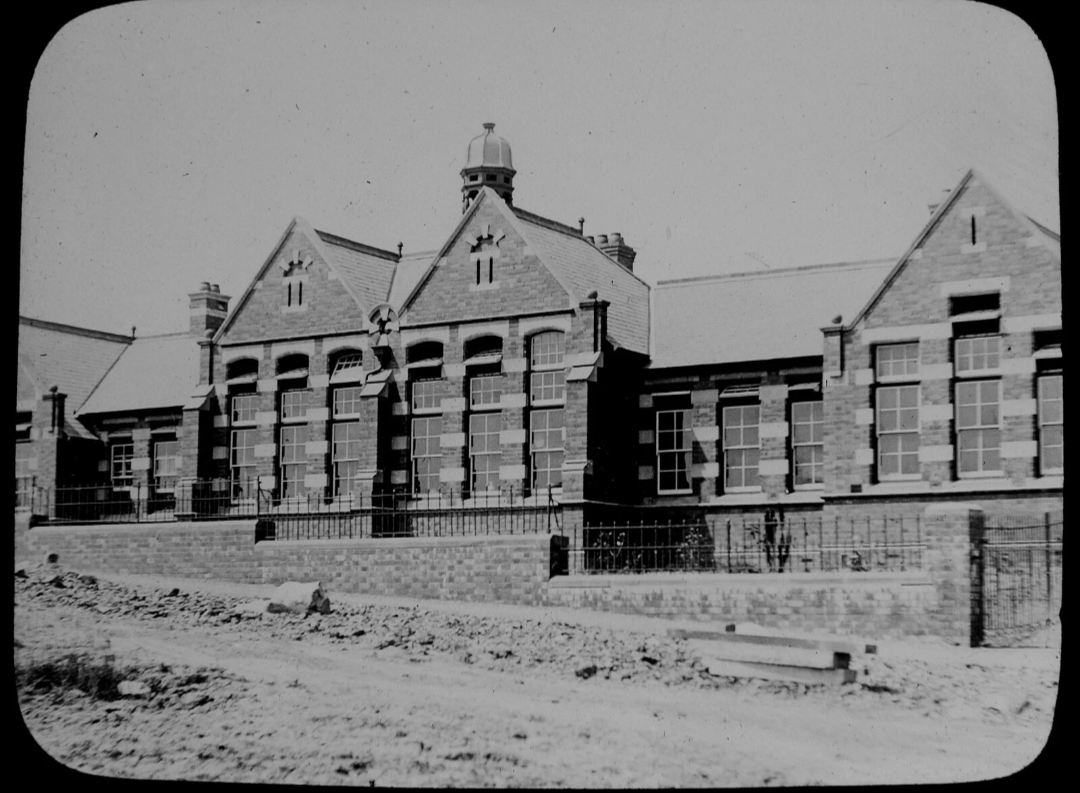
For almost ninety years, a substantial school building stood on the rising ground of Alexandra Road in Llandrindod Wells. Its steep gables, tall windows and small roof cupola made it one of the recognisable public buildings of the Victorian town. The original County School has long since disappeared, but for generations of Radnorshire families it was a familiar place, reached on foot, by train, by bus and, in the earliest years, sometimes after a journey which required a child to lodge away from home.
The school began as Llandrindod Wells Intermediate School, later becoming known as the County School and Grammar School. Its history reaches from the educational reforms of the 1880s through two world wars, selective secondary education and the creation of the comprehensive school. The building was demolished around 1987–88, nearly a century after the campaign to establish it.
Newspaper reports published between 1892 and 1898 preserve the arguments over its location, the money raised towards its establishment and the elaborate arrangements for its formal opening. Together with the surviving school records, they offer an account of an institution which had a wider significance than its position in Alexandra Road might suggest.
The campaign for secondary education
The Welsh Intermediate Education Act of 1889 transformed the prospects for secondary education in Wales. Before it, provision beyond elementary schooling was limited and uneven. Grammar schools, private establishments and endowed institutions existed, but access often depended upon money, family connections and distance. In much of rural Radnorshire, the nearest suitable school could be a considerable journey from home.
The new legislation allowed county authorities to create intermediate schools with public support, supplemented by endowments and local contributions. The intention was to widen the opportunities available to boys and girls and to establish a stronger connection between elementary education, more advanced instruction and the university colleges developing in Wales.
On Monday, 24 October 1892, the Radnorshire Joint Education Committee met at the Pump House Hotel in Llandrindod Wells. Its chairman was John Corrie Carter. Deputations from Llandrindod and Rhayader attended to argue for the location of a school under the new scheme. The report in the South Wales Daily News two days later gives an unusually clear indication of the strength of local feeling.
The Llandrindod deputation numbered sixty-five representatives drawn from thirty parishes. It was introduced by Alderman Dr William Bowen Davies, already a prominent figure in the town’s public affairs. Rhayader sent approximately twenty-five representatives, headed by Major S. W. Williams. The committee was to consider the rival claims the following day.
Llandrindod had become an expanding spa and railway town, with growing claims to serve as a centre of county administration. Rhayader was an older market town whose connections with the surrounding countryside were equally longstanding. The location of the proposed school mattered to both places. It would affect travelling distances, expenditure in the town, and the educational prospects of families across the county.
The newspaper does not give the outcome of the committee’s subsequent deliberations. It does show that Llandrindod’s eventual success was preceded by an organised campaign extending far beyond the town itself. Bowen Davies remained involved in the project for several years, adding education to his considerable work in the development of Llandrindod’s civic institutions.
Religion, politics and the governing body
The new system was not introduced without disagreement. In April 1895 a correspondent to the Brecon and Radnor Express complained that Nonconformists had been slighted in the composition of the county governing body, particularly in the districts of Llanbister, Llananno and Llanbadarn-fynydd. The writer criticised Lord Ormathwaite and Aaron Moseley, suggesting that Church of England interests were being favoured.
The letter belongs to the religious and political climate of late-Victorian Wales. Nonconformist chapels were important centres of local life, while the established Church retained close associations with many of the county’s landowning and administrative families. Appointments to public bodies could become contentious where communities believed that their religious and political traditions were not fairly represented.
The correspondent’s allegations cannot be accepted as proof of improper appointments. They are nevertheless valuable evidence of the tensions surrounding the new educational machinery. The school was being planned in a county where the authority of established local families, the claims of Nonconformist communities and demands for wider public representation were still matters of lively dispute.
The land donated by Mr Banks
By January 1896, attention had turned from the principle of the school to the practical business of building it. The Brecon and Radnor Express of 31 January described the county surveyor’s assessment of a proposed site near Myrtle Villa, given by Mr W. H. Banks.
The ground was approximately 700 yards from the centre of Llandrindod and no more than 800 yards from the London and North Western Railway station. The surveyor placed it at about 700 feet above sea level and described open, rather high land which was not disadvantaged by the buildings around it. Proximity to the railway was a possible reservation, but the site was otherwise regarded as exceptionally suitable.
The chairman considered it the most valuable offer made since the educational scheme had been under discussion. Alderman O. C. Rogers proposed that the gift be accepted, Philip Davies of Presteigne seconded the motion, and the decision was carried without opposition. The governing body formally recorded its thanks to Mr Banks.
The donor may have been William Hartland Banks (1867–1930), of the banking and landowning family associated with Ridgebourne, Hergest Croft and Howey Hall. His dates, initials and property interests fit the newspaper evidence, but the original conveyance or governors’ minutes are still needed to establish the identification beyond doubt.
The land was only part of the local contribution. The Cardiff Times of 1 February 1896 reported that £900 had been raised by public subscription. The local deputation had undertaken to provide £1,200, but asked the county governors to accept the amount collected and release the subscribers from the remaining £300. Dr Bowen Davies spoke on their behalf. The request was granted.
A building committee was then appointed to consider how construction could proceed. The new school therefore rested upon a combination of county organisation, private benefaction and money raised locally. In a town whose hotels, churches and public buildings had grown rapidly during the previous decades, this was an investment intended primarily for the permanent population and the surrounding rural parishes.
Harry Teather and the Alexandra Road building
The new premises were designed by Harry Teather (1867–1956), a Cardiff architect whose work included intermediate schools at Newtown, Llanidloes and elsewhere. An architectural competition for the Llandrindod project was recorded in The Builder in 1896.
The resulting building was a confident piece of late-Victorian institutional architecture. Its gables were strongly defined, with contrasting stone dressings and large windows admitting light into the classrooms. A roof cupola gave the central portion a distinctive profile. Low stone walls and iron railings marked the boundary with the street. An early photograph, taken when the surrounding ground still appeared relatively bare, shows the school before its setting had acquired the more established appearance remembered by later generations.
The internal arrangement was designed for what contemporary reports called a ‘dual school’, providing for boys and girls. It included separate accommodation for the two sexes, a central assembly space, and rooms intended for science and practical instruction. A report on the opening in January 1898 described a modern school rather than a simple collection of classrooms.
The institution also gave its name to the locality. The 1904 Ordnance Survey map identified the nearby road as County School Road, a small but telling indication of the building’s place in the developing town. It formed part of the wider landscape of Victorian Llandrindod Wells, alongside the hotels, churches, commercial streets and public institutions which were giving the resort a more permanent civic character.
The opening, 21 January 1898
Some later accounts date the opening of Llandrindod County School to January 1897. Contemporary evidence establishes a more precise distinction. Teaching appears to have begun before the formal inauguration, but the new building was ceremonially opened on Friday, 21 January 1898. The exact starting date of lessons remains to be confirmed from the earliest admission and management records.
The County Times of 14 January 1898 reported the final preparations. Dr Isambard Owen, Deputy Chancellor of the University of Wales, was to perform the opening ceremony. A procession, the presentation of a ceremonial key and a luncheon at the Victoria Hall were arranged, together with music and the attendance of county and educational representatives. A lengthy report in the newspaper on 28 January described the occasion itself.
Owen’s involvement reflected the connection between the intermediate-school movement and the emerging Welsh university system. The new schools were intended to prepare pupils for a wider range of studies and occupations than many earlier forms of local education could offer.
The first headmaster was William Rolleston Saunders, previously second master at Cardigan Intermediate School. His appointment to the Llandrindod headship was reported in Nature in September 1897, while a later local scrapbook explicitly identifies him as the first headmaster. The early records also mention women on the teaching staff. In January 1898, for example, an allowance towards instruction in laundry work was approved for Miss Lynch, an assistant mistress.
Behind the formal opening lay the more ordinary arrangements required to run a school. The governors discussed teachers’ duties, alterations to the premises, the planting of trees and, importantly, accommodation for pupils who could not return home each evening. Dr Bowen Davies reported on suitable lodging houses, to which licences had been issued.
It was an issue which would have been familiar to many rural families. The school had been established in Llandrindod, but its intended pupils lived across a much wider county.
A school for rural Radnorshire
The distance between home and classroom shaped the experience of attending the school. For children living in Llandrindod, the journey might be no more than a short walk. Those from Nantmel, Llanbister, Newbridge-on-Wye and other villages faced greater difficulties. The railway, local roads and later school transport brought the institution within reach of more households, but attendance still made demands upon families.
The provision of licensed lodgings during the school’s earliest years is particularly revealing. It suggests that some children were expected to stay in the town during term time, under arrangements of which the authorities had taken formal notice. The cost of lodging, books and appropriate clothing remained relevant even when secondary schooling became more accessible.
Parents would also have weighed the advantages of a longer education against the practical needs of the household. In farming communities, older children might be expected to help with animals, seasonal work or domestic responsibilities. The opportunity to continue at school could therefore represent a considerable decision.
For pupils, Llandrindod brought together children whose homes and circumstances were quite different. Some were the sons and daughters of farmers and agricultural workers, others belonged to shopkeeping, railway, professional or clerical households. School friendships and activities extended their acquaintances beyond the immediate parish.
The curriculum, too, reflected changing expectations. Academic subjects occupied a central place, while science, music and practical instruction were also provided. The original dual-school arrangements reflected the gender distinctions of the period, particularly in the subjects thought appropriate for girls. At the same time, the employment of educated women as teachers formed part of the broader expansion of professional opportunities.
The place of Welsh in education was not straightforward. One former pupil recalled being offered a choice between Welsh and French and selecting French because his friends had done so. He later remembered his father’s disappointment. The recollection cannot represent every pupil’s experience, but it is a useful glimpse of language and family expectations in mid-twentieth-century Radnorshire.
A later pupil from Glasbury, Robert Tennant-Ralphs, remembered an hour-long bus journey after passing the eleven-plus examination. His experience belongs to another generation, but the question of how children reached school had been there from the beginning.
Sport, music and old pupils
The school quickly acquired a life beyond formal lessons. Newspaper reports record musical performances and participation in eisteddfodau, while sport became part of its connection with the town.
The Ddole was one of Llandrindod’s principal recreational grounds, and County School football appears in reports from the early twentieth century. An Old Pupils’ Association gathering in July 1909 included cricket on the Ddole and tennis at the school. Such occasions enabled former pupils to maintain friendships and to take part in the social life of the district after their schooldays had ended. The history of the grounds is explored in my essay on the Ddole.
A photograph held by Powys Archives records an amateur theatrical production of J. M. Barrie’s Dear Brutus by Old Students of Llandrindod County School in 1920. The company included Cerigwen Lewis, Walter Harold Powell, Ivor Lewis, Elsie Harper, Gladys Kay and Peggy Watmough. The image, taken by local photographer Rousham Roberts, is evidence of an active former-pupil community with interests extending into drama and public entertainment.
The school magazines provide another route into that world. The National Library of Wales holds issues of Past and Present, the magazine of Llandrindod Wells Intermediate School, from 1911 to 1914. Later editions of The Ithonian, associated with the High School and County Secondary School, survive in national and local collections. Their contents may yet reveal more about pupils’ writing, examinations, societies, friendships and the personalities of the teaching staff.
The First World War and remembrance
The First World War affected the school directly. Former pupils entered the armed forces, some did not return, and teachers were absent on military service. The arrangements for one assistant master provide an especially clear example of how the war disrupted ordinary school life.
R. Michael Morgan, MA, served as a lieutenant in the South Wales Borderers and was wounded in June 1918. In November 1916 the county council had agreed an annual payment of £120 for his wife, herself a university graduate, while she undertook her husband’s teaching duties. The need to keep classes running had created an unusual but practical arrangement.
Ernest Cecil Amos, BSc, was another man closely associated with the institution. Educated at the County School, he had returned as a science master before the war. He served with the South Wales Borderers, was wounded in France and received the Military Cross in 1918. He survived the conflict and died in 1954.
Other former pupils were less fortunate. Garnet Bufton of Penybont attended the school before entering employment with the General Post Office in London. He was killed in Belgium in May 1918. His short life linked the opportunities offered by secondary education with the losses suffered by a generation sent to war.
The school eventually commemorated former pupils lost in both world wars through memorial tablets and a cenotaph bearing the words Pro Deo et Patria, ‘For God and Country’. The names remained part of the school community’s memory long after the surviving pupils had grown old.
Growing demands and overcrowding
The years between the wars brought changes to the school’s organisation and accommodation. Architectural plans survive for additions in 1914 and later alterations, while the school passed through successive headships. E. Wynne Hughes left to take up the headship of Birkenhead Institute in 1929. The county archives also contain records concerning the headship of H. G. Garrett between 1929 and 1941.
After the Second World War, the need for secondary places became increasingly pressing. The Education Act of 1944 extended and reorganised secondary education, while the raising of the leaving age added to the pressure on existing accommodation.
The extent of Llandrindod’s difficulties became a matter for Parliament. On 18 December 1952, Mr Watkins questioned the Minister of Education, Florence Horsbrugh, about overcrowding at Llandrindod Wells County Secondary School, including accommodation at Kingsland and concerns over fire precautions.
The minister confirmed that, beyond the principal school building, teaching was taking place in huts in the playground, a former private hotel and a room in a private residence. The latest figures available to her showed 446 pupils on the roll in January 1952. She added that no proposal for a new school had been included in the authority’s current building programme and that prevailing policy would in any case have prevented approval at that time.
It is a striking contrast with the optimism of January 1898. A school originally celebrated for its substantial new premises was now dependent upon a patchwork of rooms and temporary buildings. The difficulty was not confined to Llandrindod, but the parliamentary answer gives a particularly clear picture of the local circumstances.
Grammar, secondary modern and comprehensive schooling
The post-war organisation of secondary education in Llandrindod became more complicated than the earlier County School arrangement. Selective grammar-school provision existed alongside secondary modern education, while plans for additional buildings and later comprehensive reorganisation occupied the education authorities for many years.
A modern school site developed at Dyffryn Road, while the original Alexandra Road premises continued to be associated with the Grammar School and, subsequently, with the successor High School. Former teacher Tesne Davies, for example, was appointed to Llandrindod Wells Secondary Modern School in 1963 and later taught at Llandrindod High School.
The archival record contains papers concerning an official opening in 1958–59, proposals for new grammar-school accommodation, and correspondence about Llandrindod Wells Comprehensive School during 1970–1973. These documents establish important stages of planning and reorganisation, but their catalogue descriptions alone do not prove precisely when each department moved or when selection formally ended.
The transition should therefore not be reduced to a single unverified opening date. The new buildings at Dyffryn Road increasingly became the centre of secondary education, while the old County School remained in use as an annexe. That final role explains why Alexandra Road continued to feature in local recollections after the principal educational arrangements had moved elsewhere.
By January 1987, Llandrindod High School had 781 pupils, according to figures later published in a House of Commons written answer. This was a much larger institution than the intermediate school originally envisaged by its Victorian founders, although the figures cannot be used as a direct measure of growth because the organisation of secondary education had changed.
The last years of the Alexandra Road building
The precise date on which the old school ceased to be used for teaching has proved difficult to establish. The best published evidence comes from a Powys County Council investigation in February 2013, undertaken in connection with rights of way around the former school site.
The council examined property records, historical maps and the recollections of people who had known the area. Its report acknowledged that little information had been found about the final period of educational use. The Alexandra Road premises had become an annexe to the comprehensive high school and were believed to have closed around 1979–80, although a date as late as 1984 could not be ruled out.
Local witnesses remembered the boundary railings, gates, playgrounds and the footbridge linking the school side of the railway with playing fields to the west. Some also recalled the old premises being used for community activities, including Brownies and judo, after normal schooling had ended. These recollections help explain why residents have given different dates for the building’s closure. Its use appears to have diminished in stages.
One final ceremony preserved an important part of the old school’s identity. Its war memorials were transferred to Llandrindod High School, where the cenotaph was rededicated on Sunday, 18 August 1985. The programme survives at Powys Archives. By that stage, the school as an educational institution had changed its location and organisation, but the names of former pupils killed in the wars were not left behind.
Powys County Council sold the Alexandra Road site to Radnor District Council in 1986, retaining the playing fields and certain access rights. According to the council’s later investigation, the old building was demolished around 1987–88. Alexandra Court, sheltered accommodation for older residents, was built on the site.
The exact day of demolition has not yet been identified from contemporary contracts or newspaper reports. The council’s approximate dating is the strongest available evidence and should not be made more precise than the records allow.
Lives beyond the classroom
The school’s influence is found most clearly in the lives of its former pupils, many of whom remained in Radnorshire as farmers, teachers, traders, office workers and members of local communities. Others travelled much further.
One particularly poignant example is Susan Giles, later Susan Whitley, born in Llandrindod Wells in 1950 and remembered locally as a former Grammar School pupil. She became a teacher and eventually worked in Stanley in the Falkland Islands. On 12 June 1982, during the Falklands War, she was killed by shellfire, one of three civilian women who died in the conflict.
A memorial trust was established in her name to encourage creative and practical work among young people in the islands. A report in Penguin News in June 2003 recorded that donations from people in Llandrindod Wells had helped establish it. The connection between her home town and the schoolchildren of the Falklands continued long after her death.
The story brings a distant event back to the small county school where one of its victims had once been a pupil. It also reminds us that the history of a school is not confined to the years which children spend there. Their subsequent lives became part of the institution’s wider history, whether they remained in their home communities or made careers elsewhere.
A different school and a lost landmark
Llandrindod High School continued at Dyffryn Road after the old Alexandra Road premises had disappeared. On 31 August 2018 it formally closed as an independent institution, joining Builth Wells High School in the new Ysgol Calon Cymru, which opened on 1 September and operated across the existing campuses of both towns.
The reorganisation brought another change of name and administration, but many of the concerns which had occupied the county authorities in the 1890s remained familiar. Radnorshire, later part of Powys, was still a large rural area in which distance, transport and the distribution of educational facilities mattered to families.
I attended the later Llandrindod High School myself, long after the original County School had disappeared from Alexandra Road. For my generation, the Victorian building was already a part of local history. Its appearance survives in photographs, while the governors’ minutes, newspapers, school magazines and memorials help recover something of what took place within it.
The early reports show how determined local representatives were to secure the school, how much was contributed towards its establishment and how seriously its opening was regarded. The later records show a school adapting to larger numbers, changing curricula and successive educational systems. Between those documents lie the experiences of the children and teachers who occupied its classrooms.
Alexandra Court now stands where the County School once stood. Little in the present site conveys the confidence of the late-Victorian building or the place it held in the lives of Radnorshire families. Yet the old school deserves to be remembered, not merely because its architecture was lost, but because it provided an education to generations of young people from the town and the surrounding countryside.
Related Essays
- Dr William Bowen Davies: The Doctor Who Helped Build Llandrindod Wells
- A Town Marked Out on the Common: The Making of Llandrindod Wells
- Howey Hall: The Changing Life of a Radnorshire Country House
- The Ddole, Llandrindod Wells: Racehorses, Royalty and Aeroplanes
- From Spa Town to Administrative Capital: Civic Government and the Making of Llandrindod Wells
Explore more Llandrindod Wells and Radnorshire history
Continue with the Llandrindod Wells History, Radnorshire History, Victorian & Edwardian Wales and Welsh Rural History guides, or browse the related essays above.
Sources and Further Reading
South Wales Daily News, 26 October 1892, p. 6, “Intermediate Education in Radnorshire”; Brecon and Radnor Express and Carmarthen Gazette, 19 April 1895, p. 6, “The Radnorshire Intermediate Schools”.
Brecon and Radnor Express and Carmarthen Gazette, 31 January 1896, p. 8, “The Site of the Proposed Intermediate School at Llandrindod”; Cardiff Times, 1 February 1896, p. 3, “Radnorshire Intermediate Schools”.
The County Times, 14 January 1898, p. 5, “Radnorshire County Governing Body”; 28 January 1898, p. 6, “Intermediate Education in Radnorshire: Opening of Llandrindod Wells Dual School”. Nature, 9 September 1897, records William Saunders’s appointment.
Powys Archives: County Governing Body minute books R/C/E/M/M/1; management committee minutes R/C/E/M/M/3; school staff records R/E/GS/1; County Architect’s plans R/C/A/316; secondary-school records R/C/E/SF/60–61 and comprehensive-school correspondence R/C/E/SF/65/3. These are catalogue references; not all original files have been examined.
Powys Archives: Old Students’ theatrical photograph RX/39/44 and cenotaph rededication programme RX/39/25; Llandrindod Wells Library Deposit, including school magazines and scrapbook references. National Library of Wales, Past and Present and The Ithonian.
House of Commons, 18 December 1952, vol. 509, col. 244W, on overcrowding and pupil numbers; House of Commons, 27 November 1987, recording the January 1987 pupil roll.
Powys County Council, Alexandra Court, Llandrindod Wells, Definitive Map Modification Order investigation, 21 February 2013, especially paragraphs 5.41–5.42, for the final educational use, sale and demolition.
History Points, “County School war memorials, Llandrindod Wells”; AHRnet, “Harry Teather”; Nick Kingsley, Banks of Ridgebourne and Hergest Croft.
Radnorian, “A Radnorshire Casualty of the Falklands War”; Penguin News, 20 June 2003, on the Susan Whitley Memorial Trust; official school establishment record for Ysgol Calon Cymru.
Featured photograph: historic view of Llandrindod Wells Intermediate School in Alexandra Road, supplied for this research. The photographer and precise date of the image have not been established. The building was formally opened in January 1898 and demolished around 1987–88.