
There are places in Llandrindod Wells whose history survives because of what was built upon them. The great hotels, the railway station, the pump rooms and the civic buildings all left obvious marks on the town. The Ddole is different. Its importance came largely from the fact that it remained open. Lying on the broad, level ground beside the River Ithon below Rock House, later the Rock Park Hotel, it became one of the most adaptable spaces in Llandrindod. During little more than a century it accommodated racehorses, polo ponies, runners, footballers, cricketers, soldiers, livestock, sheepdogs, Scouts, royalty and aeroplanes. Few pieces of ground in the town can tell quite so much of its wider history.
The name itself belongs to an older landscape. Ddole derives from the Welsh dôl, meaning a meadow, particularly low-lying meadowland beside a river. Long before the arrival of grandstands, racing crowds or aeroplanes, this was therefore simply a practical description of the land. Its later history was determined by its geography. The field was broad, relatively level and close to the developing centre of Llandrindod, yet sufficiently open to accommodate large gatherings. As the town changed, the Ddole changed with it.
Before the Rock House Racecourse
Horse racing at Llandrindod pre-dated the creation of the later course adjoining Rock House, and it is important not to treat every early reference to racing in the district as evidence for the Ddole itself. Llandrindod already possessed an established racing tradition by the middle of the nineteenth century, and probably earlier, but the evidence now suggests that the recognisable Rock House course was a later development.
A particularly vivid report survives from August 1864, when Llandrindod hosted a substantial race meeting with hurdle races, flat racing, Galloways and pony events. The programme included the Llandrindod Stakes, the Llywynbarried Stakes and a Rock House Stakes. The meeting was energetic and, during the pony races, occasionally chaotic. Spectators repeatedly crowded onto the course, ponies collided with officials and bystanders, riders fell, and the newspaper correspondent wrote with some amusement about drunken navvies and equally argumentative local spectators.
The account is valuable because it reveals a side of early Llandrindod which can easily be lost behind the polite language of spa advertising. Race meetings brought together landowners, hotel visitors, professional men, labourers, local families and racing followers. They were social occasions, but not always genteel ones. At the end of the day the stewards withdrew to the Pump House, where around forty gentlemen sat down to dinner. The contrast between the crowded, noisy course and the formal dinner afterwards says much about the social world of early Victorian Llandrindod.
The appearance of a Rock House Stakes in 1864 shows that the hotel was already associated with racing, but it does not prove that the meeting took place on the later Ddole course. A newspaper report from 1873 is much more precise and appears to mark the beginning of the racecourse we can identify with confidence.
A New Course Beside Rock House
In October 1873 the Montgomeryshire Express reported that the Llandrindod Wells Races had taken place on what it specifically called the “new course adjoining the Rock House Hotel”. That short phrase is important. It suggests that the racecourse later so firmly associated with the Ddole had been created, or at least substantially laid out as a formal course, during the early 1870s.
By then it already possessed a grandstand, described as filled with a fashionable company. The programme included the County Cup, Llandrindod Stakes, Rock House Cup, Visitors’ Plate, Stewards’ Cup and a pony race. There was a judge, a clerk of the scales, a clerk of the course and a substantial body of stewards. This was no casual country gathering, but a properly organised Victorian race meeting.
Rock House Hotel was closely involved. W. P. James of the hotel acted as clerk of the course and, after the racing, more than sixty gentlemen sat down to dinner at Rock House. The County Cup and Rock House Cup had been supplied by John Evans, a Llandrindod jeweller, and the winners were presented with them during dinner. The newspaper added the memorable detail that the cups were repeatedly filled with champagne.
The relationship between the racecourse and the hotel was therefore commercial as well as social. Racing attracted visitors, the hotel supplied hospitality, local businesses benefited from the crowds, and the railway increasingly made it possible for people to attend from beyond the immediate district. The racecourse became part of the wider economy of the spa.
Sport, Spectacle and the Victorian Spa
The Ddole was never confined to racing. In August 1872 amateur athletic sports were held in the grounds of the Rock House Hotel, with running and jumping competitions attracting hundreds of people. Special trains brought visitors from Knighton and Builth Road, while Messrs Jones and Son of the hotel supplied refreshments.
The railway is an important part of this story. The same transport system which transformed Llandrindod into a resort also made large sporting gatherings possible. Visitors could arrive for an afternoon’s entertainment, spend money in the town and return home the same day. The Ddole became a regional gathering place because it combined open space with unusually good access.
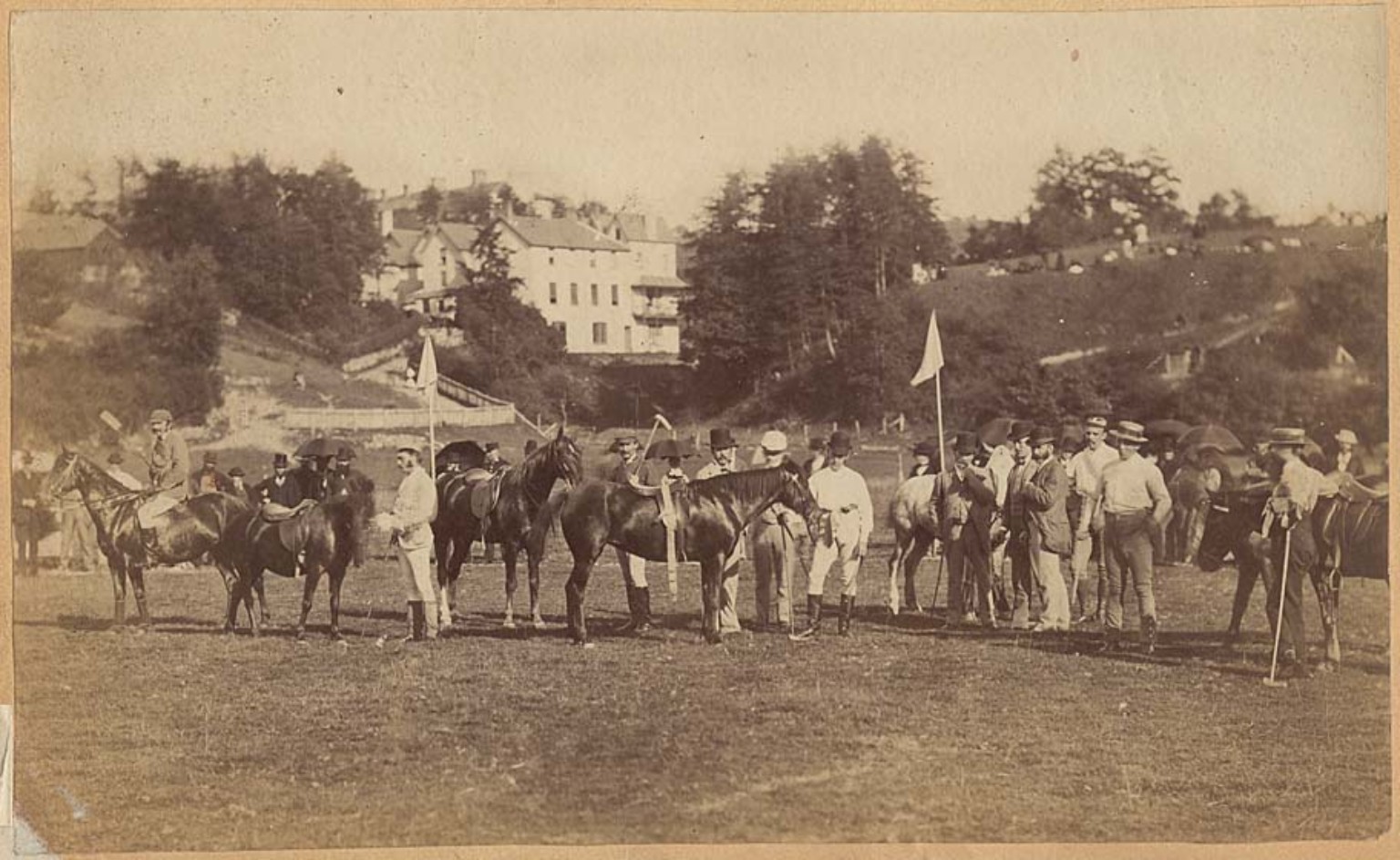
A surviving photograph from the 1870s shows preparations for polo on the Ddole, with Rock House rising behind. It is one of the finest visual records of the field because it captures the landscape before the later layers of football, agricultural shows and aviation were added. Polo belonged firmly to the fashionable world of the Victorian watering place, and the photograph demonstrates that the Ddole was already being treated as an organised recreational space rather than simply as meadowland.
In July 1881 the Herefordshire and Radnorshire Volunteers held a major review on what the press explicitly called the “racecourse belonging to the Rock House Hotel”. The site was considered large enough to drill a substantial battalion, and special railway arrangements were made for spectators. Cheap tickets were offered from stations between Knighton and Llandovery, and the newspaper went so far as to suggest that the ground would be well suited to an annual military camp.
By the early 1880s the racecourse was already functioning as something broader, one of the principal open public spaces in Llandrindod.
The Town Sports Ground
By the end of the nineteenth century the Ddole was increasingly serving the ordinary sporting life of the town. At Christmas 1898 Llandrindod Wells Reserves played Knighton Victoria there in a cup match which attracted what the Radnorshire Standard described as a huge attendance. Spectators paid fourpence and saw ten goals. The same report referred to the venue as the Rock House Ground and suggested it as a possible neutral site for an important regional cup fixture.
In September 1900 Llandrindod Football Club held its first annual athletic sports on the Ddole grounds. A large entry had been received, and there was talk that the noted Welsh runner Harry Cullum might compete. Three years later the Rock House Ddole hosted a hockey match between Llandrindod and Builth.
Football became increasingly regular. In December 1907 a replayed Welsh Amateur Cup tie between Llandrindod and Builth Wells was scheduled for the Rock House Ddole, while Llanwrtyd were due there on Boxing Day for a Mid-Wales League fixture. In November 1908 Llandrindod Wells County School played a local side known as the “Rabbits”, the school winning by four goals to two.
Cricket also found a place. During the Llandrindod Wells Intermediate School Old Pupils’ Association reunion in July 1909, a boys’ cricket match was played on the Ddole before tea and a tennis tournament at the school.
Perhaps the best evidence for the field’s place in everyday life comes from a letter printed in the Radnorshire Standard in December 1909. A correspondent complained about a spectator who regularly stood behind the Llandrindod goal and shouted unwanted advice at the home defenders. The writer remarked that he had attended all the matches played on the Ddole that season and knew exactly where the man would stand. It is a wonderfully ordinary glimpse of Edwardian Llandrindod, and it shows that the Ddole had developed a regular Saturday football culture with familiar players and returning spectators.
Racing Continues
The rise of football and other sports did not mean the disappearance of horse racing. In August 1906 the Llandrindod Wells Annual Galloway and Hurdle Races were advertised for the Rock House Grounds, with hurdle racing, trotting matches, pony races, horse-leaping contests and harness classes. Four years later, in August 1910, the Annual Galloway and Hurdle Races were again advertised there, accompanied by trotting matches and pony racing.
This matters because some later accounts have suggested that racing on the Rock House course effectively ended around 1880. The contemporary press shows otherwise. Whatever changes may have occurred in the organisation or importance of the meeting, horse racing remained part of the life of the Rock House Grounds well into the Edwardian period.
That makes what happened next all the more striking. Only three years after the 1910 race meeting, one of the best-known aviators in Britain was flying from the same field.
Gustav Hamel and the Arrival of Flight
On 6 August 1913 Gustav Hamel appeared at the Rock House Ddole. Hamel belonged to the first generation of famous British aviators and was already a national figure. His visit therefore represented something extraordinary for Llandrindod and for rural Radnorshire.
The event is unusually well documented. Powys Archives preserves photographs of Hamel at the Ddole, giving us a direct visual record of the day. A generation accustomed to trains, horses and increasingly motor cars could now see an aeroplane operating from a field which only a few years earlier had been hosting Galloway races.
Tom Norton was closely connected with this new enthusiasm for aviation. His Automobile Palace already embodied the arrival of motor transport in Llandrindod, and the aeroplane represented the obvious next frontier.
A second exhibition followed in August 1914, involving the Welsh aviator Vivian Hewitt. This occasion proved more dramatic. Hewitt was preparing to fly before a large crowd when his engine failed as he attempted to clear trees bordering the ground. His monoplane crashed and was badly damaged, although Hewitt himself escaped injury. Contemporary reporting preserved one wonderfully understated detail, after climbing from the wreckage he calmly lit a cigarette.
The timing could hardly have been more extraordinary. Britain had entered the First World War only days earlier, and the optimistic pre-war world of exhibition flying was giving way to a very different age of aviation.
Scouts, Royalty and the Ddole
Aviation was only one part of the Ddole’s interwar story. In August 1926 the first All-Wales Scout Camp was held on the Rock House Ddole, bringing another national gathering to the field.
On 6 August the Prince of Wales, later Edward VIII, arrived in his capacity as Chief Scout for Wales. The Shrewsbury Chronicle treated the occasion as historic and described it as Llandrindod Wells’s first royal visit. He was received at the railway station by Lord Glanusk and leading representatives of Radnorshire public life, while Girl Guides, Brownies and Cubs gathered to welcome him.
The occasion again demonstrates the flexibility of the Ddole. A field laid out for racing could become a national Scout camp, complete with royal ceremony, civic dignitaries and large crowds. For a brief period the meadow below Rock House became one of the principal public spaces in Wales.
The Showground of Radnorshire
The Ddole also became an important agricultural showground. In August 1927 the forty-eighth annual exhibition of the Radnorshire Agricultural Society was held there. Despite poor weather at the beginning of the day, the show achieved a record entry. There were strong classes of Hereford cattle and Kerry sheep, Shire horses, horticultural exhibits and an industrial section. The Llandrindod Wells Silver Band played, while large crowds gathered for the harness and jumping classes.
This was another meeting point between the spa town and rural Radnorshire. However fashionable Llandrindod might have appeared during the season, it remained the principal town of a deeply agricultural county. The Ddole allowed the farming world of the surrounding countryside to occupy the centre of the resort.
The following year, on 13 and 14 August 1928, the Welsh National Sheep-dog Trials were held on the Rock House Ddole. Doubles occupied the first day, while the second contained qualifying trials for international competition. The choice of Llandrindod was particularly appropriate, standing as it did between the world of the spa and one of the great sheep-farming landscapes of Mid Wales.
Sir Alan Cobham and the Aerodrome
On 31 May 1932 Sir Alan Cobham’s National Aviation Day came to Llandrindod Wells. The contemporary itinerary described the venue simply as the racecourse, a useful reminder that the field’s older identity survived even as aircraft were beginning to redefine it.
Cobham’s touring displays were intended to bring aviation to provincial Britain. People who might never otherwise have approached an aeroplane could watch flying displays, take passenger flights and imagine a future in which aviation might become part of ordinary life. At Llandrindod, that future was being demonstrated on ground already shaped by generations of public entertainment.
Within weeks the development became more serious. On 18 June 1932 the Kington Times reported that Captain Hattersley and Edgar W. Hart had flown from Manchester to Llandrindod Wells, landed on the Rock House Ddole, played a round of golf on the local links and flown home again that evening.
The same report stated that the Ddole had now been licensed as an official landing ground and that Llandrindod could claim to be “on the map as an airport”.
The phrase captures the optimism of the moment. The railway had made the Victorian spa possible. Now some in Llandrindod hoped that the aeroplane might create another transport revolution.
Tom Norton, Rock Park and Modern Transport
Tom Norton was central to that ambition. His Automobile Palace had long symbolised Llandrindod’s embrace of the motor car, but his interests extended naturally into aviation. In the early 1930s Rock Park Hotel and the adjoining aerodrome were being treated as part of the same enterprise, and Norton even advertised for a manager for the “hotel and aerodrome”.
That phrase is revealing. The Ddole was no longer simply a convenient field where enthusiasts occasionally landed. Aviation was being fitted into the tourist economy alongside hotel accommodation, motoring, golf and sightseeing.
One later recollection provides a particularly vivid image of the relationship between the aerodrome and Norton’s business. Walter Powell remembered a small aeroplane landing on the Ddole, having its wings folded and then being pushed through the streets of Llandrindod towards Norton’s premises. It is an extraordinary image, an aircraft brought down on the old racecourse and manoeuvred through the spa town towards the Automobile Palace.
The British Hospitals Air Pageant
The Ddole remained firmly on the national aviation circuit. On 22 May 1933 the British Hospitals Air Pageant visited Llandrindod Wells as part of a major touring campaign which staged flying displays, passenger flights and aerial demonstrations around Britain while raising money for hospitals.
Its appearance at Llandrindod is important because it shows that Cobham’s visit was not an isolated spectacle. By the early 1930s the Ddole had become a recognised provincial flying ground capable of attracting successive national aviation organisations.
A surviving photograph associated with the Llandrindod event appears to show a de Havilland DH.84 Dragon, although the exact identification requires caution. Even without relying upon that detail, the event itself confirms the growing place of aviation in the public life of the town.

A Working Civil Aerodrome
By 1933 the Ddole possessed more of the practical trappings of an aerodrome than might be imagined from its appearance as a grass field. Publicity described approximately twenty-five acres of usable ground, around 550 yards in length, with hangar accommodation. Aircraft owners were charged a landing fee of 2s 6d, hangarage cost five shillings for twenty-four hours, and petrol and oil were available on the field.
These details matter because they show that the Ddole had moved beyond the stage of occasional exhibition flying. For a short period it provided the basic services expected of a functioning civil landing ground.
Tom Norton later remembered a greater usable length, but his recollection was written many years after the event. The contemporary figure of around 550 yards should therefore be preferred as the best evidence for the formal aerodrome.
Universal Aircraft Services
The most ambitious attempt to establish commercial flying came in 1933. Universal Aircraft Services proposed basing two machines at Llandrindod from the beginning of August, an Avro 504K capable of carrying two passengers and a Bristol biplane carrying one. Contemporary trade reporting even published passenger-mile rates, evidence that the venture was intended as a genuine commercial operation rather than simply another attraction for visitors.
There were ambitions for air connections involving Cardiff, Birmingham and London, together with sightseeing flights over places such as the Elan Valley. Surviving material also points towards an advertised or proposed air connection between Llandrindod and Borth, although the precise nature of that service requires further confirmation from the original material.

The scheme was experimental and apparently short-lived. Llandrindod did not develop into a permanent regional airport, but for a brief period it seemed entirely plausible that a grass aerodrome beside the Ithon might connect the spa by air with major cities and other Welsh resorts.
The Aviators of the Ddole
Looking back in 1953, Tom Norton remembered a remarkable succession of aviation figures associated with Llandrindod. Alongside Gustav Hamel and Sir Alan Cobham he mentioned Campbell Black, Cathcart-Jones, Dorothy Spicer, Robert Kronfeld and visitors from the Northampton Aero Club.
Dorothy Spicer is a particularly interesting name in this context. She was one of the notable women of British interwar aviation, both a pilot and an aviation engineer. Robert Kronfeld, one of the leading gliding figures of his generation, reportedly came to Llandrindod to demonstrate the Drone aircraft. Norton also remembered Cobham bringing a substantial Handley Page machine to the field.
These recollections were recorded many years after the events and need to be treated accordingly, but they reinforce the extent to which the Ddole became known within the wider world of interwar aviation.
Why the Aerodrome Could Not Last
The Ddole was suitable for the aircraft of one generation, but aviation changed rapidly. Aircraft became heavier, faster and more demanding. Landing speeds increased, and the sort of open field which had been adequate for pioneer machines and light interwar aircraft became increasingly unsuitable.
Tom Norton understood this when he looked back on the aerodrome in 1953. In his view, changes in aircraft performance had rendered the field obsolete, although he believed it could still have accommodated helicopters.
The precise date of the final major flying display remains slightly uncertain. Later accounts variously point to 1936 and 1937, with the later event associated with Cathcart-Jones and Campbell Black. The safest conclusion is that aviation displays continued into the later 1930s, but the Ddole had reached the limit of what could realistically be achieved there.
By 1939 the aerodrome appears to have ceased operating. Because there were no hard runways or substantial permanent buildings, the field could revert remarkably easily to what it had always fundamentally been, a meadow.
The Aerodrome on Film
One of the most remarkable survivals is moving film of aircraft operating from Llandrindod. Thomas Charles Price, a Rhayader chemist and aviation enthusiast, filmed aircraft taking off from the aerodrome, providing a rare visual record of the period when the Ddole echoed to aircraft engines.
Powys Archives also preserves scrapbook material containing photographs described as planes landing at Llandrindod. The same collection includes material relating to the Prince of Wales’s Scout visit and sheepdog trials, making it one of the most valuable surviving visual sources for the changing uses of the field.
Back to Pasture
The sale of the Rock Park estate in 1948 provides an understated conclusion to the aviation period. Rock Park Hotel was sold for £37,000, while the Rock Ddole was offered separately and described simply as pasture. Extending to twenty-seven acres, it was sold subject to tenancy for £1,500 to the tenant.
The acreage is strikingly close to the approximately twenty-five acres advertised for the aerodrome during the 1930s. There is also a potentially important clue in earlier title material referring to a twenty-seven-acre enclosure allotment associated with the Rock House estate. The similarity is suggestive, although it would be premature to identify the two parcels without comparing the surviving estate plans.
What can be said securely is that by 1948 the former aerodrome had reverted formally to pasture.
The Horses Return
The return to pasture did not mean the end of public use. In the same year annual racing was again advertised on the Rock Ddole, with trotting events, named stakes and substantial prize money.
The revival was not short-lived. The annual Llandrindod meeting continued on the Rock House Ddole into the 1960s. When the August Bank Holiday was moved experimentally to the final Monday of the month in 1965, the Llandrindod meeting moved with it. Trotting became increasingly important during the 1960s and 1970s, linking Llandrindod with a lively circuit of meetings at Penybont, Knighton, Kington and Presteigne.
In 1973 Llandrindod joined those neighbouring centres in a local racing organisation. Almost a century after the Montgomeryshire Express had described the new course adjoining the Rock House Hotel, horses and spectators were therefore still gathering on substantially the same riverside ground.
There is something particularly satisfying in that continuity. The Ddole became famous through horses, embraced the aeroplane, reverted to pasture and then filled with horses again.
The Name of the Ddole
The name of the field changed gradually rather than through any obvious formal renaming. During the late nineteenth and early twentieth centuries newspapers frequently called it the Rock House Ddole, reflecting its relationship with the hotel above. Curiously, that name survived even after Rock House itself became better known as the Rock Park Hotel.
By the interwar years “Rock House Ddole”, “the Ddole”, “racecourse” and “aerodrome” could all be used for essentially the same landscape. By the post-war period the shortened form “Rock Ddole” was increasingly common.
This persistence of the older Rock House name is a familiar feature of local place-names. Buildings can change names, owners and purposes while the names attached to the surrounding landscape survive for generations.
One Field, Many Llandrindods
The importance of the Ddole lies in the fact that no single period owns it. It belonged to the fashionable Victorian spa, when polo players and racegoers gathered beneath Rock House, but it also belonged to local footballers, schoolboys, farmers, stockbreeders and sheepdog handlers. Scouts camped there, the Prince of Wales visited, and large crowds gathered for public spectacles.
For a time it also belonged to the aviation age. Gustav Hamel flew there before the First World War, Vivian Hewitt crashed at its edge and walked away, Cobham brought National Aviation Day, the British Hospitals Air Pageant followed, pilots flew in from Manchester to play golf, and Universal Aircraft Services attempted to create a commercial operation from the old racecourse.
None of these uses replaced what had gone before completely. They accumulated. The racecourse became a sports ground, the sports ground became a showground, the showground became an aerodrome, and after the aeroplanes disappeared the horses returned.
That is why the Ddole matters. Its history is not simply the story of a racecourse which later became an aerodrome. It is the history of Llandrindod repeatedly using the same landscape to meet the changing needs of the town.
Many of the buildings which defined Victorian and Edwardian Llandrindod have disappeared or altered beyond recognition. The Ddole is different. Its historical importance lies less in surviving structures than in the survival of the open landscape itself. The apparent emptiness of the field is precisely what allowed it to be reinvented so many times.
To look across that meadow beside the Ithon today is to look across ground which has known galloping horses, fashionable polo matches, Victorian athletics, football crowds, military drill, agricultural shows, barking sheepdogs, thousands of Scouts, royal ceremony and the sound of aircraft climbing away above the valley.
Few places in Llandrindod Wells have contained so many different versions of the town within the same field.
Related Essays
- Llandrindod Wells Hospital: From Cottage Hospital to County War Memorial
- Board and Lodging: The Boarding Houses of Llandrindod Wells
- Bowling in Llandrindod Wells: From the Spa Greens to Rock Park and the Indoor Game
- From the Pump House Links to Death or Glory: A History of Golf in Llandrindod Wells
- Llandrindod Grammar School: The County School and Its Lost Alexandra Road Building
Explore more Llandrindod Wells history
Continue with the Llandrindod Wells History guide, or follow the related essays above to explore the people, buildings and institutions that shaped the town.
Sources and Further Reading
The principal contemporary newspaper sources used in this essay include the Hereford Journal, 20 August 1864; South Wales Daily News, 23 August 1872 and 14 July 1881; Wellington Journal, 25 October 1873 and 22 May 1948; Montgomeryshire Express, 28 October 1873; Radnorshire Standard, 28 December 1898, 12 September 1900, 22 April 1903, 18 December 1907, 14 November 1908, 24 July 1909 and 4 December 1909; Brecon and Radnor Express and Carmarthen Gazette, 2 August 1906; Hereford Times, 6 August 1910; Shrewsbury Chronicle, 13 August 1926; Western Mail, 25 August 1927 and 19 April 1928; Kington Times, 18 June 1932 and 1 May 1948, together with contemporary aviation material relating to Universal Aircraft Services and the national flying displays of the 1930s.
Important archival material survives at Powys Archives, including photographs of Gustav Hamel on the Rock House Ddole on 6 August 1913, reference R/X/39/1–4; Llandrindod Wells Urban District Council material relating to Alan Cobham Aviation Ltd and National Aviation Day, reference R/UD/LW/A/285/1; and the Llandrindod Wells Library deposit containing photographic and scrapbook material relating to Scouts, sheepdog trials and aircraft landing at Llandrindod. Powys Archives also holds nineteenth-century plans and title material relating to the Rock House estate which may eventually allow the ownership history of the Ddole to be reconstructed more precisely.
Further visual material is held by Radnorshire Museum and People’s Collection Wales, including the important nineteenth-century photograph of polo on the Ddole. Surviving film made by Thomas Charles Price records aircraft operating from the Llandrindod aerodrome. Later recollections by Tom Norton and other local witnesses are valuable for understanding the aviation period, although where they differ from contemporary evidence the material recorded at the time has been preferred.