
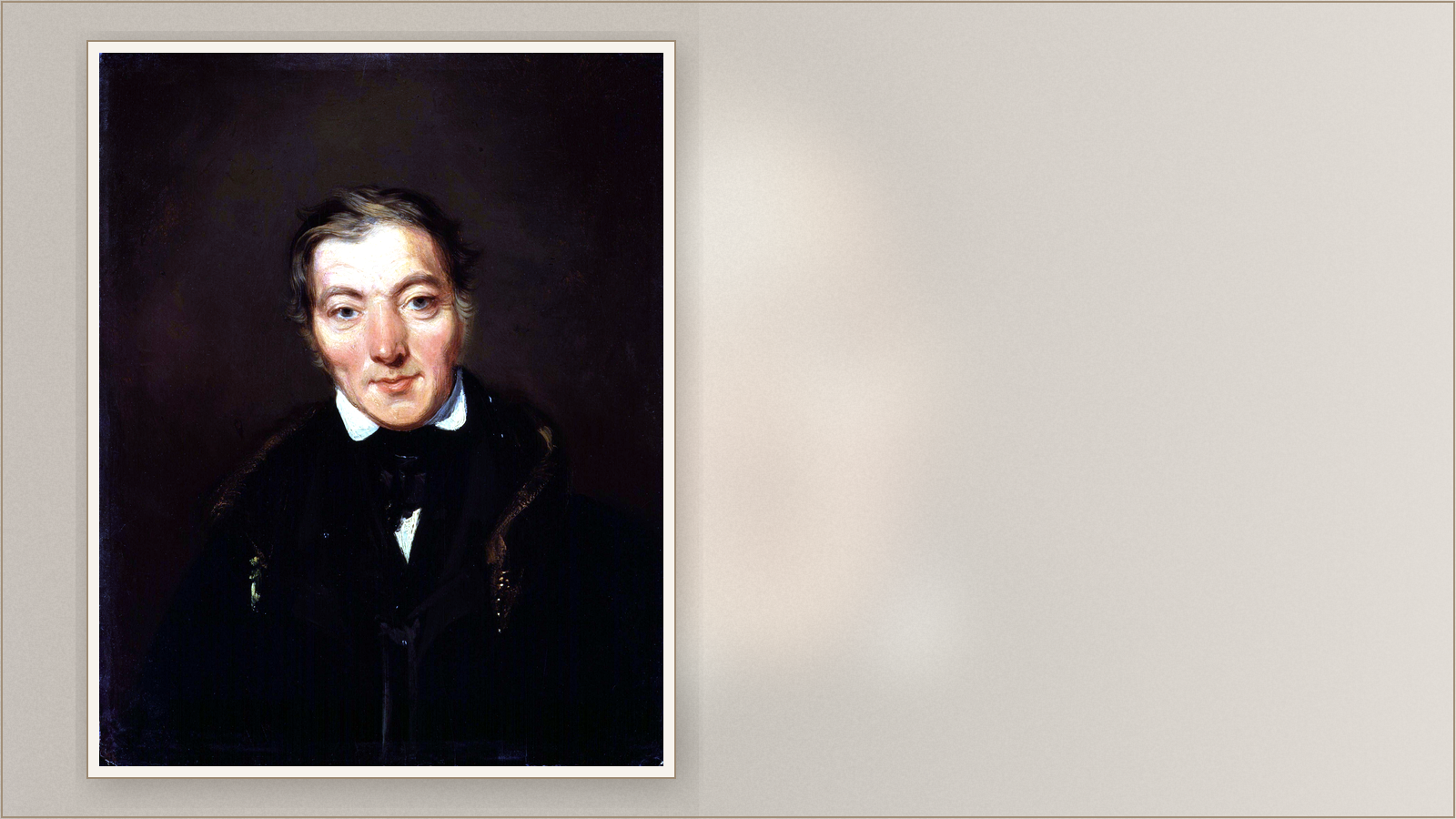
Robert Owen was born above a saddler’s shop in Newtown, Montgomeryshire, and died in the same town eighty-seven years later. Between those two points lay a life spent in Manchester, Scotland, London and the United States, a fortune made in cotton, an internationally celebrated experiment in industrial management, and a succession of increasingly ambitious attempts to reconstruct society.
He is often described as a founder of socialism, a father of co-operation and a pioneer of infant education. Each description contains some truth, although none quite captures him. Owen was neither a modern socialist nor simply a benevolent employer. He was a successful capitalist who became convinced that competition, inherited religion and the existing organisation of society had formed people badly. His answer was not charity alone, but the deliberate creation of a new social environment.
That conviction made him one of the most original reformers produced by Wales. It also led him into paternalism, failure and contradiction. New Lanark offered powerful evidence that industrial life could be made less brutal, but it remained a community governed from above. Owen denounced human misery while his mills processed cotton cultivated by enslaved labour. He spoke of universal harmony, yet often proved impatient with disagreement. His failures are therefore not incidental to his story. They reveal both the promise and the limitations of reform imposed according to a single man’s design.
From Newtown to Manchester
Owen was born on 14 May 1771, the son of Robert Owen, a saddler, ironmonger and postmaster, and Anne Williams, the daughter of a local farming family. Newtown was not yet the industrial town it would become during the nineteenth century. It was a small Montgomeryshire market centre serving an agricultural district, although textile production and trade were already part of its economy.
His background was respectable and commercially minded rather than impoverished. The several occupations followed by his father suggest the adaptable economy of a provincial market town, where craft, retailing and public service could exist within the same household. There was also, importantly, a tradition of organised mutual provision in the town before Owen was born. Newtown’s First Community Benefit Society had been established in 1762, its members subscribing for support in sickness, provision in old age and assistance with funeral costs. There is no evidence that this society directly produced Owen’s later co-operative philosophy, and it would be wrong to claim that it did. It does, however, remind us that mutual aid was not an alien idea in the community in which he grew up.
Owen’s childhood was intellectually richer than the familiar phrase that he received “little formal education” can suggest. Local traditions place his schooling at Newtown Hall, where he was said to have become a pupil assistant while still very young. He later recalled reading widely in the libraries of educated men in the town, including clergy, medical and legal figures, and claimed that histories, travel writing, biography and religious controversy occupied much of his attention. His doubts about orthodox Christianity, which later became one of the defining features of his public life, began surprisingly early.
Before leaving Newtown he also spent time assisting in a local drapery or haberdashery business, traditionally associated with the Tilsley sisters near the Bear’s Head. The detail is small, but suggestive. Owen’s life began among the retail, craft and commercial routines of Newtown, and in old age he would return to die at the Bear Hotel in the same town. The geographical circle was remarkably tight even if the world through which he travelled in between was not.
At about ten he left Montgomeryshire to become an apprentice to the draper James McGuffog at Stamford. The apprenticeship was formative in more than commercial terms. Owen learned habits of order, accuracy and stock control in a business dealing in high-quality textiles, while also enjoying access to McGuffog’s library. He later remembered reading for hours and regarded this period as important in the development of his religious scepticism. After Stamford he worked for Flint and Palmer on Old London Bridge, where the working day was long enough for him later to recall receiving only about five hours’ sleep. He then moved to Manchester after being offered a position at a salary of £40 a year.
It is tempting to locate his later philosophy fully formed in his Welsh childhood. The evidence does not permit that. Owen left Montgomeryshire too young, and his mature ideas emerged from a much wider encounter with commerce, machinery, Enlightenment thought and religious doubt. His origins nevertheless mattered. He was not the product of a university or metropolitan elite, but of a literate provincial trading family. Throughout his life he retained the self-confidence of the self-educated man, impatient with inherited authority and persuaded that practical observation could expose truths missed by established institutions.
Manchester revealed his exceptional ability. Still only about nineteen, Owen borrowed £100 from his brother William and entered a partnership manufacturing spinning mules. He later admitted that he initially knew little about the machinery, but he took responsibility for accounts, wages, supervision and organisation. When the partnership dissolved, he received several mules as his share and operated them himself. The episode is important because it reveals a characteristic that remained with him throughout his life. Owen was willing to enter a complicated system he did not yet fully understand and impose order upon it through observation, confidence and management.
He soon became manager of Peter Drinkwater’s Bank Top Mill, an advanced industrial establishment employing several hundred people. The mill formed part of the first generation of large steam-powered cotton factories, and Owen acquired direct experience of machinery, ventilation, fire precautions, labour discipline and the organisation of a large workforce. By the time he later arrived at New Lanark, he was therefore not a philanthropic amateur experimenting with industry. He was already an accomplished industrial manager.
Manchester and the Provincial Enlightenment
Owen’s intellectual development in Manchester also deserves greater attention than the simple story of a gifted young manufacturer. In 1793 he joined the Manchester Literary and Philosophical Society, one of the most important provincial learned societies of the age. Its circle included physicians, scientists, dissenting ministers and reformers such as Thomas Percival, Thomas Barnes, John Ferriar and John Dalton. Questions of public health, education, industrial conditions and the moral consequences of rapid urbanisation were being discussed there with unusual seriousness.
The Manchester Board of Health emerged from the same climate. Its investigations into sanitation, factory conditions and child labour contributed to the wider movement for early factory regulation. Owen’s ideas did not therefore emerge in intellectual isolation. Manchester placed him within a provincial Enlightenment culture which treated environment, health and human behaviour as subjects capable of rational investigation. It is even possible that information concerning David Dale’s settlement at New Lanark circulated within this network before Owen became personally involved with it.
This context helps explain a central feature of Owen’s later thought. He did not begin with abstract political theory and attempt to impose it upon industry. He began with industrial practice and increasingly generalised from it. The manager who learned that ventilation, organisation, discipline and welfare could alter the performance of a factory became the reformer who believed that the whole of human character might be altered by changing the environment in which people lived.
New Lanark and the Managed Community
In 1799 Owen married Caroline Dale, daughter of the Scottish manufacturer and philanthropist David Dale. In the same year, Owen and his partners purchased Dale’s cotton mills and village at New Lanark, on the River Clyde. Owen assumed management at the beginning of 1800.
New Lanark was already an important industrial settlement, and some of its more humane features originated with Dale. Owen did not create the village from nothing. What he did was enlarge its social purpose and turn it into the testing ground for his developing theory of character.
The community supported about 2,000 people when he arrived, including children brought from poorhouses to work in the mills. Owen ended the recruitment of pauper apprentices and eventually excluded children under ten from factory employment. He improved housing and sanitation, established sickness provision, provided reasonably priced food through the village store, and invested heavily in education. During a commercial stoppage caused by the American embargo of 1806, he continued to pay the workforce, an act which helped to win confidence in a community initially suspicious of its new manager.
The mills remained profitable. This was crucial to New Lanark’s reputation. Owen was able to argue before visitors drawn from British and European public life that better conditions need not destroy commercial success. New Lanark is now a UNESCO World Heritage Site, recognised as an industrial community whose influence extended far beyond Scotland.
The ownership of New Lanark also changed in ways that reveal the tensions within Owen’s project. Disputes with earlier partners over expenditure and social improvement eventually led to the mills being auctioned in 1813. Owen then assembled a striking new partnership, which included the philosopher Jeremy Bentham, the Quaker philanthropist William Allen and other reform-minded investors. The property was acquired in 1814 for about £114,100. The arrangement attempted to reconcile private capital with a consciously social purpose, investors receiving a limited return while resources were directed towards education and community improvement.
Yet New Lanark was humane by the standards of its age, not democratic by those of ours. Owen believed that people were formed by circumstances, but also that those circumstances should be arranged by enlightened superiors. The celebrated “silent monitor”, a four-sided coloured block displayed at each worker’s station, recorded the manager’s assessment of conduct and performance. It replaced some harsher forms of punishment, but it also made supervision continuously visible.
This was benevolent paternalism in its most accomplished form. Workers benefited from cleaner surroundings, schooling and greater security, but they did not govern the settlement. Owen’s achievement was to widen the accepted responsibilities of an employer. His limitation was that the good society still depended upon the judgement of the good proprietor.
Education and the Formation of Character
Owen’s central belief was simple and radical: character was made chiefly by circumstances rather than freely chosen by the individual. Poverty and disorder were therefore not proof of innate moral inferiority. They were the predictable results of bad surroundings, insecurity, ignorance and misdirected education.
He set out this argument in A New View of Society, published in four essays between 1813 and 1816. At New Lanark it acquired physical form. The Institute for the Formation of Character opened in 1816, followed by the School for Children. The educational provision extended from early childhood into adult life and included music, dancing, exercise, natural history and the use of maps and objects. Owen opposed corporal punishment and rejected the idea that young children should be frightened into obedience or confined to rote learning.
The infant school accepted children at an exceptionally young age. Owen’s stated principles were that they should not be beaten, should be treated kindly and should be encouraged to make one another happy. His choice of James Buchanan as one of the early infant teachers is revealing. Buchanan was valued less for scholarly distinction than for patience, warmth and an instinctive sympathy with children. Owen believed that the emotional atmosphere of a classroom mattered as much as formal instruction.
The school was among the pioneering infant educational institutions in Britain. Its importance lay not merely in admitting young children, but in the conception of childhood which supported it. Education was intended to form sociable, rational and physically healthy people. It was part of the organisation of a whole community, not simply the acquisition of skills required by the mill.
There remained an unmistakable tension. If character could be produced by controlling environment, education might become a means of liberation, but it might also become a method of social engineering. Owen had immense confidence in the power of correct formation and rather less interest in the possibility that reasonable people might reject his conclusions. That tension followed him from New Lanark into his later communities.
Factory Reform and the Limits of Influence
The end of the Napoleonic Wars brought unemployment and distress, while industrialisation intensified public concern about the employment of children. Owen sought to extend principles associated with New Lanark through legislation. His proposals included a minimum age for factory employment, limits upon working hours, education for working children and an effective system of inspection.
The Cotton Mills and Factories Act of 1819 represented a partial victory, but one greatly weakened by Parliament. It prohibited the employment of children under nine in cotton mills and limited those aged between nine and sixteen to a twelve-hour working day. It lacked an effective system of enforcement. Owen had helped establish the principle that the state could intervene in the relationship between factory owner and worker, but the statute fell far short of the protection he sought.
This episode demonstrated both his growing national standing and the resistance facing factory reform. Many manufacturers treated regulation as an attack upon property, parental authority and British competitiveness. Owen’s practical experience gave him credibility, but it could not overcome interests embedded within the industrial economy.
His reputation as a practical reformer endured for decades. In 1846 Lord Brougham presented one of Owen’s petitions to the House of Lords and, while making clear that he did not endorse all of Owen’s doctrines, praised his personal character and the example of New Lanark. Brougham repeated Owen’s claim that during many years of managing a population of several thousand he had scarcely required the intervention of magistrates in civil or criminal disputes, and publicly associated him with the establishment of infant schools in Britain. The claims should be treated cautiously, not least because Owen was the ultimate source for some of them, but their repetition in Parliament shows the stature he still possessed.
Religion and the Breaking Point
Owen’s public standing suffered a more serious blow in August 1817. Addressing meetings at the City of London Tavern, he attacked the world’s established religions as sources of error, division and hostility. His religious scepticism was not an incidental eccentricity. It followed from his theory of character. If belief was formed by inherited circumstances, Owen reasoned, no person could deserve praise or punishment merely for possessing a particular creed.
There was moral seriousness in that argument, but its public expression was politically disastrous. Supporters who could admire an enlightened manufacturer drew back from a man who appeared to challenge Christianity itself. In a society where public authority, philanthropy and moral order remained closely connected with religion, Owen had crossed a line.
The dispute also entered the management of New Lanark itself. William Allen and several of Owen’s partners were committed Christians and became increasingly uncomfortable with the secular direction of the schools. Allen pressed for the restoration of Bible teaching and objected to aspects of the educational programme. By the 1820s religious disagreement had become one of the issues dividing Owen from his partners, and his formal connection with New Lanark ended in 1829.
The episode complicates any easy attempt to present him as the direct expression of Welsh Nonconformist values. Owen shared with many religious reformers a belief in education, moral formation and disciplined community, but he rejected the theological foundations upon which they rested.
Even so, the label “atheist” can be too simple if applied across the whole of his life. Owen rejected revealed and institutional religion, but some of his later language approached a broad deism or belief in a universal creative power. In old age he turned towards spiritualism. His intellectual journey was therefore not a straightforward movement from faith to unbelief. He wanted a universal moral system capable of replacing sectarian division. His confidence that such a system could be identified and applied was typical of the man. Owen was rarely troubled by doubt once he had reached a conclusion.
Villages of Co-operation and the American Experiment
After 1817 Owen moved beyond the reform of individual factories. In response to post-war distress, he proposed self-supporting “villages of co-operation”, communities in which agriculture, manufacture, education and common welfare would be brought together. What began as a plan for unemployed workers developed into a much broader alternative to competitive society.
His fame by this stage was international. In the United States he did not address only small radical audiences. On 25 February and again on 7 March 1825 he delivered discourses in the Hall of the United States House of Representatives. The published account recorded the presence of the President, the President-elect, cabinet officers and members of Congress. Owen was effectively presenting a plan for social reconstruction before the political elite of the American republic.
His most famous experiment began later that year at New Harmony, Indiana. Owen purchased an existing settlement and several thousand acres from the Harmony Society, a German religious community, and attempted to establish a new society based upon common interest, rational education and co-operation.
Owen understood the venture in revolutionary terms. On 4 July 1826, the fiftieth anniversary of American independence, he delivered what became known as his “Declaration of Mental Independence”. Adapting the political symbolism of the Revolution, he called for liberation from what he regarded as three great inherited evils, conventional religion, private property and the existing institution of marriage. New Harmony was therefore more than an economic experiment. Owen imagined it as part of a second revolution, this time directed at the structures which shaped human thought and conduct.
The settlement, however, moved rapidly from aspiration to instability. A preliminary constitution in 1825 attempted to balance contributed property, labour and capital with a mixed system of appointed and elected authority. A more explicitly communal constitution followed in February 1826. Owen had originally envisaged a period of preparation before complete communal organisation, but the experiment accelerated before habits, expectations and systems of authority had settled. His son William expressed early doubts about whether people formed by conventional society could adapt quickly enough to communal life.
New Harmony attracted reformers, educators, scientists and idealists, but also people with sharply different expectations. Its constitution changed repeatedly, authority was uncertain, and the community lacked the cohesion and economic discipline required to survive. Owen’s absences and his faith that a transformed environment would quickly produce harmonious conduct deepened the difficulties. The communal experiment had effectively broken apart by 1827.
It was a financial and organisational failure, but not an empty one. New Harmony endured as a centre of education and scientific life through the work of those who remained, including members of Owen’s family and associates of the educational reformer William Maclure.
The later careers of Owen’s children make this especially clear. Robert Dale Owen became a writer, reformer, politician and diplomat in the United States. David Dale Owen became an important geologist and federal geological surveyor. Richard Owen also became a geologist and academic, later serving as the first president of Purdue University. The communal structure of New Harmony failed, but the intellectual community assembled around it contributed to American science, education and reform for decades afterwards.
New Harmony also revealed a fundamental weakness within Owen’s method. New Lanark had succeeded under experienced management, established production and clear authority. New Harmony attempted to create social unity before its members had agreed how power, property and work should be organised. Owen understood how to manage an existing industrial community. He was less successful at persuading a collection of independent people to surrender their competing interests to his larger vision.
Owenism, Labour and Co-operation
Returning to Britain with much of his fortune lost, Owen entered the most openly radical phase of his life. His followers, the Owenites, became active in co-operative societies, education, trade unionism and campaigns for a “New Moral World”.
The labour exchanges associated with this movement deserve more than passing mention. The National Equitable Labour Exchange opened in Gray’s Inn Road in London in 1832, followed by another at the Rotunda in Blackfriars Road and a provincial branch in Birmingham. Goods were valued using labour notes intended to represent the quantity of labour embodied in their production. The experiment attempted to remove profit-taking and conventional money from exchange, but it struggled with questions of valuation, quality, demand and administration. Owen was not the sole inventor of the idea, and earlier co-operators had experimented with related schemes, but his name gave labour exchange a national prominence it had not previously possessed.
In 1834 he became associated with the Grand National Consolidated Trades Union, an ambitious attempt to unite working people across occupations. It collapsed within months. Owen’s relationship with organised labour was always complicated. He admired collective action when it pointed towards social reconstruction, but disliked political conflict and class antagonism when they escaped the orderly path he preferred.
This helps explain his uneasy relationship with Chartism. Owen opposed the Chartist emphasis upon parliamentary and political reform, believing that social and economic transformation mattered more than constitutional change. Yet Owenism and Chartism overlapped among working-class radicals, lecturers and organisers. The distinction mattered less on the ground than it did in Owen’s own theory.
For Montgomeryshire the connection is particularly striking. Newtown, Owen’s birthplace, became the scene of the first major Chartist demonstration in Wales on 10 October 1838. Thomas Powell of Newtown was among the important local organisers, moving within wider radical networks connected with figures such as Henry Hetherington. Owen himself would not have approved of all Chartist methods or priorities, but the language of social criticism with which his name had become associated had, in another form, returned to the town he had left as a child.
Owen’s relationship to the modern co-operative movement requires careful wording. He did not invent co-operation, nor did he establish the Rochdale Equitable Pioneers Society of 1844, whose practical rules became the foundation of the modern movement. His contribution was intellectual and inspirational. He helped make co-operation part of a far-reaching criticism of competitive society, and Owenite lecturers and organisations spread that language across Britain.
The eventual success of consumer co-operation depended upon methods more limited and workable than Owen’s comprehensive communities. The Rochdale Pioneers concentrated upon honest trading, member control, shared surplus and careful administration. In one sense, their achievement fulfilled part of Owen’s vision. In another, it succeeded by abandoning his desire to remake the whole of society at once.
Harmony Hall and the Last Utopia
New Harmony did not cure Owen of his faith in the planned community. His last major attempt to give physical form to the New Moral World came at Queenwood in Hampshire. In 1839 land was leased for a community associated with the Universal Community Society of Rational Religionists, and Owen became closely involved in the development of what was generally known as Harmony Hall.
The project was physically ambitious. The estate initially comprised more than 500 acres, and an enormous H-shaped building was designed to accommodate a much larger population than ultimately settled there. Harmony Hall contained scores of rooms and stood within a landscape of agricultural improvements, walks and communal facilities. It was intended not merely as a residence, but as the architectural expression of a new social order.
Yet many of the difficulties seen at New Harmony reappeared. The land was not ideally suited to the intended agricultural system, the settlement was remote from major industrial markets, too few people with the necessary practical skills joined, and the cost of construction became excessive. Owen once again placed great faith in the power of environment while underestimating economics, geography, administration and the stubborn diversity of human motives. By the mid-1840s the community had collapsed financially.
The failure is especially revealing because it came late in Owen’s life. He was no longer the inexperienced social visionary who could explain away New Harmony as an early experiment. He had decades of industrial and reforming experience behind him. Yet he still believed that rational surroundings, correctly organised, could overcome the inherited habits of competitive society. Harmony Hall therefore exposes both the strength and the weakness of his thought. Owen never lost faith in the perfectibility of social arrangements, but he remained prone to treating practical resistance as a defect to be engineered away.
The buildings acquired an interesting afterlife. Harmony Hall became Queenwood College, an innovative educational institution known for a strong scientific curriculum. As at New Harmony, the original communal scheme failed while some of the educational and intellectual energy surrounding it survived in another form.
The Moral Contradictions of Cotton
No modern assessment of Owen can end with New Lanark’s schools and clean streets. The prosperity which financed his reforms came from cotton, and much of the cotton consumed by British mills was grown by enslaved people in the United States, Brazil and the Caribbean. New Lanark formed part of that Atlantic economy.
Owen did not own a plantation, but distance from enslavement does not remove the connection. More troublingly, during the emancipation debates of the late 1820s he sometimes adopted arguments favouring gradual improvement rather than immediate freedom. His universal language of environment and human character did not lead him consistently to the moral clarity that slavery required.
This does not erase his reforms. It places them within the economic world that made them possible. Owen could perceive the degradation created inside the British factory more readily than the coercion embedded in its raw material. The contradiction is historically important because it warns against treating benevolent industrialism as detached from empire and Atlantic slavery.
Return to Newtown
Owen remained active into extreme old age, lecturing, publishing and pursuing schemes which repeatedly outran his resources. His final public appearance came at the meeting of the Social Science Association in Liverpool in October 1858. Lord Brougham introduced him, but Owen was by then so frail that he managed only a few words before becoming too weak to continue.
From Liverpool he travelled back to Newtown and took rooms at the Bear Hotel. The choice gave the end of his life a striking local intimacy. He was dying within the town in which he had spent his childhood, close to the commercial world from which he had first emerged. Even then, according to later accounts, his instinct was still towards reform. He reportedly asked the rector to arrange a public meeting so that he might speak about improving local schools.
He died at Newtown on the morning of 17 November 1858, with his eldest son Robert Dale Owen beside him. Robert Dale later placed the time at about 6.45 in the morning. Owen was buried on 22 November in the old churchyard of St Mary’s, the burial being recorded in the Newtown parish register.
The funeral itself reveals something of his place in local memory. Contemporary accounts describe a deliberately simple procession in which elderly townspeople, including some who remembered him from earlier life, took part. Shops in Newtown reportedly closed their shutters as a mark of respect. There was also an inevitable religious tension. Owen, who had spent decades attacking organised religion, was buried with Anglican rites, and some of his radical associates objected. Thomas Allsop is said to have refused to enter the church. A funeral card recording the order of procession survives, an unusually tangible document from the final act of his life.
His return gives the life a satisfying geographical shape, although it should not be mistaken for evidence that Wales remained the principal arena of his mature work. Owen was Welsh by birth and formation, British in his industrial career, and international in ambition. His historical importance lies partly in that movement from a small Montgomeryshire town into the largest moral and economic questions of the industrial age.
Newtown itself would eventually become an industrial centre, transformed by textile manufacture and the entrepreneurial energy of the Pryce Jones family. Owen therefore belongs to the town’s history in more than a commemorative sense. His life connected the commercial culture of the eighteenth-century market town with the industrial and social upheavals of the nineteenth century.
Memory, Memorial and the Making of Robert Owen
Owen’s reputation did not end with his burial. Within the co-operative movement his grave became a place of memory and, in effect, pilgrimage. By the late nineteenth century many co-operators considered the original grave insufficient for a man they regarded as one of their intellectual forebears. George Jacob Holyoake and others helped organise the memorial eventually erected over the grave in 1902 on behalf of the co-operative movement.
That commemoration illustrates an important distinction between Owen the historical figure and Owen as later generations chose to remember him. The co-operative movement emphasised the humane employer, the advocate of education and the critic of competition. Less easily accommodated were the failures of New Harmony and Queenwood, his authoritarian paternalism, his hostility to organised religion and the contradictions of the cotton economy. Public memory simplified a life which history makes more complicated.
Newtown eventually gave Owen a more visible civic memorial. The statue erected in 1956 depicts him with a child sheltering beneath his cloak, a deliberate representation of education, protection and benevolent reform. The commission had a long history. A new memorial committee was established in 1950, the Co-operative Union provided funding, and the sculptor Gilbert Bayes received the commission in 1951. After Bayes died in 1953, William Charles Holland King completed the work.
The memorial itself remained capable of provoking debate because Owen’s religious views were never entirely forgotten in his home town. In 2024 the statue and associated memorial garden boundary wall were formally listed for their architectural and historic interest. More than two and a half centuries after his birth, Newtown therefore continues to negotiate the meaning of a man who left the town as a child but became one of the most internationally recognised Welsh-born reformers of the industrial age.
Reform, Responsibility and Control
Robert Owen’s greatest insight was that social arrangements are neither natural nor inevitable. Factories, schools and communities produce particular forms of behaviour because people have designed them in particular ways. If bad environments formed damaged lives, different environments might form healthier ones.
That belief helped enlarge nineteenth-century arguments about education, factory regulation, co-operation and the responsibilities of employers. New Lanark gave those arguments a visible example. Owen showed that a profitable industrial enterprise did not require the youngest children to labour, nor its workforce to live without education, sanitation or communal provision.
His legacy is nevertheless more challenging than a catalogue of reforms. He wanted to emancipate people from the circumstances that shaped them, but commonly imagined their emancipation being organised from above. He criticised inherited dogma while acquiring the certainty of a prophet. He preached universal benevolence while remaining entangled in the economy of slave-grown cotton. His grand communities failed, while narrower co-operative institutions endured.
These contradictions do not make Owen less significant. They make him more intelligible. He belonged to the first generation forced to confront industrialisation not simply as a method of producing wealth, but as a system which formed human beings.
From Newtown to Manchester, New Lanark, New Harmony and Queenwood, Owen insisted that economic life carried moral responsibilities. More than two centuries later, arguments about working conditions, early education, corporate power and the obligations of employers remain recognisably his arguments. The world did not become the harmonious community he imagined. The question at the centre of his life, what kind of people our institutions are designed to produce, remains unanswered.
Related Essays
- David Davies, 1st Baron Davies of Llandinam (1880–1944): Wealth, Duty and the Search for an Enforceable Peace
- Arthur Charles Humphreys-Owen (1836–1905): Land, Liberalism and Public Duty in Victorian Montgomeryshire
- Clement Davies (1884–1962): Liberal Leader and MP for Montgomeryshire
- David Gibson-Watt (1918–2002) of Doldowlod: War, Politics and Welsh Unionism
Explore more Welsh history
Browse more research in Essays and Notable People of Mid Wales.
Sources and Further Reading
Cole, G. D. H., The Life of Robert Owen (London, 1925). Hampshire Gardens Trust, research on Queenwood College and Harmony Hall.
Hansard, House of Lords debates, 14 August 1846. Indiana State Library, New Harmony collections and Robert Owen material.
Morris, Michael, “The Problem of Slavery in the Age of Improvement: David Dale, Robert Owen and New Lanark Cotton”, in Slavery and the Scottish Enlightenment (2018). National Co-operative Archive, Robert Owen Collection.
Newtown and Llanllwchaiarn Town Council, material relating to the Robert Owen statue and its listing. Newtown Heritage Trail, material on Robert Owen and the First Community Benefit Society.
OpenLearn, “Robert Owen and New Lanark”. Owen, Robert, A New View of Society; or, Essays on the Principle of the Formation of the Human Character (1813–1816).
Owen, Robert, The Life of Robert Owen Written by Himself (1857–1858). People’s Collection Wales, Robert Owen funeral material.
Robert Owen Museum, Newtown. Siméon, Ophélie, Robert Owen’s Experiment at New Lanark: From Paternalism to Socialism (Cham, 2017). Special Collections, University of Southampton, Queenwood College material. UK Parliament, “Early Factory Legislation”.
UNESCO World Heritage Centre, “New Lanark”. Williams, Chris, and Noel W. Thompson, eds, Robert Owen and His Legacy (Cardiff, 2011). Dictionary of Welsh Biography, “Robert Owen (1771–1858), Utopian Socialist”.