
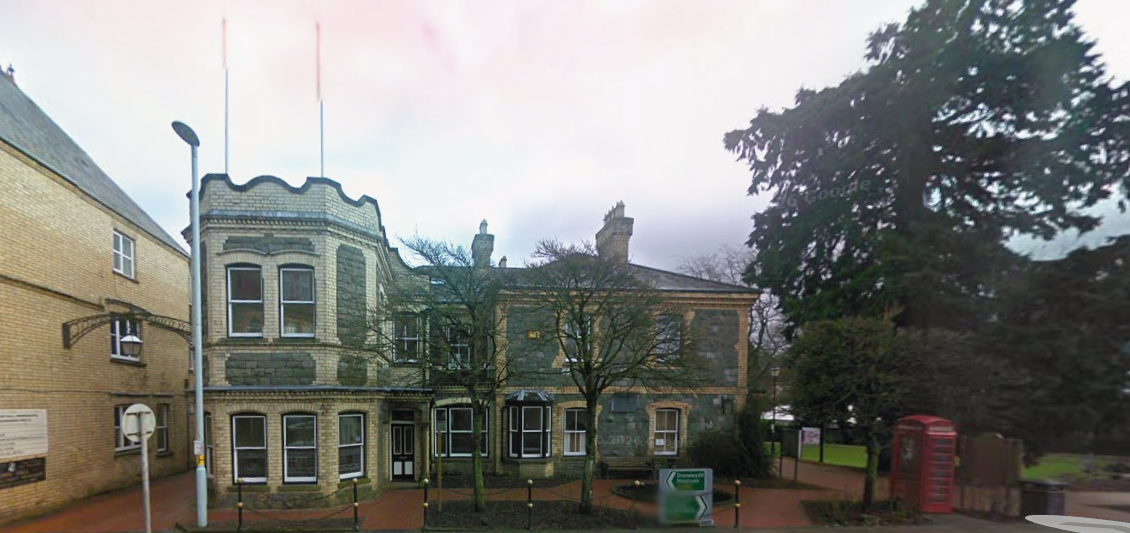
When I joined the Radnor Citizens Advice Bureau in Llandrindod Wells in early 2000, I was eighteen years old. At the time, nothing about the office seemed unusual. The handwritten case files, the filing cabinets, the fax machine, the single computer, the paper diaries, the postage scales and the constant hum of the photocopier were simply part of the working environment. Only with the distance of more than a quarter of a century does the setting reveal itself as something historically distinctive. I had entered the voluntary sector at a moment when an older model of local civic service was still fully alive, but already beginning to give way to a more professionalised, centralised and bureaucratic culture.
This essay considers the bureau as an institution and what its closure represented. For a detailed reconstruction of its later working life, see The Last Years of Radnor Citizens Advice, 2001–2007.
Radnor CAB occupied a small part of the Old Town Hall building, the former Brynarlais, which had originally been the home and surgery of Dr William Bowen Davies before becoming Llandrindod’s Town Hall in 1910. From memory, I always assumed that one large reception room had been subdivided into four smaller rooms. The reception area was little more than a narrow corridor with a chair or two and a small hatch opening into the main office.
Behind that window was the main office. Three desks filled the room: one for the manager, one for an adviser and one for administration. Each desk had a telephone. There was one computer and printer for the entire bureau, a fax machine and a large photocopier. Around seven filing cabinets dominated the remaining space. Three contained the vast adviser manuals, while four held live client files. A small fridge sat in the corner, with a kettle, mugs, tea and coffee resting on top. The same room served as office, records centre, telephone exchange, typing area and refreshment space.
Across the reception area was the main interview room. It contained the stationery cupboard and one or two filing cabinets storing completed client files. These files had to remain dormant for around seven years before they could be destroyed. A further office, entered from the main corridor of the Old Town Hall, was incredibly small and unusually dark because it had no windows at all. Every other part of the CAB had natural light coming through stained glass windows. They allowed light in but offered no view outside, and none of them opened.
I cannot remember any central heating. In winter, the offices were warmed by portable Calor gas heaters, whose smell became part of the atmosphere of the building. The whole setting was practical, improvised and rather old‑fashioned even by the standards of the time, yet nobody thought of it as remarkable.
We shared the building with Llandrindod Wells Town Council and the Tourist Information Centre. The upper floor was occupied by Mid Wales Business Support, which offered advice and funding guidance to small businesses. Upstairs also contained a room dedicated to Powys County Council’s internal IT support. It was filled with huge server boxes, wires and technical machinery. Powys County Council provided the internet connection for the building, although the contrast between that room and the CAB below could hardly have been greater. In our office, the internet was scarcely used.
The staffing structure was equally lean. The bureau was led by a highly experienced female manager, probably in her forties or early fifties, who worked full time. She handled the financial side of the organisation, supervised the advisers and provided advice on more difficult cases. There was also a deputy manager, present perhaps two or three days each week, and me, working part time. Beyond that, the service depended overwhelmingly on volunteers.
On most days, two volunteer advisers would be present. Across the week, that probably meant around ten regular advisers in total. There were no salaried specialists. No paid debt adviser, no dedicated benefits officer, no specialist project worker. The advisers were generalists who dealt with whatever problems clients brought through the door. The administrative side was similarly mixed. Alongside me were one or two long‑term volunteers and a succession of short‑term Jobcentre placements.
The volunteers were the heart of the organisation. Many had already completed substantial careers. Among them were a retired fire chief, two retired teachers who were close friends, a retired magistrate and a former Royal Navy officer. They brought with them a particular kind of confidence and judgement. Their instinct was practical. A client arrived with a problem, they listened, worked out what could be done, checked the relevant information and acted. Difficult cases were referred to the manager, but the overall culture was one of personal responsibility rather than elaborate process.
Nearly every volunteer worked a fixed day. Advisers usually committed to a full day, spending the morning seeing clients and the afternoon working on case files. Administrative volunteers also tended to come in on regular days. This gave the office a strong sense of continuity. People knew one another well, developed routines and became part of the fabric of the organisation rather than simply filling temporary gaps.
The working day itself had a clear rhythm. Most people arrived at around nine in the morning, while the office opened to the public at about ten. That first hour was used to prepare for the day. There were two principal paper diaries. One recorded which staff and volunteers were present, their hours and any absences or notable events. The other was the client appointment diary. One of the first administrative tasks each morning was to check the appointments, locate the paper files for existing clients and place them into the pigeonholes of the advisers who were due to see them.
The atmosphere before opening was usually relaxed. Tea or coffee would be made, and conversation would range from family matters to local news or whatever had appeared in the newspapers. Lunches were usually packed lunches, eaten informally while people talked. Like any workplace, the office could become tense, particularly when something had been missed or the manager was having a bad day, but the general atmosphere when I first joined was welcoming and supportive.
Smoking was not permitted inside the building, but many people still smoked. Coffee breaks therefore often moved outside. A few of us would gather near the entrance to the Old Town Hall, mugs in hand, talking and smoking before returning to work. At the time it was simply a normal part of office life. Looking back, it now seems another small marker of how different workplace culture was at the beginning of the century.
The bureau was open to the general public Monday to Friday in the mornings, from around ten until one. The afternoons were kept free so that advisers could carry out the casework generated by those appointments. When somebody arrived, they rang a doorbell in reception and an administrator came out to speak to them. In practice, the administrative team acted as gatekeepers. Appointments were sought after, so we first had to establish whether the matter was one the CAB could properly deal with. Basic details were taken, and if the problem was outside our remit the person would be signposted elsewhere. We did not provide legal advice, for example, and some matters were clearly better handled by another organisation. If the enquiry was appropriate, an appointment would be made, either in person or by telephone.
The service was intensely place‑based. I do not remember home visits being undertaken during this period. Clients came to the Old Town Hall, sat in the narrow reception area and waited to be seen. Once an adviser took on a case, it normally became that adviser’s responsibility. Cases were not routinely shared around. The adviser would interview the client, gather the facts and then often come back into the main office to consult the information manuals. They might discuss the proposed course of action with the manager before returning to the interview room and explaining what could be done.
If the case was taken on, a physical paper file would be opened. From that point, the adviser maintained it. They might write to creditors, negotiate repayment arrangements, help with benefit claims, assist with forms or correspond with public bodies. Most of the work, from memory, concerned debt and benefits. Debt cases often involved drawing up budgets and repayment plans, while benefits work frequently meant helping people complete forms that could run to many pages and often resembled small books.
The bureau’s information system was entirely physical. There was only one computer and it was used almost exclusively for typing letters. We had email, but it was still new enough to be checked only occasionally, perhaps once a week. I do not remember the internet being used for advice work at all. Advisers relied instead on the huge information manuals stored in filing cabinets, along with telephone books and annual directories.
Those manuals were maintained in a way that now seems almost unimaginable. Every few weeks, or roughly once a month, updates would arrive from the national organisation. They were printed on sheets of paper. We had to cut out the revised sections with scissors and glue them over the superseded text in the manuals. It was, in effect, a paper database updated manually by hand.
This system demanded a substantial administrative infrastructure. Advisers generally wrote letters by hand, and these were then passed to the admin team to be typed on the single office computer. The machine stored surprisingly little. There were some leaflet files, a letter template aligned to the bureau’s headed paper, the annual fundraising or “begging letter” template, and a folder of master copies. It was not an information system in the modern sense. It was effectively a word processor with storage.
The photocopier was probably the most constant soundtrack of the office. Client letters were photocopied numerous times. Forms were reproduced from master copies. When stocks fell to around ten or five sheets, a notice would appear stating “MORE COPIES NEEDED”, and another fifty or hundred would be run off. The office reproduced its own paperwork continuously.
Incoming post was handled with equal formality. Every letter was date‑stamped and entered into a physical post book with a brief description. The relevant client file was then retrieved and the correspondence placed into the adviser’s pigeonhole. The post book also enabled the manager to review what had arrived and intervene if something appeared urgent. Faxes were used for matters requiring faster attention. In practical terms, they performed the role email would later assume. Routine correspondence went by post, but an urgent letter could be faxed immediately.
Outgoing post involved another set of manual routines. We had no franking machine. Stamps were bought from the Post Office in sheets, including low‑value denominations such as 1p and 5p. Heavier envelopes were weighed on postage scales, and the correct amount was made up using different combinations of stamps. The whole process was physical, visible and time‑consuming in a way that modern office communication rarely is.
Confidentiality was taken extremely seriously. In a town the size of Llandrindod Wells, this mattered. I personally knew, or knew of, many of the people who came into the bureau. The advisers were less affected because most travelled in from elsewhere in the county. For local administrative staff, however, recognising clients was unavoidable. Some clients were clearly uneasy when they realised they knew someone in the office, but they were reassured that everything remained confidential.
That confidentiality extended beyond the building. I would occasionally see clients around town. Sometimes there might be a brief hello, while on other occasions both sides simply behaved as though we had never met. I also met fellow administrative staff socially, and I cannot remember us ever discussing a client or a case outside work. To my knowledge, we never experienced a confidentiality breach. That was not because there were sophisticated systems in place. It was because confidentiality was treated as a professional obligation.
The filing system made the physical nature of confidentiality impossible to ignore. Live client records filled several filing cabinets in the main office, while completed files were moved elsewhere and retained for roughly seven years. Every year, old inactive files had to be identified and sent away for confidential shredding. Information governance had literal weight. Seven years of people’s difficulties sat inside metal cabinets.
Those cabinets also provided one of the more memorable incidents of office life. The floor was uneven, and some cabinets had been balanced on planks of wood in an attempt to keep them level. Advisers had a habit of leaving drawers open. One day there was an enormous crash as a heavily loaded filing cabinet tipped forwards under the weight of an open drawer. Looking back, it is easy to imagine how such an incident would now trigger a formal review. At the time, it was treated much more simply. The cabinet was put right, people were reminded to close the drawers, and work resumed.
My memory of health and safety more generally is strikingly informal. I do not remember receiving anything that would now be recognised as a formal induction. I cannot recall being taken through an evacuation plan or security procedure, and I have no memory of panic alarms or formal arrangements for dealing with aggressive clients. There may have been written policies somewhere, but they played no memorable part in my introduction. The experience was essentially practical: here is your workstation, this is what you need to do, and this is how the office works.
The financial culture was equally direct. There was a petty cash tin for small purchases such as tea, coffee and milk, and for reimbursing volunteer travel expenses. The stationery cupboard contained paper, envelopes, folders, pens and other supplies. Waste was noticed. The headed writing paper was treated almost ceremonially, and a careless mistake that wasted a sheet could draw a sharp reprimand. Every physical item had an obvious cost. A mistyped letter meant wasted paper, a heavy envelope meant additional stamps, a photocopy used toner and paper, and travel expenses came directly from the petty cash tin. Scarcity was visible.
Radnor CAB was funded through a similarly local model. My recollection is that the largest contribution came from Powys County Council, but each year the bureau also sent what we jokingly called “begging letters” to town and parish councils across Radnorshire. Many responded with cheques and supported the service year after year. Publicity was also physical. Posters and volunteer leaflets were distributed around Llandrindod, particularly in doctors’ surgeries, the local hospital and other places with waiting rooms. There was no social media campaign and no sophisticated digital recruitment. The bureau made itself known by placing information where local people would see it.
The organisation had its own board of trustees, although I remember little direct contact with them. The chair is the person who remains clearest in my memory. She owned a large old farmhouse in the countryside between Llandrindod and Rhayader, where the annual CAB Christmas party was held. I do not recall trustees visiting the office regularly. Governance therefore existed at a slight distance from day‑to‑day operations. The manager ran the bureau, the advisers handled clients, and the administrative team kept the machinery moving.
What strikes me now is how much the bureau resembled a civic institution rather than a service contractor. The Old Town Hall itself reinforced that impression. The Town Council, Tourist Information Centre, business support service and CAB all occupied the same building, while the County Council provided the technical infrastructure. Different strands of local public life existed under one roof. People knew where the CAB was, knew they could come through the door, and knew that somebody would listen.
Yet even in 2000, the culture was beginning to change. The older and more established advisers were often the first to notice it. Their understanding of the job was simple. A client came in with a problem, you listened, established the facts, worked out what could be done, sent the necessary letters and followed the matter through. To them, that was the work.
As additional recording requirements began to appear, irritation grew. The same information might have to be written down in several places. New forms were introduced. Statistical requirements expanded. Processes that had once seemed direct acquired extra stages. Some advisers simply could not see the point of recording something twice when it was already clearly written in the client file. Their frustration was not with accountability itself. These were people who had spent their lives in responsible roles. What they objected to was duplication and the growing sense that paperwork was beginning to dictate the work rather than support it.
The dismay could be vocal. Some advisers eventually left, saying that the service was going downhill and forgetting what it existed to do. At eighteen, I heard those complaints without fully understanding their wider significance. They sounded like the familiar frustration of experienced people confronted with new procedures.
Only later did I recognise the pattern. Over more than twenty years in the third sector, I would hear variations of the same complaint repeatedly. Organisations became more sophisticated, reporting became more detailed, the language became more professional and the systems more elaborate, yet somewhere in the process those closest to the original purpose began asking the same question. Were we still helping people, or were we becoming increasingly occupied with recording that we had tried?
That tension became one of the defining themes of my working life. It would be wrong to romanticise the old system. The building was imperfect, the filing system cumbersome, technology primitive and health and safety informal. A modern information governance specialist might rightly be horrified by aspects of it. Professionalisation brought real improvements in safeguarding, accountability, consistency and access.
But the older model possessed strengths that are easy to overlook. It was intensely local. It gave volunteers genuine responsibility. It valued experience and judgement. It provided continuity between adviser and client. It operated cheaply. It allowed people to act quickly. Most importantly, relatively little stood between the resources of the organisation and the person seeking help.
The manager knew what was happening. The adviser knew the client. The administrator knew where the file was. Local councils knew why they were sending their cheques. The purpose of the organisation remained visible in everyday work.
For me personally, Radnor CAB was also an education in adulthood. I was eighteen, working alongside people who had already accumulated whole careers. A retired magistrate, teachers, a senior firefighter, a former naval officer and an experienced manager all became part of my earliest understanding of work. I learned that confidentiality was not optional, that a carefully written letter could change an outcome, that bureaucracy could overwhelm capable people, and that effective public service often depended on quiet competence rather than grand gestures.
At the time, I thought I was learning administration. In reality, I was learning how institutions work and how communities hold themselves together.
When I look back now, what surprises me most is how ordinary it all seemed. The handwritten files, the enormous manuals, the scissors and glue, the paper diaries, the fax machine, the post book, the pigeonholes, the one computer, the sheets of stamps, the postage scales, the photocopier, the headed paper nobody dared waste, the Jobcentre placements, the petty cash tin, the Calor gas heaters, the stained glass windows, the filing cabinets balanced on planks of wood, the smokers standing outside with coffee in their hands.
All of it belonged to a particular form of British voluntary action. It was professional without being corporate, structured without being heavily bureaucratic, local without being parochial, and volunteer‑led without being amateur.
I did not know in early 2000 that I was seeing the closing years of that world. There was no single moment when it ended. Change came gradually, through new forms, new reporting requirements, new funding arrangements, new technologies and new expectations. Eventually, the old way of doing things became almost unimaginable.
That is why the story of Radnor Citizens Advice is worth preserving, not as nostalgia for an imperfect past, but as evidence of a model of local civic service that has largely disappeared. The Old Town Hall was more than an address. It was part of a network in which voluntary action, local government, public information and community responsibility still occupied the same physical and civic space.
Related Essays
- From Spa Town to Administrative Capital: Civic Government and the Making of Llandrindod Wells
- Llandrindod Wells Hospital: From Cottage Hospital to County War Memorial
- Board and Lodging: The Boarding Houses of Llandrindod Wells
- Bowling in Llandrindod Wells: From the Spa Greens to Rock Park and the Indoor Game
Explore more Llandrindod Wells history
Continue with the Llandrindod Wells History guide, or follow the related essays above.
Sources and Further Reading
This essay draws principally on the author’s personal recollections of Radnor Citizens Advice Bureau and on the surviving public record of the organisation and its successor service. For the later institutional transition and additional documentary references, see The Last Years of Radnor Citizens Advice, 2001–2007, including the Charity Commission records for Radnor Citizens’ Advice Bureau and Cyngor ar Bopeth Powys Citizens Advice Bureau.