
The great hotels have always dominated the story of Llandrindod Wells. The Pump House, Rock Park, Gwalia, Metropole and Ye Wells were among the buildings which gave the Victorian and Edwardian resort its scale and reputation. They appeared in guidebooks and newspapers, employed large staffs, entertained prominent visitors and became part of the public image of the town. Yet they represented only one part of the accommodation industry upon which Llandrindod depended. Behind the grand hotels was another world, quieter, more domestic and spread through the ordinary streets of the town. Boarding houses, lodging houses, furnished apartments and, later, private hotels accommodated thousands of visitors who came to take the waters, enjoy the parks or spend several weeks in the Welsh uplands. Much of Llandrindod was built not simply for the people who lived there permanently, but for the seasonal population which arrived each year.
These establishments rarely left behind the same imposing monuments as the great hotels. Many occupied villas and terraces which subsequently returned to ordinary residential use, and their names gradually disappeared from public memory. Yet the boarding-house trade was fundamental to the growth of the town. It allowed householders to participate directly in the visitor economy, gave women opportunities to run substantial businesses, supported servants and local tradespeople, and provided accommodation for people who did not necessarily want the formality or scale of one of the principal hotels.
The boarding house was not simply a smaller or cheaper hotel. It belonged to a different tradition of hospitality. The guest entered something much closer to a household, usually paying for accommodation and meals for a period of days or weeks. The proprietor commonly lived on the premises, meals were often taken communally and visitors shared drawing or sitting rooms with one another. The relationship between guest and proprietor could therefore be more personal than that experienced in a large hotel. At Llandrindod the distinction was never absolute, and some establishments moved gradually from lodging house to boarding house, private hotel and eventually hotel. That blurred boundary is one of the most interesting parts of the story.
Before There Was a Victorian Town
The boarding house was not created by the railway. It belonged to the older history of Llandrindod as a watering place, long before streets, terraces and substantial hotels spread across the common.
Catherine Hutton’s account of a four-week stay in 1820 gives one of the clearest early descriptions. The Pump House was then a boarding house centred upon the saline and sulphurous springs. Its earliest accommodation had been comparatively modest, but successive enlargements had increased capacity, with an eating room, additional bedrooms and accommodation above the coach house. Some rooms carried wonderfully informal names including the Den, Salt-box, Dungeon and Post-chaise, reminders that this was still an establishment which had developed organically around the needs of visitors rather than a purpose-built Victorian hotel.
Rock House belonged to the same world. It combined farming, accommodation and hospitality, and by the middle of the nineteenth century was sufficiently well known to be described as a boarding house. Even after it developed towards hotel status, the older language survived. A surviving account from 1870 charged one visitor for twelve days’ board, and contemporary descriptions could still refer to Rock House as both hotel and boarding house.
The most vivid glimpse of life inside one of these early establishments comes from Isaac Williams, who visited Llandrindod in the late 1820s. He remembered staying where there was a “large boarding-house” in which “the people all lived together”. In wet weather the residents sat together reading aloud. This brief recollection is remarkably revealing. It shows that the boarding house was not merely a building divided into rentable bedrooms. The guests became, for a short period, part of a shared household, eating, sitting and passing time together.
This domestic tradition explains much about what followed. Visitors to the mineral waters often remained for long periods. They required not simply a bed but meals, company and somewhere to live while completing whatever course of treatment had been recommended. Boarding therefore grew naturally out of the needs of the spa, and when the railway eventually transformed Llandrindod, the new accommodation trade expanded an already established system rather than inventing one from nothing.
The Railway and a New Accommodation Economy
The arrival of the railway in 1865 changed the scale upon which Llandrindod could operate. Visitors who had previously faced an inconvenient road journey could now travel from the Midlands, South Wales and larger English towns with comparative ease. New hotels followed, but so did villas, terraces and houses designed or adapted to receive paying guests.
Alfred Russel Wallace, looking back on the transformation in 1905, noted that after the railway arrived “a few villas and boarding-houses were built”, followed by continued development as the resort grew. He was told that around 10,000 visitors came each summer and that much of the increase in housing had been for their accommodation. The precise estimates of visitor numbers varied considerably from one contemporary source to another, but Wallace’s observation is valuable because he understood the physical transformation of the place. Houses were appearing because visitors needed somewhere to stay.
The directories show how quickly the accommodation trade spread through the new town. Slater’s Directory of 1880 already listed lodging houses and private apartments at Norton Terrace, Hampton House, Mainstone House, Ethel Villas, West End House and elsewhere. Mrs Edwards advertised first-class private apartments on Norton Terrace, emphasising their position near the station and opposite the park. M. and S. Evans were at Hampton House, J. Griffiths at Mainstone House, Mrs B. Hurst at Norton Terrace, Mary Lewis in High Street and John Roberts at West End House. William Gittoes was already among those taking lodgers. The Pump House Hotel itself appeared within the lodging-house section, an indication of how fluid contemporary classifications could be.
By the 1890s and early twentieth century the trade was still more extensive. Boarding houses, lodging houses and apartments were scattered through Spa Road, Park Terrace, Tremont Road, South Crescent, Temple Street and the streets surrounding the station. What looks today like a conventional Victorian residential townscape was therefore partly created as tourist infrastructure. Behind bay windows and front doors were bedrooms let by the week, communal dining rooms, servants’ quarters and proprietors whose household was also their place of business.
The House as a Business
The boarding house occupied an unusual position between home and commercial premises. A large hotel increasingly became a specialised organisation. It possessed separate dining and drawing rooms, substantial kitchens, reception areas and, in the better establishments, billiard rooms, smoking rooms, gardens, recreational facilities and transport. The boarding house generally remained centred upon the household, even when it had grown into a substantial business.
That did not mean that the trade was amateur or casual. Proprietors had to purchase provisions, manage servants, advertise, keep accounts, maintain the building and satisfy visitors who might remain for several weeks. Reputation mattered, particularly in a resort where returning visitors and personal recommendation were important. A well-run house could develop a loyal seasonal clientele and become a valuable commercial property.
The accommodation trade also allowed people to combine different sources of income. Slater’s 1880 directory shows how blurred the boundaries of occupation could be. James Trillo appears both as a retailer of beer and a lodging-house keeper, while others involved in local trade also offered accommodation. The visitor economy entered directly into the domestic and commercial life of the town.
Evan Bufton provides a particularly good example of this opportunity. He acquired land and erected Hampton House, where he began business as a lodging-house keeper while continuing his bootmaking trade. He later built London House, expanded his commercial interests, entered auctioneering and property, and became one of the familiar figures of the developing town. His career demonstrates that the lodging trade was not simply something undertaken by people who were already wealthy. In some cases it formed part of the process by which wealth and property were accumulated.
Women Behind the Boarding Houses
Women are particularly prominent in the history of Llandrindod’s accommodation trade. The surviving directories repeatedly record female proprietors running boarding houses, lodging houses and private hotels. Some were widows, some unmarried women and others members of families whose businesses moved gradually from domestic accommodation into substantial hotel management.
This was a significant avenue of female enterprise. A woman with access to a suitable property could convert domestic experience and household organisation into a commercial business. The work was demanding. Rooms had to be prepared, meals provided, servants supervised, household accounts controlled and visitors looked after. Yet the business could offer a degree of independence which was not easily available to women in many other occupations.
By 1907 women were running a striking number of establishments classified as private hotels. Mrs W. R. Davies was associated with the Berkeley, Mrs Thomas Duggan with Duggan’s, Miss Sheen with The Lindens, Miss Jones with Park House, Mrs Bryan Smith with South View and Ye Wells, and Miss Jenkins with York House. The prominence of women within this sector is difficult to dismiss as incidental. The accommodation economy of Llandrindod created a sphere in which women could be visible commercial proprietors rather than merely employees.
Mary Bryan Smith provides perhaps the strongest example of what that could become. By 1895 she was running the Montpellier as a boarding house, before moving on to Ye Wells, one of the major hotels of Edwardian Llandrindod. Her subsequent success, and the substantial estate she left at her death, demonstrate how far a woman could rise within a hospitality trade which had often begun in the domestic sphere.
Park House, Now Plas Dinam
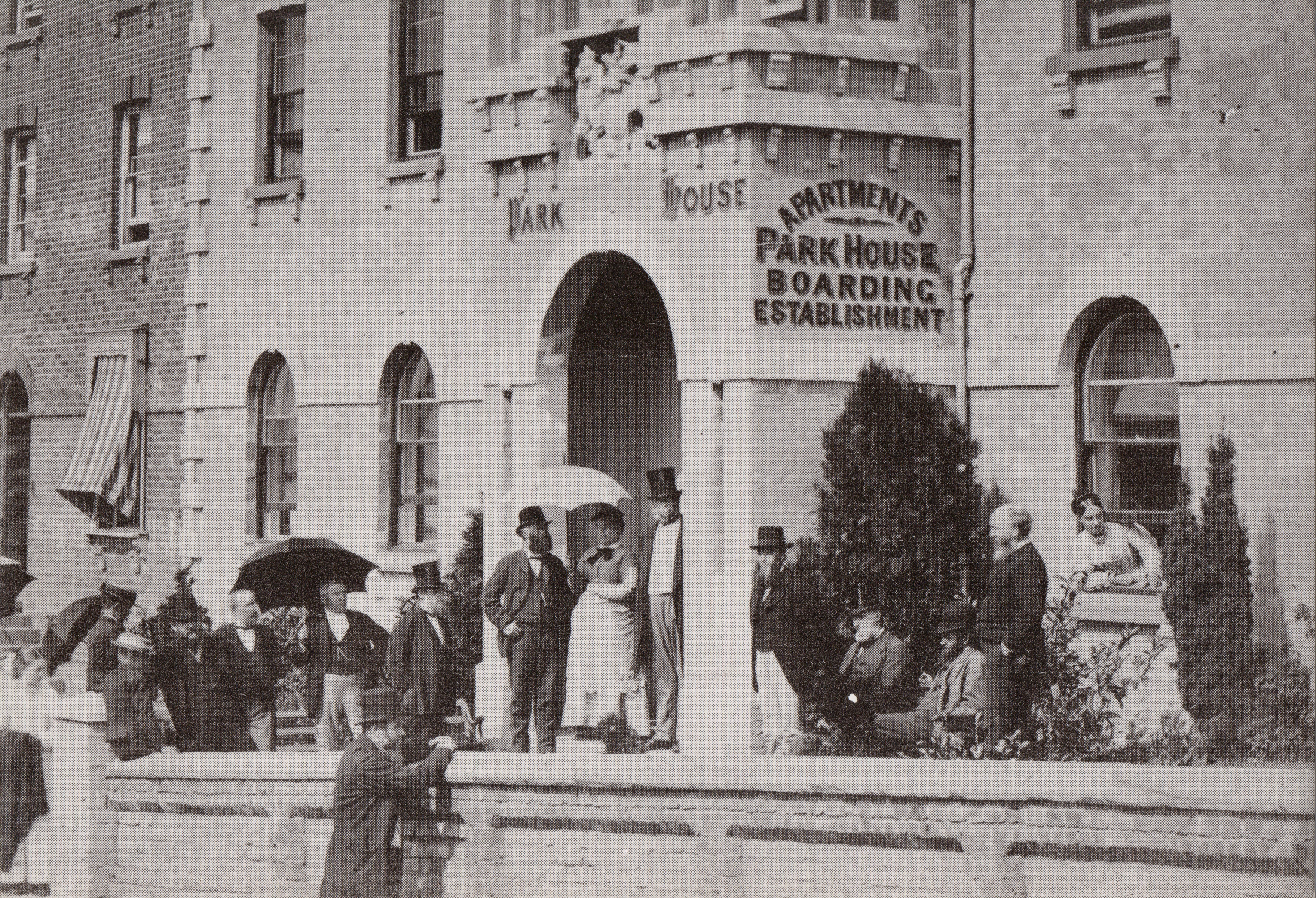
Few surviving images illustrate the boarding-house world more effectively than the photograph of Park House, the building now known as Plas Dinam. Across the front of the property are the words “Apartments”, “Park House” and “Boarding Establishment”. The sign tells us plainly what the building was, while the group of people gathered outside gives the scene an unmistakably domestic character.

Park House, now Plas Dinam, photographed when its frontage openly advertised “Apartments” and “Boarding Establishment”. The people gathered outside give a rare visual impression of the social and domestic character of Llandrindod’s boarding-house trade.
What makes Park House particularly revealing is that Cope’s Directory of 1907 placed it not among lodging houses but among private hotels, with Miss Jones as proprietor. The building itself advertised as a boarding establishment while the directory classified it as a private hotel. Both descriptions could evidently be used at the same time.
That single example captures the central difficulty of defining the trade too rigidly. Boarding house and private hotel were not always separate institutions. An establishment might retain the domestic style of a boarding house while adopting the more fashionable language of the private hotel, or it might be described differently by its owner, a guidebook and a trade directory.
The term “private hotel” appears to have occupied useful middle ground. It suggested something more substantial than ordinary lodgings while retaining an element of privacy and residential respectability. It was particularly well suited to a spa where guests might stay for several weeks and where the relationship between proprietor and resident remained important.
From Boarding House to Private Hotel
The transition from domestic accommodation to larger commercial establishment can be followed in several Llandrindod properties.
The Lindens is one of the clearest examples. In November 1892 plans were submitted to Llandrindod Wells Urban District Council specifically for a boarding house for Miss Sheen. This matters because it demonstrates that boarding houses were not always existing homes casually opened to visitors. Buildings could be purposefully planned or adapted around the trade.
By 1907 The Lindens was being listed among the town’s private hotels. The terminology had changed, but the underlying business had developed from the world of board and apartments.
Bryn Awel provides an even clearer progression. Jeffrey Jones purchased land on South Crescent in 1893 and plans were submitted the following year for three dwelling houses. By 1895 he was already described as a lodging-house proprietor. In 1901 he was a private hotel keeper at Bryn Awel, with a resident workforce including a cook, parlourmaid, housemaids, nursemaid, boots and an employee associated with the billiard room. Within a few years ordinary houses had entered the lodging trade, expanded and developed into a substantial private hotel.
The first Gwalia followed a similar pattern. Edward Jenkins opened it in 1889 as the “Gwalia Private Hotel and Boarding Establishment”. Within a year extensions had added nineteen bedrooms together with a drawing room, billiard room, smoking room, lending library, news room and hairdressing saloon. Weekly and daily terms were offered. The language of the boarding establishment remained, but the range of services was already moving firmly towards hotel territory.
These examples show that the accommodation categories used in Llandrindod were not fixed stages imposed by regulation. They were part of a commercial continuum. Houses grew into lodging establishments, lodging houses became boarding establishments and successful businesses adopted the language of the private hotel.
Who Stayed in the Boarding Houses?
It is easy to discuss boarding houses as buildings and businesses without asking who actually occupied them. Yet the people who stayed in these establishments tell us much about the social character of Llandrindod Wells. The typical boarding-house visitor was unlikely to belong either to the very wealthy world associated with the grandest hotel suites or to the poorest sections of society. Spending a week, fortnight or month away from home required both time and disposable income. The boarding houses therefore drew heavily upon the expanding middle and lower-middle classes of Victorian and Edwardian Britain, people who possessed sufficient means to take a holiday or health cure but who did not necessarily seek the scale, formality or expense of the principal hotels.
The surviving evidence from Llandrindod’s private hotels, many of which had developed directly from boarding or lodging houses, gives a useful impression of this clientele. At Bryn Awel the visitors and residents included people drawn from medicine, law, education, commerce and religion. Doctors, solicitors, clerks, teachers, ministers and businessmen belonged comfortably within the social world which supported the private hotel and boarding trade. These were respectable people of moderate or comfortable means, part of the increasingly mobile professional and commercial classes whose prosperity helped sustain British resort culture during the later nineteenth century.
Families were an important part of the market. A husband and wife might come together for a health cure, sometimes accompanied by children, another relative or even a servant. For a family remaining several weeks, the boarding house offered considerable advantages. Meals were provided, the domestic work was taken care of and a settled routine could be established, but the surroundings remained more intimate than those of a large hotel. The family did not have to maintain a rented house of its own, yet neither was it entirely absorbed into the more public life of one of the principal hotels.
Women travelling without husbands were also well suited to the boarding-house environment. Widows, unmarried sisters, mothers travelling with daughters and women visiting for health reasons could stay within what was presented as a respectable private household. Respectability mattered greatly in nineteenth-century travel, particularly for women travelling alone. An establishment run by a known female proprietor could offer an atmosphere which appeared more domestic and socially secure than the public world traditionally associated with an inn.
This may help explain the prominence of female proprietors within Llandrindod’s accommodation trade. A house run by Miss Sheen, Miss Jones or one of the Smith sisters was not merely selling a room. It could also sell the reputation of the household itself. Guests were entering a domestic environment over which the proprietor exercised personal control, and the character of that proprietor was part of the business.
Health naturally remained an important reason for staying. Some residents were genuinely unwell or convalescent. Llandrindod was a health resort before it became a general holiday destination, and visitors came with a wide range of complaints for which mineral waters, fresh air, rest and moderate exercise were recommended. Such treatment could involve a stay of several weeks, making weekly board particularly practical. Other people came as companions to an invalid relative and effectively became visitors because another member of the family required treatment.
Not everyone was ill. By the later nineteenth century the resort had developed a substantial social and recreational life of its own. Visitors came for concerts, theatre, golf, bowls, cycling, excursions, parks and the opportunity to spend time away from industrial and commercial centres. The waters might remain part of the ritual of the visit without being its sole purpose. A boarding-house resident could take the waters in the morning, walk through Rock Park, spend an afternoon on an excursion and return to the same shared dining table in the evening.
The railway greatly widened the geographical range of these visitors. Published visitor lists show people arriving from London, Manchester, Birmingham, Liverpool, Dublin and numerous Welsh towns, as well as from neighbouring English counties. The larger hotels dominate many of those printed lists because they were more likely to submit names and were often given greater prominence by the newspapers, but the boarding houses operated within exactly the same railway network. For the professional family, commercial traveller, teacher, minister, shopkeeper or retired couple, Llandrindod had become accessible in a way that would have been impossible before 1865.
There was probably a degree of social sorting between establishments. Particular houses acquired reputations. Some may have been especially suited to families, some to older visitors, some to those seeking quiet surroundings and others to people interested in golf, fishing or other recreation. Mainstone advertised its croquet ground and proximity to the golf links, while rural accommodation could offer fishing and greater seclusion. The proprietor was therefore not merely filling rooms but cultivating a particular sort of clientele.
Repeat business would have reinforced these patterns. A family which had enjoyed three weeks in one house might return the following summer and recommend it to friends. Guests could arrive already knowing the name of the proprietor or having been directed there by somebody who had stayed previously. The boarding house could therefore acquire a recurring community which changed from week to week but was not entirely anonymous.
The poorest sections of society were much less able to participate in this world. A person living from weekly wages might struggle to afford both the cost of accommodation and the loss of earnings caused by spending several weeks away from work. Boarding houses were not necessarily luxurious, but the ability to take an extended holiday or health cure itself reflected a degree of financial security. Cheaper lodgings, excursions and charitable provision widened access, but the commercial boarding house remained predominantly part of the world of people who could afford to purchase time away from home.
That does not mean that the boarding house was exclusively middle class or that every guest occupied the same social position. The market was broad, and establishments ranged considerably in price and status. What mattered was that the boarding house offered a form of respectable temporary residence between the individual rented room and the great hotel.
This also helps explain why the atmosphere mattered. A guest was not merely buying a bed. They were entering a temporary household of people who were, broadly speaking, considered socially compatible. Meals were shared, conversations continued from one day to the next and acquaintances could form quickly. Isaac Williams’s recollection from the 1820s of everyone in the boarding house “living together” captures something fundamental which survived into the later resort. Around a single dining table might sit a retired officer, a clergyman and his wife, a widow, a schoolteacher, a businessman recovering from illness and a family spending its annual holiday in Wales. For several weeks they inhabited the same small social world.
That, perhaps, was where the boarding house differed most profoundly from the great hotel. The hotel offered scale, specialised service and a greater degree of anonymity. The boarding house offered something closer to membership of a household. For many visitors that was not a second-best alternative. It was precisely what they wanted.
More Than Spare Rooms
Some boarding establishments were capable of offering facilities which challenge the assumption that they were necessarily modest.
Mainstone advertised board and apartments in a detached property near the station, post office, pump rooms, baths and golf links. It had a croquet ground, offered moderate charges and even had a hackney carriage available for hire.
This is significant because it shows that recreational facilities and transport were not confined to the largest hotels. A boarding establishment could provide croquet, convenient access to fashionable leisure and private transport while still presenting itself as a place of board and apartments.
William Gittoes demonstrates the commercial value which lodging property could attain. In October 1899 Gittoes, described specifically as a lodging-house keeper of Templefield House, purchased Tower House in South Crescent for £1,950. This was substantial property investment, not the casual letting of a spare room.
A photograph from the summer of 1909 survives showing visitors in front of the Towers Guest House. The archive catalogue suggests that Gittoes may be the man seated in the centre. The image is valuable because it shows the people behind the terminology, families and individuals actually occupying one of these establishments during the season.
The boarding-house economy also created opportunities for other businesses. Visitors needed food, laundry, transport, newspapers, entertainment and repairs. They arrived with luggage and, increasingly by the end of the nineteenth century, bicycles. Accommodation was therefore only the beginning of the expenditure generated by each seasonal resident.
What Actually Made a Boarding House Different?
The distinction between boarding house and hotel cannot be reduced to one feature. Board itself was not the difference, because hotels also charged visitors for prolonged periods of board. Rock House did so, and the Pump House had grown directly from the older boarding tradition.
Nor was the presence of recreation decisive. Mainstone had croquet, while private hotels could possess billiards and other facilities. Neither was price alone a reliable guide, because respectable boarding houses could be expensive and some travellers chose them for reasons other than economy.
The difference is better understood as a combination of scale, organisation and atmosphere. The boarding house usually remained recognisably a household. The proprietor lived within it, supervised the domestic arrangements and dealt personally with the guests. Meals were commonly shared, and visitors repeatedly encountered the same people in dining and sitting rooms.
The large hotel increasingly separated these functions. It had specialist staff, public rooms and a greater degree of anonymity. A visitor interacted with reception staff, waiters, chambermaids, porters and managers rather than entering directly into the proprietor’s household.
The private hotel stood somewhere between the two. Cope’s Directory of 1907 illustrates the ambiguity perfectly. It placed Park House, Bryn Awel, The Lindens, Ye Wells and several others among the private hotels, while more conventional hotels such as the Pump House and Rock House appeared separately. Yet some of those private establishments continued to advertise apartments and board in the language of the older boarding trade. The distinction was therefore real, but never absolute.
Living Together
The social character of the boarding house is perhaps what distinguished it most strongly from the larger hotel.
Isaac Williams’s recollection of people “living together” in the 1820s captures something which survived throughout the century. A visitor staying for two or three weeks would repeatedly meet the same people. Breakfast, dinner and the sitting room became places where relationships formed. Guests then encountered one another again at the mineral springs, in Rock Park, at church or chapel, at concerts, on excursions and around the town.
For somebody travelling alone, the boarding house could provide an immediate social circle. For a family, it offered company without the greater formality of a large hotel. Returning visitors could come back to the same house and perhaps find familiar proprietors and residents waiting for them.
This temporary community was an important part of the experience of Llandrindod. During the season the town acquired a second population, people who might remain only for several weeks but who nevertheless occupied its rooms, shops, parks and places of worship as though temporarily resident.
The architecture of the town supported that way of life. Villas and terraces contained shared sitting rooms, dining rooms and bedrooms which could accommodate a constantly changing population. Much of the activity was invisible from the street, but it helped create the distinctive seasonal society of the spa.
Not Simply Rich and Poor
It would be misleading to divide the accommodation trade into wealthy hotel visitors and poorer boarding-house guests.
Llandrindod offered a broad spectrum of accommodation. At one end stood the great hotels with elaborate facilities and substantial staffs. At the other were householders letting individual rooms or apartments. Between them were respectable boarding houses and private hotels capable of attracting prosperous middle-class visitors.
The Pump House itself demonstrates how social distinctions could operate within one establishment. During the early nineteenth century it developed different tariffs for different classes of guest, eventually giving rise to the informal descriptions “House of Lords” and “House of Commons”. Class did not disappear because people had come to improve their health. It remained embedded within the organisation of travel and accommodation.
A visitor might choose a boarding house because it was less expensive, but equally because it was quieter, more personal or better suited to a long stay. A respectable woman travelling alone might prefer the atmosphere of a private establishment. A family remaining for a month could value the familiarity of returning to the same dining table each evening.
The boarding house therefore occupied its own social place. It was not merely the poor relation of the hotel.
Tredawel and the Home of Rest
The accommodation economy extended beyond commercial boarding houses and hotels.
Tredawel, the Girls’ Friendly Society St David’s Diocesan Home of Rest, belonged to a different tradition, but its presence helps demonstrate the variety of residential accommodation which developed around the resort. Powys Archives holds reports for Tredawel from 1900 to 1905, together with later billheads and household account books for local butchers and grocers. These records provide a glimpse of an establishment concerned with rest and recuperation rather than conventional commercial tourism.

The Girls’ Friendly Society Home of Rest at Tredawel. Although different in purpose from a commercial boarding house, it formed part of the wider network of residential accommodation available within the spa town.
Tredawel should not be described as simply another boarding house. Its purpose was charitable and institutional rather than commercial. Yet it belongs within the wider story because it shows how Llandrindod’s reputation for health and rest attracted organisations as well as individual visitors.
The town could therefore accommodate people at many different levels, from those staying in the finest suites of the principal hotels to visitors using private boarding houses, furnished rooms or a home of rest.
The Boarding House and the Shape of the Town
The significance of boarding houses can still be read in the streets of Llandrindod.
The great hotels are obvious because they were designed to dominate their surroundings. Boarding houses are less easily recognised. Once the signs disappeared and the businesses closed, many simply became substantial houses again.
Yet their former role helps explain why the Victorian town contains so many large villas, terraces and properties with generous numbers of bedrooms. Tourism influenced not only the construction of hotels but the design and use of ordinary residential architecture.
The surviving council record for Miss Sheen’s proposed boarding house demonstrates this directly. Accommodation for visitors was being planned into the physical fabric of the town.
Wallace had noticed the same process from a broader perspective. After the railway came, villas and boarding houses appeared and the growth of housing increasingly reflected the need to accommodate visitors.
Llandrindod was therefore not simply a permanent town with hotels attached to it. Much of the town itself was shaped around a seasonal population.
A Trade With a Long Afterlife
The traditional boarding-house economy did not disappear suddenly with the end of the Victorian age.
As late as September 1932 Mary Cook Jenkins of Lansdowne, South Crescent, was formally described in a property conveyance as a boarding-house keeper. This demonstrates that both the terminology and the business model remained recognisable well into the interwar period.
What changed gradually was the wider culture of travel. The traditional spa cure lost some of its importance, motor transport altered the way visitors moved, domestic service became more difficult to sustain and holidaymakers increasingly expected shorter stays and greater independence.
Some boarding houses adapted by becoming private hotels or guest houses. Others returned to residential use. Some survived under new names while the old language of “board and apartments” slowly disappeared.
The process was therefore one of evolution rather than sudden extinction. The boarding house had itself already demonstrated an extraordinary ability to change. Rock House had moved from farm and boarding establishment towards hotel. The Lindens progressed from boarding accommodation to private-hotel status. Bryn Awel grew from dwelling houses to lodging house and then hotel. Park House could be called a boarding establishment and a private hotel at the same time.
The decline of the old terminology did not erase the tradition overnight. Much of it passed quietly into the twentieth-century guest house.
The Other Llandrindod
The history of the great hotels is indispensable to understanding Llandrindod Wells, but it tells only part of the story.
Behind their grand façades was another resort, one of landladies, servants, family businesses, shared dining tables, weekly accounts and bedrooms let by the season. It was a world in which a shoemaker could become a lodging-house keeper and property owner, in which women could run substantial accommodation businesses, and in which ordinary houses became part of a visitor economy extending through much of the town.
The boarding houses also remind us that the history of tourism is not simply the history of those who travelled. It is the history of the people who made travel possible. Someone cooked the meals, changed the beds, carried hot water, swept the rooms, bought provisions and answered the door. Someone decided to convert a house into a business and risk money on the belief that visitors would come again next summer.
The great hotels concentrated that work into large organisations. The boarding houses distributed it through the town.
Few images express this better than Park House, now Plas Dinam. The old photograph shows a substantial but recognisably domestic building, its commercial purpose written openly across the façade and a group of people gathered outside. There is nothing monumental about the scene, yet it captures an institution which was fundamental to the life of the resort. For perhaps a century, thousands of visitors experienced Llandrindod in this way.
They did not all enter through the doors of the Metropole, Gwalia or Pump House. Many climbed the steps of an ordinary-looking villa, gave their names to the proprietor and became, for a week or a month, part of somebody else’s household. The boarding house was therefore not a footnote to the history of the spa.
It was one of the ways in which the spa became a town.
Related Essays
- Llandrindod Wells Hospital: From Cottage Hospital to County War Memorial
- Bowling in Llandrindod Wells: From the Spa Greens to Rock Park and the Indoor Game
- From the Pump House Links to Death or Glory: A History of Golf in Llandrindod Wells
- Dr William Bowen Davies: The Doctor Who Helped Build Llandrindod Wells
- Plas Winton and the Hotel Commodore, Llandrindod Wells
Explore more Llandrindod Wells history
Continue with the Llandrindod Wells History guide, or follow the related essays above to explore the people, buildings and institutions that shaped the town.
Sources and Further Reading
The early development of board and lodging at Llandrindod can be traced through Catherine Hutton’s recollections of her 1820 stay, T. J. Llewelyn Prichard’s The Cambrian Balnea, Isaac Williams’s Autobiography and later descriptions of the Pump House and Rock House. Williams’s recollection is especially valuable for its description of communal life within an early boarding house.
For the railway-era expansion of the accommodation trade, Alfred Russel Wallace’s My Life provides an eyewitness retrospective account of villas and boarding houses appearing after the railway, while Slater’s Directory of 1880 gives a detailed contemporary list of lodging houses and private apartments. Cope’s Directory of 1907 is particularly important for its distinction between private hotels and conventional hotels and for the inclusion of Park House, The Lindens, Bryn Awel and other establishments within the private-hotel category.
Powys Archives holds important material relating to the physical and commercial development of the trade, including the 1892 boarding-house plans for Miss Sheen, property records relating to William Gittoes and Tower House, photographs of visitors at the Towers Guest House, the 1932 conveyance describing Mary Cook Jenkins as a boarding-house keeper and records of the Girls’ Friendly Society Home of Rest at Tredawel.
The wider context can also be followed through the separate histories of the Pump House, Rock Park Hotel, Gwalia, Ye Wells, Bryn Awel, Montpellier and the development of Llandrindod Wells published elsewhere on this website.