
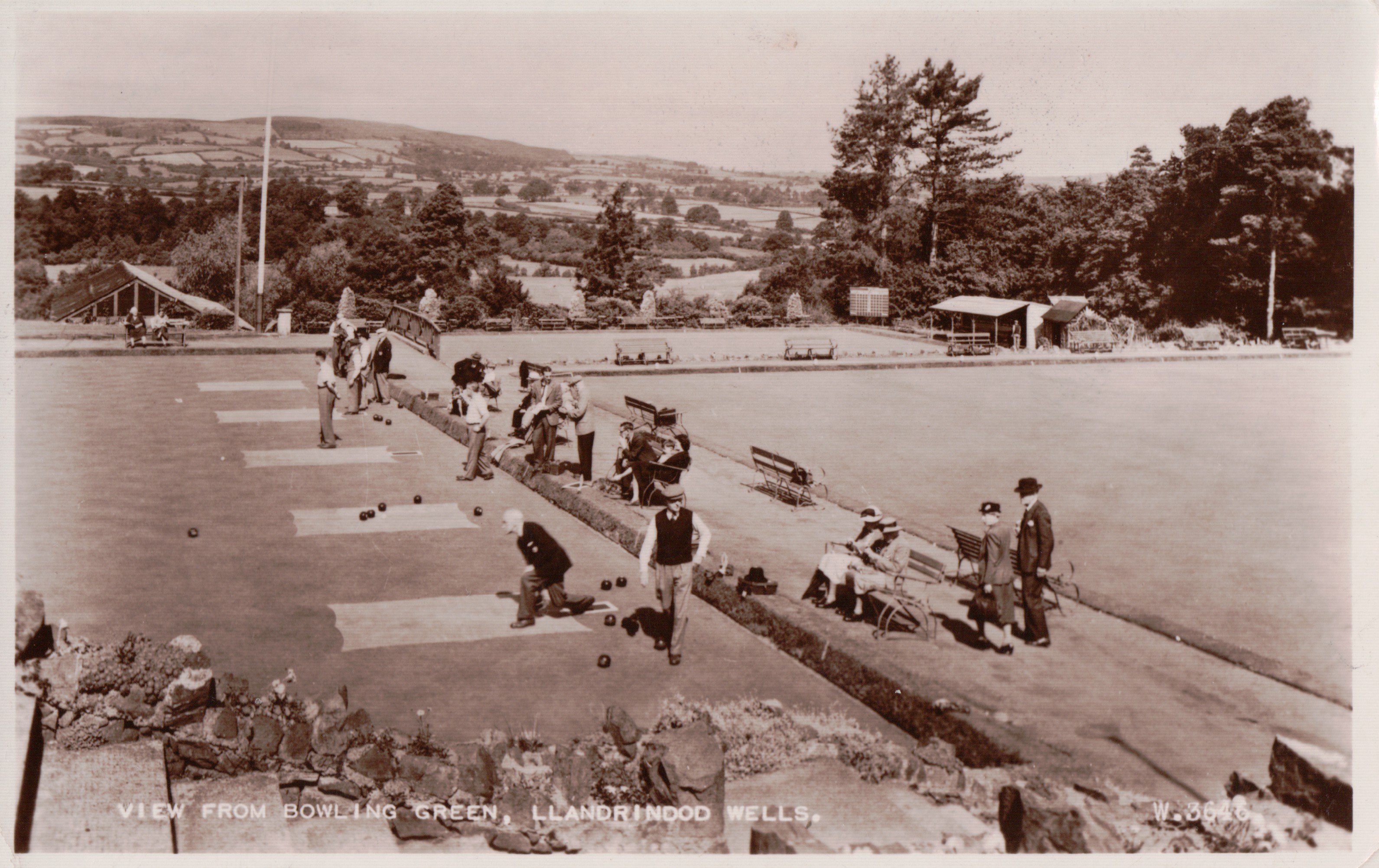
Bowling has been part of the recreational life of Llandrindod Wells for much longer than the history of the present outdoor club alone might suggest. Its story reaches back beyond the familiar greens in Rock Park, beyond the formation of the Radnor County Bowling Club in 1912, and beyond the first organised tournaments on the Recreation Ground in the opening years of the twentieth century. Like so much of Llandrindod’s history, bowls developed alongside the town’s growth as a spa, a visitor resort and a place where recreation was not merely an amusement, but part of the local economy.
The history is therefore broader than that of a single club. It begins with bowling as one of the recreations associated with the old eighteenth-century spa, reappears among the hotels and pleasure grounds of Edwardian Llandrindod, becomes an important feature of the Recreation Ground, and then develops into the organised tournament culture of Rock Park. During the twentieth century Llandrindod became a recognised venue for national and international bowls, while local men and women established their own reputations within the game. In 1990 a further chapter opened with the creation of the Radnorshire Indoor Bowling Centre, giving the town a separate indoor tradition and making bowls a year-round part of local sporting life.
Few recreations associated with the old spa have enjoyed such continuity. Hotels have closed, mineral-water establishments have disappeared or found other uses, and much of the seasonal social world which once filled the streets with visitors has faded. Bowling survived because it gradually ceased to belong solely to the resort. Local people adopted it, organised it, competed in it and built institutions around it.
Bowling and the old spa
The association between Llandrindod and bowling is considerably older than the modern town. During the eighteenth century, when visitors travelled to the original Llandrindod Hall spa near the old parish church, a bowling green formed part of the recreations available to those taking the waters. The establishment which developed there in the middle decades of the century offered the sort of social and recreational environment expected of a fashionable watering place, including dancing, indoor entertainments and outdoor amusements.
There is no reason to suggest an unbroken bowling tradition from that Georgian resort to the modern clubs. The old spa declined, and the settlement which later developed around the railway belonged to a very different period. Yet the existence of an eighteenth-century bowling green is significant. Bowls was associated with both of Llandrindod’s great periods as a health resort.
The game was particularly well suited to spa life. It involved skill and competition without demanding strenuous exertion, could be watched as easily as played, and fitted naturally into the routines of visitors staying for several weeks. Those same characteristics would again make bowling attractive when the modern resort expanded during the nineteenth and early twentieth centuries.
Hotels, visitors and the return of the game
By the opening years of the twentieth century Llandrindod Wells had developed into a substantial inland resort. Hotels and boarding houses competed for visitors, while mineral waters, concerts, golf, tennis, boating, excursions and other recreations filled the summer programme. Visitors staying for a week or more required entertainment, and sporting facilities became part of the way hotels marketed themselves.
Bowling had reappeared within this hotel culture before the formation of the town’s best-known club. By 1905 Bryn Awel was advertising a bowling green among its attractions, alongside lawn tennis, billiards and fishing. Other major establishments also provided extensive recreational facilities. Bowls was therefore already becoming part of the competitive visitor economy.
These private facilities could serve only a proportion of the town’s visitors and residents. The more important development was the emergence of bowling at the Recreation Ground, where the game became a public and increasingly organised activity.
The Recreation Ground before bowls
The Recreation Ground had a complicated history long before bowling became established there. Contemporary correspondence in 1898 stated that the land had been awarded to the parishioners of Cefnllys under the enclosure arrangements some twenty years earlier. It was therefore not simply a piece of land purchased by the local authority for sporting development, but public recreation ground with older rights attached to it.
Its use was already controversial.
In October 1898 a correspondent writing under the name “Pro Bono Publico” complained that the best and most central portion of the ground had been enclosed for lawn-tennis courts and kept under lock and key for a relatively restricted group. The writer questioned whether the local authority possessed the right to allow public recreational land to be used in this way.
That dispute is important because a similar argument would return once bowling expanded. From the beginning, the Recreation Ground had to accommodate competing ideas about general public access, organised recreation and the requirements of the visitor economy.
Only weeks later another meeting considered how the ground might be developed as a source of income. Attention turned to the possibility of discovering mineral water beneath the site, and around £70 was promised towards experimental work. The Recreation Ground was already being considered as something more than open space. It might become part of the commercial and recreational machinery of the spa.
An unpopular ground
The future of the Recreation Ground remained uncertain for several years.
At a meeting of Llandrindod Urban District Council in June 1906, the Pleasure Grounds Committee recommended further improvements. Hotel, lodging-house and boarding-house keepers were to be invited to provide seats for visitors, with the names of donors attached to them. The council also considered developing the well and acquiring additional adjoining land.
The discussion revealed considerable disagreement over the value of the site. Councillor Swettenham described the Recreation Ground as “certainly not a popular place” and suggested that the council might be better advised to turn its interest in the land into money. He was also sceptical about spending heavily upon the well because of uncertainties surrounding underground water rights.
Other councillors took a more optimistic view. The proposals were approved, and during the summer further efforts were made to improve the ground, including the provision of seating and continuing work connected with the well.
The importance of this debate becomes apparent when it is compared with what happened almost immediately afterwards. In 1906 the Recreation Ground could still be dismissed in the council chamber as unpopular. By the following year successful bowling tournaments were being staged there before sizeable crowds.
The breakthrough of 1907
Bowling appears to have been one of the activities which helped change the fortunes of the Recreation Ground.
By September 1907 organised tournaments were already taking place there. One competition for the “Standard” Silver Cup attracted thirty-two entries. The final, played before what the newspaper described as a good crowd, brought together J. S. Paterson of Onibury in Shropshire, a member of Craven Arms Bowling Club, and J. Ernest Morris of Llandrindod. Paterson won by 21 points to 18.
A second tournament followed for the Lindens Hotel Silver Cup, presented by Miss Sheen. This time the finalists were two local men, J. P. Bowen and H. Wickenby, with Bowen winning another close contest by 21 points to 18.
Several features of later Llandrindod bowling were therefore already present. There were named trophies, outside competitors, local players, repeated competitions and spectators. The connection with the hotel trade was equally clear. A hotel had every reason to support a tournament which entertained existing guests and brought additional visitors into the town.
Only weeks afterwards, the Urban District Council was discussing the Recreation Ground in very different terms from those heard the previous year. In October 1907 Councillor Jones referred to the “great success” which had attended the development of the ground during the season and argued for a much more ambitious scheme. Competitive plans for its future were suggested, and there was discussion of expenditure running into thousands of pounds.
Bowling cannot be credited alone with this transformation, because mineral-water development and other improvements were also involved. Nevertheless, the first successful bowling tournaments belong precisely to the season which councillors subsequently regarded as having demonstrated the potential of the Recreation Ground.
Visitors make the game their own
The following year showed that bowling was no passing experiment.
In June 1908 a London newspaper reported that the bowling facilities and lawns at the Recreation Ground were being extensively patronised by visitors. By September, visitors were organising competitions themselves.
Two tournaments promoted by people staying in Llandrindod were held on successive days. J. Lightfoot of Chester won one, with D. Francis of Cardiff second and the Rev. J. L. Williams of Tenby third. The other was won by J. Patterson of Onibury, with the Rev. D. M. Davies second and Andrew Mills of Llandrindod third. Good entries were recorded on both occasions and favourable weather drew substantial numbers of spectators.
The geographical spread of the competitors is revealing. Chester, Cardiff, Tenby and Shropshire were represented. Four years before the formation of the Rock Park club, Llandrindod was already functioning as a meeting place for bowlers from well beyond Radnorshire.
More important still, visitors were no longer merely using facilities provided by the town. They were organising tournaments themselves. Bowling had become part of the social life of the Llandrindod season.
By this time the Recreation Ground was also developing as a spa amenity. A mild chalybeate saline spring had been tapped there, fulfilling ambitions first discussed during the previous decade. Mineral water and organised recreation now occupied the same public landscape.
Investment before Rock Park
The growing popularity of bowls encouraged further expenditure. In March 1911 it was reported that the bowling greens at the Recreation Ground were being relaid. The use of the plural is important. By this time Llandrindod’s bowling provision there was clearly substantial.
The work appeared alongside reports of road widening and improvements to the lower golf links. Bowls was therefore part of a wider civic effort to strengthen the recreational attractions of the resort.
Relaying a green was not a superficial undertaking. The quality of a bowling surface depended upon levelling, drainage, turf preparation and constant maintenance. The willingness to invest in such work suggests that bowls had become sufficiently popular to justify serious attention.
This also explains references in 1912 to completed or improved greens at the Recreation Ground. Bowling had unquestionably existed there for several years. The work of 1911 and 1912 represented renewal and expansion rather than the introduction of the sport.
The decisive development of 1912 would take place elsewhere.
The Radnor County Bowling Club
On Friday 23 February 1912 a meeting was held in the lounge at the Baths in High Street to consider the formation of a bowling club to use a new green then being constructed in Rock Park.
Councillor Tom Norton presided over a substantial attendance drawn from the professional, commercial and civic life of the town. Among those present were Dr F. G. Parker, A. Cary, W. Gittoes, J. Griffiths, Bennett Davies, C. S. Davies, J. Powell, W. Davenport, A. G. Sprague, G. W. Moseley, Clement Smith, W. M. Jones, Gill M. Davies, G. Baillie, C. M. Binyon, J. Lewis Wilding, C. C. Hughes, Penry Jones and W. Edwards.
A. Cary proposed the formation of the club, observing that bowls was rapidly increasing in popularity across the country. More importantly, he believed that a successful club would be of considerable advantage to Llandrindod itself. The proposal was carried unanimously.
The new organisation was named the Radnor County Bowling Club.
G. Baillie explained that a first-class green was being constructed and expressed the hope that Llandrindod would become a centre for bowlers from across the country. Enquiries about matches had already been received, prizes were being promised, two cups had been offered, and affiliation to the national Bowling Association was intended.
Then came a statement which, with hindsight, appears remarkably prophetic. Because of Llandrindod’s central position, Baillie hoped that the town might one day be selected as the venue for an international match.
That ambition was expressed before the new green had even opened.
Within thirteen years it had been achieved.
Captain J. M. Gibson-Watt was elected the club’s first president, linking the new organisation with the family whose interests had long been associated with Rock Park and the wider development of the town. A substantial list of vice-presidents was proposed from among the local landed, political, medical and professional establishment.
The founders were also concerned that the club should possess a strong local membership. There was a general feeling that subscriptions for residents should be kept at a reasonable level. The aim was not merely to create another facility for affluent visitors, but to produce local players capable of representing Llandrindod successfully.
That balance between visitor attraction and community participation would remain one of the defining characteristics of bowls in the town.
Rock Park and the Gibson-Watt Cup
The first Rock Park green was completed during the spring of 1912, with Tom Norton laying the final turf on 9 May. A few days later the national press reported that bowling greens in the park and at the Recreation Ground had been completed, and that Mrs Gibson-Watt of Doldowlod Hall was to perform the formal opening of the Rock Park green.
The location was ideal. Bowling was not placed on an isolated sporting field but within the landscaped heart of the spa. Visitors could take the waters, walk through Rock Park, watch or play bowls and then return to one of the town’s hotels or boarding houses.
The sport fitted naturally into the social world of the resort.
By December 1912 a valuable silver challenge cup had been promised for competition during the following year. This was almost certainly the trophy which became the Gibson-Watt Cup, introduced in 1913 as a visitors’ singles competition.
The Gibson-Watt Cup developed into one of the defining competitions of Llandrindod bowls. During the inter-war years it formed part of a tournament programme which attracted players from across Britain, and by 1938 its final was important enough for the BBC’s Welsh Regional Programme to carry an eye-witness account from the Rock Park green.
The competition survived far beyond the world which created it. More than a century later the Gibson-Watt name remained attached to competition at Llandrindod, albeit with changes to the format.
Few trophies provide such a direct link between Edwardian Llandrindod and the modern game.
Public space and competing needs

The photograph above is especially valuable because it preserves the physical relationship between the Grand Pavilion and the Recreation Ground green. Bowling was not tucked away on the edge of the resort, but occupied a prominent place within its civic and recreational landscape. The green remained in use until at least 1925 and annually hosted the Brynawel Cup before that competition transferred to Rock Park from 1926.
The expansion of bowling was not universally welcomed.
At an Urban District Council meeting in September 1912, Councillor J. Jones reported complaints that the construction of the Pavilion and bowling greens at the Recreation Ground had deprived local children of part of their playground. He proposed that another piece of land should be drained and prepared for children’s recreation.
The argument closely echoed the controversy over tennis courts in 1898. Fourteen years had passed and the sport had changed, but the underlying question remained the same: how much public land should be devoted to specialised organised recreation rather than unrestricted community use?
The same council meeting was also concerned with charges for drinking mineral water at the Recreation Ground Pavilion. Bowling greens, mineral water, the Pavilion and children’s play all occupied the same civic landscape.
That tension is important to the wider history of the town. Improvements made for visitors and organised sport could provide real economic benefits while also reducing the amount of open space available for informal local use.
War and recovery
The First World War disrupted the life of the resort, but bowls continued to have a place in Llandrindod.
The town became a place of recuperation for wounded servicemen, many of whom stayed in hotels and other establishments. Bowling was particularly suitable for men recovering from wounds or illness, providing competition and companionship without the exertion demanded by many other sports.
One wartime tournament at the Recreation Ground attracted thirty-six competitors, including wounded servicemen. Private Lees reached the final and Private Coady the semi-final, while George Ramsay, the celebrated Aston Villa secretary-manager and a regular visitor to Llandrindod, refereed the final.
The episode shows how recreational facilities originally created for tourism could be adapted to the very different circumstances of wartime.
After peace returned, the sport entered a period of rapid expansion.
The great tournament years
In 1921 the organisation adopted the name Llandrindod Wells Bowling Club, and a second Rock Park green was opened. The additional playing surface allowed much larger tournaments to be staged.
Llandrindod possessed several advantages. The railway made it accessible from much of Wales and the Midlands. The town had substantial hotel and boarding-house accommodation. It was accustomed to conferences and large seasonal gatherings. Most importantly, the greens themselves were developing a reputation.
Tournament entries rose into the hundreds. Bowls became economically valuable in its own right. Competitors needed rooms and meals, spectators spent money in shops and cafés, and sporting visitors might remain in town for several days.
In this sense, bowls gradually became one of the means by which Llandrindod sustained its visitor economy as the older culture of mineral-water treatment began to change.
The ambition of 1912 fulfilled
In July 1925 Llandrindod hosted the men’s Home Internationals, bringing together Wales, England, Scotland and Ireland.
The significance of the event becomes clear when set beside the foundation meeting thirteen years earlier. Before Rock Park had opened, the club’s founders had expressed the hope that Llandrindod’s central position might one day secure an international match. That ambition had now become reality.
The tournament developed over three days. Scotland opened by defeating Ireland by a single shot. Wales then met England, with contemporary accounts describing cheers and counter-cheers moving from rink to rink as the contest developed. Wales subsequently defeated Ireland by 119 shots to 81, while England beat Scotland 98 to 88.
The championship ultimately came down to Wales and Scotland. By the latter stages of the final match it had become clear that Wales would take the series, completing victories over all three of the other home nations.
The event was not confined to the greens. Llandrindod Urban District Council provided extensive hospitality, the Metropole Hotel played a central role in accommodating and entertaining the associations, and an international concert at the Albert Hall, part of the wider entertainment culture explored in the history of Llandrindod’s Grand Pavilion and public entertainment brought together performers from all four countries.
Major bowls events had become whole-town occasions.
That was precisely the type of activity the founders had envisaged. The greens supplied the sport, but the hotels, entertainment venues, local authority and wider business community supplied the experience.
New Zealand, Australia and the wider bowling world
The international reputation of Rock Park continued to grow.
In 1928 a touring New Zealand side visited Llandrindod during the first British tour by New Zealand bowlers. Before play the visitors performed a haka on the green, creating one of the most memorable scenes in the early history of the club.
The significance of the visit went beyond novelty. Only twenty-one years earlier, Llandrindod’s Recreation Ground tournaments had been drawing competitors from neighbouring counties and other parts of Wales. Now a team from the other side of the world was playing at Rock Park.
Australian bowlers followed in 1930, Canadians in 1933 and South Africans in 1935. Later decades brought further visits from overseas teams.
By this stage Llandrindod was no longer simply a successful Welsh club. It had become part of the international touring circuit of the game.
A bowling season of its own
By the early 1930s Llandrindod’s reputation as a bowling centre was already firmly established. A feature on the town published on 25 May 1931 described Llandrindod as well known to bowls enthusiasts and referred to the crowds of bowlers who met annually on the town’s four greens. The wording is important because it shows that the scale of bowling provision extended beyond any single green or club site. It also demonstrates how firmly bowls had become embedded within the recreational identity of the spa alongside golf, tennis, fishing, riding and boating.
By the middle of the 1930s the town possessed something approaching a complete bowling season.
A programme published in August 1935 shows the scale of activity. A women’s open tournament was held from 7 to 9 August, including singles and pairs competition. The men’s open tournament followed from 19 August until 7 September.
The programme included the Ormathwaite Cup, Brynawel Cup, Gibson-Watt competition, pairs events and the Hospital Cup.
These were not occasional weekend fixtures. Competitive bowls occupied several weeks at the heart of the traditional summer season.
The economic implications were obvious. Players and spectators required accommodation, food and transport. Bowling could bring visitors into Llandrindod independently of the mineral waters which had originally created the resort.
The names of the trophies also reveal the network of relationships surrounding the sport. Hotels, prominent families, charitable causes and local institutions were all represented. Annual competitions gave continuity to the season and allowed traditions to accumulate over generations.

Women and the growth of the game
Women had played bowls at Llandrindod before the creation of a formal separate organisation, but the establishment of a women’s club during the early 1930s gave the game a stronger structure.
By 1935 the women’s open tournament included singles and pairs competitions, and in 1938 Llandrindod hosted the women’s Home Internationals.
The development was important socially as well as competitively. Bowls offered women organised sporting opportunities at a time when many other competitive sports remained overwhelmingly male.
In later decades Llandrindod would produce an exceptional succession of women capable of representing Wales at British, Commonwealth and international level. Betty Morgan became one of the outstanding figures, enjoying a long senior international career and achieving major success in British Isles competition. Mary Davies, Joanna Weale, Shirley King, Wendy Price and others also carried the name of Llandrindod into high-level competition.
The town also played an administrative role in the development of women’s bowls across Mid Wales, helping to provide a regional centre around which clubs could organise more effectively.
Three greens at Rock Park
The success of major competitions created pressure for further expansion.
During the 1930s Llandrindod became established as a national championship venue, and in 1935 the Rock Park complex gained a third green and improved pavilion facilities.
The scale of the site now reflected its importance.
Three full-sized greens allowed large competitions to run simultaneously and gave Llandrindod the capacity to host national and international tournaments which would have been impossible on a single playing surface.
In less than thirty years, bowling in the town had progressed from visitor tournaments on the Recreation Ground to a purpose-built complex of national importance.

Post-war bowls and local champions
The Second World War again interrupted normal competitive life, but bowling survived and quickly regained its place afterwards.
Overseas teams returned, including representatives from South Africa, the United States, Canada, Australia and New Zealand. Home Internationals and national competitions also continued to bring visiting players to Rock Park.
At the same time Llandrindod increasingly produced international players of its own.
Lewis Williams became one of the early post-war Welsh internationals associated with the club. Brian Maund later emerged as another notable figure, gaining Welsh honours and representing his country at the first World Bowls Championships in Adelaide in 1966.
This represented an important change. In the earliest years, Llandrindod’s reputation had largely rested upon the quality of its greens and the visiting players attracted to them. Increasingly, the town itself was producing players capable of competing at the highest level.
Bowling becomes part of everyday Llandrindod
One of the most important developments of the post-war period was the expansion of municipal and local league bowls.
The municipal league brought hundreds of residents onto the greens, including many who might never have joined a traditional bowling club. Businesses, organisations and groups of friends could form teams, giving the game a much wider social base.
By the early 1980s the league contained three divisions, more than thirty teams and around 300 participants.
For a town the size of Llandrindod, this represented extraordinary involvement.
This local participation was probably as important to the survival of bowls as any international tournament. The great events gave Rock Park prestige, but league bowls gave the sport roots within the community.
In 1982 the men’s and women’s sections and the municipal league were brought together within a single organisation. Llandrindod Wells Bowling Club now represented the different strands which had developed over the previous seventy years, competitive club bowls, women’s bowls and broad local participation.
A new outdoor clubhouse followed in 1992.
A second bowling tradition: the indoor centre
The creation of the Radnorshire Indoor Bowling Centre opened another chapter in the history of the game, but it did so on a site with a much older bowling history. The centre stands on the old Recreation Ground, where organised outdoor bowling had been established by 1907 and where the Brynawel Cup was still being played in 1925.
The six-rink indoor centre opened in December 1990 and provided Llandrindod with a purpose-built venue for year-round bowls. Its location creates a direct physical link between the Edwardian Recreation Ground and the modern indoor game. More than eighty years after competitive bowls had first become established on the site, bowls returned there in a new form. This was particularly significant in Mid Wales, where outdoor play had always been dependent upon the season and weather.
Indoor bowls did not replace the Rock Park tradition. It complemented it.
The new centre also developed its own organisational identity. Llandrindod Wells Bowling Club remained the historic outdoor club based at Rock Park, while Radnorshire Indoor Bowling became a distinct part of the town’s sporting life. The two belong to the same wider local bowling culture, but should not be treated as simply one club operating from two venues.
The indoor centre allowed players to continue through the winter months, provided opportunities for separate leagues and competitions, and broadened the range of bowling available in the town. It also meant that by the early 1990s Llandrindod possessed something unusual for a town of its size: extensive outdoor championship greens alongside a six-rink indoor bowling centre. This later development complemented the town’s other long-established leisure traditions, including golf and recreation around the lake.
Bowls had become a year-round sport.
Rock Park on the international stage
The closing years of the twentieth century demonstrated that Rock Park had lost none of its ability to attract major competitions.
In 1997 Llandrindod hosted the Atlantic Rim Games, bringing competitors from fourteen countries to the town. It was perhaps the most spectacular fulfilment yet of the ambition expressed at the foundation meeting in 1912.
National championships, British Isles competitions, Home Internationals and events involving the Civil Service, police, fire services, blind bowlers and deaf bowlers all added to the extraordinary variety of competition staged in Llandrindod.
The venue’s appeal has always rested upon more than the greens themselves. Rock Park provides a setting which is difficult to reproduce in a modern sports complex. The greens form part of a historic spa landscape, surrounded by the physical remains of the town’s older recreational and mineral-water culture.
The setting gives bowls at Llandrindod a distinctive sense of place.
The people behind the greens
None of this history would have been possible without generations of greenkeepers.
A well-prepared bowling surface appears deceptively simple. In reality it requires constant knowledge of grass, soil, drainage, cutting, weather and wear. Major tournaments could not have been brought repeatedly to Llandrindod without greens maintained to a consistently high standard.
The contribution of the greenkeepers therefore belongs alongside that of players, officials and tournament organisers. Their work provided the physical foundation upon which Llandrindod’s reputation was built.
The same applies to the countless volunteers and committee members whose names rarely appear in sporting reports. Clubs survive because people arrange fixtures, prepare facilities, organise refreshments, maintain records and perform the routine work which allows competitions to happen.
Bowling in Llandrindod has lasted because successive generations continued to do those things.
Two clubs, one bowling town
Today the bowling tradition of Llandrindod is represented principally by two distinct organisations.
Llandrindod Wells Bowling Club carries forward the outdoor tradition centred upon Rock Park. Its history encompasses the Radnor County Bowling Club of 1912, the Gibson-Watt Cup, the great inter-war tournaments, international fixtures, municipal leagues and generations of Welsh representatives.
Radnorshire Indoor Bowling represents the later indoor game, developing from the purpose-built centre opened in 1990 on the site of the old Recreation Ground and providing a separate year-round home for competition.
Their histories are different, but complementary.
Together they explain why bowls occupies a position in Llandrindod unlike that of most other sports. The town does not merely possess a bowling club or a bowling green. It possesses a bowling tradition which has developed across different sites, different forms of the game and nearly three centuries of spa and community history.
From the old spa to the modern town
The history of bowling in Llandrindod Wells mirrors the history of the making of Llandrindod itself.
Its earliest appearance belonged to the Georgian spa, when visitors came to take the waters near the old parish church and expected recreation as part of the experience. Its Edwardian revival belonged to a new town of railway passengers, hotels, boarding houses and municipal improvements. Private hotel greens were followed by public bowling at the Recreation Ground, where successful tournaments demonstrated that the game could attract both visitors and spectators.
The creation of the Rock Park club in 1912 gave that success organisation and ambition.
The founders did not merely want somewhere to play. They wanted Llandrindod to become known for bowls.
Their hopes were fulfilled with remarkable speed.
Within thirteen years the town was hosting the Home Internationals. Within another few years overseas touring teams were playing at Rock Park. National championships and international competitions followed, while local men and women increasingly represented Wales themselves.
The post-war municipal leagues ensured that bowls was not simply an elite or visitor sport. It became part of ordinary community life. The creation of the indoor centre in 1990 then returned bowls to the old Recreation Ground site in a new form and made year-round play possible.
Perhaps the most remarkable aspect of the story is therefore not any one trophy, tournament or international match.
It is continuity.
Many of the institutions created for Llandrindod’s old resort economy disappeared when patterns of tourism changed. Mineral-water drinking ceased to dominate the local economy. Great hotels closed or acquired new purposes. The intensely seasonal social world of the old spa gradually faded.
Bowling survived because it adapted.
What began as a recreation associated with visitors became a sport rooted in the community. Local people formed teams, maintained clubs, served on committees, cared for the greens, built an indoor centre and continued inviting the wider bowling world back to Llandrindod.
The greens at Rock Park and the indoor centre are therefore more than sporting facilities. Together they form part of the historical landscape of the town, carrying within them the story of the old spa, public recreation, Edwardian civic ambition, inter-war tourism, Welsh sporting achievement and generations of local social life.
From the bowling green associated with eighteenth-century Llandrindod Hall to the outdoor greens of Rock Park and the modern indoor game, the history extends across almost three centuries.
Few aspects of Llandrindod’s recreational life can claim a richer inheritance.
Related Essays
Explore more Llandrindod Wells history
Continue with the Llandrindod Wells History guide, or follow the related essays above to explore the people, buildings and institutions that shaped the town.
Receive new historical essays by email
For new essays on Welsh history, biography, genealogy and rural community life, subscribe on the homepage.
Sources and Further Reading
Principal contemporary newspaper sources used in this essay include the South Wales Daily News, 25 October and 8 December 1898, for the Recreation Ground and its early development; the Radnorshire Standard, 13 June and 18 July 1906, for improvement proposals and the Recreation Ground well; the Brecon and Radnor Express and Carmarthen Gazette, 3 October 1907 and 24 September 1908, for the early bowling tournaments; the Radnorshire Standard, 16 October 1907 and 30 January 1908, for the council’s developing ambitions for the Recreation Ground; the Manchester Courier, 10 March 1911, for the relaying of the bowling greens; the Hereford Times, 2 March 1912, for the formation of the Radnor County Bowling Club, and 21 September 1912 for the debate over recreation space; and the Daily Telegraph & Courier, 15 May and 4 December 1912, for the new greens and the promised challenge cup.
For the inter-war period, important sources include the London Daily Chronicle, 10 July 1925, and the Pontypridd Observer, 18 July 1925, for the Home Internationals and Wales’s victory; contemporary material showing the Recreation Ground green still in use in 1925 and the annual Brynawel Cup moving to Rock Park from 1926; the “Health That Is Wales” supplement of 25 May 1931, which described annual crowds of bowlers meeting on four greens in Llandrindod; the Western Mail, 7 August 1935, for the summer tournament programme; and the BBC Welsh Regional Programme schedule of 3 September 1938 for the broadcast of the Gibson-Watt Cup final from Rock Park.
Further evidence comes from the historical records of Llandrindod Wells Bowling Club, the Mid Wales Women’s Bowling Association, Powys Archives, the National Library of Wales and People’s Collection Wales. The Percy Benzie Abery photographs reproduced here are from the National Library of Wales collections via People’s Collection Wales and are used with the attribution and licence information supplied by that source.