
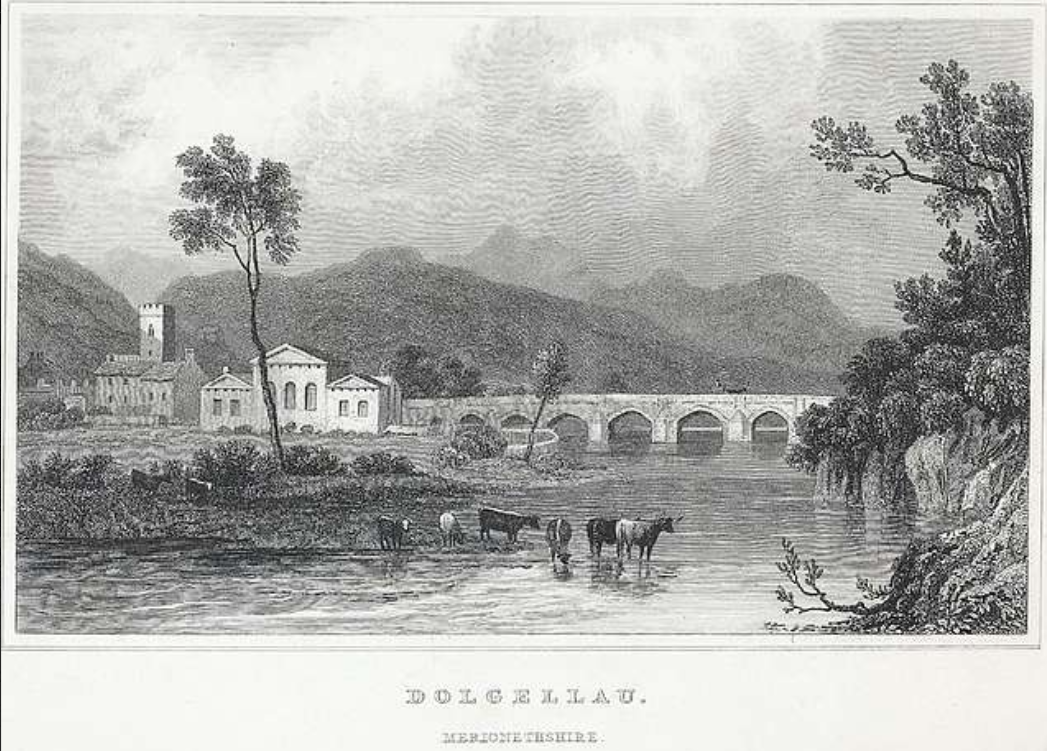
The story of the Jones family of Glandwr does not begin at Glandwr Hall. It begins a generation earlier in Dolgellau, with a man who belonged to a rather different Wales.
John Howel was not a country gentleman, magistrate or London professional. He was a wool and web manufacturer, part of the commercial world of late eighteenth and early nineteenth-century Merionethshire, when wool, weaving, fulling mills and small manufacturers formed an important part of the economy of Dolgellau. A later City of London biographical record describing his son William identifies John specifically as a wool and web manufacturer of Dolgellau whose will was proved in 1835. That description places him securely within one of the most important industries of the town at precisely the period when it was enjoying its greatest prosperity.
From this comparatively obscure household emerged a family whose descendants would move into law, property, the Church, the military, sport and the arts. Their lives would eventually stretch from Wales and London to France, India, Australia and the United States. John therefore deserves to stand at the beginning of the Glandwr story. His son William Jones would create Glandwr Hall and establish the landed family remembered today, but William did not emerge from nowhere. Behind his education, professional training and eventual prosperity stood a family which had already achieved a considerable degree of economic security.
John Howel represents the transition between two worlds, from the manufacturing economy of Georgian Wales to the increasingly professional and property-owning middle class of nineteenth-century Britain.
Dolgellau and the Woollen Economy
John came of age at almost precisely the right moment to prosper from the Dolgellau woollen trade. The town was then one of the important centres of woollen manufacture in Merionethshire. The Universal British Directory of 1791 recorded seven merchants, eleven web manufacturers, one web merchant, five skinners and a woolstapler among the town’s trades, while Heneb’s historic landscape study concludes that Dolgellau’s woollen industry reached its peak at about 1800. This was not a marginal cottage trade, but one of the foundations of the local economy.
Much of the work still operated through a dispersed system in which spinning and weaving took place in cottages and farmhouses, while fulling mills, or pandai, used water power to clean, thicken and finish the woven material. The finished lengths of cloth were generally known as webs. By the late eighteenth century the scale of production was substantial, and Dolgellau had become an important collecting and trading centre for cloth produced across the surrounding district. Dealers increasingly came directly into the area to purchase material rather than relying solely upon the older Shrewsbury market, and John’s working life coincided almost exactly with this period of expansion.
Earlier family research suggested that John probably operated a fulling mill. That remains possible, but it has not yet been demonstrated that he owned a particular pandy. The firmer evidence is now stronger than that assumption, because he can be described confidently as a wool and web manufacturer. This is an important distinction. He was directly involved in the manufacture of woollen cloth, but there is no need to assign a particular mill to him until documentary evidence allows us to do so.
The cloth produced around Dolgellau travelled considerably further than the valleys in which it had been woven. Shrewsbury had traditionally acted as the great market for Welsh woollens, but by John’s lifetime the dominance of the Shrewsbury drapers was weakening. Dealers increasingly travelled directly into Wales, while finished cloth also moved through Barmouth to wider British and overseas markets. This broader commercial world included military, European and colonial demand, and coarse Welsh cloth also formed part of the Atlantic economy of slavery. There is no evidence presently known that John Howel personally supplied slave merchants or plantation owners, and it would be wrong to suggest otherwise, but the industry within which he prospered was connected to markets far beyond Merionethshire.
From Talyllyn to Dolgellau
John’s life before his marriage remains obscure. On 2 November 1788 he married Sarah Jones. The parish entry identifies him as being of Talyllyn parish and shows that he could sign his own name. This apparently small detail is important. Literacy was far from universal among rural Welshmen of his generation, and John’s ability to write suggests that he had received at least a basic education.
His precise parentage has not yet been established. The Howel name was certainly present within the Talyllyn and Corris district in the eighteenth century, but no baptism has so far been identified which can safely be assigned to him. This is one of those points at which restraint is more useful than speculation. Welsh patronymic naming, combined with the repeated use of a relatively small number of Christian names, makes apparently convincing family connections surprisingly easy to construct. Until stronger evidence appears, John’s origins before 1788 should remain open.
John and Sarah established their family at Dolgellau. Sarah appears to have died sometime between 1804 and 1808, and John remarried on 27 May 1808, his second wife being Jenett Griffith. No children from this second marriage have yet been securely identified. John died at Dolgellau in 1835 at about seventy years of age, while Jenett survived him and died at Barmouth on 7 June 1839, aged sixty-seven.
The names used by John and his children preserve something of an important transition in Welsh social history. John carried the surname Howel, while his children became Jones, preserving the Christian name John within the next generation. Thereafter Jones became the fixed hereditary surname used by their descendants. The family therefore sits close to the point at which older Welsh patronymic practice was giving way to permanent surnames. Howel became Jones, and Jones remained Jones.
The Children of John Howel
John Howel’s significance becomes much clearer when his children are considered together. Their lives show that the family did not simply make one dramatic leap from trade into the landed classes. Different children followed very different paths, into London law, Welsh skilled trades, commerce and rural society. Within a single sibling group we can see several different forms of social mobility operating at once.
The eldest known child, Elizabeth Jones, was born at Dolgellau in about 1790 and married Richard Griffith of Dolgellau on 23 December 1818. Richard was associated with the skinning and carrying trades, placing the household within the skilled commercial life of the town. They had three known children, John Griffith, Sarah Griffith and Catherine Harriet Griffith. Elizabeth’s later life became closely intertwined with that of her brother William, and family tradition associates her with the domestic organisation of Glandwr during its early years. Her exact formal status, however, should be treated with caution. She was William’s elder sister, a married woman with a household of her own, not an ordinary domestic servant. The surviving evidence is firmer for her daughters.
Sarah Griffith lived for many years within William’s household as his niece, first as a woman of independent means and later as a recognised member of the family. Only after Harriet Jones’s death was Sarah formally recorded, in the 1881 census at Glandwr, as William’s housekeeper. Catherine Harriet Griffith should not be described as succeeding her mother or sister in that office. The 1871 and 1881 censuses both record Catherine as a visiting niece, distinct from the paid domestic servants. Neither sister married, and both remained closely connected to the Jones family. Sarah died at Crosby Buildings in 1885, while Catherine later acquired property there in her own right. Catherine’s estate eventually became substantial enough to provoke a complicated family dispute following her death in 1899.
William Jones, born at Dolgellau on 20 September 1792, was the child who transformed the family’s position most dramatically. Before travelling to London he worked in the office of the Dolgellau solicitor Humphrey Williams. He was then formally articled for five years to William Price of Lincoln’s Inn in January 1812 and admitted as a solicitor in 1817. This gives us a much clearer picture of his progression. William did not leave his father’s woollen household and somehow appear fully formed in the London legal profession. His journey began locally, inside a solicitor’s office at Dolgellau, and from there he moved into formal metropolitan training. That progression tells us a great deal about John Howel. He was sufficiently prosperous and socially established for his son to be educated, gain professional experience and undertake a lengthy London apprenticeship. William would eventually accumulate considerable wealth and begin acquiring the land near Barmouth upon which Glandwr Hall was built. John was still alive when that process began, meaning that the father lived long enough to witness the extraordinary direction in which his son’s life was moving.
Catherine Jones, born in 1794, followed a quieter path. In 1824 she married Ellis Griffiths, and the couple settled at Pwllheli, where Ellis worked as a cabinetmaker. They had three children. A cabinetmaker was a skilled craftsman, and Catherine therefore remained within the respectable artisan and trading society of nineteenth-century Wales, a world much closer to that inhabited by her father than to the landed existence eventually created by William. Her branch does not appear prominently in the later Glandwr wills, suggesting that it developed largely independently of the wealthier branch.
Sarah Jones, born in 1796, is particularly important to the wider family story because she provides the connection between the Howel household of Dolgellau and the rural families whose history later unfolded across the Llyfnant Valley. She was also directly involved in the redistribution of the family’s property. Her younger brother Richard left instructions that his affairs should be realised and the proceeds divided between three of his sisters, Sarah among them. Her second husband, David Jones, later worked from premises in Mill Lane, Dolgellau, and her son Griffith Jones Rees also worked there. Earlier research raised the possibility that these premises retained some connection with the old Howel family business. That cannot yet be proved, but the continued association with Mill Lane is sufficiently interesting to note. Through Sarah, the Glandwr story reconnects with the farms, small towns and kinship networks of rural Wales.
Griffith Jones appears to have been born at Dolgellau in about 1798. Like William, he entered the legal profession, moving to London in about 1821 and becoming apprenticed to his elder brother. This is particularly revealing because it shows the family beginning to use its newly established position to advance another member of the same generation. William had entered London law from Dolgellau, and Griffith followed through William. In 1827 Griffith married Maria Josephine White and they had one known son, Griffith Maria John Howel. Griffith’s career was tragically short, and he died in London in February 1832 at only about thirty-three years of age. Contemporary references described him as a gentleman, while the later circumstances of his family suggest that his brief legal career had nevertheless been prosperous.
His son had an unusual life of his own. Born Griffith Maria Jones in 1829, he later adopted the surname Howel, deliberately reviving the name of his grandfather. He subsequently settled in France, became a naturalised French citizen in 1863 and established himself at Abbeville, where he became a landowner and respected local figure. He married Marie Caroline Hélène Pannier and had a daughter before dying there in 1876. The adoption of Howel as a surname is a small but fascinating detail, suggesting that John’s name retained meaning within the family long after Jones had become hereditary.
Far less is known about John Jones, born around 1801. He appears in the wills of his father and brother Richard, establishing that he survived into adulthood, but thereafter the documentary trail disappears. The problem is his name. John Jones was among the commonest names in nineteenth-century Wales, and without an occupation, address, wife or other identifying relationship, the numerous surviving records cannot safely be separated. For the present, his later fate remains unknown.
The youngest known child, Richard Jones, was born about 1804 and survived his father by only a short period, dying in October 1836 at around thirty-two years of age. His story requires particular caution because earlier research appears to have confused some of his commercial activities with those of another prominent Dolgellau man of the same name. The famous Richard Jones of the Gomerian Press was a different person altogether, born at Bontddu in 1787 and surviving until about 1855. He was also an auctioneer, which explains how the two men may have become conflated in commercial directories. What can safely be said is that John Howel’s son Richard appears to have inherited at least some of his father’s affairs, and his will directed that his estate or business should be realised for the benefit of three sisters, including Sarah. His premature death may have helped bring the old family business to an end just as the next generation was moving in quite different directions.
John Howel’s Legacy
John’s will was proved in 1835 and remains one of the principal means by which his immediate family can be reconstructed. It is frustratingly brief and does not provide the detailed inventory of land, premises, machinery, stock or household possessions that would allow his commercial life to be rebuilt in full. Its importance lies instead in establishing relationships between his children and showing that there was property worth distributing.
John should not be transformed into a great industrial magnate for whom there is no evidence. His importance is subtler. He appears to have been a successful provincial manufacturer whose working life coincided with the height of one of Merionethshire’s most important industries. He created a household sufficiently secure for his children to pursue opportunities that would have been beyond the reach of most Welsh families of the period. The strongest evidence of his success may therefore lie less in anything recorded about John himself than in what his children were able to do.
Looking at the seven children together reveals something more interesting than a simple story of upward mobility. William and Griffith moved into the metropolitan professions. Elizabeth and her daughters became part of the family network which maintained William’s establishments in London and at Glandwr. Catherine remained within the respectable skilled society of the Welsh towns. Sarah linked the Howel family back into the rural communities and farming families of Wales. Richard appears to have remained closest to the commercial world of his father, while John disappears from the surviving record.
This was not a family that simply moved together from one class to another. The siblings occupied several different social worlds at once, tied together by inheritance, employment and kinship. That is much closer to the reality of nineteenth-century social mobility than the conventional image of a family simply rising from trade into gentility.
The Beginning of the Glandwr Story
John died in 1835 at the precise moment when the family’s transformation was becoming visible. His world had been Georgian Dolgellau, wool, woven webs, mills, merchants and a commercial economy still closely connected to the surrounding farms and cottages. William’s world was becoming something different. He had already entered the London legal profession, established himself in the City and begun acquiring property overlooking the Mawddach.
The contrast between father and son is striking, but the two careers should not be separated too sharply. William had received an education, worked in a solicitor’s office and undertaken formal articles in London. His brother Griffith subsequently followed him into the same profession. Those opportunities required more than individual ability. They required money, confidence, education and a household capable of imagining a life beyond Dolgellau. John Howel had provided that foundation.
It would be easy to begin the history of the Jones family with the construction of Glandwr Hall. That would miss the most revealing part of the story. The family did not originate among the ancient landed houses of Merionethshire. There was no centuries-old Glandwr estate awaiting an heir. The position was created.
Before Glandwr there was Dolgellau. Before the estate there was wool. Before the magistrate and country gentleman there was the manufacturer.
John Howel never became a gentleman of Glandwr, and he never lived in the house which would eventually define his descendants. Yet he lived long enough to see William begin acquiring the land upon which it would stand. Within two years of John’s death, Glandwr Hall stood above the Mawddach. The Jones family of Glandwr had arrived. But the story had begun with John Howel.
Continue the Glandwr Story
- The Jones Family of Glandwr Hall, Barmouth, the complete family guide and chronology.
- William Jones of Glandwr Hall, 1792–1882, the next generation and the creation of the landed estate.
- Old Llyfnant Valley Farming Families, for the wider family and rural context.
Related Essays
- The Women of Glandwr: Kinship, Household and Inheritance in a Victorian Welsh Family
- Athelstan Jasper Blaxland (1880–1963): A Glandwr Descendant and a Surgeon Through Two World Wars
- Gatty Wynne Jones (1859–1913): From Melbourne and Glandwr to the American Banjo
- Gattison Jones (1895–1955): From Glandwr to Broadway and the Vanishing World of Vaudeville
Explore more family and Glandwr history
Continue with the Jones Family of Glandwr Hall, or browse Family History & Genealogy.
Sources and Further Reading
Antony David Davies, Old Llyfnant Valley Farming Families: Including the Jones Glandwr and Davies Caeadda Families (2014), particularly the original research concerning John Howel, his marriages, children, will and the early Jones family. Will of John Howel of Dolgellau, proved 1835.
Parish register material relating to the marriage of John Howel and Sarah Jones, 2 November 1788, and John Howel and Jenett Griffith, 27 May 1808.
Heneb, Historic Landscape Characterisation: Dolgellau, for the development, scale and decline of the Dolgellau woollen industry. Amgueddfa Cymru, National Wool Museum, for the wider Atlantic context of Welsh woollen manufacture.
Dictionary of Welsh Biography, “Jones, Richard (1787–1855?), printer and publisher”, for the identification of the proprietor of the Gomerian Press and the correction of the earlier conflation with John Howel’s son Richard Jones.
City of London biographical records, for the identification of John Howel as a wool and web manufacturer and for William Jones’s early legal career. Family wills, probate material and parish records relating to the children and descendants of John Howel.