
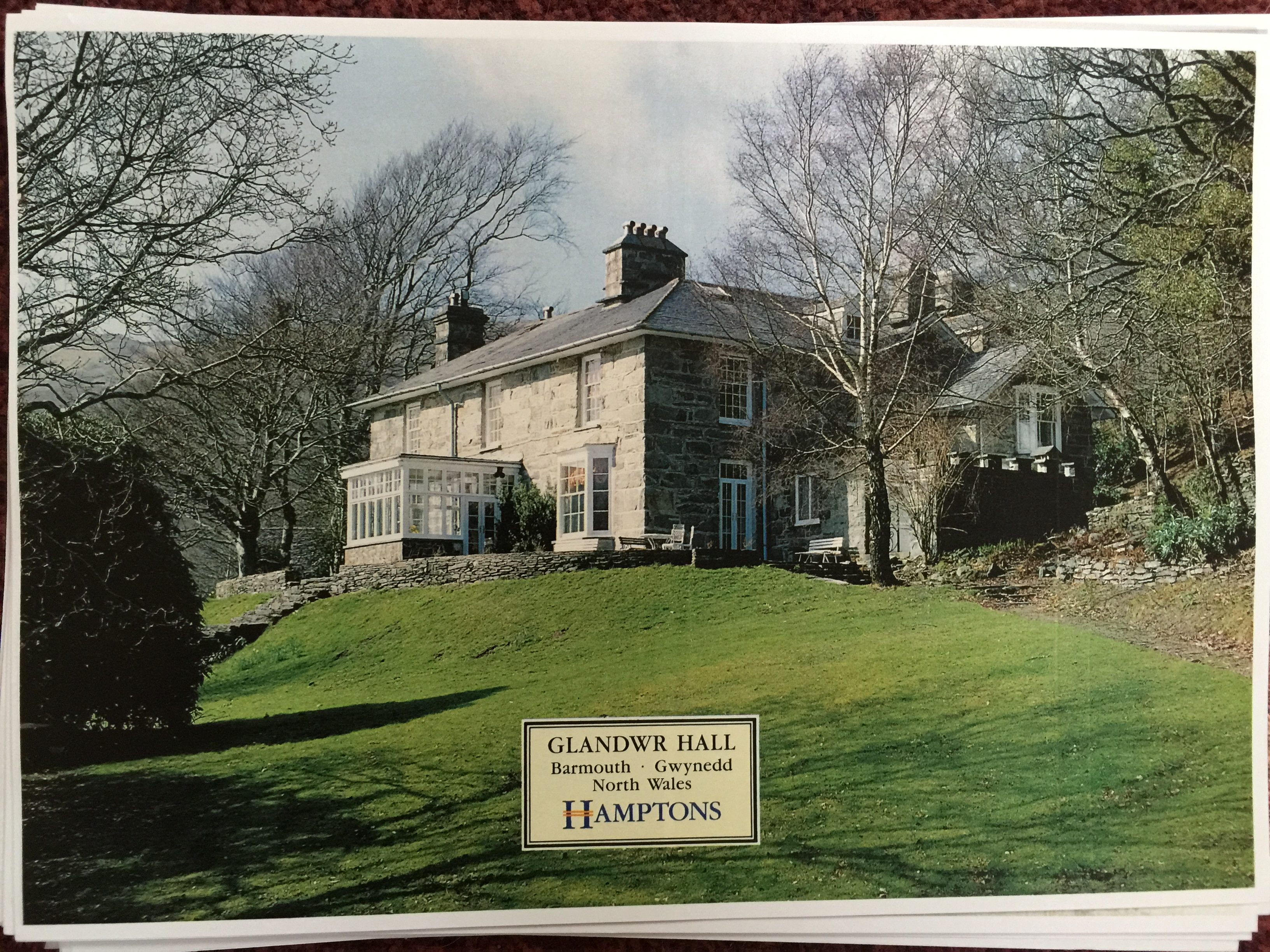
The history of Glandwr Hall is naturally dominated by the men who owned it. William Jones created the estate from the proceeds of a long and successful legal career in London. His son, William Halse Gatty Jones, inherited it, while later generations attempted to preserve the house and its lands through a period of declining agricultural income, rising costs and the increasingly difficult economics of maintaining a substantial country house.
Yet Glandwr was never sustained by its owners alone. Behind the public history of solicitors, magistrates, soldiers and landowners stood a network of women whose contribution was quieter and consequently much easier to overlook. Some were paid servants whose names survive only in census returns. Others belonged to the Jones family itself and occupied an uncertain position between relative, companion, dependant, housekeeper and property owner. Among the most important were William Jones’s elder sister Elizabeth Jones, and Elizabeth’s daughters Sarah Griffith and Catherine Harriet Griffith. Their lives connected the commercial society of early nineteenth-century Dolgellau with the London household at Crosby Square and, eventually, Glandwr Hall. Through another branch of the family, their story also became entangled with that of my own great-great-grandparents, John and Ann Elizabeth Pugh.
What emerges is not simply a history of women attached to a prosperous family. It is a story about how Victorian families actually functioned, how property moved between branches, how women assumed responsibility without necessarily holding formal office, and how relationships of care could eventually become questions of inheritance and law.
A Daughter of John Howel
Elizabeth Jones was born at Dolgellau in about 1790, the eldest known child of John Howel, the wool and web manufacturer whose commercial success formed the foundation from which later generations of the family advanced. Her younger brother William, born in 1792, followed a very different path. Leaving Dolgellau, he entered the legal profession in London and established himself at 7 Crosby Square, Bishopsgate. His career eventually gave him the means to acquire property near Barmouth and establish Glandwr as the centre of a substantial landed estate.
Elizabeth remained closer to the commercial society from which the family had emerged. On 23 December 1818 she married Richard Griffith of Dolgellau. Richard was associated with the skinning and carrying trades, occupations which placed him within the skilled commercial life of the town. Elizabeth and Richard had three known children, John Griffith, born in 1820, Sarah Griffith, born in 1821, and Catherine Harriet Griffith, born in 1825.
Family tradition later associated Elizabeth closely with the establishment of Glandwr during the 1830s. She has sometimes been described simply as William’s housekeeper, but that description needs qualification. Elizabeth was his elder sister, a married woman with a household and children of her own. If she assisted with the establishment or management of her brother’s Welsh household, she did so as a trusted relative rather than as an ordinary domestic servant. That distinction matters because the relationship between family and household work was often blurred in prosperous Victorian families. A sister, niece or unmarried cousin might organise domestic arrangements, care for relatives or supervise servants without ever appearing in the records as an employee.
Between London and Glandwr
For much of his adult life, William Jones maintained two principal establishments. At 7 Crosby Square in London, the lower parts of the building accommodated his legal practice while the upper floors formed the family home. Glandwr, overlooking the Mawddach estuary, became his Welsh residence and the clearest expression of his advancement into landed society. Maintaining the two required considerable organisation.
William’s wife, Harriet Cartwright Jones, naturally occupied an important place within the domestic household, but the surviving census returns reveal that other female relatives became closely embedded within the family. By 1851 Sarah Griffith, then in her late twenties and unmarried, was living at Crosby Square. Crucially, she was not listed among the servants. She was described as William’s niece and as a woman of independent means, and she remained with the household in 1861.
This tells us a good deal. Sarah was not simply a domestic employee who happened to share the family name. She possessed a recognised position within the household and sufficient resources to be described as financially independent. Whatever practical assistance she provided, she lived there because she belonged to the family.
The distinction becomes clearer still in 1871. At Glandwr, Sarah was explicitly described as a “Member of the Family”. Her sister Catherine Harriet Griffith was also present, but was recorded as a visitor. Around them were the paid servants whose work sustained the house, including a cook, housemaid, dairymaid, parlour maid and coachman. Sarah and Catherine therefore occupied the house socially with the family rather than with the servants.
The census evidence is sufficiently clear that it corrects an easy assumption. Catherine should not be described as William’s housekeeper simply because she was unmarried and frequently associated with Glandwr. The records consistently treat her as a relative and visitor. Sarah’s position was different.
Sarah Becomes Housekeeper
Harriet Jones died in 1873. By the time of the 1881 census, William was an eighty-eight-year-old widower. Sarah Griffith, now fifty-nine, was still living with him at Glandwr, but her description had changed. She was recorded as his niece and housekeeper. Catherine was again present, and again described as a visitor.
The change in Sarah’s status makes sense. William was elderly and increasingly dependent upon those around him. Sarah had known his household for decades, both in London and Wales. She understood the family, the property and the servants. Entrusting the domestic management of Glandwr to her avoided placing an unrelated professional between an elderly widower and the private workings of his household.
Yet this was not quite the same as employing an ordinary housekeeper. Sarah possessed independent means and family standing. Her authority came from kinship as well as office. In a large Victorian house, the formal housekeeper could occupy a powerful position, supervising female servants, linen, stores, furnishings and much of the daily domestic economy. Sarah appears to have taken on that responsibility while remaining, first and foremost, William’s niece.
How Unusual Was This?
The arrangement was not especially unusual. Domestic service was one of the largest forms of female employment in nineteenth-century Britain, but alongside paid servants existed another, less easily documented form of female household labour. Unmarried women of respectable families often lived with brothers, sisters, uncles or other prosperous relatives. For women who did not marry, opportunities for independent professional employment were limited. Living within the household of a relative could provide financial security and social respectability, but it frequently came with responsibilities.
Such women might supervise servants, organise correspondence, receive visitors, care for children, nurse elderly relatives or manage a household during illness or bereavement. Because this labour took place within a family rather than through a formal contract, it often disappears from the historical record. Sarah Griffith is particularly valuable because the census allows us to see the transition occurring. She was not simply “the housekeeper” throughout her life. She began as a niece with independent means, became a recognised member of the household, and only after Harriet’s death and during William’s old age was she formally described as housekeeper.
Catherine Before Glandwr
Catherine Harriet Griffith also had a life in Dolgellau independent of Glandwr. In May 1854 she appeared as a witness at the marriage of Jane Griffith and Humphrey Owen. It is a small record, but it matters because it places Catherine within the social and family networks of the town long before her later appearances at Glandwr.
It is tempting to connect this Jane Griffith with the Jane Owen who later helped administer Catherine’s estate, but the surviving evidence does not yet prove that they were the same woman. For the moment, the significance is simpler. Catherine was not merely an appendage to her uncle’s household. She had her own local relationships and place within Dolgellau society.
Crosby Buildings
William Jones died in 1882. The sisters’ subsequent lives bring another property into the story, Crosby Buildings in Dolgellau. The name was not accidental. William’s London home and legal practice had stood at 7 Crosby Square for many years, and near the end of his life the name was reproduced in his native town.
Official architectural research dates Crosby Buildings to 1881 and identifies the development with William Jones. The new range replaced older buildings near Eldon Square and formed part of a wider improvement of the junction. Shops occupied parts of the ground floor, with accommodation above. The timing is striking. In 1881 William made his final will. In the same year Sarah appears in the census as his housekeeper at Glandwr, and Crosby Buildings were being developed in Dolgellau. William was approaching ninety, yet he remained involved in property and estate affairs almost to the end of his life.
Sarah was subsequently living at 4 Crosby Buildings. She died there on 6 February 1885, and was buried at Dolgellau shortly afterwards. Her personal estate was valued at £593 10s, and administration was granted to Catherine Harriet Griffith, described in the probate calendar as her sister and only next of kin. That small entry tells us much about the closeness of the two women. Catherine was not merely a relative who occasionally visited Sarah. At Sarah’s death, she was the person legally responsible for administering her estate.
William Halse Gatty Jones later left Catherine outright ownership of 5 Crosby Buildings. The gift carried particular significance. The property had originated in a development created by her uncle William, passed through his son, and was then transferred to William’s niece. A portion of the property accumulated by the principal Glandwr line had moved back into the family of William’s elder sister.
Catherine’s Independence
Catherine’s later life should not be interpreted simply as that of an unmarried woman dependent upon wealthy relations. The evidence suggests something considerably more independent. By 1891 she was living in the Eldon Square area as the head of her own household, supported by her own means and with domestic assistance. She had moved far beyond the position of the visiting niece recorded at Glandwr twenty years earlier.
For an unmarried Victorian woman, possession of property and independent income mattered enormously. Catherine, by remaining unmarried and acquiring property of her own, entered old age with a degree of economic autonomy denied to many women of her generation. The census descriptions therefore chart another progression. In 1871 and 1881 she was the visitor. By the 1890s she was the mistress of her own household.
Another Daughter of John Howel
The story now returns to another of John Howel’s daughters and to my own direct ancestry. Elizabeth’s younger sister Sarah Jones, born in 1796, was my three-times great-grandmother. Sarah married first William Rees and later David Jones, a schoolmaster, baker and carrier of Dolgellau. Their daughter Ann Elizabeth Jones was born on 8 August 1840.
During the 1840s Sarah and David moved from Dolgellau to Tymawr near Aberangell. The farm belonged to her brother William Jones and appears to have been placed in the hands of his sister and brother-in-law. David died from tuberculosis at Tymawr in 1850.
The 1861 census is particularly revealing about what happened next. Sarah did not simply remain there as the widow of a former occupier. She was recorded as the head of the household and as keeping the farm. That is an important piece of evidence. A widowed woman was managing an agricultural holding belonging to her prosperous brother’s estate. Sarah Jones should therefore be understood not merely as a dependent sister benefiting from William’s generosity, but as a working farmer responsible for the household and land after her husband’s death. Her daughter Ann grew up within that world.
Ann Elizabeth and John Pugh
On 22 February 1862 Ann Elizabeth married John Pugh at Mallwyd. John had been born at Cemmaes on 7 October 1834, the son of an agricultural labourer. His childhood belonged to a very different social world from that of William Jones and the Glandwr household, and by the age of seventeen he was already working in agriculture.
There was therefore a real contrast between husband and wife when they married. Ann was the niece of William Jones of Glandwr and had grown up on one of his farms. John came from a labouring family and had made his way through agricultural work. There was a religious distinction as well. The wider Jones family was closely associated with Anglicanism, while John was a Methodist, and their children appear to have followed their father’s Nonconformist tradition.
It would be tempting to turn their marriage into a romantic story of rebellion against class or family expectation, but there is no evidence for doing so. What the records do show is something more interesting. The social difference between them did not remain static. John rose.
From Labourer’s Son to Substantial Farmer
John Pugh’s progress can be followed through the census returns. At Tymawr in 1871 he was farming approximately 120 acres. Within a decade the scale of his agricultural occupation had changed dramatically. By 1881, after moving to Gwastadgoed, he was farming approximately 350 acres and employing labour.
That was a substantial holding. A man occupying several hundred acres and employing agricultural servants belonged to a very different economic position from the farm labourer’s household in which John had been born. His rise should therefore be understood as genuine rural social mobility.
John subsequently farmed at Glyncaerig and Alltddu and ultimately became a property owner in his own right. When he died in 1912, his gross estate was valued at £2,510. The son of an agricultural labourer had become a substantial farmer and proprietor.
This matters when considering his relationship with Glandwr. John benefited indirectly from the opportunities created through his marriage and his occupation of Tymawr, but his later success was not simply inherited from the Jones estate. He built an agricultural position of his own.
John Pugh in William Jones’s Will
William Jones’s will of 1881 nevertheless provides an intriguing glimpse of the relationship between the two branches of the family. John Pugh was specifically mentioned as the occupier of Tymawr. William knew perfectly well who he was and where he fitted into the family network. Yet the farm was not devised to John or Ann. It was kept within the principal Glandwr inheritance and passed to William’s son.
Whether William personally disapproved of John cannot now be established. There is a much simpler explanation. Victorian landowners commonly sought to keep estate property together rather than dispersing farms among increasingly distant relatives. Tymawr formed part of the Glandwr estate, and William intended it to remain so.
Even so, the contrast remains striking. Sarah and Catherine Griffith received personal legacies. Other branches of the immediate family benefited from trusts and property. John Pugh was acknowledged as the man occupying Tymawr, but he did not acquire ownership through William. In the event, that did not prevent his advancement. John and Ann left Tymawr and built their own position elsewhere.
Ann as Executrix
Ann Elizabeth’s importance within the wider family becomes clearer when her mother’s estate is examined. Sarah Jones of Tymawr died on 2 October 1876. When her will was proved in May 1878, Ann Pugh, wife of John Pugh, was named as her daughter and sole executrix. Sarah’s personal estate was valued at under £800.
This is a significant addition to Ann’s story. More than twenty years before Catherine Harriet Griffith died, Ann had already been trusted with responsibility for settling a family estate. Her later involvement at Crosby Buildings was therefore not the sudden appearance of a relative when property became available. Ann had long occupied a position of responsibility within her family.
Catherine’s Final Years
Catherine Harriet Griffith died at Crosby Buildings on 21 February 1899, aged seventy-three. During her final years she had been cared for by Ann Elizabeth Pugh. Contemporary evidence described Ann as Catherine’s companion and indicated that she had at one time lived with her.
The relationship survived despite the very different paths their lives had taken. Ann had spent decades within working farming households. Catherine had remained closely associated with the prosperous Jones family and eventually possessed urban property and independent means. Yet more than thirty-five years after Ann’s marriage, the two cousins were close enough for Ann to care for Catherine during her final illness.
After Catherine’s death, Ann also dealt with the practical consequences. She arranged the funeral, and a disagreement followed over the undertaker’s account. Hughes, a draper of Queen Street, Dolgellau, charged £16 10s. Ann considered the amount excessive and paid £13. Hughes subsequently brought the matter before the magistrates and recovered a further £3 3s.
In financial terms the dispute was modest, but historically it is valuable. It places Ann at Catherine’s side before and immediately after her death. She was not a remote cousin appearing once an estate had to be divided. She had nursed Catherine, organised her burial and dealt with the expenses personally.
The Estate Without a Will
Catherine left no will. Her effects were valued at £2,477 11s 8d, a substantial estate for an unmarried woman at the end of the nineteenth century. Administration was granted in June 1899 to three people, Jane Owen, Ann Pugh, wife of John Pugh, and John Richard Griffith, a cabinet-maker.
That wording is important. Ann was not merely one of several relatives with a possible financial interest. She was one of the people formally entrusted with administering Catherine’s intestate estate. The probate evidence makes her centrality unmistakable.
The distribution subsequently became complicated. Other members of the extended Glandwr family challenged the original interpretation of who was entitled to inherit. William Wilding Jones became involved, and Major-General Howel Locke Jones, William Jones’s surviving son, was among those whose position had to be reconsidered. The dispute eventually reached Chancery.
The precise final division of every part of Catherine’s estate has not yet been recovered, and it would be wrong to manufacture certainty where the surviving evidence does not provide it. What is clear is that Catherine’s death forced the descendants of John Howel to reconstruct their own family relationships through the law.
Sarah’s Estate Returns
An even more revealing consequence followed. Sarah Griffith had died fourteen years earlier, in 1885, and Catherine had originally been granted administration of her estate as her sister and only next of kin. After Catherine’s death, Sarah’s estate required further administration.
In 1899 a new grant was made to Jane Owen, Ann Pugh and John Richard Griffith, the same circle of relatives who were administering Catherine’s affairs. Sarah’s effects were then recorded at £655, with explicit reference to the former grant of 1885.
The legal sequence is remarkable. Sarah’s affairs had passed first to Catherine. After Catherine’s death, responsibility moved again to the surviving kin, including Ann Pugh. There is therefore a documentary chain running through these women, from Sarah Griffith to Catherine Harriet Griffith, and then to Ann Pugh and the remaining family.
The relationships of care and kinship that had operated privately for decades finally became visible in probate law.
Ann and John in Old Age
The 1911 census provides a final domestic glimpse of John and Ann. By then they had been married for almost half a century. The return records the length of their marriage and the children born to them, providing a rare summary of the family in their own lifetime. John himself signed the schedule.
There is something particularly valuable about seeing the document in that form. The young agricultural labourer who had married into a collateral branch of the Glandwr family had become an established farmer, household head and property owner. Beside him remained Ann, the daughter of the widowed farmer of Tymawr, who had administered her mother’s estate, cared for Catherine Griffith and later helped administer the affairs of both Griffith sisters.
Their lives had travelled a considerable distance from the circumstances of their marriage in 1862.
Women, Work and Family Obligation
None of these women fits neatly into a single Victorian social category. Elizabeth appears to have assisted her brother in the domestic world surrounding Glandwr, but should not be reduced to a servant. Sarah Griffith lived for many years as a niece of independent means and a member of William’s household before formally becoming his housekeeper. Catherine remained a visiting relative at Glandwr, later becoming a property owner and head of her own household. Sarah Jones managed Tymawr as a widow. Ann Elizabeth Pugh became executrix of her mother’s estate, companion and carer to Catherine, organiser of her funeral and administrator of the complicated estates that followed.
Around them stood the paid women whose names also deserve recognition. Cooks, housemaids, dairymaids and other servants performed the daily physical labour without which neither Crosby Square nor Glandwr could have functioned. The distinction matters. The female relatives discussed here were not servants in the ordinary sense. Their contribution grew from kinship, expectation and trust, and that often left their work less visible rather than less important.
The Other History of Glandwr
The history of Glandwr can easily be reduced to a succession of male owners. William acquired the estate, Gatty inherited it, and later generations reorganised, rented and eventually disposed of parts of it. That chronology is necessary, but it is not sufficient, because Glandwr was also a household and the centre of a much wider network of kinship, work and obligation extending through Dolgellau, London, the Mawddach valley and the surrounding farms.
Women moved continually through that network. They kept households together, managed farms, supervised servants, administered estates, nursed relatives and preserved connections between branches of the family which had moved into very different social worlds. The Griffith sisters are especially revealing because their lives cannot be dismissed as those of dependent unmarried women. Sarah became the trusted housekeeper of an elderly landowner, while Catherine acquired her own property and independent household. Sarah Jones kept a farm after widowhood, and Ann Pugh repeatedly assumed legal and practical responsibility when relatives died.
Their story eventually converged at Crosby Buildings, where Catherine died under the care of her cousin. It moved from there to the undertaker’s account, to probate, and finally into Chancery, where descendants of John Howel argued over the meaning of kinship in legal terms.
The public history of Glandwr was made largely by men. Its private history is harder to reconstruct, but it is there, in census descriptions such as “member of the family”, “housekeeper”, “visitor” and “keeping a farm”, in probate grants naming sisters, daughters and cousins, and in the ordinary acts of care that seldom found their way into formal records.
The women did not merely stand beside the history of Glandwr. They helped hold it together.
Related Essays
- Athelstan Jasper Blaxland (1880–1963): A Glandwr Descendant and a Surgeon Through Two World Wars
- John Howel (c.1765–1835): The Woollen Manufacturer Behind the Jones Family of Glandwr
- Gatty Wynne Jones (1859–1913): From Melbourne and Glandwr to the American Banjo
- Gattison Jones (1895–1955): From Glandwr to Broadway and the Vanishing World of Vaudeville
- John Pugh of Glyncaerig (1834–1912): From Farm Labourer’s Son to Montgomeryshire Landowner, the marriage of Ann Elizabeth Jones of the Glandwr family and the subsequent history of the Pughs of Glyncaerig.
Explore more family and Glandwr history
Continue with the Jones Family of Glandwr Hall, or browse Family History & Genealogy.
Sources and Further Reading
- Antony David Davies, Old Llyfnant Valley Farming Families: Including the Jones Glandwr and Davies Caeadda Families, family history research concerning John Howel, the Jones family of Glandwr and the Pugh family.
- Will of William Jones of 7 Crosby Square and Glandwr, dated 20 June 1881 and proved at the Principal Registry, London, 24 July 1882.
- Will of William Halse Gatty Jones, proved 1897.
- Probate Calendar and administration records relating to Sarah Jones of Tymawr, Sarah Griffith and Catherine Harriet Griffith, 1878–1899.
- Contemporary newspaper reports concerning Catherine Harriet Griffith’s funeral expenses and the subsequent dispute over her estate.
- 1851 and 1861 Census of England and Wales, 7 Crosby Square, Bishopsgate, William Jones household.
- 1871 and 1881 Census of England and Wales, Glandwr, Llanaber, William Jones household.
- 1891 Census of England and Wales, Catherine Harriet Griffith household, Dolgellau.
- 1861, 1871, 1881 and 1911 census returns relating to Sarah Jones, John Pugh and Ann Elizabeth Pugh.
- Parish and civil registration records relating to the Jones, Griffith and Pugh families of Dolgellau, Aberangell, Mallwyd and the surrounding district.
- Dolgellau parish marriage register, 1854, including Catherine Harriet Griffith as a witness.
- Cadw, Dolgellau: Understanding Urban Character, for Crosby Buildings and the redevelopment of Eldon Square.
- Eryri National Park Authority, Dolgellau Conservation Area material, for the date, form and development of Crosby Buildings.
- National Trust historical material on Victorian domestic service and the role of the housekeeper in country-house households.