
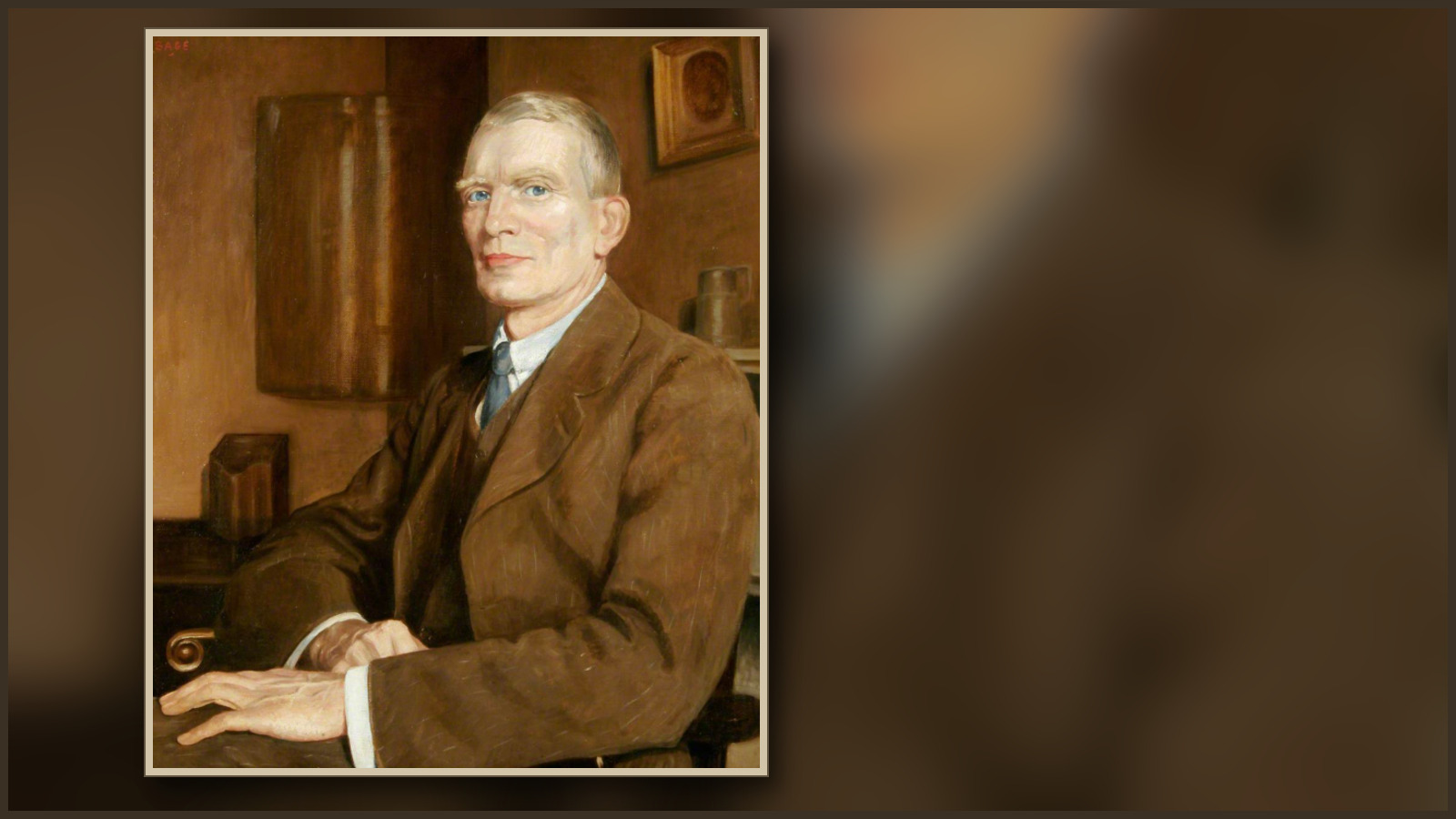
Among the descendants of William Jones of Glandwr Hall, few led a life of greater public usefulness than his great-grandson, Athelstan Jasper Blaxland. Known throughout his professional life as Jasper, he belonged to a generation for whom inherited opportunity brought with it an expectation of service. He became one of Norwich’s leading surgeons, treated wounded men behind the Western Front during the First World War, helped to guide the Norfolk and Norwich Hospital through the air raids of the Second, and contributed observations from his own practice to the development of British surgery.
His life may appear, at first sight, to lie some distance from the wooded slopes above the Mawddach where his great-grandfather established Glandwr Hall. Jasper was born in London, educated at Westminster School and University College London, and spent almost his entire medical career in Norwich. Yet his story belongs within the Glandwr series. It reveals what became of one branch of the family after it moved into the professional life of Victorian England. The connection was no mere genealogical accident. It grew from the partnership between William Jones and George Blaxland, a professional association strengthened by marriage, and it carried the ambitions and habits of one generation into the public service of the next.
From Glandwr to London
Jasper’s connection with Glandwr descended through his paternal grandmother, Rebecca Cartwright Jones. Born in 1822, Rebecca was the eldest daughter of William Jones and his wife, Hannah Cartwright. Her father had risen from comparatively modest Welsh origins to become a successful London solicitor and a substantial Merionethshire landowner. By 1837 he had built Glandwr Hall near Barmouth, creating both a family home and a visible statement of the position he had attained.
William’s legal career also shaped Rebecca’s future. In 1839 he entered into partnership with George Blaxland, forming the London firm of Jones and Blaxland. On 5 September 1844, George and Rebecca were married at Llanaber Church. Business, kinship and social advancement were thus drawn together. The marriage joined the Jones family to an established Kentish family with its own tradition of property, professional service and civic responsibility.
Rebecca and George’s eldest son, William Athelstan Blaxland, continued that progression. He entered the family firm, which became Jones, Blaxland and Son, and later established a considerable reputation as an authority on local government law. From 1891 until 1905 he served as solicitor to the London County Council, participating in the work of the new metropolitan authority during a period when London’s government and infrastructure were being transformed. His involvement in the municipal acquisition and electrification of the tramways placed him close to one of the great programmes of urban modernisation at the turn of the century.
On 27 September 1877, William married Frances Elizabeth Shears, the daughter of an engineer. Their son, Athelstan Jasper Blaxland, was born on 14 September 1880. He grew up in a household shaped by professional achievement, public institutions and the belief that education was the natural route to responsibility. In that respect, his upbringing represented the mature fruit of the social ascent begun by his Welsh great-grandfather.
Education and the making of a surgeon
Jasper entered Westminster School on 27 April 1893 and remained there until July 1898. He then studied medicine at University College London. Surviving college records place him there during the sessions from 1899 to 1904, while his subsequent qualifications show a determined progression through one of the most demanding professional educations of the period. He became a Member of the Royal College of Surgeons and a Licentiate of the Royal College of Physicians in 1904, gained his Bachelor of Medicine that year and his Bachelor of Surgery in 1905, and completed the higher qualifications of Master of Surgery and Fellow of the Royal College of Surgeons in 1908.
These were not ornamental distinctions. Surgery at the beginning of the twentieth century was changing rapidly. Anaesthesia, antiseptic practice and improved hospital organisation had made operations possible that would have been unthinkable within living memory, but the surgeon still worked without antibiotics, modern blood transfusion services or many of the diagnostic methods later taken for granted. Success depended upon judgement, speed, anatomical knowledge and the ability to recognise danger from limited evidence.
In 1907 Jasper joined the Norwich general practice of his uncle by marriage, Donald Douglas Day. Day, the husband of Jasper’s aunt Henrietta Sarah Blaxland, had himself become a respected figure in Norwich medicine and took his nephew under his wing. The arrangement provided Jasper with both practical experience and entry into the professional life of the city. In 1909 he was appointed an assistant surgeon at the Norfolk and Norwich Hospital.
The hospital was then a voluntary institution, dependent upon subscriptions, donations and charitable support rather than a national health service. Its honorary medical staff combined private practice with hospital work, caring for patients who often had few alternatives. To secure a surgical appointment there at the age of twenty-eight was a mark of professional confidence. It also established the connection with Norwich that would define the rest of Jasper’s life.
On 6 November 1912 he married Anna Marion Andrews, daughter of William Andrews of Chediston in Suffolk. The couple made their home in Norwich, where Jasper practised from 29 Surrey Street. Their family included four sons. The domestic life formed during these years would soon be disrupted by war, as it was for families across Britain.
A surgeon on the Western Front
Jasper was thirty-four when he volunteered for military service. On 26 March 1915 he received a temporary commission as a captain in the Royal Army Medical Corps and was attached to the 2nd London Casualty Clearing Station. His immediate appointment to captain reflected his age, qualifications and surgical experience. The Army did not need to train him as a doctor. It needed to adapt an established civilian surgeon to the conditions of industrial warfare.
He landed in France on 28 April 1915 and joined the 1/2nd London Casualty Clearing Station at Merville on 1 May. A casualty clearing station occupied a crucial position in the medical chain. Lying behind the front, it received men from field ambulances, assessed their wounds, performed urgent operations and prepared those who could travel for evacuation to hospitals farther from the fighting. Despite the word ‘clearing’, these were substantial medical units. During major actions they could be overwhelmed by men suffering from shell wounds, compound fractures, abdominal injuries, gas poisoning, shock and infection.
Jasper remained at Merville until April 1916. The station served the Armentières and Béthune sector during a period of trench raids, artillery fire and sniping, punctuated by heavier fighting at Aubers Ridge, Festubert and Loos. The arrival of casualties rose sharply during such operations. Indian troops were serving on this part of the front during 1915, and Jasper would therefore have treated wounded men drawn from across the British Empire, not only from Britain itself.
He returned to Britain for home duties in April 1916, although the surviving papers do not reveal the nature of that work. By March 1917 he was again in France, serving with No. 63 Casualty Clearing Station. During the following twenty-three months the unit moved repeatedly in response to the changing front. Its stations included Boubers-sur-Canche, Arneke, Watten, Senlis, Elnes, Ebblinghem and Ascq. In June 1917 it moved to the group of medical units near Proven which British soldiers called Bandaghem, alongside places nicknamed Mendinghem and Dozinghem. Jasper remained there during the Third Battle of Ypres and through the winter of 1917–18.
His work was not confined to his own station. He was repeatedly sent out with a specialist surgical team to other casualty clearing stations, including units serving near Arras and elsewhere across the British medical system. Such teams brought an experienced surgeon, anaesthetist and supporting staff to places where the pressure was greatest. Their movement between hospitals indicates that Jasper’s abilities were being used as a specialised resource rather than as part of the ordinary staffing of a single unit.
On 4 January 1918 he was appointed acting major while ‘specially employed’. The surviving records do not explain the precise duty concealed behind that phrase, and it would be wrong to invent one. Nevertheless, the promotion accords with the responsibility already evident in his surgical attachments. He was an experienced operator working within a medical service that had been forced to learn, on an immense scale, how to manage traumatic wounds, infection and mass casualties.
Jasper’s own health eventually required treatment. He had first noticed an inguinal hernia in August 1916, and the condition worsened during the summer of 1918. On 17 October he was admitted to the New Zealand Stationary Hospital at Wisques, near Saint-Omer, where he underwent an operation described as a ‘radical cure’. He rejoined No. 63 Casualty Clearing Station at Ascq on 9 November, only two days before the Armistice.
The final movements of his service are imperfectly recorded. He relinquished his acting rank on 13 February 1919 and was demobilised at Shorncliffe two days later. In November 1920 he resigned his commission and was granted the continuing rank of major. His overseas service entitled him to the 1914–15 Star, the British War Medal and the Victory Medal. No evidence has been found that he received a gallantry decoration or was mentioned in despatches. His distinction lay instead in sustained professional service, much of it undertaken in the difficult and exhausting environment of casualty clearing stations.
Surgery in peacetime
After the war, Jasper withdrew from general practice and devoted himself fully to surgery at the Norfolk and Norwich Hospital. The decision suggests both the direction of his ambition and the effect of his wartime experience. For several years he had worked amid grave trauma, where diagnosis and decisive intervention could determine whether a man lived, died or remained permanently disabled. Returning to the broader routines of general practice may no longer have held the same attraction.
Jasper had already begun to publish clinical observations before the war. In 1911 the British Medical Journal printed his paper on post-anaesthetic acid intoxication, and in 1913 he and G. P. C. Claridge published observations on seven cases of acute pancreatitis. His writing continued for more than thirty years. Later papers dealt with intussusception of the appendix, gallstones, symptomless haematuria, fibromas of the stomach, acute spreading peritonitis and progressive post-operative gangrene of the skin.
The subjects were characteristic of a practical hospital surgeon. These were not abstract theories, but difficult cases, unusual complications and observations that might help another doctor confronted by the same problem. His publications reveal an alert and reflective practitioner who considered experience worth recording and sharing. They also place Norwich within a wider medical conversation. Important clinical knowledge did not flow from the London teaching hospitals alone. It was also produced by surgeons working in regional centres, drawing conclusions from the patients placed in their care.
In 1924 Jasper became a founder member of the Travelling Surgical Club. Its members visited hospitals, watched operations and discussed new methods, creating an informal but influential exchange of surgical knowledge. His involvement shows that he belonged to a national professional network and was willing to expose his own practice to the scrutiny of respected colleagues. The club’s connection with Norwich continued through later generations of the city’s surgeons.
He also helped to train younger doctors. Among those who worked under him was Geoffrey Gerrard Gillam, later a distinguished physician and cardiologist, who served as Jasper’s house surgeon at the Norfolk and Norwich Hospital. Such appointments were formative. The house surgeon learned not only operative technique, but the habits of observation and judgement upon which a medical career depended.
Jasper’s standing within the county was recognised when he became president of the Norfolk Branch of the British Medical Association for 1930–31. By then he had spent more than twenty years on the hospital’s surgical staff. He had progressed from a young assistant surgeon to one of the institution’s senior professional figures, with a reputation founded upon clinical work, teaching, publication and military service.
The hospital under bombardment
The outbreak of another war in 1939 found Jasper approaching sixty. He did not return to military service, but the war came to Norwich and to the hospital in which he had spent his working life. As chairman of the Nurses Committee throughout the conflict, he was also described as the surgeon responsible for carrying out the hospital’s wartime emergency management. He worked closely with the matron, Edith Stolworthy, often seeing her daily as the hospital prepared for, and responded to, air raids.
The burden was severe. Between 1939 and 1943 Norwich experienced 1,443 air-raid alerts. Preparations had included semi-underground shelters and emergency operating theatres beneath the casualty department, but no plan could remove the danger. On 27 April 1942, during the first of the Baedeker raids upon Norwich, the hospital admitted eighty-seven casualties and treated another ninety-five as outpatients. Two nights later, fire obstructed access, electrical power failed and telephone communications were lost.
Further bombing on 27 June caused still greater damage. The main operating theatre and linen room were destroyed, wards were struck, about 120 beds were put out of use and some eighty nurses and domestic staff were made homeless. A hospital expected to receive the city’s wounded had itself become a casualty. Maintaining treatment under those conditions required more than surgical skill. It demanded organisation, improvisation and the preservation of confidence among staff working while their own lives were at risk.
Jasper later paid tribute to Stolworthy’s courage and to the morale of the nurses. His praise also illuminates his own role. By 1942 he was sixty-one, old enough to remember medical practice before the First World War, yet once again responsible for ensuring that wounded people could be received, operated upon and cared for amid the consequences of modern warfare. The setting had changed from a casualty clearing station in France to the wards of Norwich, but the essential duty remained recognisable.
Even during this period he continued to contribute to medical literature. In December 1942 the British Medical Journal published his account of fatal phosphorus poisoning caused by a bullet, followed by further correspondence in February 1943. It was an unusual and grimly wartime subject, and another example of his determination to turn a difficult case into knowledge that might be useful elsewhere.
Family, retirement and reputation
The public demands of medicine and war did not exhaust the Blaxland family’s association with service. Jasper and Anna’s son William Gregory Blaxland, generally known as Gregory, was commissioned into the Buffs in July 1939. He served with the British Expeditionary Force and was evacuated from Dunkirk on 31 May 1940, later seeing service in North Africa, Italy and Greece. After contracting polio in Kenya in 1954, he built a second career as a military historian, despite being left dependent upon a wheelchair. His books included Amiens 1918, a study of the campaign in which medical units like those served by his father had worked under immense pressure. Another son, Stephen, entered medicine and practised at Bury St Edmunds.
Jasper retired from the Norfolk and Norwich Hospital in 1946, ending thirty-seven years on its surgical staff. A portrait painted by Faith Kathleen Sage in about 1950, now held by the Norfolk and Norwich University Hospital, preserves the appearance of the elderly surgeon. It is an institutional portrait, but also evidence of the esteem in which he was held by the hospital community.
The British Medical Journal’s obituary remembered a character who could be unorthodox and whimsical, but who inspired affection. Away from medicine, his interests included tennis, golf and shooting, pursuits belonging to the social world of the prosperous professional classes into which the Blaxland branch of the family had firmly settled. Yet the lasting substance of his reputation lay in his work, particularly in the difficult cases he treated, the younger doctors he trained and the steadiness with which he accepted responsibility during two national emergencies.
Athelstan Jasper Blaxland died in a Norwich nursing home on 7 December 1963, aged eighty-three. His funeral was held in Norwich Cathedral. The scale and setting of that final observance reflected a life deeply embedded in the institutions of the city.
The Glandwr inheritance
Jasper was not a squire of Glandwr, nor should an attempt be made to turn him into one. His significance lies precisely in the distance travelled by this branch of the family. William Jones had combined Welsh landed identity with a successful London legal career. His daughter Rebecca’s marriage to George Blaxland united the family and professional worlds of Jones and Blaxland. Their son became solicitor to the London County Council, while their grandson carried the family tradition of professional service into medicine.
Across four generations, the setting changed from the law offices of nineteenth-century London and the estate above the Mawddach to an operating theatre in Norwich and the casualty clearing stations of the Western Front. What remained was an attachment to education, professional standing and public responsibility. The wealth and connections created by earlier generations gave Jasper opportunities, but they do not explain what he did with them. His qualifications had to be earned, his surgical judgement acquired through practice, and his wartime responsibilities borne in person.
His story therefore broadens the history of Glandwr. A family history centred too narrowly upon an estate can end when the property changes hands or the direct male line fails. A wider history follows daughters as well as sons and recognises that the influence of a household may continue in professions, marriages, institutions and acts of public service far from the original home. Through Rebecca Cartwright Jones, the Glandwr inheritance passed into the Blaxland family. In Jasper it produced not another landowner, but a surgeon whose working life spanned the transformation of modern medicine and the demands of two world wars.
Related Essays
- The Women of Glandwr: Kinship, Household and Inheritance in a Victorian Welsh Family
- John Howel (c.1765–1835): The Woollen Manufacturer Behind the Jones Family of Glandwr
- Gatty Wynne Jones (1859–1913): From Melbourne and Glandwr to the American Banjo
- Gattison Jones (1895–1955): From Glandwr to Broadway and the Vanishing World of Vaudeville
Explore more family and Glandwr history
Continue with the Jones Family of Glandwr Hall, or browse Family History & Genealogy.
Sources and Further Reading
- Old Llyfnant Valley Farming Families, family history research concerning William Jones of Glandwr Hall, Rebecca Cartwright Jones and the Blaxland family.
- fourteeneighteen|research, Report on Athelstan Jasper Blaxland, 31 March 2016, drawing upon surviving military correspondence, medal records and unit war diaries.
- The National Archives, WO 374/71260, surviving correspondence relating to Athelstan Jasper Blaxland.
- The National Archives, war diaries of the 1/2nd London and No. 63 Casualty Clearing Stations, and associated casualty clearing stations.
- The London Gazette, commission, promotion and resignation notices concerning A. J. Blaxland, Royal Army Medical Corps, 1915–1920.
- Westminster School Archive, biographical register entry for Athelstan Jasper Blaxland.
- University College London Archive, student records and re-entry documentation, 1899–1904.
- University of London, War Service, 1914–1918, entry for Athelstan Jasper Blaxland.
- Royal College of Surgeons of England, biographical and fellowship records.
- British Medical Journal, A. J. Blaxland’s clinical papers and correspondence, 1911–1943, and obituary, 1964, volume 1, page 123.
- British Journal of Surgery, papers by A. J. Blaxland, 1920–1931.
- Norfolk and Norwich University Hospital, historical accounts of the hospital during the Second World War and the Nurses League history.
- Art UK, Athelstan Jasper Blaxland (1880–1963), Consultant Surgeon (1909–1946), portrait by Faith Kathleen Sage, c. 1950, Norfolk and Norwich University Hospital.
- The Travelling Surgical Club, historical account and membership records.
- The Buffs, Royal East Kent Regiment, obituary and service account of Major William Gregory Blaxland.
- National Army Museum, papers relating to Major William Gregory Blaxland, 1918–1986.