
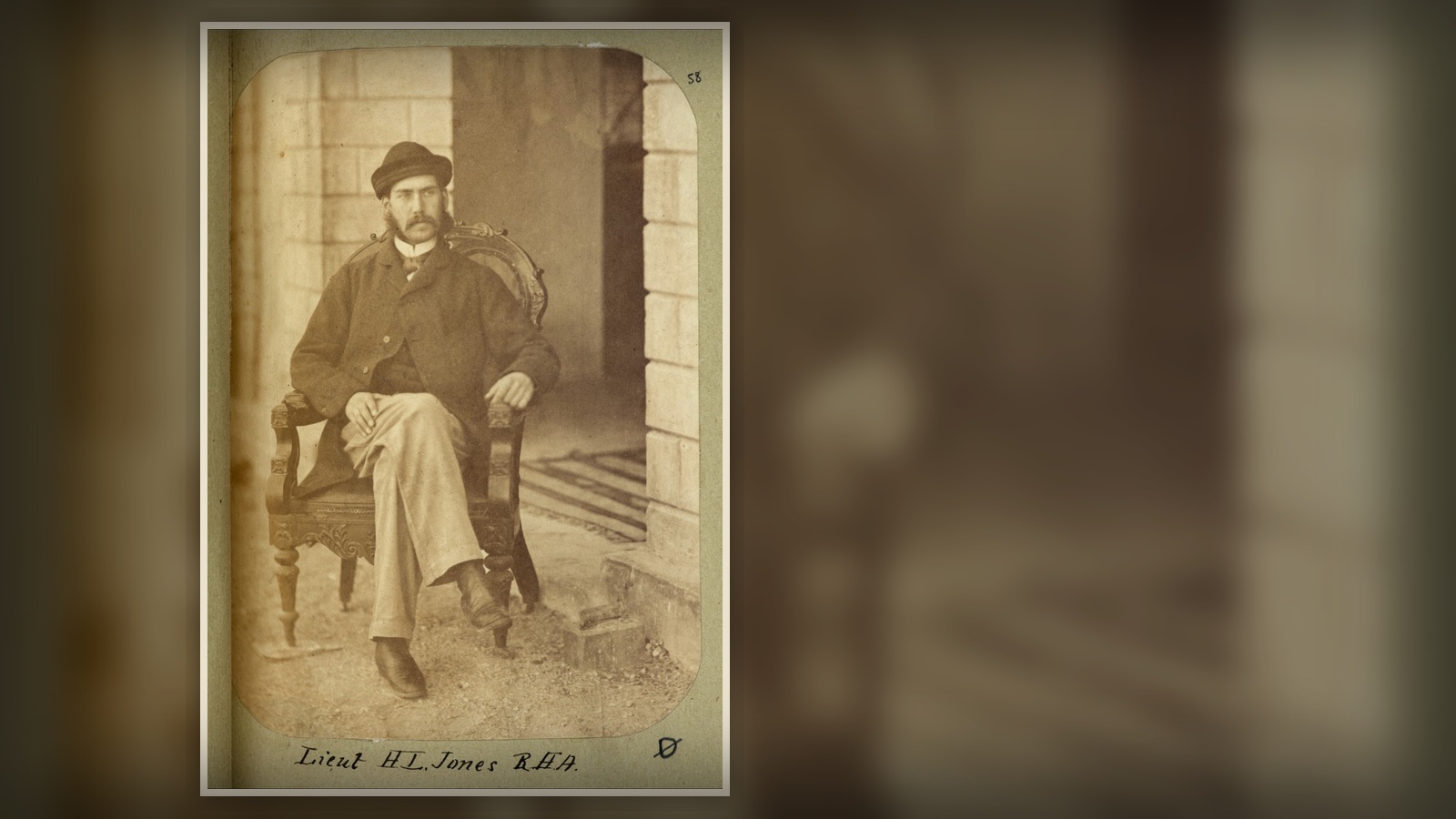
Among the six children of William Jones of Glandwr, Howel Locke Jones followed perhaps the most distant path from the Mawddach. He did not inherit Glandwr Hall, follow his father into the law, or establish himself as a figure in Welsh public life. Instead, at the age of nineteen, he entered the Bengal Artillery of the East India Company and began a military career which took him through the upheaval of the Indian Rebellion of 1857 and eventually to the rank of Major-General.
When I first wrote about Howel in Old Llyfnant Valley Farming Families, his life formed only a relatively small part of the much larger story of the Jones family. Further research has considerably strengthened that account. His Indian Mutiny Medal has been identified, his artillery unit during the rebellion can now be established, contemporary military records clarify parts of his career, and a remarkable early photograph survives in the British Library showing him as a young lieutenant in India. The marriage register, successive census returns and his probate record now allow us to follow his private life far more closely as well. His two surviving sons also continued the military tradition, one becoming involved in the early development of British military ballooning, while the other served with distinction in the Royal Artillery during the First World War.
Howel’s life is interesting in its own right, but it also illustrates the extraordinary social and geographical distance travelled by one Welsh family during the nineteenth century. Within two generations, a family rooted around Dolgellau had produced a successful City of London solicitor, a substantial Merionethshire landowner and a Major-General whose career had been forged thousands of miles away in India.
From Bishopsgate to Glandwr
Howel Locke Jones was born in Bishopsgate, in the City of London, on 4 April 1835. He was the youngest child of William Jones and Hannah Cartwright.
His father had been born at Dolgellau in 1792 and had left Wales as a young man to train as a solicitor in London. William prospered. He established a successful legal practice, became involved in the professional and civic world of the City and eventually based his family and business at 7 Crosby Square, Bishopsgate.
The house neatly illustrates the social position into which Howel was born. The lower parts of the building contained the kitchens, servants’ accommodation and William’s legal offices, while the upper floors formed the family residence. It was the home of an increasingly prosperous professional family rather than an inherited aristocratic household.
Wales nevertheless remained central to William’s identity. During the 1830s he purchased land overlooking the Mawddach estuary near Barmouth and built what became Glandwr Hall. He gradually enlarged the estate until he became one of the more substantial local landowners. Glandwr provided the family with the country residence and landed identity which their London prosperity could now sustain.
Howel therefore grew up between two worlds. London provided the family’s wealth, education and professional connections, while Glandwr represented its continuing roots in Merionethshire. His father remained involved with Welsh organisations in London and retained a strong attachment to Wales even after decades in the capital.
Like his brothers, Howel was educated at Merchant Taylors’ School. As the youngest son, however, there was little expectation that the family estate would eventually become his. Younger sons of prosperous Victorian families were commonly directed towards the Church, the professions or the armed forces.
Howel chose the Army.
A Young Officer of the Bengal Artillery
In November 1854 Howel entered the Bengal Artillery of the Honourable East India Company as a cadet. On 9 December he was commissioned as a second lieutenant. He was only nineteen years old.
The organisation he joined was unlike the modern British Army. The East India Company was not simply a trading business. By the middle of the nineteenth century it governed enormous territories in India and maintained its own military establishment. The Bengal Army alone contained tens of thousands of men, while its European officers occupied a distinctive professional world of their own.
Artillery was among the more technically demanding branches of the service. An officer required knowledge of mathematics, range, ammunition, horses and the increasingly sophisticated equipment of nineteenth-century warfare. Howel’s education and family background made him well suited to such a career. Within three years of his arrival the political and military world around him was transformed.
In 1857 large areas of northern and central India rose against East India Company rule. Older British histories usually described the conflict as the Indian Mutiny. The broader term Indian Rebellion of 1857 better reflects its complexity. Military grievances among Indian soldiers became intertwined with resentment against Company government, political annexation, economic pressures and fears of interference with established religious and social traditions. Howel was twenty-two when the rebellion began.
My earlier family history associated him with fighting around Agra during 1857. Further investigation suggests that the precise description of his movements should be treated cautiously. It is safer to distinguish between what is securely documented and what remains to be established from detailed service records.
What can now be demonstrated is that Howel served during the rebellion with the 2nd Company, 5th Battalion, Bengal Artillery. His surviving Indian Mutiny Medal is named to “Lieut. H. L. Jones, 2 Co, 5 Bn Ben. Arty.”
This is considerably more valuable than simply knowing that he belonged to the Bengal Artillery. It places him within a specific company operating during one of the most confused periods of nineteenth-century Indian history.
Surviving military evidence shows men of the 2nd Company, 5th Battalion, involved in operations in northern India during the rebellion. The evidence supports the wider family tradition that Howel was involved in the turbulent Agra and northern Indian theatre, although his precise movements should not be reconstructed beyond what the surviving documents allow.
The important point remains remarkable enough. A young man whose family roots lay around Dolgellau and whose childhood had been spent in Bishopsgate found himself, aged only twenty-two, serving as an artillery officer during one of the greatest crises in the history of British rule in India.
The Indian Portrait
One of the finest surviving pieces of evidence for Howel is not a written record at all.
The British Library preserves an albumen photograph from the collection of Major-General Francis William Stubbs, himself an officer of the Bengal Artillery. The original mount is plainly inscribed “Lieut H. L. Jones R.H.A.” The album page is numbered 58, corresponding with the British Library catalogue entry for the portrait. The photograph dates from around 1860.
There is consequently little reason now to treat the identification merely as a possibility. The initials, rank, artillery connection, Indian provenance, date and contemporary handwritten identification all point convincingly to Howel Locke Jones.
The photograph shows him as a young man, probably around twenty-five years old. He sits cross-legged in an ornate chair, dressed informally rather than in full ceremonial uniform, with a dark moustache and the self-contained expression characteristic of so many early Victorian photographs.
It is a particularly valuable image because it brings us unusually close to him. Army Lists and promotion notices reduce a military career to names, dates and ranks. Here we see the young lieutenant himself, photographed in India only a few years after the rebellion.
For a man whose career was spent so far from Glandwr, it is perhaps the most appropriate surviving portrait.
Marriage to Mary Helen Richards
Howel married on 6 September 1864 at Holy Trinity Church, Paddington. The original parish register now gives us considerably more than the brief marriage notices previously available. Howel was recorded as twenty-nine years old, a bachelor and an officer of the Royal Artillery. His residence was given as Inverness, suggesting a British military posting immediately before the marriage. His father was recorded simply and accurately as William Jones, solicitor.
His bride, Mary Helen Richards, was twenty-six and a widow. She was resident in the parish of Paddington and was the daughter of Matthew Benjamin Pollock, M.D.
The contemporary newspaper announcement adds the wider family context. Mary was the widow of a member of the Bengal Civil Service and the daughter of Matthew B. Pollock of the Madras Medical Service. The ceremony was conducted by Howel’s elder brother, the Reverend John Cartwright Jones, Rector of Shelton in Nottinghamshire.
Mary’s Indian connections are important. She was not simply the wife of a soldier whose career happened to take him overseas. Her father had served in the Madras Medical Service and her first husband in the Bengal Civil Service. India was already part of her own family experience before her marriage to Howel. Their marriage therefore joined two families closely associated with British India.
The Jones Family at Hilsea
The census returns allow us to follow Howel and Mary through the next stages of his military career.
In 1871 the family were living at Hilsea Barracks in Hampshire. Howel, aged thirty-five, was described as a Captain in the Royal Artillery. Mary was thirty-two and her birthplace was recorded as Madras in the East Indies.
Their two surviving sons were in the household. Four-year-old Harry Balfour Jones was recorded as having been born in Merionethshire, North Wales, while two-year-old Walter Howel Jones had been born at Woolwich in Kent. This is a revealing little family group.
Howel himself had been born in London, but his elder son had been born back in Merionethshire, the county from which the family had originated. Walter, by contrast, was born at Woolwich, one of the great centres of British artillery and military education.
Their birthplaces almost encapsulate the family’s nineteenth-century journey, Merionethshire, London, the Army and the wider Empire all interwoven within a single generation.
The household at Hilsea also included domestic servants, demonstrating the comfortable social position occupied by a Royal Artillery officer and his family.
Sheffield and the Later Army Career
By the time of the 1881 census, Howel had risen considerably in rank.
The family were living at 85 Clarkehouse Road, Sheffield, in the parish of Ecclesall Bierlow. Howel, now aged forty-six, was recorded as a Lieutenant-Colonel, Royal Artillery, active list. Mary was with him, as was their twelve-year-old son Walter, who was still at school.
Harry was no longer living at home. He was receiving the education which would ultimately lead him into the Royal Engineers.
Howel’s military advancement had been steady. Contemporary records correct one date given in my earlier family history. His promotion to lieutenant took effect on 1 January 1858, rather than 24 January. He became Captain on 1 July 1864, Major in 1872, Lieutenant-Colonel in 1879 and Colonel in 1883.
His career had therefore survived not only the dangers of service during the rebellion but the enormous reorganisation which followed it.
The East India Company did not survive 1857 in its old form. Under the Government of India Act of 1858 its territorial government was transferred to the Crown. The Company’s European military establishment was subsequently absorbed into the imperial Army, and Howel’s later career belonged to the Royal Artillery.
He had entered India as an officer of a commercial company with its own army. He would retire from the military establishment of the British Empire.
In June 1885 he retired with the rank of Major-General. His active military career had lasted approximately thirty years.
The Medal That Survived
One of the most tangible survivals from Howel’s career is his Indian Mutiny Medal.
On 25 May 2005 the specialist auction house Morton & Eden offered an example named to Lieutenant H. L. Jones of the 2nd Company, 5th Battalion, Bengal Artillery.
Even more interestingly, the catalogue noted that this was a replacement medal issued in 1901.
By then Howel was sixty-six years old. More than forty years had passed since the events for which the medal had been awarded.
The surviving record does not explain why a replacement was required. The original may have been lost or damaged, but it would be wrong to manufacture an explanation where none survives. What can be said is that the medal commemorating his service as a young lieutenant remained sufficiently important for an official replacement to be issued nearly half a century later. It survived Howel himself by almost another century before appearing on the London medal market. Whether it remains in a private collection today is unknown.
The Children of Howel and Mary
Howel and Mary had three children. Their first child, Amy Helen Jones, was born in India in 1865 but died during infancy. Her brief life is easily lost amongst the military chronology, yet it reminds us of the personal realities behind Victorian imperial service. Rank and comfortable circumstances offered little protection against the dangers of childbirth and infancy.
Their elder surviving son, Harry Balfour Jones, was born in Merionethshire in 1866. Later evidence places his birth in the Dolgellau area, bringing this branch of the family briefly back to the country from which Howel’s father had come.
Harry was educated at Cheltenham College and then entered the Royal Military Academy at Woolwich. He was commissioned into the Royal Engineers in 1885.
His subsequent career took him into an unexpectedly important field, the earliest development of British military aviation.
Before the practical aeroplane existed, the British Army experimented with observation balloons. The Royal Engineers were responsible for this work, using tethered balloons to give observers a view over terrain and enemy positions which could not be obtained from the ground.
Harry became closely associated with that specialist branch. During the South African War, Captain H. B. Jones commanded the 1st Balloon Section, which left Britain for South Africa in November 1899. The section carried out aerial observation at Magersfontein and during later operations, including the advance towards Paardeberg. The balloons were also used to assist British artillery by spotting positions from the air.
It would be excessive to describe Harry as a founder of the Royal Air Force, but his career unquestionably belonged to the institutional prehistory of British military aviation. The Royal Engineers’ balloon organisations eventually contributed to the development of the Air Battalion, the Royal Flying Corps and, much later, the RAF.
By the time of his father’s death in 1907, Harry had reached the rank of Major in the Royal Engineers, a fact independently confirmed by Howel’s probate record. He later rose to Colonel and held the distinction of Companion of the Order of the Bath.
The younger surviving son, Walter Howel Jones, was born at Woolwich on 16 April 1868 and baptised there the following month. Like his brother, he entered the military profession, but he followed their father more directly into artillery.
Walter was commissioned into the Royal Artillery in 1887. His early career included extensive service in India and on the North-West Frontier. He later became a Major in the Royal Garrison Artillery, part of the increasingly specialised world of heavy and defensive artillery.
He married Leonie Forbes in 1899, and their daughter Monica Leonie Jones was born in Brighton in 1901. By 1911 Walter and his family were living at Bourne House, Totland, on the Isle of Wight. Detailed local historical research gives his date of birth as 16 April 1868 and places his death in Thanet, Kent, in 1926.
Walter’s most distinguished period of service came during the First World War. He rose to Lieutenant-Colonel and received the Distinguished Service Order. In the 1919 Birthday Honours he was appointed a Companion of the Order of St Michael and St George for services connected with military operations in France and Flanders.
The two brothers therefore continued their father’s military tradition in very different directions. Harry became involved in observation from the air at the beginning of military aviation. Walter belonged to the world of increasingly powerful modern artillery which culminated in the industrialised warfare of 1914–18.
Across the careers of father and sons, the transformation of warfare during little more than half a century is unusually visible.
The Continuing Connection with Glandwr
Although Howel spent much of his working life far from Wales, he did not become detached from the Glandwr family.
His father suffered a paralytic stroke in 1881 and died at Glandwr Hall on 7 May 1882. At William’s funeral, Howel and his elder brother Gatty were named among the principal mourners, accompanied by several of William’s grandsons. William’s estate was valued at £31,525, the culmination of a remarkable life which had begun in Dolgellau and developed through the professional world of London.
Howel appeared again in the affairs of the extended Glandwr family in 1900.
Catherine Harriet Griffith, a relative who had long been closely associated with William Jones and his household, died in 1899 without leaving a will. Her estate was worth £2,477. Arguments followed over who was legally entitled to inherit.
Members of the Jones family, led by William Wilding Jones, challenged the original distribution through the Court of Chancery. They successfully argued that descendants of deceased relatives were entitled to participate in the estate and that Howel Locke Jones, by then the last surviving son of William Jones, had himself been wrongly excluded.
There is an appealing symmetry in the episode. William Jones had spent much of his professional life dealing with precisely the sort of inheritance, property and trust questions which occupied the Court of Chancery. His youngest son, after a career spent commanding artillery rather than preparing legal pleadings, eventually became involved in just such a dispute.
More importantly, it shows that geographical distance had not severed Howel’s family connection.
India and the Army had shaped his adult life, but he remained one of the Joneses of Glandwr.
48 Ladbroke Grove
By 1891 Howel’s military career was over. The census of that year places Howel and Mary at 48 Ladbroke Grove, Notting Hill, in west London. Howel was recorded as a retired Major-General, late Royal Artillery. His birthplace was given as Bishopsgate, while Mary’s was again recorded as Madras.
The address became their settled retirement home. Ten years later the 1901 census found the couple still at 48 Ladbroke Grove. Howel was sixty-five and described as a retired Major-General of the Royal Artillery. Mary was sixty-three. Also living with them was Mary’s unmarried sister Margaret Pollock, aged sixty-two, who was described as living on her own means and, like Mary, had been born in India. The household also included servants.
The census allows us to see something that Army Lists never could. After decades of postings, military service and travel, Howel and Mary appear to have enjoyed a comparatively settled later life in one London house.
There is also a sense of the Indian world of their younger years quietly following them into retirement. Mary had been born in Madras, her sister Margaret had also been born in India, and Howel’s own adult identity had been shaped there.
The family which gathered at 48 Ladbroke Grove was, in that sense, a household created by Britain’s nineteenth-century imperial world.
His Will and the Future of the Family
Howel had begun thinking formally about the future of his family long before his retirement. On 16 December 1882, while describing himself as a Lieutenant-Colonel of the Royal Regiment of Artillery residing at the Barracks in Sheffield, he drew up a new will and revoked all earlier testamentary arrangements. The timing is interesting. His father William Jones of Glandwr had died only seven months earlier, although there is no evidence to show that the two events were directly connected.
The will gives one of the clearest glimpses of Howel’s private life. Mary Helen was to receive his linen, china, glass, books, pictures, prints, wines and liquors, furniture and other household possessions, together with his carriages and horses. He also left her £200 outright, payable within three months of his death.
His silver plate was treated more carefully. Mary could use it for as long as she remained his widow, but it was to be insured and properly preserved before ultimately passing to whichever of his sons first attained the age of twenty-one. In practice this favoured Harry Balfour Jones, the elder of the two. The distinction is revealing. The plate was not treated merely as another household possession, but as family property intended to pass into the next generation.
The greater part of Howel’s real and personal estate was placed in trust. During Mary’s widowhood the trustees were to provide £150 each year towards the maintenance or education of each of his sons, with the remainder of the trust income going to Mary. After her death or remarriage, the trust capital was to pass equally to Harry Balfour Jones and Walter Howel Jones, provided they survived Howel and reached the age of twenty-one.
Howel also made careful provision for the next generation. If either son died during his lifetime leaving children, those children could inherit the share which their father would otherwise have received. The trustees were additionally empowered to advance as much as £2,000 from either son’s expected inheritance for his advancement, preferment or benefit. Given that both Harry and Walter pursued professional military careers, the clause is an interesting indication of the financial support Howel was prepared to make available for their establishment in adult life.
The investment provisions reflect the wider world in which Howel had lived. His trustees could invest not only in British government securities and Bank of England stock but also in Government of India securities and railway investments connected with India and the wider Empire. Such clauses were not unusual in Victorian wills, so they should not be over-interpreted, but they are particularly fitting in the testament of a man whose professional life had been shaped by India.
One of Howel’s original trustees and executors was his nephew, the Reverend George Cuthbert Blaxland, another grandson of William Jones of Glandwr, alongside George Anson Thompson. Mary was to act as guardian of the children during her lifetime, with Blaxland and Thompson becoming guardians afterwards if necessary. The arrangement is another indication of how closely the wider Glandwr family remained connected despite its geographical dispersal.
A later codicil altered the executorship arrangements and brought Howel’s own sons directly into the administration of the estate. Harry Balfour Jones and Walter Howel Jones were named as executors. When Howel died in 1907, probate was granted to George Anson Thompson, by then a retired civil servant, and Major Harry Balfour Jones of the Royal Engineers, then stationed at Bulford Camp near Salisbury. Power was reserved for Walter Howel Jones to prove the will later if required.
Death and Probate
Howel Locke Jones died on 9 October 1907. His probate record provides the final firm documentary details of his life. He was described as being of 48 Ladbroke Grove, Notting Hill, Middlesex. Probate was granted in London on 7 November 1907 to George Anson Thompson, retired civil servant, and Harry Balfour Jones, Major in the Royal Engineers. Harry was then stationed at Bulford Camp, Salisbury, Wiltshire, while power was reserved for Walter Howel Jones, the other executor named in the codicil, to prove the will later if required.
His estate was valued at £14,334 17s. 6d. gross, with a net personal estate of £14,300 4s. 1d. These exact figures refine the rounded value previously used in my earlier family history.
It was a substantial estate, evidence of the comfortable circumstances in which a long military career and prosperous family background had left him. The will itself shows that Howel’s wealth was organised primarily through personal property, investments and trusts for his wife and sons rather than through a landed inheritance centred upon Glandwr.
The appointment of Harry as one of the executors provides an appropriate final link between two generations of soldiers. The father had entered the Bengal Artillery in the 1850s and served through the Indian Rebellion. The son was by then a Major in the Royal Engineers whose own career had already brought him into the experimental world of military ballooning. Mary survived her husband and died in 1918.
A Son of Glandwr in a Wider World
Howel Locke Jones was not a great public figure, nor is there any need to turn him into one. His importance lies in what his life reveals.
He belonged to the first generation of the Glandwr family to grow up after William Jones had firmly established himself in the London professional classes. His father had travelled from Dolgellau to London and used the law to create wealth, status and eventually a country estate. Howel was able to take the next step. His world was no longer bounded by Wales and the City of London. It extended to India and the professional officer corps of the British Army.
His career also crossed one of the great dividing lines in nineteenth-century imperial history. He entered the Bengal Artillery while India was still governed over vast areas by the East India Company. He served during the rebellion which helped destroy that political arrangement and continued his career within the reorganised forces of the Crown.
There is no reason to romanticise the imperial setting in which that career unfolded. British authority in India rested upon conquest and political power, while the rebellion of 1857 was a brutal conflict whose Indian experience was very different from the military narratives written by British officers afterwards. Howel needs to be understood within that wider history rather than presented simply as an adventurous Victorian soldier in an exotic landscape. Yet neither should the individual disappear beneath the history of empire.
He was nineteen when he entered the Bengal Artillery and only twenty-two during the crisis of 1857. He remained in military service for roughly thirty years and retired as a Major-General. A photograph survives of him as a young lieutenant in India. His campaign medal survived into the twenty-first century. Census returns trace him from barracks in Hampshire to Sheffield and finally to a quiet retirement in Notting Hill. His children carried the story forward.
Harry Balfour Jones, born back in Merionethshire, entered the Royal Engineers and became involved in the experimental use of balloons for military reconnaissance. Walter Howel Jones, born at Woolwich, followed his father into artillery and emerged from the First World War as Lieutenant-Colonel Walter Howel Jones, D.S.O., C.M.G.
Within the lives of a father and two sons can therefore be seen an extraordinary transformation in warfare, from the Bengal Artillery of the 1850s to observation from the air and the immense artillery operations of the First World War.
And behind all three remained Glandwr. The house overlooking the Mawddach was only one physical place, but its family history extended far beyond its gates. From Dolgellau came William Jones, from William came a Major-General of the Bengal and Royal Artillery, and from Howel came another generation of professional soldiers whose careers reached South Africa, India and the battlefields of Europe.
Howel Locke Jones never inherited Glandwr Hall. Nevertheless, few members of the family demonstrate more clearly just how far the world of Glandwr had expanded.
Explore the wider family: The Jones Family of Glandwr Hall, Barmouth brings Howel’s life together with the other generations of the Glandwr family.
Related Essays
- The Women of Glandwr: Kinship, Household and Inheritance in a Victorian Welsh Family
- Athelstan Jasper Blaxland (1880–1963): A Glandwr Descendant and a Surgeon Through Two World Wars
- John Howel (c.1765–1835): The Woollen Manufacturer Behind the Jones Family of Glandwr
- Gatty Wynne Jones (1859–1913): From Melbourne and Glandwr to the American Banjo
Explore more family and Glandwr history
Continue with the Jones Family of Glandwr Hall, or browse Family History & Genealogy.
Sources and Further Reading
- Antony David Davies, Old Llyfnant Valley Farming Families: Including the Jones Glandwr and Davies Caeadda Families (2014), particularly the chapters concerning William Jones and his children.
- Holy Trinity Church, Paddington, marriage register, 6 September 1864, entry 224, marriage of Howel Locke Jones and Mary Helen Richards.
- North Wales Chronicle and Advertiser for the Principality, 10 September 1864, marriage announcement for Howel Locke Jones and Mary Helen Richards.
- 1871 Census of England and Wales, Howel Locke Jones household, Hilsea Barracks, Wymering, Hampshire.
- 1881 Census of England and Wales, 85 Clarkehouse Road, Ecclesall Bierlow, Sheffield, household of Lieutenant-Colonel Howel L. Jones, Royal Artillery.
- 1891 Census of England and Wales, 48 Ladbroke Grove, Kensington, household of Major-General Howel L. Jones, retired Royal Artillery, RG12/22.
- 1901 Census of England and Wales, 48 Ladbroke Grove, Kensington, household of Major-General Howel L. Jones, including Mary Helen Jones and Margaret Pollock, RG13/32.
- Will of Howel Locke Jones, dated 16 December 1882, with later codicil, proved in the Principal Probate Registry in 1907.
- National Probate Calendar and probate grant, 1907, recording Howel’s death on 9 October 1907, his home at 48 Ladbroke Grove, probate to George Anson Thompson and Major Harry Balfour Jones, and an estate of £14,334 17s. 6d. gross and £14,300 4s. 1d. net personal estate.
- British Library, Major-General Francis William Stubbs Collection, portrait of “Lieut H. L. Jones R.H.A.”, c.1860, original album page 58.
- Morton & Eden, War Medals, Orders and Decorations, 25 May 2005, entry for the replacement Indian Mutiny Medal issued in 1901 to Lieutenant H. L. Jones, 2nd Company, 5th Battalion, Bengal Artillery.
- Royal Air Force Historical Society, material concerning the Royal Engineers Balloon Sections in South Africa, including the 1st Balloon Section commanded by Captain H. B. Jones.
- London Gazette, 3 June 1919, appointment of Lieutenant-Colonel Walter Howel Jones, D.S.O., Royal Artillery, as Companion of the Order of St Michael and St George.
- Golden Hill Country Park Community Archaeology Project, Social History Research Report, biographical research on Walter Howel Jones.