
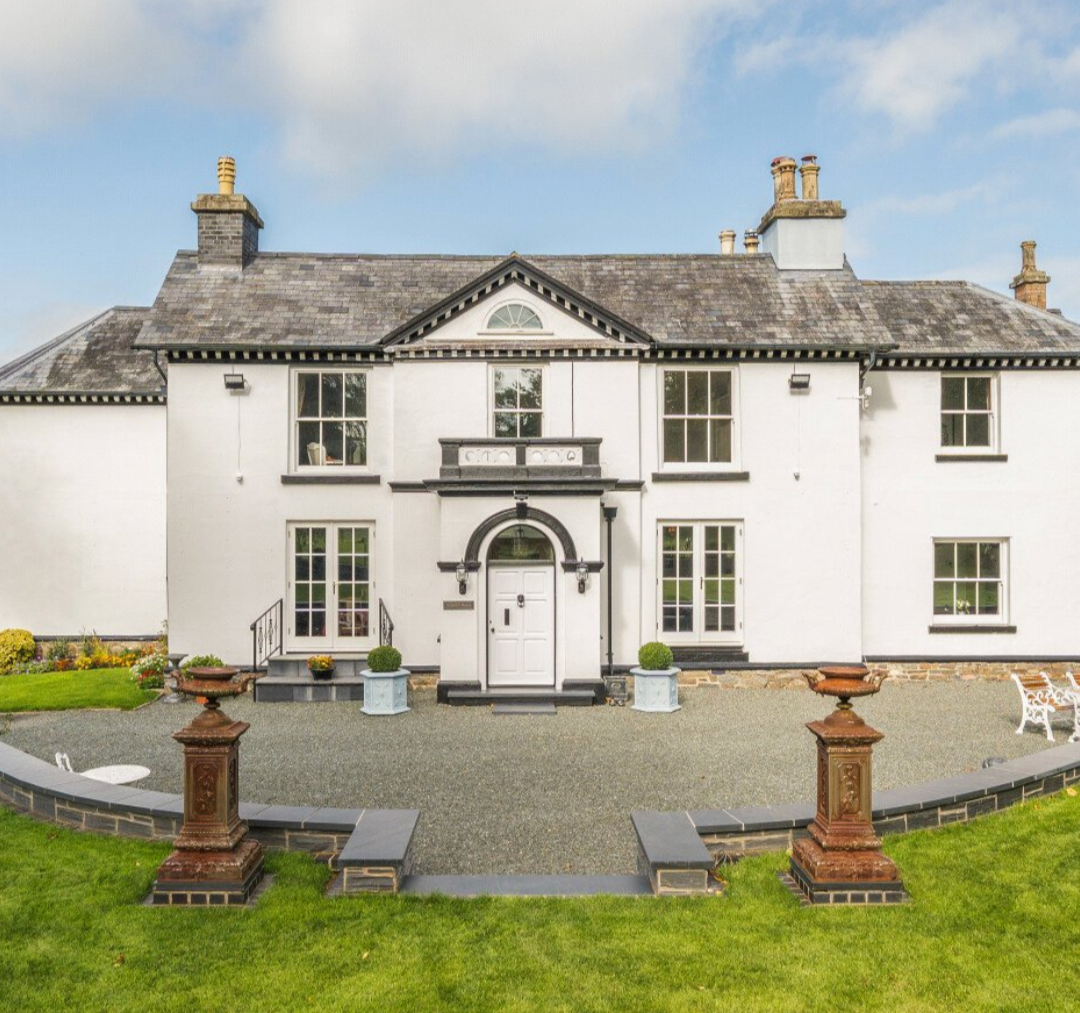
Standing just outside Howey, on the road between Llandrindod Wells and Builth, Howey Hall has never been one of Radnorshire’s great houses. Its history is nevertheless unusually rich. Behind the late Georgian front lies the story of a land agent connected with James Watt, an independently wealthy widow, bankers and soldiers, village children entertained on the lawn, an ambitious Edwardian county club, and the gradual transformation of a small landed estate during the twentieth century.
From Pantylodau to Howey Hall
The familiar appearance of Howey Hall belongs largely to the early nineteenth century. Cadw describes it as an early nineteenth-century villa, already shown on the Ordnance Survey map of 1833 and the Disserth tithe map of 1838. It was subsequently enlarged on both sides during the nineteenth century, and by the Ordnance Survey of 1889 it had broadly acquired its later plan. The earlier house is still discernible at the rear of the late Georgian villa. Howey Hall was therefore not created in a single moment, but altered and enlarged as the circumstances of its occupants changed.
The man most closely associated with its transformation was James Crummer. In 1804 Crummer purchased a property called Pantylodau, in the parish of Disserth. During the negotiations he described the house as having only eight or nine acres of meadow attached to it, about a mile and a half from Llandrindod Wells. He bargained hard. His first offer was £275, which he remarked would buy a house in London when in perfect repair. The vendor wanted £300, and the negotiations continued for several months before the property finally changed hands.
The modest house Crummer bought was subsequently turned into something rather more ambitious. J. B. Sinclair and R. W. D. Fenn, writing from the surviving Crummer papers and diaries, described the change from Pantylodau to Howey Hall and noted that the house occupied by James and Esther Crummer was still appreciably smaller than the building known today. The later wings belong to a further phase of nineteenth-century expansion.
Crummer was not simply a man buying himself a country residence. He was an experienced land agent, closely associated with the Harley estates at Berrington, and he became an important figure in the management of James Watt’s Welsh property. Surviving correspondence between Crummer and the Watt family deals with surveys, farms, planting and estate business. Through Crummer, Howey Hall became connected with Doldowlod and with one of the most remarkable industrial families of the age.
The relationship went beyond business. The Watts visited Howey Hall and the Crummers were entertained in return. In April 1819 James Watt gave Esther Crummer a Scots fir which was planted at Howey. James Watt junior also knew the place well and commented favourably on the richness of the surrounding farmland. The friendship lasted long after James Crummer’s death. When Esther suffered a serious fall in the garden at Howey in October 1845, James Watt junior came over from Doldowlod carrying a special liniment for her injury.
Crummer approached Howey as both a home and a place to improve. Trees and shrubs were planted around the house, while vines obtained from Berrington were established in the grounds. There was a productive garden, livestock, haymaking, brewing and cheese-making. In 1814 another possibility briefly presented itself when a pump sunk on Crummer’s land produced sulphurous water. The water was examined, but did not contain enough mineral content to establish Howey as another watering place. It is nevertheless a fascinating episode, coming at a time when the mineral springs around Llandrindod were beginning to attract wider attention.
Crummer’s public standing also rose. He served as High Sheriff of Radnorshire in 1820. By then Howey Hall was a very different place from the small property he had purchased sixteen years earlier.
The house described in 1821
The clearest picture of Howey Hall in Crummer’s lifetime comes from an attempt to sell it in 1821. His failing health appears to have prompted thoughts of leaving Howey. The sale did not go ahead, but the particulars show what had been created there.
Howey Hall was described as a desirable family residence with an entrance hall, dining parlour, drawing room, breakfast room and library or gentleman’s room. There were two kitchens, domestic offices and good cellars, together with eight principal bed chambers and servants’ rooms. Outside stood a coach house, stabling for ten horses, a barn, beast houses and other buildings. The grounds included a large garden and fruitery, mature trees, fish ponds and a stream, while the household possessed a pew at Disserth Church large enough for twelve people.
The scale of the accommodation is significant. In less than twenty years Crummer had taken a house with only a few acres attached and created a recognisable gentleman’s establishment, complete with servants, horses, gardens and ornamental grounds. Yet Howey remained a working place as well as a fashionable one. Esther’s diaries record livestock, vegetables, fruit, poultry, brewing, preserving and the constant round of work required to maintain both house and land.
James Crummer died at the end of 1821. He left a considerable fortune, his estate being calculated at more than £63,000. The inventories of his property at Kington and Howey included watches, firearms, fine ceramics and a notably well-stocked cellar. Esther inherited his interest in the Kington and Radnorshire banking concern together with his landed property, including Howey Hall.
Esther Crummer and life at Howey
Esther Crummer was only about thirty-eight when she was widowed and survived her husband by more than thirty-five years. She deserves to be treated as a central figure in the history of Howey Hall rather than simply as the widow of the man who transformed it.
Her surviving diaries and accounts reveal a woman managing complicated financial, domestic and property affairs. She employed long-serving servants and estate workers, among them Mary Hearne, who entered her service as cook in 1829 and remained for twenty-five years; James Watkins, taken on at Howey as a fifteen-year-old stable boy in 1830; William Tedstone, a coachman; Joseph Jones, a workman; and David Powell, employed from 1839 to tend the gardens and pleasure grounds and act as bailiff.
The household produced and preserved much of its own food. Esther’s records mention fruit, vegetables, poultry, dairy produce, bacon, beer and preserves. Vines were cultivated, while cattle, sheep and pigs were part of the small estate economy. Drawing rooms and dining parlours were only one side of country-house life. The other was the routine of feeding animals, storing hay, brewing beer, making cheese and keeping an extensive household supplied.
Howey was also part of the small social world growing around the mineral waters at Llandrindod. The season was shorter and less elaborate than it would become later in the Victorian century, but there were balls, visits and dinners. Weather and roads could still decide whether the occupants of Howey reached the Wells at all. Esther’s diaries record social occasions abandoned because storms made the journey impractical.
From the later 1830s Esther divided her time between Howey Hall and Ridgebourne, near Kington. Her brother James Davies acquired Ridgebourne after James Cheese inherited it and made the house available to his sister. Esther did not, however, abandon Howey. She continued to move between the two houses and remained closely attached to the Radnorshire property almost to the end of her life.
She died at Ridgebourne on 9 January 1858, aged seventy-five, and was buried beside James at Kington. Her coffin plate recorded simply, “Esther Crummer, widow”, a restrained description for a woman who had spent decades managing considerable property and financial interests.
The precise descent of Howey Hall immediately after Esther’s death has not yet been established with complete certainty. That gap matters, particularly because the later Banks ownership emerged from the same interconnected border world of lawyers, bankers and landowners in which the Crummers and Davies family had moved. Until the relevant deed or testamentary evidence is found, it is better to leave that part of the chain open than to force a neat succession unsupported by the evidence.
A Victorian country residence
By the later nineteenth century Howey Hall increasingly appears not as the permanent seat of a single family but as a substantial country residence occupied by a succession of people of means.
In 1871 a report on the St David’s Benefit Society at Howey described the Hall as the residence of the chief constable. The society itself had been founded about twelve years earlier to provide support to working people in sickness and at death. After processing behind the Builth Amateur Brass Band to Disserth Church, its members called at Howey Hall and were given refreshments. The chief constable has not yet been securely identified, but the report is important because it shows that the relationship between the Hall and the village, so visible later under the Powells, had earlier roots.
In March 1872 a birth announcement placed the wife of Colonel W. A. Barnard at Howey Hall. By 1880 Arthur F. Cheese was listed there. Two years later the Field advertised the property to let for a term of five years.
That 1882 advertisement gives a particularly clear picture. Howey Hall contained three sitting rooms, eight bedrooms and a dressing room, with servants’ offices. Outside were stables for three horses, a double coach house, wash house, accommodation for a manservant, cowhouse and wood house with a hay loft. The ornamental pleasure grounds covered a little under four acres, while another twelve and a half acres of grassland adjoined them. The house was marketed for its southern aspect, ornamental trees, garden and proximity to Llandrindod Wells railway station and Newbridge-on-Wye.
This was the small Victorian country house in working order. Horses, servants, productive land and ornamental grounds all belonged to the same establishment. It was substantial without being grand, the sort of residence that could support the life of a prosperous professional man, retired officer or county figure without the costs of a great landed estate.
David Price Powell and the Hall on the lawn
The best documented later Victorian occupant was David Price Powell, JP, who was certainly established at Howey Hall by July 1891. That summer he invited a large gathering of people from the surrounding district to tea on the lawn. Sports followed, and the newspaper remarked upon his generosity shortly after his return from a visit to Australia.
The gathering was not an isolated event. In July 1893 the Brecon County Times described it as Powell’s “laudable custom” to provide an annual treat for children from the local schools “irrespective of creed”. Children from Disserth National School, the Church Sunday School and Howey Baptist Sunday School came together at the Hall, accompanied by adults from the surrounding district. Several hundred people were reportedly entertained to tea before the grounds were given over to foot races, sack races, three-legged races, putting the weight and tug-of-war. Toys, buns and sweets were distributed before the gathering ended on the lawn.
There was an unmistakable element of Victorian paternalism in such occasions. The occupant of the large house offered hospitality and recreation, while speeches publicly acknowledged his generosity. Yet the events also show how Howey Hall sat within village life. The lawns and pleasure grounds could become, for an afternoon, a meeting place for schoolchildren, farmers, tradespeople, clergy and the families of the Hall.
Powell also took part in public affairs beyond the estate. In 1895 he presided over a meeting of the local governors for the Llandrindod Wells district under the Radnorshire intermediate education scheme. By 1899, when he married Catharine Boucher, he was still styled “of Howey Hall”.
Two years later his association with the property was coming to an end. In October 1901 auctioneers Bufton & Son announced the sale at Howey Hall of his stock, agricultural implements, garden tools, cart and gig harness, saddlery and part of the household furniture because he was “leaving the neighbourhood”. The contents of the sale are revealing in themselves. This remained a horse-powered and partly agricultural country-house establishment.
The departure can be traced almost month by month. In November 1901 Powell was still formally described as “of Howey Hall” when nominated for the office of High Sheriff, but by April 1902 William Hartland Banks of Hergest Croft was advertising the house to let.
The 1902 advertisement described four reception rooms, eight bedrooms, stabling, cowhouse, gardener’s cottage and seventeen acres of pasture. In 1904 the Hall was again available as an unfurnished “gentleman’s residence”, this time with a drawing room measuring twenty-four by fifteen feet, three additional sitting rooms, eight bedrooms, a bathroom with hot and cold water, good offices, stabling and the same seventeen acres.
The figures are worth noticing. The roughly sixteen acres advertised with the house in 1882 and the seventeen acres of 1902 and 1904 show a remarkably stable core property. Howey Hall at this stage was not an enormous estate. It was a compact country establishment, large enough to support servants, horses and gardens, but small enough to be offered readily to tenants.
Major Wolrige-Gordon and Edwardian Llandrindod
By 1907 another distinctive figure had taken up residence. The Radnorshire Standard named Major Henry Gordon Wolrige-Gordon of Howey Hall as president of a competitive gathering at Disserth Parish Room. Wolrige-Gordon was an officer of the Cameron Highlanders who had served in the Sudan and later served again during the First World War. In 1895 he had married Lady Florence Agnes Adelaide Hay, daughter of the 19th Earl of Erroll.
His years at Howey brought the Hall directly into the story of Edwardian Llandrindod Wells. In July 1909 the Radnorshire Standard devoted an illustrated feature to the newly completed Radnorshire County Club and explicitly identified Major H. G. W. Gordon of Howey Hall as its originator and proprietor.
The club had been conceived as a non-political meeting place for gentlemen interested in the county, the arts, sciences, literature and sport. The first sod was cut in January and the substantial new building completed by June. It contained dining, reading, card and billiard rooms and a striking entrance hall, while electric lighting and furnishings from the Army and Navy Stores spoke of an establishment intended to meet modern expectations.
This was no minor venture. A later report stated that the club had cost £12,000. Wolrige-Gordon subsequently experienced financial difficulties, and in April 1914 a receiving order was made against him under the Bankruptcy Acts. In 1916, while serving during the war, he was discharged from bankruptcy at Newtown County Court. His debts were reported at a little over £2,099 and were attributed chiefly to money-lending transactions rather than simply to the County Club. The same report stated that his creditors had ultimately been paid twenty shillings in the pound.
His story illustrates something characteristic of Howey Hall. Its occupants were rarely confined to the house itself. Crummer’s influence reached Doldowlod and the banking world, Price Powell moved through education and county affairs, and Wolrige-Gordon helped shape the social life of Edwardian Llandrindod Wells.
From estate to “miniature estate”
The First World War marked another turning point. By 1920 Howey Hall had become part of a wider estate which included Holly Farm, Crossway Cottage, Cwmhowey Cottage, a blacksmith’s shop and Disserth Farm. The estate was due to be offered by public auction on 24 August.
Only weeks before the sale, Radnorshire County Council debated whether part of the property should be acquired for smallholdings. The council’s committee had already attempted to negotiate privately with the owner but had been unsuccessful. Members were told that the Howey Hall estate was already occupied in part by smallholders, while the tenant of Holly Farm was leaving.
The episode places Howey Hall within a much wider change in rural Wales after the First World War. The future of land was no longer simply a matter between an estate owner and his tenants. County councils, smallholders and the politics of land settlement had entered the picture. The old estate had begun to serve purposes quite different from those imagined when Crummer landscaped his pleasure grounds a century earlier.
The story did not end with the 1920 auction. In 1934 Howey Hall again appeared on the market, now described in the Western Mail as a “miniature estate” of ninety acres. The house contained eight bedrooms, a bathroom and three reception rooms, with stabling, a garage, well-laid-out grounds and two tennis courts. Golf and trout fishing were promoted nearby, and electricity was available.
The contrast with the earlier advertisements could hardly be clearer. In 1882 prospective residents were offered a coach house, room for a manservant, cowhouse and hay loft. In 1902 there was still a cowhouse and stabling. By 1934 the selling points were a garage, tennis courts, electricity, golf and fishing. The horse, the cow and the resident servant were giving way to the motor car, leisure and modern convenience.
Further sales followed. Surviving particulars record an auction of Howey Hall, its outbuildings and grounds on 24 May 1946, while another set survives from May 1993. The estate changed shape repeatedly, just as the house itself had done.
A house shaped by change
Howey Hall survives as a Grade II listed building, valued not because it is a monumental country seat but because it retains the character of the late Georgian villa and the nineteenth-century additions which followed. Cadw notes its symmetrical three-bay front, pedimented centre, later wings, surviving staircase, panelled doors and shutters. Coflein records the Hall standing on its levelled platform south of the Howey Brook, with ornamental grounds, outbuildings and a surviving fishpond.
The surrounding landscape carries a still older history. Close to the Hall is a square enclosure beside the Roman road which has been interpreted as a probable Roman military practice camp rather than a permanent fortlet. It is a reminder that the landscape around Howey had been occupied, crossed and reorganised long before any gentleman looked out from the windows of the Hall.
What makes Howey Hall particularly interesting, however, is not one great architectural moment or one celebrated family. Its value lies in continuity and adaptation. James Crummer took a modest property at the beginning of the nineteenth century and fashioned it into a gentleman’s residence. Esther Crummer maintained it for decades while managing property, servants and substantial financial interests of her own. Later Victorian occupants treated the Hall as a desirable country residence within reach of the railway and the growing spa town. Under David Price Powell its lawns became the setting for large community gatherings. Under Major Wolrige-Gordon the house was linked directly with the ambitions of Edwardian Llandrindod Wells. After 1918 the history shifts again, towards smallholdings, estate sales and a new conception of the country house as a place of leisure rather than the centre of a traditional domestic and agricultural establishment.
Howey Hall was never one of the largest houses of Radnorshire. That is precisely why its history matters. It belonged to the broad middle ground of rural society, between farmhouse and great estate, and its history sits naturally alongside the wider story of country houses and estates. It was occupied by people whose wealth came from land agency, banking, professional life, military service and public office. Across two centuries its rooms, gardens and surrounding acres reflected the changing expectations of that world.
The house survived because it changed with it.
Related Essays
- Doldowlod Hall: Industry, Landscape and the Making of a Radnorshire Estate
- The Waters That Built a Town: Rock Park, the Mineral Springs and the Making of Llandrindod Wells
- Llandrindod Hall: The Lost Georgian Resort Before Llandrindod Wells
- Penybont Hall: The Rise and Fall of a Radnorshire Estate
- Bryntirion, Rhayader: From Country House to Model School
- Beyond the Country House: The Workers, Tenants and Families Who Made the Welsh Estate
Explore more Radnorshire history
Continue with the Radnorshire History, Llandrindod Wells History and Country Houses & Estates guides, or browse the related essays above.
Receive new historical essays by email
For new essays on Welsh history, biography, genealogy and rural community life, subscribe on the homepage.
Sources and Further Reading
The principal source for the early history is J. B. Sinclair and R. W. D. Fenn, “The Life and Times of the Late Mrs Esther Crummer of Howey Hall”, Transactions of the Radnorshire Society, volume 67, 1997, pages 72–100. The article draws extensively upon the Banks Archives, Esther Crummer’s diaries and the James Watt papers.
Contemporary newspaper evidence used in this essay includes the Wellington Journal, 11 March 1871 and 7 August 1920; Homeward Mail from India, China and the East, 25 March 1872; Field, 25 March 1882; Montgomeryshire Echo, 25 July 1891; Brecon County Times, 14 July 1893; Brecon and Radnor Express and Carmarthen Gazette, 1 March 1895 and 21 November 1901; Radnorshire Standard, 23 August 1899, 9 October 1901, 9 April 1902, 25 May 1904, 10 April 1907 and 24 July 1909; Reading Mercury, 11 April 1914; and Western Mail, 22 March 1916 and 9 July 1934.
Further architectural and landscape evidence is preserved by Cadw, Coflein and the regional Historic Environment Record. The surviving 1920, 1946 and 1993 sales particulars remain important sources for future work on the changing extent of the estate.