
History usually remembers the preacher whose sermons appeared in print, the politician whose speeches entered the parliamentary record, or the benefactor whose name was carved upon a building. John Davies of Erglodd belonged to a quieter order of influence.
He was a farmer, Calvinistic Methodist elder, Sunday School teacher, temperance speaker, charitable organiser and elected Poor Law guardian. He published no theological work and held no ordained ministry, yet across Taliesin, Talybont and the surrounding countryside of northern Cardiganshire he became known for his work with children and for the steady authority that grew from long service.
Later chapel history remembered John as an Apostol y Plant, a Children’s Apostle, because of his Sunday School work. That description requires care, since the same epithet is most famously associated with Robert Owen of Nefyn, whose national reputation among Welsh Calvinistic Methodists was of a different scale. The surviving evidence nevertheless shows that the name was genuinely applied to John within his own religious community. It was not simply a later family embellishment.
John Davies was my first cousin three times removed. His story is therefore part of my own family history, but it reaches beyond genealogy. His life opens a window onto the local machinery of Victorian Welsh Nonconformity, the farm household, the chapel, the Sunday School, the temperance lodge, the school meeting, the charitable club, the sanitary authority and the Board of Guardians. It also reveals the contradictions of rural authority, for John could be remembered as a generous benefactor while also being identified as the owner of cottages condemned as unfit for habitation.
From Esgair Hir to Cardiganshire
John Davies was born at Esgair Hir in the parish of Llanwrin, Montgomeryshire, on 19 November 1821 and was baptised at the farm on 30 November. His parents, Thomas Davies and Mary Morgan, had married at Llanwrin earlier that year. They belonged to the interconnected farming society of the Dyfi uplands, where kinship, tenancy, markets and chapel membership linked households across parish and county boundaries.
John’s childhood was marked by movement between farms. By 1826 his father was farming at Poisnant, near Cemmaes, and by 1841 the family was at Cae Du, or Caedw, near Machynlleth. During the following years they crossed into Cardiganshire and established themselves at Erglodd, between Taliesin and Talybont. The move carried them across an administrative boundary, but not outside the social and cultural world of the Dyfi. Machynlleth remained a principal market centre, while family, commercial and religious relationships flowed across the county line with little regard for later historical neatness.
Erglodd, tenancy and rural standing
The tithe apportionment of 1844 allows Erglodd to be seen more clearly than the later census returns alone. Thomas Davies occupied the holding under J. M. Davies, Esq., so the family were substantial tenant farmers rather than the freeholders of the principal farm. The holding amounted to 162 acres, 3 roods and 27 perches and included the farmhouse and buildings, arable, meadow and pasture, woodland, together with cottages and gardens. It was a sizeable and varied agricultural holding by local standards.
The 1851 census described Thomas as farming 120 acres and employing two men. The household itself was strikingly large. Alongside Thomas, Mary and John were three adult male farm servants, a ten-year-old errand boy and two female domestic servants. The precise relationship between the acreage recorded in the tithe and census reflects the changing ways in which holdings were described and occupied, but both records make the same larger point. Erglodd was not a marginal subsistence farm. It stood securely within the prosperous tenant-farming class from which Welsh Methodism drew many of its most dependable lay leaders.
By 1861 Thomas was recorded as farming about 100 acres and employing one labourer and three boys. John, then forty and unmarried, remained at home. The farm, its servants and its household economy formed the material foundation upon which his increasingly extensive religious and public activity rested. His faith was never separate from ordinary rural work. It was lived within the rhythms and obligations of a substantial working farm.
A Methodist household
The religious character of Erglodd can be demonstrated directly. A surviving Rehoboth Chapel membership list from 1859 records Thomas Davies, Mary Davies and John Davies of Erglodd, together with Elizabeth Jones and Mary Jones. John’s parents, John himself, his widowed sister and his niece therefore belonged to the same Calvinistic Methodist congregation. The membership list has been transcribed by the Llangynfelyn local history project.
This is more revealing than a general statement that the family was Nonconformist. Erglodd was an intergenerational Methodist household. Farming, kinship and chapel membership were bound together under the same roof, and John’s later prominence emerged from a domestic culture in which religious belonging was already deeply embedded.
Dafydd Rolant and the making of a chapel leader
A nineteenth-century biography of the Calvinistic Methodist preacher Dafydd Rolant preserves an unusually vivid glimpse of John as a young man. While John was still living near Machynlleth, he walked to the Methodist Association at Dolgellau with Rolant and William Hughes of Pantperthog. Their conversation naturally turned to religion, and John took part freely enough for Rolant to remark that he hoped the young man would receive abundant grace, because he already possessed sufficient natural gift to conduct a seiat, the Methodist fellowship meeting that lay at the heart of chapel discipline and spiritual formation.
The anecdote matters because it predates John’s later standing. His confidence, religious intelligence and ability to express himself were recognised before he became an established elder. The same account later described him as an active religious worker, a useful elder at Taliesin and Talybont, and a man of considerable prominence within the North Cardiganshire Monthly Meeting. The Welsh-language recollections can be read in Cofiant Dafydd Rolant, Pennal.
A later local historical account goes further and describes John as having served as president of the North Cardiganshire Monthly Meeting and as a representative to the Associations. That would place him still higher within the denominational structure, although until the underlying contemporary minutes are checked it is prudent to treat the exact offices with some caution. What is already secure is that he was more than a locally useful chapel elder. His reputation extended into the wider organisation of Calvinistic Methodism in the district.
Talybont, Nazareth and the Children’s Apostle
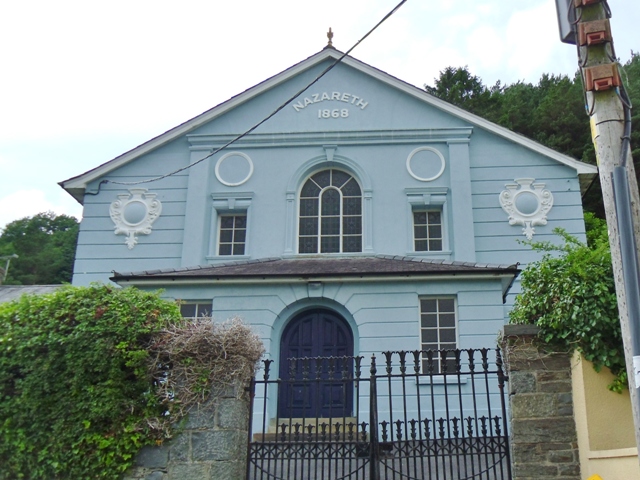
John’s importance at Talybont can now be stated more firmly. A history of Nazareth Chapel records that Rehoboth, the mother church at Taliesin, appointed John Davies of Erglodd to take charge of the new cause at Talybont. Nazareth was built in 1868, but the religious community that gathered there depended upon lay organisation, teaching and oversight as much as upon visiting ministers. John was therefore not simply an elder who occasionally attended the new chapel. He was one of the people entrusted with establishing and sustaining it.
The same chapel history says that John was known in his own time as the “children’s apostle” because of his work in the Sunday School. This changes the interpretation of the epithet Apostol y Plant. It remains important not to confuse John with Robert Owen of Nefyn, the Calvinistic Methodist minister whose work among children made that title famous across Wales and whose biography was eventually published under it. Yet the phrase was not necessarily an exclusive formal title. Within John’s own religious community it was plainly used to express the same quality of patient, intelligent engagement with children.
An earlier version of this essay also attributed a well-known teaching anecdote to Robert Owen and suggested that it placed John within Owen’s religious circle. The original source does not support that reading. The observation that a child possesses a mind and should be given fair play, together with the story of asking why wool was placed upon the sheep rather than the lion, belongs to Dafydd Rolant himself. The recollection of John follows separately. Correcting the attribution is important because the strongest early personal connection visible in the evidence is not with Robert Owen of Nefyn, but with Dafydd Rolant.
John’s local description as an Apostol y Plant is, if anything, more meaningful once this distinction is made. It did not depend upon borrowing the fame of another man. It arose from the judgement of a community that had watched him teach.
The Sunday School in rural Wales
To modern eyes, the Sunday School can appear a minor adjunct to church worship. In nineteenth-century Wales it was one of the principal institutions through which religious knowledge, literacy, public confidence and communal discipline were transmitted. Classes were not confined to young children. Adults attended, scripture was read and questioned, catechisms and hymns were learned, and teachers developed methods of explanation suited to people whose formal schooling might have been limited.
Its purpose was explicitly Christian, but its social effects went further. In communities where statutory educational provision remained uneven, the Sunday School created a dependable framework for reading, recitation and discussion. It also preserved Welsh as a language of serious thought at a time when formal advancement was increasingly associated with English. The chapel classroom demonstrated each week that Welsh could carry theology, moral reasoning and intellectual enquiry.
John devoted more than thirty years to this work in Taliesin, Talybont and the surrounding district. Contemporary recollections praised not simply his biblical knowledge but his ability to communicate. His reputation seems to have rested upon questioning, humour and clarity, qualities that helped children participate rather than merely submit to instruction. In a culture that could sometimes rely heavily upon memorisation and discipline, that ability was distinctive enough to be remembered long after the lesson itself had disappeared.
Beyond the chapel, the Board Schools
John’s interest in children did not stop at the Sunday School. Earlier accounts described his connection with the “National schools” of the district, but the surviving evidence points instead to the new Board School system created after the Elementary Education Act of 1870. The distinction matters. A National School normally belonged to the Anglican National Society tradition, whereas a Board School was part of the emerging system of locally elected statutory elementary education.
In September 1874 some 250 Board School children from the district were taken on an outing to Borth. With the accompanying adults, around 450 people sat down to tea. They travelled in eight wagons, eleven carts and two carriages, an impressive movement of children and families from scattered rural communities. Among the men who addressed the gathering was Mr Davies of Erglodd. The contemporary account survives in a transcription of the Cambrian News.
Two years later, on 24 October 1876, the new Llangynfelyn Board School was formally opened. The building had accommodation for about 130 pupils. After tea, cake and what the report called rustic sports for the children, a public meeting was held and John Davies of Erglodd was again among the speakers. The opening ceremony is preserved in the local history record of the school.
John was not one of the five elected members of the School Board itself, so his role should not be inflated into formal educational office. The evidence is nevertheless significant. He moved comfortably between Methodist Sunday School education and the new statutory system, supporting the public education of local children without apparently treating the two as rivals.
Recognition during his lifetime
John’s service did not pass unnoticed. He held senior positions within the district’s Sunday School organisation and participated in the inter-chapel meetings through which neighbouring schools compared progress and maintained standards. In 1878, after decades of work, he was presented with a painted portrait and a formal address.
For a lay farmer this was a striking honour. Portraiture carried real social meaning in Victorian rural Wales. To commission and present a likeness was to say that a person’s face, as well as his name, deserved to be preserved. The honour celebrated neither inherited rank nor military distinction, but the accumulated weight of work with children. It tells us as much about the values of the community making the presentation as it does about John himself.
Erglodd after Thomas Davies
Thomas Davies died at Erglodd in March 1876, after which John succeeded him as farmer. The 1881 census recorded John as an unmarried farmer of 120 acres. His widowed sister, Elizabeth Jones, remained with him, together with a young farm servant and two female domestic servants. Erglodd was therefore both a family home and an employing farm, and John’s ability to participate in chapel, educational, temperance and public work depended in part upon the labour of others who sustained the agricultural and domestic economy.
This qualification is worth making because Victorian biography often converted public service into the achievement of a single man while leaving the household that supported it almost invisible. Elizabeth, in particular, possessed a charitable identity of her own.
Elizabeth, Mary and practical charity
Elizabeth had married William Jones and had one daughter, Mary. After William’s death, mother and daughter returned to Erglodd. John appears to have shared in Mary’s upbringing, making the farm an intergenerational household shaped by widowhood, kinship and mutual dependence.
Elizabeth’s charitable work can now be measured more precisely. In December 1874 the Cambrian News reported that the Poor Women’s Club serving Tre’rddol, Taliesin and the surrounding neighbourhood was flourishing, with Mrs Jones of Erglodd as treasurer. At its annual distribution 85 tickets were issued, each allowing a member to obtain warm clothing for the winter. This was not occasional private kindness. Elizabeth was helping to administer an organised local system of mutual aid and charitable support.
John’s own most frequently remembered charitable gift was the sheep he provided each Christmas so that poorer inhabitants of Taliesin could have meat. The gesture was practical and entirely suited to a farmer. It also belonged to the paternalistic economy of Victorian rural welfare, in which poorer households could depend upon the generosity of those with property. John would later move from this personal form of charity into the much more formal world of Poor Law administration.
Mary Jones and the continuation of the Nazareth connection
John’s influence at Nazareth continued through the family around him. In 1869, only a year after the chapel was built, his niece Mary Jones, who had been raised at Erglodd, presented Nazareth with a notably fine and costly set of communion vessels. The gift was important enough to be recorded in Y Drysorfa, and it tied the Erglodd household materially as well as spiritually to the new cause.
On 16 October 1876 Mary married James Thomas Morgan of Maesnewydd, near Talybont. Morgan became a substantial farmer and landowner, a Justice of the Peace and a Cardiganshire county councillor. He also became a deacon at Nazareth and served as chapel treasurer until 1923. Their son Richard William Morgan JP followed him in the treasurership, extending the family’s institutional connection with the chapel into another generation.
Mary and Elizabeth were also remembered for welcoming travelling ministers at Maesnewydd. Such hospitality was an important but easily overlooked element of chapel life. Ministers travelling between scattered causes depended upon homes where they could eat, rest, converse and sometimes stay overnight. The religious network was sustained in kitchens and dining rooms as surely as it was from pulpits.
Temperance and the Good Templars
During the early 1870s John became active in the International Order of Good Templars, the fraternal temperance movement committed to complete abstinence from alcohol. The Order organised local lodges, adopted ceremonies and offices, trained members in committee procedure and public speaking, and offered them a sense of belonging to an international moral campaign.
Temperance possessed particular strength within Welsh Nonconformity. Alcohol was associated with lost wages, poverty, domestic disorder and spiritual failure, and abstinence was therefore presented as both a personal discipline and an instrument of social reform. John became a speaker for the movement in northern Cardiganshire, and newspaper reports described him as humorous and effective before an audience.
That humour may help explain why he was also successful with children. The surviving portrait of John is not of a relentlessly severe Victorian moralist, but of a man who could make serious arguments without stripping them of warmth. The prominence of the Good Templars in Wales can be seen in surviving photographs and records, including an 1880s temperance gathering preserved by People’s Collection Wales.
The uncomfortable evidence, John as a landlord
One of the most revealing pieces of evidence about John does not fit comfortably into a purely celebratory biography. On 17 March 1879 the local Medical Officer reported three houses at Nantyllain, occupied by Mary Rees, Mary Thomas and Evan Morgan, as unfit for human habitation. The clerk was instructed to send the report to “Mr Davies of Erglodd”, who was explicitly described as the owner of the houses. The sanitary authority minutes survive in transcription.
In the context of 1879, when John was the head of the Erglodd household, the identification almost certainly refers to him, although the wording should retain that slight degree of caution. It is also important to distinguish ownership of these cottages from ownership of Erglodd itself. The 1844 tithe record shows the Davies family occupying the principal farm as tenants, and later valuation evidence likewise warns against assuming that John acquired the freehold of Erglodd.
The Nantyllain minute tells us neither why the cottages had deteriorated nor what John did after receiving the report. It would therefore be wrong either to excuse him automatically or to condemn him beyond the evidence. What it does show is that he stood within the rural property system as well as within the charitable system. A man remembered for giving food to the poor could also own housing which public health officials judged unacceptable.
That tension makes him more historically intelligible. Victorian philanthropy and Victorian paternalism often occupied the same life. John was not outside the inequalities of his society dispensing charity from a morally neutral position. He participated in the structures that produced both authority and obligation.
Typhoid, water and the sanitary reform of Taliesin
The sanitary records also show John on the other side of the public health question. Taliesin suffered serious problems with water and drainage during the late 1870s. In 1878 the Medical Officer recorded nine cases of typhoid, including deaths, and drew attention to defective drainage, insanitary houses and water sources exposed to contamination from pigsties, refuse and sewage. Further concern followed over the pollution of Ffynnon Stephen.
At a public meeting in January 1881 the parish appointed eleven men to carry through a scheme for a wholesome water supply. One was explicitly named as John Davies, Erglodd. The sanitary authority authorised expenditure of up to £20, and water was obtained from an uncontaminated source. By 1882 the Medical Officer could report that Taliesin, after several years of typhoid, had avoided further fever, a change he attributed in part to the improved water supply and associated sanitary measures.
This gives John a civic role before his election to the Board of Guardians. It also provides an instructive counterpoint to the Nantyllain cottages. Within only a few years the same man appears in the records as a property owner called to account over poor housing and as one of the local men entrusted with helping to secure cleaner water for the village. Such evidence resists simple moral categories and brings us closer to the complicated workings of authority in a Victorian rural community.
Guardian of the poor
In 1882 John entered another sphere of public responsibility when he became a member of the Aberystwyth Board of Guardians. The boards had been established within the reformed Poor Law system after 1834. Elected by local ratepayers, guardians oversaw relief, the workhouse, appointments and expenditure across the union. The National Archives provides a useful account of the structure and responsibilities of Boards of Guardians.
Guardianship was both public service and social power. A guardian might help ensure that an elderly, sick or destitute neighbour received assistance, but he also participated in a system deliberately constructed to make dependence upon public relief restrictive and, in many circumstances, humiliating. John’s charitable reputation may suggest the sort of guardian he wished to be, but the evidence presently available does not tell us how he voted in individual cases and should not be made to do so.
What can be said is that his neighbours trusted him sufficiently to elect him and that he continued in office until his death. His career had moved from the private gift of a Christmas sheep, through local sanitary work, into the statutory administration of poverty. Victorian welfare operated through all three worlds at once.
A life organised around service
John never married, but there is little reason to describe him as solitary. His life was densely connected. He belonged to an extended family household, a substantial farm, the Rehoboth and Nazareth chapel communities, a Sunday School network, the Good Templars, the North Cardiganshire Monthly Meeting, public educational gatherings, sanitary reform and the Poor Law union.
Nor was he a man without social position. A farmer responsible for a sizeable holding, servants and additional property occupied a position of consequence in rural Cardiganshire, while membership of the Board of Guardians was a genuine public office. His distinction lies not in having lacked authority, but in the uses to which much of that authority was put.
This is also why the surviving evidence concerning children is so important. The title Apostol y Plant did not celebrate wealth or institutional rank. It identified the quality for which his own religious community most wanted him remembered, his ability to teach and engage the young.
Illness and the imagery of Job
John’s final illness lasted approximately eighteen months. His death certificate recorded “general decay” brought about by chronic eczema. The language belongs to nineteenth-century medicine and should not be converted too confidently into a modern diagnosis. Severe chronic skin disease could involve relentless itching, broken skin, infection, disturbed sleep and profound exhaustion, and contemporary medicine had comparatively little with which to relieve it.
Those who visited John compared his suffering with that of Job. The comparison arose naturally in a community formed by biblical language. Job represented undeserved affliction endured without the abandonment of faith. Ministers and friends interpreted John’s illness through that scriptural pattern, finding spiritual meaning in suffering that medicine could do little to ease.
Modern readers may be uneasy with the idea that suffering ripened character. Such language could console, but it could also romanticise pain. For John’s contemporaries, however, the manner in which a person endured illness formed part of the moral assessment of a life. His patience in sickness was remembered as a final extension of the steadiness he had shown in health.
Death and funeral
John Davies died at Erglodd on 15 June 1887, aged sixty-five. His funeral took place on Saturday 18 June. Despite the summer heat, a large company gathered to accompany his body to the Calvinistic Methodist burial ground at Talybont, associated with Nazareth Chapel, where he had asked to be buried.
Ministers and lay representatives attended, reflecting his standing within North Cardiganshire Methodism. Their tributes concentrated less upon formal achievement than upon the accumulated consistency of his life. One eulogist said, in effect, that John had written his own elegy through the manner in which he had lived. Another used the agricultural image of mildew ripening the grain, applying the language of harvest to his final affliction.
The metaphor would have been immediately intelligible to a farming congregation. The life of the field and the language of scripture met naturally at the funeral of a farmer and elder. Children, former pupils, neighbours and chapel members formed the more enduring testimony. They had known him not through a printed biography, but through repeated encounters over many years.
What became of Erglodd and Nazareth?
The documentary trail does not end with John’s death. An index to local wills records papers relating to “John Davies, Erglodd, parish of Llangynfelyn, farmer” under 1886, now associated with the National Library of Wales Maesnewydd material. The will itself, or the surviving papers connected with it, remains one of the most promising sources for establishing the extent of John’s personal property, his executors, family provision and any charitable or chapel bequests.
The Maesnewydd papers are equally tantalising. National Library of Wales descriptions identify an account book for Maesnewydd Farm extending from 1825 to 1918, a volume recording the 1888 sale connected with Erglodd, including valuations of stock and crops and conditions of sale, and Calvinistic Methodist diaries covering years that overlap John’s mature career, final illness and death. The 1888 material should not be treated as proof that John owned the freehold of Erglodd, since the tithe and later valuation evidence point in a different direction, but it may help explain how the farm and its working assets were reorganised after his death.
Nazareth itself survived far longer than the world that created it. Worship ceased there in 2022 when the congregation merged with Bethel Chapel in Talybont. In February 2026 Ceredigion County Council approved the conversion of the former chapel into a three-bedroom home. The planning report argued that retaining the building, even in residential use, would allow the cultural history of the settlement to remain visible. The decision was reported by the Cambrian News on 19 February 2026.
There is something fitting in that afterlife. The congregation John helped to nurture has gone, but the building remains within the village landscape. Its altered use is another reminder that institutions disappear more quickly than the relationships and memories through which they once mattered.
The measure of a layman
John Davies’s importance should not be exaggerated into national celebrity. He did not transform Welsh education and he did not exercise influence across the whole of Wales. Robert Owen of Nefyn remains the nationally celebrated Apostol y Plant. John’s achievement was regional, sustained and intimate.
That scale matters. Religious cultures are not maintained by famous leaders alone. They depend upon people willing to teach week after week, keep accounts, organise meetings, visit households, welcome ministers, maintain buildings, raise money and accept responsibility when there is no wider audience. John’s portrait was presented because his community had watched that kind of service accumulate over decades.
The new evidence also makes the portrait more complex. John supported poorer neighbours and served as a guardian, yet he was also identified as the owner of cottages condemned by the sanitary authority. He helped establish Nazareth and spent decades teaching children, but the work depended upon the labour of the household and farm around him. He participated in private charity, voluntary reform and statutory welfare, three systems that could complement one another while embodying very different assumptions about poverty and social order.
That complexity does not diminish him. It rescues him from becoming a plaster saint and returns him to the society in which he actually lived.
The quiet architecture of Welsh Nonconformity
The history of Welsh Nonconformity is often written through revivals, great preachers and political campaigns. John Davies directs attention towards its local architecture. That architecture was made of farms and kitchens as well as chapels. It depended upon women such as Elizabeth, who administered charity, and Mary, who gave materially to Nazareth and welcomed ministers. It depended upon servants whose labour released farmers for public work, upon children willing to learn and upon adults prepared to teach them.
John stood within this network rather than above it. His life joined Montgomeryshire and Cardiganshire, farming and faith, Sunday School and Board School, private charity and public welfare. He represented the prosperous rural middle rank from which Welsh Methodism drew much of its organisational strength.
As his kinsman, I take pride in recovering his story, but that pride does not require turning him into something he was not. He was not Robert Owen of Nefyn, nor was he a national educational reformer. He was John Davies of Erglodd, a man whom his own chapel tradition remembered as an Apostol y Plant because, for more than thirty years, children listened when he spoke.
His neighbours entrusted him with public responsibility. His chapel trusted his judgement. His family carried his religious commitments into another generation. His charity touched poorer households, his civic work reached questions of water, health and relief, and even the uncomfortable evidence of the Nantyllain cottages reminds us that his authority was exercised within the imperfect social structures of his age.
That was the reach of his life, local rather than national, quiet rather than spectacular, but deep enough to be remembered.
Related Books
Voices from the Uplands: The Davies Family and the Soul of Rural Wales
John belongs to the wider network of upland families, chapel culture and rural communities explored in this book.
Kindle · Paperback
The Davies Caeadda Family: A Welsh Farming Dynasty, 1700–1966
This earlier family history provides the broader Davies family context from which John’s branch emerged.
Kindle · Paperback
Old Llyfnant Valley Farming Families
For the wider rural family networks and farming communities of the Llyfnant Valley connected with this story.
Kindle · Paperback
Related Essays
- From Spa Town to Administrative Capital: Civic Government and the Making of Llandrindod Wells
- Llandrindod Wells Hospital: From Cottage Hospital to County War Memorial
- Board and Lodging: The Boarding Houses of Llandrindod Wells
- Bowling in Llandrindod Wells: From the Spa Greens to Rock Park and the Indoor Game
Explore more Welsh history
Browse more research in Essays and Notable People of Mid Wales.
Receive new historical essays by email
For new essays on Welsh history, biography, genealogy and rural community life, subscribe on the homepage.
Sources and Further Reading
- Antony David Davies, The Davies Caeadda Family, for the reconstruction of the Esgair Hir, Erglodd and later family lines.
- Llangynfelyn tithe apportionment, 1844, for Thomas Davies’s occupation of Erglodd under J. M. Davies, Esq., and the acreage and composition of the holding.
- Census returns for Llangynfelyn parish, particularly 1851, 1861 and 1881, for the acreage, servants and composition of the Erglodd household.
- Rehoboth Chapel, Taliesin, membership list, 1859, recording Thomas Davies, Mary Davies, John Davies, Elizabeth Jones and Mary Jones of Erglodd within the congregation.
- Cofiant Dafydd Rolant, Pennal, especially the recollection of the young John Davies walking to the Dolgellau Association and the later description of his standing at Taliesin, Talybont and within the North Cardiganshire Monthly Meeting.
- History of Nazareth Chapel, Talybont, for Rehoboth’s appointment of John to take charge of the new Talybont cause, his contemporary reputation as a “children’s apostle”, Mary Jones’s communion gift and the later Morgan family treasurership.
- Cambrian News, 1874, for the Board School outing to Borth, the Poor Women’s Club and Mrs Jones of Erglodd’s work as treasurer.
- Llangynfelyn Board School history and contemporary reports, for the formal opening of the school on 24 October 1876 and John Davies’s participation in the public meeting.
- Rural Sanitary Authority minutes for the Taliesin district, 1878–1882, for typhoid, polluted water supplies, the Nantyllain housing report and John Davies’s participation in the 1881 water scheme.
- Contemporary Welsh denominational and regional newspapers, including Y Goleuad, Baner ac Amserau Cymru, Y Tyst and the Cambrian News, for John’s Sunday School, temperance, funeral and public activity.
- Aberystwyth Poor Law Union and Board of Guardians records, 1882–1887, for John’s period of elected public service.
- The National Archives, “Poverty and the Poor Laws”, for the organisation and responsibilities of Boards of Guardians after 1834.
- People’s Collection Wales, “Temperance Gathering in Llandrindod Wells, 1880s”, for wider visual context on the International Order of Good Templars in Victorian Wales.
- Llangynfelyn wills index, entry for John Davies of Erglodd, farmer, 1886, referring to National Library of Wales material associated with Morgan of Maesnewydd.
- National Library of Wales, Maesnewydd papers and Annual Report description, including the Maesnewydd farm account book, the 1888 Erglodd sale material and Calvinistic Methodist diaries overlapping John’s later life.
- Papur Pawb, March 2014, for the later statement that John served as president of the North Cardiganshire Monthly Meeting and represented it at the Associations. The exact offices await confirmation against contemporary denominational minutes.
- Cambrian News, 19 February 2026, “Former Talybont chapel to be turned into family home”, for the closure of Nazareth in 2022, its merger with Bethel and approval of residential conversion.
- Civil registration records, including John’s death certificate, which recorded his death at Erglodd on 15 June 1887 and attributed his final decline to chronic eczema.