
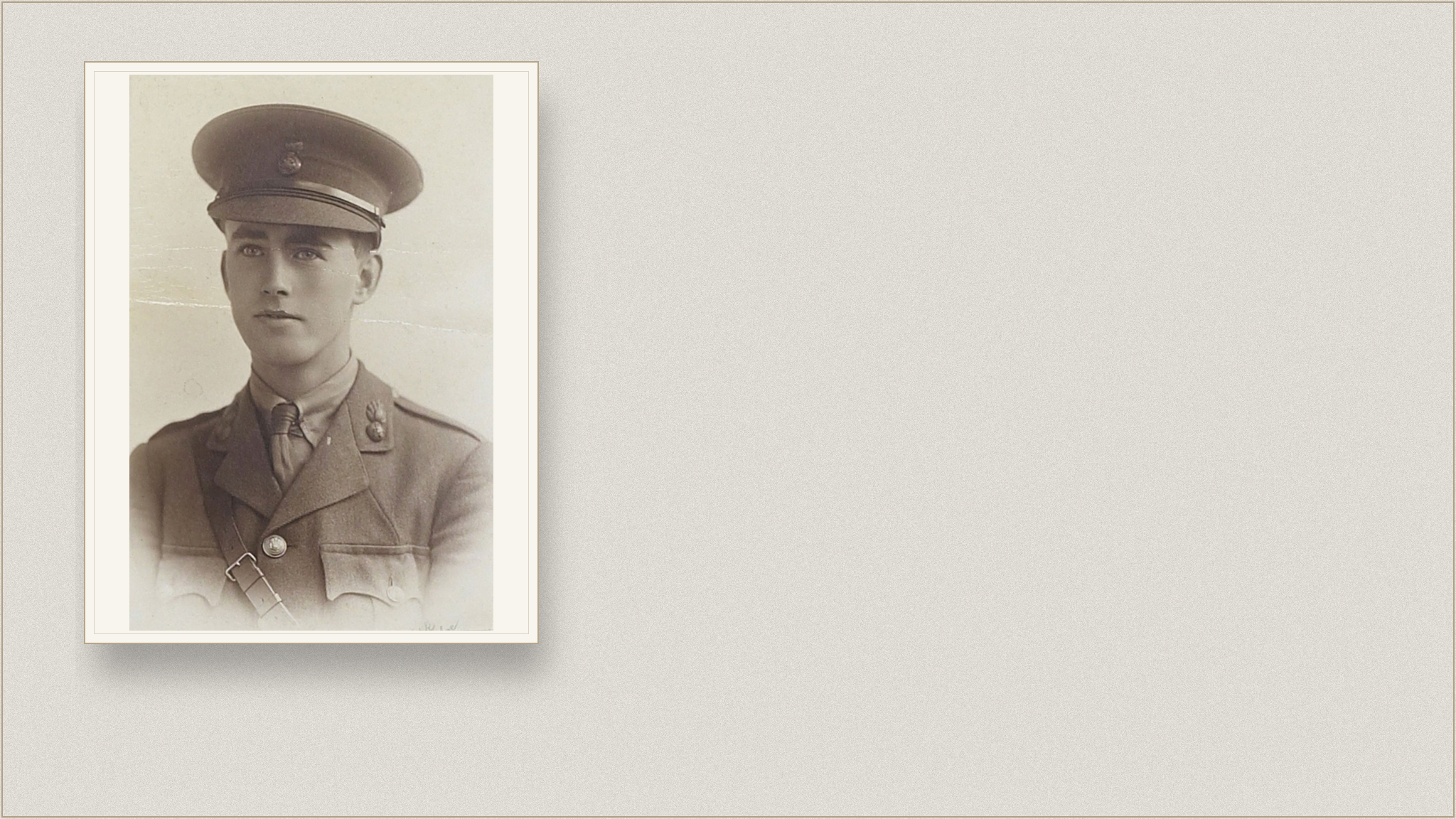
Seven days after Lieutenant Hugh Wynn Wilding-Jones died in a military hospital near Salonika, Bulgaria signed an armistice and withdrew from the First World War.
He had survived service on the Western Front, a gunshot wound, colitis, influenza and jaundice. After long periods of convalescence and restricted duty, he had been declared fit to serve abroad again. In the summer of 1918 he joined the 11th Battalion of the Royal Welsh Fusiliers in Macedonia, where he became responsible for the battalion’s Lewis guns.
On 18 September, during the final Allied offensive at Dojran, Hugh advanced with his battalion against some of the strongest Bulgarian defences on the Balkan front. He was wounded during a battle in which the 11th Royal Welsh Fusiliers suffered catastrophic losses.
Evacuated to hospital, he died on 22 September 1918. He was twenty-two. Before the war, Hugh had been educated at Tonbridge School and Corpus Christi College, Oxford. As the eldest son of William Wilding Jones, he occupied the expected position of heir to the Glandwr estate near Barmouth. His future appeared to lie within the familiar world of education, professional employment and family responsibility.
War dismantled that future in stages. Oxford gave way to officer training, academic promise to military administration, and the inheritance of a Welsh estate to a grave in Greece.
The Glandwr inheritance
Hugh was born at Haywards Heath, Sussex, on 3 March 1896, the eldest son of William Wilding Jones and Ellen Marie Jones.
His paternal family belonged to the professional and landowning world created by his great-grandfather, William Jones of Glandwr. Born in Dolgellau in 1792, the elder William established himself as a successful London solicitor before constructing Glandwr Hall outside Barmouth during the 1830s.
By the 1870s the estate comprised roughly 1,000 acres around the Mawddach. It represented the conversion of metropolitan professional wealth into Welsh landed identity. Glandwr gave the family a territorial centre, although successive generations increasingly lived and worked elsewhere. By Hugh’s childhood, the economic foundations of this world were becoming less secure.
The long agricultural depression had reduced the profitability of landed estates, while taxation, maintenance costs and changing social expectations placed additional burdens upon families whose wealth was tied to property. Hugh’s father never settled permanently at Glandwr Hall. From 1905 the house was let to tenants, first to William Henry Higgins and later to the Rowe family.
The letting of the Hall did not mean that the estate had ceased to matter. It remained a source of income, an inherited asset and the principal territorial expression of the family’s Welsh identity. Hugh, as William’s eldest son, would ordinarily have been expected to assume responsibility for it in due course.
That expectation should not be mistaken for certainty. Family settlements, wills, financial pressures and the claims of other heirs could all modify inheritance. Nevertheless, before 1914, Hugh stood at the beginning of the most obvious line of succession. His education reflected that anticipated position.
Marlborough House and Tonbridge
Hugh was first educated at Marlborough House Preparatory School in Hove. In September 1910, aged fourteen, he entered Tonbridge School, where the school’s Roll of Honour later recorded him as a Day Boy. During these years the family lived at Gable House, Yardley Park Road, Tonbridge, and Hugh’s father, William Wilding Jones, served as one of the Governors of the School. The connection was therefore more than educational, the family had become part of the institutional life of Tonbridge itself.
Tonbridge belonged to the established public-school system through which professional and landowning families prepared their sons for university, the armed forces and positions of authority. Its education was academic, but it also emphasised loyalty, discipline, physical activity and service.
Hugh appears to have been both able and well liked. Later recollections described him as intelligent, sociable and possessed of a quiet sense of humour. The surviving descriptions do not suggest a flamboyant personality. He seems instead to have impressed through conversation, steadiness and understated companionship.
He was also recorded as suffering from poor eyesight. This did not prevent his later commission, but it complicates the idealised image of the perfectly fit Edwardian officer. As his Oxford contemporaries later remembered, the matter concerned Hugh himself. When he arrived at Corpus Christi he feared that his sight might prevent him from entering the Army, and he was delighted when he learned that he had nevertheless been accepted for a commission.
At Tonbridge, Hugh joined the Officer Training Corps. Such corps had expanded considerably before the First World War, supplying boys and university students with elementary military instruction. Training might include drill, musketry, field exercises, map reading and the rudiments of command.
Participation did not make war inevitable, nor did every member intend a military career. It nevertheless prepared a generation of educated young men to meet the Army’s sudden demand for junior officers after August 1914.
By Hugh’s final year at Tonbridge, Oxford had become a definite objective rather than an abstract expectation. In January 1915 the University of London examination records listed “Wilding-Jones, Hugh Wynn, Tonbridge School” among candidates taking Supplementary Latin Prose with a view to Oxford Responsions. The entry places him within the ordinary academic routines of his final school year even as the war was reshaping the world around him. It does not establish what subject he intended to read at Oxford, but it shows that he was actively preparing to meet the university’s entrance requirements before leaving Tonbridge.
Corpus Christi College
Hugh entered Corpus Christi College, Oxford, in October 1915. His university career had scarcely begun before military service overtook it. He completed only two terms and took no Oxford University examinations. The subject he intended to study has not been conclusively identified. Family research has suggested law, a plausible choice given the legal tradition of the Jones family and Hugh’s expected responsibility for property. Without a university record confirming the subject, however, this must remain an inference.
The surviving college recollection is unusually valuable because it allows us to see something of Hugh before the Army reduced his life to ranks, medical boards and movements. Corpus remembered him as a good conversationalist, tolerant of opinions unlike his own and possessed of a quiet humour that was never malicious. Men of markedly different temperaments seem to have enjoyed his company.
There is one particularly vivid detail. Hugh gathered groups of freshmen in his room above the Junior Library, where conversation could continue far into the night. His contemporaries remembered evenings when they almost “talked the stars to rest”. For a man whose surviving military papers are necessarily formal, the image is remarkable, a twenty-year-old undergraduate in his rooms at Oxford, surrounded by friends, talking long after the college had grown quiet.
His poor eyesight also had a more personal significance than the medical record alone suggests. When Hugh first came up to Corpus he worried that his sight would prevent him from entering the Army. Later that term, when he learned that he had been accepted for a commission, his friends remembered his delight. We cannot now disentangle the precise mixture of patriotism, duty, social expectation and personal conviction behind his wish to serve, but the evidence establishes that military service was something he actively sought rather than merely endured.
The chronology makes the speed of the transformation especially stark. At the beginning of 1915 Hugh was still preparing for Oxford entrance requirements. In October he arrived at Corpus. By December he had applied for a commission, and his formal military service began on 6 July 1916. Within little more than a year, the academic routines of school and university had given way to officer training and active service.
Oxford had already been transformed by war. Students enlisted, college rooms were emptied and established academic lives were suspended. Yet Hugh’s friends did not regard his departure as the end of his university life. They expected that he would return. The recollection preserved after his death makes clear that they imagined meeting him again at Corpus and recovering something of the companionship they had known before military service carried him away.
That expectation matters. Hugh’s unrealised future was not constructed only by later family memory or by historians looking backwards from his death. The people who knew him at Oxford assumed there would be an after-war in which the young man who had talked with them late into the night above the Junior Library would come back.
The college memorial closed its recollection with the classical phrase Dis aliter visum, loosely, “it seemed otherwise to the gods”. The wording belonged naturally to the classical educational culture of Hugh’s generation, but its meaning was painfully simple. His friends had expected one future, events produced another.
Application for a commission
Hugh applied for a commission in December 1915. His former headmaster at Tonbridge supported the application, certifying his education and character.
The requirement was typical of contemporary officer selection. The British Army was expanding at a speed unimaginable before the war, but ideas of leadership remained closely connected to education, conduct and social recommendation. Public schools and universities became important recruiting grounds because they were assumed to have prepared men for command.
Hugh entered officer cadet training at Cambridge. He was recorded as approximately five feet nine inches tall and weighing about 140 pounds. On 6 July 1916 his military service formally began and he received his commission as a second lieutenant in the Royal Welsh Fusiliers. The appointment was subsequently confirmed in the London Gazette in November 1916, providing the formal public record of his rank.
The regimental connection was appropriate for a family whose estate and identity remained associated with Wales, although Hugh himself had been born at Haywards Heath and educated and largely raised in England. His Welsh identity was therefore inherited through family, property and ancestry as much as through residence. It is tempting to connect his choice of regiment directly with Glandwr, but without evidence in his own papers that should remain a possibility rather than a conclusion.
A commission brought status, but also danger. Junior infantry officers were expected to lead from the front, maintain discipline under fire and make rapid decisions with limited experience. Their visibility to both their own men and enemy marksmen contributed to exceptionally high casualty rates. Hugh was twenty when he entered that world.
France and the 1st Battalion
In September 1916 Hugh crossed to France and joined the 1st Battalion, Royal Welsh Fusiliers.
The battalion was serving on the Western Front during the later stages of the Somme campaign. By then, the great offensive had already consumed hundreds of thousands of casualties. The landscape into which Hugh arrived was one of damaged villages, waterlogged trenches, artillery destruction and continual movement between front-line, support and reserve positions.
For a newly commissioned officer, the adjustment was severe. Training could teach procedure but not reproduce the strain of command under bombardment. A junior officer might be responsible for men far more experienced in trench life than himself, while simultaneously answering to superiors and learning the routines of an active battalion.
Hugh’s surviving record suggests that he was entrusted with genuine operational responsibility. In January 1917, during operations near Beaumont-Hamel, he led a patrol intended to establish contact with neighbouring troops. The incident was recorded in the battalion war diary.
Such patrols were essential and dangerous. They required men to move through broken or contested ground, often at night and under the threat of rifle, machine-gun and artillery fire. The objective might sound limited, but the information obtained could determine whether units remained connected or whether gaps had opened in the line. Shortly afterwards, Hugh was wounded by a gunshot to his left thigh.
Wound and illness
The thigh wound was described as superficial. In another man’s record, it might have represented a temporary interruption followed by a straightforward return to duty. For Hugh, it began a much longer period away from the front.
After evacuation to Britain, his recovery was complicated by persistent gastrointestinal illness, eventually diagnosed as colitis. He also suffered episodes of influenza and jaundice. His military file records repeated examinations, periods of sick leave and uncertainty over his fitness for active service.
These illnesses reveal another dimension of the war’s attrition. Military history naturally concentrates upon battle wounds, but disease removed enormous numbers of men from duty. Even away from the front, illness could become chronic, debilitating and difficult to treat.
Colitis could produce abdominal pain, weakness, diarrhoea, dehydration and loss of weight. Influenza and jaundice added further strain to a body already weakened by active service and injury.
Hugh remained in uniform, but his military usefulness was restricted. He performed light and reserve duties in Britain and Ireland while medical boards considered whether he was fit to return overseas.
This period must have carried its own frustration. He had left Oxford to serve, crossed to France and joined a regular battalion, only to spend much of the following year moving through hospitals, convalescence and restricted employment.
His promotion to lieutenant took effect in January 1918. Eventually, despite his medical history, he was again judged fit for general service.
The Salonika front
Hugh’s return overseas did not take him back to France. In 1918 he was sent to the British Salonika Force. Formally he remained an officer of the 3rd Battalion, Royal Welsh Fusiliers, the Special Reserve battalion, but for active service in Macedonia he was attached to the 11th Battalion. That distinction matters, because the 11th was the battalion with which he fought and was wounded at Dojran.
The Allied army had landed at Salonika in 1915, initially in an unsuccessful attempt to support Serbia. It subsequently maintained a long front across Macedonia against Bulgarian and other Central Powers forces.
The campaign was sometimes mocked as strategically inactive, but the conditions were formidable. Troops endured extremes of heat and cold, poor roads, difficult supply lines and widespread disease. Malaria became so prevalent that sickness frequently caused more casualties than enemy action.
Hugh’s history of colitis and other illness made the posting particularly hazardous. Nevertheless, by the summer of 1918 he was again serving with an operational battalion.
He was appointed Lewis Gun Officer.
The Lewis gun
The Lewis gun was a portable light machine gun capable of providing mobile automatic fire. By the later stages of the war, it had become essential to infantry tactics. Lewis-gun teams could protect an advance, suppress defensive positions and strengthen ground after its capture.
As Lewis Gun Officer, Hugh was responsible for more than carrying a weapon into battle. He had to supervise training, maintenance, ammunition supply and the tactical deployment of gun teams across the battalion.
The appointment required technical knowledge and organisation. It also suggests that his commanders considered him capable of managing a specialist part of the battalion’s fighting strength despite his interrupted service and medical history.
The role placed him at the centre of the changing nature of infantry warfare. The British Army of 1918 depended increasingly upon coordinated firepower rather than the rifle line alone. Light machine guns gave small units greater independence, but their effectiveness depended upon careful positioning and an adequate supply of ammunition.
At Dojran, those weapons would be taken against a defensive system constructed over several years.
The Bulgarian defences
By September 1918, the Bulgarian positions around Lake Dojran were among the strongest on the Macedonian front.
The defenders occupied high ground protected by trenches, fortified posts, wire, ravines and carefully positioned artillery and machine guns. They had spent years studying the approaches and preparing interlocking fields of fire. Previous Allied assaults had demonstrated the difficulty of attacking such positions.
The wider Allied offensive was intended to break Bulgaria’s capacity to remain in the war. French and Serbian forces would attack further west around Dobro Pole, while British and Greek formations assaulted the Dojran defences. Strategically, the attacks formed part of the same operation. Tactically, their results were very different.
At Dobro Pole, the Bulgarian front was broken. At Dojran, the British and Greek assault encountered concentrated defensive fire and suffered enormous casualties.
The attack of 18 September
The 11th Royal Welsh Fusiliers belonged to the 67th Brigade of the 22nd Division. On 18 September 1918, the battalion advanced into broken ground around the Bulgarian positions.
Its objectives took the men towards a succession of strongly defended features, including Dagger and Sabre Ravines, Jumeaux Ravine and a position known as the Hilt.
The language of maps can make the action appear orderly. On the ground, units faced smoke, dust, noise, steep terrain and machine-gun fire from positions that had survived the preliminary bombardment. Communications became difficult, officers and runners were hit, and formations fragmented as they attempted to cross ravines and continue the advance.
The battalion suffered devastating losses. A regimental account recorded that it entered the action with twenty officers and approximately 480 other ranks. By the end, only three officers and around one hundred men remained unwounded.[1]
Hugh was among those struck during the advance. The surviving evidence points to the fighting of 18 September as the occasion on which he was mortally wounded, although some later summaries give different dates. His duties as Lewis Gun Officer would have required him to monitor and coordinate gun teams while the battalion moved through increasingly confused and dangerous ground. The precise moment at which he was hit cannot now be reconstructed with certainty. He survived the battlefield and was evacuated.
Kalamaria
Hugh was taken to a military hospital at Kalamaria, near Salonika. He died there on 22 September 1918, four days after the attack. He was twenty-two years old.
His death came during a sudden collapse of the Central Powers’ position in the Balkans. Although the attack at Dojran had been repulsed at terrible cost, the Franco-Serbian breakthrough further west forced the Bulgarian army to retreat to avoid encirclement.
Bulgaria requested an armistice. The Armistice of Salonica was signed on 29 September and came into force the following day.
Hugh had died one week before the agreement was signed. It would be misleading to call his death militarily pointless simply because the war in Bulgaria was almost over. The soldiers attacking Dojran could not know the precise speed with which the wider front would collapse. Nevertheless, the proximity of peace sharpens the tragedy. After surviving France, injury and prolonged illness, Hugh died during the final days of a campaign already approaching its conclusion.
Burial at Mikra
Hugh was buried at Mikra British Cemetery at Kalamaria, now within Thessaloniki. The cemetery contains men who died in hospitals and medical establishments serving the Salonika Force. Unlike soldiers whose bodies could not be recovered from the battlefield, Hugh received an identified grave. The inscription chosen by his father reads:
OF CORPUS CHRISTI COLLEGE OXFORD
DEARLY LOVED
DEEPLY MOURNED
The words are restrained. They identify not only the soldier, but the student he had been before the Army claimed the remainder of his short life.
Corpus Christi represented the future interrupted by war. It recalled learning, companionship and possibilities that had not yet hardened into a settled career. By placing the college upon the grave, Hugh’s father preserved the identity that military rank alone could not contain.
Hugh is also commemorated at Tonbridge School, Corpus Christi College, All Saints’ Church in Hove and Llanaber church, where a memorial plaque connects him with the Glandwr family and its Welsh landscape.[2] The Hove commemoration is readily explained by the family’s later residence there. By the time of Hugh’s death, William and Ellen Wilding Jones were living at 53 Wilbury Road, Hove, having previously been at Gable House in Tonbridge.
Those memorials locate Hugh in several different worlds at once. Tonbridge remembered the schoolboy, Oxford the undergraduate, Hove the son of a resident family, Llanaber the Glandwr heir, while his grave in Macedonia marked the place where the war finally ended his life. The geographical spread of those commemorations reflects the character of the family itself, Welsh in ancestry and property, but increasingly English in education, residence and professional life.
The official aftermath
Hugh died intestate. The Army settled the pay and allowances due to him, while his parents dealt with the administrative consequences of his death.
They later claimed the medals to which he was entitled, the British War Medal and Victory Medal. These were issued after the war to commemorate service, but their arrival in bereaved households could only underline the absence of the person who had earned them.
Some of Hugh’s personal possessions were lost. His father attempted unsuccessfully to obtain compensation from the Army.
The loss of such objects could cause distress disproportionate to their monetary value. A watch, photograph, letter or item of uniform might be among the last physical connections between a family and a dead son. Military administration treated them as effects to be inventoried and returned. To a bereaved household, they belonged to memory.
Letters from Hugh’s fellow officers offered a more personal record. He was remembered as quietly enthusiastic, dependable and deeply liked. These descriptions accord with the recollections preserved by Corpus Christi, suggesting a man whose appeal rested upon steadiness rather than display.
The postcard
One surviving object carries Hugh’s voice more directly.
A postcard preserved within the family archive was sent to his younger sister. Its message is brief. He records his safe arrival and asks that his love be passed to those at home.
There is no attempt at grand reflection. It is ordinary family correspondence, written by someone expecting other messages and other homecomings to follow. That ordinariness gives it much of its power.
Military files record movement, promotion, illness and death. War diaries describe battalions and operations. Memorials compress a life into a name, regiment and date. The postcard preserves something different, the habits of affection that continued even as Hugh moved between home, training and war. He did not know that the message would outlive him.
The heir who never inherited
Hugh’s death altered the expected succession to the Glandwr estate. As the eldest son, he would ordinarily have stood before his younger brother Eric. Had he survived, he might eventually have inherited or assumed responsibility for the estate, although the financial realities of Glandwr were already difficult.
His death did not, by itself, destroy the estate. The Hall remained let, the land continued to produce income and the family’s legal ownership survived. Nor can we know how Hugh would have managed it. He might have restored Glandwr as a residence, continued leasing it or disposed of parts of the property. What disappeared was the most obvious line of continuity.
Eric became the surviving son. He too had been shaped by Tonbridge’s pre-war and wartime military culture, leaving the School’s Army Class in 1917 after service in the Officer Training Corps, before entering the Royal Military Academy, Woolwich, and receiving a commission in the Royal Field Artillery. Unlike Hugh, Eric survived the war, but his later life was troubled by ill health, alcoholism and the collapse of his military career. He died in 1942 without children. Their sister Sylvia inherited a life interest under their father’s will and eventually sold Glandwr Hall and much of the estate in 1955.
The eventual end of the family’s ownership had several causes, including agricultural decline, maintenance costs, family decisions and the absence of a secure succeeding generation. Hugh’s death formed part of that history, but it should not be made to explain everything that followed.
His loss was first a personal one.
A family future interrupted
The language of “lost generations” can become too broad. Not every young officer would have inherited an estate or entered public life, and survival did not guarantee happiness or distinction. Hugh’s future nevertheless had a discernible shape.
He possessed a strong education, a place at Oxford and a recognised position within his family. His military service demonstrated resilience after injury and illness, while his appointment as Lewis Gun Officer indicates technical responsibility and the confidence of his battalion.
None of this tells us precisely what he would have become. It shows only that possibilities existed.
The Oxford recollection allows one of those possibilities to be seen more clearly. His friends did not remember his departure as a final severance. They expected him back. In their minds there would be another term, another gathering in his rooms, another conversation continuing late into the night. The future Hugh lost was therefore not an abstraction. It had already begun.
The war progressively narrowed those possibilities. It interrupted Oxford, damaged his health, separated him from ordinary family life and finally killed him on a battlefield far removed from the Western Front that dominates British remembrance.
Remembering Dojran
The Salonika campaign occupies an uncertain place in British memory. It lacked the familiar names of the Somme, Passchendaele and Ypres. Its long periods of apparent inactivity encouraged dismissive descriptions, while disease and logistics seemed less heroic than trench warfare in France.
For the men who served there, nothing about the danger was imaginary. The 11th Royal Welsh Fusiliers entered the Dojran attack with nearly five hundred men and twenty officers. Only a fraction emerged unwounded. The battalion’s losses demonstrate the intensity of fighting on a front too often dismissed as peripheral.
Dojran was also an Allied tactical defeat within a strategically successful offensive. Bulgarian forces held their positions against British and Greek attacks, but the breakthrough at Dobro Pole forced a wider retreat and accelerated Bulgaria’s withdrawal from the war.[3]
Hugh died within that contradiction. His battalion’s immediate objective was not securely won, yet the campaign of which it formed part helped bring about the first armistice with one of Germany’s principal allies.
Dearly loved, deeply mourned
Hugh Wynn Wilding-Jones lived for twenty-two years. He was a schoolboy at Tonbridge, an undergraduate at Corpus Christi, a son and brother, a wounded officer, a prolonged patient and finally a specialist machine-gun officer in a battalion sent against the heights above Dojran.
His biography should not reduce him to a lost heir. Glandwr explains the family expectations surrounding his youth, but inheritance was only one possible part of a life that remained unfinished.
Nor should he be remembered solely through the manner of his death. The surviving recollections point to intelligence, humour, tolerance and quiet enthusiasm. They also preserve a much more ordinary young man, sitting above the Junior Library at Oxford and talking with friends until the stars seemed to disappear. His postcard preserves affection without ceremony. The medical record shows persistence through illness, while his return to overseas duty followed a desire to serve that had been evident from the beginning.
The grave inscription chosen by his father remains the most honest conclusion. It does not claim that Hugh died gloriously or attempt to explain the purpose of his sacrifice. It remembers the college he had left and expresses the grief of those who knew him.
“Dearly loved, deeply mourned” was not the language of strategy or inheritance. It was the language of a family whose future had returned from Macedonia as a name upon a grave.
Related Books
William Jones of Glandwr Hall: Law, Authority, and the Making of a Victorian Life
The origins of the Glandwr estate and the family position Hugh was expected to inherit are explored in this fuller study.
Kindle · Paperback
Old Llyfnant Valley Farming Families
This broader family history follows the Jones of Glandwr line across several generations, including the estate’s later decline and dispersal.
Kindle · Paperback
Related Essays
- The Women of Glandwr: Kinship, Household and Inheritance in a Victorian Welsh Family
- Athelstan Jasper Blaxland (1880–1963): A Glandwr Descendant and a Surgeon Through Two World Wars
- John Howel (c.1765–1835): The Woollen Manufacturer Behind the Jones Family of Glandwr
- Gatty Wynne Jones (1859–1913): From Melbourne and Glandwr to the American Banjo
Explore more family and Glandwr history
Continue with the Jones Family of Glandwr Hall, or browse Family History & Genealogy.
Receive new historical essays by email
For new essays on Welsh history, biography, genealogy and rural community life, subscribe on the homepage.
Sources and Further Reading
- The National Archives, service papers of Lieutenant Hugh Wynn Wilding-Jones, Royal Welsh Fusiliers.
- The National Archives, war diaries of the 1st Battalion and 11th Battalion, Royal Welsh Fusiliers.
- Tonbridge School, Roll of Honour 1914–1918, entry for Lieutenant Hugh Wynn Wilding-Jones, including his school status, family addresses, military attachment and obituary. Digitised reproduction.
- Tonbridge School archives, admission register and Officer Training Corps records.
- University of London, Matriculation Examination records, January 1915, Supplementary Latin Prose, Hugh Wynn Wilding-Jones of Tonbridge School, candidate 1217, entered with a view to Oxford Responsions. University of London archive.
- Corpus Christi College, Oxford, First World War Roll of Honour and the contemporary Pelican Record recollection of Hugh Wynn Wilding-Jones, including his arrival in October 1915, the fact that he took no Oxford examinations, his concern over his eyesight, his acceptance for a commission and the memories of his undergraduate companionship. Corpus Christi College Roll of Honour.
- The London Gazette, Supplement, 16 November 1916, p. 11133, confirmation of H. W. Wilding-Jones as a Second Lieutenant in the Royal Welsh Fusiliers. London Gazette.
- Commonwealth War Graves Commission, casualty record for Lieutenant Hugh Wynn Wilding-Jones and cemetery information for Mikra British Cemetery, Kalamaria.
- Kelly’s Directory of Kent, contemporary listing for William Wilding-Jones at Gable House, Yardley Park Road, Tonbridge. Digitised directory.
- All Saints’ Church, Hove, First World War memorial, including Lieutenant Hugh Wynn Wilding-Jones.
- Royal Welsh Fusiliers account of the 11th Battalion at Dojran, reproduced in the Holyhead War Memorial history.
- Foreign, Commonwealth and Development Office, “From Wales to Macedonia: Dojran Stories”.
- Antony David Davies, Old Llyfnant Valley Farming Families: Including the Jones Glandwr and Davies Caeadda Families (2015), pp. 108–116.
- Antony Davies, “William Jones of Glandwr Hall, 1792–1882: From Dolgellau to the City of London and Back Again”, for the revised chronology and scale of the Glandwr estate. Read the essay.
- Family correspondence and papers, including Hugh’s surviving postcard to his sister.
- Alan Wakefield and Simon Moody, Under the Devil’s Eye: Britain’s Forgotten Army at Salonika 1915–1918.
- Alan Wakefield, Dojran 1917–18: The Forgotten Front.
- Research supplied by fourteeneighteen|research, based upon Hugh’s surviving service papers, medical records, battalion war diaries and associated military sources.