
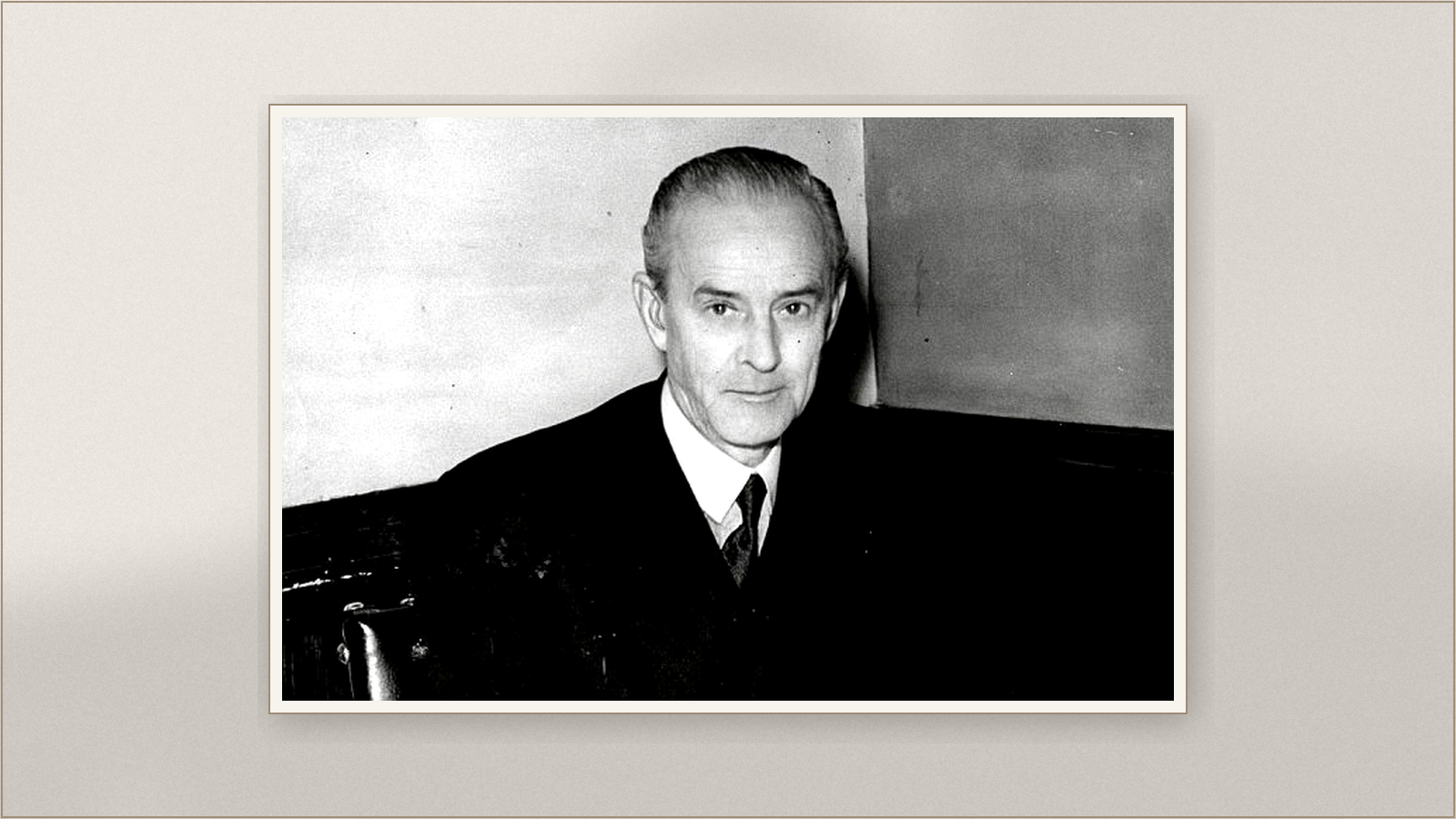
Clement Davies occupies an unusual place in the political history of Wales. He represented Montgomeryshire for almost thirty-three years, helped to bring down Neville Chamberlain’s government in 1940 and led the Liberal Party through the most precarious period in its modern existence. Yet he is remembered less readily than David Lloyd George, Jo Grimond or even some of the colleagues who served under him.
That neglect partly reflects the nature of his achievement. Davies did not lead the Liberals back to power. He did not possess Lloyd George’s theatrical force or Grimond’s promise of intellectual renewal. His period as leader, from 1945 until 1956, coincided with electoral contraction, financial weakness and repeated predictions that the party was approaching extinction.
His importance lies elsewhere. Davies preserved political continuity when revival was beyond his reach. He helped maintain an independent Liberal presence in Parliament until circumstances became more favourable. In Montgomeryshire, he represented the persistence of an older political culture shaped by local reputation, Nonconformist inheritance and independence of judgement.
His career was not a simple story of unwavering party loyalty. It included ambition, defection, return, private tragedy and impaired health. To understand him properly, those complexities must remain visible.
From Llanfyllin to Cambridge
Edward Clement Davies was born at Llanfyllin on 19 February 1884, the youngest of seven children born to Moses Davies and Elizabeth Margaret Jones.
Contrary to some later accounts, his father was not a Baptist minister. Moses Davies was an auctioneer, an occupation that placed him within the commercial and agricultural life of the district. The family background nevertheless belonged firmly to the culture of rural Welsh self-improvement.
Clement attended the local elementary school before winning a scholarship to Llanfyllin County School when it opened in 1897. The development of intermediate education in Wales created opportunities for academically able children from families outside the traditional elite. Davies became one of its notable beneficiaries.
From Llanfyllin he progressed to Trinity Hall, Cambridge, where he became a senior foundation scholar and achieved first-class honours in both parts of the law tripos, alongside several academic prizes. His performance was therefore not merely respectable but exceptional, and it marked the culmination of the educational opportunities opened to talented Welsh pupils by the expansion of intermediate education at the end of the nineteenth century.
His education carried him far beyond the expected horizons of a small Montgomeryshire town, but it did not sever his connection with the county. Like many Welsh professional men of his generation, he moved between metropolitan institutions and a powerful sense of local belonging.
A Distinguished Legal Career
Before entering Parliament, Davies established a formidable legal career.
He lectured in law at the University College of Wales, Aberystwyth, during 1908 and 1909, and was called to the Bar by Lincoln’s Inn. He practised first on the North Wales Circuit and then on the Northern Circuit before moving to London.
His legal ability brought government responsibilities during the First World War. He advised on enemy activities in neutral countries and at sea, and subsequently worked at the Board of Trade on matters involving commerce with the enemy.
After the war, he served as secretary to the President of the Probate, Divorce and Admiralty Division and then to the Master of the Rolls. He was junior counsel to the Treasury between 1919 and 1925 and became King’s Counsel in 1926.
His legal interests retained a strong connection with his background. He published on agricultural law and on the law governing auctions and auctioneers. These were practical subjects, closely connected with property, rural commerce and the professional world in which his father had worked.
Davies also assisted the National Library of Wales in securing the deposit of important Welsh legal records, including wills and documents from the Courts of Great Sessions. This aspect of his career is easily overshadowed by politics, but it represents a lasting contribution to the preservation of the Welsh historical record.
Entering Parliament
Davies had been considered as a possible parliamentary candidate before the First World War, but he did not enter the House of Commons until 1929.
He was elected Liberal MP for Montgomeryshire in May of that year, initially as a supporter of David Lloyd George. The constituency possessed a powerful Liberal inheritance, but his first majority, just over 2,000 votes, was not overwhelming.
He arrived at Westminster at an extraordinarily difficult moment for his party. The Liberals had been divided by the rivalry between Lloyd George and H. H. Asquith, weakened by the rise of Labour and increasingly squeezed by a political system dominated by two larger parties. The economic crisis of 1931 then produced further fragmentation. Davies’s response complicates any attempt to present him as a lifelong guardian of independent Liberalism.
In 1931 he joined the Liberal Nationals, the group that supported the National Government and moved increasingly towards cooperation with the Conservatives. For much of the decade, he sat not with the independent Liberals but with a formation that many traditional party members regarded as having abandoned Liberal autonomy.
This was more than a technical parliamentary arrangement. It placed Davies within the political realignments that were dismantling the old Liberal Party.
The Liberal National Interlude
Davies’s association with the Liberal Nationals should neither be concealed nor treated as proof that he had abandoned every Liberal conviction.
The crisis of the early 1930s disoriented politicians across party lines. The National Government presented itself as a response to economic emergency rather than an ordinary partisan coalition. Some Liberals believed that participation offered the best means of influencing policy and protecting national stability.
Yet the Liberal Nationals gradually became closely aligned with Conservatism. Their existence divided the Liberal tradition between those who prioritised participation in government and those who believed that organisational independence mattered more. Davies grew increasingly dissatisfied.
Pressure also came from Montgomeryshire. His local Liberal organisation and his predecessor as MP, Lord Davies of Llandinam, wanted him to move into opposition, and the surviving papers show that the issue developed into a genuine political dispute in 1938–39 rather than a passing difference of opinion. Lord Davies, as president of the Montgomeryshire Liberal Association, pressed Clement Davies to state plainly where he stood on the National Government and on appeasement. There was even contemporary speculation that Lord Davies’s son might challenge him as an independent Liberal, although Lord Davies dismissed that report as gossip. The dispute mattered because it exposed the tension between Clement Davies’s parliamentary alignment and a constituency organisation that still understood itself as independently Liberal.
He resigned from the Liberal National and National Government whip in 1939. For a period he sat as an Independent Liberal before formally returning to the Liberal Party during the war, usually dated to 1941 or 1942 in different summaries of his career.
His return was therefore the result of experience rather than untested loyalty. Davies had seen the consequences of Liberal cooperation with a much larger Conservative machine. That experience helps explain his later caution about formal coalition and absorption.
Tuberculosis and the Health of Wales
Before the Second World War, Davies undertook one of the most substantial pieces of public work of his career outside ordinary party politics. In 1937 the government appointed a committee consisting of Davies and Dr F. J. H. Coutts to investigate the anti-tuberculosis service in Wales and Monmouthshire. The inquiry had been sought by the King Edward VII Welsh National Memorial Association at a time when tuberculosis mortality in Wales remained markedly worse than in England.
The report, published in 1939, confronted a disturbing pattern. Mortality had not declined in Wales as rapidly as it had in England, young adults were especially vulnerable, and the position of young women caused particular concern. Anglesey, Caernarfonshire and Merioneth were among the areas where the disease was especially severe. The investigation therefore addressed not an abstract administrative question but one of the starkest inequalities in the health of inter-war Wales.
Davies was closely involved in shaping the report. The committee recognised the strengths of the Welsh National Memorial Association’s sanatoria, but criticised inadequate aftercare and the separation of tuberculosis treatment from wider health and welfare services. It was especially critical of the extent to which local authorities, particularly in rural Wales, had allowed responsibility to drift towards the Association rather than building adequate public provision themselves. The episode is important because it reveals Davies as more than a lawyer and party politician. Years before the creation of the National Health Service, he was engaged directly with the structural weaknesses of Welsh health administration and with the social conditions that allowed preventable disease to remain so destructive.
The All-Party Action Group
Davies achieved national prominence through his opposition to Neville Chamberlain’s conduct of the war.
By 1939 he had become convinced that the government lacked the energy and administrative competence required by the crisis confronting Britain. He chaired the All-Party Action Group, an informal body of around sixty MPs drawn from different political backgrounds.
The group sought more forceful leadership and provided a point of coordination for parliamentarians dissatisfied with Chamberlain. Davies’s legal training, organisational ability and wide parliamentary contacts made him important behind the scenes.
His role challenges the image of him as inherently passive. Davies was capable of decisive political action when he believed institutional failure had become dangerous.
The Norway Debate
The German invasion of Norway in April 1940 exposed serious deficiencies in British military planning and execution. The resulting Commons debate on 7 and 8 May became one of the most consequential parliamentary confrontations of the twentieth century.
Davies spoke on 8 May. His criticism extended beyond the failure in Norway to the wider record of preparation and leadership. He questioned the speed, efficiency and direction of rearmament, and argued that Britain required the fullest mobilisation of its resources and organising capacity.
His speech was not the most celebrated intervention of the debate. Leo Amery’s invocation of Cromwell, ending with the demand that Chamberlain should go, has occupied the larger place in public memory. Nor did Davies act alone. The government was damaged by criticism from Conservatives, Labour, Liberals and independent members.
Nevertheless, Davies’s contribution mattered. His All-Party Action Group helped prepare the parliamentary revolt, and his speech formed part of the accumulation of criticism that demonstrated the collapse of confidence in Chamberlain.
The government technically won the division, but its majority fell disastrously. Chamberlain resigned on 10 May, and Winston Churchill became Prime Minister.
Davies had helped to prove that parliamentary conscience could still overcome party discipline at a moment of national danger.
Coalition, Radical Action and Return
Davies supported Churchill’s wartime coalition, but his renewed Liberal allegiance did not mean political inactivity.
He became associated with Radical Action, a group seeking a more assertive and distinctive Liberal programme. Its members were impatient with wartime electoral arrangements that protected sitting MPs and prevented the party from demonstrating an independent appeal.
This combination is characteristic of Davies. He could support national coalition in an emergency while remaining concerned about the survival of his own political tradition.
By the general election of 1945, the Liberal Party faced a stark future. Labour offered an ambitious programme of social reconstruction, while the Conservatives retained vast organisational resources. Liberalism struggled to define an electoral territory between them.
Davies entered the post-war period not as the obvious architect of renewal, but as an experienced parliamentarian who had returned from the political margins.
Welsh Affairs, Devolution and National Distinctiveness
Davies’s politics also contained a stronger Welsh constitutional dimension than is sometimes remembered. During the passage of the Welsh Church (Burial Grounds) Bill in March 1945, he welcomed the settlement of a controversy that had helped divide Anglican and Nonconformist Wales for generations. He spoke of the hope that old denominational bitterness was giving way to greater Christian understanding. It was a revealing moment for a politician formed by Welsh Liberalism, a movement whose nineteenth-century identity had been shaped in no small part by Nonconformist resistance to Anglican privilege.
More substantially, Davies became a persistent advocate of greater political recognition for Wales. His papers contain sustained material on the demand for a Secretary of State for Wales from the 1930s onwards. In the Commons debate on Welsh affairs on 24 November 1948 he went further, arguing that Westminster was too overloaded to deal adequately with every domestic question and that democracy required devolution. He called for a properly elected Welsh body, whether styled a Parliament, council or grand council, to deal with matters that concerned Wales alone. When challenged, he made clear that he was arguing for legislative devolution within Britain rather than political separation.
That position places Davies within a much longer Welsh constitutional tradition. He was not a nationalist in the later party-political sense, but he regarded Wales as a distinct political community whose language, traditions and circumstances justified institutions of its own. Near the end of his life he expressed the same principle during the 1961 debate on Sunday closing. Objecting to the Welsh question being inserted into a general Licensing Bill, he insisted that Wales possessed a separate language, heritage, philosophy, habits and customs, and was entitled to separate consideration. The continuity between 1948 and 1961 is striking. Welsh distinctiveness was not a rhetorical convenience for Davies, but a settled part of his political understanding.
Leader by Circumstance
The 1945 general election brought a landslide Labour victory and reduced the Liberal Party to twelve MPs. Its leader, Sir Archibald Sinclair, lost his seat. Davies was chosen to replace him.
He had not actively sought the leadership, and his Liberal National past created understandable doubts. Some expected him to serve only until Sinclair could return to Parliament. That return never occurred, and Davies remained leader for eleven years. The scale of the task should not be understated.
The party possessed little money, a diminished constituency organisation and only a small parliamentary group. Several of its remaining MPs differed sharply over whether Liberalism should align more closely with Labour or the Conservatives. The first-past-the-post electoral system punished a geographically dispersed third-party vote. Davies inherited not a party awaiting inspiration, but an organisation uncertain whether it possessed a future.
Leadership at the Liberal Nadir
Davies’s leadership cannot honestly be described as a period of political success. At the 1950 election, the Liberals returned nine MPs. In 1951 and 1955, only six were elected. The party contested fewer seats and its national share of the vote fell sharply.
Davies was not an effective public communicator in the mould required by post-war politics. His speeches could lack direction, and his leadership did not resolve the party’s internal divisions. He had been selected partly because the parliamentary party contained few plausible alternatives.
His health also deteriorated. Later biographical accounts have addressed his long struggle with alcohol, a subject omitted from many earlier commemorative treatments. He was hospitalised during two of the three general-election campaigns he fought as leader.
This should be acknowledged without allowing it to consume the biography. Alcohol dependency affected his effectiveness and placed additional burdens upon colleagues and family. It belongs to an honest assessment of his leadership. At the same time, it existed alongside bereavement, political pressure and continued public service.
Davies was neither merely the dignified saviour of the Liberal Party nor the inadequate leader of a failing organisation. He was a damaged, capable and sometimes inconsistent man carrying a responsibility for which his health and temperament were not always suited.
The Deaths of Three Children
Davies’s private life was marked by an almost unbearable concentration of loss.
He married Jano Elizabeth Davies in 1913. Jano was an accomplished teacher, public speaker and political partner who made a substantial contribution to his career. They had three sons and a daughter.
Three of the children died at the age of twenty-four. Their eldest son, David, died in 1939 from causes associated with epilepsy. Their daughter, Mary, serving with the Auxiliary Territorial Service, took her own life during the war. Another son, Geraint, was killed while serving with the Welsh Guards. Only Stanley survived his parents.
The exact chronology differs in some secondary accounts, which is one reason the family and military records should remain the principal authority. The underlying fact is beyond dispute: within a few years, Clement and Jano lost three of their four children.
It is impossible to measure precisely how this bereavement affected Davies’s political judgement, health or dependency upon alcohol. Biography should not reduce every later action to private trauma.
But neither should the losses be mentioned briefly and then set aside. Davies continued his parliamentary work through circumstances that would have overwhelmed many people. The restraint remembered by contemporaries was not necessarily evidence of emotional tranquillity. It may also have been the public form taken by private suffering.
Preservation Was Not Nothing
Davies’s defenders have argued that his principal achievement as leader was keeping the Liberal Party alive.
That claim is broadly justified, but it needs qualification. A political party can survive institutionally while continuing to decline electorally. Davies did not discover a route back to national relevance, and the later revival associated with Jo Grimond depended partly upon a change in leadership and tone.
Nevertheless, survival was not automatic. The party could have divided between Labour-oriented and Conservative-oriented factions. Its remaining MPs could have sought safer careers elsewhere. Financial pressure could have reduced it to a historical society with parliamentary remnants.
Davies maintained enough cohesion for an independent succession to remain possible. Grimond inherited a weak party, but he inherited a party.
Preservation was a limited achievement. Under the circumstances, it was also an essential one, and contemporary correspondence suggests that this was how many Liberals themselves understood his service. When Davies announced his resignation at the Folkestone Liberal Assembly in 1956, letters reaching him repeatedly thanked him for having kept a Liberal Party in existence through what correspondents called the darkest or “blackest” years in its history. That judgement came before the later Grimond revival could colour retrospective assessments. It confirms that those closest to the party understood how real the danger of disappearance had been.
Churchill’s Offer
The clearest test of Liberal independence came after the 1951 general election. Winston Churchill returned as Prime Minister and offered Davies a Cabinet position as Minister of Education, together with some involvement in government policy. Churchill saw value in broadening the appearance of his administration and bringing the Liberal leader into government.
Davies met Churchill at Hyde Park Gate on 27 October and again at Chartwell the following day. He then referred the proposal to the Liberal Party Executive.
The executive rejected the offer by eleven votes to one. Violet Bonham Carter cast the only vote in favour. Davies consequently informed Churchill that he could not accept.
The decision was not simply a heroic personal refusal. Davies appears to have been interested in the possibility, and the decisive opposition came from the party executive. This distinction matters.
Even so, he accepted the collective judgement rather than using Churchill’s offer to escape the difficulties of opposition. Had the Liberal leader entered a Conservative Cabinet, the party’s independent identity might have become impossible to sustain. His experience with the Liberal Nationals would have made that danger particularly clear.
Montgomeryshire and Personal Representation
While Davies struggled as national leader, his relationship with Montgomeryshire remained remarkably durable.
He represented the county from 1929 until his death in 1962. His survival crossed changes of party alignment that might have destroyed a less deeply rooted politician.
The constituency belonged to a tradition in which representation was intensely personal. A county MP was judged through accessibility, casework, reputation and knowledge of local concerns as well as through national policy.
Davies’s legal authority and Montgomeryshire origins helped sustain trust, but the surviving constituency papers reveal the practical work behind that reputation. They range across education, electricity supply, flooding, health, housing, roads, social services, railways, road transport and water supply. Rail correspondence continued into 1961–62, immediately before his death. This breadth matters. Davies was not sustained in Montgomeryshire simply because electors admired a national statesman. He continued to perform the older function of the rural county MP, intervening in the everyday infrastructure and welfare problems of scattered communities and maintaining a personal relationship between Westminster and local life.
This should not be romanticised as a perfectly harmonious relationship between member and constituency. His Liberal National alignment created local pressure and disagreement. But the fact that Montgomeryshire continued to return him demonstrates his ability to repair and preserve political loyalty.
He became chairman of the county’s Quarter Sessions in 1935 and remained in that position until his death. His public identity therefore joined Parliament, law and local civic authority.
Jano Davies
Any assessment of Clement Davies should give greater recognition to Jano. The Dictionary of Welsh Biography describes Jano as an accomplished speaker who provided considerable assistance in her husband’s political career, but her surviving papers show a public life of her own. Before marriage she had been a senior mistress at Latymer School and was remembered as an exceptionally young head teacher in London. In later life she remained engaged with women’s rights, the campaign to admit women to the House of Lords, the Forum Club and the Women’s Voluntary Service for Civil Defence. She therefore belonged to the wider Liberal culture of education, civic participation and women’s public service, rather than merely appearing at the margins of her husband’s career.
Political wives were often expected to sustain constituency relationships, undertake public engagements and maintain family life without formal recognition. Jano did so while enduring the deaths of three children and the pressures created by her husband’s health and public position.
Her contribution was not merely supportive in a passive sense. She possessed her own public ability and political judgement.
The survival of Clement Davies as a constituency figure and party leader was partly made possible by labour that conventional political biography has too often left at the margins.
After the Leadership
Davies stood down as Liberal leader in 1956 and was succeeded by Jo Grimond.
The transition has sometimes been described as a generational revolt. Grimond offered intellectual energy, a clearer public image and a belief that Liberalism could again become a serious national force. His leadership came to symbolise revival, while Davies’s became associated with stagnation.
The contrast is useful but too simple. Grimond benefited from changes in political conditions and from the continued existence of the organisation Davies had held together. Davies, in turn, had reached a point at which retirement from the leadership was necessary.
He remained MP for Montgomeryshire and continued to pursue wider interests. His commitment to international cooperation found expression through the Parliamentary Association for World Government, of which he was president. His 1955 Nobel Peace Prize candidacy was more international than a simple count of supporting MPs suggests. The Nobel archive records eight separate nominations for his work for a World Parliament, backed by parliamentarians from Britain, the Netherlands, Germany, Norway, Israel, Mauritius, the Bahamas, Canada, Japan, Sweden, Italy, Pakistan and France. His belief in supranational authority was still visible on 5 November 1956, when Soviet forces were crushing the Hungarian Revolution. Davies urged action through the United Nations, proposing an international police force and, if necessary, diplomatic and economic sanctions against the Soviet Union. He also argued that the Suez intervention had weakened Britain’s moral standing. Even as he left the Liberal leadership, he remained committed to the idea that international crises should be answered through law and collective institutions rather than unilateral power.
Formal recognition accumulated around these years. Davies was appointed to the Privy Council in 1946, becoming entitled to the style “The Right Honourable”. Trinity Hall elected him an honorary fellow in 1950, Lincoln’s Inn made him a Bencher in 1953, and in 1955 he became a Freeman of Welshpool and received an honorary LL.D. from the University of Wales. Together these honours linked the three worlds that had shaped his public life, Parliament, the law and Wales.
Death and Succession
Clement Davies died at a London clinic on 23 March 1962. He was seventy-eight and remained Montgomeryshire’s MP, although in 1960 he had already announced that he would not stand at the next general election. His Commons career was therefore approaching its intended conclusion, even if death prevented the planned retirement from taking place.
His death came shortly after the dramatic Liberal victory at the Orpington by-election, one of the clearest signs that the party he had led through its nadir might again possess an electoral future.
He was buried at Meifod. The resulting Montgomeryshire by-election was won by Emlyn Hooson, who continued the county’s Liberal representation. The succession complicates any suggestion that Davies was the final expression of Welsh Liberal public life. Hooson, and later Liberal figures in Montgomeryshire, carried parts of the tradition into different political circumstances.
Davies was therefore not the “last Liberal statesman” in any literal sense. He was the bridge between Liberal Wales as an established inheritance and Liberalism as a minority politics struggling to redefine itself.
Historical Judgement
Clement Davies does not fit easily into a heroic political narrative. He was an outstanding lawyer and a serious parliamentarian. He played a meaningful role in the revolt against Chamberlain, helped expose the structural weaknesses of inter-war Welsh tuberculosis provision, argued persistently for greater political recognition and devolution for Wales, and defended the continued existence of an independent Liberal Party.
He was also politically inconsistent, having spent much of the 1930s aligned with the Liberal Nationals. His leadership did not arrest electoral decline. His poor health and alcohol dependency sometimes reduced his effectiveness. None of these facts should be removed to protect his reputation.
His importance becomes clearer when they are retained. Davies’s career was lived amid the collapse of the political tradition that had formed him. He tried cooperation with the National Government, returned to independent Liberalism, helped force a change of wartime leadership and then accepted responsibility for a party few believed could survive.
He did not restore Liberalism to power. He preserved the institutional thread through which later renewal became possible.
Political history tends to celebrate founders and victors. Clement Davies belongs to a more ambiguous category, those who inherit a weakened institution, fail to revive it, but prevent its extinction. That was not triumph. It was still a form of service.
Related Essays
- David Davies, 1st Baron Davies of Llandinam (1880–1944): Wealth, Duty and the Search for an Enforceable Peace
- Arthur Charles Humphreys-Owen (1836–1905): Land, Liberalism and Public Duty in Victorian Montgomeryshire
- Robert Owen of Newtown (1771–1858): Industry, Character and the New Moral World
- David Gibson-Watt (1918–2002) of Doldowlod: War, Politics and Welsh Unionism
Explore more Welsh history
Browse more research in Essays and Notable People of Mid Wales.
Sources and Further Reading
- Dictionary of Welsh Biography, “Clement Edward Davies”.
- J. Graham Jones, “Clement Davies, 1884–1962”.
- Alun Wyburn-Powell, Clement Davies: Liberal Leader, Politico’s, 2003.
- David Dutton, Liberals in Schism: A History of the National Liberal Party, I. B. Tauris, 2008.
- Emlyn Hooson, “Clement Davies: An Underestimated Welshman and Politician”, Transactions of the Honourable Society of Cymmrodorion, subsequently reproduced in the Journal of Liberal Democrat History, no. 24.
- J. Graham Jones, “Churchill, Clement Davies and the Ministry of Education”, Journal of Liberal Democrat History, no. 27.
- Journal of Liberal History, “The Liberal Nadir, 1935–56”.
- UK Parliament, Norway Debate, House of Commons, 8 May 1940.
- UK Parliament, Welsh Church (Burial Grounds) Bill, House of Commons, 16 March 1945.
- UK Parliament, Welsh Affairs, House of Commons, 24 November 1948.
- UK Parliament, Hungary, House of Commons, 5 November 1956.
- UK Parliament, Sunday Closing in Wales and Monmouthshire, House of Commons, 6 June 1961.
- Clement Davies and F. J. H. Coutts, Report of the Committee of Enquiry into the Anti-Tuberculosis Service in Wales and Monmouthshire, HMSO, 1939.
- Nature, notice and discussion of the Welsh tuberculosis inquiry, 25 March 1939.
- Nobel Prize Nomination Archive, Edward Clement Davies, nominations for the Nobel Peace Prize, 1955.
- National Library of Wales, Clement Davies (Liberal MP) Papers, including political, constituency, Welsh affairs, world government, Privy Council, Cabinet-offer and leadership-resignation series.
- National Library of Wales, Lord Davies Papers, material relating to the political dispute between Lord Davies and Clement Davies, 1938–39.
- National Library of Wales, Jano Davies Papers, including material on women’s rights, the House of Lords campaign, the Forum Club and the Women’s Voluntary Service.