
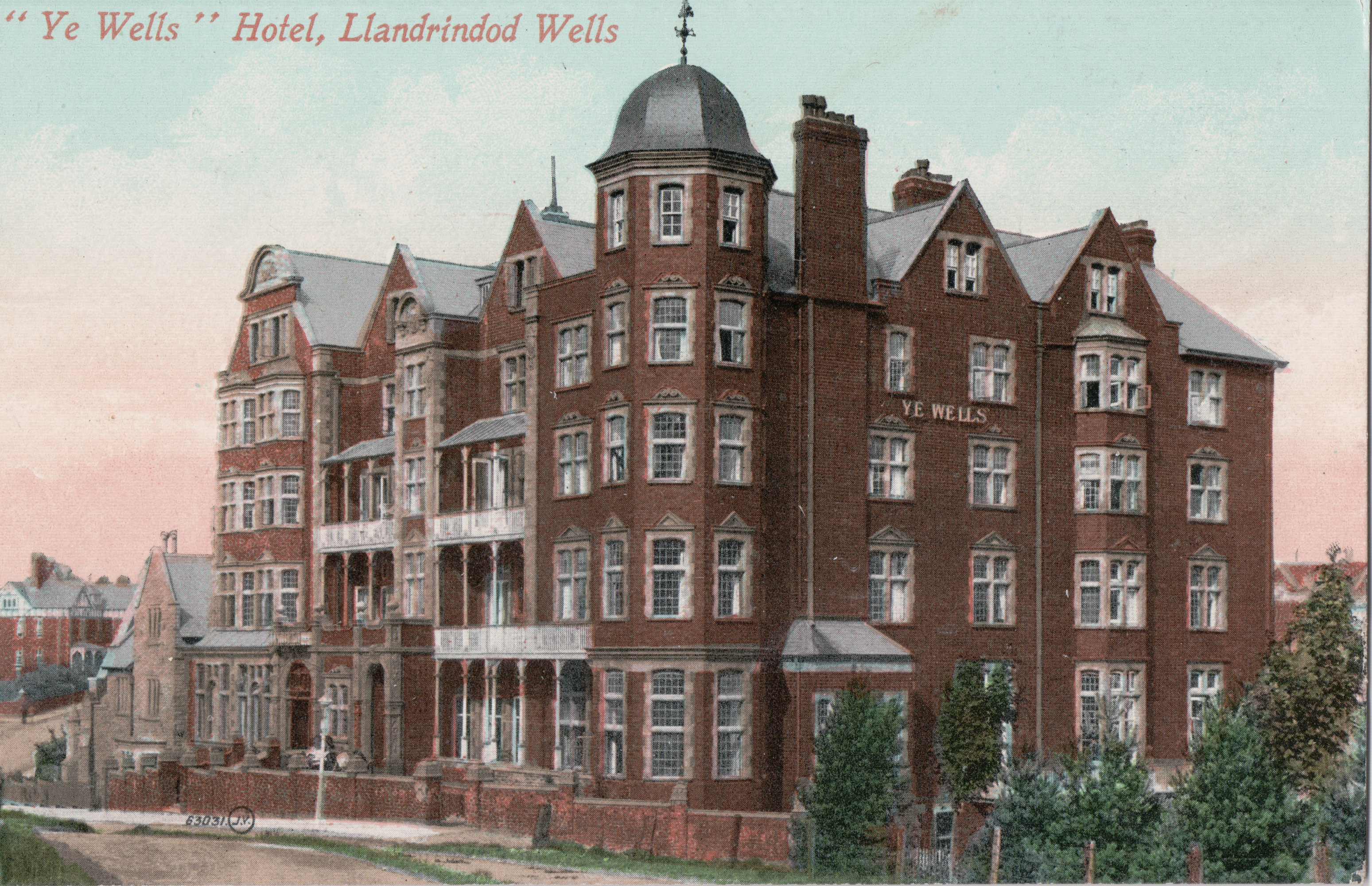
Ye Wells has stood on Spa Road East for so long that it is easy to treat it as part of the scenery of Llandrindod Wells. It is large, red-brick, unmistakably Edwardian and difficult to miss, yet familiarity can make buildings almost invisible. Few buildings in the town have been asked to perform so many different roles, or have contained so many different communities. The present Ye Wells began as one of the great hotels of the spa, but subsequently became a wartime hospital, part of an emergency teacher-training college, a residential school for deaf children and eventually a further-education college. Thousands of people have slept, worked, studied, taught, recovered from illness or simply passed through its doors.
I was one of them. In the late 1990s Ye Wells was simply Coleg Powys to me, and I studied there for an Advanced GNVQ in Business Studies. My mother also worked for Coleg Powys for many years, so the building belonged to family life as well as to my own education. At the time, however, I knew only vaguely that the college occupied an old hotel. Like most teenagers, I gave little thought to the lives that had occupied those corridors before us. A classroom was simply where the timetable said you had to be, and an old building was merely the setting in which ordinary student life took place.
Historical research has changed that completely. The more I have looked into Ye Wells, the less it has seemed to be simply the history of one building. It is really a history of Llandrindod itself, of the rise of the spa, its visitors and workers, the changes brought by war, the decline of the traditional hotel economy and the repeated attempts to find new purposes for the enormous buildings left behind. There is also an important complication, because the Ye Wells standing on Spa Road East was not the first Ye Wells.
Before the hotel
The name itself reaches much further back than either hotel. Long before the Victorian town existed, travellers came to this part of Radnorshire for its mineral springs. An eighteenth-century milestone near Howey still carries the wonderfully direct instruction, “To ye Wells”. That simple phrase captures the origins of Llandrindod more effectively than almost anything else. There was no Victorian resort waiting for visitors, only scattered farms and houses, common land and the springs which drew people into the district.
The arrival of the railway in 1865 transformed what had previously been an inconvenient journey. Llandrindod suddenly became accessible from South Wales, the Midlands and the larger English cities, and what followed was extraordinary. Hotels, boarding houses, shops, villas, churches and entertainment venues appeared with remarkable speed. The mineral waters became the foundation of an entire local economy. Visitors drank saline, sulphur, magnesium and chalybeate waters and subjected themselves to whatever therapies contemporary medicine recommended. Some came because they were seriously ill, others because they were ageing or exhausted, while many simply came because Llandrindod had become fashionable.
Ye Wells belonged to this world, but the hotel business was already well established before the familiar building on Spa Road East existed.
The first Ye Wells
By March 1898 the Wellington Journal was advertising for staff at the Ye Wells Private Hotel. A single man was wanted to act as hall porter and boots, while a girl was required as a housemaid. These were not the staffing arrangements of a small lodging house. A hotel employing specialised domestic staff was already operating with the routines expected by respectable late-Victorian visitors.
The picture becomes much clearer in July 1898. An advertisement in the Radnorshire Standard described Ye Wells as occupying a convenient and central position “on the open Common”, commanding extensive views and facing the golf links. It offered a good dining room with separate tables, drawing and reading rooms, bathrooms, private sitting rooms and a billiard room with a new table by Burroughes and Watts. There was electric lighting throughout, a balcony and verandah, a tennis lawn, a lock-up bicycle house, and the hotel boots met every train. The proprietress was Mrs Bryan Smith.
The advertisement adds an important detail. Mary Anna Bryan Smith was described as the “late Proprietress of Montpellier”. Her connection with the hotel trade therefore pre-dated Ye Wells. This becomes still more interesting because her sister, Frances Tysoe Smith, was also closely associated with the Montpellier. The development of Ye Wells was consequently not the story of an outsider suddenly entering the hotel business, but part of a wider family involvement in the hospitality economy of the growing spa.
The same issue of the Radnorshire Standard published a guest list. Visitors came from Bournemouth, Haverfordwest, Nottingham, Banbury, Dublin, Torquay, Cheltenham, Brighton, Cardiff, Sunderland, London, Anglesey and Bridgnorth. There were clergy, military officers, married couples, groups of women and individuals travelling alone. At least two female visitors had brought their personal maids with them. This is particularly valuable evidence because it shows the kind of establishment Mary Bryan Smith had already created. Ye Wells was drawing a geographically wide and socially prosperous clientele before the end of the nineteenth century.
The hotel was also modern. The bicycle accommodation advertised in July 1898 is supported by local building records for a bicycle shed at Ye Wells that same year. Golf, tennis, billiards, electric lighting and cycling were all being offered alongside the medicinal attractions of the spa. Ye Wells was not simply somewhere to sleep while taking the waters. It was part of the social experience of Llandrindod.
A report from December 1898 adds another geographical clue. During an experiment with a water diviner in the Recreation Ground, the reporter referred to “the road leading from the Park to Ye Wells” and described supposed underground water flowing from the side of the hotel. Whatever value one places upon Victorian water divining, the topographical evidence is useful. The first Ye Wells stood within the recreational landscape of the Common, Park and golf links.
Where was the original Ye Wells?

For many years the location of the first Ye Wells has been surprisingly difficult to establish, largely because the name became so completely associated with the later building. The 1901 census now provides the strongest evidence. The enumerator recorded Ye Wells Private Hotel as schedule 45. Immediately before it came Brynteg, while immediately afterwards came Hawthornden, followed by Sorrento, York House, Lake View, Plas Madoc and Penybryn.
Several of these properties can still be located in the Temple Street and Fiveways area. Contemporary council records also place Ye Wells close to Wellfield House. In July 1905 Mary Bryan Smith and neighbouring property owners asked the Urban District Council to construct a concrete pavement in front of houses opposite “Ye Wells and Wellfield House”. When this evidence is combined with the 1901 enumeration sequence, the earlier references to the Common and the road from the Park, the first Ye Wells can be placed with considerable confidence on Temple Street, south of Fiveways.
The most likely modern location is on or very close to the site occupied by the Spa Residential Home, immediately south of Hawthornden. That identification should still be treated as probable rather than finally proven, because a surviving photograph or the original building plans may yet establish the precise footprint. Even so, the broad location can now be reconstructed with far greater confidence than previously. The first Ye Wells was a real part of the Temple Street landscape, facing towards the recreational ground and golf links, rather than some indistinct predecessor to the later hotel.
A fashionable private hotel
By 1900 Ye Wells had acquired a reputation far beyond its size. A remarkable account published in the Radnorshire Standard that November described Llandrindod from the perspective of a London visitor who had previously taken the cure at Harrogate and had heard the Welsh resort recommended as an alternative to more famous watering places. He observed that Llandrindod contained hotels in abundance, but singled out two establishments which, in his words, “the salt of the earth patronise”. They were the Pump House Hotel and Ye Wells.
The Pump House was the great sprawling flagship of the resort. Ye Wells was described instead as a “comparatively small private hotel”, but one where particular care was taken to follow doctors’ instructions concerning the preparation of food. That distinction is important. Mary Bryan Smith was not attempting to compete with the Pump House simply on size. Ye Wells had developed a reputation for personal attention and for meeting the needs of visitors who had come to Llandrindod under medical advice.
The hotel therefore occupied a useful position between medicine and leisure. A visitor could follow a prescribed diet and take the waters, but could also play golf or tennis, use the billiard room, cycle and participate in the social life of a fashionable resort. In April 1903 the Radnorshire Standard reported that the musician Wino Arnis was performing during dinner at Ye Wells, South View and Brynawel. He was advertised as having played before Queen Victoria and the Queen of Romania and performed on the harp and flageolet. Whatever the precise history behind those royal claims, their use tells us something about the atmosphere being created for hotel guests. Dinner itself could become part of the entertainment.
By this stage, the limitation of the original Ye Wells was not its reputation. It was its size.
The metamorphosis of Ye Wells
The move towards a much larger hotel began in the autumn of 1905. Two years later, on 1 May 1907, the Radnorshire Standard carried a substantial illustrated advertisement for the “YE WELLS (NEW) HOTEL”. It offered accommodation for 100 visitors, fine rooms supplied with magnetic waters, high-class cuisine and “perfect service”, with Mrs Bryan Smith remaining as proprietress.
The same issue reported a letter from her to Llandrindod Wells Urban District Council asking that the path should be continued past “the new hotel” without delay. The contractor had written separately about the same matter. The new Ye Wells was therefore already being promoted while finishing work around the site was still being completed.
A week later the story became even clearer. On 8 May 1907 the Radnorshire Standard announced the “Opening of a New Hotel at Llandrindod”, under the splendid subheading “Metamorphosis of ‘Ye Wells’”. The paper reported that the scheme had been taken in hand in the autumn of 1905 and that, after around eighteen months of building, decorating and finishing, the new hotel was receiving its first visitors that week. The opening can therefore be dated with unusual precision to the week beginning 6 May 1907.
The newspaper also identified the people behind the scheme. The owner of the new building was Daniel Meredith of Newbridge-on-Wye, who was congratulated for the considerable amount of capital invested in the project. Mary Bryan Smith and her family supplied the hotel experience. The building had been designed to meet their practical requirements after years of running what the newspaper itself called the “original Ye Wells”. The architect was Richard Wellings Thomas, F.R.I.B.A., whose work contributed greatly to the architectural character of Edwardian Llandrindod.
The new Ye Wells was an ambitious purpose-designed spa hotel. There were two approaches from the road, one of them avoiding steps for the convenience of invalid visitors. The entrance hall led to a broad staircase and an electric lift. The principal rooms included a large lounge, smoking room, ladies’ drawing room and cloakroom, while the dining room could accommodate around 100 people. There were private sitting rooms, suites, bedrooms with balconies and extensive views across the surrounding countryside. Outside, the grounds were being laid out with croquet and tennis lawns, flower beds and shrubberies.
The Radnorshire Standard described the new building as providing “the most modern accommodation for the upper and middle classes”. That phrase says much about the market Ye Wells had cultivated. It was intended for prosperous professional and business families, comfortable middle-class visitors and those of still greater means who might expect private rooms, servants and the best attendance the hotel could offer. The new building did not create Ye Wells. It gave an established Victorian hotel business the scale its reputation now demanded.
A family hotel

The censuses show how completely the Bryan Smith family became identified with Ye Wells. Mary Anna Bryan Smith had been widowed in 1892. By 1901 she was recorded at the original Ye Wells as proprietor of the private hotel, while her daughters Margaret, Emily and Rachel were living with her. The establishment also contained a cook-housekeeper, kitchen maid, house-parlour maid, housemaid, waiter and hotel porter, providing a revealing picture of the organisation required to maintain even the smaller Victorian hotel.
By 1911 the family occupied the new Ye Wells. Mary remained proprietress, her son Ernest Bryan Smith was hotel manager, and her daughter Rachel was assisting with the management. Ye Wells was therefore not simply a commercial enterprise directed from elsewhere. It was the family home, and management passed increasingly into the next generation.
The 1921 census shows Ernest and his wife Beatrice Mary Bryan Smith living at Ye Wells with their children. Their son appears as Alexander Montague Butler Smith, the boy who later became known throughout Llandrindod as Monty Bryan Smith, while their daughter was Sheila Mary Bryan Smith. The 1939 Register shows the family still embedded in the hotel. Mary was by then a retired hotel proprietress, Ernest a retired hotel manager, Beatrice remained hotel manageress and Sheila was an assistant hotel housekeeper.
Behind the family stood the large resident workforce necessary to keep such an establishment functioning. Chambermaids, housemaids, waitresses, staff-hall workers, cooks, kitchen staff, gardeners, porters, waiters and bookkeepers all contributed to the polished world the visitor encountered. Ye Wells was a family business, but its success depended upon the labour of many people whose names rarely entered conventional histories of the spa.
Inside the hotel
The most vivid surviving account of working life at Ye Wells is that of Ellen Phillips. She left school at fourteen and worked briefly at the Royal Oak Hotel before hearing that Ye Wells might have employment. She wrote directly to Mrs Bryan Smith and received an offer of a position as a first-floor housemaid, together with five shillings towards her rail fare. She had scarcely travelled beyond Leominster.
Arriving at Llandrindod station, she remembered the activity surrounding the great hotels, with vehicles waiting for guests and luggage. As she walked into the town past the Metropole, Llandrindod seemed to her almost like London. At Ye Wells a page boy answered the bell and took her to reception. She remembered the great staircase, the bookkeeper’s office and the staff room, where the established employees examined the newcomer over tea. She was so intimidated that she considered taking the next train home.
She remained for more than ten years. Her working day could begin at half past six in the morning. Guests who had ordered early tea had to be attended to, followed by bedrooms, bathrooms, sweeping, dusting, bed-making and the preparation of rooms for new arrivals. Evening duties included checking rooms and turning down beds, while late duty could continue until eleven. She earned two shillings and sixpence a week, with board and lodging, and relied upon tips to supplement her wage. Staff supplied their own uniforms and changed from practical morning dress into black dresses and decorative aprons later in the day.
At around half past nine in the evening, staff assembled in the staff hall for prayers. Waiters, maids, billiard markers and others were expected to attend. Mrs Bryan Smith emerges from Phillips’s recollections as a formidable matriarch. Ye Wells was both her home and her business, and discipline mattered.
The hotel season generally ran from spring until autumn. Before opening, staff spent days airing mattresses, pillows and rooms. At the end of the season many employees had to find work elsewhere, and Phillips herself spent winters working in Cardiff and at Burton Manor in Cheshire. For the visitor, Ye Wells represented comfort, polished service and apparently effortless gentility. For the people who created that atmosphere, it meant long hours, hard physical work and seasonal insecurity.
Guests, status and the inter-war hotel

The clientele confirms that Ye Wells occupied a distinctive place within the social world of the spa. The original hotel already drew clergy, military officers, professional people and visitors of private means. Some women travelled with personal maids. After the move to Spa Road East the scale increased, but the social character remained broadly similar. Census returns record merchants, stockbrokers, officers, clergy and people living on private means. Ye Wells was not exclusively aristocratic, but it clearly appealed to the prosperous middle and upper-middle classes.
There were more celebrated visitors. Sir Paul Vinogradoff wrote from Ye Wells on hotel stationery in 1918. Frances Stevenson, secretary, companion and long-term partner of David Lloyd George, stayed there in 1925 and wrote to him from the hotel. The most remarkable arrangement came in 1926, when Mary Bryan Smith entered into an agreement with Lord Tredegar giving him exclusive use of a first-floor suite for seven years. He was permitted to furnish and alter the rooms and was guaranteed the hotel’s best attendance, food and services whenever he or his guests occupied them. It amounted to something close to a private seasonal residence within a commercial hotel.
Ye Wells also became a conference venue. In March 1923 about 120 officers of the Girl Guide movement in Wales assembled there for a conference, with leading English officers attending as speakers. The scale of the meeting demonstrates that Ye Wells had become capable of hosting substantial national gatherings as well as ordinary hotel guests. The spa hotel was developing another role before the traditional spa economy had disappeared.
The building itself continued to evolve. Plans survive for alterations and additions in 1911, an extension and balcony in 1916, further service development during the First World War and additional work in the 1920s. The Ye Wells remembered from later photographs was therefore not frozen at the moment of its opening in 1907. Like the business itself, the building continued to adapt.
War enters Ye Wells

The First World War disrupted the world for which the great Llandrindod hotels had been created. Ye Wells accommodated members of the Royal Army Medical Corps, and some of the men formed a football team and played against other Corps sides. Uniformed men were now occupying rooms created for spa visitors, but for Mary Bryan Smith the war was not simply something happening within the hotel.
Her son James Clement Smith, a Second Lieutenant in the Royal Fusiliers, was killed in action on 27 March 1916. His body was not recovered for identified burial and his name appears on the Menin Gate at Ypres. Ellen Phillips remembered the effect of his death inside Ye Wells, recalling that Mrs Bryan Smith took to her bed for days after the news arrived. A memorial light was later placed in Holy Trinity Church. Mary’s stepson Charles Howard Smith also served, while another son, Ernest, appeared before a military tribunal in 1917 when an attempt was made to secure his exemption from service.
The war had therefore entered the hotel family itself. It is one thing to record military personnel occupying Ye Wells, but another to understand that the woman running the establishment was simultaneously coping with the death of her own son.
Mary Bryan Smith
Mary Bryan Smith deserves to be remembered as considerably more than the proprietress of a single hotel. She had entered Llandrindod’s hospitality world through the Montpellier and developed Ye Wells into one of the town’s leading establishments. She carried the business from a comparatively small Victorian private hotel into a major Edwardian building and remained associated with it through decades of profound social change.
When she died on 23 November 1948, the Wellington Journal described her as the “Queen of Llandrindod Wells”, a name affectionately given to her because of her public work for the spa. That contemporary judgement is important. By then she had lived through almost the entire mature history of Llandrindod as a resort, from its late-Victorian expansion through Edwardian confidence, two world wars and the inter-war years into the collapse of the hotel economy she had helped to create.
Her probate records show an estate of £27,985 19s. 1d., a substantial sum which reinforces the impression of a successful businesswoman. Her death came at almost exactly the point when the old world of the great spa hotels was disappearing for good.
The Second World War: hospital, not hotel
The Second World War brought a more fundamental transformation than the first. The chronology is now much clearer than earlier accounts suggested. During May and June 1940 the Ministry of Pensions acquired Ye Wells and the Pump House for conversion to hospital use. Together the two former hotels provided around 500 beds. Llandrindod was regarded as comparatively safe from enemy bombing, and patients were transferred there from facilities in more vulnerable parts of the country.
The great hotels were well suited to institutional conversion. They already possessed bedrooms, kitchens, bathrooms, laundries and large communal spaces. What had been built for the mass accommodation of spa visitors could be adapted to wartime medicine.
In July 1941 the Western Mail advertised a four-day auction of the “exceptionally choice and superior appointments” of Ye Wells, including the contents of 120 rooms. The timing is important. The auction did not precede wartime occupation, because hospital use had already begun. It instead appears to mark the dispersal of much of the material world of the former hotel after conversion had changed what the building required. Furniture and fittings which had served generations of spa visitors were broken up and sold, while the building itself continued in institutional use.
The Ministry of Pensions hospitals at Llandrindod closed in March 1946. Within months another organisation was preparing to take over.
The Emergency Teachers’ Training College
Britain emerged from the Second World War with an acute shortage of teachers. Wartime disruption, demographic change and the ambitions of the 1944 Education Act created an urgent need to train large numbers of men and women quickly. The Government responded through the Emergency Training Scheme, and Llandrindod was selected as one of the locations.
In February 1946 the Western Mail reported that the Ministry of Education had asked Radnorshire Education Committee to administer a training college occupying both the Pump House and Ye Wells hotels. By November the college was described as “shortly to be opened” and staff recruitment was under way. The vacancies reveal the scale of the new institution: resident women stewards, dining-room stewards, male stewards, cooks, assistant cooks, a chauffeur-caretaker, laboratory boy and head gardener.
The gardener was to be responsible for kitchen gardens, grounds and tennis courts, a detail which captures the continuity between hotel and college. The architecture and landscape had changed purpose, but much of the physical infrastructure inherited from the spa remained useful.
The college trained large numbers of men and women through intensive post-war courses. By May 1950 its end was already known. The Aberdare Leader reported that the institution would close in September, describing Ye Wells and the Pump House as two “massive, many-windowed and quite magnificent former hotels” standing amid lawns, mature trees and the distant mountain skyline. There would be no return to hotel use, because another institution was already preparing to move in.
The children of Ye Wells
The Royal Cambrian tradition of education for deaf children in Wales dated back to the nineteenth century. The Swansea institution had been disrupted by wartime bombing, with children accommodated at Newbridge-on-Wye and Rhayader. After the war, larger permanent premises were required, and Ye Wells and the Pump House offered the necessary scale.
The Emergency Training College closed in September 1950. On 17 October the Royal Cambrian and Llandrindod Wells Residential School for the Deaf opened with 157 pupils. The changeover therefore took only weeks. Rooms which had housed hotel guests and trainee teachers became bedrooms and classrooms for children, while dining rooms, corridors, staircases and grounds designed around Edwardian tourism became the daily geography of childhood.
For more than twenty years Ye Wells was not simply an institution or workplace, but a home. That history should not, however, be sentimentalised. Mid-twentieth-century education for deaf children was shaped overwhelmingly by hearing administrators and teachers, and oral methods frequently took precedence over signing. Former pupils have subsequently challenged many of the assumptions that governed their education.
There were also darker experiences. Evidence discussed in the National Assembly for Wales in 2017 drew attention to complaints made in 1953 concerning a housemaster. Contemporary records referred to “unsavoury incidents”, interviews with boys and the departure of the man concerned. Former pupils subsequently alleged sexual abuse. The Assembly debate did not determine individual criminal liability, but it placed those allegations formally on the public record.
That evidence has to remain part of the history. Ye Wells contained friendship, education and community, but institutions can also contain vulnerability and failures of protection. The children who lived there were not merely recipients of benevolent provision. They were individuals whose own experiences deserve to remain central to the story.
The school remained at Llandrindod until 1973, but plans for another future for Ye Wells had already been developing for almost a decade.
From residential school to further education
The move into further education did not begin suddenly in 1973. On 29 May 1964 Radnorshire Education Authority agreed to purchase the former Ye Wells Hotel for use as a further education and youth centre. Sir C. Michael Venables-Llewelyn argued that the existing building could be adapted without great expense, whereas acquiring a new site and constructing a purpose-built centre might take ten years and cost between £60,000 and £70,000.
Once again, the building survived because of its adaptability. Plans for further-education use followed during the 1960s, although the residential school continued until 1973 and the precise division of space during those transitional years deserves further investigation. After the school finally closed, Ye Wells became firmly associated with further education.
The grand hotel rooms were divided and adapted, bedrooms became classrooms and offices, and the architecture of the spa remained beneath layers of institutional alteration. Eventually the Llandrindod provision formed part of Coleg Powys, alongside centres at Brecon and Newtown. For a rural county this mattered enormously. Further education made qualifications, vocational training, adult learning and professional development available to people who could not realistically travel every day to Cardiff, Swansea, Birmingham or further afield. The old spa hotel had become an educational building serving the communities among whom it stood.
My Ye Wells
That is the Ye Wells I knew. By the late 1990s it was simply part of Coleg Powys. My mother had worked for the college for many years, and I attended as a teenager to study for an Advanced GNVQ in Business Studies. There was nothing remotely aristocratic about the experience. We were not Lord Tredegar taking possession of a private suite, nobody arrived with a personal maid, and nobody came to drink sulphur water or expected a hotel boots to meet the train.
We were ordinary Mid Wales students carrying folders through a building constructed for an entirely different social world. That, in retrospect, is precisely what seems so interesting. Further education had democratised the grand hotel. Rooms originally designed around wealth, servants and seasonal leisure had become places where young people from Llandrindod, Rhayader, Builth and the surrounding countryside could acquire qualifications.
At the time I did not know the name of Mary Bryan Smith. I did not know that the original Ye Wells had stood elsewhere on Temple Street, or that the present building had opened in May 1907. I did not know that Lord Tredegar had possessed a private suite there, that Frances Stevenson had written to Lloyd George from the hotel, or that the building had accommodated hospital patients, trainee teachers and generations of deaf children.
A corridor was simply a corridor. Historical research changes that. The college I remember now contains another building beneath it, and another history beneath that.
The Bryan Smith family after Ye Wells
The family did not disappear from Llandrindod when the hotel era ended. Ernest Bryan Smith’s son Alexander Montague Butler Smith, known as Monty, became a familiar figure in the town. He served with the RAF during the Second World War and opened The Book Shop in Llandrindod in 1946. That same year he contracted polio and was subsequently paralysed from the waist down.
He nevertheless developed a successful bookselling career. In 1953 the Western Mail reported that he had passed six certificate examinations in two years and gained the Booksellers’ Association diploma, believed to be the first such diploma awarded in Wales. The family connection with Llandrindod had moved from hospitality into bookselling and the cultural life of the town.
His sister Sheila also created a reputation far beyond Ye Wells. Born in Llandrindod in 1917, she was recorded as assistant hotel housekeeper in 1939 but later became one of Wales’s leading women golfers. She won the Welsh Ladies’ Amateur Championship in 1949 and represented Wales internationally on numerous occasions over a long playing career. Golf had been advertised as one of the attractions of the original Ye Wells in the 1890s; two generations later, it became part of the family’s own story.
After Monty’s death in 1980 Sheila succeeded him as owner of The Book Shop. In April 1981 the business passed to Ian Davies and Hilary Long. The Bryan Smith family’s visible commercial association with Llandrindod had therefore continued for more than eighty years after Mary first appeared at Ye Wells.
The end of the college
Coleg Powys merged with Neath Port Talbot College in 2013 to form the NPTC Group. Ye Wells continued for a time as the Llandrindod campus, but its educational role gradually diminished and the Spa Road East campus eventually closed.
For perhaps the first time in more than a century, the great building no longer had a community which obviously needed it. That absence is visible. Ye Wells makes sense when imagined full of people. Its scale belongs to crowds, guests arriving with luggage, hotel staff moving through service corridors, hospital patients, trainee teachers, schoolchildren and students. Empty, the building feels different.
Recent attempts to sell and redevelop it have demonstrated the difficulty of valuing a place such as this. Its historical importance is obvious, but its commercial usefulness is less straightforward. Ye Wells is enormous and requires substantial investment. Historic character does not repair a roof, heat thousands of square metres or satisfy modern building regulations.
The building is also unlisted. That may offer greater flexibility for redevelopment, but it also means that prominence and statutory protection are not the same thing. Any viable future will require compromise. It is unrealistic to imagine that every corridor and partition should remain frozen as it appeared in 1907. Ye Wells survived precisely because previous generations were willing to adapt it. The more important question is whether future change can occur without erasing the character and memory which make the building worth saving.
A building as biography
It would be easy to describe Ye Wells as a relic of Llandrindod’s lost spa age. That is true, but incomplete. Its history is far more interesting because Ye Wells repeatedly escaped the purpose for which it had originally been built.
The first Ye Wells was a successful Victorian private hotel on Temple Street. Mary Bryan Smith carried its reputation into the great new building which opened in 1907. That hotel served generations of visitors and created livelihoods for generations of workers. War changed it, medicine changed it and education changed it. The spa hotel became a hospital, the hospital became part of an emergency teacher-training college, the college became a residential school, and the school eventually gave way to further education.
Each generation inherited the same enormous structure and asked what it could now be used for. That history complicates any simple story of Llandrindod’s decline. The spa hotel disappeared, but the building remained. The residential school closed, but the building remained. Coleg Powys disappeared as an independent institution, and eventually education itself left Spa Road East, yet Ye Wells still stands.
Its greatest historical importance may lie precisely in that continuity. The building has spent more than a century being useful, while the people who filled it are gradually passing from living memory. Mary Bryan Smith and her hotel staff belong to another world. The men of the First World War survive largely as names on memorials. The wartime hospital patients and emergency teachers are increasingly beyond personal recollection. Former pupils of the residential school are growing older. Even the Coleg Powys I knew in the 1990s has become unmistakably historical.
I was once simply a student there. Nearly three decades later, I can look back through the building and see the layers behind my own experience. Somewhere beneath the classroom I remember was an Edwardian hotel room. Along those corridors chambermaids made beds and porters carried luggage. Visitors arrived to take the waters. Lord Tredegar’s party came and went. Wartime patients occupied rooms created for holidaymakers. Young teachers were trained there because post-war Britain desperately needed them. Deaf children grew up within those walls. Eventually students like me arrived carrying folders and coursework.
None of us knew all the others, yet for a time we occupied the same place. That is what gives Ye Wells its importance. Buildings cannot remember people for us. That task falls to those who come afterwards.
If Ye Wells has another life ahead of it, as one must hope it does, whoever takes responsibility for the building will inherit rather more than six floors of brick, stone, corridors and empty rooms. They will inherit all of this.
Related Essays
- Llandrindod Wells Hospital: From Cottage Hospital to County War Memorial
- Board and Lodging: The Boarding Houses of Llandrindod Wells
- Bowling in Llandrindod Wells: From the Spa Greens to Rock Park and the Indoor Game
- From the Pump House Links to Death or Glory: A History of Golf in Llandrindod Wells
- Newbridge-on-Wye: A Village Made by Movement
Explore more Llandrindod Wells history
Continue with the Llandrindod Wells History guide, or follow the related essays above to explore the people, buildings and institutions that shaped the town.
Sources and Further Reading
The early history of Ye Wells has been reconstructed principally from contemporary newspapers, census returns and surviving local authority records. Particularly important are the Wellington Journal, 19 March 1898, for the recruitment of staff at the first Ye Wells; the Radnorshire Standard, 13 July 1898, for Mary Bryan Smith’s proprietorship, her previous association with the Montpellier, the hotel’s facilities and contemporary guest list; the Radnorshire Standard, 21 December 1898, for the description of the road from the Park to Ye Wells and the hotel’s position within the Recreation Ground landscape; and the Radnorshire Standard, 7 November 1900, for the independent account describing Ye Wells and the Pump House as the leading hotels of the resort and emphasising Ye Wells’s careful provision for medically prescribed diets.
The 1901 Census of England and Wales is particularly important for the original hotel. The enumeration sequence records Ye Wells Private Hotel between Brynteg and Hawthornden and immediately before Sorrento, York House, Lake View, Plas Madoc and Penybryn. Together with the 1905 Urban District Council reference to properties opposite Ye Wells and Wellfield House, this provides the basis for locating the first hotel on Temple Street, south of Fiveways. Surviving building-control material in Powys Archives, including records relating to the Ye Wells bicycle shed, alterations to the earlier hotel and subsequent plans for the new hotel, offers the possibility of identifying its precise footprint more securely in future.
The development and opening of the present Ye Wells are particularly well documented in the Radnorshire Standard of 1 and 8 May 1907. The former carried the advertisement for the “Ye Wells (New) Hotel” and the Urban District Council discussion of the path outside the new building. The latter published the extensive article “Opening of a New Hotel at Llandrindod: Metamorphosis of ‘Ye Wells’”, identifying Daniel Meredith as the building owner, Richard Wellings Thomas as architect and Mary Bryan Smith and her family as the experienced hotel operators for whom the building had been designed. The article also provides the most detailed contemporary description of the new hotel’s internal arrangement, grounds, intended clientele and opening week.
The 1901, 1911 and 1921 censuses and the 1939 Register are central to the reconstruction of the Bryan Smith family and the hotel workforce. They record Mary Anna Bryan Smith as proprietress, Ernest Bryan Smith as hotel manager, Rachel Smith assisting in the management, Beatrice Bryan Smith as manageress and Sheila Bryan Smith as assistant hotel housekeeper, together with the cooks, chambermaids, waiters, gardeners, porters, bookkeepers and other employees whose labour maintained the hotel. Mary Anna Smith’s probate entry records her death on 23 November 1948 and an estate valued at £27,985 19s. 1d. The Wellington Journal of 1 January 1949, reviewing events of the previous year, remembered her affectionately as the “Queen of Llandrindod Wells” because of her public work for the spa.
Ellen Phillips’s recollections of service at Ye Wells, published in Joel Williams’s Voices of Llandrindod Wells, remain among the most important sources for everyday working life inside the hotel. They provide detail which formal records cannot, including wages, uniforms, working hours, staff prayers, seasonal employment, the arrival of guests and Mrs Bryan Smith’s personal management of the establishment.
For the inter-war period, the agreement between Mary Bryan Smith and Lord Tredegar dated 13 December 1926, preserved by the National Library of Wales, is particularly revealing. Frances Stevenson’s correspondence with David Lloyd George provides another glimpse of Ye Wells in 1925. The Wellington Journal of 31 March 1923 records the conference of approximately 120 Girl Guide officers at the hotel, demonstrating its importance as a venue for large organised gatherings as well as individual visitors.
The wartime history requires careful distinction between military use during the First World War and the institutional conversion of the Second. Official Ministry of Pensions material records the acquisition of Ye Wells and the Pump House in May and June 1940 for hospital purposes, together providing approximately 500 beds, and the closure of the Llandrindod hospitals in March 1946. The Western Mail of 26 July 1941 advertised the four-day auction of the contents of 120 rooms at Ye Wells and should therefore be read within this hospital chronology rather than as evidence that wartime occupation began after the sale.
The establishment of the Emergency Teachers’ Training College is documented particularly clearly by the Western Mail of 16 February 1946 and 29 November 1946. The first records the decision that the college should occupy the Pump House and Ye Wells hotels, while the second advertises the wide range of staff being recruited as the institution prepared to open. The Aberdare Leader of 27 May 1950 provides the other end of this short institutional history, recording that the training college was due to close in September and that the two former hotels were already intended for use by the residential school for deaf children.
The National Library of Wales holds extensive records of the Royal Cambrian and Llandrindod Wells Residential School for the Deaf, including logbooks, pupil records, photographs, papers relating to headmaster T. G. Richards and surviving film material. Parliamentary records confirm that the school opened at Llandrindod on 17 October 1950 with 157 pupils. The National Assembly for Wales debate of 18 January 2017 is important for the later allegations concerning events recorded at the school in 1953 and should be read alongside, rather than substituted for, the surviving contemporary institutional records.
The later educational history is illuminated by the Liverpool Daily Post of 30 May 1964, which records Radnorshire Education Authority’s decision the previous day to purchase the former Ye Wells Hotel for a further education and youth centre. County architectural records from the 1960s onwards document the gradual adaptation of the building for further education, later associated with the Radnor Further Education Centre and Coleg Powys.
The later Bryan Smith family history can be followed through contemporary newspapers and the specialist bookselling press. The Western Mail of 13 November 1953 records Monty Bryan Smith’s award of the Booksellers’ Association diploma and gives details of his post-war career and disability. The Bookseller of 19 July 1980 records Sheila Bryan Smith succeeding her late brother as owner of The Book Shop, Llandrindod Wells, while the issue of 28 March 1981 records the transfer of the business to Ian Davies and Hilary Long from 1 April. Contemporary golf reporting, including the Liverpool Echo of 29 September 1953, together with Welsh golfing records, documents Sheila Bryan Smith’s career as Welsh champion and international player.
Further useful sources include the Richard Wellings Thomas architectural papers and building plans in Powys Archives; the surviving Ye Wells visitors’ book material held locally and reproduced through People’s Collection Wales; Royal Commission and Cadw material relating to Llandrindod’s historic buildings; contemporary hotel advertisements; council minutes and building-control records; local newspapers including the Radnorshire Standard, Western Mail and Wellington Journal; Hansard; and the surviving postcards and photographs of both Ye Wells hotels. The surviving c.1900 postcard of the first Ye Wells and the original 1898 and 1902 building plans remain especially important avenues for future research, because together they may finally establish the exact site and appearance of the Victorian hotel beyond reasonable doubt.