
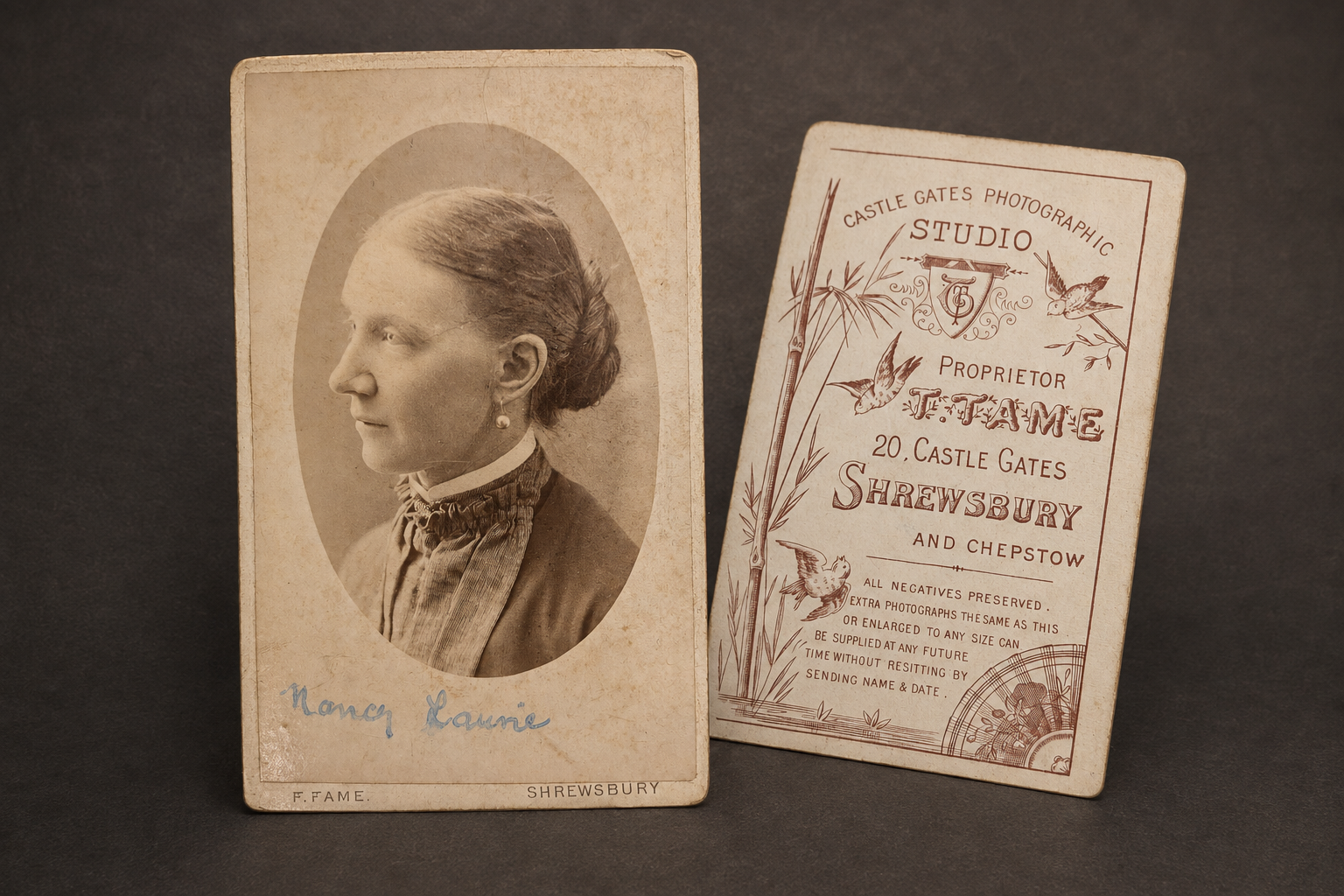
A named Victorian photograph is a small act of resistance against oblivion. The woman in this carte de visite is shown in profile, her hair drawn tightly into a bun, a single earring visible beneath it. Her clothes are sober and carefully arranged. She does not smile, but neither does she appear severe. Beneath the portrait, written in fading blue ink, are two words: “Nancy Laurie”.
The reverse identifies the photographer as F. Fame of the Castle Gates Photographic Studio, 20 Castle Gates, Shrewsbury. Nothing else explains who Nancy was, why she visited the studio, or how her photograph survived.
Living in Shrewsbury myself, I found the local connection irresistible. A name and a photographer’s address were enough to begin an investigation. What emerged was the life of a Victorian governess whose career carried her from the commercial heart of London to Hodnet Hall in Shropshire, then into another distinguished household before a financially secure retirement.
Nancy was never famous. She married nobody, held no public office and left no published account of her experiences. Yet the records allow us to recover something more valuable than a list of dates. They reveal the working life of an educated Victorian woman who occupied an uncertain position between family and servant, dependence and independence, private duty and professional identity.
A childhood in the City of London
Nancy Laurie was born on 23 June 1840 and baptised on 31 July at St Katherine Cree, the ancient City church standing close to Leadenhall Street. The baptismal register names her parents as James and Mary Laurie, gives their address as Billiter Street, and records James’s occupation as wine merchant.
Her father had been established at 9 Billiter Street for some years. A Scottish court record from 1833 identifies James Lawrie, the spelling varying as it often did, as a wine merchant of that address pursuing payment from a debtor in Edinburgh. London directories continued to place him there during the following decade.
Billiter Street lay within the densely commercial world east of Bishopsgate, among merchants, warehouses, counting houses and the institutions of the City. It was both the family home and the centre of James’s business. Nancy’s childhood was therefore spent not in a quiet residential suburb, but amid the traffic and enterprise of Victorian London.
Her parents had married at St Mary’s Church, Lancaster, on 18 September 1838. James was described as a merchant, the son of John Laurie, a manufacturer. Nancy’s mother, Mary Howitt, came from a respected Lancashire medical family. Her father, Thomas Howitt, was a surgeon, while her brother, another Thomas Howitt, became a prominent Lancaster surgeon, mayor of the borough and later a Justice of the Peace.
James Laurie was more than a wine merchant. In 1847 he published British and Foreign Share Tables, explicitly identifying himself as “James Laurie, Wine Merchant”. He also compiled widely used tables dealing with simple and compound interest, exchange, brokerage, stocks and investment. Later editions of his calculating works remained in circulation for decades after his death, evidence that his name had become associated with practical commercial arithmetic rather than with a single ephemeral publication.
His expertise brought him into the national debate over decimal currency. In the early 1850s Laurie appeared among the witnesses examined during discussion of decimal coinage, alongside some of the leading scientific and mathematical authorities of the period. In 1854, the final year of his life, he published Decimal Coinage: A Practical Analysis of the Comparative Merits of One Pound & Tenpence as the Ruling Integer of a Decimal Currency for the United Kingdom. The book applied the habits of the counting house to a question of national monetary reform, considering merchandise, foreign currencies, profits, insurance and exchange.
The Laurie household therefore combined commerce, authorship, applied mathematics and professional standing. Nancy grew up in an environment in which books, calculation and intellectual discipline were visibly part of family life. We cannot assume that James personally directed her education, but the atmosphere in which she was raised makes her later career as a governess less accidental than it first appears.
The 1841 census found James and Mary in Billiter Street with the infant Nancy. Thomas Howitt also appears to have been present, suggesting that the connection between the London household and Mary’s Lancashire family remained close. By 1851, ten-year-old Nancy was living at 9 Billiter Street with her parents and younger sister Maggie. James was again recorded as a wine merchant.
Then, in 1854, the structure of the family changed. James Laurie died when Nancy was about fourteen, leaving Mary to manage a large household without him.
It is tempting to turn this into a simple story of sudden poverty and decline. The evidence does not support so dramatic a conclusion. James’s death undoubtedly altered the family’s prospects, but subsequent records show that Mary received annuity income and continued to maintain a respectable household. Several of the children entered professional, commercial or skilled occupations. The family adjusted, but it did not disappear into destitution.
For Nancy, however, her father’s death may have narrowed the range of choices available to her. She belonged to a class that expected women to be educated and accomplished, but offered them few acceptable ways of earning an independent income.
Becoming a governess
Nancy has not yet been securely identified in the 1861 census. She may already have been living with an employer, attending a school, travelling, or recorded under a damaged or mistranscribed name. The 1861 returns contain more missing and defective material than any other surviving nineteenth-century census, so her absence may ultimately prove impossible to resolve. By 1871, however, her occupation was clear.
Nancy was living with her widowed mother at 143 Gloucester Road in St Pancras. She was thirty, unmarried and described simply as a governess. Her mother was an annuitant, while Nancy’s brothers pursued work connected with commerce, engraving and the dental trade. The household also employed a domestic servant.
This was not a family on the edge of the workhouse. It was a respectable metropolitan household adapting to life after the death of its principal provider. Nancy’s employment should therefore be understood not merely as an act of desperation, but as part of a wider negotiation between family responsibility, social position and personal independence.
The governess was one of the most difficult figures to place within the Victorian household. She was paid to work, but was not ordinarily regarded as part of the domestic staff. Her education and manners distinguished her from the servants, yet she did not belong to the family that employed her. She might eat separately from both, live in a private room and spend much of her day in the company of children.
Her position depended upon trust. She was expected to provide instruction, model respectable behaviour and help shape the character of her pupils. At the same time, her employment could end when the children grew older or were sent away to school.
For an unmarried middle-class woman, governessing offered a rare means of preserving respectability while earning a living. It also demanded adaptability, self-command and the ability to live for long periods within households that were not her own.
Hodnet Hall
By 1881, Nancy had travelled from London to Shropshire and secured a position at Hodnet Hall.
The census records her in the extensive household of the Heber-Percy family. She was forty years old, unmarried and employed as a governess. The household contained several generations of the family and numerous children, as well as a considerable domestic staff.
Hodnet Hall had been rebuilt in 1870 for the Heber-Percys, replacing an earlier house with a new Victorian mansion in an Elizabethan style. Nancy therefore entered a country-house world that was itself comparatively new, a reconstructed expression of landed status rather than an untouched ancestral interior. The estate belonged to a family whose connections extended into the clerical and imperial establishment, including descent through Emily Heber from Reginald Heber, Bishop of Calcutta and the well-known hymn writer.
The precise identity of all Nancy’s pupils should be treated cautiously. The household contained several generations, and the younger Heber-Percys included Algernon Hugh, born in 1869, and Josceline Reginald, born in 1880. Rather than imagining a large informal classroom without evidence, it is safer to say that Nancy worked within a substantial intergenerational household and was entrusted with the education of its younger members.
The census classified her as a servant. That administrative description captures the contradiction at the heart of her position. Nancy shared the family’s educational assumptions and probably something of its manners and conversation, but in legal and economic terms she remained an employee.
We should not assume that her years at Hodnet were necessarily unhappy. The familiar image of the lonely and humiliated governess owes much to Victorian fiction. Some women endured isolation and insecurity, while others formed affectionate relationships with their pupils and remained connected with their employers for many years. Without Nancy’s letters, we cannot know where her experience lay between those possibilities.
What we can say is that she remained in the profession for decades. Longevity of that kind required competence and reliability. A governess entrusted with the children of prominent families carried responsibilities that seldom appear in formal records, but which her employers would have regarded as deeply important.
The Shrewsbury portrait
Nancy’s carte de visite was probably made during her years at Hodnet Hall.
The reverse advertises F. Fame’s Castle Gates Photographic Studio in Shrewsbury, with an additional connection to Chepstow. The design promises that negatives would be preserved, allowing further copies or enlargements to be ordered without another sitting. Such language belonged to the increasingly commercial world of late Victorian portrait photography, when the carte de visite had become an affordable means of exchanging and preserving personal likenesses.
The exact date of the portrait remains uncertain. Her clothing, hairstyle and apparent age suggest the 1880s, which fits comfortably with her documented residence at Hodnet. Shrewsbury was the obvious regional centre for shopping, professional services and photography, and a visit from Hodnet would have been entirely practical.
The address on the card adds another layer. The present building at 20 Castle Gates dates from about 1900, so if Nancy sat for the portrait in the 1880s she entered an earlier building on the site, or a property affected by subsequent renumbering or redevelopment. A contemporary Shrewsbury directory also places the photographer Thomas Turner at 20 Castle Gates, showing that the address had a genuine photographic history. That does not identify F. Fame, whose independent career remains elusive, but it strengthens the connection between Nancy’s portrait and Castle Gates as an established photographic location.
Why the portrait was taken is unknown. It may have marked a birthday, a family visit, a departure, or simply the opportunity to have a respectable likeness made. Its survival suggests that copies were given to relatives or friends.
The inscription is especially important. Thousands of Victorian portraits survive without names and have become detached from the lives they represented. Someone took the trouble to write Nancy’s name beneath her image. That small act made her recovery possible.
A second distinguished household
By 1891 Nancy had returned to London and was working as school governess in the household of Sir George Rendelsham Prescott, 4th Baronet.
Prescott belonged to a banking family and moved within the prosperous professional and landed world of late Victorian Britain. Sir George, born in 1846, had served in the 2nd Life Guards, was a Deputy Lieutenant of Sussex and had been High Sheriff of Hertfordshire in 1883. Nancy’s appointment to his household therefore placed her once again within a socially prominent family whose expectations of education and conduct would have been exacting.
The children make Nancy’s role more tangible. George Lionel Prescott had been born in 1875 and Charles William Prescott in 1877, making them about fifteen and fourteen respectively in 1891. Their sister Maude Helen also belonged to the family circle. Nancy’s description as a “school governess” consequently fits an experienced teacher concerned with adolescent education rather than nursery supervision.
The later lives of the Prescott children also underline the social world in which Nancy worked. George Lionel and Charles William both eventually succeeded to the baronetcy, while Maude Helen married Lieutenant-General Sir Raleigh Gilbert Egerton. Nancy’s own name almost disappeared from public memory, yet for a period she stood within the educational formation of children who would later inhabit Britain’s landed, military and imperial establishment.
The word “school” in her occupational description may distinguish her educational duties from those of a nursery governess. She was no longer a young woman supervising infants. By fifty, she was an experienced educator entrusted with the formal instruction of children in a socially elevated household.
Her career had endured for at least twenty years and probably longer. It had taken her from her widowed mother’s home to one of Shropshire’s principal country houses and then back to a baronet’s household in London.
That is not a story of spectacular advancement. It is one of sustained professional trust.
Retirement and private means
By 1901 Nancy had retired.
She was living at 26 Cavendish Avenue in Headingley, Leeds, with her cousin Martha Nichols. The census described Nancy as a retired governess, aged sixty and born in the City of London. Martha lived on her own means, and the household maintained domestic servants.
Ten years later, Nancy was at Havelock Lodge in Wokingham, Berkshire. The original 1911 household schedule records her as a seventy-year-old unmarried boarder, born in the City of London and living on private means.
Havelock Lodge was an eight-roomed house headed by Eleanor Hurrell, herself an unmarried woman of private means. Another elderly boarder also possessed an independent income, and a resident general servant attended to the household. This was not an institution or an impoverished lodging house. It appears to have been a respectable domestic arrangement for women with sufficient resources to maintain privacy and comfort without establishing separate households.
These records overturn any suggestion that Nancy’s life ended in genteel poverty. Whatever combination of salary, saving, investment and inheritance produced her income, she achieved a financially secure retirement.
The financial culture of her childhood now makes that independence particularly interesting. James Laurie’s published work dealt repeatedly with interest, stocks, exchange and investment. That does not prove that Nancy inherited a portfolio from him, or that her later estate derived directly from his business, but it does show that she had been raised in a household unusually familiar with the mechanics of money and investment. Her eventual private means may therefore have rested not only upon years of careful saving, but upon habits of financial understanding formed much earlier in life.
Her long years as a governess may have required sacrifice, but they did not leave her destitute.
Nancy and her nephew
One family relationship helps explain the final chapter of Nancy’s life.
In 1871, the Laurie household in St Pancras included a three-year-old boy named Henry Layland. The census identified him as the grandson of Nancy’s widowed mother. He was the son of Nancy’s sister, Mary Howitt Laurie, and her husband Henry Layland, making the younger Henry Nancy’s nephew.
The boy grew up to pursue a maritime career and became an officer in the Royal Naval Reserve. During the First World War he served in the Dover area, eventually becoming Acting Commander of Dover Dockyard. In 1918 he was appointed an Officer of the Order of the British Empire for his wartime service.
The relationship between aunt and nephew endured long after their shared appearance in the 1871 household. Henry would eventually become one of the executors of Nancy’s estate.
Death at Deal
Nancy Laurie died on 27 May 1915 at Gwella, London Road, Deal. Her permanent address was recorded as 31 Belsize Square, Hampstead.
Deal lay close to Dover, where her nephew Henry was serving during the war, so the geographical connection between Nancy’s final residence and his naval service is significant. It would, however, go beyond the surviving evidence to state that Gwella was Henry’s house or that Nancy was certainly living in his immediate household. What can be said is that she died within easy reach of a close nephew who subsequently acted as one of her executors, a family connection that gives her presence on the Kent coast a plausible context.
A brief announcement appeared in the Morning Post on 31 May:
“LAURIE.—On the 27th inst., at Deal, Nancy Laurie, in her seventy-fifth year.”
The notice was restrained, as Victorian and Edwardian death announcements often were. It mentioned neither her profession nor her relatives. Nevertheless, the probate record restores something of the family context.
Probate was granted in London on 29 June to Henry Layland, then described as a lieutenant commander in the Royal Naval Reserve, and Frederick James Thairlwall, solicitor. Nancy’s effects were valued at £5,062 3s. 7d.
This was a substantial estate. It confirms what the census had already suggested, that Nancy possessed genuine financial independence by the end of her life. The surviving probate calendar does not identify her beneficiaries or explain the source of her wealth. Her complete will may yet reveal whether it passed to Henry, other members of the Laurie family, friends or charitable causes.
The meaning of an unmarried life
It would be easy to impose sadness upon Nancy because she did not marry or have children of her own. Victorian women are still too often judged according to the domestic lives they did not lead rather than the lives they actually constructed.
Nancy worked for decades in education. She occupied positions of trust in two prominent households. She helped form the childhood worlds of pupils whose names may be easier to trace than her own. She remained connected with her wider family, knew her nephew from his infancy and entrusted him with her affairs at the end of her life. She retired with sufficient means to live comfortably and independently.
None of this proves that she was content. Nor does it prove that she was lonely. The records do not preserve her private thoughts, and honesty requires us to leave that silence intact.
What they do preserve is evidence of resilience, professional competence and continuity. Nancy adapted to the loss of her father, entered one of the few respectable occupations available to an educated woman, sustained that career into middle age and secured her own future.
Her life was constrained by the expectations of Victorian society, but it was not defined entirely by defeat.
A life recovered
The photograph with which this investigation began does not show a generic Victorian governess. It shows a particular woman at a particular stage of a long life.
Nancy had grown up above or beside a wine merchant’s business in the City of London, but the fuller picture now shows that her father was also a published authority on commercial calculation whose work reached into contemporary debate over decimal coinage. She was raised in a household shaped by commerce, books, mathematics and professional ambition, experienced her father’s death while still in adolescence, then fashioned a long career from the education that world had helped make possible. She became a governess, lived at Hodnet Hall, worked for the Prescott family, retired first to Yorkshire and then Berkshire, and died in Kent within reach of a nephew engaged in wartime naval service.
Much remains unknown. Her 1861 whereabouts have not been found. We do not possess her letters or know what subjects she most enjoyed teaching. We cannot yet say when she entered or left each household, how she accumulated her estate, or where she was buried. Yet the central outline has returned.
That is the value of a named photograph. It restores a face to records and a human presence to genealogy. Nancy Laurie no longer survives merely as a governess entered between the children and servants of other families. She can be seen again as a working woman with her own history, relationships and hard-won independence.
Her portrait travelled further than anyone intended. More than a century after her death, it has allowed her to step out from the margins of other people’s households and reclaim her own place in the historical record.
Related Essays
Explore more Welsh history
Browse more research in Essays and Notable People of Mid Wales.
Sources and Further Reading
Primary sources
- Parish register of St Katherine Cree, City of London, baptism of Nancy Laurie, 31 July 1840, recording her birth on 23 June 1840.
- Marriage register of St Mary, Lancaster, James Laurie and Mary Howitt, 18 September 1838.
- 1841 Census of England and Wales, James Laurie household, Billiter Street, City of London, HO 107.
- 1851 Census of England and Wales, 9 Billiter Street, City of London, HO 107/1532.
- 1871 Census of England and Wales, 143 Gloucester Road, St Pancras, RG 10/277.
- 1881 Census of England and Wales, Hodnet Hall, Shropshire, RG 11/2676, schedule 32.
- 1891 Census of England and Wales, household of Sir George Rendelsham Prescott, RG 12/69.
- 1901 Census of England and Wales, 26 Cavendish Avenue, Headingley, RG 13/4248, schedule 16.
- 1911 Census of England and Wales, Havelock Lodge, Wokingham, RG 14/6614, schedule 23.
- Principal Probate Registry, Calendar of the Grants of Probate and Letters of Administration, Nancy Laurie, 1915.
- Morning Post, 31 May 1915, death notice for Nancy Laurie.
- Scottish sheriff court extract decree, James Lawrie, wine merchant of 9 Billiter Street, London, 24 July 1833.
- Original carte de visite of Nancy Laurie, photographed by F. Fame, Castle Gates Photographic Studio, 20 Castle Gates, Shrewsbury.
- London Gazette and Royal Naval Reserve honours records concerning Acting Commander Henry Layland, OBE.
Further reading
- Kathryn Hughes, The Victorian Governess (Hambledon, 1993).
- Ruth Brandon, Other People’s Daughters: The Life and Times of the Governess (Weidenfeld & Nicolson, 2008).
- M. Jeanne Peterson, “The Victorian Governess: Status Incongruence in Family and Society”, in Martha Vicinus, ed., Suffer and Be Still: Women in the Victorian Age.
- James Laurie, British and Foreign Share Tables (1847).
- James Laurie, Decimal Coinage: A Practical Analysis of the Comparative Merits of One Pound & Tenpence as the Ruling Integer of a Decimal Currency for the United Kingdom (1854).
- Contemporary editions and advertisements for James Laurie’s commercial interest, exchange and investment tables, demonstrating their continued circulation after his death.
- Historic England, listing entry for 20 Castle Gates, Shrewsbury, dating the present building to about 1900.
- Shrewsbury trade directory entry for Thomas Turner, photographer, 20 Castle Gates.
- Hodnet Hall Gardens and local historical material concerning the rebuilding of Hodnet Hall and the Heber-Percy family.
- The National Archives, Census Records Research Guide.
- Lancashire OnLine Parish Clerk Project, marriage records for St Mary, Lancaster.
- The Gazette, official notices and honours relating to Henry Layland and the Royal Naval Reserve.