
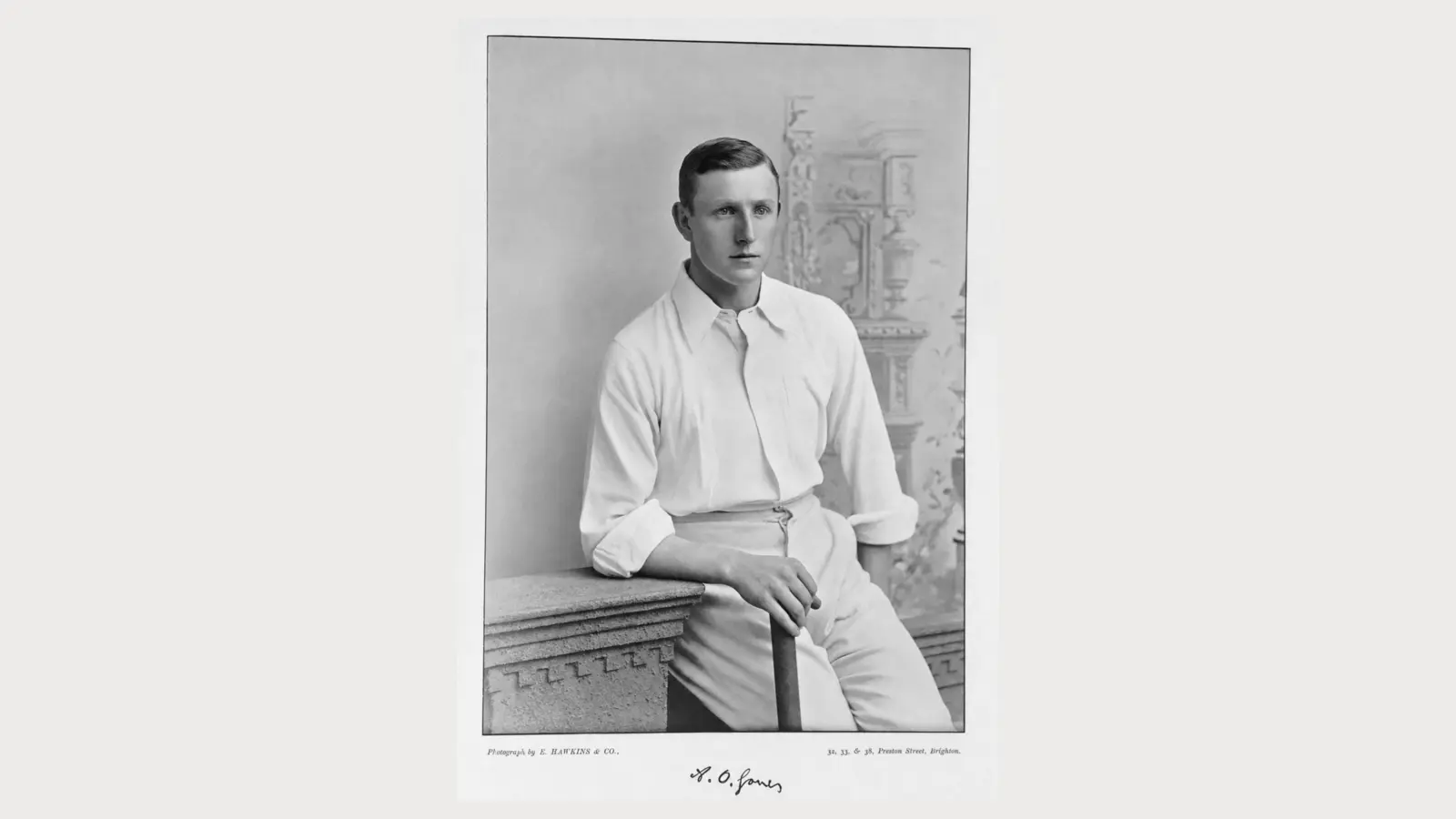
There are some historical figures whose names survive because each generation retells their story, and others whose reputations gradually retreat into the footnotes. Arthur Owen Jones belongs largely to the second group. In his lifetime he was one of the best-known cricketers in Britain, captain of England, captain of Nottinghamshire, a Wisden Cricketer of the Year and a sportsman regarded by contemporaries as one of the finest fielders the game had produced. He also played rugby at a high level and later became an international referee. Yet, outside the specialist world of cricket history, his name is now surprisingly little known.
For me, there is another reason for returning to his story. Arthur Owen Jones was a relation of mine and belonged to the wider Jones family of Glandwr Hall near Barmouth, a family whose history I have spent many years researching. His story therefore forms part of a much wider Welsh family history, but it is important not to turn that connection into sentimentality. Jones deserves attention because of what he achieved in his own right, and because his life tells us something interesting about the society which produced him. He stood at the meeting point of Welsh family identity and English institutions, Victorian ideas of respectability and Edwardian sporting celebrity, public prestige and rather less secure private circumstances.
From Glandwr to Nottinghamshire
Arthur Owen Jones was born at the rectory at Shelton in Nottinghamshire on 16 August 1872. He was the seventh son of the Reverend John Cartwright Jones and his wife Mary, and a grandson of William Jones of Glandwr Hall. Although Arthur was born and raised mainly in England, his paternal family belonged firmly within the history of Merionethshire, particularly the Dolgellau and Barmouth area. The Jones family had accumulated property, professional standing and considerable local influence during the nineteenth century, and Glandwr became the physical centre of that identity.
His father, John Cartwright Jones, represented another feature of the Victorian family. Born in London in 1831, John had been educated at Merchant Taylors’ School and Christ Church, Oxford, before entering the Church of England. He eventually became Rector of Shelton. The clergy occupied an important social position in Victorian Britain, particularly in rural communities. A rector was not simply responsible for Sunday services. The rectory could be a centre of education, charity, local administration and social leadership, while the children of the clergy grew up surrounded by expectations of duty, discipline and respectable conduct.
Arthur barely had time to know his father. John Cartwright Jones died in January 1875, when Arthur was not yet three years old. Mary was left a widow with nine children, and the family subsequently settled in Bedfordshire. Early bereavement was hardly unusual in Victorian Britain, even within relatively comfortable professional families, but the consequences could still be profound. Arthur had been born into the security and status of a rectory household, only for that structure to disappear almost immediately.
There was nevertheless continuity. Education remained important, and Arthur attended Bedford Modern School between 1881 and 1890. He excelled not simply at cricket but at several sports, before entering Jesus College, Cambridge, in 1891. He played cricket for Cambridge University the following year and gained his Blue in 1893, representing Cambridge against Oxford at Lord’s. By his early twenties he had therefore entered the distinctive world of late Victorian amateur sport, a world in which athletic ability, social standing, education and ideas about character were often closely intertwined.
Cricket and the gentleman amateur
Cricket already had a place within the Jones family. Arthur’s father had established a parish cricket team, while his uncle William Halse Gatty Jones had been involved with the Melbourne Cricket Club during his years in Australia. The wider Glandwr family had shown an enthusiasm for the game from an early period. Arthur’s eventual success was exceptional, but his interest in cricket did not emerge from nowhere.
He made his first class debut for Nottinghamshire in 1892 and remained associated with the county for the rest of his life. Over 472 first class matches he scored 22,935 runs, including 34 centuries, and took 333 wickets with his leg spin. Those figures alone would have secured him a respectable place in cricket history, but statistics only partly explain his contemporary reputation. Jones was known for his enthusiasm, leadership and extraordinary ability in the field, qualities which were particularly valued in an age when cricket was still presented as a school of character as much as a professional sport.
In 1900 he was named one of Wisden’s Cricketers of the Year and became captain of Nottinghamshire. Three years later came the innings for which he is perhaps most easily remembered. Playing Gloucestershire at Trent Bridge in July 1903, Jones scored 296. He batted for six hours, hitting 36 fours, 13 threes and 24 twos. No other batsman in the innings passed 76. It was then a record individual score for Nottinghamshire and, remarkably, it remains the highest first class score made at Trent Bridge by a Nottinghamshire batsman.
Yet batting was only one part of his game. Jones acquired an almost legendary reputation as a fielder. Contemporary observers repeatedly praised his anticipation, speed and concentration, and later recollections credited him with transforming Nottinghamshire’s attitude towards fielding. He has sometimes been described as the inventor of the gully position. That claim should probably be treated cautiously, because cricketing positions evolved rather than appearing at a single identifiable moment, but Jones was certainly associated with the development and popularisation of specialised close fielding in that area. His importance lay less in creating a name on a field diagram than in demonstrating how aggressively intelligent fielding could influence a match.
This aspect of his career is particularly revealing. Modern sporting history naturally gravitates towards runs, wickets and victories because they can be easily measured. Fielding is harder to preserve. A brilliant catch might survive in a newspaper report, but anticipation, positioning and the constant pressure applied to a batsman largely vanish when the players themselves have gone. Jones was famous for precisely those qualities which leave the faintest statistical trace.
The championship captain
His greatest achievement as a leader came in 1907. Nottinghamshire went through the County Championship season undefeated, recording fifteen victories and four draws, with one further match abandoned. They became county champions for the first time since the competition had been formally organised on a points basis. The club’s own committee placed considerable emphasis on Jones’s leadership when reporting upon the achievement.
Captaincy in this period was different from the role exercised by the modern professional sports captain. The amateur captain was expected to embody authority without appearing authoritarian. He had to manage professional players who might possess greater technical experience than himself, maintain relationships with committees and members, make tactical decisions and, above all, set the tone of the side. Jones appears to have been particularly suited to that world. His leadership rested upon example. The same man who expected his players to remain alert in the field was known for throwing himself fully into the work himself.
The 1907 championship also reminds us how misleading individual sporting statistics can sometimes be. Jones did not need to be the greatest batsman or bowler in England to be an exceptional captain. His contribution was partly organisational and psychological. He helped create a side in which fielding, discipline and collective effort mattered, and Nottinghamshire’s undefeated season was the clearest result.
More than a cricketer
It would also be wrong to remember Jones as someone who happened to play only one game particularly well. He belonged to an era when the ideal amateur sportsman was expected to turn his hand to several sports, and he did so with considerable distinction. While at Bedford he had played rugby as well as cricket, and he later became closely associated with Leicester. He subsequently moved into refereeing and officiated at international level. He even played some association football.
This versatility places him firmly within the sporting culture of his age. Organised sport was expanding rapidly during the closing decades of the nineteenth century. Clubs were becoming permanent institutions, national competitions were developing, newspapers were creating sporting celebrities and large crowds were beginning to follow teams with something approaching modern enthusiasm. At the same time, however, the older ideal of the gentleman amateur remained immensely powerful.
That word, amateur, can be misleading to modern readers. It did not mean that Jones lacked ability or commitment. The distinction was primarily social and financial. Cricket maintained a division between the Gentlemen, who were amateurs, and the Players, who were professionals. The amateur ideal claimed that sport should develop character and be pursued for honour rather than money. In practice, it also reflected the class assumptions of Victorian and Edwardian Britain.
Jones occupied this world almost perfectly. He had the education, family background and social standing expected of a gentleman cricketer, but that status did not provide permanent financial security. By the time of the 1911 census, a man who had captained England and led Nottinghamshire to a championship was earning his living as an insurance salesman. There is nothing particularly remarkable about respectable commercial employment, but it provides a useful corrective to modern ideas of sporting fame. Celebrity did not necessarily produce wealth.
England and the Australian illness
Jones represented England in twelve Test matches between 1899 and 1909. His international record was modest compared with his achievements for Nottinghamshire, with 291 Test runs at an average of 13.85. Judged solely by those figures, it would be easy to underestimate him. International cricket occupied a much smaller part of a player’s career than it does today, and Jones’s reputation among those who watched him week after week was built primarily in county cricket.
His success in leading Nottinghamshire nevertheless brought the highest honour available to an English cricketer. He was appointed captain for the 1907 to 1908 tour of Australia. It should have been the culmination of his career.
Instead, shortly after reaching Australia he contracted pneumonia. He was sufficiently ill to miss the first three Tests and returned only for the final two matches. England lost the series. Jones therefore carried the title of England captain without ever receiving the uninterrupted opportunity to demonstrate the leadership which had made him so successful at Nottinghamshire.
The illness was more important than a disappointing cricket tour. Nottinghamshire’s own history records that he never quite recovered from the pneumonia, although he continued playing and captaining the county afterwards. It would be wrong to claim that pneumonia caused the tuberculosis which later killed him, but his physical health had clearly been seriously damaged.
There is something particularly Edwardian about this part of the story. Jones had reached the summit of a culture which celebrated physical vigour, self-control and endurance, only to discover the limits of all three. Before antibiotics, serious respiratory illness could change a life with frightening speed. Social status, education and sporting fitness offered no immunity.
The final season
Jones continued playing cricket into 1914, but by then his health was failing. He managed only six first class matches that summer before tuberculosis made further play impossible. After his final appearance against Hampshire in June he entered a sanatorium in the New Forest. Eventually there was little more that could be done, and he went to stay with his brother, Dr Christopher Lloyd Jones, at Dunstable in Bedfordshire. Arthur Owen Jones died there on 21 December 1914. He was only forty-two.
The timing of his death almost guaranteed that public attention would move elsewhere. Britain had been at war for more than four months. Families across the country were receiving news from France and Belgium, casualty lists were lengthening and the comfortable assumptions of the Edwardian world in which Jones had flourished were themselves beginning to collapse. A famous cricketer dying prematurely was a tragedy, but it occurred against a national catastrophe of an entirely different scale.
Nottinghamshire did not forget him. After the war the county arranged a subscription for a permanent memorial at his grave in Dunstable. The memorial stone was erected in 1920, recording his long service to the county and remembering him simply as a great cricketer. Two of his bats also survive in the collections at Trent Bridge.
A Welsh family story and a British sporting life
Arthur Owen Jones cannot neatly be claimed as a Welsh sportsman in the conventional sense. He was born in Nottinghamshire, educated in England and achieved fame playing for an English county and England itself. To force him into a modern national category would distort the evidence. Yet neither should the Welsh element of his story be ignored.
His roots lay within the Jones family of Glandwr and the world of nineteenth-century Merionethshire from which earlier generations had emerged. His life illustrates something common among successful Welsh families of the Victorian period. Their children and grandchildren increasingly moved beyond Wales into the professions, universities, empire and great institutions of British public life. Geography changed, accents changed and identities became more complicated, but family networks and inherited ideas about education, service and respectability travelled with them. Arthur’s life belonged to that movement.
He also represents a lost sporting world. The modern international cricketer is a highly paid professional whose career is recorded ball by ball and preserved indefinitely on film. Jones belonged to a generation whose greatest performances survive in scorebooks, newspaper columns, photographs and the memories committed to paper by those who saw them. Much of what made him exceptional, his anticipation in the field, his authority as captain, his enthusiasm and his influence over other players, can only be reconstructed indirectly.
That perhaps explains why his reputation faded. He did not possess a spectacular Test record which could preserve his name statistically, and his life ended before a later generation could turn him into one of the elder statesmen of the game. He died at forty-two, during the opening months of the First World War, at almost exactly the moment when the society which had shaped him was disappearing.
Yet obscurity should not be confused with insignificance. Arthur Owen Jones captained England. He led Nottinghamshire through an undefeated championship season. He scored one of the great innings in the history of Trent Bridge. He was regarded by his contemporaries as an outstanding fielder and sporting leader, and his abilities extended well beyond cricket. These were substantial achievements in any period.
For me, however, the interest goes deeper than recovering another name from a family tree. Jones demonstrates why genealogy becomes most valuable when it moves beyond names and dates. Through one individual we can see the movement of a Welsh family into English professional society, the educational world of Victorian Britain, the development of organised sport, the peculiar economics of amateurism, the dangers of disease before modern medicine, and finally the interruption of an entire social order by war.
Arthur Owen Jones was once famous. History subsequently became forgetful. More than a century after his death, there is good reason to put him back into the story.
Related Books
Arthur Owen Jones (1872–1914): England Captain, Gentleman Amateur, and the Fragility of Edwardian Greatness
The full biography of Jones, covering his cricketing career, family background, leadership, illness and Edwardian sporting world.
Kindle · Paperback
Old Llyfnant Valley Farming Families
For the broader Jones of Glandwr family history from which Arthur’s branch emerged.
Kindle · Paperback
Related Essays
- The Women of Glandwr: Kinship, Household and Inheritance in a Victorian Welsh Family
- Athelstan Jasper Blaxland (1880–1963): A Glandwr Descendant and a Surgeon Through Two World Wars
- John Howel (c.1765–1835): The Woollen Manufacturer Behind the Jones Family of Glandwr
- Gatty Wynne Jones (1859–1913): From Melbourne and Glandwr to the American Banjo
Explore more family and Glandwr history
Continue with the Jones Family of Glandwr Hall, or browse Family History & Genealogy.
Sources and Further Reading
This essay draws on family-history research, contemporary sporting records, newspapers, institutional material and later scholarship. The sources below are divided between material directly relevant to Arthur Owen Jones and wider works which help to place his life within the social history of Victorian and Edwardian Britain.
Family and genealogical sources
- Antony David Davies, Arthur Owen Jones (1872–1914): England Captain, Gentleman Amateur, and the Fragility of Edwardian Greatness (2026).
- Antony David Davies, Old Llyfnant Valley Farming Families: Including the Jones Glandwr and Davies Caeadda Families, particularly the chapters on the Jones family, William Jones of Glandwr Hall, John Cartwright Jones and Arthur Owen Jones.
- England and Wales civil registration records, including birth and death registration for Arthur Owen Jones and relevant records for the wider family.
- Census returns for 1881, 1891, 1901 and 1911, for household structure, residence and occupation.
- Probate, wills and related testamentary records for members of the Jones of Glandwr family, where located.
- Burial and cemetery records for Dunstable, including the grave and later Nottinghamshire County Cricket Club memorial to Jones.
- Crockford’s Clerical Directory, for the clerical career and social world of the Reverend John Cartwright Jones.
- Clergy of the Church of England Database, for clerical appointments and networks associated with the Jones family.
Contemporary cricket and sporting sources
- Wisden Cricketers’ Almanack, annual volumes covering Jones’s career, particularly the 1893 volume for his Cambridge period, 1900 for his selection as a Cricketer of the Year, contemporary coverage of the 1907–08 Australian tour, and the 1915 volume for obituary and retrospective material.
- Nottinghamshire County Cricket Club annual reports and committee records, particularly the reports covering Jones’s captaincy and the undefeated 1907 County Championship season.
- Official scorecards for Nottinghamshire, Cambridge University, Gentlemen v Players and England Test matches, 1892–1914.
- Marylebone Cricket Club, contemporary Laws of Cricket, circulars and administrative material relating to the organisation and conventions of the game.
- Bedford Modern School, The Eagle, for Jones’s school cricket, rugby, fives, captaincy and contemporary assessments of his sporting ability.
- Jesus College, Cambridge, The Chanticleer, for Jones’s college cricket and his emergence into university and county cricket.
- Oakham School Magazine and school records, for the period in which Jones served as a master and for his sporting activities there.
- Bedfordshire Mercury, including the report of 5 September 1891 describing Jones’s fielding before his first-class career.
- Dunstable Borough Gazette, obituary and local reporting surrounding Jones’s death and funeral.
- The Times, match reports, tour dispatches, selection commentary and notices.
- The Manchester Guardian, cricket reports and Australian tour coverage.
- Nottingham Evening Post, Nottinghamshire match reporting, local reaction and later commemoration.
- Nottingham Journal, local sporting reports and public commentary, where available.
- The Sporting Life, match reports, selection debate and wider sporting coverage.
- Athletic News, county cricket reporting and opinion.
- The Field, for contemporary discussion of cricket, amateur sport and gentlemanly sporting culture.
- The Illustrated London News, for sporting portraiture, visual culture and public presentation of leading cricketers.
- Contemporary Australian and British newspaper coverage of the 1907–08 MCC tour, particularly reports concerning Jones’s pneumonia and delayed appearance in the Test series.
Archives and institutional material
- Nottinghamshire County Cricket Club, Trent Bridge historical archive, including the Arthur Jones player biography, the 1903 innings of 296, the 1907 championship season, the 1914 season, memorial material and surviving bats associated with Jones.
- MCC Library and Archives, for tour papers, correspondence, administrative records and the wider governance of cricket.
- MCC Museum, including catalogue material relating to the Leicester Football Club cap associated with A. O. Jones.
- Jesus College and University of Cambridge archives, for matriculation, college life and sporting records.
- Bedford Modern School archives, for school registers, The Eagle and sporting records.
- Oakham School archives, for Jones’s employment as a master between 1896 and 1898 and associated school sporting records.
- Leicester Tigers historical records, match programmes, annuals and club publications relating to Jones’s rugby career.
- Rugby Football Union records and historical reference works, where accessible, for refereeing appointments and the wider rugby context.
- World Rugby Museum, historical material relating to early international refereeing and Jones’s standing as an experienced referee.
- Local archives in Bedfordshire and Nottinghamshire, for cemetery records, local newspapers and related biographical material.
Biographical, statistical and reference works
- Association of Cricket Statisticians and Historians, Famous Cricketers No. 63: A. O. Jones, the most detailed specialist study of Jones’s life and sporting career.
- CricketArchive, A. O. Jones career record, scorecards, match lists and season-by-season statistics.
- ESPNcricinfo, A. O. Jones player profile, Test record and first-class career summary.
- Alan Gibson, The Cricket Captains of England (Cassell, 1979; revised edition, 1989), particularly for Jones’s England captaincy and the traditional claim that he helped establish the gully fielding position.
- Stuart Farmer and David Hands, The Tigers Tale: The Official History of Leicester Football Club, 1880–1993 (ACL & Polar Publishing, 1993).
- Stuart Farmer and David Hands, Tigers 1880–2014: Official History of Leicester Football Club (Rugby Development Foundation, 2014), for Jones’s Leicester career and the wider history of the club.
Cricket, amateurism and British sporting culture
- Derek Birley, A Social History of English Cricket (Aurum Press, 1999).
- Rowland Bowen, Cricket: A History of its Growth and Development (Eyre & Spottiswoode, 1970).
- Keith A. P. Sandiford, Cricket and the Victorians (Scolar Press, 1994).
- Mike Marqusee, Anyone But England: Cricket and the National Malaise (Verso, 1994).
- Jack Williams, Cricket and England: A Cultural and Social History of the Inter-war Years (Frank Cass, 1999), particularly for the later construction of cricketing memory.
- Richard Holt, Sport and the British: A Modern History (Oxford University Press, 1989).
- Mike Huggins, The Victorians and Sport (Hambledon and London, 2004).
- Wray Vamplew, Pay Up and Play the Game: Professional Sport in Britain, 1875–1914 (Cambridge University Press, 1988), for the economics of sport and the relationship between amateur ideals and professional practice.
- Tony Collins, Rugby’s Great Split: Class, Culture and the Origins of Rugby League Football (Frank Cass, 1998), for the class structures and arguments surrounding late Victorian rugby.
Society, masculinity and institutional culture
- J. A. Mangan, Athleticism in the Victorian and Edwardian Public School: The Emergence and Consolidation of an Educational Ideology (Cambridge University Press, 1981).
- John Tosh, A Man’s Place: Masculinity and the Middle-Class Home in Victorian England (Yale University Press, 1999).
- David Cannadine, The Decline and Fall of the British Aristocracy (Yale University Press, 1990).
- Eric Hobsbawm, The Age of Empire: 1875–1914 (Weidenfeld & Nicolson, 1987).
Medicine, illness and the pre-antibiotic world
- Anne Hardy, The Epidemic Streets: Infectious Disease and the Rise of Preventive Medicine, 1856–1900 (Clarendon Press, 1993).
- Linda Bryder, Below the Magic Mountain: A Social History of Tuberculosis in Twentieth-Century Britain (Clarendon Press, 1988).
- Roy Porter, The Greatest Benefit to Mankind: A Medical History of Humanity (HarperCollins, 1997).