
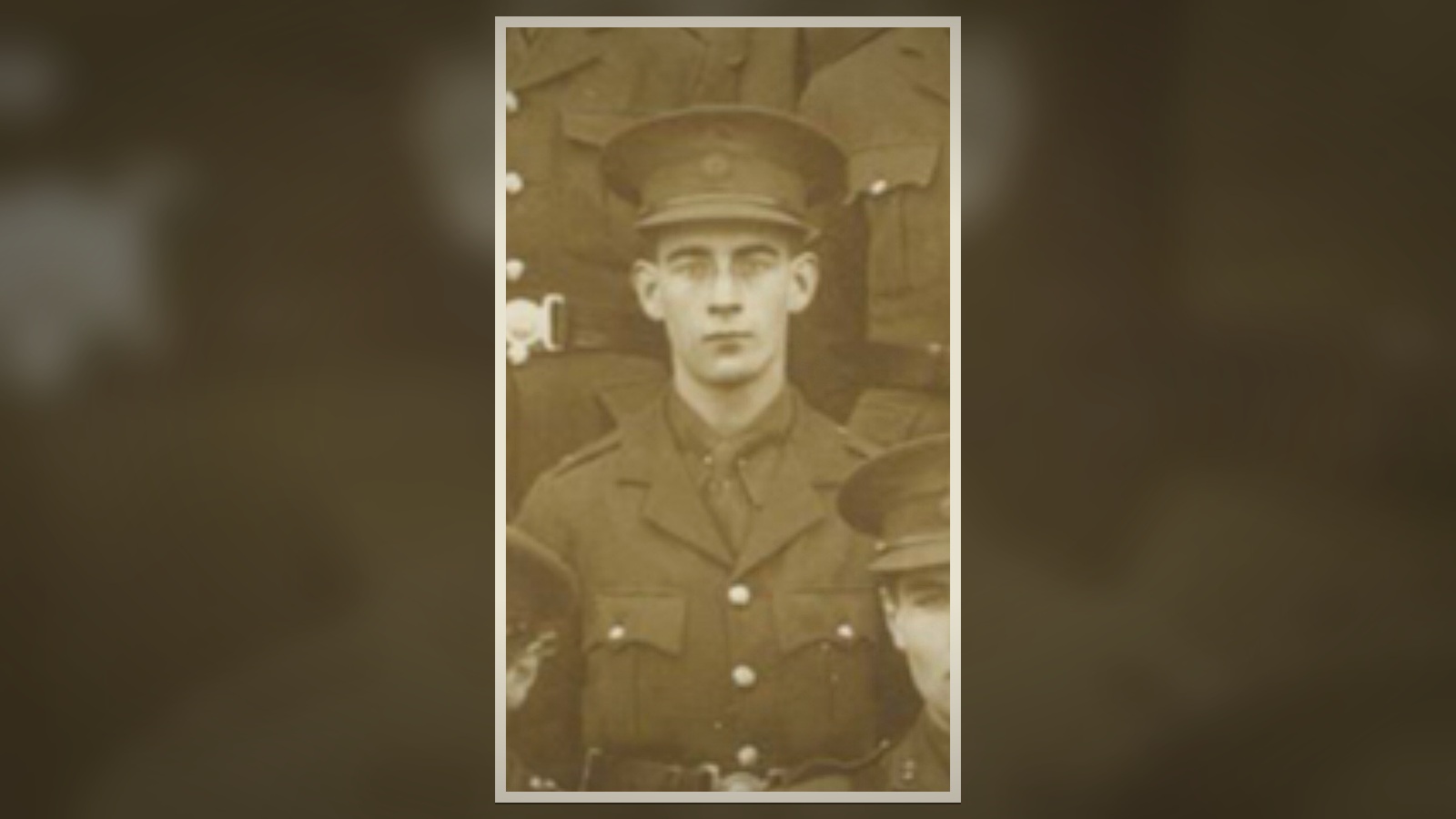
The end of a landed family is rarely a single event. Houses are sold, estates are divided and families move away, but the real ending often begins much earlier. It can take decades for the old relationship between a family, its land and the community around it to disappear. This was certainly true of the Jones family of Glandwr. When Eric Vaughan Wilding-Jones was born in 1899, the family still owned the estate established by his great-grandfather more than sixty years earlier. Yet the world which had created Glandwr was already passing away. By the time Eric died in 1942, he had become the last surviving son in the direct Glandwr line, but he had never occupied the ancestral house as its master. The final chapter would instead fall to his younger sister Sylvia, who retained the estate for another thirteen years before finally severing a family connection with the Mawddach which had lasted for almost 130 years.
Eric’s story is therefore about considerably more than the unhappy circumstances of his death. His life began with considerable promise. He received an expensive education, trained at the Royal Military Academy at Woolwich and became an officer in the Royal Artillery. He served in India and married into a distinguished legal family. Yet alcoholism destroyed his military career, forcing him to construct a different life in rural Kent, where he turned his interest in dogs into a breeding and boarding business. The outbreak of another world war found him working near one of Britain’s largest military camps. Within months of his father’s death he was dead himself, aged only forty-three. Seen against the longer history of Glandwr, his life reflected something of the estate’s own experience, inherited advantages remained, but the security which had once accompanied them had disappeared.
The Inheritance of Glandwr
Glandwr had been developed substantially by Eric’s great-grandfather, William Jones, a Dolgellau-born solicitor who made his career and fortune in the City of London. During the 1830s William acquired land outside Barmouth overlooking the Mawddach estuary. Glandwr Hall was substantially complete by 1837 and developed into a comfortable country residence with seven bedrooms, reception rooms, a lodge, stables, farm buildings, private lakes and access to the estuary. It was not one of the enormous Welsh country houses, but it represented something socially important. William had used the wealth generated by a successful professional career to establish his family among the landowning classes of his native Merionethshire.
For much of the nineteenth century the Jones family moved easily between Glandwr and London. Eric’s grandfather, William Halse Gatty Jones, followed his father into the law, spent several eventful years in colonial Australia and represented the constituency of Evelyn in the Victorian parliament before returning to Britain. He later became a prominent figure in the City of London while maintaining his connection with Glandwr. By the time of his death at the Hall in September 1897, however, the finances of the estate were considerably less secure than its outward appearance suggested. His estate was worth only £3,927 before debts and duties further reduced its value. The long agricultural depression of the late nineteenth century had badly damaged the economics of landownership, while the cost of maintaining a country estate remained substantial.
The problem passed to Gatty’s eldest surviving son, William Wilding Jones. Wilding was a solicitor rather than a farmer or traditional resident squire, and his treatment of Glandwr was notably pragmatic. After inheriting in 1897 he sold substantial portions of the estate, including property around Dolgellau and interests in the local gold and copper mines. Within a decade almost half the land he had inherited had gone, leaving a more compact estate of around 1,500 acres. Wilding believed that what remained would be easier to manage and more economically viable.
His professional life gave him particular insight into the problems facing the Welsh landed world. Papers preserved in Bangor University’s Nanney Williams Collection identify Wilding Jones as solicitor to the Nannau Estate, while earlier papers show his father Gatty acting professionally for the same estate. The surviving archive includes correspondence concerning estate duties, trusts, rents, land, timber and the administration of Nannau. Wilding therefore encountered the changing economics of landownership from both sides, as the owner of Glandwr and as the solicitor responsible for helping to manage another historic Merionethshire estate.
By 1905 the consequences were visible at Glandwr itself. The Jones family ceased to occupy the Hall as its principal country residence and let it to tenants. William Henry Higgin, a chemical manufacturer, and his family occupied the property between 1905 and 1911. The surviving Rowe memorial at St Philip’s, Caerdeon, records the family’s association with Glandwr from 1915, suggesting that their tenancy began around that year rather than immediately after the Higgins left. Wilding built the smaller house of Islwyn nearby, which became the family’s own Welsh residence. The distinction was significant. Glandwr still belonged to the Joneses, but it was no longer really their home. It had become an asset expected to generate income. It was against this background that Eric Vaughan Wilding-Jones grew up.
A Younger Son Who Became the Heir
Eric was born on 9 April 1899. A military census return completed in 1921 records his birthplace as Haywards Heath in Sussex, where his parents were then living during this period of their lives. He was not originally the son expected to inherit the family position at Glandwr. That responsibility belonged to his elder brother, Hugh Wynne Wilding Jones.
Hugh, born in 1896, had all the appearance of a natural successor. He was educated at Tonbridge School and afterwards entered Corpus Christi College, Oxford. College records remembered him as an engaging young man with a quiet humour. His future, however, became one of the countless casualties of the First World War. After only two terms at Oxford he abandoned his studies and volunteered for military service. Commissioned into the Royal Welch Fusiliers, he served on the Western Front and was wounded in the thigh in January 1917. Ill health delayed his return to active service, but in 1918 he joined his regiment in the Balkans. He was wounded during operations there and died on 22 September 1918, aged only twenty-two.
Hugh’s death altered the future of the Glandwr family. Eric, until then the younger son, became Wilding’s only surviving son.
Like Hugh, Eric had received an education intended to prepare him for a position of responsibility. He entered Tonbridge School in 1913 and remained there until 1917. The school records are revealing. Eric left from the Army Class in July 1917 and had served as a House Praepostor and Lance-Sergeant in the Officers’ Training Corps. These were positions of trust within the school, and they present a picture of the young Eric which is easily obscured by the difficulties of his later life. At eighteen he was not regarded as a failure or an obvious problem. He was a young man being prepared for commissioned service and entrusted with responsibility by one of the country’s established public schools.
From Tonbridge he progressed to the Royal Military Academy at Woolwich, where he studied between October 1917 and January 1919. He was commissioned as a Second Lieutenant in the Royal Artillery in 1919. A surviving photograph from that year shows him in uniform, still little more than a boy, at the beginning of what appeared to be an entirely conventional military career.
The 1921 military census provides another snapshot of this period. Eric was recorded aged twenty-two years and two months, unmarried, born at Haywards Heath and serving as a Second Lieutenant in the Royal Field Artillery. He was subsequently promoted to Lieutenant. Everything about his circumstances still pointed towards a secure career. Tonbridge, Woolwich and the Royal Artillery represented a familiar route for young men from professional and landowning families. Had his life continued along that course, Eric might have combined military service with his eventual responsibilities at Glandwr.
It did not.
India and Muriel
During the 1920s Eric served in British India, and the surviving Indian Army Lists now allow that service to be traced more closely. By April 1926 Lieutenant E. V. Wilding-Jones was serving with the 71st Field Battery, Royal Artillery, at Jubbulpore, now Jabalpur, in central India. He remained associated with the battery into 1929. This places Eric within the professional military world of inter-war India much more precisely than was previously possible. It was also a period of increasing political uncertainty, as Indian nationalism gathered strength and the imperial confidence which had characterised the world of his grandparents began to weaken.
The unit’s movements also add useful context to Eric’s relationship with Muriel. The 71st Field Battery was recorded as having moved from Allahabad in January 1926, only a few months before Eric’s engagement to Muriel Ross Alston was announced in April. Muriel’s family was firmly established at Allahabad, where her father practised at the High Court. The surviving evidence does not prove that Eric first met Muriel while the battery was stationed there, but the geographical connection is suggestive and provides a plausible setting for their acquaintance. The couple married at Allahabad on 12 February 1929, while Eric was still serving in India.
Muriel came from a distinguished Anglo-Indian legal family. Her father, Sir Charles Ross Alston, was a leading figure at the Allahabad Bar and was particularly associated with criminal advocacy. Later recollections of the Allahabad High Court described him as the leader of the criminal side of the Bar and an exceptionally effective advocate.
There was therefore a certain symmetry to the marriage. Eric’s great-grandfather, grandfather and father had all built their professional lives around the law, while Muriel was the daughter of one of the best-known British advocates practising at Allahabad.
Eric’s return to Britain can also be placed within the movement of his brigade. In March 1929 the 40th Field Battery sailed from Bombay on transfer to the Home establishment, and the 26th Field Brigade was recorded at Bulford later that year. By the time of Eric’s court-martial in 1931 he was serving with the 40th Field Battery, still within the 26th Field Brigade. His later posting was therefore not a move into an entirely unrelated formation, but part of the continuing history of the same brigade in which he had served in India. Eric and Muriel had no children.
For many years the surviving family evidence suggested that the marriage had broken down relatively early. The recently examined 1939 Register allows that assumption to be refined considerably. On 29 September 1939 Eric and Muriel were still living together at The Lodge, Cackets Lane, Cudham, Kent. Both were recorded as married. Muriel, born on 10 October 1906, was described as undertaking unpaid domestic duties.
If they later separated, as other family evidence suggests had happened by the time of Eric’s death, the separation must therefore have occurred after September 1939. The contemporary register gives us something particularly valuable, a glimpse of the marriage ten years after the wedding, with husband and wife still sharing a household.
The Court-Martial of 1931
The decisive rupture in Eric’s life came in 1931. Unlike many episodes preserved only through family recollection or later newspaper reports, the original proceedings of his General Court-Martial survive at The National Archives. They allow the circumstances to be described with considerable precision.
Eric was then Lieutenant Eric Vaughan Wilding-Jones of the 40th Field Battery, 26th Field Brigade, Royal Artillery. He faced two charges under Section 19 of the Army Act. The first alleged that at Larkhill on 27 May 1931 he “was drunk”. The second alleged that at Larkhill on the afternoon of 28 May he was again drunk.
The General Court-Martial reached its findings on 17 June 1931. Eric was found guilty of the first charge. He was found not guilty of the second.
This distinction is important. Later accounts can easily compress an event such as this into a general description of persistent drunkenness, but the surviving proceedings are much more exact. He faced two charges and was convicted of one. The wording of the charge sheet should also be respected. It does not describe him as drunk while on duty, it states simply that at Larkhill on 27 May he “was drunk”.
The sentence was nevertheless severe. The court ordered that Lieutenant Eric Vaughan Wilding-Jones should be “dismissed from His Majesty’s Service”.
For Eric this represented the destruction of the career around which his adult life had been constructed. From Tonbridge’s Army Class he had progressed to Woolwich and then to more than a decade in the artillery. The Army had provided his occupation, social standing and much of his identity. At thirty-two all of that disappeared.
There is, however, a revealing qualification within the court papers. A sentence of dismissal ordinarily involved the loss of the gratuity which an officer had accumulated through his years of service. When the proceedings were forwarded to the General Officer Commanding-in-Chief, Southern Command, the court specifically recommended that Eric should not forfeit any part of that gratuity. The final question of whether it should be withheld was left to the Army Council.
The papers do not explain why the officers made this recommendation, and there is no value in inventing a motive which the record does not provide. Yet the detail is significant. The same court which considered Eric’s offence sufficiently serious to end his career did not consider it necessary that he should automatically suffer the additional financial penalty normally attached to dismissal.
The administrative process took several further weeks. On 31 July 1931 the London Gazette formally announced that Lieutenant E. V. Wilding-Jones had been dismissed from the service by sentence of General Court-Martial, with effect from 25 July. The June and July dates therefore refer to different stages of the same case, the court pronounced sentence on 17 June, while the dismissal formally took effect on 25 July.
Whatever its causes, alcohol had now cost Eric the career for which he had been prepared since his schooldays.
A New Life at Cudham
What happened afterwards is perhaps one of the more interesting parts of Eric’s story, because it shows that the court-martial did not simply bring his useful life to an end.
During the 1930s he established himself at Cudham in Kent. Earlier research had revealed his growing involvement with dogs and local agricultural life. He became associated with horse and dog shows and developed a particular interest in Cairn terriers, with which he enjoyed success at shows in southern England. Cricket also remained an interest, continuing a sporting tradition which had run through several generations of the Jones family.
The 1939 Register now allows us to see that these activities had developed into a genuine occupation. At The Lodge, Cackets Lane, Eric described himself as a “Breeding & Boarding Kennel Propr.” He was therefore not merely keeping and showing dogs as a gentleman’s pastime. He was running a commercial breeding and boarding kennel.
That changes the picture of his post-Army years. Eric had attempted to start again. He took something in which he had developed expertise and enthusiasm and turned it into a means of earning a living. Muriel was still living with him at The Lodge, and the household recorded in September 1939 appears, from the outside at least, considerably more settled than might have been assumed from knowledge of what eventually followed.
There is also something appropriate about Eric finding a second occupation rooted in animals and country life. He had never become the resident master of Glandwr, but elements of the country gentleman remained in his interests, dogs, horses and cricket rather than law or commerce. His life in Kent was far removed from the conventional military career envisaged for him at Tonbridge, yet it appears to have given him a new direction after the humiliation of 1931.
Catterick and the Last Year
By 1942 Eric’s circumstances had changed again. He was living in Yorkshire and working as manager of the Gaiety Theatre at Catterick.
Catterick was then dominated by its enormous military camp. The Second World War had brought thousands of servicemen through the district, and organisations such as ENSA, the Entertainments National Service Association, provided entertainment for men and women serving in the forces. There is an obvious irony in Eric’s final employment. More than a decade after the Army had dismissed him, he had once again found himself making a living within a community shaped overwhelmingly by military life.
His health was deteriorating. Evidence later given at his inquest suggested that he had suffered a number of heart attacks, although he appears to have resisted seeking medical assistance.
Then, on 31 January 1942, his father died. William Wilding Jones had reached the age of eighty-six and died at his home, 53 Wilbury Road, Hove. His gross estate was valued at £16,612, although debts and death duties reduced the amount remaining to £5,573.
Eric survived him by less than five months. On 21 June 1942 he died by suicide at Richmond in Yorkshire. He was forty-three years old.
The circumstances of Eric’s final hours can now be reconstructed more closely from a contemporary report of the inquest. His body was found on the Monday morning on stones in the bed of the River Swale, about forty feet below Station Bridge at Richmond. At the inquest, held at Richmond Hospital, the verdict was that he had died from injuries received in the fall, “by his own act, when his mind was unbalanced”. Evidence also traced part of the previous evening. T. E. Eales, a porter at Richmond station, said that Eric had called there on the Sunday night and asked for paper to write “two business notes”. After writing them, he asked Eales and the booking clerk to sign one, telling them that it concerned NAAFI business. At the inquest that document was produced as Eric’s will. A separate letter was also found on his body.
R. Jackson, with whom Eric was lodging, told the inquest that Eric suffered from heart attacks and giddiness but had never spoken of taking his own life. The evidence does not explain why Eric died, but it strengthens the picture of deteriorating physical health and suggests that whatever distress lay behind his death had not been openly communicated to those around him. Although the document prepared at Richmond station was produced at the inquest as his will, it did not ultimately take legal effect. The surviving grant of administration records explicitly that Eric died intestate. The contents of the separate letter found on his body were not reported in this account.
On 29 May 1943 administration of Eric’s estate was granted at Llandudno to his lawful widow and relict, Muriel Ross Wilding-Jones, then living at the Sundridge Park Hotel in Bromley, Kent, and to Ethel Colbeck, spinster, of 75 Formosa Road, Wandsworth Common, London SW12. The original grant records Eric’s last address as Bells Stores, Shute Road, Catterick Camp, and confirms that he had died at Richmond on 21 June 1942.
The original letters of administration valued Eric’s estate at £2,642 13s. 4d. gross and £2,493 18s. 8d. net. The estate was subsequently resworn at £3,211 5s. 10d. These figures are modest beside the property wealth associated with earlier generations of the Glandwr family, but they also show that Eric did not die penniless.
There is equally little value in trying to impose a retrospective diagnosis upon the circumstances of his death. His difficulties with alcohol, failing physical health, the end of his military career, possible problems within his marriage and the recent death of his father all provide context. None of them can tell us with certainty what was in his mind on 21 June 1942.
What can be seen is the accumulation of loss. Hugh had died from wounds received during the First World War. Eric’s mother Ellen died in 1940. Wilding followed in January 1942. Before the summer was over, Eric himself was dead.
The Last Male Heir
Eric’s death might appear to have ended the male succession to Glandwr, but even before then the traditional idea of an heir had become largely theoretical.
William Wilding Jones had not arranged his affairs on the simple principle that Glandwr would pass outright to his surviving son. His will instead treated the estate increasingly as an economic asset. It was to remain intact and provide income for his two surviving children, Eric and Sylvia. The eventual remainder was directed through Sylvia’s son rather than through any hypothetical descendants Eric might have produced.
It is tempting to see the arrangement as evidence that Wilding had lost confidence in Eric after the court-martial. That is possible, but unless further evidence emerges it would be wrong to present it as fact. Wilding may equally have been attempting to protect an estate which he had spent four decades trying to make financially sustainable.
Whatever his reasoning, the arrangement demonstrates how thoroughly the old pattern had changed. William Jones had developed Glandwr as the visible centre of a newly established landed family. Gatty Jones had lived and died there. By Eric’s generation the Hall had been occupied by tenants for more than thirty years, the owners lived principally elsewhere, and the surviving son had neither settled there nor been given unrestricted control of its future.
The legal position after the deaths of Wilding and Eric can now be followed more closely. Surviving title papers record the appointment of Ethel Colbeck as a new trustee on 3 September 1947 and a vesting assent dated 23 September. Colbeck had been Wilding’s trusted secretary and was already closely involved in the family’s affairs. These documents show that her authority continued in a formal legal capacity during the final years of the estate. Eric was the last male heir, but he was never really the master of Glandwr.
Sylvia and the End of the Jones Era
The final chapter of the family’s history at Glandwr therefore belongs to Eric’s younger sister, Sylvia May Wilding-Jones.
Sylvia was born at Hove on 15 May 1903. On 14 August 1930 she married Geoffrey St John Martin, with whom she had two children. The marriage later ended in divorce. The deaths of her father and brother within a few months of one another in 1942 left Sylvia as the surviving child through whom the future of Glandwr would be decided. They also brought an immediate financial consequence. Death duties arising from the two estates amounted to almost £1,200, another reminder that by the middle of the twentieth century inherited landed property could carry considerable financial burdens.
For another thirteen years Sylvia retained Glandwr. On 2 November 1950 she married Charles Robert Hughes at Dolgellau. Charles was not simply a local Barmouth man, as the surviving family story might initially suggest. Later official records described him as a retired Lieutenant-Colonel of the Indian Army. His background creates an unexpected connection with Eric. Eric had spent part of his own military career in India and had married Muriel at Allahabad. Years afterwards his sister married another officer whose life had also been shaped by British India.
Sylvia and Charles lived not at Glandwr Hall but at Islwyn, the smaller house built by Wilding at the beginning of the century. By then the arrangement almost summed up the history of the estate. The family still possessed Glandwr, yet they lived next door to it. The Rowes had occupied the Hall from about 1915 and had spent far more of the twentieth century living within its walls than the Jones family who owned it.
The Rowe years preserved something of the older country-house world while also adapting it to new circumstances. Recollections gathered by Anna Cawson describe garden fêtes, tennis parties and a large wooden building with a dance floor near the site of the later swimming pool. The chauffeur-mechanic and his family lived in Glandwr Bungalow, while hampers from Harrods and similar suppliers were collected from Barmouth station. During the Second World War, a former member of the Women’s Land Army remembered working with the Glandwr gardener and lodging at Tynycoed. She recalled that Constance Rowe had the rose garden dug up for vegetables, planted potatoes in the fields beside the bungalow and sent produce into Barmouth by horse and cart, with the surplus stored in the Hall’s basement. These are later oral recollections rather than official estate records, but they preserve a vivid picture of Glandwr as a working household during wartime. In January 1955 Sylvia sold Glandwr Hall and the majority of the remaining estate.
A conveyance dated 1 January 1955 shows how part of that final disposal was conducted. It named Sylvia Hughes of Islwyn as vendor, Ethel Colbeck and Frederick James Mann as trustees, and William Clayton Russon of Glan-y-Mawddach as purchaser. The property described included Llwyngleddreath, with grazing rights for 140 sheep, Llwyn Onn Uchaf, Catia, hay rights at Gwaithgwr, peat-cutting rights at Pwlldu Turbary and approximately 4.388 acres forming part of Glandwr Farm. The deed therefore captures not merely the sale of a country house but the dismantling of a landed system made up of farms, grazing, hay, turbary, water and other inherited rights.
There was no spectacular bankruptcy or sudden collapse. The end of Glandwr had taken the better part of sixty years. Wilding had begun selling outlying property after inheriting in 1897. The family had ceased to occupy the Hall in 1905. Hugh’s death in 1918 removed the son originally expected to inherit. Eric’s life took him increasingly far from the conventional role of a Welsh landowner. Wilding’s will converted the estate into a protected source of income rather than an unrestricted inheritance. Eric died in 1942, and Sylvia finally accepted in 1955 that there was little reason to preserve the old estate simply because her great-grandfather had created it. Even then, however, the family had not quite gone.
Sylvia retained Islwyn and continued living there with Charles. He died on 29 December 1956, aged sixty-two, and was buried at Llanaber.
There is something quietly appropriate about that burial. Llanaber had formed part of the family landscape for generations. Gatty Jones, who had died in 1897, was the last of the old Glandwr family to be buried there. Almost sixty years later the second husband of the woman who finally disposed of the estate was laid to rest in the same parish.
After Charles’s death Sylvia sold Islwyn and left the district. That was the true end of the Jones Glandwr era.
The sale of the Hall the previous year had transferred ownership of the great house, but the family had still possessed a home within sight of the estate. When Sylvia left Islwyn, the last physical connection was broken. A relationship with the Mawddach which had begun when William Jones acquired the land in the 1830s had lasted for almost 130 years.
Sylvia eventually settled at Cheltenham. She lived long enough to see the world of her childhood pass entirely into history, dying aged ninety-two at Henleigh Hall Nursing Home in Sheffield on 3 March 1996.
Eric Vaughan Wilding-Jones occupies a poignant position within this longer story, but it would be unfair to remember him only for his failures. The young man who left Tonbridge in 1917 had shown promise and been entrusted with responsibility. Woolwich prepared him for a professional military career, and for more than a decade that career appears to have proceeded successfully. His alcoholism ultimately cost him his commission, but the records from Cudham show that he did not simply give up. He established another livelihood, turned his knowledge of dogs into a business and, as late as 1939, was living with Muriel at a kennel enterprise he was running himself.
His was therefore not a simple story of privileged decline. There was achievement, failure and an attempt at recovery.
In some respects the same can be said of Glandwr. The estate had been created during the confident expansion of the nineteenth-century professional classes. It survived agricultural depression, falling land values, death duties, two world wars and the deaths of the sons who might once have been expected to secure its future. Wilding repeatedly adapted it in an attempt to make it viable. Sylvia retained it for more than a decade after his death. Eventually, however, ownership alone was no longer sufficient reason to preserve a way of life which had already disappeared. Eric died before that final decision had to be made.
It was Sylvia who closed the door. When she left Islwyn after Charles Hughes’s death, there was no younger Jones waiting to return to Glandwr, no resident heir preparing to assume the responsibilities of the estate and no longer any meaningful connection between ownership of the land and the life of the family. Glandwr Hall remained among the woods above the Mawddach. The Jones era was over.
Explore the wider family: The Jones Family of Glandwr Hall, Barmouth follows the family from the creation of the estate to the final end of the Jones era.
Related Essays
- The Women of Glandwr: Kinship, Household and Inheritance in a Victorian Welsh Family
- Athelstan Jasper Blaxland (1880–1963): A Glandwr Descendant and a Surgeon Through Two World Wars
- John Howel (c.1765–1835): The Woollen Manufacturer Behind the Jones Family of Glandwr
- Gatty Wynne Jones (1859–1913): From Melbourne and Glandwr to the American Banjo
Explore more family and Glandwr history
Continue with the Jones Family of Glandwr Hall, or browse Family History & Genealogy.
Sources and Further Reading
Private correspondence between Anna Cawson and Antony David Davies, January–February 2017, including local recollections of Glandwr under the Rowe family and abstracts of title recording Ethel Colbeck’s trusteeship and the conveyance of 1 January 1955.
Antony David Davies, Old Llyfnant Valley Farming Families: Including the Jones Glandwr and Davies Caeadda Families. The work brings together census returns, parish registers, probate material, military records, contemporary newspapers and extensive family research concerning the Jones family and Glandwr Estate.
The National Archives, WO 209/103, Proceedings of General Court-Martial of Lieutenant Eric Vaughan Wilding-Jones, Royal Artillery, 1931. The original proceedings record Eric’s service with the 40th Field Battery, 26th Field Brigade, Royal Artillery, the two charges under Section 19 of the Army Act, his conviction on the first charge and acquittal on the second, the sentence of dismissal from His Majesty’s Service and the court’s recommendation concerning his gratuity.
The London Gazette, 31 July 1931, p. 5025, recording the formal dismissal of Lieutenant E. V. Wilding-Jones from the Royal Artillery by sentence of General Court-Martial, effective 25 July 1931.
1921 Census of England and Wales, military return of officers and other ranks on service, recording Eric Vaughan Wilding-Jones, aged twenty-two years and two months, unmarried, born at Haywards Heath, Sussex, and serving as a Second Lieutenant in the Royal Field Artillery.
Indian Army List, April 1926, recording Lieutenant E. V. Wilding-Jones with the 71st Field Battery, Royal Artillery, at Jubbulpore; and Indian Army List, April 1929, again recording him with the battery and noting its move from Allahabad in January 1926. See also the Royal Military College Review, 1930, recording the 40th Field Battery sailing from Bombay on 26 March 1929 for transfer to the Home establishment, and the surviving history of the 26th Field Brigade recording the brigade at Bulford later that year.
1939 Register, The Lodge, Cackets Lane, Cudham, Kent, recording Eric as proprietor of a breeding and boarding kennel and Muriel Ross Wilding-Jones within the same household.
Newcastle Evening Chronicle, 24 June 1942, “Death Fall from Richmond Bridge”, report of the inquest into the death of Eric Vaughan Wilding-Jones, including the verdict, the evidence of porter T. E. Eales concerning the document produced as Eric’s will, the separate letter found on his body, and R. Jackson’s evidence concerning Eric’s heart attacks and giddiness.
Principal Probate Registry, Letters of Administration of the Estate of Eric Vaughan Wilding-Jones, 29 May 1943. Eric, of Bells Stores, Shute Road, Catterick Camp, died intestate at Richmond on 21 June 1942. Administration was granted to his lawful widow and relict, Muriel Ross Wilding-Jones of Sundridge Park Hotel, Bromley, and Ethel Colbeck of 75 Formosa Road, Wandsworth Common. His estate was initially valued at £2,642 13s. 4d. gross and £2,493 18s. 8d. net, and was subsequently resworn at £3,211 5s. 10d.
Tonbridge School records, including the surviving school account of Hugh Wynne Wilding-Jones and its reference to Eric’s departure from the Army Class as House Praepostor and Lance-Sergeant in the Officers’ Training Corps.
Bangor University Archives and Special Collections, Nanney Williams Collection, particularly the legal and estate correspondence identifying William Wilding Jones and W. H. Gatty Jones as solicitors concerned with the Nannau Estate.
Allahabad High Court historical material concerning Sir Charles Ross Alston and the legal world into which Eric married through Muriel Ross Alston.