
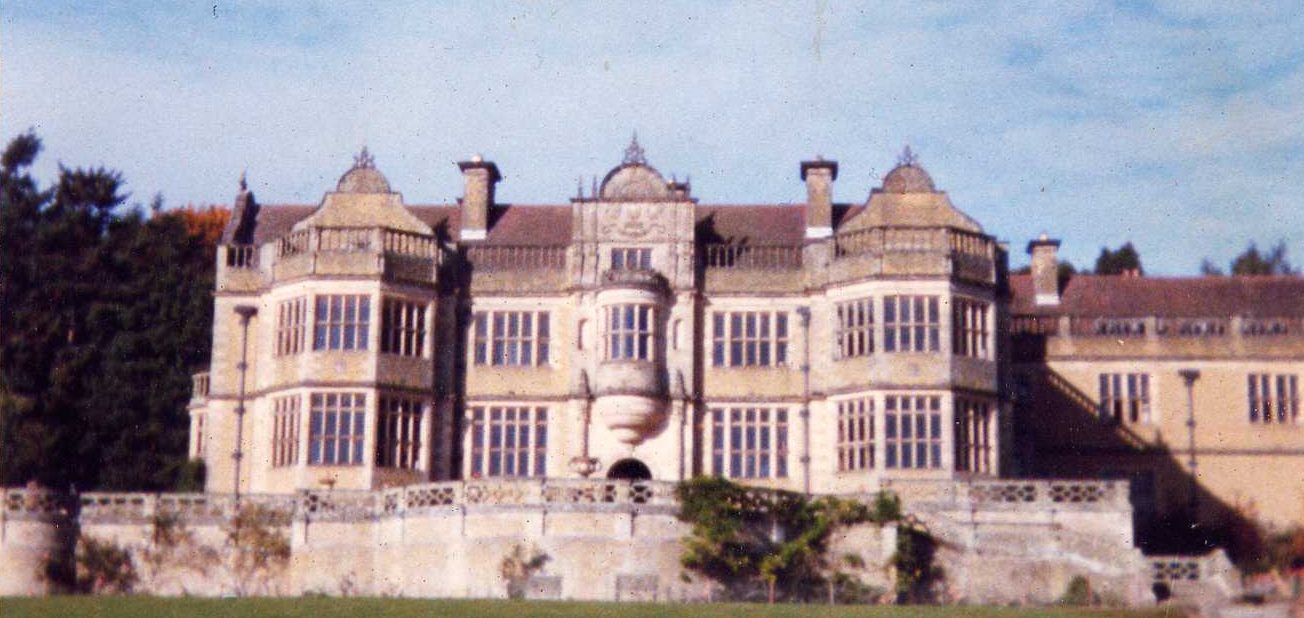
I was four years old when my family moved to Stokesay Court in 1985. My father had been appointed head gardener and chauffeur, taking over from the long-serving Dick Pinches, and for the next nine years the estate became the landscape of my childhood.
We lived in the Lodge, some distance from the main house. It was a large single-storey building with two bedrooms, a living room, pantry, hallway, toilet and shed, together with a large garden. The rooms were generously proportioned and had high ceilings. To me there was nothing particularly remarkable about any of this. It was simply home.


That is one of the strange things about childhood. Experiences that seem extraordinary when looked back upon can feel completely ordinary at the time. I did not think of myself as a boy growing up on a country-house estate. Stokesay Court was where my father worked, where my mother also spent many hours, and where I played.
Stokesay Court had been built for John Derby Allcroft in the closing years of the nineteenth century, a house on a scale that made sense to a wealthy Victorian family with a large domestic establishment. By the time I knew it, Sir Philip and Lady Jewell Magnus-Allcroft lived in only a small part of it. I knew nothing of the architect or the social history of the building. What I knew was which passages led where, which rooms were usually empty and where I was likely to find someone.

During school holidays I had almost complete freedom of the estate and, remarkably, of the house itself. I could wander through corridors, investigate unused rooms, explore the stable block or disappear on my bicycle into the parkland. Nobody treated the house as though it were a museum and I certainly did not. It was an enormous playground. Only much later did I understand quite how unusual that childhood had been.
A Job That Became a Way of Life
My father’s position as head gardener and chauffeur was not really the sort of job where work and home could easily be separated. He generally began at about eight in the morning, but depending upon what needed doing he might still be working at eight in the evening. He worked alongside George Gough, whom I remember from those years, and between them there was much more to attend to than flowerbeds and lawns. My father undertook basic forestry work and the countless practical tasks that came with maintaining an estate created for an entirely different age. Living at the Lodge meant that an urgent job was rarely very far from our front door.
By the 1980s only a comparatively small portion of the once elaborate gardens around Stokesay Court was being maintained. Much of what had been formal pleasure ground had been reclaimed by nature. The greenhouses were largely ruined, their broken glass and uncontrolled vegetation giving them a rather mysterious appearance. One greenhouse close to the lake was something my father attempted to restore. The walled kitchen garden had become almost a miniature jungle and, much to my fascination, was home to grass snakes.

The old gardener’s sheds particularly fascinated me. Inside were old coats and motoring magazines from the 1940s and early 1950s, apparently abandoned where their owners had left them. Even as a child there was something rather sad about them. They gave the impression that work had simply stopped one day and nobody had thought to clear away what remained.
The stable block was much the same. The old blacksmith’s shop was derelict and part of its chimney had collapsed. The carriage bays remained useful for estate machinery, but the stalls themselves belonged to another age. Their doors still carried horses’ names. One of them, Duchess, has remained in my memory ever since. Above the stalls were the former sleeping quarters of the stable boys and a passage leading towards the clock. I would sometimes follow my father up there while he wound it.
There was an old boathouse beside the lake, the remains of a rock garden and a circular summerhouse with stained glass. By my childhood the summerhouse had become so rotten that my father eventually had to demolish it. None of these were heritage attractions then. They were simply remnants of a working estate whose scale could no longer be sustained in the way its builders had intended.
The Chauffeur
My father’s other role was chauffeur. By our time the great social world that had once surrounded a country house like Stokesay had largely disappeared. There was no endless succession of grand visitors, shooting parties and formal engagements that I remember. The duties were much quieter.
Sir Philip Magnus-Allcroft enjoyed a drive through the countryside on a Sunday and my father would take him. I never accompanied Sir Philip on these trips. Lady Jewell was also driven out during the week, particularly when she went to the hairdresser, and I occasionally travelled with her.
Their car was a silver Ford Granada Ghia. I can still picture it, and it is one of those ordinary details which fixes the period more clearly in my mind than any grand description of the estate. The chauffeur-driven car had survived, but its purpose had changed. It took Sir Philip on his Sunday drives and Lady Jewell to have her hair done. The old forms remained, although the social world they had once served had become much smaller.
A Great House Being Lived in Very Small
The same contraction could be seen inside Stokesay Court. The house had been designed for a large family household supported by an equally substantial domestic staff. By my childhood much of that arrangement had ceased to have any practical purpose.
Sir Philip and Lady Jewell had created a comparatively small living area for themselves within the vast interior. There was a tiny upstairs kitchen, really little more than enough space for one person to work comfortably. A small radio was frequently playing there and the room became one of the informal centres of daily activity.
Nearby was what amounted to a staff room. It had formerly been a bedroom and still contained its old bed, dressing table and wardrobes. As a child it did not occur to me to question why a staff room contained bedroom furniture.
The household was much smaller than the one for which the house had been designed, but it still depended on people whose work was often largely invisible to visitors. My father could spend a day in the grounds and then be required to drive the family. My mother worked inside the house and, as Lady Jewell’s health declined, increasingly helped with her care. For the people employed there, the division between work and home could be rather less definite than the grandeur of the rooms suggested.
The great reception rooms were little used. The old dining room had become largely a passage through the house. Paintings stood stacked against walls. One wing was effectively abandoned and parts of the building were in poor condition. I vividly remember heavy rain around 1990 or 1991 causing water to pour through the roof into the billiard room. The billiard table became soaked and equipment had to be brought in to remove the standing water.
Another memory can be dated precisely. On 2 April 1990, I was at Stokesay Court when the Bishop’s Castle earthquake struck. The shaking was so unexpected that the first fear among the staff was not that there had been an earthquake, but that part of the house had collapsed. Given the size of the building and the condition of some of its less-used rooms, that seemed an entirely plausible explanation. Only afterwards did we learn that a magnitude 5.1 earthquake, centred near Clun and Bishop’s Castle, had been felt across a large part of Britain.
Yet children are remarkably unconcerned with the difference between grandeur and decay. There were expensive Persian carpets in the rooms Sir Philip and Lady Jewell used. I discovered that their patterns made excellent racing tracks for toy cars.
That was Stokesay Court to me.
Sir Philip
Sir Philip belongs to some of my clearest memories. He was an elderly gentleman by then and seemed, even to a child, to belong to an older generation. He was formal without being unkind and spoke with the sort of upper-class accent that appeared entirely natural in Stokesay Court.
One little ritual remains particularly vivid. I would sometimes take Sir Philip his slippers in the afternoon. His bedroom and study were some distance apart, which made the errand feel substantial to a small boy. In his desk he kept a box of Black Magic chocolates. After I delivered the slippers he might say, “Thank you, my dear boy. Would you care for a sweetie?”
I always did. There were After Eight mints elsewhere and a tin of travel sweets in the car. Chocolate and Sir Philip consequently became closely connected in my childhood mind.
More important was the interest he took in my curiosity. Sir Philip gave me a guidebook to nearby Stokesay Castle and would test me on its history. Who had built the castle? Why had it been fortified? Correct answers might lead to another chocolate. He encouraged me to look through the books in the library and treated my questions seriously.
At Christmas he enjoyed giving presents personally to members of staff. Despite my young age, my presents from him included an Oxford English Dictionary and my first encyclopaedia. The encyclopaedia was my present in 1988. Sir Philip died shortly before Christmas and I never had the opportunity to thank him for it.
I would not claim that Sir Philip alone made me a historian. Life is rarely so neat. But I was an only child and his interest in my reading meant a great deal. He belonged to a generation so much older than mine that I experienced something of a grandfatherly presence in his company. I did not then understand his reputation as a biographer, and he certainly did not need to impress me with it. He was simply a gentleman who expected me to have read the book he had given me and who was pleased when I could answer his questions.
Lady Jewell and Timmy
Lady Jewell was quieter and more reserved than her husband, but I remember her as unfailingly kind towards me. She liked to talk about the past, particularly about her mother and her brother. Photographs and portraits around the house were not simply pictures to her. They represented people she had known, and she would point them out and explain who they were.
That undoubtedly influenced me as well. The portraits which seemed mysterious to a child gradually became part of a family story. My curiosity about who these people had been would eventually become curiosity about the entire Allcroft family.
Lady Jewell also had a ginger cat called Timmy. I used to go looking for him for her.
Another small episode illustrates the rather curious mixture of formality and amusement which still existed in the house. One of Lady Jewell’s female visitors, whose name I can no longer remember, decided to teach me how to serve wine, treating me for the occasion as a little footman. Lady Jewell watched the proceedings with evident amusement. I was only a boy, but I remember being taken quite seriously in this temporary role. Looking back, I find it an amusing glimpse of a world in which the conventions of domestic service were still familiar enough to become a children’s game.
It is perhaps the least aristocratic image imaginable: somewhere in the enormous interior of Stokesay Court, the head gardener’s young son could be wandering through corridors trying to locate a ginger cat because Lady Jewell wanted him found. Those are often the memories that survive most clearly.
My mother also worked at Stokesay Court and helped care for Lady Jewell. As Jewell became increasingly infirm she needed someone in attendance around the clock. My mother sometimes worked evenings or nights, and on those occasions I occasionally slept in the house. I remember those nights from a child’s point of view, but they are also a reminder that the last years of the household involved very real work. The demands of caring for an elderly person did not diminish because that person lived in a country house.
The Bells
One feature of Stokesay Court provides perhaps the clearest evidence that the old country-house system had not entirely disappeared. The original servants’ bell board was still there. More remarkably, it was still working.
It remained connected to the upstairs rooms and during the earlier years of my childhood the bells were frequently used. This was not a decorative survival kept for historical interest. Someone in one of the rooms could still summon assistance through the system installed for the old household.
I was fascinated by it. One of my childhood games involved pulling a bell in one of the rooms and then racing through the corridors to reach the board and discover which room had appeared.
As Lady Jewell became increasingly infirm, fewer parts of the house were being used and the bells gradually became less important. Eventually they fell largely silent.
The bell board tells its own story. It was an everyday means of summoning assistance, left over from a much larger and more formal household, and it continued to be used while there was a practical need for it. By the end of my childhood it had largely fallen silent. There was no ceremony to mark the change. People simply stopped ringing the bells.
Deference in the 1980s
I was very young, but I understood that Sir Philip and Lady Jewell were important people. Adults behaved differently around them. There was respect, but there was also something more recognisably old-fashioned. Some of the older staff still genuinely bowed or curtseyed to them.
That is now one of the details that strikes me most strongly. By the late 1980s British society had changed enormously. Yet inside Stokesay Court there were still people whose behaviour towards the owners had been formed in a very different social world.
One of those people was Fanny Pinches. Fanny had begun working at Stokesay as a housemaid in the early 1940s. By the time I knew her she was elderly and became almost a grandmother figure to me. She spoiled me with sweets and presents and, more importantly for my later interests, told me stories.
She remembered the older Stokesay Court. Each room seemed to have a history and Fanny knew what many of them had once been used for. I liked watching her work because conversation with her could suddenly turn into a story about somebody who had lived there decades earlier.
Once Fanny showed me the attic bedroom she had occupied as a young servant. I remember a bed, a chest of drawers and a wooden chair. At the time I assumed that most of its contents had been removed. Only when I was older did another possibility occur to me: perhaps there had never been very much in it. I cannot know how the room had been furnished during all the years she slept there, but I have never forgotten how different it was from the great rooms downstairs.
Fanny’s stories gave me something that the portraits, books and sale catalogues could never quite supply, a sense of the people who had kept the place running. She did not speak to me as somebody delivering an account for a future historian. She was talking to a child she knew, often while going about her work. That is probably why so much of it has stayed with me.
Nights at Stokesay
I was never frightened of the house. That may sound surprising when one considers its size and how little of it was occupied by then. At night the corridors could be very quiet. Bats occasionally flew through them and doors in the attics could bang in the wind. But Stokesay never seemed sinister to me. It was too familiar.
There is probably a considerable difference between spending one night as a visitor in an almost empty Victorian mansion and having known it from the age of four. What might have frightened somebody else was simply part of the ordinary soundscape of my childhood. The house had its own noises and moods, just as any home does. Stokesay’s were simply on a rather larger scale.
The Estate as a Playground
Outside, my freedom was just as great. The Lodge stood within the estate and my bicycle gave me access to a world that seemed almost limitless. I followed the stream running from the lake towards the River Onny, passing beneath the drive and the ornamental bridge. I explored the parkland and the old buildings and spent hours in places which I now realise I was extraordinarily fortunate to experience in that way.
At nearby Stokesay Castle I could also roam while my father worked nearby. In those days even the car park seemed little more than a field.
I remember Lady Jewell speaking about the castle as we passed it. “That is my castle. My family saved it from ruin,” she told me. Only later did I learn more about the restoration undertaken by her family and the responsibilities which came with owning such a place. At the time I merely accepted what she said. To a small boy, the idea that somebody he knew could have a castle seemed perfectly reasonable.
I did not think of these places as historically important. They were simply where I went. That perhaps gave me a relationship with historic buildings which was different from the one gained through museums or organised visits. I learned first that old places were lived environments and only afterwards that they were history.
A Household Becoming Quieter
Sir Philip died on 21 December 1988. His death was an important break in the Stokesay Court I had known, although at seven I could not have understood its wider significance. I remember him through small acts of kindness and the encouragement he gave me, rather than through the books and public offices by which other people knew him.
Lady Jewell remained. Her world became smaller as her health declined. More care was required. Fewer parts of the house mattered to everyday life. The bells became quieter.
Lady Jewell died in 1992. Fanny Pinches died only months afterwards. Her funeral at Onibury church was extremely well attended and remains in my memory as evidence of the affection in which she was held locally. I can still remember how full the little church seemed.
It would be easy to make the story tidier than it really was and say that the old Stokesay household ended at a particular moment. It did not. People continued working, the estate carried on and my family remained at the Lodge. But after those deaths the place was undoubtedly different.
The Sale of 1994
Then came the Sotheby’s sale, held over four days from 28 September to 1 October 1994. It was widely publicised and attracted attention far beyond Shropshire. For those few days the quiet entrance beside the Lodge became extraordinarily busy.
I helped my father direct traffic. The cars arriving were astonishing to me: Rolls-Royces, Bentleys, Ferraris and other expensive vehicles that seemed utterly removed from ordinary village life. At thirteen I inevitably found some of it exciting.
Only later did I appreciate what was really happening. Objects which had been ordinary features of my childhood surroundings were now numbered, catalogued, valued and sold. The paintings, furniture, books and objects which had simply existed in rooms were becoming sale lots.
During the week of the sale the family allowed estate tenants to walk through Stokesay Court and see the rooms and contents before they disappeared. I did not know that it would be the last time I would enter the house.
A month or so later another event changed the direction of my life in a way I could never have predicted. I was knocked down by a car in Onibury and seriously injured. While recuperating I read through the Sotheby’s sale catalogues. With little else to occupy me, I began writing to organisations connected with the Allcrofts. The Freemasons were among the first to reply, sending information about John Derby Allcroft.
One answer produced another question. That was really the beginning of the Allcroft research which eventually occupied decades of my life.
The contrast still interests me. As a young child I had been allowed to run around rooms whose contents I scarcely understood. As a teenager I was studying those same objects as evidence, trying to work out who had acquired them, who had used them and why they had been preserved. It was not a planned beginning to a career in historical research, but it was a beginning nonetheless.
Leaving
Late in 1994 my family received notice to leave the Lodge. We packed over Christmas and departed for another chapter of our lives. My father took another gardening position, this time at Doldowlod Hall in Radnorshire. Stokesay Court ceased to be our home.
That distinction matters. It would be wrong to describe 1994 as the end of Stokesay Court itself. What ended was the particular Stokesay that I had known: the household of Sir Philip and Lady Jewell, the remaining servants who remembered earlier generations, the bells, the small makeshift apartment within the huge Victorian house, and my family’s place within that world.
The house did not cease to be a family home. Under Caroline Magnus, Stokesay Court entered a new chapter and experienced a genuine rebirth. Repair, restoration and renewed care gave the house a future very different from the one I had known, but no less real. The later story of Stokesay is therefore not simply one of decline or disappearance.
That is important when writing about country houses. They do not survive by remaining frozen in one period. They survive because somebody finds a way to make them work for another generation.
Looking Back
Memory is not the same thing as a contemporary record. I have checked dates and events wherever I can, and there are details whose precise sequence I can no longer be certain of. Some of what seemed obvious to me as a child acquired a different meaning when I began reading the records as an adult. That does not make the recollections worthless. It means they need to be presented for what they are, the memories of somebody who lived alongside the household, rather than a complete account of everybody who worked or lived there.
For many years I regarded my Stokesay childhood chiefly as a collection of personal memories. I now think they have some value as historical testimony, especially because they concern the working household rather than simply the owners of the house.
Between 1985 and 1994 I lived through a period of transition at Stokesay Court. It was no longer the Victorian or Edwardian household for which it had been built. The principal entertaining rooms had fallen quiet, much of the house went unused and only a fraction of the extensive gardens could be maintained. Yet the daily work went on, and much of it was carried out by people whose names rarely appear in conventional accounts of country houses.
Yet the older world had not vanished completely. There was still a head gardener who doubled as chauffeur. There was domestic service and round-the-clock attendance. Older staff bowed and curtseyed. A silver Granada waited to take the owners out. Former servants’ rooms continued to be used. The original bells still rang.
It was something in between the old country-house world and what came afterwards, and that is what makes the period interesting to me now.
A huge Victorian mansion contained a small and improvised household. A former bedroom became the staff room. An upstairs kitchen had a radio playing. Persian carpets became racing tracks for toy cars. The head gardener’s son searched the corridors for Lady Jewell’s ginger cat. Bats flew through the house at night. A servant who had arrived in the 1940s could still show a child the attic bedroom in which she had once slept. And nobody involved necessarily thought that they were preserving history. They were simply living their lives.
I have twice since been offered the opportunity to return inside Stokesay Court and declined. That may seem strange, given how happy my memories are. But the Stokesay Court I remember is extraordinarily vivid. I can still picture rooms and corridors and recall particular sounds and smells. The people who inhabited that world have mostly gone and the house has rightly moved on into another phase of its existence. I have never felt a great need to replace the Stokesay in my memory with the Stokesay of another time.
The important point is that Stokesay Court survived. It is possible both to regret the disappearance of the household I knew and to appreciate the work that has given the house a future. The years I remember were not the end of Stokesay Court, only the end of our part in its history.
I had simply been the head gardener’s son, fortunate enough to spend nine years treating one of Shropshire’s great houses as his playground.
It took me many years to realise that, while I was playing, I had also been watching history.
Related Essays
- Beyond the Country House: The Workers, Tenants and Families Who Made the Welsh Estate
- Doldowlod Hall: Industry, Landscape and the Making of a Radnorshire Estate
- Sir Philip Magnus-Allcroft of Stokesay Court: A Memory That Stayed
- David Gibson-Watt (1918–2002) of Doldowlod: War, Politics and Welsh Unionism
Explore more country house and estate history
Continue with Country Houses & Estates, or browse the related essays above.
Sources and Further Reading
Davies, Antony David, The Allcroft Family: From Worcester to Stokesay (2016); The House of Allcroft: Power, Paternalism, and Decline at Stokesay Court (2026). This account draws chiefly upon my recollections of the Stokesay Court household between 1985 and 1994, contemporary family photographs and material collected during subsequent research.
For the architectural history of the house and its stable buildings, see Historic England’s listing for Stokesay Court and the listing for the stables and outbuildings. For the family’s account of the house and its later restoration, see the Stokesay Court website. The history of Stokesay Castle is also documented by English Heritage.
British Geological Survey, record of the Bishop’s Castle earthquake of 2 April 1990; Sotheby’s, The Contents of Stokesay Court, Ludlow, Shropshire (1994), with catalogue details recorded by the Rijksmuseum Research Library.
Related Books
The House of Allcroft: Power, Paternalism, and Decline at Stokesay Court
My fullest study of Stokesay Court, the Allcroft family and the changing social world of the house.
The Allcroft Family: From Worcester to Stokesay
The earlier genealogical study of the family, tracing the line that led from Worcester to Stokesay Court.