
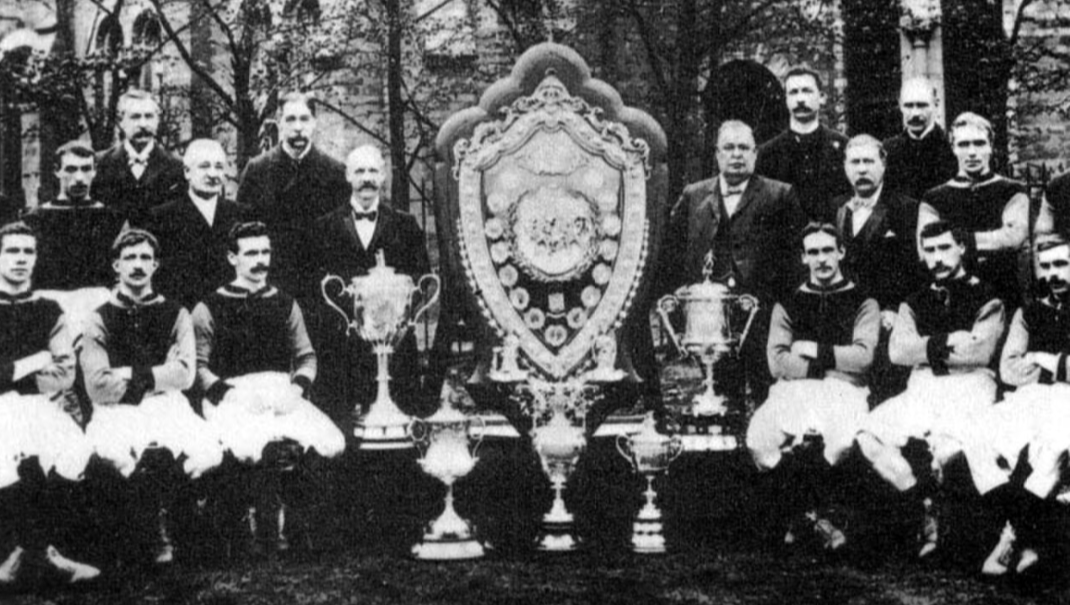

At first sight, Aston Villa and Llandrindod Wells seem to belong to very different histories. One became one of the great names of English football, rooted in the industrial and sporting world of Birmingham. The other grew rapidly as a Welsh spa town, known for its mineral waters, hotels, parks, entertainments and seasonal visitors. Yet in the early twentieth century those worlds were not nearly as separate as they might now appear. The surviving evidence reveals a small but persistent connection between Aston Villa and Llandrindod, one that began with visiting football teams and developed into a much more personal association through George Burrell Ramsay.
Ramsay was one of the most important figures in Aston Villa’s early history and one of the formative personalities in the development of organised football. His name is overwhelmingly associated with Birmingham and Villa Park, but Llandrindod Wells became a recurring part of his later life. He played bowls there, officiated at local tournaments, competed seriously on the town’s greens and, in 1935, died there. Taken together, these details amount to rather more than an incidental connection.
George Ramsay and Aston Villa
George Burrell Ramsay was born in Glasgow in 1855 and moved to Birmingham as a young man. In 1876 he encountered members of the recently established Aston Villa Football Club playing in Aston Park and was invited to join them. He soon became one of the club’s leading figures and helped shape the style of football for which Villa became known.

Ramsay belonged to the generation that helped bring a more developed passing game into English football. The Scottish game had placed greater emphasis on combination and movement, and Ramsay was among those who helped introduce those ideas to the growing football culture of the Midlands. His playing career was cut short by injury in 1882, but by then his place within Aston Villa was secure.
He moved into the administrative side of the club and became secretary, a position which in the late nineteenth and early twentieth centuries carried many of the responsibilities that would now be associated with a manager. Ramsay remained at the heart of Aston Villa for decades. During his long tenure the club won six League Championships and six FA Cups, establishing itself as one of the dominant forces in British football.
By the beginning of the twentieth century the Aston Villa name carried a reputation far beyond Birmingham. That reputation reached Llandrindod Wells.

Aston Villa comes to Llandrindod
One of the earliest surviving indications of the connection appeared in February 1905, when the Brecon County Times carried a Cambrian Railways advertisement for a “Grand Football Match” between Aston Villa and Llandrindod and District. Cheap excursion tickets were to be issued to Llandrindod Wells for the occasion.
That small advertisement is revealing. The railway company clearly thought that a team carrying the Aston Villa name was sufficiently attractive to draw people into the town. In an age when rail travel was central to Llandrindod’s economy, sport could be promoted in much the same way as the spa’s entertainments, concerts and other attractions.
It is important, however, not to overstate what the advertisement tells us. Aston Villa’s senior first team could not have been playing in Llandrindod that afternoon, because on 4 February 1905 Villa were at home to Leicester Fosse in the first round of the FA Cup, winning 5–1. The Llandrindod fixture must therefore have involved a reserve, junior or other representative Villa side.
A newspaper report from the following year helps clarify the nature of these visits. In March 1906 Llandrindod and District again faced a team connected with Aston Villa, and this time the Montgomeryshire Echo gave a much fuller account. The visitors were described, quite carefully, as “a team representing Aston Villa”.
Despite unfavourable weather, about 700 spectators attended the match. For Llandrindod, that was a considerable crowd, and it gives some sense of the attraction that the Villa name already held in Mid Wales. The home team was drawn from a wider area than the town itself, with players associated with Llandrindod, Knighton, Rhayader and neighbouring communities. The fixture was therefore genuinely representative of the district.
The visiting side won the toss and quickly began to put pressure on the home team, although the newspaper thought that Llandrindod and District had acquitted themselves creditably. Aston Villa eventually won by two goals to nil, with Penry Jones of Llandrindod acting as referee.
The significance of the match lies less in the score than in what it tells us about the sporting life of the town. Llandrindod is usually remembered through its spa culture, the hotels, mineral waters, promenades and parks that shaped its late Victorian and Edwardian identity. Yet by the beginning of the twentieth century football had also become part of its popular life. A crowd of around 700 turning out in poor weather to see a team representing Aston Villa suggests a substantial local appetite for the game.
The 1905 advertisement and the 1906 match report therefore point to a genuine, if modest, sporting relationship between Aston Villa and Llandrindod Wells before the First World War. That relationship became much more personal when George Ramsay himself began to appear in the records of the town.
Ramsay and the bowling greens
Bowls occupied a much more important place in the social life of early twentieth-century Llandrindod than might now be appreciated. The town’s bowling greens became places where local residents, regular visitors and those staying for longer periods could meet and compete. In a spa town built around health, leisure and seasonal sociability, the game fitted naturally into the wider culture of recreation.
The First World War gave that recreational landscape another purpose. Llandrindod accommodated wounded and recovering servicemen during the war years, and the town’s sporting facilities became part of their recuperation and social life. One surviving newspaper report places George Ramsay directly within that world.
The first tournament of the season on the Recreation Ground green attracted an entry of thirty-six competitors, including prominent local and visiting bowlers and a number of wounded soldiers. J. Bolton of Llanelly eventually won the competition, with Private Lees of The Orchards finishing second. W. Skym of Llanelly and Private Coady, also of The Orchards, occupied the other places.
The semi-finals were closely contested. Bolton defeated Coady 18–16, while Lees beat Skym 18–14. The final was closer still, with Bolton defeating Lees 21–20 after what the newspaper described as a particularly exciting game.
The man chosen to referee the final was George Ramsay, identified in the report as “Mr George Ramsay, the popular secretary of Aston Villa F.C.”
It is one of those small details that brings the past to life. One of the men who had helped build Aston Villa into one of the great football clubs of the age was standing on a bowling green in Llandrindod Wells, refereeing a final between a Llanelli bowler and a wounded soldier. Yet there is no reason to think that his presence seemed especially strange to those around him. Ramsay was himself a keen bowler, and by this stage Llandrindod appears to have become one of the places to which he returned.
The tournament is interesting for another reason. The wounded soldiers were not merely being entertained as spectators. They were taking part. Private Lees reached the final and Private Coady the semi-final, competing alongside experienced civilian bowlers. The game offered activity, companionship and a degree of normality within the wider disruption of wartime.
Both soldiers were described as being at The Orchards. The evidence at present does not justify describing The Orchards itself as a military hospital, and it would be wrong to turn a possibility into a fact. What can safely be said is that wounded servicemen staying there were among those taking part in Llandrindod’s wartime sporting life.
That distinction is worth keeping. Local history is often most convincing when the evidence is allowed to speak for itself.
Llandrindod in wartime
The bowling tournament also gives us a glimpse of Llandrindod at a remarkable moment in its history. Before 1914 the town had spent decades building an economy around visitors, health and leisure. The war brought a very different kind of visitor. Men came not simply to take the waters or spend a summer season, but to recover from wounds and illness.
The town was, however, unusually well suited to this new role. It already had hotels and boarding houses, parks, walks, sporting grounds and places of entertainment such as the Grand Pavilion. The same surroundings that had been promoted as beneficial to Victorian invalids and holidaymakers could now provide recovering soldiers with fresh air, occupation and company.
The bowling tournament belongs to that wider story. The scorecard preserves only a few names, but behind them was a town adapting itself to wartime circumstances. Civilian visitors and wounded servicemen shared the same green, sport continued while the war was being fought overseas, and George Ramsay was part of that local scene.
The War Memorial Tournament of 1922
Ramsay’s connection with Llandrindod did not end with the war. By 1922 he was returning not merely as an official or spectator, but as a serious competitor.
The Western Mail of 15 July 1922 reported on the Llandrindod Wells War Memorial Tournament, one of the important bowling competitions held in the town. Among those progressing through the tournament was “G. B. Ramsey (Birmingham)”, clearly George Burrell Ramsay, whose surname was rendered by the newspaper with the alternative spelling. Later in the same report he was identified as secretary of Aston Villa Football Club.
Ramsay reached the semi-final.
There he faced the local bowler Sid James, who defeated him to earn a place in the final against David Harris of Llanelli. Harris was the holder of the fifty-guinea challenge cup and had reached the final for the second successive year.
Ramsay’s progress to the last four should not be dismissed as the good fortune of a famous visitor. He had advanced through several rounds of a competitive tournament involving experienced bowlers from Llandrindod and elsewhere. His performance confirms that bowls was a genuine sporting interest, not simply a leisurely pastime taken up in retirement.
It also adds another layer to his relationship with the town. Years after appearing at a wartime tournament, he was still returning to the Llandrindod greens and competing seriously. The connection was becoming habitual.
There is something particularly appealing in the contrast. Ramsay had spent most of his adult life helping to shape Association football into one of Britain’s great spectator sports. In Llandrindod, however, he could be found taking part in the quieter sporting life of the spa town, competing alongside local Welsh bowlers rather than directing the fortunes of Aston Villa.
The War Memorial Tournament also belonged to the post-war history of Llandrindod itself. The town that had accommodated wounded soldiers during the conflict was now commemorating the war through one of its established sporting traditions. Ramsay, who had already been involved with bowls in the town during the war years, remained part of that community afterwards.
More than a passing visitor
The surviving evidence increasingly suggests that Llandrindod occupied a genuine place in Ramsay’s later life. His appearances on the bowling greens were not isolated. He officiated, competed and returned over a period of years. By 1922 he was reaching the semi-final of a significant tournament, and later accounts continued to associate him with bowls in the town.
That pattern matters because it changes the meaning of his final connection with Llandrindod. Had he simply died there during a single visit, the fact would amount to little more than a biographical curiosity. Instead, the evidence shows a sustained association.
Ramsay had spent half a century inside the highly competitive world of Aston Villa. By the time he retired as secretary in 1926, he had lived through the transformation of football from a comparatively young Victorian recreation into one of Britain’s great professional sports. Llandrindod offered something different. It was quieter, but it was not an escape from sport. Bowls gave him competition, companionship and continuity.
Ramsay’s death in Llandrindod
George Ramsay died at Llandrindod Wells on 7 October 1935, aged eighty.
His death in the town is often treated as little more than a final line in accounts of his life. That is understandable. His reputation belongs overwhelmingly to Birmingham, Aston Villa and the wider history of football. Seen from Llandrindod, however, the place of his death has a richer context.
He did not simply happen to die while passing through the town. He had been coming to Llandrindod for years. He had refereed on its bowling greens, competed in its tournaments and become part of its sporting life. By the time of his death, Llandrindod was not an accidental place on the map of his biography.
The man whose sporting life began in Glasgow and whose career was made in Birmingham ended his life in a small Welsh spa town which had become part of his later years.
Aston Villa and a Welsh spa town
The relationship between Aston Villa and Llandrindod Wells should not be exaggerated. There is no evidence that the town was ever an official Villa training base, and the early twentieth-century fixtures should not be presented as appearances by Aston Villa’s senior first team. The evidence is more interesting when it is kept within its proper limits.
In 1905 the Cambrian Railways advertised an Aston Villa versus Llandrindod and District match and issued excursion tickets for the occasion. In March 1906 a team representing Aston Villa returned and attracted about 700 spectators despite poor weather, eventually defeating Llandrindod and District by two goals to nil.
During the First World War George Ramsay appeared on a Llandrindod bowling green as referee of a tournament in which wounded soldiers competed alongside civilian bowlers. In 1922 he was himself competing seriously and reached the semi-final of the Llandrindod Wells War Memorial Tournament. His association with the town continued into later life, and in October 1935 he died there.
Taken separately, each of these facts might appear minor. Together they reveal a relationship stretching across several decades and linking one of Britain’s great football clubs with the sporting and social history of Llandrindod Wells.
They also remind us of the sort of place Llandrindod once was. The spa drew people from far beyond Radnorshire. Its hotels, railways, parks, sporting grounds and entertainments brought together local people and visitors from across Britain. Famous names and ordinary residents could share the same spaces.
George Ramsay belonged within that world. For Aston Villa supporters he remains one of the architects of their club. For Llandrindod Wells, he was also a recurring visitor, a bowler, a familiar sporting figure and, ultimately, one of the many people from elsewhere who made the Welsh spa town part of their own story.
Related Essays
- The Grand Pavilion, Llandrindod Wells, entertainment, sport, politics and public life in the town’s principal gathering place.
- The Waters That Built a Town, the mineral springs and visitor economy that created the spa to which Ramsay returned.
- Llandrindod Wells Railway Station, the railway network that brought visitors and sporting excursions into the town.
- Bryn Awel and the Glen Usk Hotel, a hotel history in which bowls remained part of Llandrindod’s visitor culture for generations.
- Tom Norton of Llandrindod Wells, motoring, enterprise, tourism and sporting promotion in the changing spa town.
- The Rock Park Hotel, the history of hospitality and reinvention beside one of Llandrindod’s principal recreational landscapes.
Sources and further reading
Brecon County Times, 3 February 1905, Cambrian Railways advertisement for the football match between Aston Villa and Llandrindod and District.
Montgomeryshire Echo, 31 March 1906, report of Llandrindod and District versus a team representing Aston Villa, including an attendance of approximately 700 spectators and Aston Villa’s 2–0 victory.
Contemporary newspaper report, “Bowls at Llandrindod”, recording the tournament at the Recreation Ground, including J. Bolton, Private Lees, W. Skym and Private Coady, with George Ramsay acting as referee.
Western Mail, 15 July 1922, report of the Llandrindod Wells War Memorial Tournament, recording George Burrell Ramsay reaching the semi-final before losing to Sid James.
Llandrindod Wells Bowling Club, historical notes on the development of bowls in the town and the use of its greens during and after the First World War.
Aston Villa historical records relating to George Burrell Ramsay, his playing career, secretaryship and role in the club’s early development.
Contemporary and later biographical accounts of George Ramsay, including his interest in bowls, his association with Llandrindod Wells and his death there on 7 October 1935.