
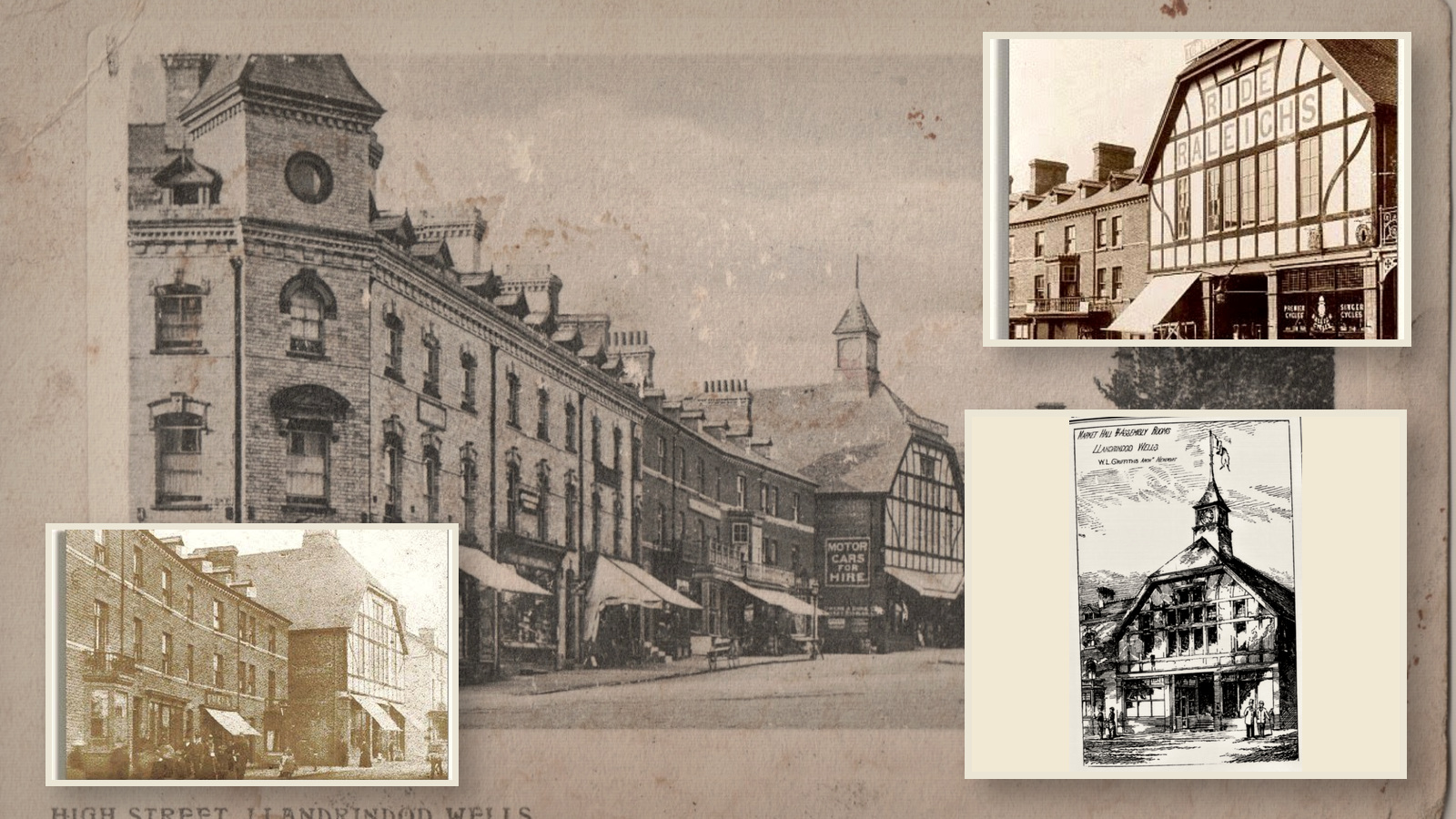
There was something slightly unusual about the Market Hall at Llandrindod Wells. In an older market town such a building might have stood at the centre of commercial life for generations. Llandrindod had no such tradition. Its Market Hall belonged to the making of the town itself. When it opened in 1872, the railway was still a recent arrival, building was spreading across the former common and the mineral springs were drawing a growing seasonal population. The hall was one of the institutions intended to turn a scattered watering place into a recognisable town.
It stood in High Street, in what became one of the busiest parts of Victorian Llandrindod. From the beginning it was more than a place of trade. The building included an Assembly Room, and over the next eighty-five years it was used for public meetings, concerts, theatre, business, political gatherings, medical treatment and community activity. Its changing uses tell us a good deal about the changing character of Llandrindod itself.
A hall for a new town
The Market Hall was being drawn into public life even before its formal opening. In April 1872, while Llandrindod was still trying to provide the basic institutions expected of a growing settlement, a meeting considering elementary education discussed the possibility of using the room above the Market Hall as a temporary schoolroom. Among those involved were Edward Middleton Evans, R. D. Green Price, Colonel Barnard, Captain Lloyd, the Rev. Tudor Thomas and Dr William Bowen Davies.
The formal opening followed on Wednesday 12 June 1872, when an amateur concert was held in the new Assembly Room. The programme included Rule Britannia, Men of Harlech and God Save the Queen, with D. Buallt Jones conducting. It was an appropriate beginning. Although the building was called a Market Hall, the room above it immediately gave the young town somewhere to gather.
The original Llandrindod Market Hall Company was registered in June 1872 with nominal capital of £600, divided into 120 shares of £5. It was a modest undertaking and very much part of the way early Llandrindod developed. Hotels, shops, houses and public facilities appeared through a mixture of local initiative and private investment rather than through a single municipal plan.
The Assembly Room soon became useful for much more than entertainment. On 21 August 1877 a well-attended public meeting was held there to advance the proposed Llandrindod Wells Cottage Hospital and Convalescent Home. Edward Middleton Evans became chairman of the committee and Dr William Bowen Davies its honorary secretary. By then £712 had been promised in donations and £128 in annual subscriptions. One of the institutions which later became central to the town was therefore organised, in part, within the Market Hall complex. The story is considered more fully in my essay Llandrindod Wells Hospital: From Cottage Hospital to County War Memorial.
Trying to establish a market
The commercial purpose of the building was genuine. In November 1878 it was announced that the hall would open every Tuesday for the sale of live and dead poultry, butter, hams, bacon and other agricultural produce. The first of these markets was held on 12 November, and prospective customers were told that several dealers intended to attend.
The idea made sense. Llandrindod stood within a strongly agricultural district, while the spa was creating a new concentration of hotels, lodging houses, visitors and permanent residents who all needed to be supplied. A produce market could connect the surrounding farms with the new economy developing around the wells and railway.
Yet the first company did not prosper for long. In May 1879 a notice appeared concerning the winding-up of the Llandrindod Market Hall Company Limited. The surviving material does not yet explain the failure in detail, nor does it make entirely clear how ownership of the property passed afterwards. The building itself remained in use, however, and the Assembly Room continued to serve the town.
By 1880 it was being used for lectures and light entertainments during the visitor season. This was a period when Llandrindod could look impressive and unfinished at the same time. The South Wales Daily News reported a particularly large influx of visitors that September, but also criticised the roads and footpaths and complained of neglected sanitary arrangements. The town was attracting people faster than some of its public services were developing. The Market Hall belonged to that early, improvised phase of Llandrindod, ambitious, useful and still adapting to circumstances.
The rebuilding of 1891
By the early 1890s Llandrindod was a much more substantial resort. In May 1891 the Llandrindod Wells Market and Public Hall Company Limited was formed with nominal capital of £15,000 in £5 shares. Its purpose was to acquire the freehold High Street property known as the Llandrindod Wells Market and continue the enterprise. The difference between the £600 company of 1872 and the £15,000 concern of 1891 says something in itself about the growth of the town during those nineteen years.
Later that year the Market Hall was partially rebuilt and enlarged. The architectural drawing names W. L. Griffiths of Newport as architect. The remodelled frontage, with its prominent half-timbering, gave the building a distinctive appearance in High Street, while the Market Hall and Assembly Rooms were now substantial enough to attract attention in the architectural press. This was not a completely new building replacing that of 1872, but a major enlargement and remodelling of the existing premises.
Old photographs show how conspicuous it became. The tall gable and dark timbering stood out against the adjoining brick terraces, and later photographs associated with the cycle trade show the frontage covered with commercial lettering. The building had become one of the recognisable landmarks of High Street.
Politics, theatre and public life
The enlarged Assembly Rooms gave Llandrindod something the growing town badly needed, a sizeable indoor meeting place. Political meetings were among the many events held there. On 6 June 1892 a demonstration concerning Welsh Disestablishment brought together figures including Stuart Rendel, S. T. Evans and Frank Edwards, with S. C. Evans-Williams in the chair. A Liberal county gathering followed two years later.
The same room could be theatrical rather than political. In July 1898 the Evans-Ellis Company, led by Rothbury Evans, appeared there for six nights and a matinee, performing plays including East Lynne, The Bells and The Private Secretary. Different admission prices and gallery accommodation show that this was no longer simply a room used when nothing better was available. The Assembly Rooms had become part of the entertainment life of the spa.
By this stage the name “Market Hall” concealed how varied the building’s actual life had become. Commerce remained part of it, but public meetings, entertainments and rented business premises were at least as important.
Tom Norton and the cycle years
One of the best-known occupants was Tom Norton, who established his cycle and sporting-goods business in rented premises within the Old Market Hall and Assembly Rooms complex in 1898. It was a well-chosen location. Cycling had become enormously popular, and a resort full of visitors offered a ready market for machines, repairs, storage and accessories.
By 1899 Norton was advertising storage for as many as 200 bicycles. Photographs of the building from this period show how thoroughly the frontage had been absorbed into the cycle trade, with Raleigh advertising dominating the gable. Building-control records also record alterations associated with Norton and, in 1905, an application for a verandah in front of the Old Market Hall. The history of the building had moved a long way from the weekly sale of poultry, butter and bacon.
Curiously, while the old Market Hall continued to stand, Llandrindod seems to have lost the very facility its name implied. In September 1908 Joseph Hall complained about the lack of proper accommodation for people bringing poultry, eggs and vegetables into the town. During the season they came in daily, but in poor weather there was little shelter. Hall described women becoming so wet that they had taken refuge in a resident’s kitchen to dry their clothes. The report does not state in so many words that the former Market Hall was unavailable to them, but by then its original purpose had plainly become secondary.
The High Street Baths
In 1909 the building changed again. Norton’s occupation was ending, and plans were made to turn the premises into a modern treatment establishment. An auction of his furniture was advertised at the Assembly Rooms in March, and the following month details appeared of the proposed High Street Baths.
The treatments belonged very much to the Edwardian spa world. They included Aix and Vichy douches and massage, Plombières treatment, liver packs, peat treatment, electrically generated hot air, an electric cabinet, an arc lamp and X-ray equipment. Modern medicine would view some of the claims then made for spa treatment very differently, but the list shows how determined Llandrindod was to present itself as a modern health resort rather than a place relying only upon the drinking of mineral water.
The High Street Baths opened in 1909. A building first intended to bring agricultural produce into the new town had, within less than forty years, become part of the medical and therapeutic machinery of the spa. This development belongs beside the wider story of the mineral springs, considered in The Waters That Built a Town.
The conversion did not entirely erase the building’s older public role. On 23 February 1912 the lounge of the High Street Baths was used for the meeting which established the Radnor County Bowling Club. Tom Norton presided, Captain J. Gibson-Watt became president, and George Baillie was among those associated with the new organisation. The choice of venue is worth noting. Three years after the old Market Hall had been turned into a treatment centre, people were still using it as somewhere to conduct the business of the town.
By the later 1920s the High Street Baths formed part of a much wider spa establishment. Contemporary guides described four pump rooms and treatment facilities spread between High Street, Rock Park and the Recreation Ground. Baths and massage were now offered alongside X-rays, electrical treatment, heat and light therapies. Visitors could therefore move between drinking the mineral waters and receiving an increasingly elaborate range of treatments. The old Market Hall had become one component in a much larger health industry.
From private enterprise to municipal ownership
A further change came in the 1920s. At an extraordinary meeting of Llandrindod Wells Springs Limited on 18 November 1925, shareholders approved the sale to Llandrindod Wells Urban District Council of important spa assets, including Rock Park, its waters and baths, together with the High Street Baths. Tom Norton, by then a justice of the peace and an established figure in public life, was in the chair, while Sir Thomas O. Jones KBE moved the relevant resolution.
The transfer reflected the wider development of the town. Victorian Llandrindod had grown through companies, hotel proprietors, landowners and individual entrepreneurs. By the interwar period the Urban District Council had become increasingly involved in services and amenities which affected the whole resort. The old Market Hall was now part of the municipal spa establishment. That transition is also part of the wider story told in From Spa Town to Administrative Capital.
There is a broader pattern here. The first Market Hall had belonged to the improvised private enterprise of the new Victorian resort. The enlarged building of the 1890s belonged to a more confident commercial town. Under the council, the same premises became part of the municipal machinery by which Llandrindod tried to maintain and modernise its position as a spa.
War, community and the fire of 1957
The building found another use during the Second World War. Between 1942 and 1946 the premises served as a British Restaurant, providing inexpensive meals during years of rationing and disruption. It was another practical adaptation of a building which had already survived several changes of purpose.
After the war, rooms were used by local organisations, including Llandrindod Wells Silver Band, the Youth Club and the Male Voice Choir. These were not simply incidental tenants. By the 1950s the old spa premises had become part of the everyday community life of the town. There was also a neat, if accidental, continuity. The Assembly Room had opened in 1872 with an amateur concert. More than eighty years later music was still being made within the same complex.
That long history ended in March 1957 when the High Street Baths were destroyed by fire. Contemporary reporting did not establish a clear cause. The organisations using the premises lost equipment and instruments, while the destruction also left the council with a practical problem. Treatments which had been provided in High Street still had patients who required them, and attention turned again towards Rock Park, including the possibility of using the Winter Gardens.
In the longer term the centre of Llandrindod’s surviving spa treatment shifted back towards Rock Park. Treatment continued there until 1972, when physiotherapy provision at the hospital brought another stage in the medical history of the resort to an end. The destruction of the High Street building therefore did not instantly end spa treatment in Llandrindod, but it removed one of the principal places in which that treatment had been provided for almost half a century.
A building which changed with Llandrindod
The old Market Hall is interesting because it never remained what its founders intended it to be. It began as a market with an Assembly Room above, and very quickly became useful for almost anything the young town lacked. A schoolroom was considered there, the cottage hospital movement met there, agricultural produce was sold there, politicians spoke there, actors performed there and Tom Norton built part of his early business there. Later came hydrotherapy, municipal ownership, wartime meals, choirs and youth organisations.
Its history also follows the different stages through which Llandrindod passed. At first there was the private enterprise and improvisation of a new Victorian resort. Then came the larger commercial spa of the late nineteenth and early twentieth centuries, confident enough to rebuild, advertise and invest in increasingly elaborate treatments. Finally came the municipal and community town, in which the council owned the baths and local organisations filled rooms once intended for visitors and traders.
The Market Hall lasted from the first great years of expansion after the railway arrived until well into the post-war period. By the time fire destroyed it in 1957, the small watering place for which it had been built had long disappeared. The building had survived because Llandrindod kept finding another use for it. What began with poultry, butter, public meetings and an upstairs concert hall ended with spa patients, wartime meals, a silver band, a youth club and a male voice choir.
Few surviving records tell the story of Llandrindod quite so neatly. For eighty-five years, much of the changing life of the town passed through this one High Street building.
Related Essays
- A Town Marked Out on the Common: The Making of Llandrindod Wells
- The Waters That Built a Town: Rock Park, the Mineral Springs and the Making of Llandrindod Wells
- Tom Norton of Llandrindod Wells: The Man Behind the Automobile Palace
- Bowling in Llandrindod Wells: From the Spa Greens to Rock Park and the Indoor Game
Explore more Llandrindod Wells history
Continue with the Llandrindod Wells History guide, or follow the related essays above to explore the people, buildings and institutions that shaped the town.
Receive new historical essays by email
For new essays on Welsh history, biography, genealogy and rural community life, subscribe on the homepage.
Sources and Further Reading
This essay draws principally upon contemporary newspaper reports and company notices, including the Montgomeryshire Express, 30 April 1872; Wellington Journal, 15 June 1872; Echo, 15 June 1872; Hereford Times, 16 November 1878; Wrexham Guardian and Denbighshire and Flintshire Advertiser, 17 May 1879; South Wales Daily News, 21 September 1880; Financial News, 14 May 1891; Building News, 18 September 1891; Radnor Express, 10 September 1908; Radnorshire Standard, 27 February and 3 April 1909; Hereford Times, 2 March 1912; and Western Mail, 18 November 1925. Contemporary Llandrindod guidebooks of the later 1920s have also been used for the range of spa facilities and treatments. The early hospital meeting is discussed by R. C. B. Oliver in “Llandrindod Wells Hospital: Its Beginnings and Early Years”, Transactions of the Radnorshire Society, vol. LI, 1981. Contemporary local reporting has also been used for the British Restaurant period, the 1957 fire and the subsequent concentration of treatment at Rock Park.