
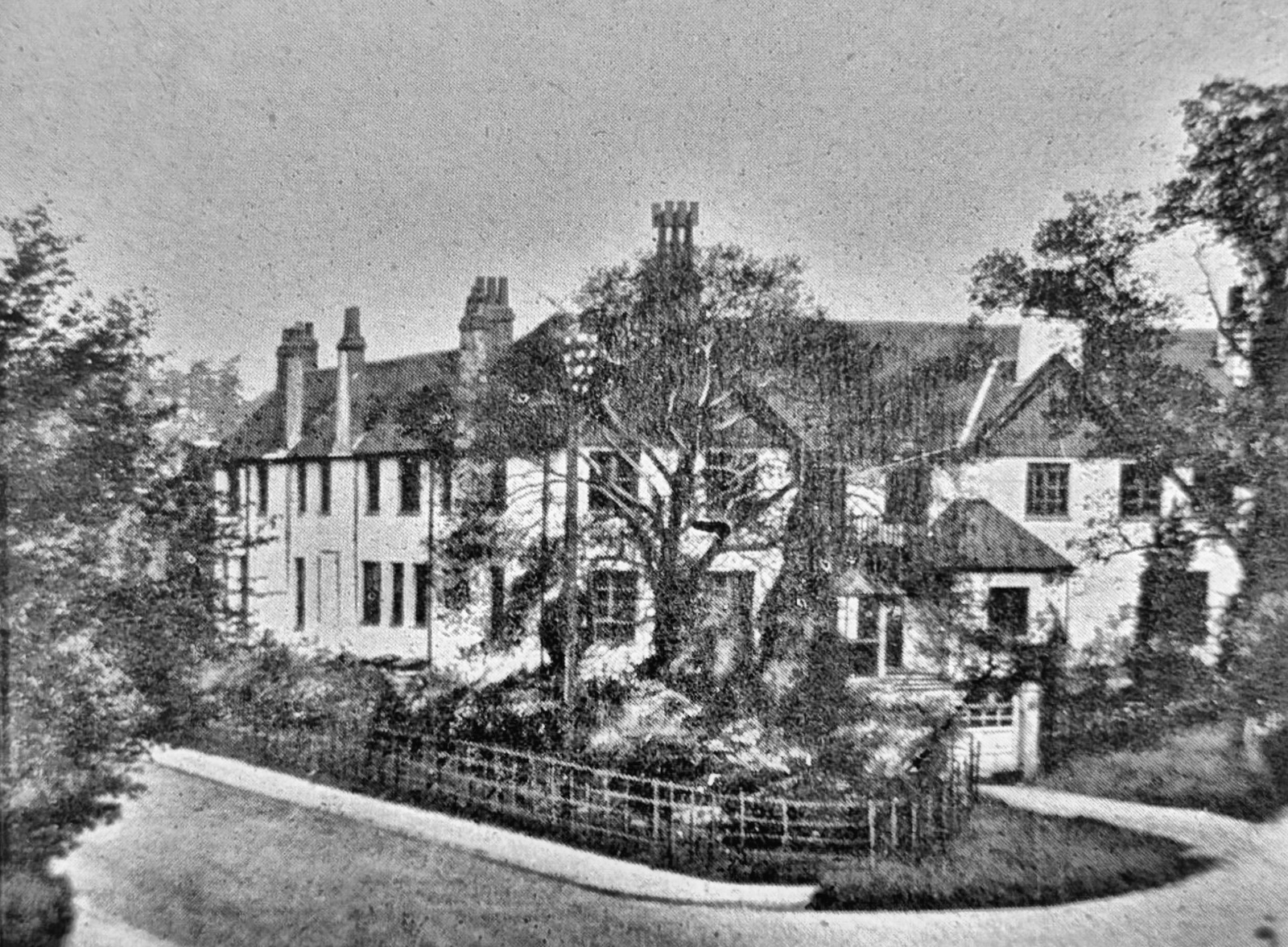
Few buildings in Llandrindod Wells have passed through as many different lives as the former Radnorshire County Club. Standing at the junction of Beaufort Road and Cefnllys Lane, it began as an ambitious Edwardian institution intended for the social life of the county. Within little more than five years its rooms were occupied by wounded soldiers. It later became a hotel, survived another period of wartime disruption, and eventually entered public ownership as the headquarters of the Radnorshire library service. More than a century after its construction, the building was again in the news following a serious fire in June 2026.
Its history is therefore about considerably more than one house. The County Club belongs to the period when Llandrindod was expanding rapidly beyond its Victorian spa centre, but its changing uses also reflect wider changes in Radnorshire itself. The world of private county sociability which produced it in 1909 was followed by war, a changing hotel trade, the growth of local government and the expansion of public cultural services. Much of that story can now be reconstructed in unusual detail from newspapers, building plans and surviving local authority records.
A new club for Edwardian Radnorshire
The ground upon which the County Club was built formed part of the continuing Edwardian expansion of Llandrindod Wells. In May 1908 more than eleven acres of the former Middleton Evans Estate between Beaufort Road and Gorse Lane, later Cefnllys Lane, were conveyed for £5,000 to Evan Bufton, auctioneer, James Edwards, builder, Walter Scott Deakin, architect, and Archibald Lindsay Careless, solicitor. The conveyance referred to the proposed Beaufort Road and specifically included land on which the later library headquarters would stand. By December the same men were conveying plots from what was described as the Llandrindod Wells Building Estate. The County Club was therefore one element in a larger expansion of the town rather than an isolated development.
The man principally responsible for the club itself was Major H. G. W. Gordon of Howey Hall. A substantial illustrated article in the Radnorshire Standard of 24 July 1909 described him as the proprietor and explained that, after coming to live in Radnorshire some five or six years earlier, he had recognised what he believed to be the need for a county club. The scheme was allowed to develop gradually until sufficient support had been obtained.
Construction proceeded with remarkable speed. The first sod was cut on 9 January 1909 and the building was completed on 9 June. The architect was Glendinning Moxham, FRIBA, of Swansea, while the contractors were Messrs Hughes and Stirling of London and Liverpool. Only six months later further additions were being proposed for Gordon, the Llandrindod Wells Urban District Council plans recording work at the Radnorshire County Club on 10 December 1909.
The intentions behind the new institution were set out clearly in the contemporary account. It was formed for gentlemen interested in the county of Radnor, together with those concerned with arts, science, letters or sport, and was expressly described as social and non-political. The wording tells us much about the world in which it was created. This was an establishment rooted in the male professional, landed and sporting society of Edwardian Radnorshire, yet it aspired to something broader than a place for dining and drinking. Culture, learning and county life were part of its stated purpose.
Its physical scale matched those ambitions. The principal feature was an impressive entrance hall extending through two floors, with a gallery and staircase leading towards the upper accommodation. Members had use of a dining room, reading room, card room and billiard room, while bedrooms allowed the club to function as a residential establishment. Servants’ accommodation and domestic offices were incorporated into the building, and contemporary descriptions emphasised its modern fittings. The Army and Navy Stores furnished the premises, placing the new County Club unmistakably within the comfortable, metropolitan world to which its founders aspired.
That combination of public rooms and bedrooms was important. The County Club was not merely somewhere local men gathered for an occasional dinner. It had much in common with the residential clubs found in larger towns and cities, adapted to the circumstances of a small Welsh county whose administrative and social life was increasingly centred upon Llandrindod.
The club also fitted naturally into the life of the spa. On 1 June 1910 the Morning Post, describing Llandrindod to golfers, anglers and visitors, noted that approved visitors could obtain temporary membership by applying to Major Gordon, by then described as honorary secretary. Membership was therefore selective, but not confined to permanent residents. A visitor staying at one of Llandrindod’s principal hotels could, if approved, enter the social life of the County Club during his stay.
That arrangement helps explain why such an institution belonged in Llandrindod. The town brought together two groups which otherwise might rarely have met on the same terms, the county families, officials and professional men of Radnorshire, and the prosperous seasonal population attracted by the waters, golf, fishing and hotels. The County Club stood somewhere between those worlds.
An ambitious house and a short first chapter
The first phase of the County Club was shorter than its confident opening suggested.
In October 1912, barely three and a half years after completion, auctioneer R. A. Campbell announced an “exceptionally important” sale of furniture at the County Club on the instructions of Major Gordon. The sale was sufficiently substantial to occupy three days, 9, 10 and 11 October.
The reason was not stated and should not be invented. It may have accompanied changes in management, ownership or furnishing, but the surviving advertisement does not say that the club closed. What is clear is that something significant was happening to Gordon’s original establishment.
Less than a year later the freehold itself was on the market. On 23 September 1913 Messrs Bufton and Son offered the Radnorshire County Club at the Hotel Metropole. The property, explicitly situated on Beaufort Road, was offered at £2,700 but withdrawn. The sale particulars described an entrance hall, dining room, several entertaining rooms, billiard room, bedroom accommodation and bathrooms, together with an adjoining building site.
The attempt to dispose of the premises before the First World War is important. It prevents us from assuming that the war alone brought the original club arrangements to an end. The building’s future was already uncertain by 1912 and 1913.
Yet it remained in private ownership when European war arrived in August 1914, and its size and internal arrangement suddenly made it useful for an entirely different purpose.
War comes to the County Club
The transformation was rapid.
On 28 October 1914 the Daily Telegraph & Courier reported that more than fifty wounded Belgian soldiers were expected in Llandrindod and that accommodation had been arranged at the Cottage Hospital and at the County Club, which had been fitted up as a convalescent home.
The following day’s Liverpool Daily Post recorded what had happened. Forty wounded Belgian soldiers had arrived on the evening of 28 October and had received a hearty welcome. They were divided between the Cottage Hospital, the Nursing Home and the County Club. The local branch of the Red Cross Association had fitted the latter building as a convalescent home and had assumed responsibility for thirty men accommodated there.
Within five years, rooms designed for dining, reading, cards and billiards had become part of a wartime medical establishment.
The fullest early account appeared in the South Wales Daily News on 16 November 1914. It described the hospital as occupying the spacious premises of the County Club and reported a local claim that it might have been the first Red Cross hospital established in Wales. That claim should be treated as precisely that, a contemporary claim rather than an established national distinction, but the remainder of the report gives a valuable picture of the operation.
The local Red Cross committee had assembled everything required to equip the hospital and had accepted responsibility for what the newspaper called a heavy rent. Local Red Cross nurses took duty in rotation. The hospital had, according to the report, given complete satisfaction to the military authorities, and formal recognition as a War Office hospital was expected.
It was also no longer caring only for Belgians. By mid-November the County Club had been practically full of both British and Belgian wounded soldiers since the first arrivals on 28 October. Across the County Club, Nursing Home and Cottage Hospital, the number of wounded men accommodated in Llandrindod had reached seventy-one, with fifty-six present when the article was published.
The wartime use did not remain static. In 1915 the Red Cross established a hospital at Highland Moors after the County Club was commandeered by the Royal Army Medical Corps. The change formed part of the much larger military presence in Llandrindod during the war.
The adaptability of the building is striking. Its large public rooms, bedrooms, service areas and substantial domestic accommodation had originally been created for comfort and sociability. Those same features allowed it to be turned rapidly to medical and military purposes when circumstances demanded.
The club’s original staff should not be forgotten either. One identifiable employee was Fred Shopland, a young Llandrindod man who worked at the County Club before entering railway employment and later losing his life during the war. His story is a reminder that behind the polished rooms and club membership stood a much less visible workforce of servants and employees.
The war therefore gave the County Club a place in Llandrindod’s social history which Major Gordon could hardly have imagined when construction began in January 1909.
Sale and the inter-war years
The building returned to the market soon after the war.
On 28 June 1919 the Western Mail reported the sale of the freehold Radnorshire County Club. The property was offered at the Hotel Metropole and was described on a scale which leaves no doubt about the size of the establishment. There were five reception rooms, a billiard room, twenty-five bedrooms, three bathrooms, a servants’ hall, steward’s room, housekeeper’s rooms, kitchens and other offices. An adjoining freehold building site was included.
Bidding began at £2,000 and rose to £3,000 before the property was subsequently sold for £3,575.
Who bought it remains one of the unresolved points in the story, but building records begin to suggest the new direction. In March 1920 alterations were proposed for D. L. Smith, while in June 1927 additional accommodation was planned at the County Club for Mrs Bryan Smith.
The latter name is particularly significant. Mary Bryan Smith was already one of the best-known figures in the Llandrindod hotel world, associated with Montpellier and later Ye Wells. In December 1926 she was still formally described as being of Ye Wells Hotel, yet within six months work was being proposed at the County Club for a Mrs Bryan Smith. By 1948 the connection had become explicit. Her obituary in the Western Mail gave her address as the Old County Club, Llandrindod Wells.
Mary Bryan Smith’s precise legal interest in the property has still to be established. It would be unwise to say that she purchased it in 1927 without documentary proof. What can be said is that her association with it was substantial and prolonged. The inter-war records also include a Smith giving his or her address as “The County Club, Cefnllys Road”, while other probate addresses show that the name “Old County Club” was already in use during the 1930s.
Mary’s connection is important because it links the building with one of the most prominent women in Llandrindod’s twentieth-century civic and hotel history. Her 1948 obituary recalled service as secretary of the Cottage Hospital, former presidency of the Llandrindod Wells Development Association, membership of the Welsh Scout Council and the presidency of the local Boy Scout Association. The County Club had begun as a gentlemen’s institution, but by the inter-war years its story had become entwined with one of the town’s leading female public figures.
From club to hotel
By the Second World War the building had acquired a commercial identity.
Wartime accounts record the County Club among Llandrindod properties commandeered during 1940, but the position was evidently more complicated than continuous military occupation. On 25 April 1941 the Western Mail carried a staff advertisement directing applicants to “Mrs Careless, County Club Hotel, Llandrindod Wells”.
That establishes the hotel use considerably earlier than the post-war advertisements once suggested. Mrs Careless has not yet been conclusively identified. The surname is nevertheless intriguing because the Careless family had long-standing professional connections with Llandrindod, and Archibald Lindsay Careless had been one of the purchasers of the larger building estate in 1908.
By November 1948 Mary Bryan Smith was living at the Old County Club. Ground-floor alterations followed in 1949, and by March 1951 the Western Mail was advertising the Old County Club Hotel as offering modern comfort and excellent food.
The hotel settled into a quieter post-war identity. An advertisement of March 1956 described it as standing in its own grounds only a few minutes’ walk from the town centre. It promised good food and every comfort in pleasant and homely surroundings and emphasised that the establishment remained open throughout the year.
The language was a long way from that of 1909. There was no longer talk of gentlemen interested in science, letters and sport, nor of approved temporary members. The emphasis was now upon food, comfort and hospitality.
Yet the physical inheritance of the old club remained. It had been built from the beginning with extensive bedrooms, reception rooms and domestic accommodation, so its conversion into a hotel was not as radical as the change in name might imply.
The scale of the business can be seen clearly in advertisements from the 1960s. In June 1966 the Old County Club House Hotel was offered for sale as a going concern. It had twenty letting rooms, each with a washbasin, a dining room seating forty-five, three reception rooms, a cocktail bar, domestic offices and a self-contained managerial suite. The building stood in its own well-kept grounds, close to the centre but marketed as secluded.
The attempt to sell the operating business appears not to have settled matters. In July 1967 the property was again advertised, this time for auction on 18 August. The advertisement described a freehold private hotel at the junction of Beaufort Road and Cefnllys Lane and offered vacant possession on completion. Its twenty bedrooms, two lounges, cocktail bar, dining room and gardens were accompanied by much of the antique and modern furniture.
By the summer of 1968 the hotel era had effectively reached its end. On 10 and 11 July Campbell & Edwards conducted a two-day sale of the contents of the County Club Hotel. China, glassware, silver plate, brass, copper and pewter were sold alongside lounge, dining-room and bedroom furniture, carpets, bed linen and table linen. A printed catalogue was available for one shilling.
It must have been a substantial dispersal. The rooms which had been furnished for an Edwardian county club, adapted for wartime patients and later used by generations of hotel guests were being emptied.
From private club to public library
Three months later the future of the building was becoming clear.
On 23 October 1968 the Liverpool Daily Post reported that Radnorshire County Council was to acquire the former County Club Hotel for £12,000 as the new headquarters of the county library service. A further £30,000 was expected to be spent upon conversion and furnishing. Surviving County Council records confirm files relating to the purchase and conversion of the Beaufort Road property into the county library headquarters and Llandrindod branch library.
The 1968 newspaper report referred to a proposed library and museum. In practice the arrangement developed differently. The former Carnegie Library became increasingly associated with the museum, while the County Club was converted for library use.
The official opening of the new county library headquarters and Llandrindod branch library took place on 22 September 1971, an event for which the programme survives among the Radnorshire County Council education records.
The change in use was profound. In 1909 entry had depended upon membership or approval. In 1971 the same building was being used for a public library service. It would be too neat to present this as some predetermined progression from exclusivity to democracy, but the contrast is nevertheless revealing. Radnorshire society had changed enormously during the intervening sixty years, and the uses found for the building changed with it.
There was also a curious continuity. Major Gordon’s original club had declared an interest in arts, science and letters. More than half a century later the building was once again associated with books, knowledge and cultural life, although now in the service of the wider public.
The library remained on Beaufort Road for more than four decades. By February 2015 council minutes referred to the recent opening of the relocated Llandrindod Library at the Gwalia Building. Other contemporary accounts place the relocation project in 2014, so the move appears to have taken place during 2014 and early 2015.
The library itself has since moved again. It left the Gwalia in December 2024 and reopened on 6 January 2025 on the ground floor of the Radnorshire Museum building in Temple Street.
The old County Club after the library
The former County Club survived the departure of the library, still recognisable as the building created in 1909 despite more than a century of adaptation. The Royal Commission photographed the Old County Club House from the air on 30 June 2015, providing a useful record of the site immediately after its long period of library use.
A far more serious event followed in June 2026.
At about 11.20pm on Saturday 20 June, emergency services were called to a fire at the former Llandrindod Wells Library. Ten fire crews attended and dealt with multiple fires inside the building. Dyfed-Powys Police subsequently confirmed that enquiries into the cause were taking place. No later public report establishing a definitive cause has been identified at the time of writing.
The fire added another chapter to an already extraordinary building history. The County Club had been conceived at the height of Edwardian Llandrindod, when the town was still expanding rapidly and confidence in its future as a spa and county centre remained strong. It had welcomed members and approved visitors, housed wounded Belgian and British soldiers, accommodated hotel guests and eventually provided books and library services to generations of local residents.
Its survival through those changes is itself significant. Buildings of this kind often outlive the institutions for which they were created because their size, position and internal arrangements allow each generation to find a new use for them. The Radnorshire County Club was never simply one thing for very long.
Major Gordon could scarcely have imagined in January 1909 what lay ahead. Within five years his new club was a Red Cross hospital. Within a generation it was moving towards hotel use. Within sixty years it had passed into public ownership, and for more than forty years afterwards it served the county as a library.
That long sequence makes the old County Club one of the more revealing surviving witnesses to the changing social history of Llandrindod Wells. Its story begins with the confidence and exclusivity of Edwardian county society, but extends through war, hospitality, local government and public culture. Few buildings in the town have served so many different communities, or reflected so clearly the changing character of Radnorshire across more than a century.
Related Essays
- Llandrindod Wells Hospital: From Cottage Hospital to County War Memorial
- Howey Hall: The Changing Life of a Radnorshire Country House
- Ye Wells, Llandrindod Wells: The Many Lives of a Spa Landmark
- The Montpellier Hotel, Llandrindod Wells
- From Spa Town to Administrative Capital: Civic Government and the Making of Llandrindod Wells
- A Town Marked Out on the Common: The Making of Llandrindod Wells
Explore more Llandrindod Wells and Radnorshire history
Continue with the Llandrindod Wells History, Radnorshire History and Victorian & Edwardian Wales guides, or browse the related essays above.
Sources and Further Reading
The principal contemporary newspaper sources used for this history include the Radnorshire Standard, 24 July 1909, for the illustrated account of the newly completed club; the Morning Post, 1 June 1910, for temporary membership arrangements; the Hereford Times, 5 October 1912, for Major Gordon’s furniture sale; the Western Mail, 25 September 1913, for the attempted sale of the freehold; the Daily Telegraph & Courier, 28 October 1914, the Liverpool Daily Post, 29 October 1914, and the South Wales Daily News, 16 November 1914, for the conversion of the premises into a Red Cross hospital and the reception of wounded Belgian and British soldiers; the Western Mail, 28 June 1919, for the post-war sale; the Western Mail, 25 April 1941 and 25 November 1948, for the hotel and Mary Bryan Smith connections; the Western Mail, 10 March 1956, for the post-war hotel; the Coventry Evening Telegraph, 18 June 1966, and Birmingham Daily Post, 29 July 1967, for later sale particulars; the Wellington Journal, 28 June 1968, for the dispersal of the hotel contents; and the Liverpool Daily Post, Welsh edition, 23 October 1968, for the proposed County Council purchase and conversion.
Powys Archives catalogues provide important additional evidence for the 1908 Llandrindod Wells Building Estate, the 1909, 1920, 1927 and later building works, the County Council purchase and conversion, and the official opening of the library headquarters on 22 September 1971. Further contextual material comes from History Points, Coflein, Powys County Council records and contemporary reporting of the June 2026 fire.