
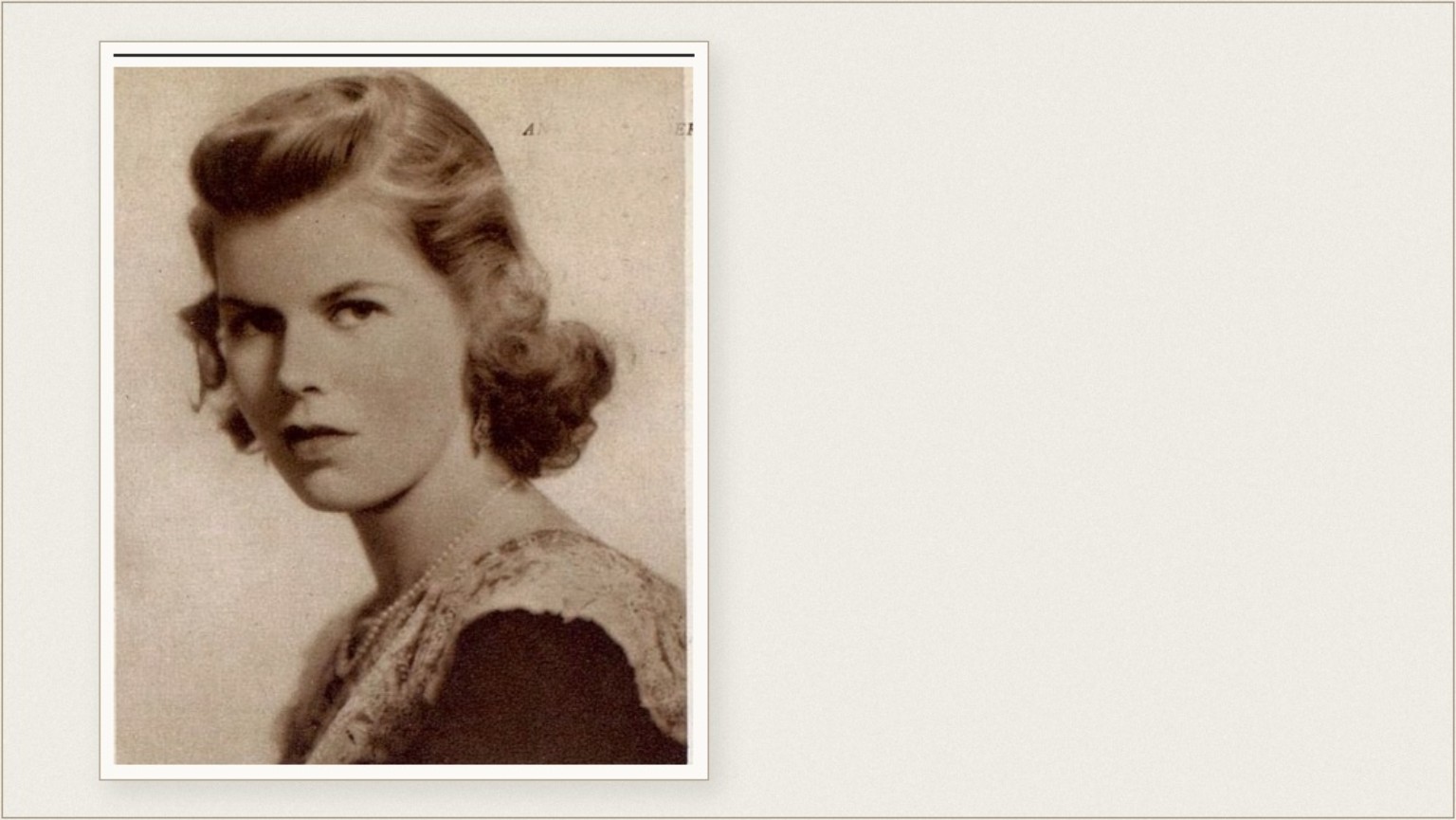
Diana Hambro was born on 27 January 1922, the second daughter of Sir Charles Jocelyn Hambro and his first wife, Pamela Cobbold. Through both sides of her family she belonged to a world of banking, landed property and public service, but the bare facts of ancestry and marriage conceal a much more interesting life. Diana experienced early bereavement, undertook hospital nursing during the Second World War, married a serving Welsh Guards officer while still only nineteen, endured the loss of her first child, and spent almost sixty years associated with Doldowlod in Radnorshire. There she became identified not only with her husband’s public career, but with the gardens, livestock and daily life of the estate itself.
Family, loss and inheritance
Her father, Charles Hambro, belonged to the prominent Hambro banking family. He had served during the First World War and received the Military Cross. In 1928 he became a director of the Bank of England, and during the Second World War he moved into the highest levels of Britain’s clandestine wartime organisation, heading the Special Operations Executive from 1942 until 1943. Diana therefore grew up in a family in which finance, public service and national affairs were part of the ordinary background of life.
Her mother’s family was equally distinctive. Pamela Hambro had been born Pamela Cobbold, daughter of John Dupuis Cobbold and Lady Evelyn Murray. Diana’s maternal grandmother, Lady Evelyn Cobbold, was a traveller and writer who developed a deep attachment to Islam and in 1933 undertook the Hajj to Mecca. She is widely recorded as the first British-born Muslim woman to make the pilgrimage. There is no evidence that Diana shared her grandmother’s religious outlook, but the connection is an important part of the family background into which she was born.
Diana’s childhood was marked by a profound loss. Her mother died in 1932, when Diana was ten. Jane Dismore’s account of Pamela Hambro’s final illness records that she developed septicaemia after being kicked by one of her hunters and subsequently contracted pneumonia. The children were themselves in quarantine with whooping cough. Dismore also records that the daughters’ final sight of their mother was through a bedroom window, reached by ladder because they could not enter the house normally. It is a striking detail, and one which should be understood as coming from the surviving family account rather than from Diana’s own later testimony.
Nursing and a wartime marriage
By 1941 Diana was beginning to appear in her own right in the contemporary press. A portrait published in The Tatler and Bystander on 30 April that year stated that Diana Hambro was “nursing at a hospital somewhere in England”. The precise hospital and the capacity in which she served have not yet been identified, so it would be unsafe to assign her to a particular nursing organisation or to describe her as a professionally qualified nurse. What the contemporary caption does establish is that she was undertaking nursing work in a hospital during the war.

Less than nine months later, on 10 January 1942, Diana married Lieutenant James David Gibson-Watt of the Welsh Guards at the Royal Military Chapel, Wellington Barracks. A surviving wedding photograph shows David in uniform beside his young bride. Genealogical sources derived from Burke’s Peerage and the Cobbold Family History Trust give Diana’s birth date as 27 January 1922, which means that she was still nineteen and only seventeen days short of her twentieth birthday. A contemporary society report described her as “not yet nineteen”; on the evidence presently available, that appears to have been a simple reporting error.

The marriage also joined families whose connections already crossed through the Cobbold world. Contemporary reporting in The Queen noted that David’s sister Patricia had married Robert Nevill Cobbold in 1935, a member of the same Suffolk family from which Diana’s mother came. The association became closer still in 1951 when Diana’s younger sister Pamela, known as Pammie, married David’s younger brother Andrew Gibson-Watt. These connections are worth noting, but they should not obscure the individuals themselves.
The timing of Diana and David’s marriage gave their early married life a seriousness which can easily be lost beneath the society photographs. David remained on active service with the Welsh Guards and fought in North Africa and Italy. The Dictionary of Welsh Biography records that he was wounded in Tunisia and received the Military Cross, later gaining two Bars for further acts of leadership in Italy. Diana’s father, meanwhile, was moving into the leadership of the Special Operations Executive. Diana herself had already been nursing in a hospital. Their marriage began not in the comfortable rhythm of peacetime country-house life, but against the background of mobilisation, military service and uncertainty.
Their first son, Jamie, was born on 29 March 1943. He died on 24 October 1946, aged three. The loss came just as David’s military career was ending and the family was beginning what might otherwise have been expected to become a more settled post-war life at Doldowlod. Diana had already lost her mother as a child. She now experienced the death of a child of her own. It would be wrong to speculate about feelings she did not record publicly, but any account of her life which omitted these bereavements would be incomplete.
Doldowlod, garden and estate
Doldowlod became the centre of Diana’s adult life. The estate had long been associated with the Watt and Gibson-Watt family, and David was proud of his descent from James Watt. For Diana, however, Doldowlod was not simply a historic inheritance into which she had married. It became her home and the setting in which much of her own character and interests were expressed.
She was not simply an occupant of the house. The official Cadw record for the historic garden at Doldowlod specifically states that the then Lady Gibson-Watt had created the pool garden and the bamboo walk, dating the former to about the 1960s and the latter to about 1990. That evidence is unusually valuable because it identifies work which can be attributed to Diana personally. It places her within the continuing history of the Doldowlod landscape rather than treating her merely as the wife of its owner.
Her interests also extended beyond ornamental gardening. A catalogue entry for a photograph by the Welsh photojournalist Geoff Charles identifies “Mrs D Gibson-Watt of Doldowlod, Llandrindod” with heifers which she had entered in a show in Paris. Another Geoff Charles record documents a Welsh Black Cattle Society field day at Doldowlod in October 1972. David’s own interest in Welsh Black cattle is well documented, but the Paris-show reference is useful because it places Diana herself within the agricultural life of the estate.
Politics and public life
David’s career increasingly took him into public life. He represented Hereford in Parliament from 1956 until 1974, served as Minister of State at the Welsh Office, and was created Baron Gibson-Watt in 1979. From then Diana was known as Lady Gibson-Watt. Contemporary reporting remembered her as a strong supporter of her husband’s work, but it also preserves glimpses of a woman who was willing to speak publicly and firmly when she thought it necessary.
One such glimpse survives from the controversies surrounding local government reorganisation in the early 1970s. The Hereford Times, writing after her death, recalled that when David was criticised over the changes which brought Herefordshire and Worcestershire together, Diana told audiences that her husband had “fought like a tiger” to secure the best possible outcome for the county. The phrase is brief, but it is one of the few surviving examples of her public voice and it shows that she followed the political arguments closely enough to defend his position herself.
When Diana died in August 2000, the Hereford Times remembered her under the headline “Lady Gibson-Watt, MP’s loyal wife, dies”. The article stated that she had been a great supporter of David’s work during his years as an MP and noted that the couple had celebrated their golden wedding in January 1992. That description was understandable in the conventions of political reporting of the time, but the surviving evidence allows a fuller picture than the label of a loyal political wife alone.
Encouraging others
One particularly revealing recollection comes from the Welsh jeweller and gemstone artist Gareth Eckley. In his own account of his career he describes Lady Diana Gibson-Watt as an early supporter who “opened many doors” for him and became his friend. He also lists her among the clients for whom he made jewellery. It would be wrong to generalise too far from one testimony, but it does provide independent evidence of a willingness to encourage someone younger whose work interested her.
My memories of Lady Gibson-Watt
That recollection has particular resonance for me because I knew Lady Gibson-Watt during my own teenage years at Doldowlod. My father was the gardener on the Doldowlod Hall Estate, and during the school holidays I sometimes helped him with summer work there. I was still a schoolboy, and this was not a job or formal employment. The paragraphs which follow are personal recollections rather than claims drawn from the documentary record, and I include them because they preserve something which formal sources rarely capture: how she spoke to, encouraged and challenged a younger person.
She always took an interest in my education. She would ask about my lessons and what I was learning at school, but her interest went beyond polite enquiry. She wanted me to take notice of politics and current affairs and would ask what I thought about the issues of the day. More importantly, she expected me to explain why I thought it. She encouraged me to have opinions, but also taught me that an opinion ought to have evidence behind it. Simply holding a view was not enough; I should be able to justify it.
Looking back, that was an important part of my education. I would not claim that Lady Gibson-Watt made me a historian, because intellectual development is rarely so simple, but her insistence upon evidence, reasoned argument and engagement with the wider world formed part of the environment in which my own interests were developing.
She also took an interest in physical fitness. I was allowed frequent use of the swimming pool at Doldowlod Hall, something which as a teenager I naturally appreciated, and she encouraged me to keep active. At times that meant being told to run a certain number of laps around the lawns. In my memory, education and physical activity were both things she thought should be cultivated rather than left to chance.
Horticulture, however, was the passion with which I most strongly associate her. During school holidays she would sometimes ask me to help her in the garden and tried to teach me about plants and practical gardening. I have to admit that her enthusiasm was never successfully transferred to me. Gardening was not one of my interests, despite her best efforts. What stayed with me was the seriousness with which she approached it and the pleasure she took in the grounds at Doldowlod.
The Cadw garden record gives those memories an added significance. The woman I remember trying to teach me horticulture was also the woman whom the official record credits with creating the pool garden and bamboo walk. Her interest in gardening was therefore not simply a late-life pastime remembered by a teenager; it formed part of her documented contribution to the estate over many years.
Looking back, I owe her a considerable debt of gratitude. The habits she encouraged in me, to question, to look for evidence, to explain rather than merely assert, and to take an interest in the world beyond my immediate surroundings, became indispensable aids throughout my working life. I could not have known that as a teenager, and I doubt that she could have foreseen where those lessons would eventually lead, but their value became clearer with the passing years. Whatever direction my career took, the ability to think critically, to defend a position with evidence and to resist accepting something simply because it was said with authority remained with me.
A life remembered
By the time I knew her, Diana had been associated with Doldowlod for more than half a century. She had arrived there as a young wartime bride from one of Britain’s best-known banking families and had lived through enormous changes in country-house life, agriculture, politics and rural society. The Doldowlod of her later years was not the labour-intensive estate of an earlier generation, but her attachment to the place remained evident.
Further Reading: Doldowlod
The following essays examine other aspects of Doldowlod’s history, including the family, the working estate, its railway and personal recollections. Each may also be read independently.
Diana’s background was one of considerable privilege, but her life also contained service, bereavement and responsibility. The documentary record shows wartime nursing, a long marriage lived alongside public duty, involvement in the gardens and agricultural life of Doldowlod, and a willingness to support and encourage others. My own recollections add something different: a woman who wanted a young person to learn, to think, to keep active and, unsuccessfully in my case, to appreciate gardening.
For me, that is ultimately more revealing than the title Lady Gibson-Watt. The public record preserves family connections, offices and dates. Memory preserves character. She took an interest, and she expected that interest to be returned with thought, effort and evidence.
Diana Gibson-Watt died in August 2000 after fifty-eight years of marriage. David survived her by less than two years, dying at Doldowlod in February 2002. Her story remains inseparable from Doldowlod, but she deserves to be remembered as more than part of its background and more than the wife of one of its best-known owners. In the gardens she helped create, in the rural life in which she participated, in the people she encouraged and in the memories of those who knew her, her own character remains visible.
Related Essays
- Doldowlod Hall: Industry, Landscape and the Making of a Radnorshire Estate
- David Gibson-Watt (1918–2002) of Doldowlod: War, Politics and Welsh Unionism
- Doldowlod Hall Estate: My Teenage Years, 1995–1997
- Doldowlod Railway Station: A Country Station on the Mid-Wales Line
- Beyond the Country House: The Workers, Tenants and Families Who Made the Welsh Estate
Explore more Radnorshire and country-house history
Continue with the Radnorshire History, Country Houses & Estates, Welsh Rural History and Notable People of Mid Wales guides, or browse the related essays above.
Sources and Further Reading
The Tatler and Bystander, 30 April 1941, portrait and caption recording Diana Hambro as nursing at a hospital in England.
The Sketch, 3 December 1941, portrait of Diana Hambro published a little over a month before her marriage.
The Queen, 14 January 1942, wedding photograph and “Youthful Bride” notice concerning Diana Hambro and Lieutenant James David Gibson-Watt.
The Tatler, 21 January 1942, wedding photograph of Diana Hambro and Lieutenant James David Gibson-Watt following their marriage at the Royal Military Chapel, Wellington Barracks.
Hereford Times, 17 August 2000, “Lady Gibson-Watt, MP’s loyal wife, dies”.
Dictionary of Welsh Biography, “James David Gibson-Watt, Baron Gibson-Watt (1918–2002)”, for his military, political and family history.
Cadw Register of Landscapes, Parks and Gardens of Special Historic Interest in Wales, Doldowlod, Ref. PGW (Po) 52 (POW), especially the record of the pool garden and bamboo walk.
National Library of Wales, Geoff Charles photographic collection, catalogue material relating to Mrs D. Gibson-Watt, Doldowlod and Welsh Black cattle.
Cobbold Family History Trust, Diana Hambro and related Hambro, Cobbold and Gibson-Watt family entries.
Jane Dismore, The Voice from the Garden: Pamela Hambro and the Tale of Two Families Before and After the Great War; see also her account “Pamela Hambro and the lost world of Milton Abbey”.
Gareth Eckley, artist biography, for his recollection of Lady Diana Gibson-Watt as an early supporter and friend.
Burke’s Peerage-derived genealogical material and the Cobbold Family History Trust have been used to cross-check dates and family relationships. Where sources disagree, the disagreement has either been stated or the disputed detail omitted.
The passages concerning my teenage years at Doldowlod are my own personal recollections. They are presented as memory and kept separate from documentary fact.